Offered by Gregory Redding
REQUEST INFORMATION

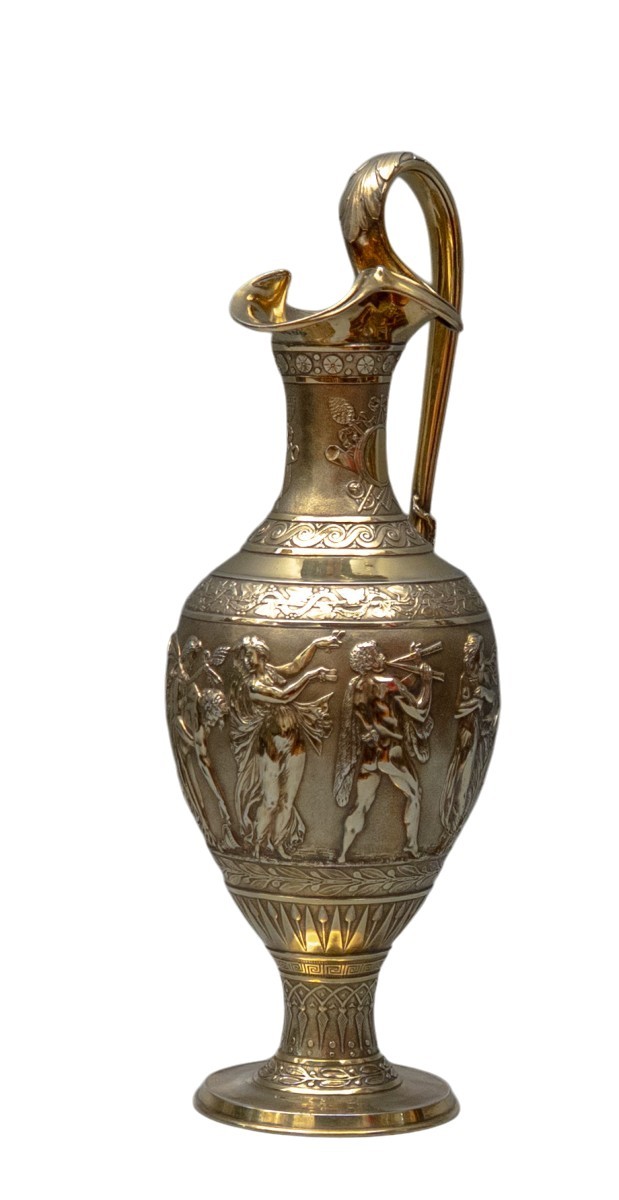
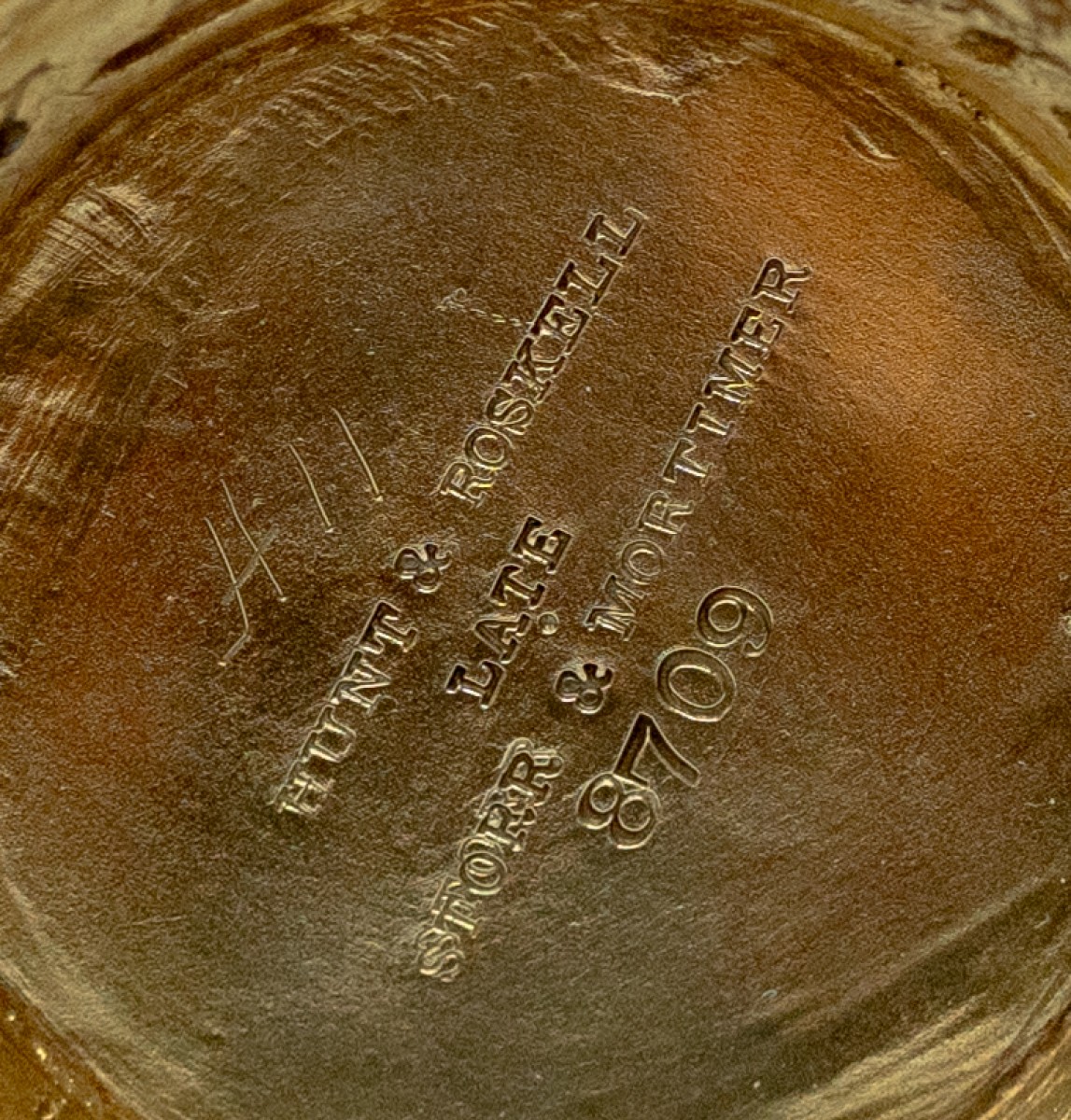
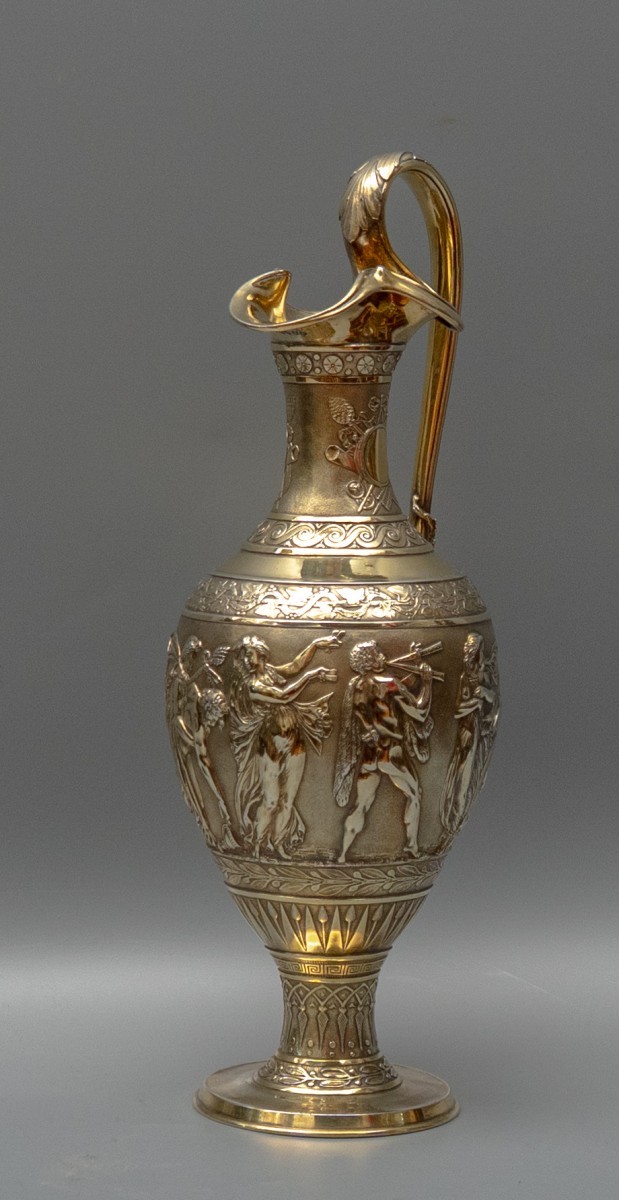
A magnificent Victorian silver-gilt ewer by Hunt & Roskell, one of the foremost luxury silversmiths of nineteenth-century London, stamped on the base HUNT & ROSKELL / LATE MORTIMER & STORR, numbered 8709.
The ewer is of classical oenochoe form, raised on a circular stepped foot with a tapering stem, the body surmounted by an elongated neck with trefoil lip and a sinuous serpentine handle enriched with acanthus leaves at its upper terminal and applied vine leaves at its lower junction. The neck is articulated by a band of rosettes above and a Vitruvian scroll below, between which appear ribbon-tied medallion cartouches set against Bacchanalian trophies — a thyrsus, pipes, and musical instruments.
The principal ovoid body, framed above by a band of entwined vines and below by a laurel frieze, carries an elaborate high-relief Bacchanalian procession after the Borghese Vase: Bacchus draped in a panther skin and bearing a thyrsus, accompanied by his wife Ariadne playing a lyre; a Satyr; and the figures of Maenads and male revellers playing castanets, tambourine, and panpipes. A further scene shows Bacchus supporting the elderly, rotund Silenus as he reaches unsteadily for a spilled wine cup — one of the most celebrated motifs of the antique relief tradition.
The Bacchanalian frieze is derived from the famous Borghese Vase, a monumental Pentelic marble krater carved in Athens in the first century A.D., rediscovered in 1566 in the gardens of Sallust in Rome, acquired by Napoleon Bonaparte in 1807, and today in the Musée du Louvre, Paris. The composition was widely disseminated through Giovanni Battista Piranesi's influential Vasi, Candelabra, Cippi, Sarcofagi… (1778, pls. 109–110), which established it as a canonical source for Neoclassical decorative arts. Copies of the Borghese Vase were made in alabaster for Houghton Hall, Norfolk, and in bronze at Osterley Park, Middlesex; the composition was reproduced three times for the Bassin de Latone at Versailles, and in jasperware by Wedgwood. The same Bacchic frieze was adapted by Karl Friedrich Schinkel for a silver goblet in 1820, and reproduced on a reduced bronze scale by Giovanni Zoffoli in Rome (example c. 1795, Metropolitan Museum of Art, New York).
Hunt & Roskell — direct successors to the workshop of the great Paul Storr (1771–1844) through the lineage of Storr & Mortimer (1822–38) ? Mortimer & Hunt (1838–43) ? Hunt & Roskell (1843–97) — ranked throughout the Victorian era alongside Garrard as London's supreme manufacturers of sculptural presentation silver. A contemporary visitor to the firm's Harrison Street workshop described it as "ranking as the very highest of the class — not alone for the beauty of their workmanship, but for the exquisitely artistic taste, as well as for the consummate care and thoughtfulness displayed in their designs" (Trades and Manufactures of Great Britain, 1865). The firm employed outstanding modellers and designers, including the French metalworker Antoine Vechte (1800–68), designer of the celebrated Titan Vase (Goldsmiths' Company, London), exhibited at the Great Exhibition of 1851, as well as the sculptor Edward Hodges Baily (1788–1867), pupil of John Flaxman. Hunt & Roskell participated in the Great Exhibition (1851), the London International Exhibitions of 1862 and 1872, the Exposition Universelle, Paris (1867), and the Health Exhibition, London, 1884 — the very year this ewer was hallmarked.
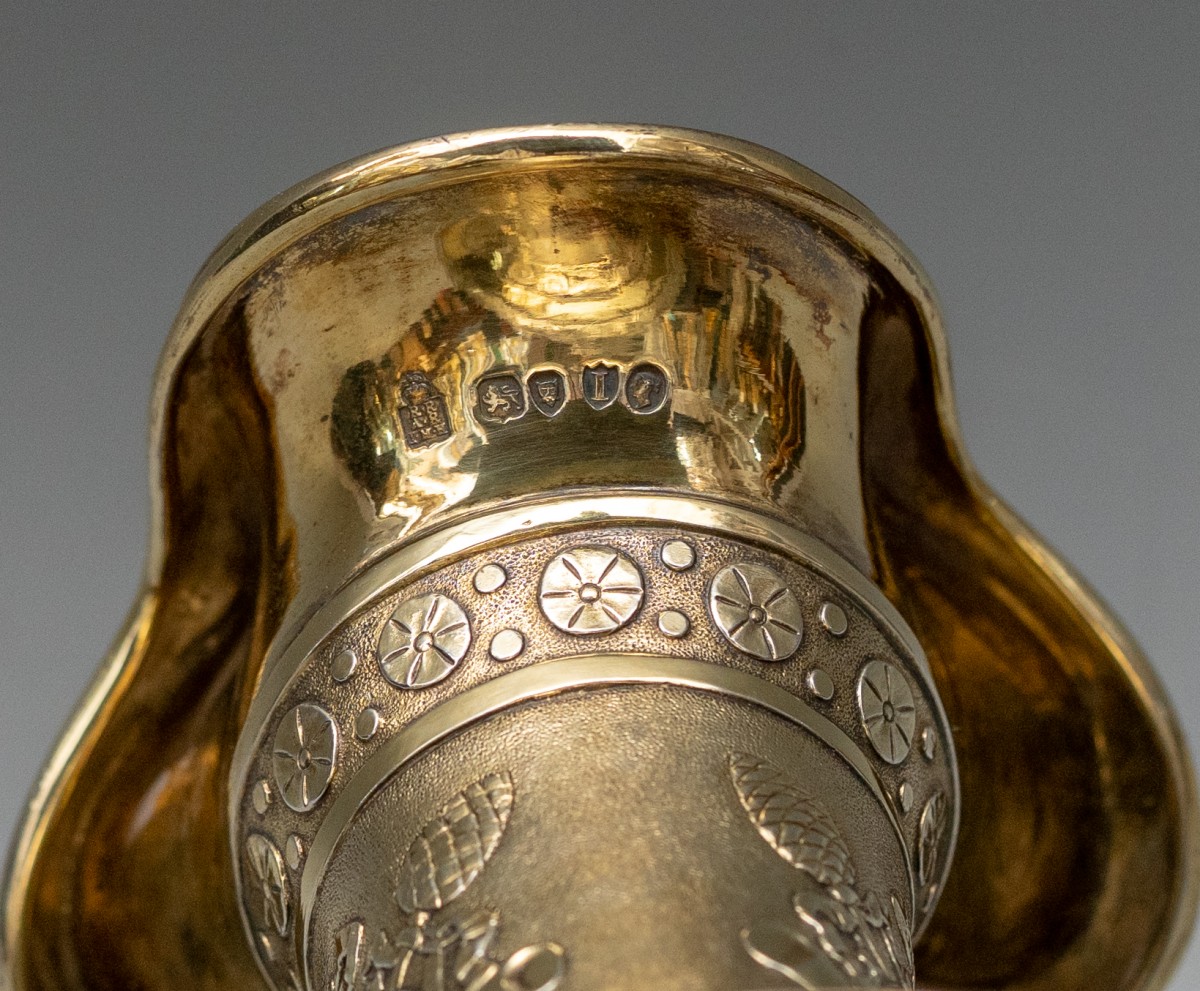
Fully hallmarked to the interior of the neck: maker's mark, lion passant, leopard's head (London), and date letter for 1884.
Literature:
Giovanni Battista Piranesi, Vasi, candelabra, cippi, sarcophagi, tripodi, lucerne, ed ornamenti disegnati ed incise dal Cav. Gio. Batt. Piranesi, Rome, 1778, pls. 109–110 — illustrating the Bacchanalian procession as reproduced on the Borghese Vase and on the present ewer
Trades and Manufactures of Great Britain, 1865 — contemporary account of Hunt & Roskell's Harrison Street workshop
Measurements:
Height: 38.5 cm
Weight: 1,070 g
Condition: Excellent. Gilding rich and largely intact throughout; relief work crisp and well-preserved.