Offered by Galerie Léage
REQUEST INFORMATION

France, Régence period
Chased and gilt bronze
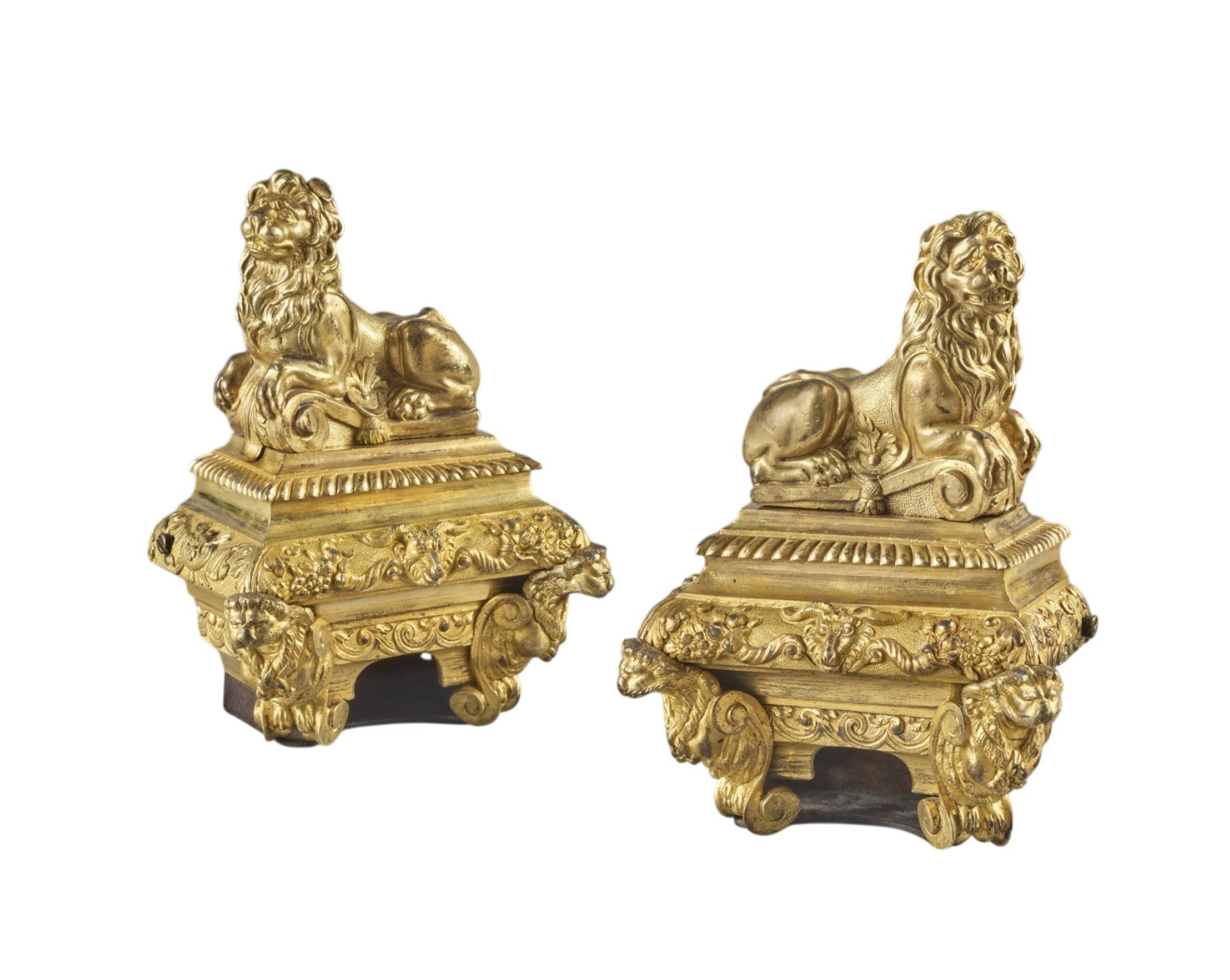
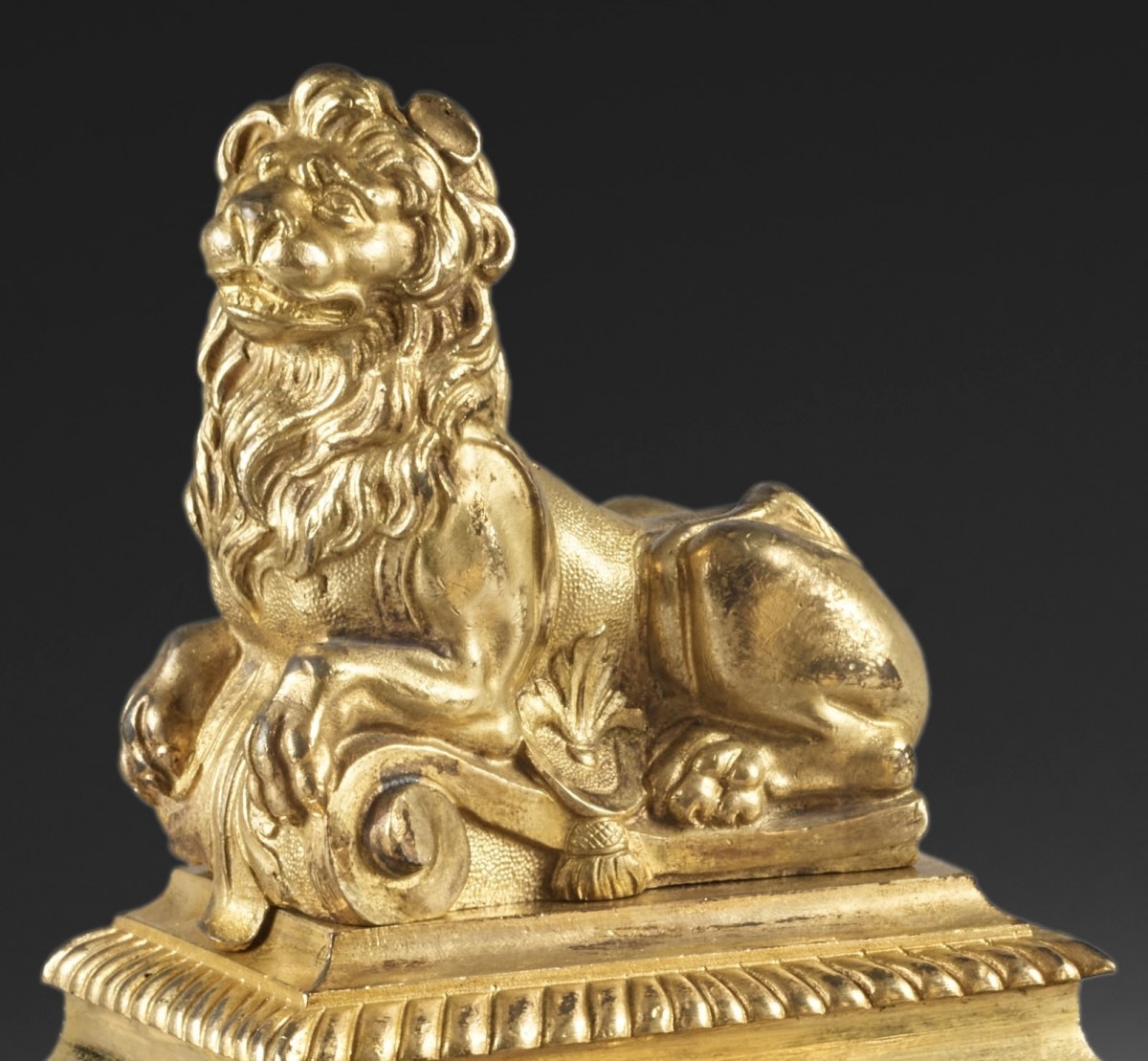
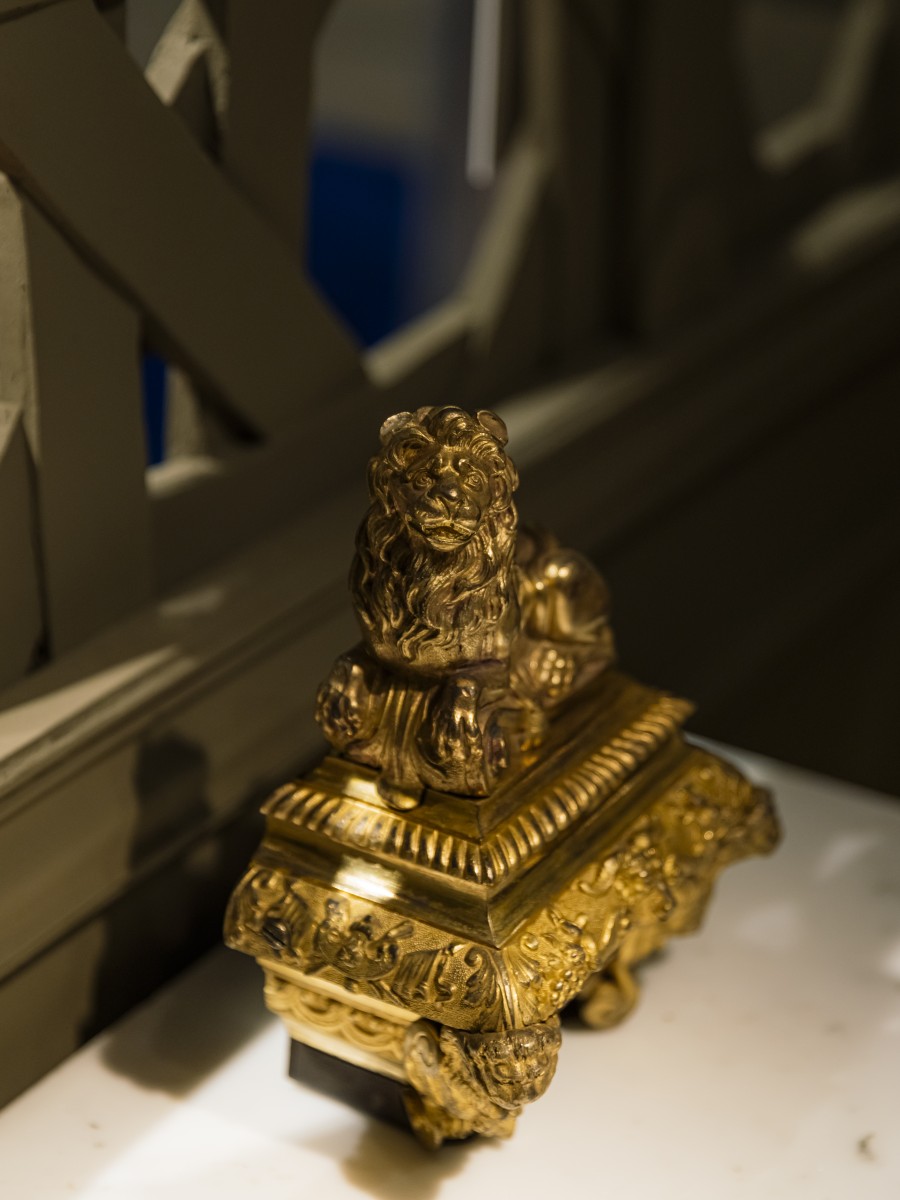
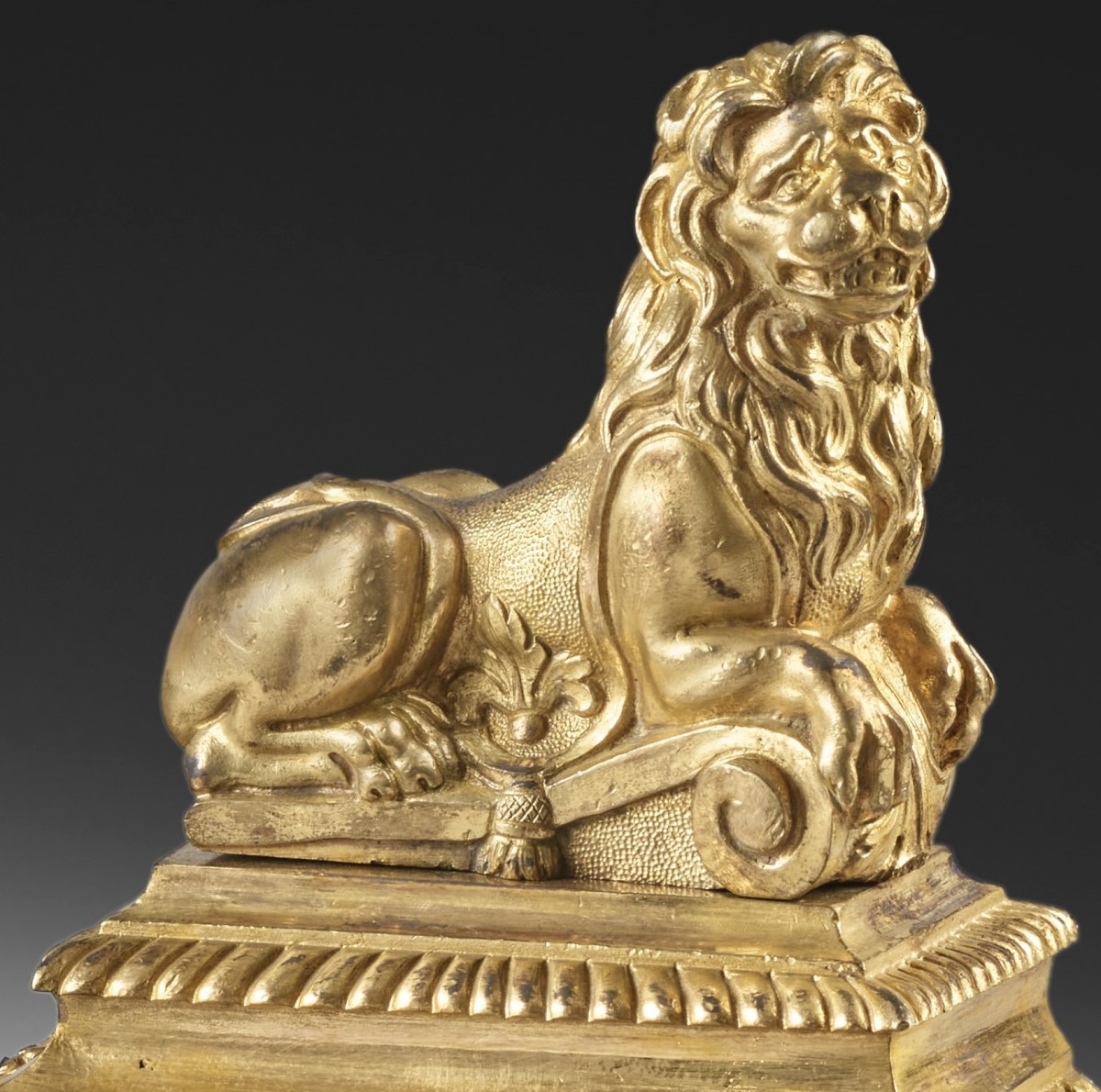
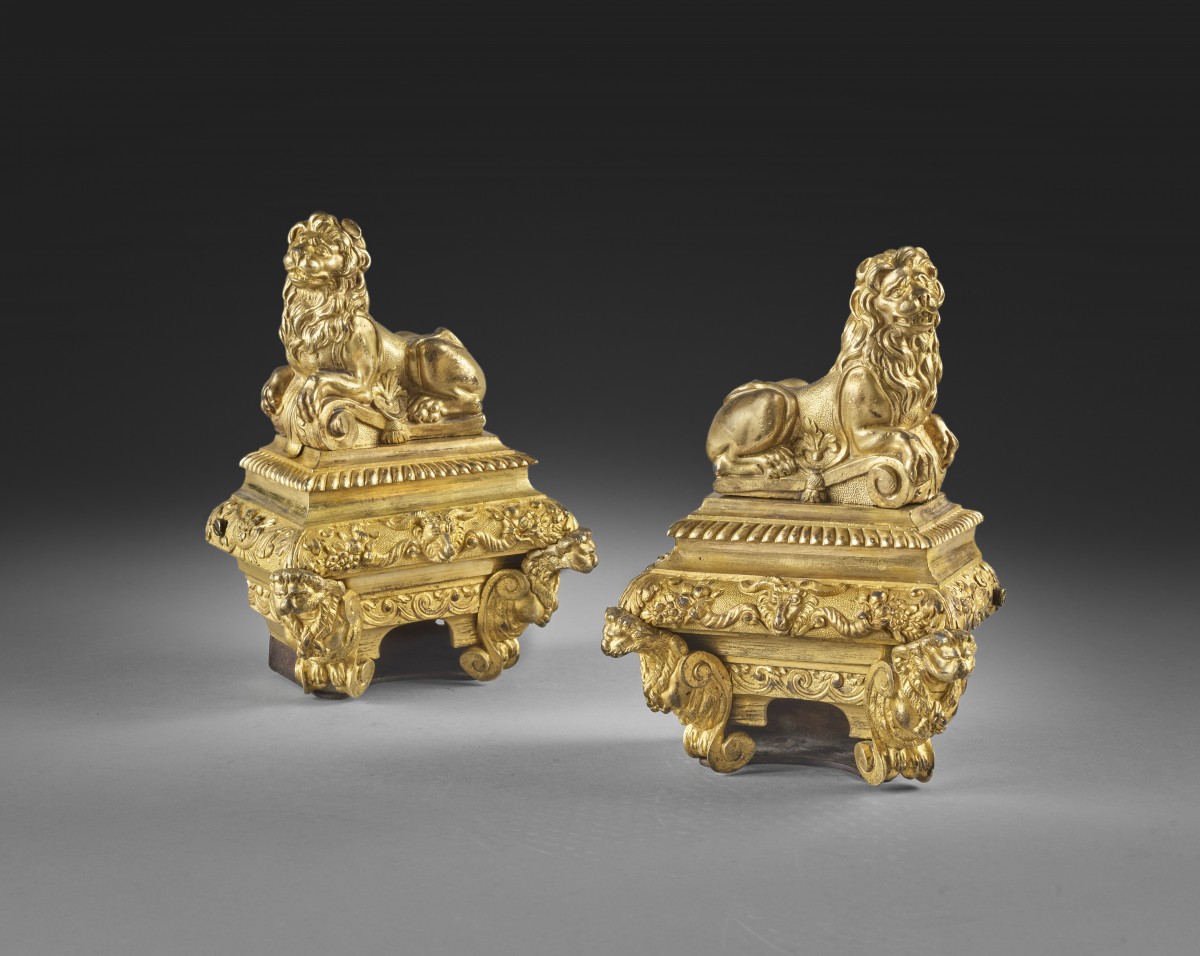
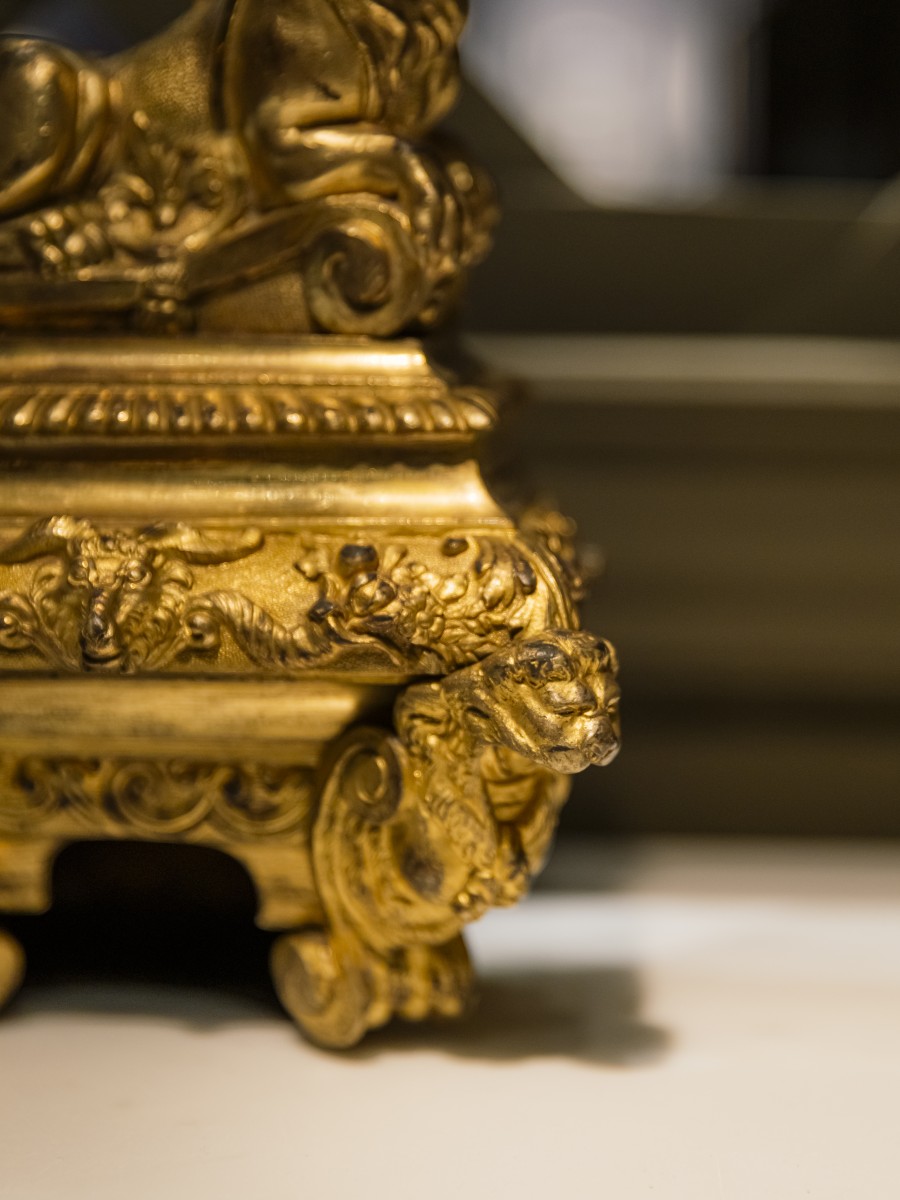
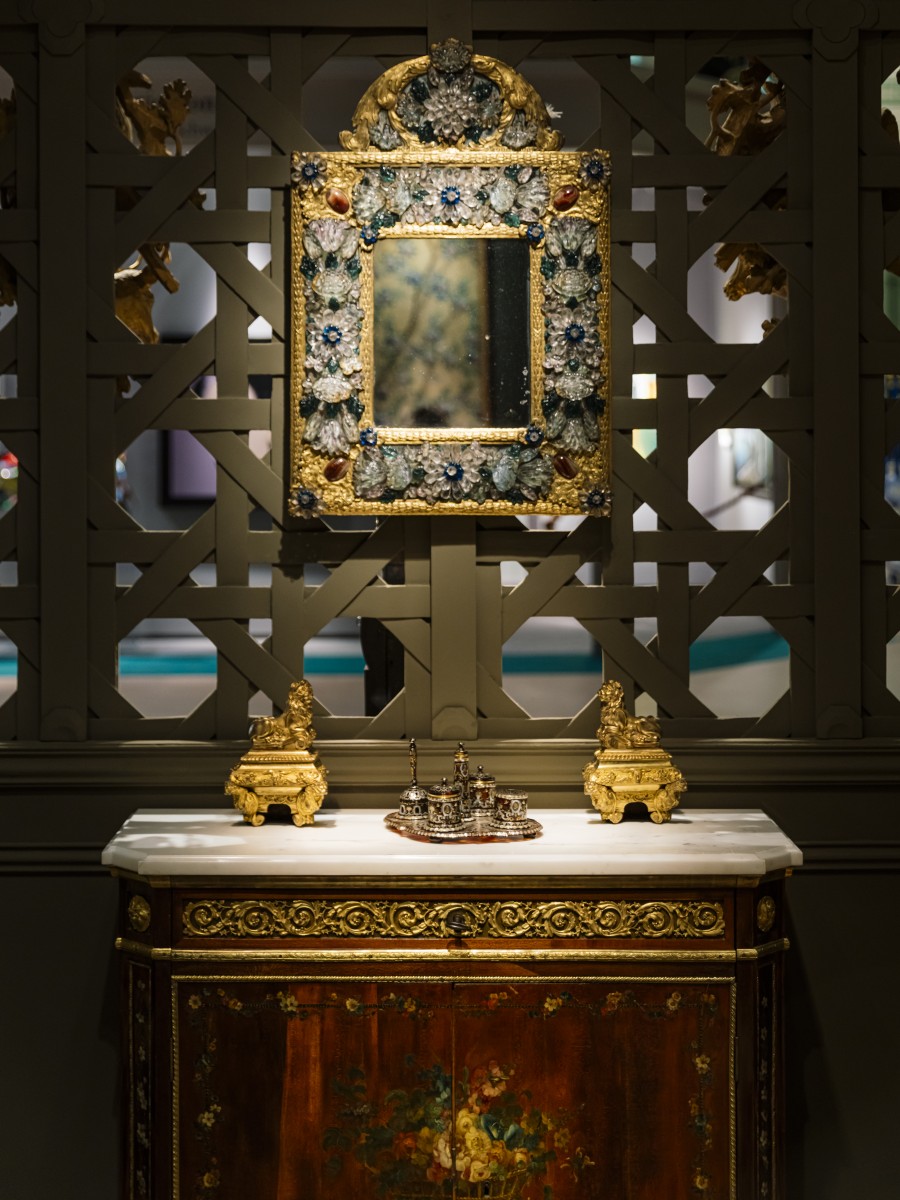
This pair of firedogs depicts reclining lions resting upon richly ornamented architectural bases. The animals, conceived in symmetrical opposition, sit back on their haunches with heads held high and turned in profile. Their abundant manes, finely chiseled, cascade in wavy locks over the shoulders. They rest upon an inclined plinth animated with lateral scrolls and covered by a stylized drapery ornamented with a central leaf motif and a tassel. The whole is set upon a hollow molding.
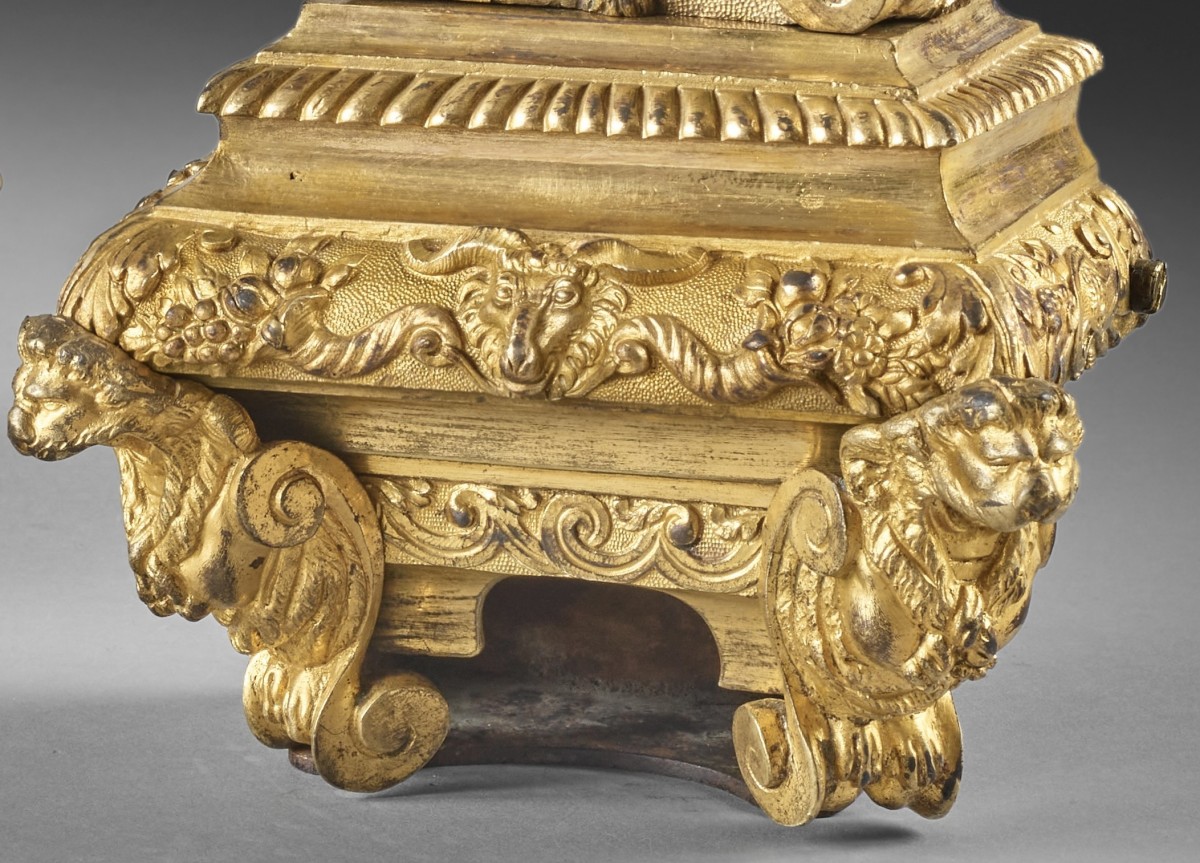
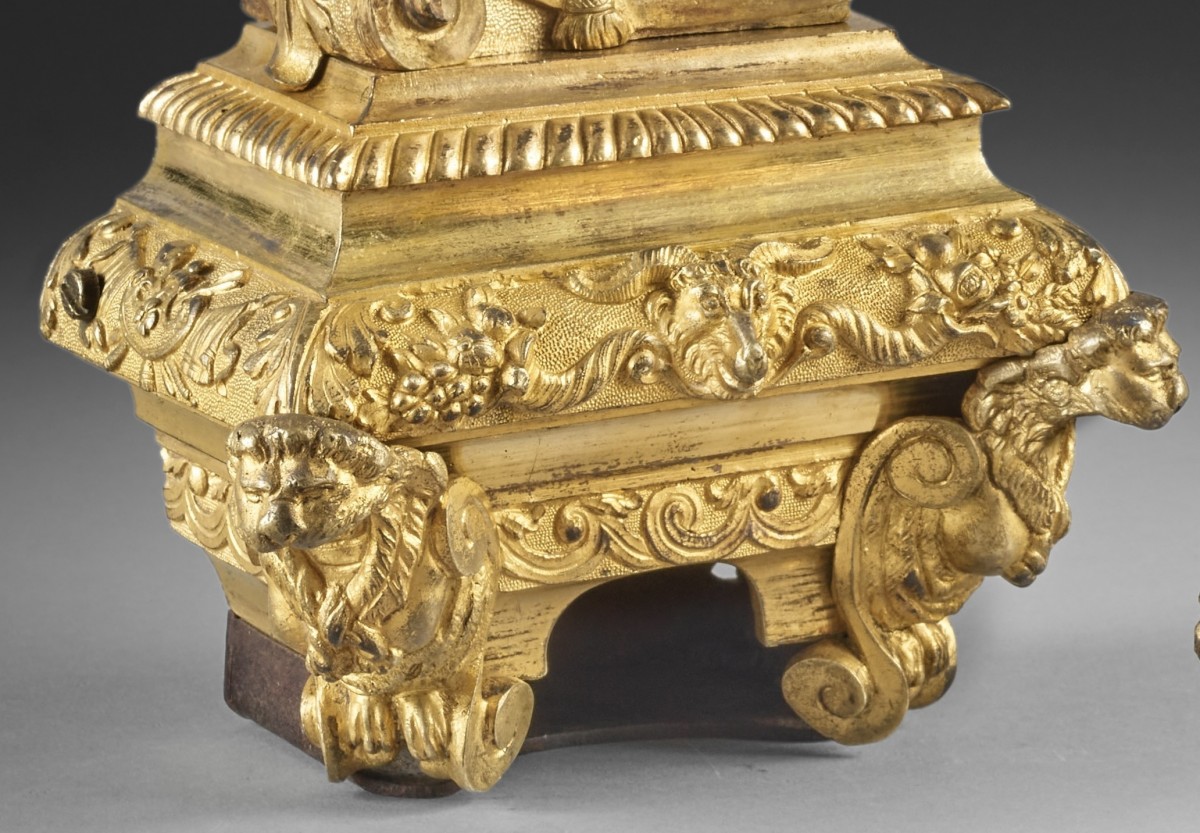
The base adopts a rectangular outline with chamfered corners and displays a profusion of decoration. Beneath the upper molding runs a gadrooned band across all four sides. Below, a broader hollow molding supports a projecting section adorned with rich chiseling on a guilloché ground. At the center of the front face appears a ram’s mascaron flanked by two opposed cornucopias. The lateral faces are embellished with trophies of arms combining lances, firearms, and cut-leather motifs.
This projecting section rests on another hollow molding, itself supported by a plain molding enriched with a frieze of balusters. At the front, the firedogs stand on two voluted feet terminating in mascarons representing roaring lions. These double scrolls, unfolding at the angles, link back to the projecting section and enhance the overall richness of the ensemble.
The Use of Firedogs in the 18th Century
Unquestionable masterpieces of French decorative bronze in the 18th century, firedogs epitomize the luxury and refinement of interiors. Together with their iron bar, log grate, and accessories such as the shovel, tongs, or pincers, they formed the functional ensemble of the hearth. Their practical role extended beyond supporting the logs: they also contributed to the staging of the fire, a central element of domestic life and sociability.
In the 17th century, firedogs appear as the very first item of furniture listed in Parisian inventories, a testimony to their symbolic value and their privileged place within the hierarchy of furnishings. At that time, they were made in silver or copper and thus belonged to a particularly luxurious category. During the reign of Louis XV, bronze progressively replaced these precious metals. This evolution encouraged increasingly sophisticated modeling and chiseling, in pursuit of elegance and refinement.
The 18th century witnessed a profound transformation of interiors. A growing aspiration for comfort led to the multiplication of fireplaces, adapted to more intimate spaces that were easier to heat. Alongside grand reception rooms appeared smaller private spaces for retreat and conversation, such as cabinets, petits appartements, and boudoirs. In these refined settings, smaller fireplaces were fitted with proportionate firedogs, whose delicacy of ornament harmonized with the elegant and subdued character of these interiors.
The play of firelight across polished and chiseled surfaces further enhanced the richness of these objects, making them a favored medium for decorative expression. In keeping with contemporary aesthetic trends, forms adopted rocaille lines or drew inspiration from mythological and naturalistic themes.
Under Louis XVI, models evolved towards a more geometric and symmetrical aesthetic, dominated by fluting, vegetal garlands, and neoclassical motifs, in harmony with the architecture and furniture of the period.
Thus, the use of firedogs occupied a dual register: at once technical and decorative, but also social and symbolic. The present pair, dating from the Régence period and of modest dimensions, perfectly illustrates this evolution. They were probably intended to adorn the fireplace of a boudoir or a small salon, characteristic spaces of the early 18th century marked by the pursuit of comfort and intimacy. The choice of the lion as a decorative motif places these firedogs within a rich iconographic tradition, while fully aligning them with the refinement and elegance characteristic of such furnishings.
The Theme of the Lion in the Decorative Arts of the 18th Century
A quintessential royal symbol, associated with power and wisdom since Antiquity and traditionally embodying Strength, Valor, and Courage, the lion was a heraldic motif of great popularity and a constant presence in Versailles iconography. Although Louis XIV did not adopt it as his personal emblem—since the animal was already claimed by the king of Spain— he nonetheless had it represented throughout the painted and sculpted decoration of the château. As an image of royal magnanimity, it appears notably on the central panel of the Salon d’Apollon in the King’s Grand Apartments. It also features in several allegorical iconographic programs conceived as part of the “Grande Commande” of 1674 (The Zodiac Signs, The Four Elements, The Hours of Day and Night, The Parts of the World, and The Temperaments of Man), as well as among three hundred and thirty naturalistically rendered animals of the royal garden’s Labyrinth.
The naturalistic treatment, also perceptible in this pair of firedogs, is characteristic of French art of the 17th and 18th centuries, nourished by the great encyclopedic works of natural history such as Claude Perrault’s Mémoires pour servir à l’histoire naturelle des animaux (two volumes, Paris, 1671–1676) and Buffon’s monumental Histoire naturelle, générale et particulière (thirty-six volumes, Paris, 1749–1804). Richly illustrated with anatomical plates of animals observed in the Ménagerie of Versailles, these works, in harmony with the spirit of the Enlightenment, provided lasting inspiration to artists and artisans. In the decorative arts, from the last third of the 17th century onward, one observes the flourishing of a hybrid bestiary in which real animals mingled with fantastical and mythological creatures.
From the 1760s onwards, the return to classicism revived the popularity of the lion motif across all domains. Already linked to the iconographic vocabulary of Louis XIV’s personal reign—as evidenced by the gilt-bronze mounts of André-Charles Boulle’s furniture and the engravings of the now-lost silver furnishings—it once again assumed a central place in decorative repertories. While neoclassicism attenuated the lion’s symbolic association with royal authority, it continued to exploit the motif abundantly in the decorative arts, in the form of paws, claws, muzzles, pelts, or full figures adorning mounted porcelains, furniture, and gilt bronzes.
This pair of firedogs thus belongs fully to the flourishing animal art of the early 18th century, in which the lion remained a privileged and versatile motif.
Bibliography
Hans Ottomeyer & Peter Pröschel, Vergoldete Bronzen. Die Bronzearbeiten des Spätbarock und Klassizismus, Vol. I, Munich, Klinkhardt & Biermann, 1986, p. 298, ill. 4.18.6. Alexandre Maral & ----Nicolas Milovanic (eds.), Les animaux du Roi, exhibition catalogue, Versailles, Château de Versailles, 12 October 2021 – 13 February 2022.
Pierre Verlet, Les Bronzes Dorés Français du XVIIIe Siècle, Paris, Éditions Picard, 1987, pp. 138–140.