Offered by Franck Anelli Fine Art
REQUEST INFORMATION

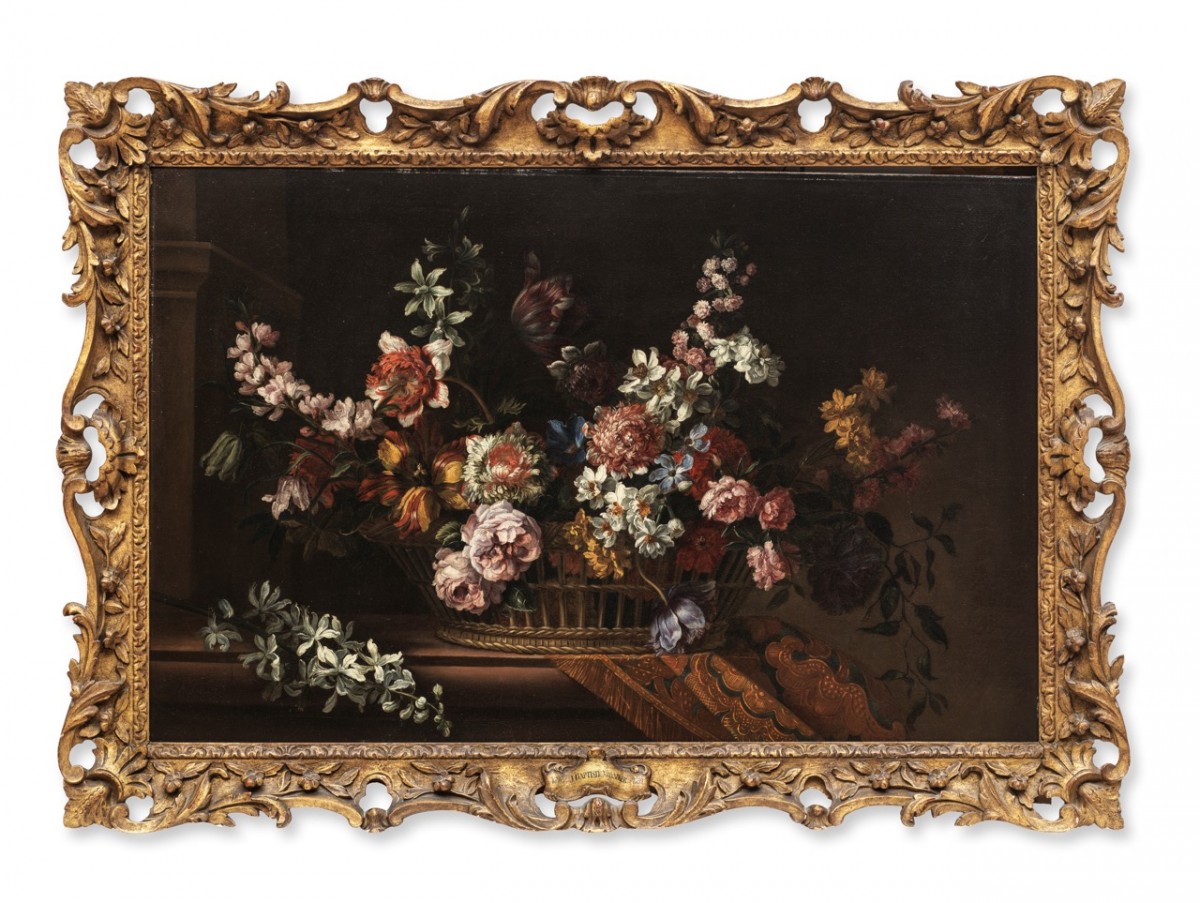
Still Life with a Wicker Basket Filled with Moss Roses, Tulips, Double Anemones, Daffodils and Other Flowers, Set on a Stone Console Partly Covered with a Brocade Cloth, and an Orchid Stem Lying Directly on the Console
Oil on canvas, H. 63 cm × W. 95.7 cm
Provenance: With Leggatt Brothers, London, 1929; with Richard Green, London, where purchased by the present owners.
Jean-Baptiste MONNOYER is unquestionably the most important French flower painter of the 17th century. However, he established himself in Paris primarily as a painter of large-scale decorative schemes rather than as an easel painter.
The 1660s indeed marked the beginning of a great decorative fervor within royal residences, if not major architectural transformations, as the king divided his time among the châteaux of Vincennes, Fontainebleau, the Tuileries, and Saint-Germain, while extensive works were also undertaken at the Louvre and at Versailles. Jean-Baptiste MONNOYER became involved in these projects at an early stage and became the principal collaborator of Le Brun in the field in which he excelled. The scale of these commissions, to which Jean-Baptiste MONNOYER remained associated throughout his life as an ??????ician—allowing him, moreover, to be attached to the Gobelins Manufactory and to receive commissions for the execution of tapestries produced in its workshops—had a number of consequences for his easel painting. Indeed, the practice of large decorative work gradually facilitated the acquisition of a swift, confident, and vigorous technique, which Jean-Baptiste MONNOYER employed both in his overdoor paintings and in his easel works. Furthermore, the fact that Jean-Baptiste MONNOYER was constantly absorbed by royal commissions reduced the time he could devote to the execution of his canvases, which explains the scarcity of this specific production on the market, even today.
DESCRIPTION AND STYLISTIC ANALYSIS OF THE PAINTING
The motif of the wide-format basket is rare in the work of Jean-Baptiste MONNOYER. It nevertheless clearly relates to his own engraved series, particularly the one that ROBERT-DUMESNIL titled Les Grandes Corbeilles en largeur. The painting indeed presents the same broadly woven basket, the same framing, the same arrangement of the flowers and the same varieties, and finally the same soberly molded console seen in this remarkable series. The painting does not reproduce one of the prints themselves, but instead reinterprets—following the method that Jean-Baptiste MONNOYER likely employed from the mid-1670s onward—the assembly of different motifs drawn from his own compositions into a new arrangement.
The composition examined here differs from the two canvases mentioned above by the presence of an orchid stem, which replaces the hyacinth stem placed directly on the console to the right, as well as by the presence of a brocade cloth covering the right corner of the console, likely painted by a collaborator or by Antoine.
CHRONOLOGY
The way in which the flowers stand out against the background, emphasizing a two-dimensional deployment of the composition—achieved by separating the flowers from one another and generally avoiding their overlap—is characteristic of Jean-Baptiste MONNOYER’s entire production. The painting, however, is more specifically related to those works he produced in the final decade of his activity. Indeed, the depiction of the elderflower and the common orchid (Dactylorhiza fuchsii?) are motifs that Jean-Baptiste MONNOYER painted exclusively in his later works.
Likewise, the blue double anemone cascading over the front of the basket appears in this same posture and exact hue in another painting, A Basket Filled with Flowers Set on a Stone Ledge, oil on canvas, H. 43 cm; W. 96 cm, Boughton House, Kettering, The Duke of Buccleuch and Queensberry (published in S. Pavière, Jean-Baptiste Monnoyer (1634–1699), Leigh-On-Sea, 1966, p. 21, no. 58 [J.B. Monnoyer]).
That painting, as well as another at Boughton House depicting again A Basket Filled with Flowers Set on a Plinth, oil on canvas, H. 99 cm; W. 87 cm, Boughton House, Kettering, The Duke of Buccleuch and Queensberry (published in S. Pavière, Jean-Baptiste Monnoyer (1634–1699), Leigh-On-Sea, 1966, p. 19, no. 40, pl. 51), in which the orchid stem appears in a spiked form, certainly date from the final period, as they originate from the set of overdoors that Jean-Baptiste MONNOYER executed with his collaborators for Lord Montagu (see C. Salvi, Jean-Baptiste Monnoyer (1636–1699): Peindre des fleurs et des fruits à l’âge classique, unpublished doctoral thesis under the supervision of Olivier Bonfait, Aix-Marseille University, 2016).
Accordingly, in line with this analysis, the composition examined here was executed in the final decade of the 17th century.