Offered by Galerie William Diximus


REQUEST INFORMATION



Antoinette-Cécile-Hortense Haudebourt-Lescot
Portrait of Louis Philippe Léon Haudebourt, son of the artist, 1832
Oil on canvas, 166 × 125 cm
– Salon of 1833, no. 1215
Antoinette-Cécile-Hortense Haudebourt-Lescot (1784–1845) is now recognized as one of the major figures in early 19th-century French painting. Trained by Guillaume Guillon Lethière, she benefited from a high level of academic instruction from an early age. She followed her master to Rome, despite women being officially excluded from the Académie de France, and developed an artistic culture nourished by classical and modern references. From her very first submissions, she enjoyed constant success at the Salon, the central venue for artistic recognition at the time.
Back in Paris, she established herself as an accomplished artist, supported by prestigious patrons such as the Duchess of Berry during the Restoration, then by official commissions under the July Monarchy. Winner of two gold medals at the Salons of 1819 and 1827, she became part of the most influential artistic circles and, at the end of her life, ran a drawing school in her Paris studio. Her work, now preserved in numerous French and international public collections, bears witness to a sensitive renewal of genre painting and portraiture.
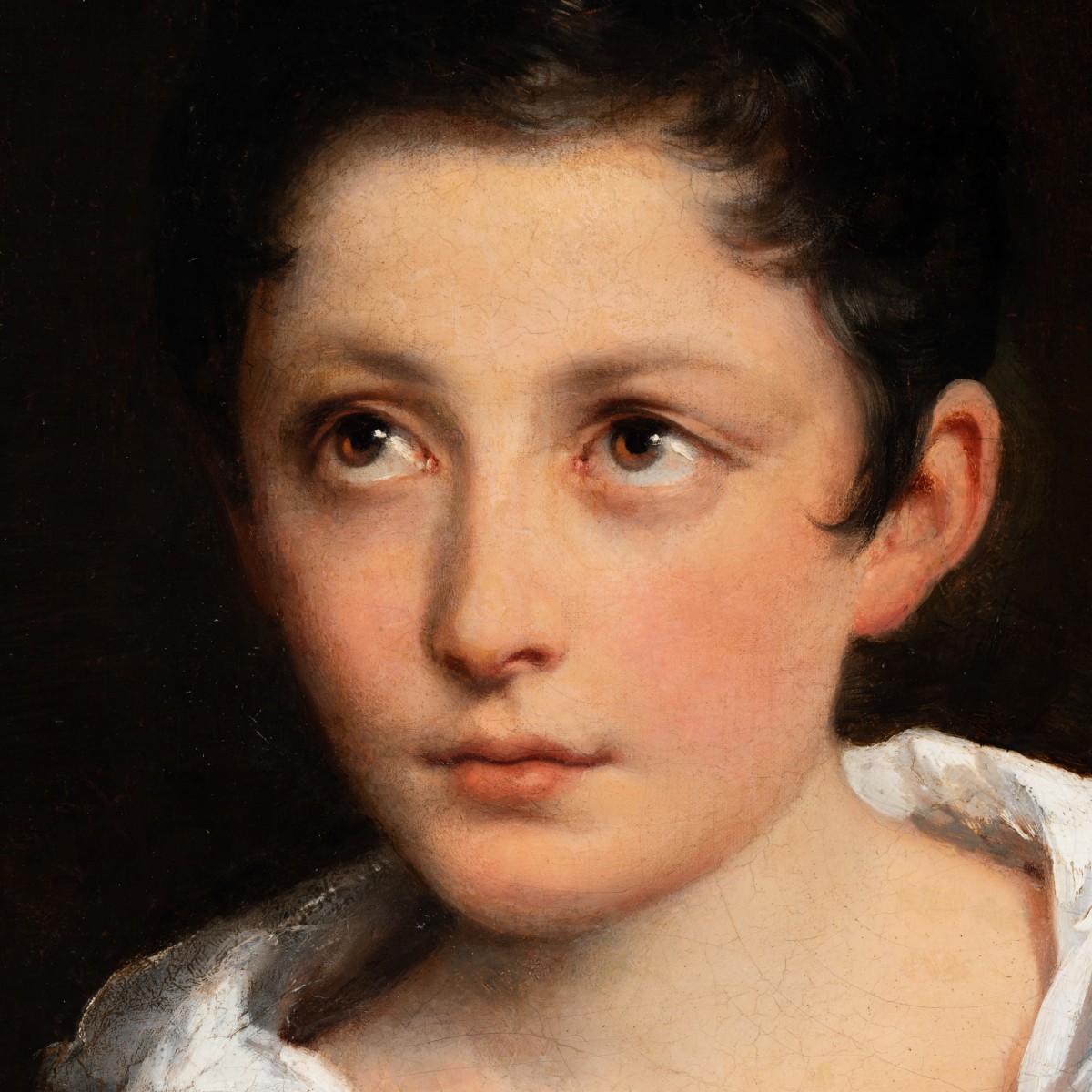
The Portrait of Louis Philippe Léon Haudebourt, painted in 1832 and presented at the 1833 Salon, is one of the highlights of his work. It depicts his twelve-year-old son sitting on a rock in a twilight landscape. The child has stopped reading; a book and a portfolio of drawings lie beside him, explicit symbols of the intellectual and artistic education imparted by his parents, both renowned artists.
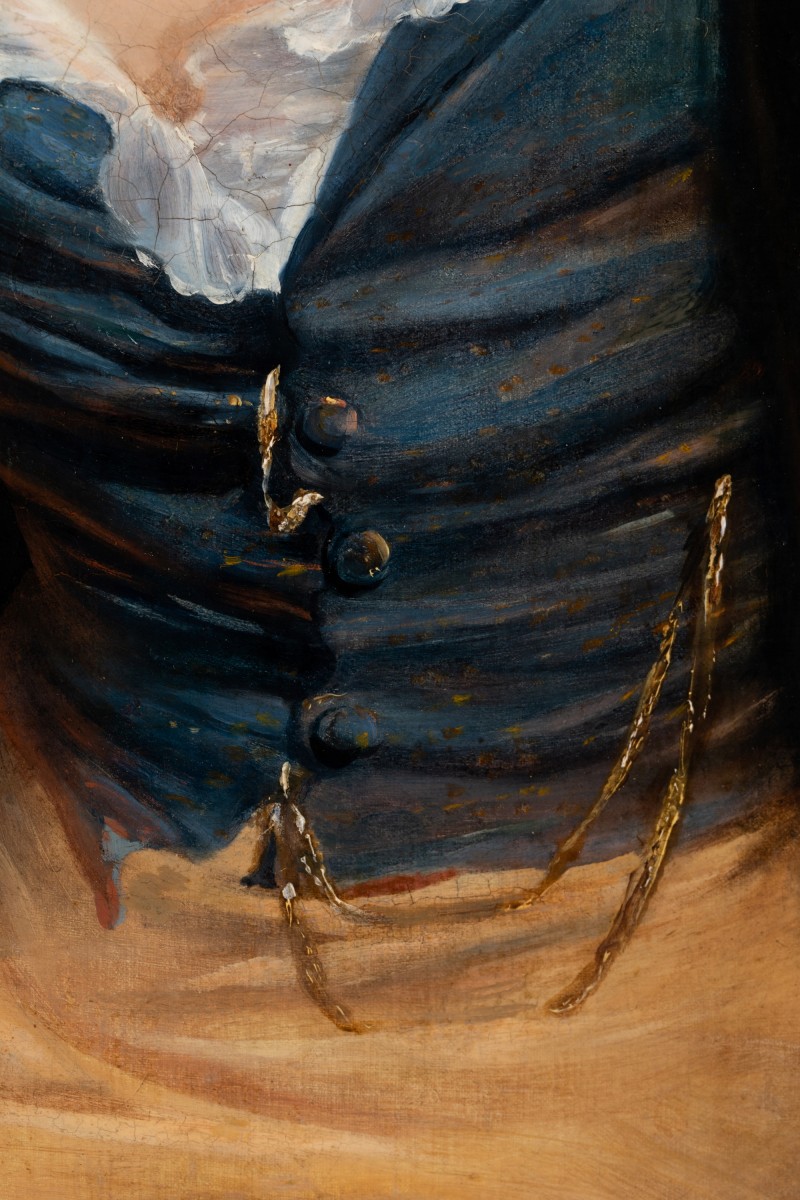
The composition brings together all the elements of a Romantic portrait: a nocturnal atmosphere, a dark cave, a pond animated by swans, and a sculpted group representing a faun and a nymph in the background. The enveloping nature, overgrown with ivy and climbing plants, accentuates the child's meditative solitude. The sober elegance of his attire, rendered with great finesse, contrasts with the psychological depth of his gaze, slightly averted, suggesting introspection and becoming.
Hortense Haudebourt-Lescot succeeds in going beyond simple resemblance to offer a poetic and symbolic vision of childhood. The young boy's meditative pose, combined with the nocturnal environment, evokes both innocence and the promise of a future in the making. The work is distinguished by a subtle balance between intimate observation and artistic ambition, giving the portrait a universal dimension.
Presented at the 1833 Salon among a large collection of works, the painting was unanimously praised by critics. Commentators highlighted the influence of English portrait painter Thomas Lawrence, particularly his famous portrait of the young Charles William Lambton, while acknowledging Haudebourt-Lescot's more accessible narrative approach and unique sensibility. This connection was part of the strong Anglophilia that characterized French society in the 1830s, fueled by British literature and culture.
Biographically, Louis Philippe Léon Haudebourt, born in Paris in 1820, trained with his father, the architect Louis Pierre Haudebourt, an important figure in 19th-century Parisian architecture. Although his career remained more low-key, he nevertheless participated in major projects, notably the construction of Napoleon I's tomb at Les Invalides.
At the height of her career, this portrait stands out as a key work, fully revealing Hortense Haudebourt-Lescot's technical mastery, psychological depth, and maternal sensitivity. Her death in 1845 caused a stir in the art world, which paid tribute to both the renowned artist and the attentive wife and mother.
The Portrait of Louis Philippe Léon Haudebourt stands out as a landmark work, both a masterpiece of Romantic portraiture and an exceptional intimate testimony. In the absence of a definitive catalogue raisonné, it occupies a central place in the critical rediscovery of the artist and is a major piece for any collection or museum exhibition devoted to 19th-century French painting and the fundamental role of women artists.
Today, the work of Hortense Haudebourt-Lescot is the subject of considerable renewed interest. Numerous French and international institutions are preserving or acquiring her paintings, attesting to the historical and aesthetic importance of her work.
Catalogued in:
“Exposition au Louvre,” Journal des artistes, March 31, 1833, vol. XIII, p. 224;
S. C., “Salon de 1833. Peinture,” l‘Artiste, vol. V, p. 194;
Augustine Jal, Les Causeries du Louvre. Salon de 1833, Paris, Ch. Gosselin ed., 1833, p. 165.
Delevery information :
DELIVERY INFORMATION
Delivery is free in mainland France.
For all deliveries outside France, shipping costs are the responsibility of the buyer and are calculated based on the destination, volume and specific transport constraints.
The William Diximus Gallery works with carriers specializing in the transport of works of art, guaranteeing suitable packaging and secure handling.
A fast and personalized delivery quote can be provided upon request.