Offered by Galerie Léage
REQUEST INFORMATION

France, Louis XIV period
Boulle marquetry: brass, pewter and tortoiseshell
Chased and gilt bronze
Description
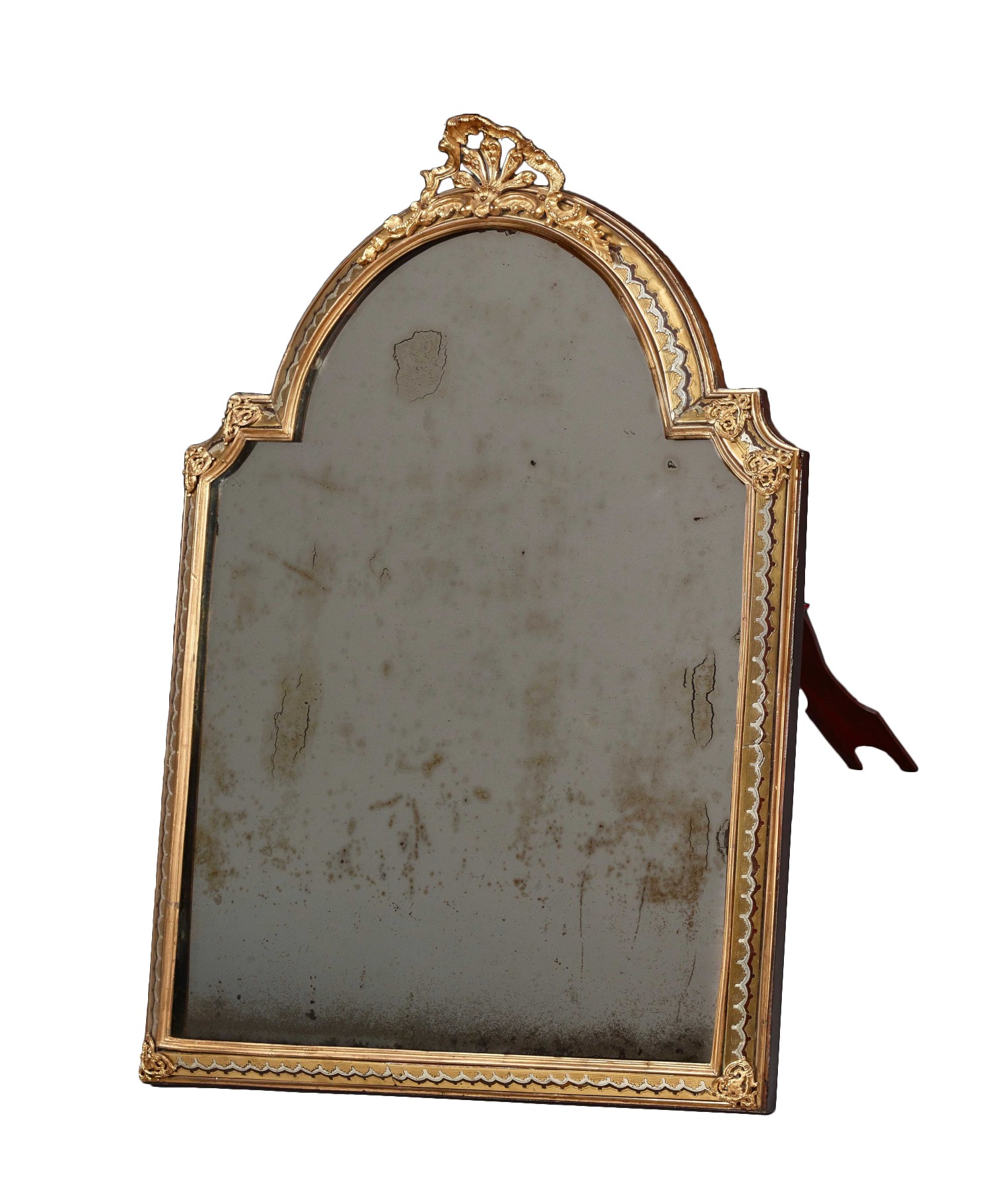
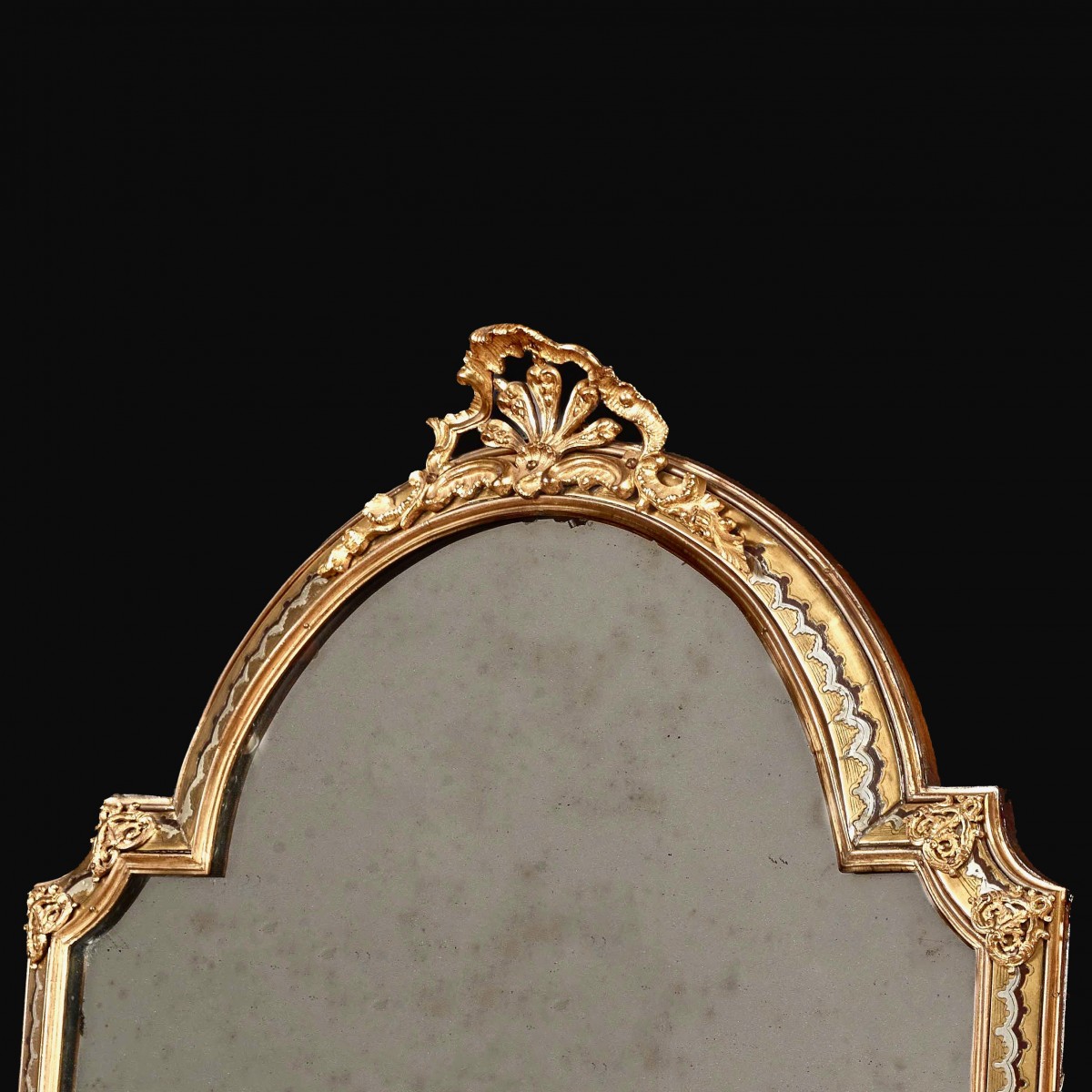
Rectangular in the lower part, this mirror has a double movement in the upper part and ends at the top with a curve. The marquetry of brass, pewter and tortoiseshell represents a drapery, framed by two gilt bronze rods and adorned with a chased and gilt bronze leaf pierced in each corner. At the top, there is an important leaf ornament of pierced bronze. The rosewood veneered back has a support to lay the mirror and a ring at the top to hang it.
Mirrors in the 17th and 18th Centuries
The pedimented mirror described here illustrates the use, in the 18th century, of the so-called “mercury technique,” at that time the only method capable of producing high-quality glass plates of large dimensions. Originating in Italy, on the island of Murano, this process consisted in applying, while hot, an amalgam of mercury and tin onto a glass plate. Extremely toxic, it caused the gradual poisoning of many workers before being replaced in 1837 by the silvering technique, and was definitively banned in 1850.
For several centuries, the Republic of Venice maintained a dominant position on the glass market. This preeminence was based on several determining factors, foremost among them the production of a particularly clear and colorless glass, cristallino, made possible by a rigorous selection of raw materials, notably soda ash imported from the East. To this was added remarkable technical mastery of cylinder-blown glass, a process developed in the Near East a century and a half before our era.
This technique consisted in blowing glass into the form of a hollow cylinder, whose ends were then cut off. The cylinder was split lengthwise, opened, and reheated to be flattened into a sheet. Although this method imposed considerable physical constraints on the glassblower and limited the size of panes to less than one meter in height, the glass surface was then ground, polished, and coated with a layer of tin to produce the reflective effect.
The usual dimensions obtained by this method reached about 40 inches (approximately one meter), but the skill of Venetian master glassmakers sometimes allowed heights of 50 to 60 inches.
In order to put an end to Venetian hegemony, Jean-Baptiste Colbert brought several Venetian glassmakers to Paris between 1665 and 1667, despite the strict prohibition against transmitting their know-how. In 1665, the Royal Mirror Glass Manufacture was officially founded. It was part of a broader program for the development of luxury industries, and its expansion accompanied fifty years of building projects at Versailles. The first establishment was located in Paris. From 1667, an annex was set up in Tourlaville, near Cherbourg, to benefit from proximity to maritime and forest resources. This extension made it possible to increase production capacity. The Parisian site then retained only cold work: grinding, polishing, and tin-coating the mirrors.
As early as 1672, a decree of the Council banned the import of Venetian glass, a measure increasingly enforced, even though in 1670 Colbert still expressed concerns about the company’s capacity. Prices remained high, reflecting persistent productivity problems.
To cover large wall surfaces, mirrors were juxtaposed on wooden paneling using moldings. The Hall of Mirrors at the Palace of Versailles, whose construction began in 1678 and was completed in 1684, represents the most accomplished example of this decorative scheme. The average dimensions of the mirrors were about 90 centimeters in height and 80 centimeters in width, corresponding to the limits of manual glassblowing at that time.
Between 1664 and 1715, the Surintendance des Bâtiments allocated more than 400,000 livres to glazing and mirror-making expenses. Of this amount, 371,660 livres were specifically dedicated to the royal apartments at Versailles, Trianon, and Marly. These massive orders stimulated the evolution of glassmaking techniques in France.
In the 1680s, a major innovation emerged with the development of the table-cast glass. This method, presented by Bernard Perrot, a glassmaker in Orléans, who submitted his idea to the Academy of Sciences on April 2, 1687, consisted of pouring molten glass onto a perfectly flat metal table and spreading it with a roller. This process made it possible to obtain thicker plates, of larger dimensions, and with a more regular surface than those produced by blowing. After annealing, the plates were ready to receive the mercury coating.
Having imprudently advertised his method in the Mercure, a contemporary journal, and demonstrated samples before the court, Perrot saw his process appropriated and his claims dismissed, while his casting equipment was seized. From 1688, royal patents authorized a groupof investors around Louvois to establish a new mirror manufactory, with a clause equivalent to a patent of invention. It was authorized to produce cast plates from 60 inches (1.62 m) upwards, while panes of 40 inches (1.08 m) and less remained reserved for the initial establishment. This situation led to industrial instability. In 1695, the two establishments merged. The new entity settled at Saint-Gobain, in the Aisne, on the site of the former castle of the Sires de Coucy, becoming the main production center.
The development of casting made it possible to produce sheets between 60 and 85 inches high, then reaching 100 inches as early as the 1720s. This process improved productivity and reduced manufacturing costs. It gave the French manufactory a technical monopoly on a European scale, maintained until the end of the 18th century. Between 1720 and the 1780s, mirror sales quadrupled, reaching a peak of 2,780,000 livres in 1786.
At the end of Louis XIV’s reign, the French mirror industry, led by the Royal Manufacture, exported mirrors throughout Europe each year, with an estimated value of between 300,000 and 400,000 gold livres.
The Venetian monopoly then gave way to French expertise.
The French Revolution put an end to royal privileges. The manufactory then began its transformation, gradually evolving into what became the Saint-Gobain company, today the custodian of this exceptional know-how.`
A toilet mirror
The fashion for toilet services probably appeared during the first half of the 17th century at the French court. The word “toilet” which first designated the cloth (the canvas) that covered the table where the care utensils were placed, gradually applied to the rite of changing the linen. Indeed, while public baths were frequent in the Middle Ages, they gradually disappeared during the Renaissance. Taking a bath then became a rare practice. Only a few large castles had “bathing apartments” and in the cities “bathhouses”.
Scarce in the cities and often foul smelling, water was feared. The “dry” toilet developed gradually at this time, consisting in wiping oneself with soft and white fabrics, perfumes or ointments. Responding to these practices, more and more refined objects ended up constituting what we call from then on the “toilet services” of which the mirror constitutes one of the major elements. Conceived to rest on a table, this mirror is provided with a support mounted at the back.
The improvement of the manufacturing method of the glass mirror in the 17th century let to obtain larger and larger surfaces which were decorated with a luxurious frame.
Bibliography
Graham Child, Les miroirs, 1650-1900, Paris, Flammarion, 1990.
Nicolas Courtin, L’art d’habiter à Paris au XVIIe siècle, Paris, Éditions Faton, 2011.
Nadeije Laneyre-Dagen, Georges Vigarello, La toilette, La naissance de l’intime, catalogue d’exposition Musée Marmottan, 2015.
Georges Vigarello, Le propre et le sale : l’hygiène du corps depuis le Moyen Âge, Paris, Seuil, 1985.
Measurements:
Height: 68 cm - 27 inches
Width: 51,5 cm – 20 1?4 inches
Depth: 5 cm – 2 inches