Offered by Richard Redding Antiques
REQUEST INFORMATION

Leading antique and fine art gallery, specialises in the finest French clocks.
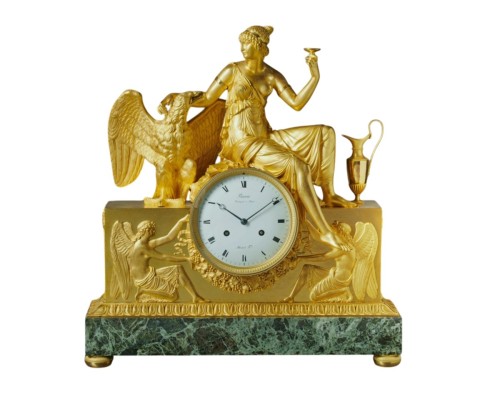
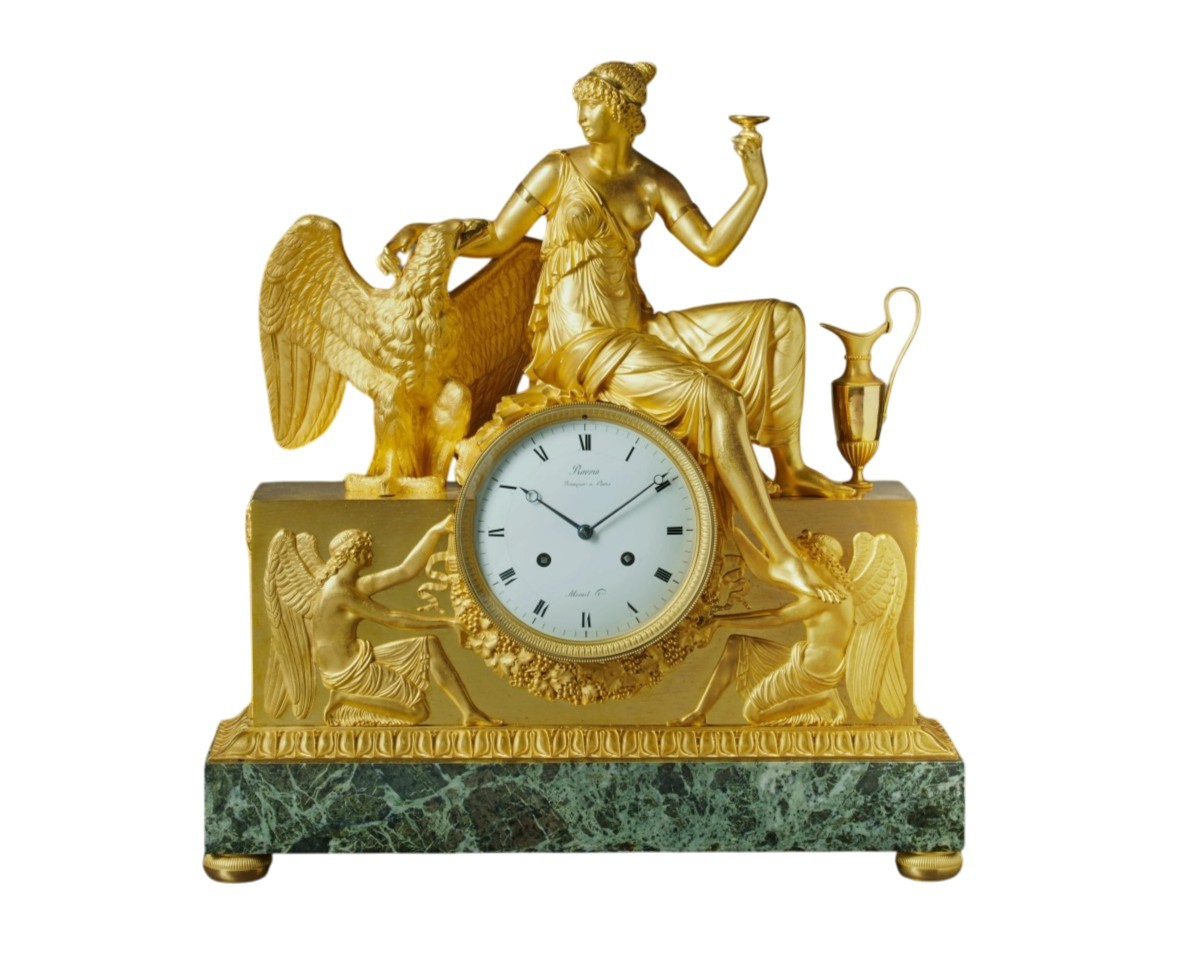
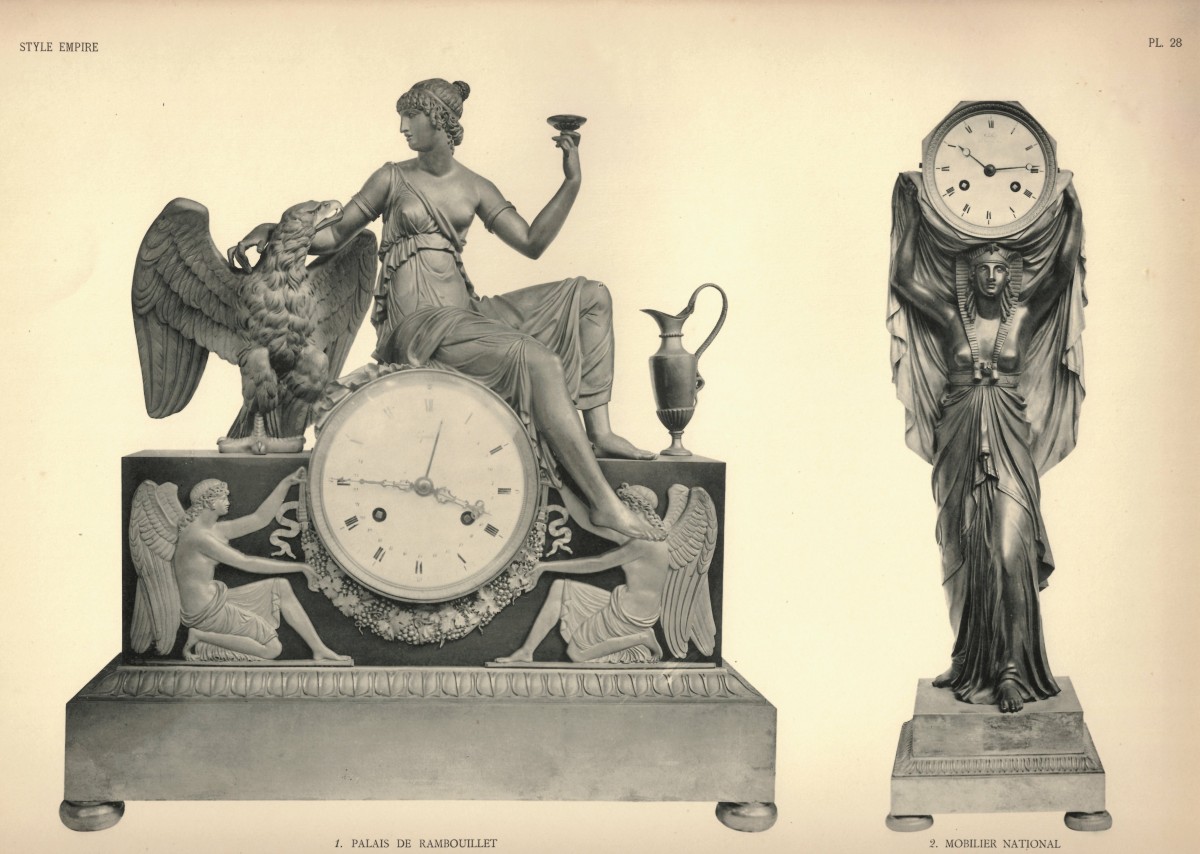
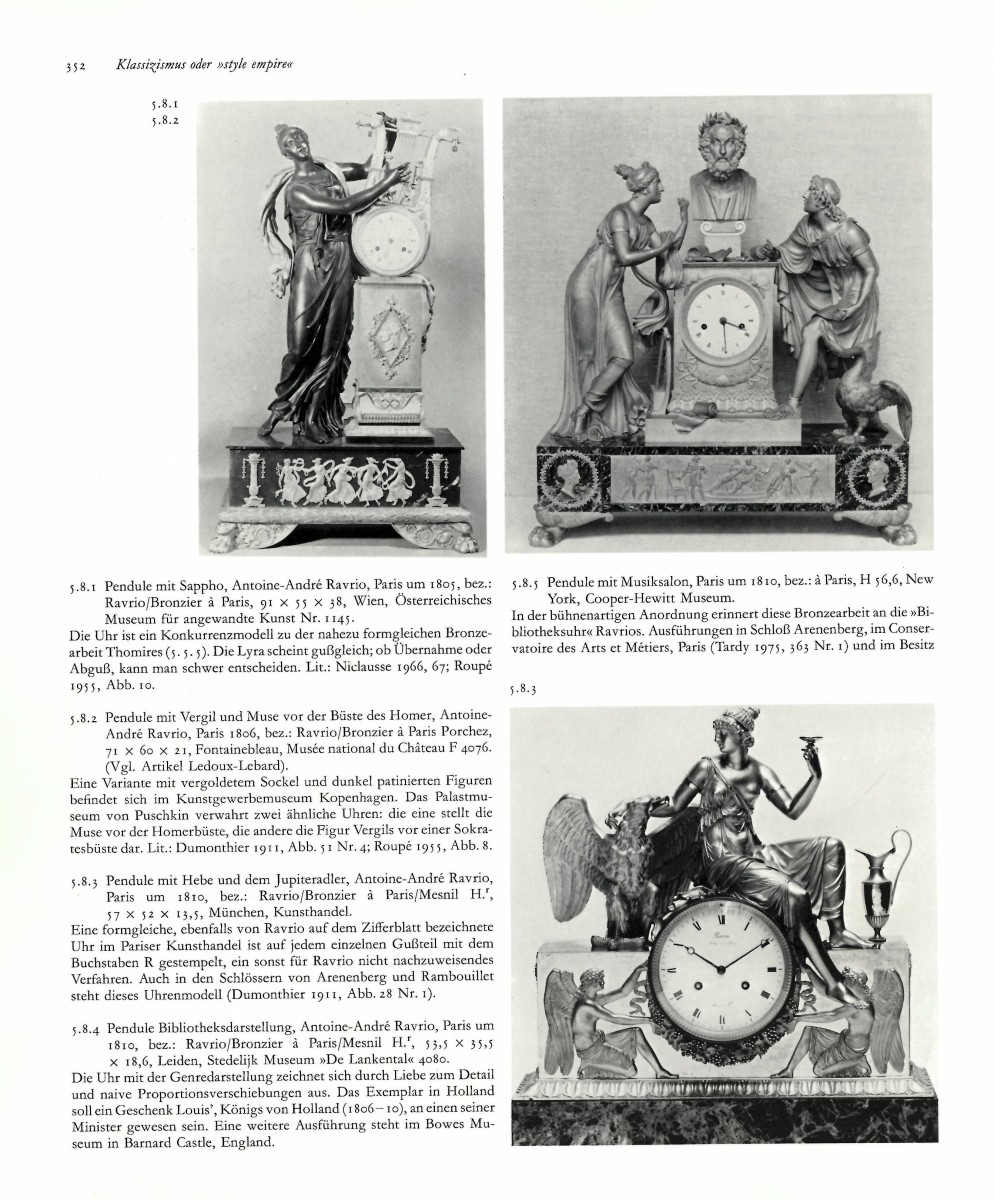
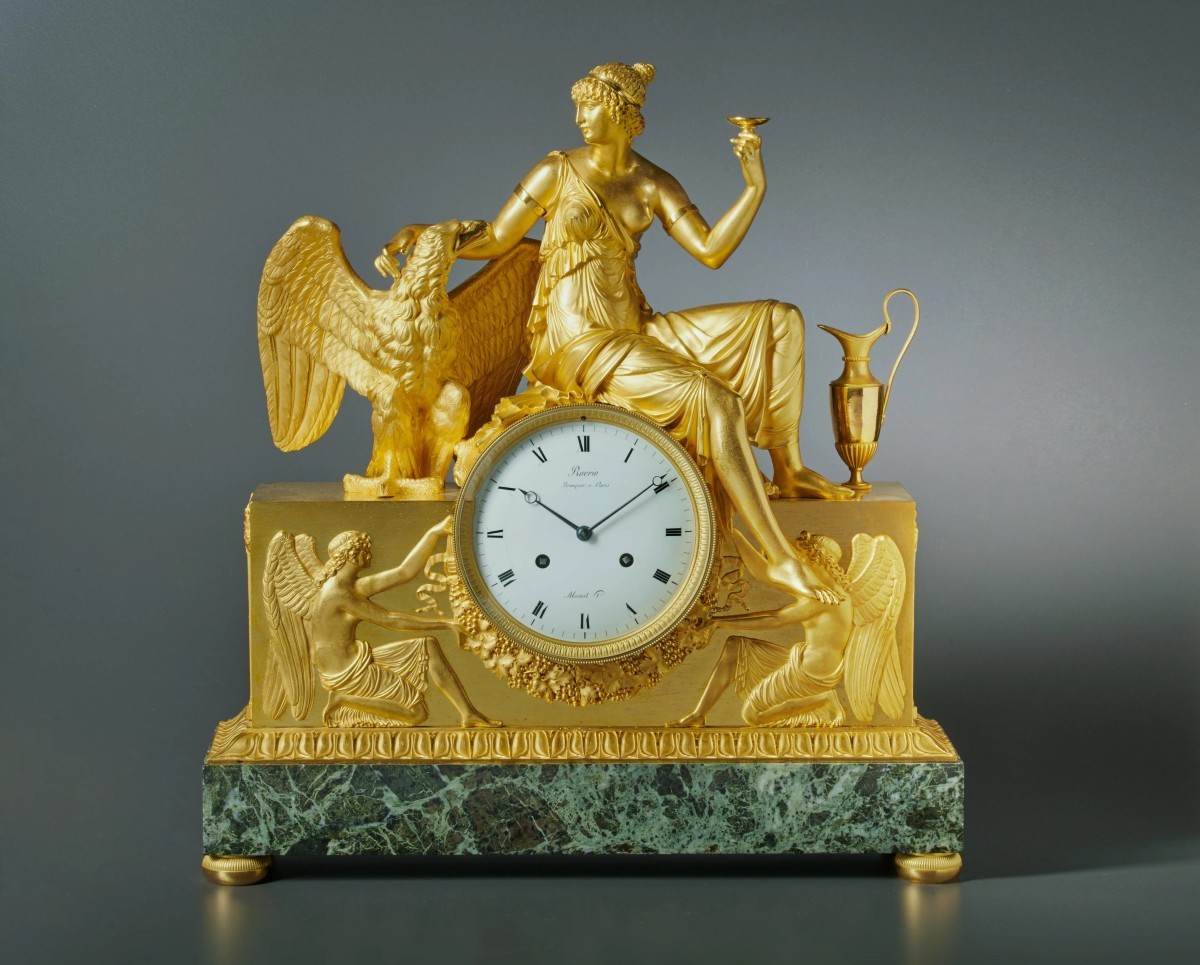
A very beautiful Empire gilt bronze and grey veined marble mantel clock of eight day duration by Mesnil à Paris, housed in a magnificent case by André-Antoine Ravrio, signed on the white enamel dial Ravrio/ Bronzier à Paris /Mesnil hr. The dial with Roman numerals and a fine pair of Breguet style blued steel hands for the hours and minutes. The movement with anchor escapement, silk thread suspension, striking on the hour and half hour on a single bell, with outside count wheel. The case with the clock drum set within a rectangular plinth and surmounted by the figure of Hebe whose left foot is placed upon the plinth beside a ewer and whose right leg arches over the right hand side of the clock drum, she is semi-draped, has her coiled hair tied up by a ribbon and holds out a cup in her left hand while looking toward the eagle of Jupiter to her left whose head she is stroking, in turn the eagle, with wings outstretched looks up toward Hebe. The dial adorned below by ribbon-tied floral and foliate swag is seemingly held up by a pair of winged classical figures who half kneel either side of the dial, the plinth with a stiff leaf border set upon a rectangular grey veined marble base supported on bun feet
Paris, date circa 1810
Height 55 cm, width 51 cm, depth 13.5 cm.
Several versions of this magnificent clock are known including one now in Le Petit Trianon and another at Arenenberg Castle. As documented on the dial itself, the case was created by the esteemed bronzier André-Antoine Ravrio (1759-1814), while the movement was made by Mesnil à Paris, whose combined names can be found on other equally sumptuous clocks. The case portrays Hebe, the Greek goddess of youth, who according to myth was the daughter of Jupiter and Juno and married Hercules after his ascent to Olympus. Hebe was the general handmaiden of the gods and the god’s cup-bearer until Jupiter abducted Ganymede who then took over this role from her.
André-Antoine Ravrio, one of the greatest French bronziers of the pre and post Revolution period, was a highly successful, well-respected businessman and an exceptionally gifted artist. In addition to his bronze work he wrote and published two volumes of poetry and had three of his plays performed at the Vaudeville Theatre, Paris. He came from a very interesting and well-connected background that must have proved useful during his career. His maternal grandfather was the eminent ébéniste François Vandercruse whose son, (Ravrio’s uncle), was Roger Vandercruse, known as Lacroix. Furthermore, Ravrio’s mother was sister-in-law to the royal ébéniste, Jean-Henri Riesener. After attending a good school, Ravrio joined the Académie. He then trained as a fondeur under his father, André, whose family had been fondeurs since 1661. In 1774 the great bronzier, Pierre-Philippe Thomire personally recommended Ravrio to the comte d’Artois. Three years later he was received as a maître-fondeur and afterwards joined Jean Baptiste Disnematin-Dorat, a Parisian doreur-argenteur. In 1790 Ravrio married Disnematin-Dorat’s daughter; his father-in-law then sold him his warehouse stock, which Ravrio rapidly expanded. Like Claude Galle, Ravrio sold bronzes by others as well as his own and in turn supplied the leading ébénistes, notably Georges Jacob, his uncle, Riesener and Guillaume Beneman.
Although Ravrio enjoyed success during Louis XVI’s reign, like Thomire he achieved far greater fame under Napoleon Bonaparte. He took part in the first Exposition de l’Industrie, Paris, 1803 and then won a silver medal there in 1806. The same year he supplied a number of bronze furnishings for the Empress Joséphine’s apartments in the Tuileries and in 1810 was appointed to bronzier to the Emperor. As such he supplied some of the finest Empire bronze pieces including fine sculptured clock cases, girandoles and candelabras to many of the Imperial residences at the Tuileries, Fontainebleau, Saint-Cloud, Versailles, Compiègne and Rambouillet. Ravrio also worked for the Quirinal in Rome, Monte-Cavallo, for Stupinigi near Turin, King Ludwig of Holland and many other notable figures and venues.
In order to meet demand, Ravrio employed over a hundred craftsmen. With success came substantial rewards. He lived in great luxury in a large house full of fine art and furnishings as well as a large library of classical literature (which he often referred to when seeking artistic inspiration); he also had an extensive wardrobe (which included 72 cravats). A portrait of him by his cousin, Henri-François Riesener (1812; Musée du Louvre, Paris) shows a prosperous and well-educated man, seated with books, bronzes and an open sketchbook. Sadly, none of his three children survived, though he had an adopted son, Louis-Stanislas Lenoir-Ravrio (1784-1846) who became his partner in 1811 and continued the business after his death. It is presumed that he died from mercury poisoning especially since he bequeathed 3,000 francs to anyone who could protect craftsmen from the effects of mercury gilding. The prize was won three years later by the fondeur and chemist, Darcet. Ravrio’s bronzes are regarded as some of the most beautiful of their kind. Examples can be seen among the finest collections including the above mentioned palaces as well as the Stedelijk Museum Lakenhal, the Upper Belvedere Vienna, Musée Massena Nice and the Residenz, Munich.
His clock cases are among some of the finest made during the Empire period and like a number by Pierre-Philippe Thomire, they also house clock movements by the Parisian clockmaker Mesnil, counting among them one which was made for the Empress Joséphine for the Palais de l’Elysées. Other clocks with cases by Ravrio and movements by Mesnil include one in the Stedelijk Museum at Leiden and another at Stockholm Castle (illustrated in Ottomeyer and Pröschel, op. cit., p. 353). Despite the quality of his craftsmanship and close association with the finest fondeurs of his day, relatively little is known about Mesnil à Paris although Tardy notes that by 1806 the firm was based at Charnier des Innocents and then from 1812-15 at rue Neuve Saint-Marc.