Offered by Desmet Galerie
REQUEST INFORMATION
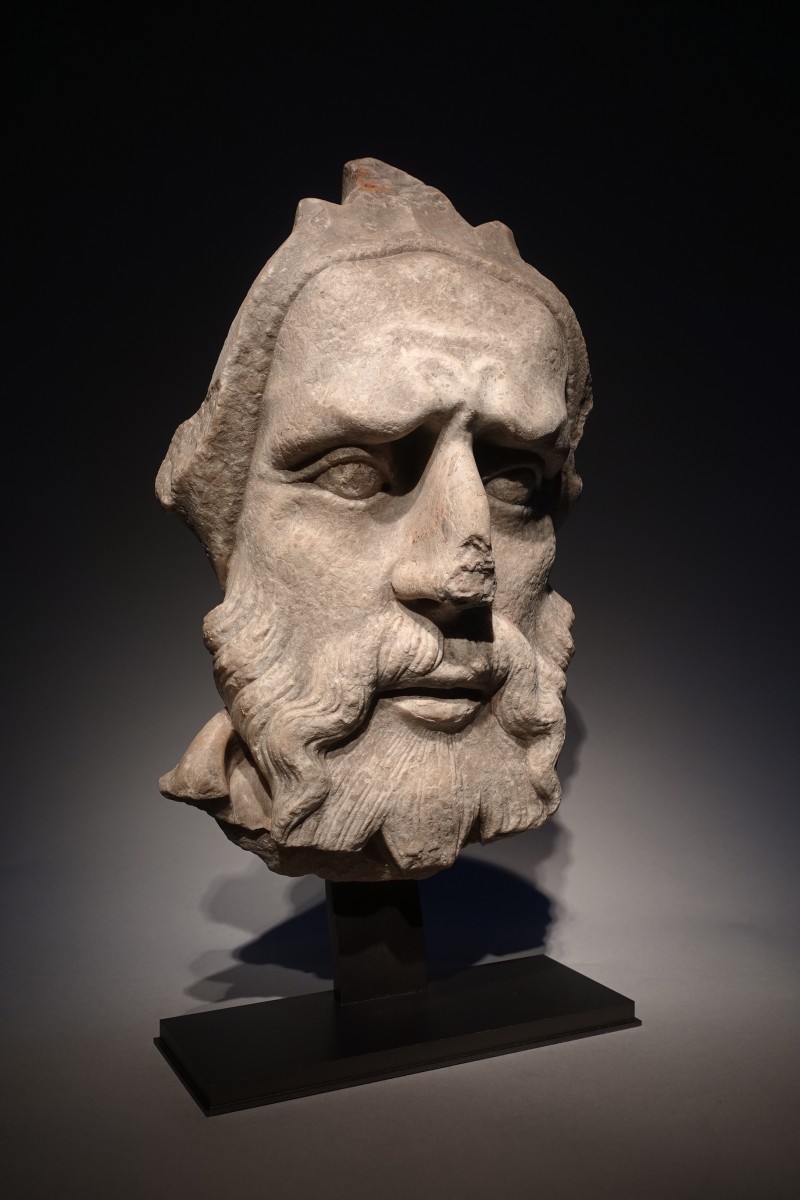

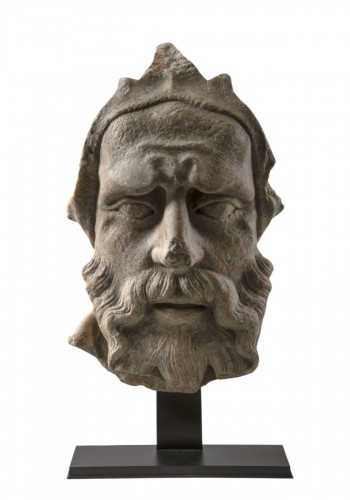
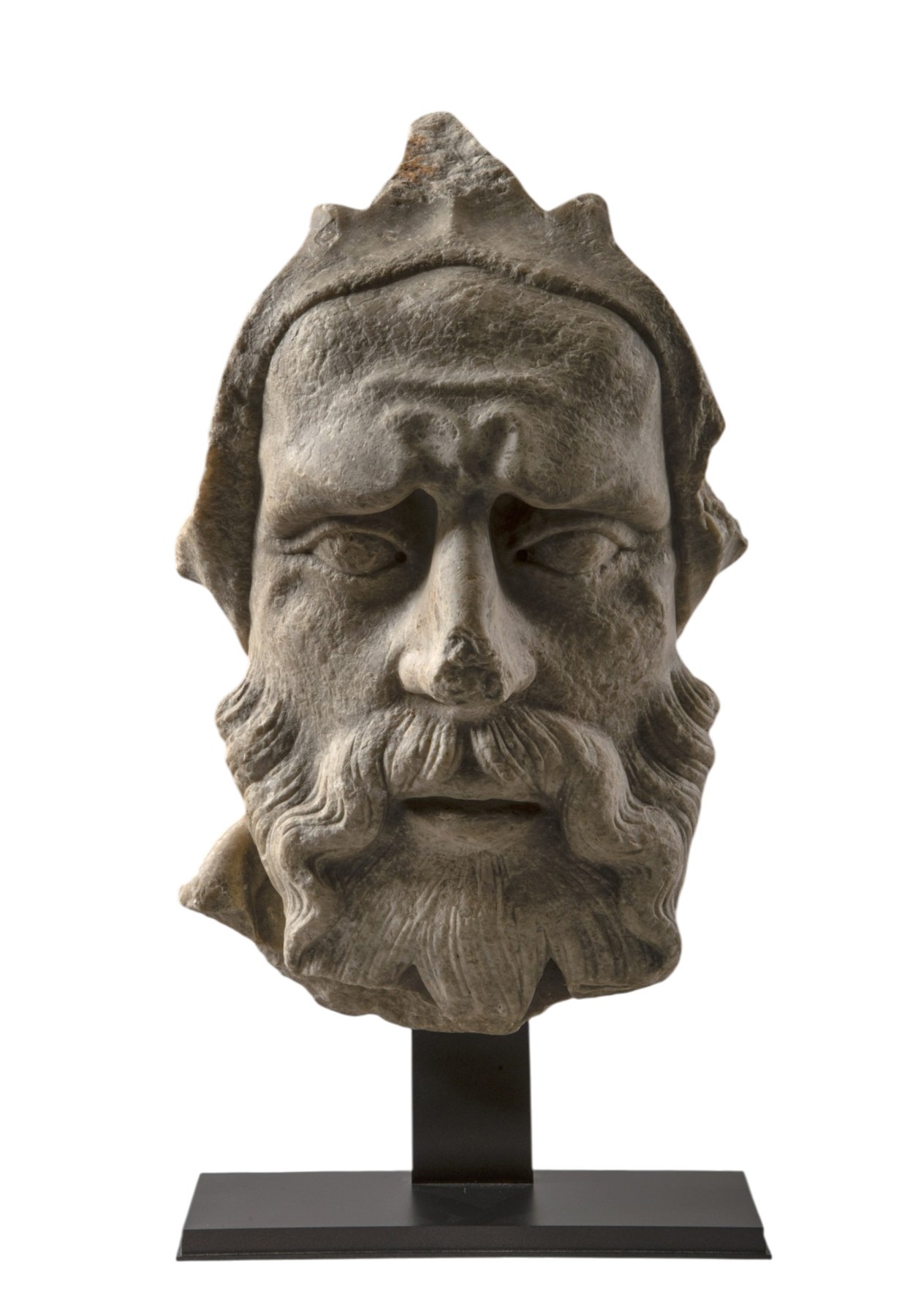
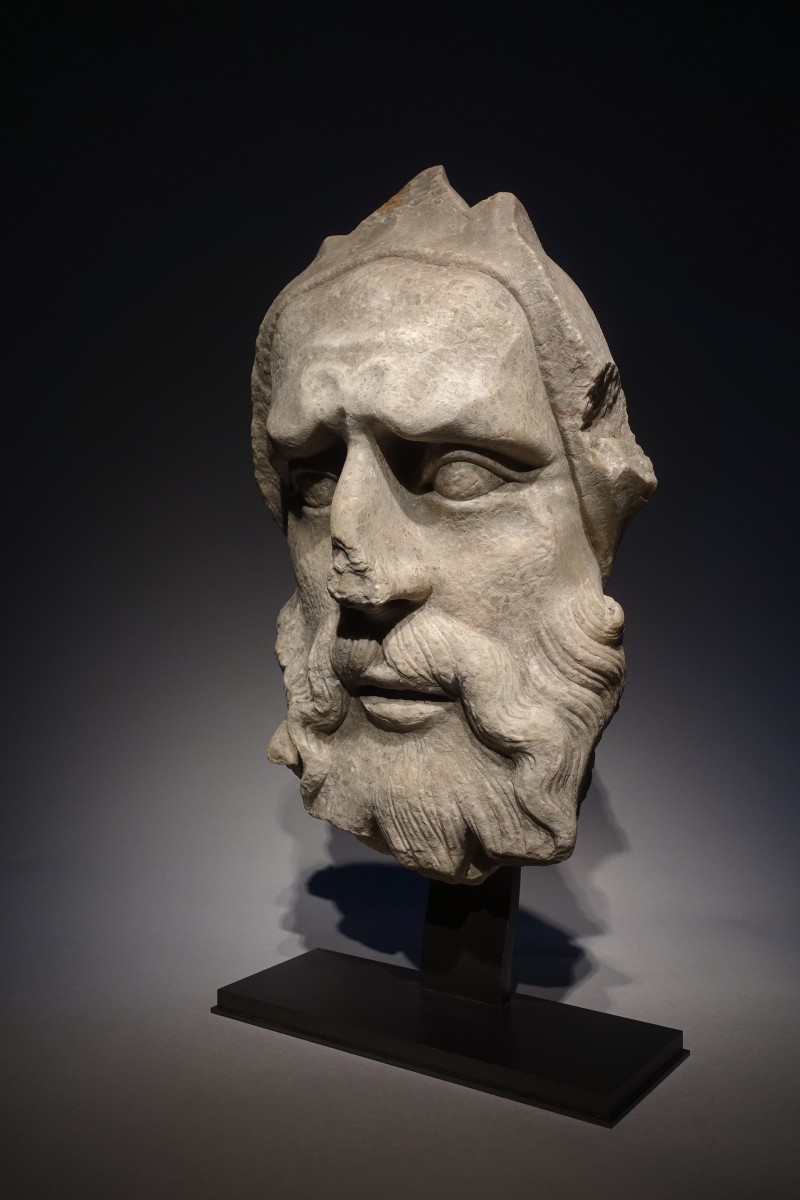
The sculpture is a carved bust-head of a mature bearded man wearing a cap. The face is broad and deeply modelled, with a strong brow, solemn eyes, and a full beard carefully worked into three distinct locks. The moustache merges into the beard, framing a slightly parted mouth. The nose has suffered some loss, as have parts of the cap and beard, but the overall impression remains one of dignity and gravitas. The cap fits close to the head, framing the forehead, giving a rather sober, functional impression (rather than highly ornate). The hair is cropped under the cap, but high on the sides, waved locks of the beard continue to frame the face. The expression is calm, perhaps slightly serious; not overtly expressive or dramatic, but with a sense of inward presence or contemplation.
On the back, the surface is relatively plain, and there are chisel marks; the lower neck is truncated. Part of his collar is visible on the side. It has been broken from the neck down, indicating it was part of what was once a larger statue.
The preservation is fair: damage to the nose, some chipping at edges (cap and beard). The marble surface shows weathering, possibly some later abrasion. The quality of carving is refined: the beard is well modelled, and fine-detailed as one might see in very high late Gothic or Renaissance work; the style seems more restrained, which indicate a later Gothic.
The stylisation of the beard, divided into three rhythmic locks, is a feature frequently encountered in Gothic sculpture across Europe, particularly in representations of prophets, apostles, and patriarchs. Comparable examples can be found among the prophets carved for the façade of Milan Cathedral in the late 14th and early 15th centuries, as well as in a marble Head of a Prophet in the Victoria and Albert Museum, London (inv. 7647-1861), dated to about 1400. The monumental solidity of the face and the restrained handling of the marble are in keeping with North Italian sculpture from the later Gothic period, while the absence of the heightened naturalism of Renaissance portraiture points to a date in the early 15th century.
Old Testament prophets, typically shown with long beards, were a common feature of architectural sculpture, especially on façades and portals. They were usually portrayed bare-headed or with hoods, rather than with a cap. The presence of a cap in this work, however, introduces another possibility: that the figure represents a saint of monastic or scholarly standing — a hermit saint, an early Church Father, or perhaps one of the Doctors of the Church.
In some Northern Italian contexts, particularly in Venice and Lombardy, the close-fitting skullcap or zucchetto came into use among clerics from the 13th and 14th centuries onwards. Its appearance here may not signify episcopal rank, but rather the general status of a learned or ecclesiastical man.
Taken together, these features make it most plausible to interpret the head as that of a prophet or saint, rather than as a portrait of a specific, identifiable individual.
The head was originally intended as part of a larger decorative scheme, probably architectural. Figures of prophets and saints, presented in isolation or in cycles, were integral to Gothic façades, portals, pulpits, and choir enclosures. The monumental scale and austere presence of this head suggest that it belonged to just such a setting, serving both as a didactic image of sanctity and as a powerful embodiment of divine wisdom.
Delevery information :
We can arrange shipping.