Offered by Galerie PhC

European paintings from the 17th, 18th and 19th centuries.
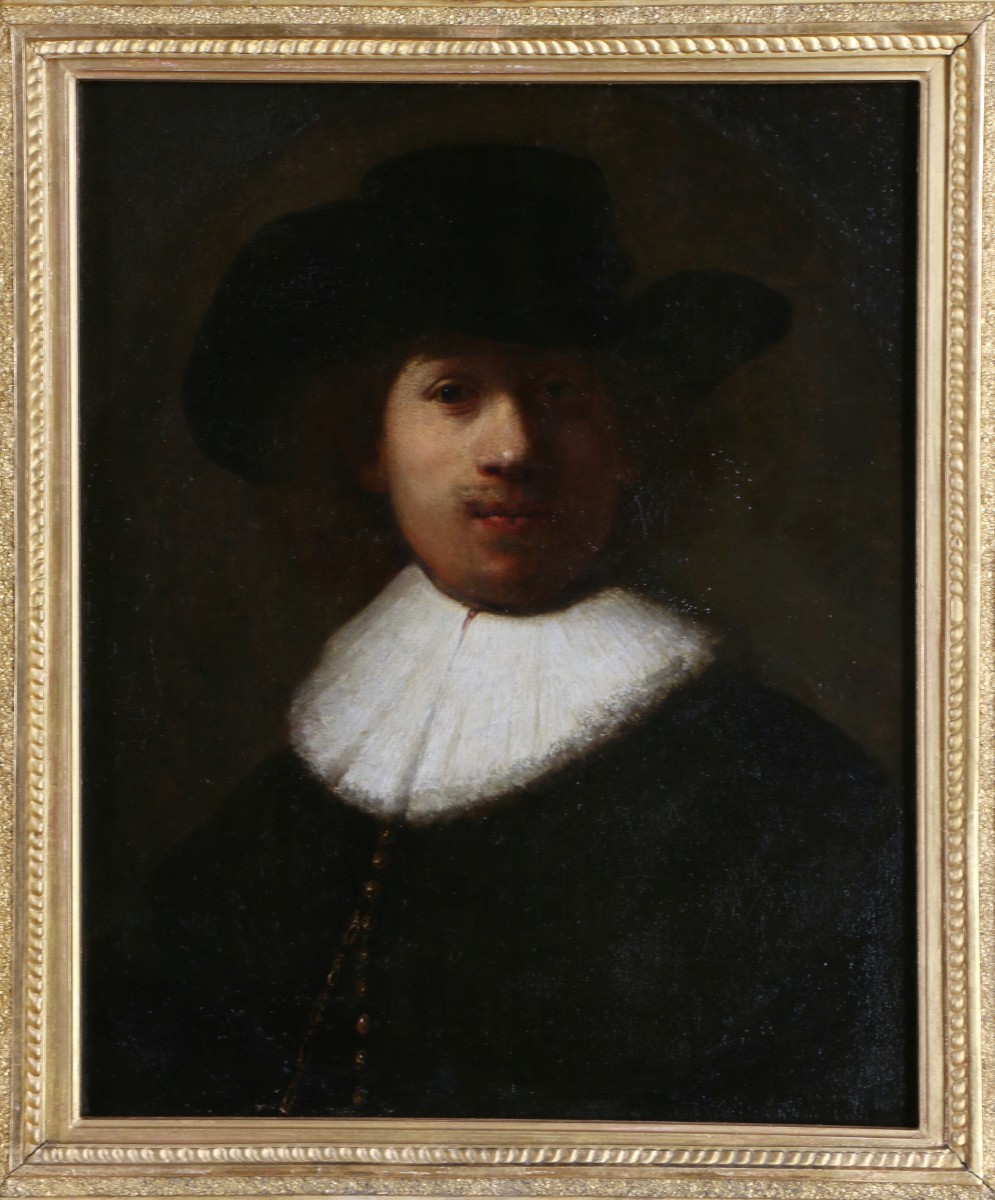
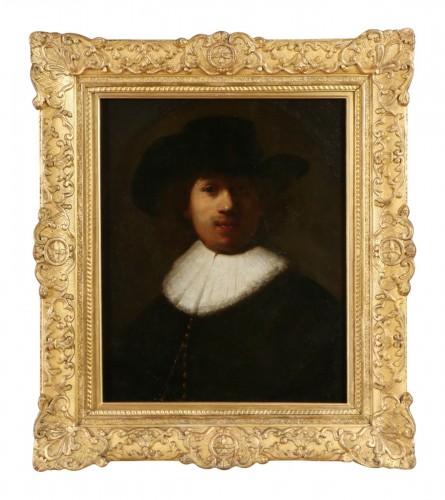
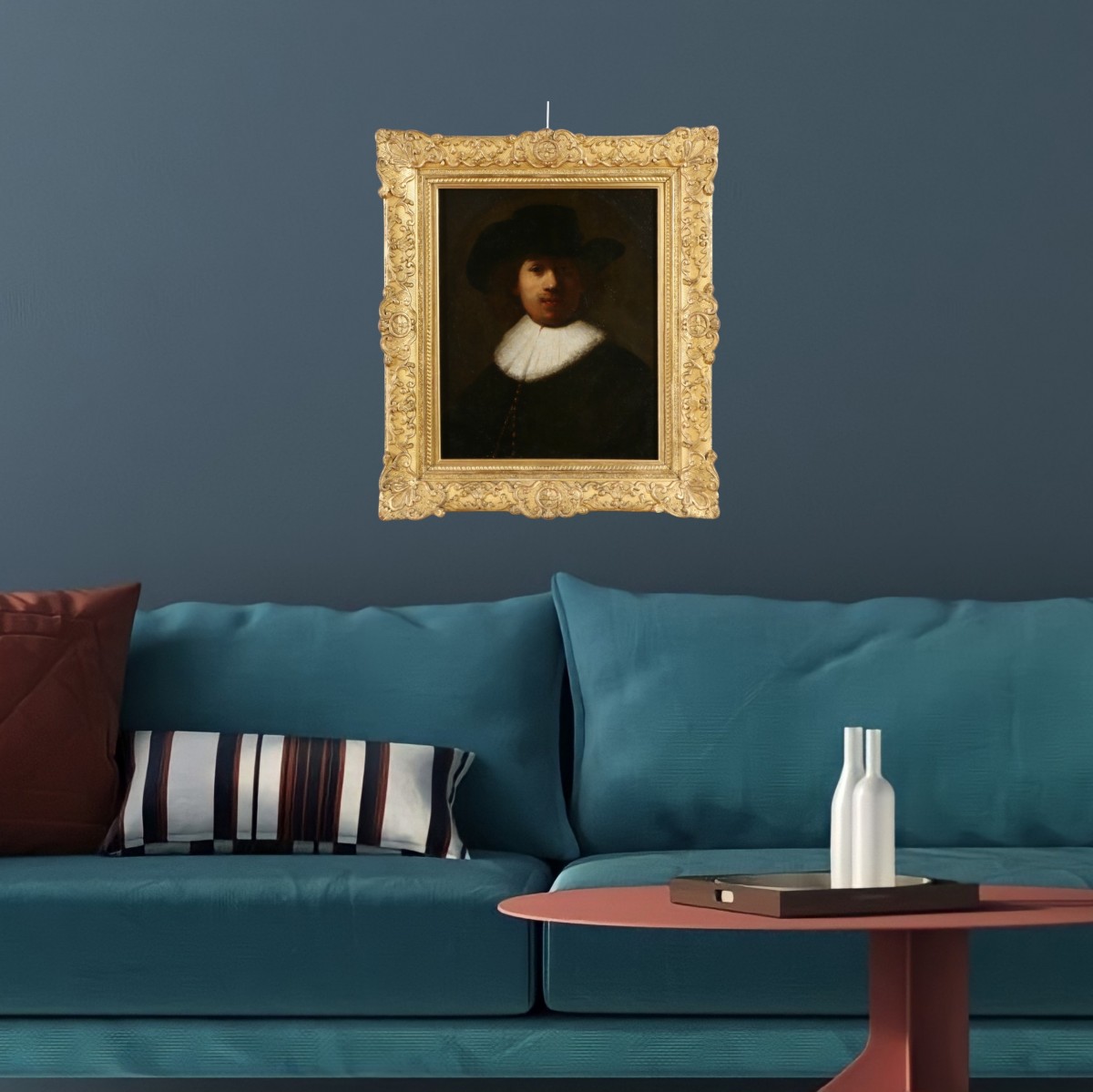
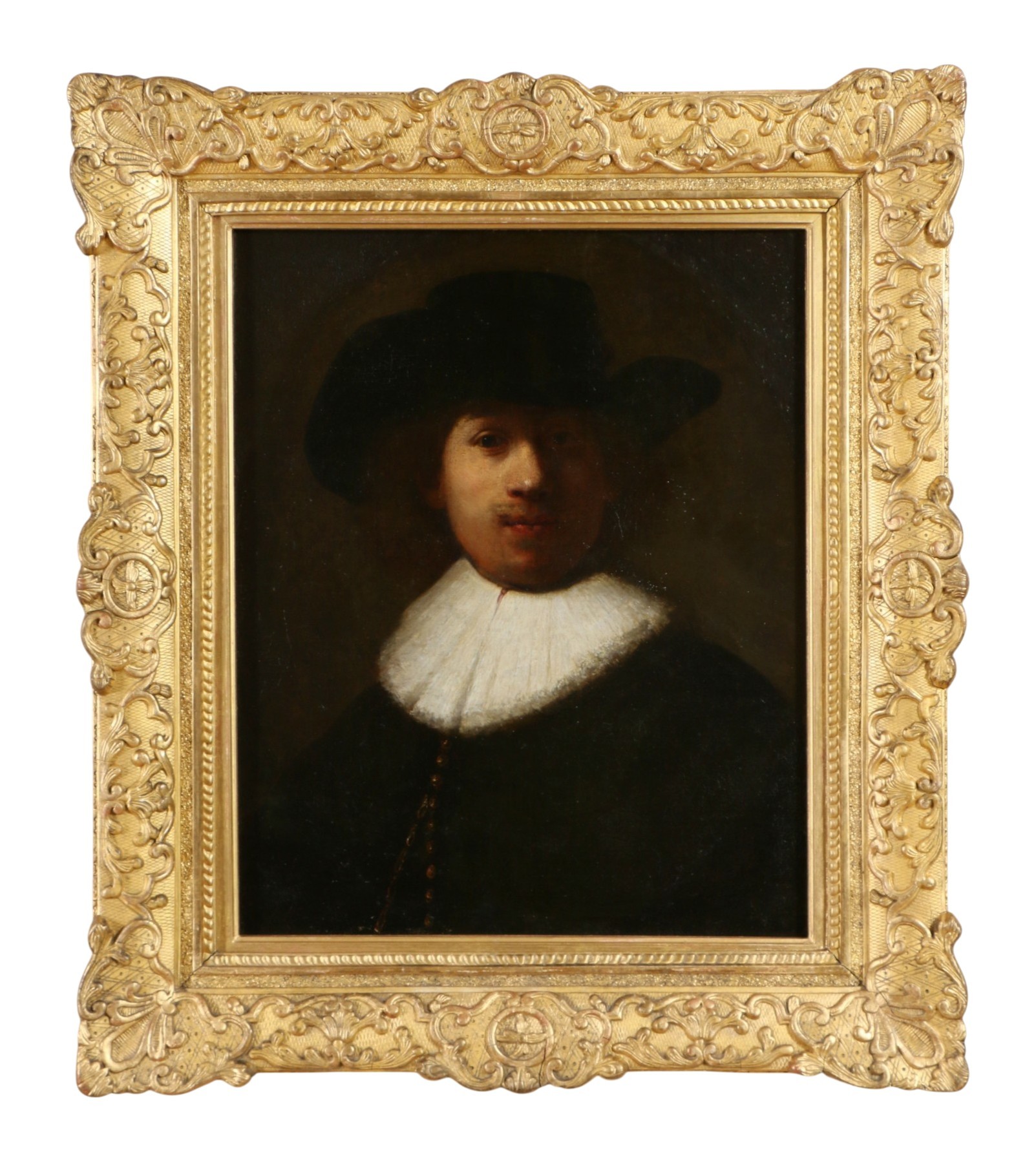
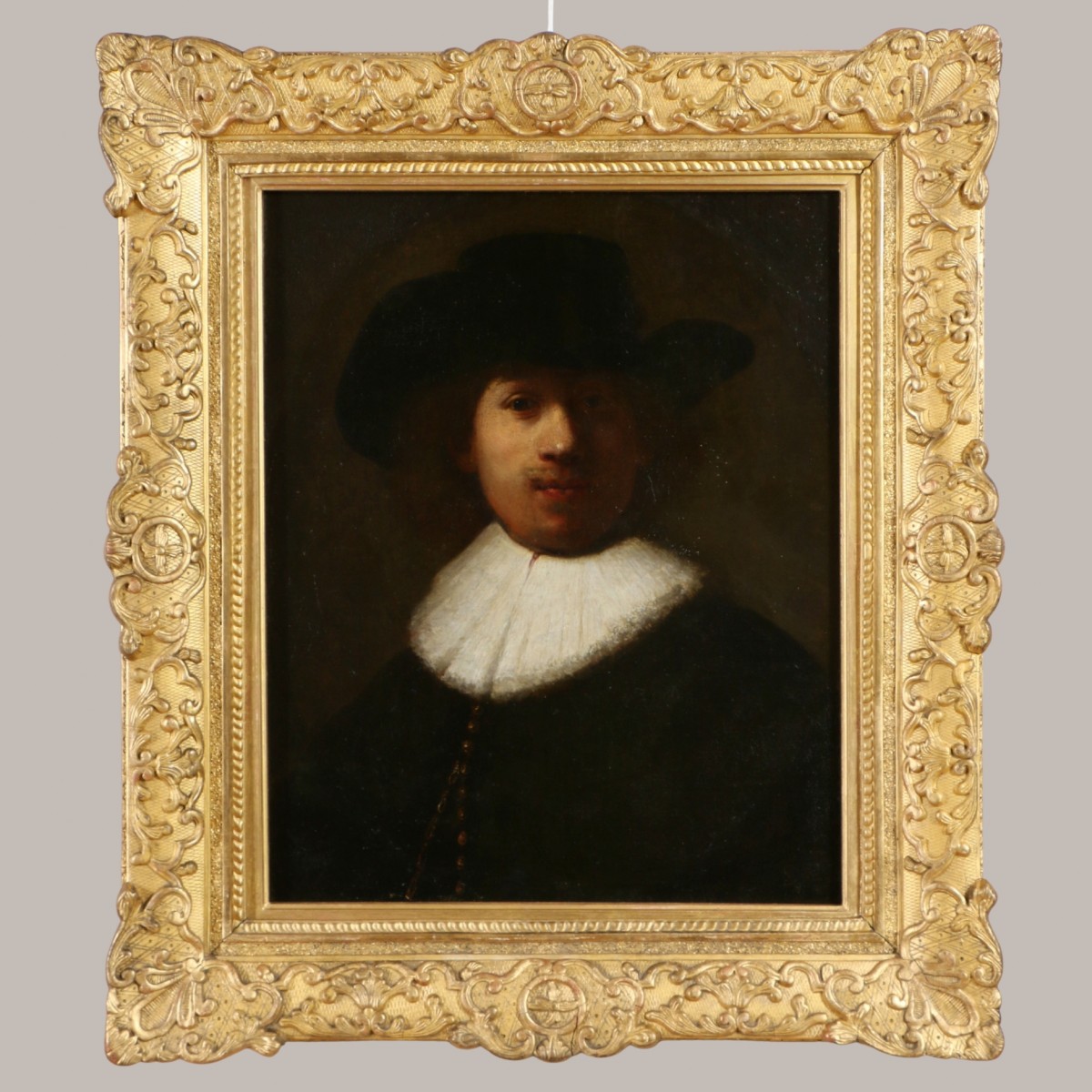
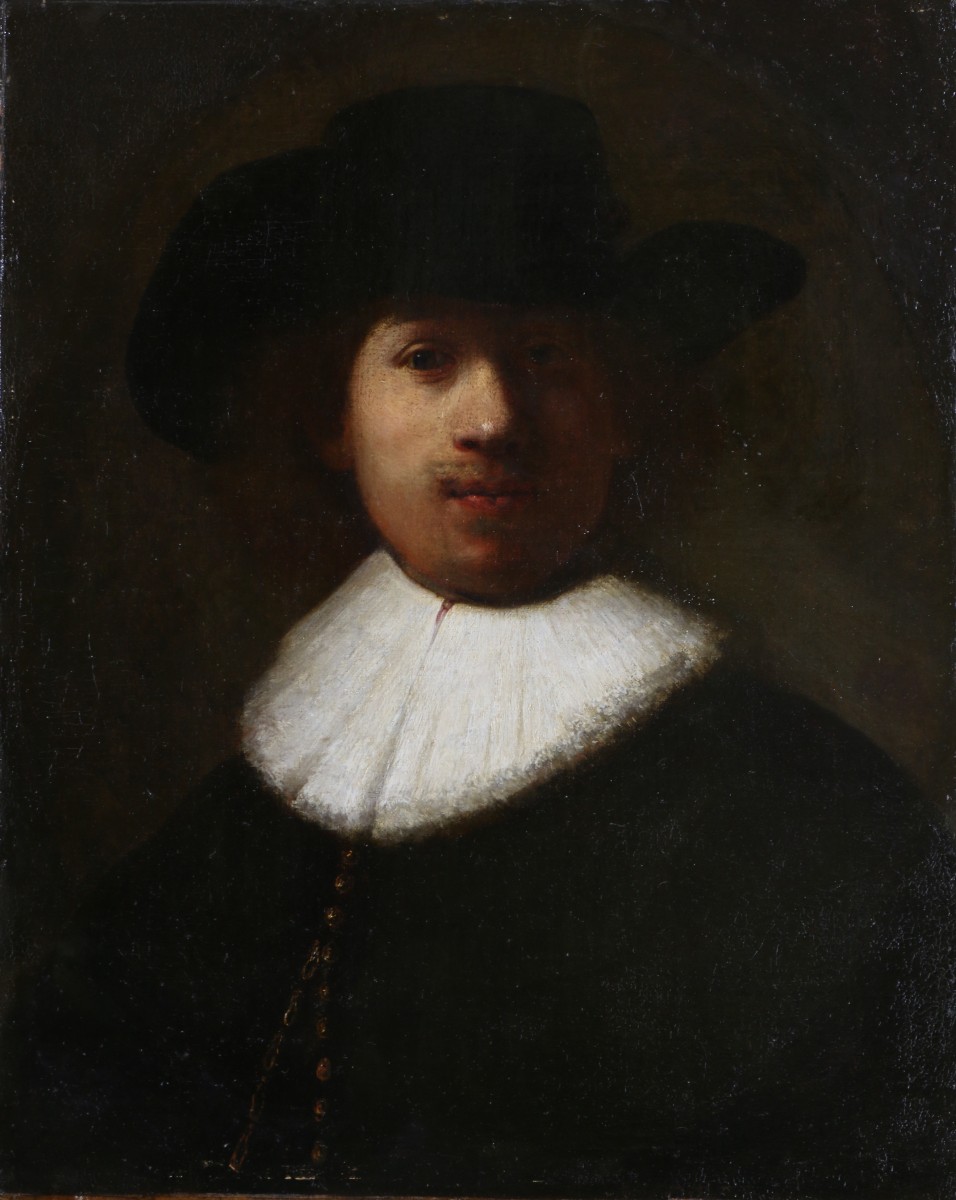
Workshop of Rembrandt Harmensz. van Rijn(1606–1669)Portrait of Rembrandt Wearing a Wide-Brimmed Hat17thcentury, after his 1632 self-portrait.
Oil on re-stretched canvas, 57.5 cm by 46.5 cm.
Antique frame, 76 cm by 66 cm
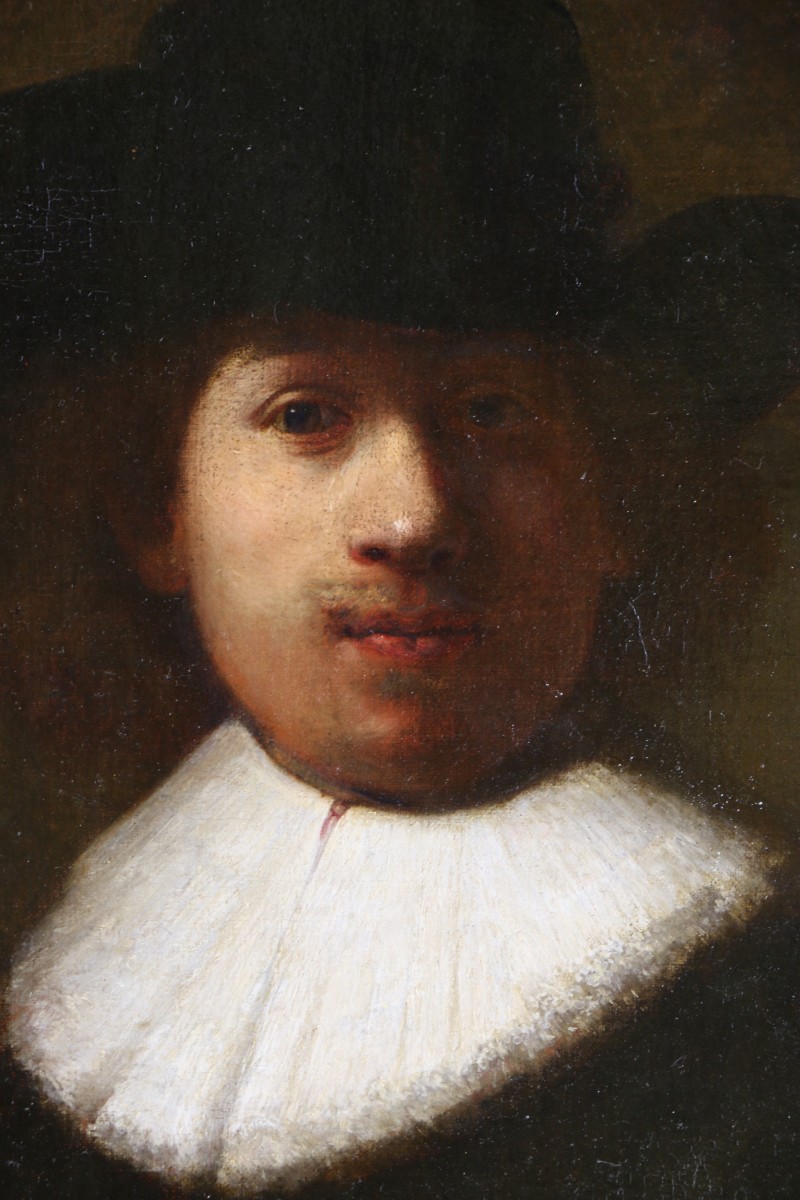
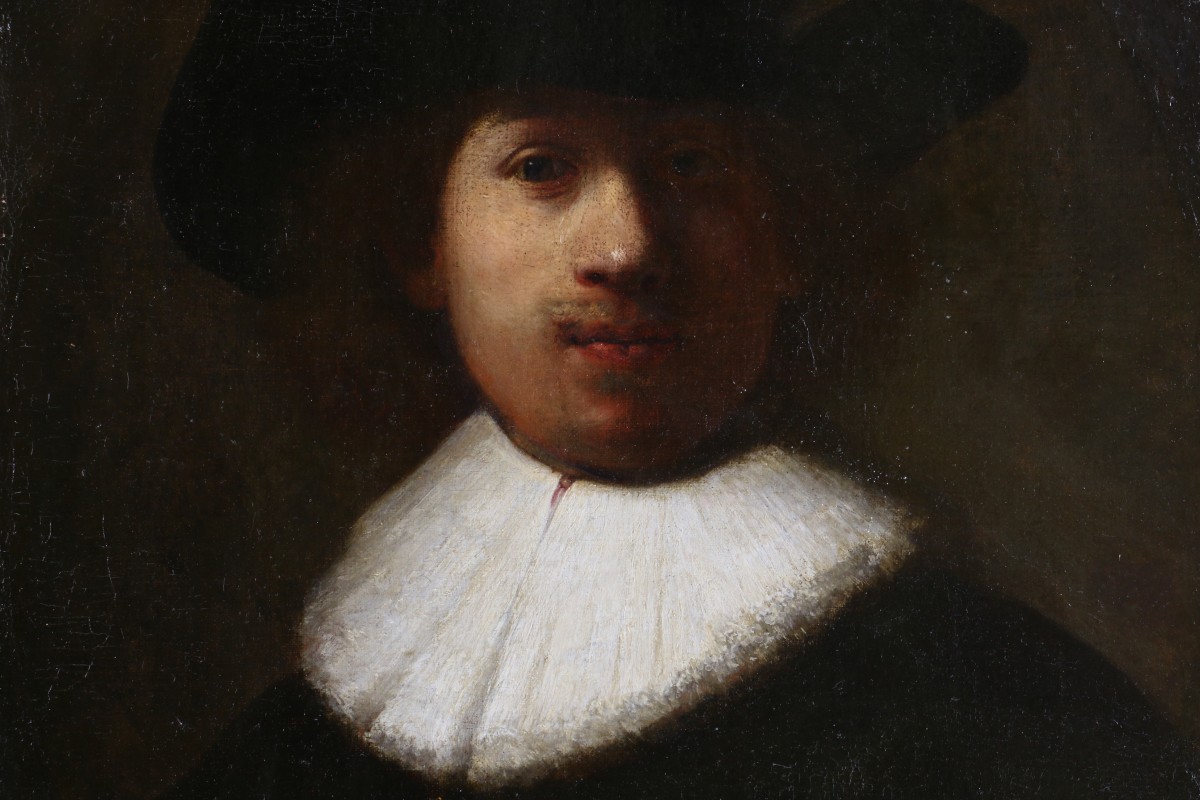
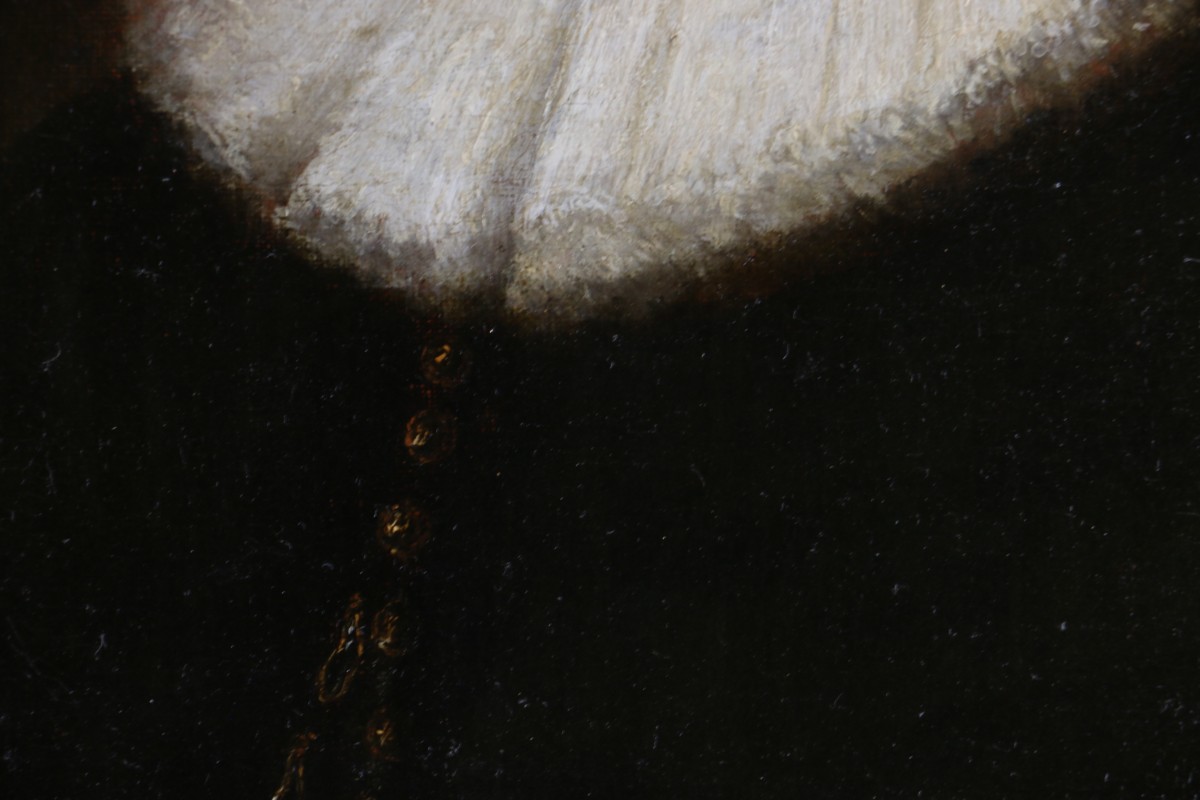
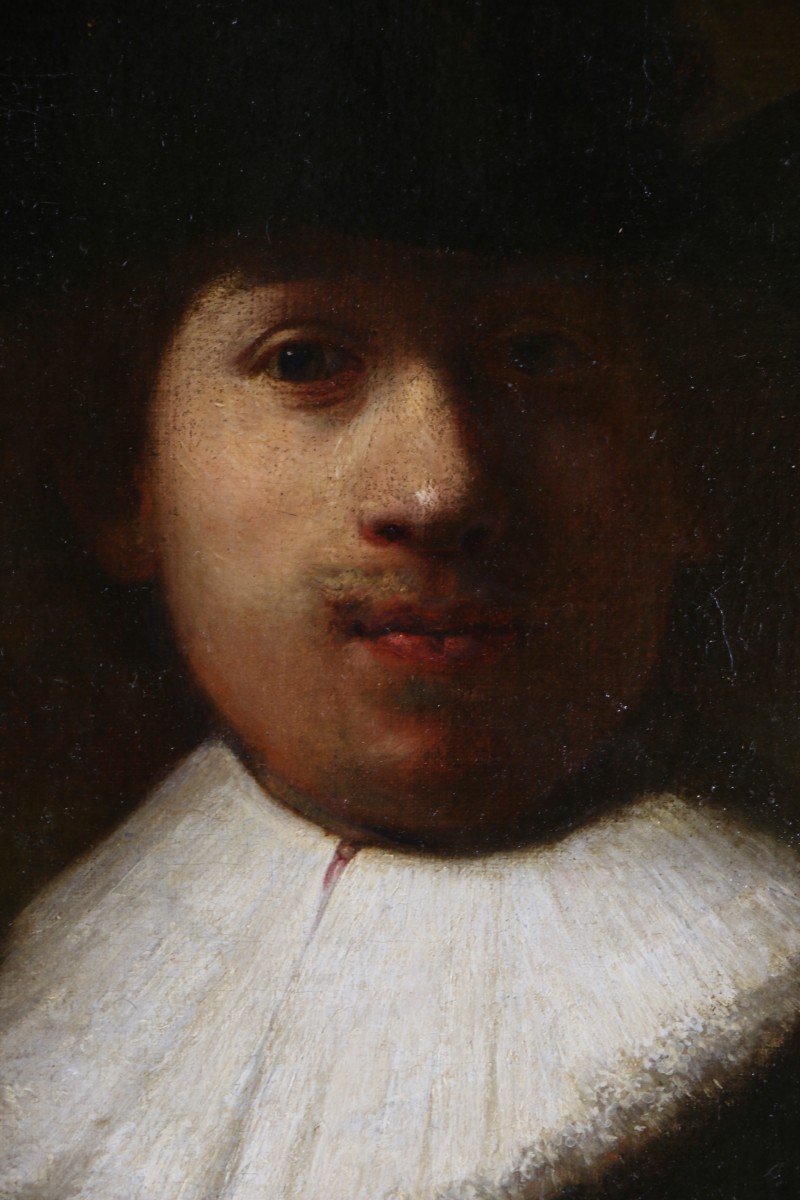
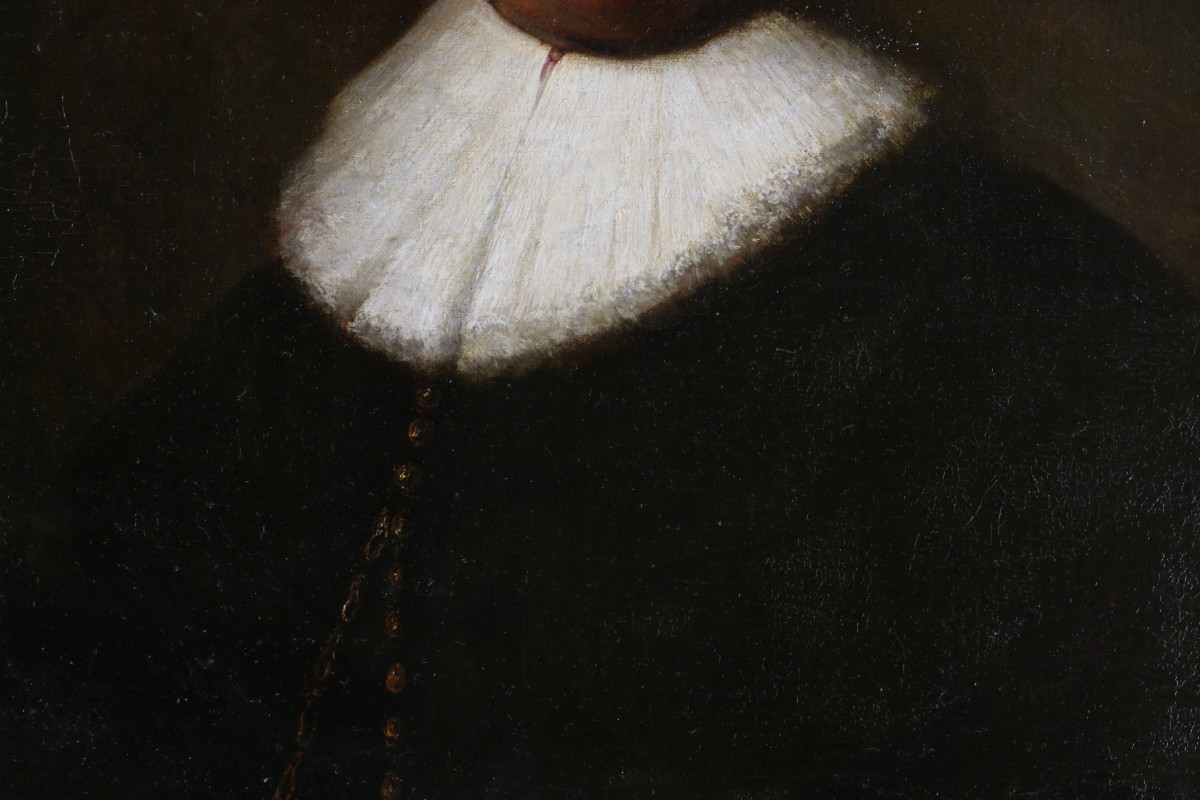
Our painting is a studio replicaof Rembrandt’s 1632 self-portrait held at the Burrell Collection inGlasgow. Another version very similar to our painting is held at the National MuseumNational Museum in Warsaw (inv. M.Ob.296). Rembrandt is depicted in a bust portrait, almost facing forward,wearing a wide-brimmed black hat. He is dressed in a dark suit,accented on the front with small gilded ornaments, and a wide, turned-down white collarthat serves as the composition’s primary source of light.The face stands out against a dark brown background thanks toside lighting that highlights the cheek, the eye, and the bridge of the nose, whilethe rest of the face remains in the shadow cast by the hat. Theskin tones are rendered in a range of beige, pinkish, reddish, andbrown hues, with more intense accents around the eye, nose, mustache,and the lips.The wide white collar is rendered with long,radiating brushstrokes, modulated with white, gray, and ochre, with amore pronounced texture along its edge. The black coat blends largely into the darknessof the background, while the garment’s ornamentation is suggested by a feworange-brown and golden brushstrokes.
The composition echoes the Self-Portrait paintedby Rembrandt in 1632 and now housed in the Burrell Collection inGlasgow. It is also related to the early replicaheld at the National Museum in Warsaw.
Rembrandt’s Studio and the Practiceof Replicas in the 17thCentury
When Rembrandt Harmensz. van Rijn (1606–1669)settled permanently in Amsterdam in the early 1630s, his reputationgrew rapidly. After his formative years in Leiden, heworked in Amsterdam within the circle of the art dealer and entrepreneurHendrick Uylenburgh, whose studio played an important role in thedevelopment of his career as a portrait painter. From this period onward,Rembrandt received numerous commissions and gradually surrounded himself with students,assistants, and young painters who came to train under him and help himdistribute his works; commissions were plentiful.The studio of a great 17th-century Dutch painter should not be understoodmerely as a place where assistants mechanically executedminor parts of the master’s paintings. It was also a place oftraining and inspiration, where students studied his approach to composition, hisuse of light, his painting technique, and his way of renderingexpressions. Painters such as Gerrit Dou, Govert Flinck,Ferdinand Bol, Carel Fabritius, and Samuel van Hoogstraten, at varioustimes, were trained by Rembrandt or worked within hiscircle. They learned from his works and sometimes adopted hispictorial vocabulary so closely that it is difficult today todistinguish certain studio productions from the master’s own works.This closeness was not accidental. Inthe artistic training of the 17thcentury, copying or reinterpreting the master’s compositions was part of thetraining. Students could study an original, reinterpret itscomposition, execute a variation, or work from a model used inthe studio. A single idea could thus give rise to severalpaintings differing in size, medium, detail, orexecution.Rembrandt’s self-portraits occupy aspecial place within this phenomenon. Rembrandt depicted himself throughouthis career, in paintings, drawings, and engravings. His own faceserved as an immediately available model for studying expressions,light, and physiognomic features. But some of Rembrandt’s imageswere also reproduced by his students and those around him.
Delevery information :
All our paintings benefit from careful and secure packaging. No geographic restrictions.