Offered by Ars Antiqua

Old Masters paintings, furniture, sculptures and modern art
August Querfurt (1696, Wolfenbüttel – 1761, Vienna), attr.
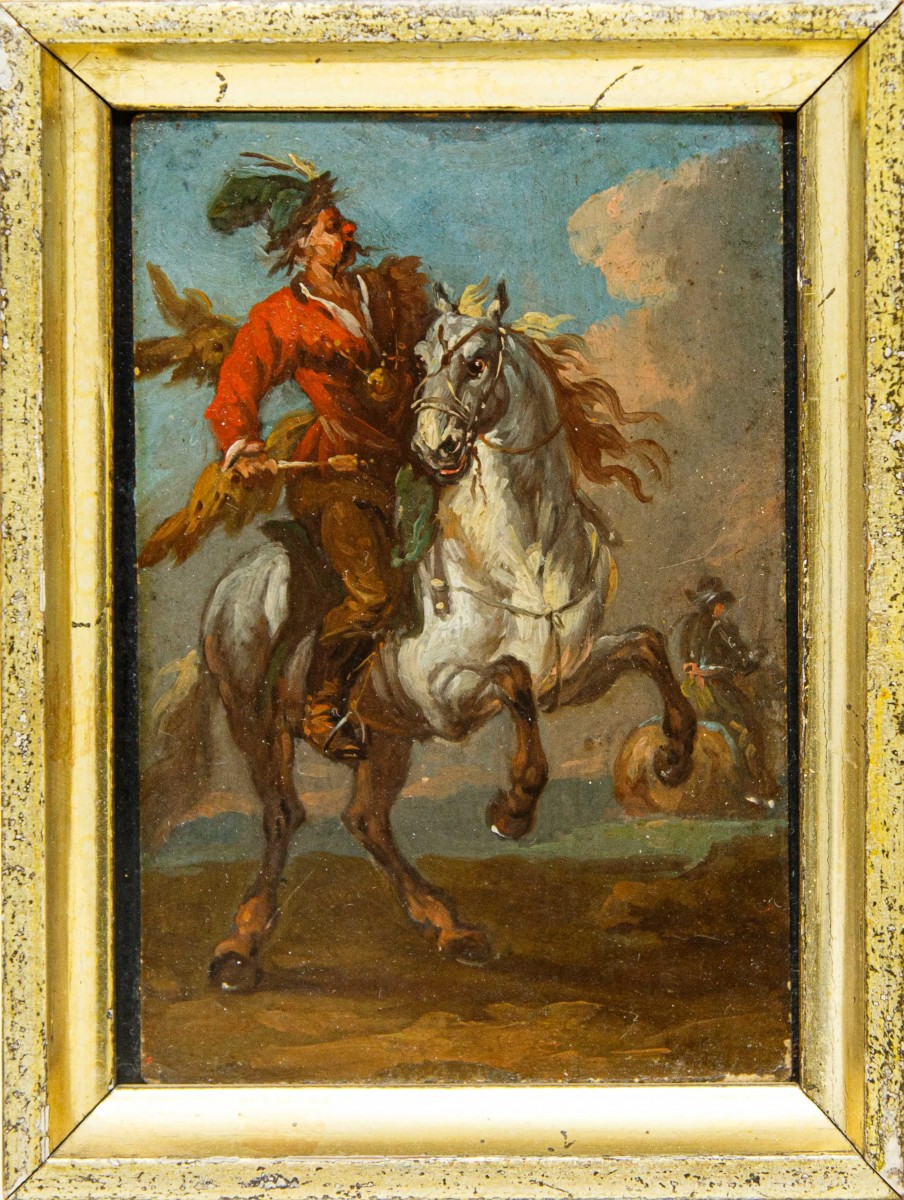
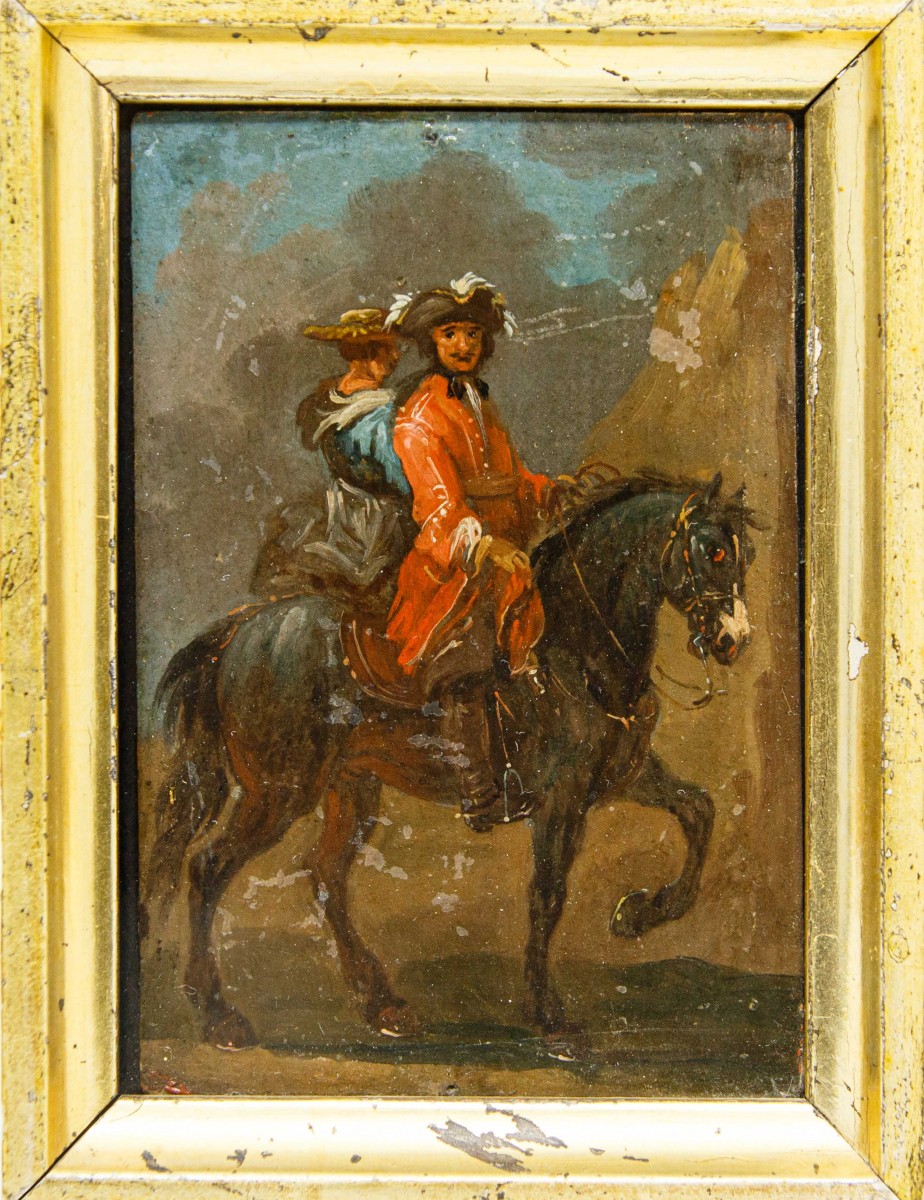
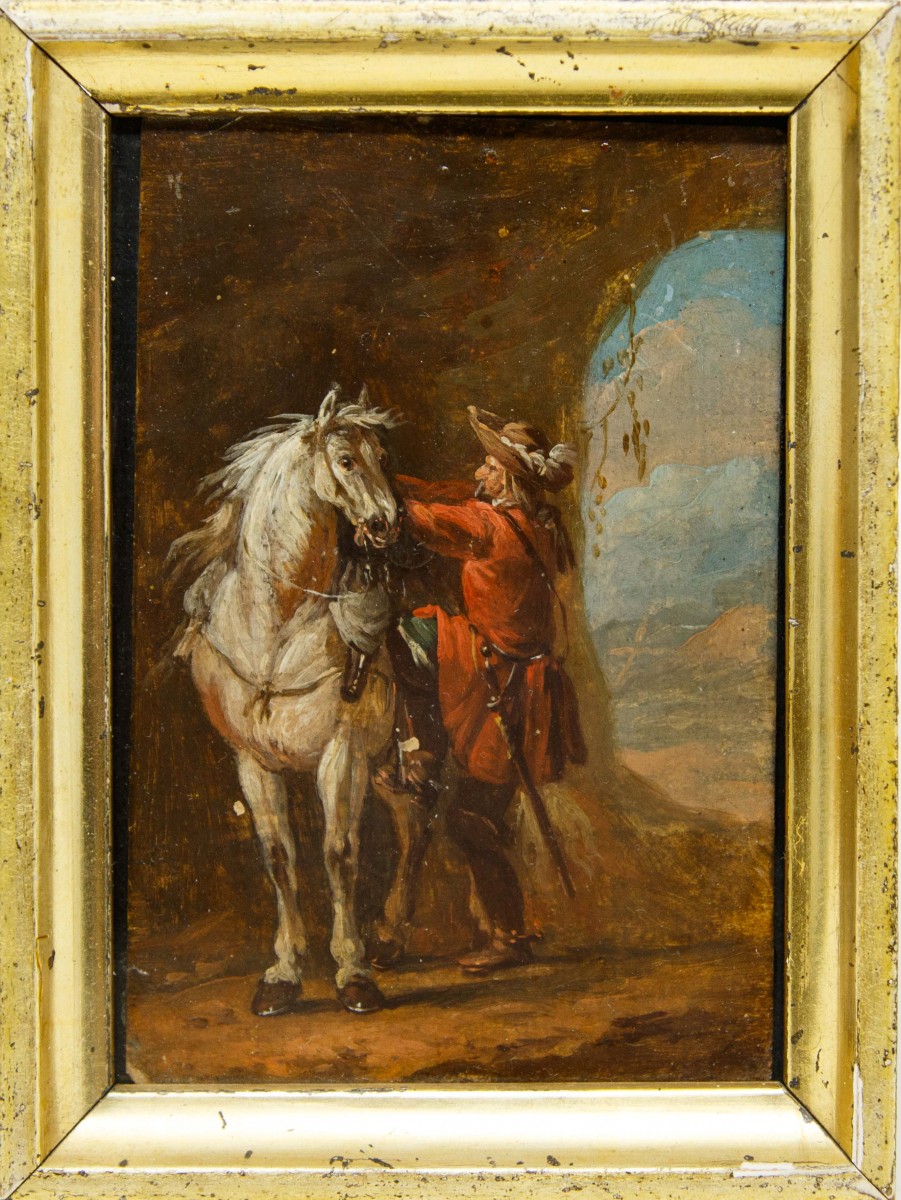
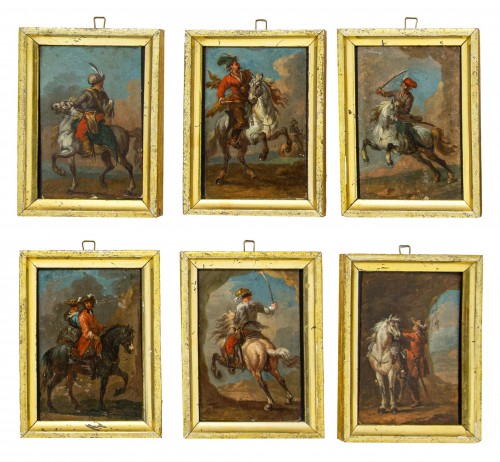
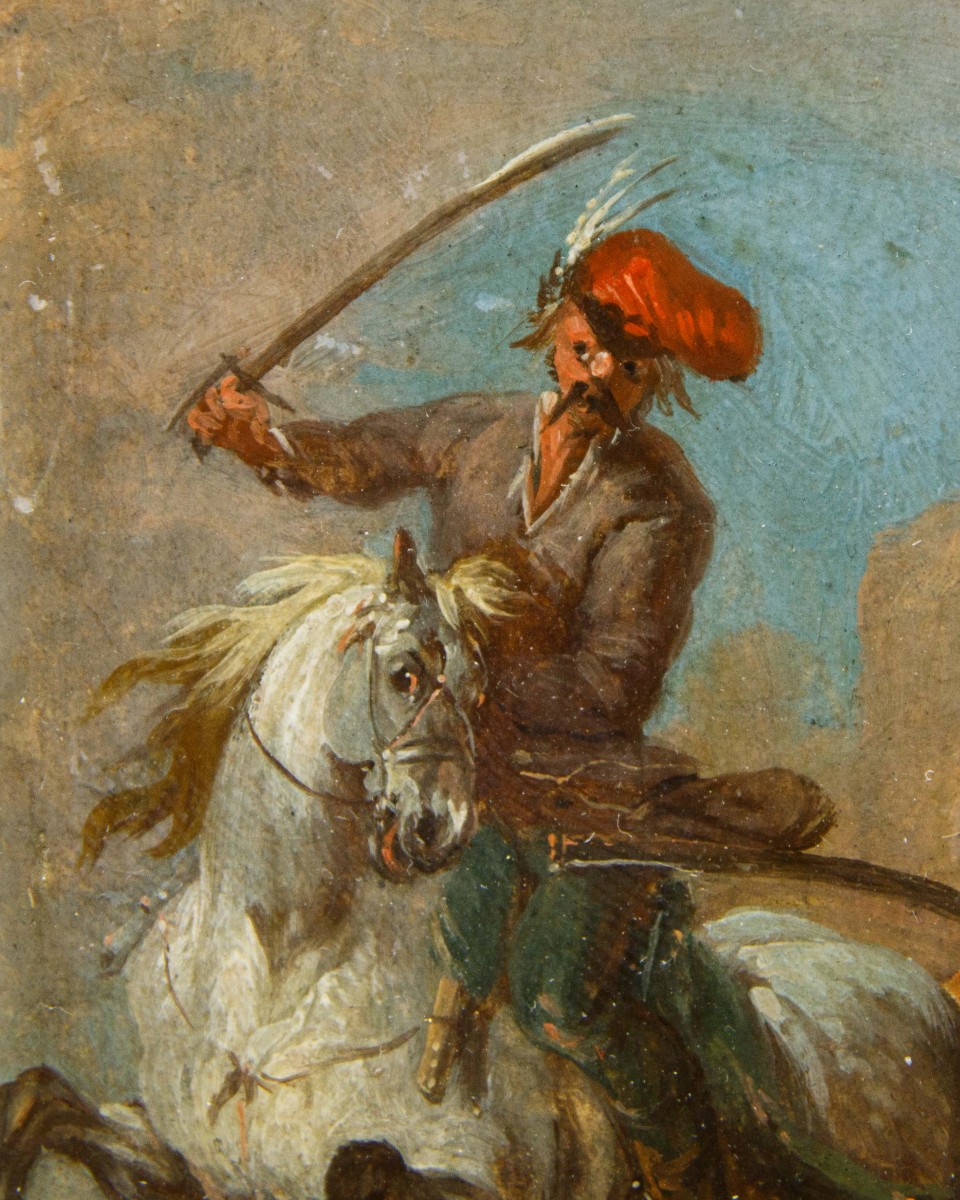
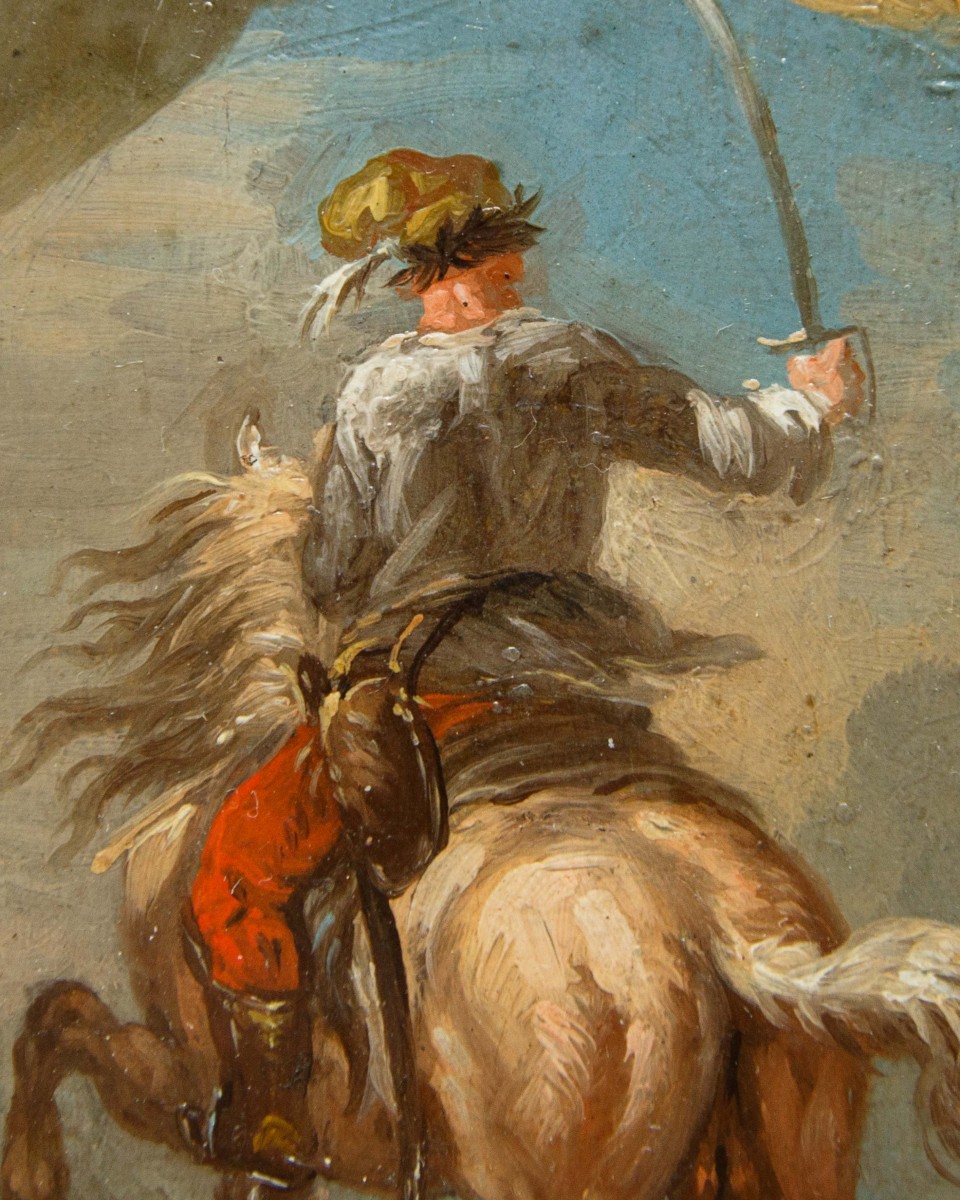
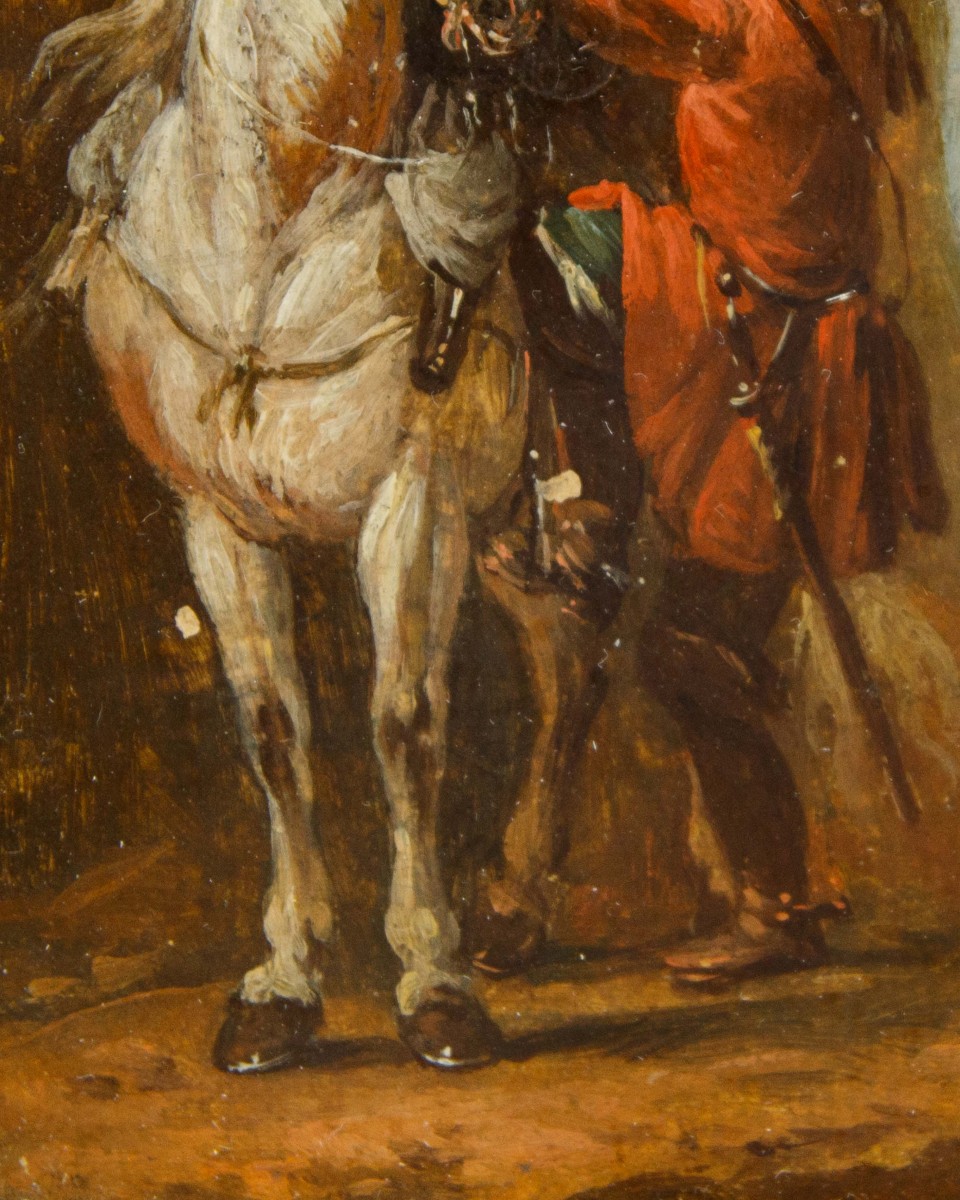
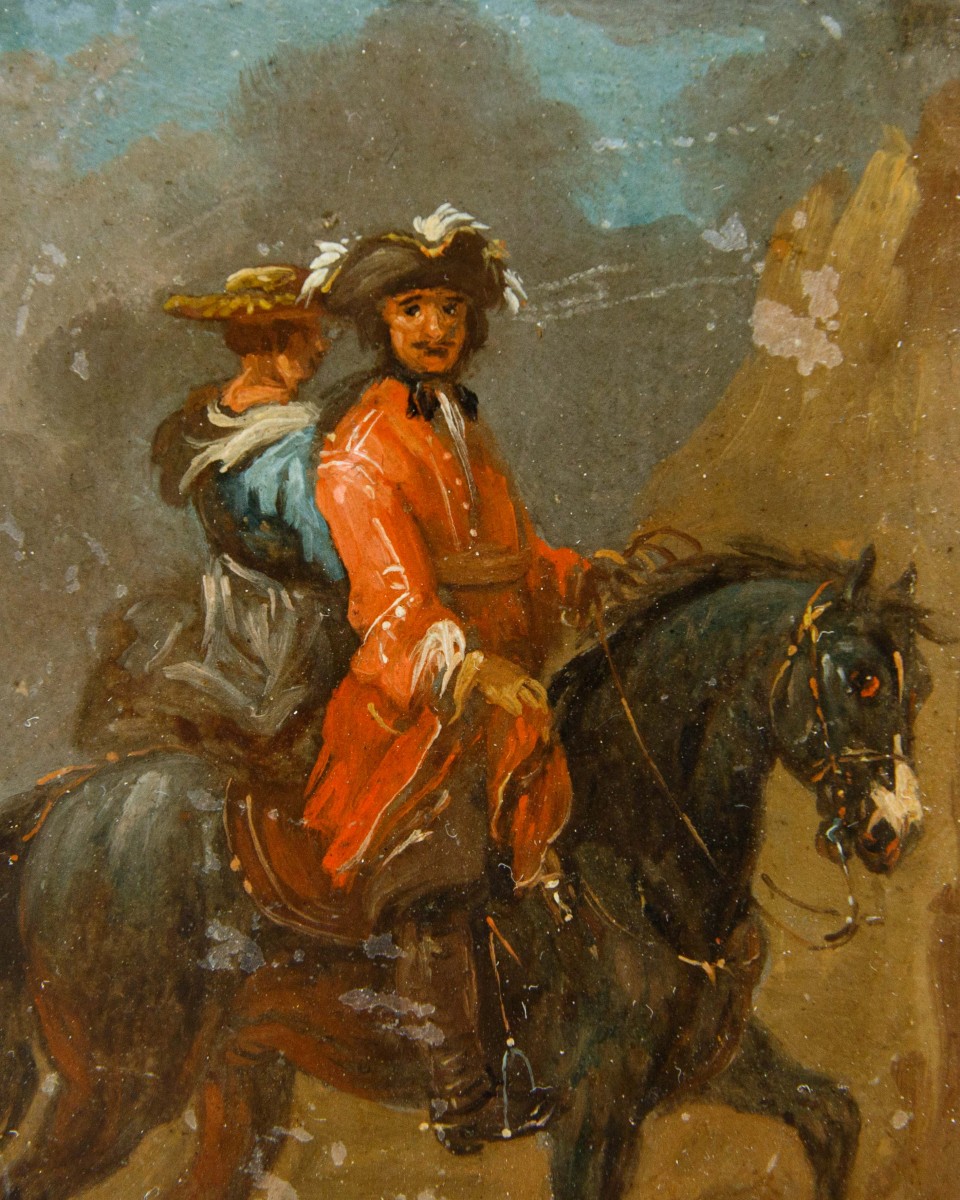
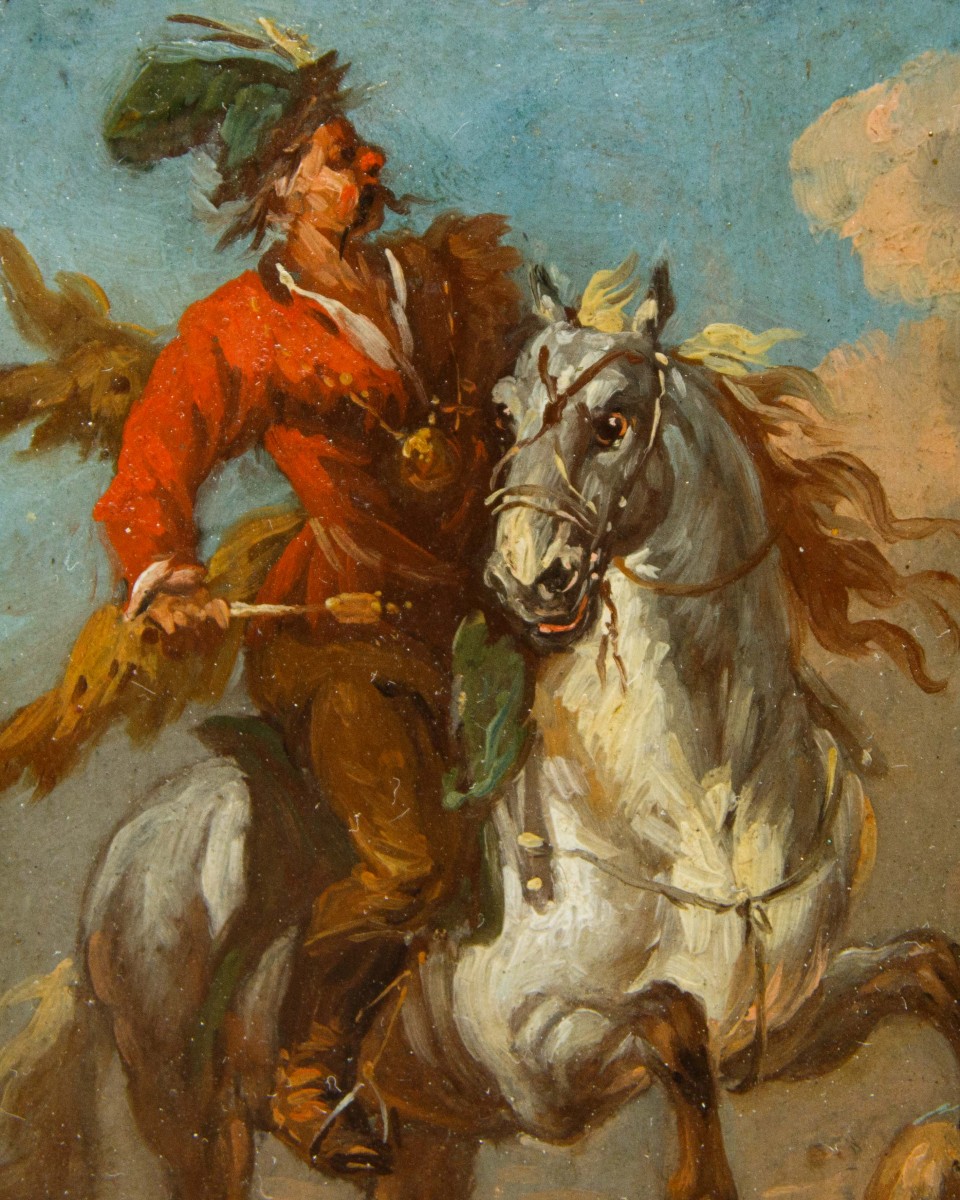
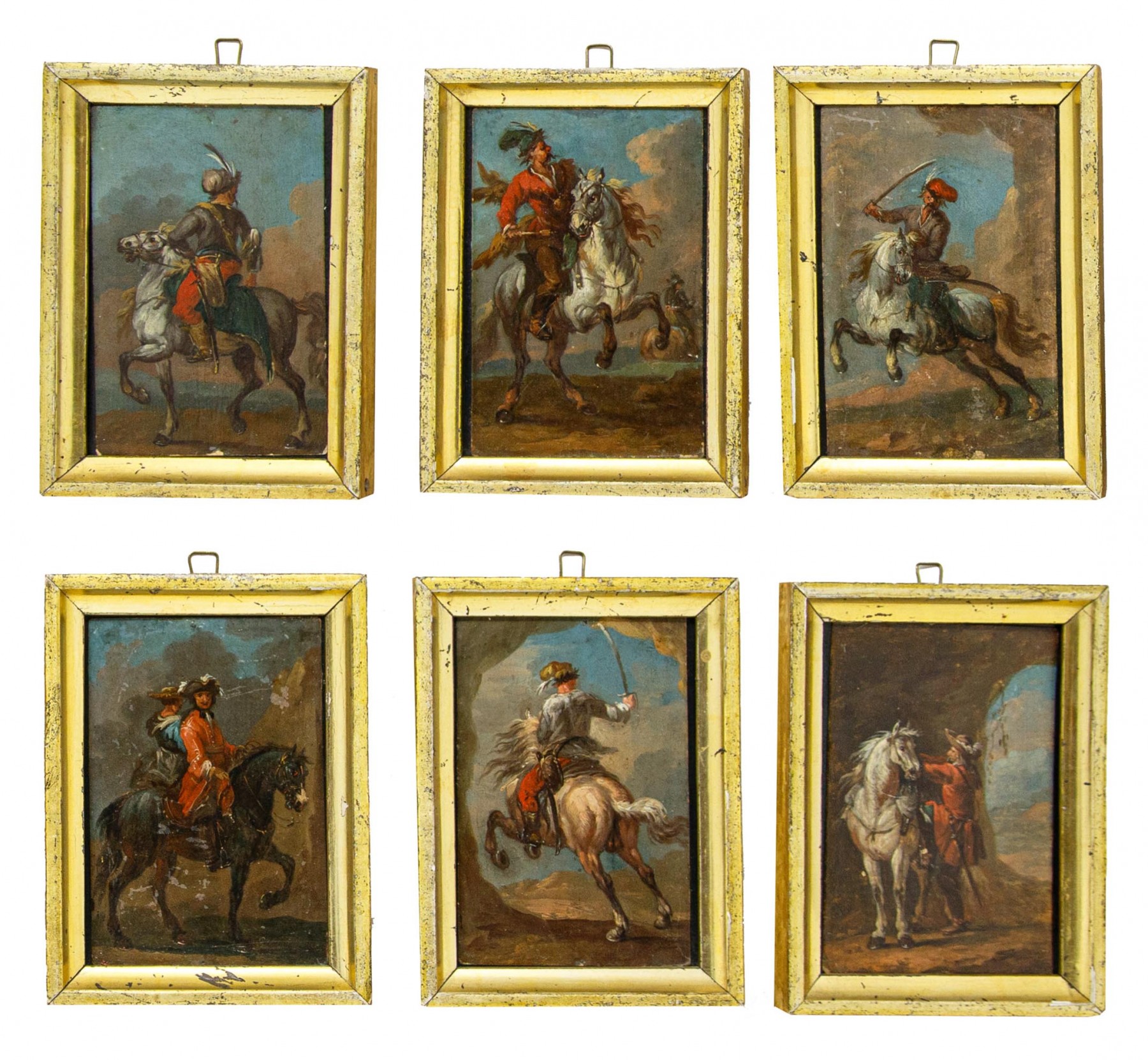
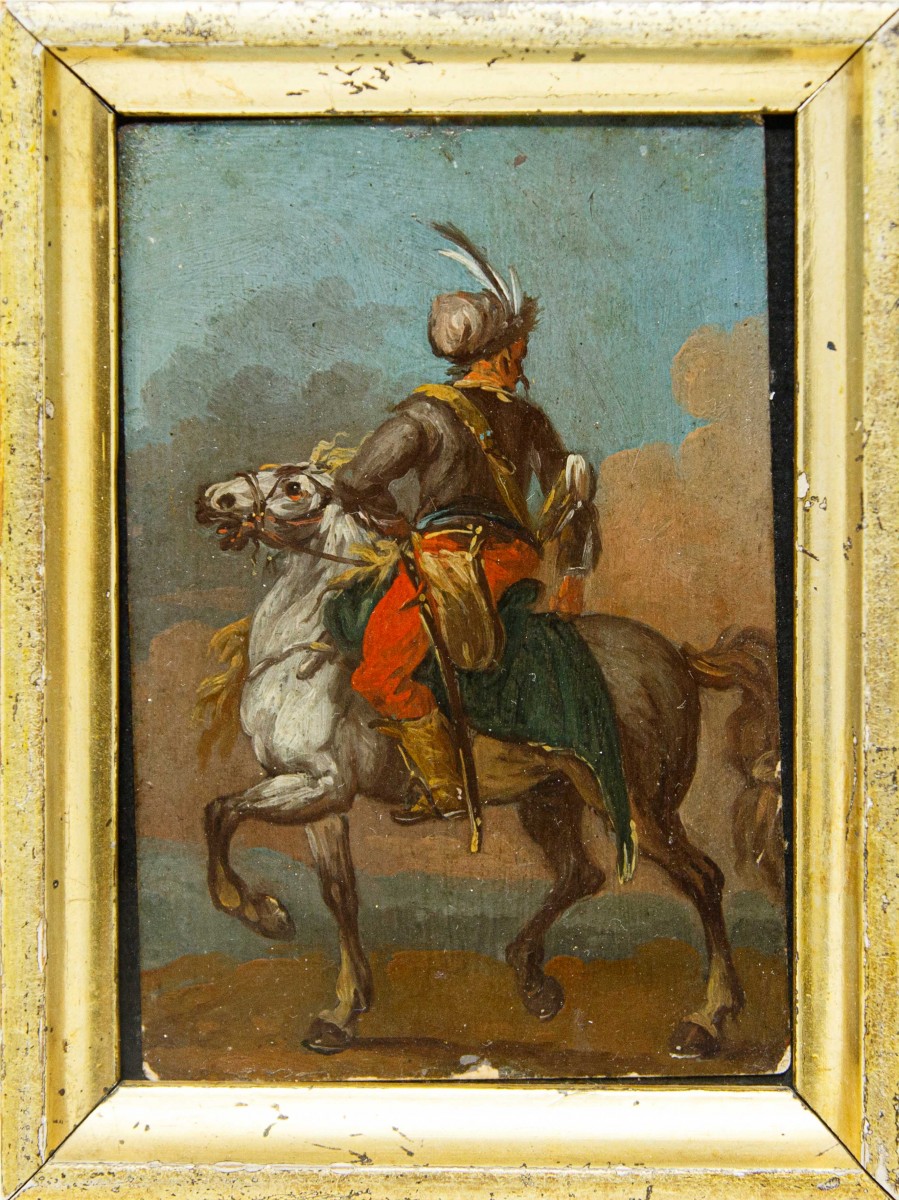
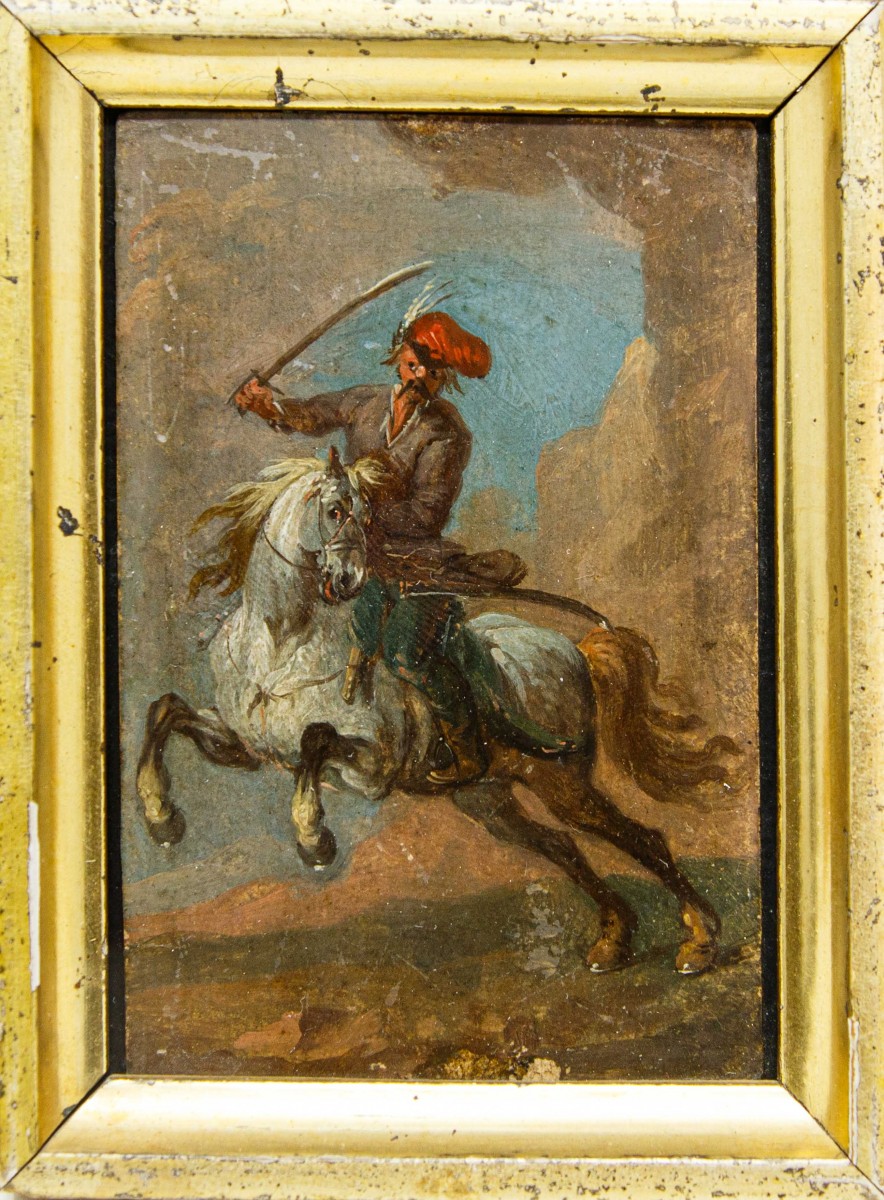
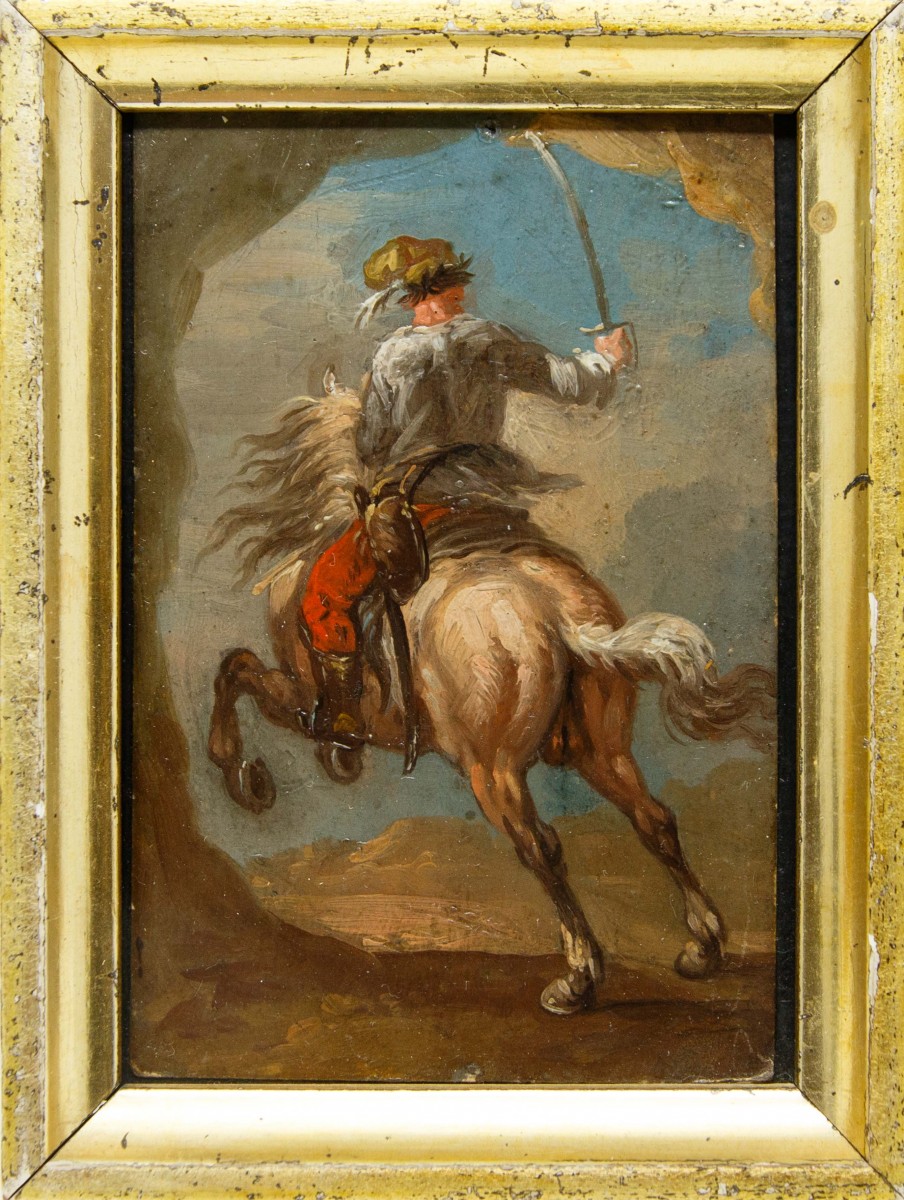
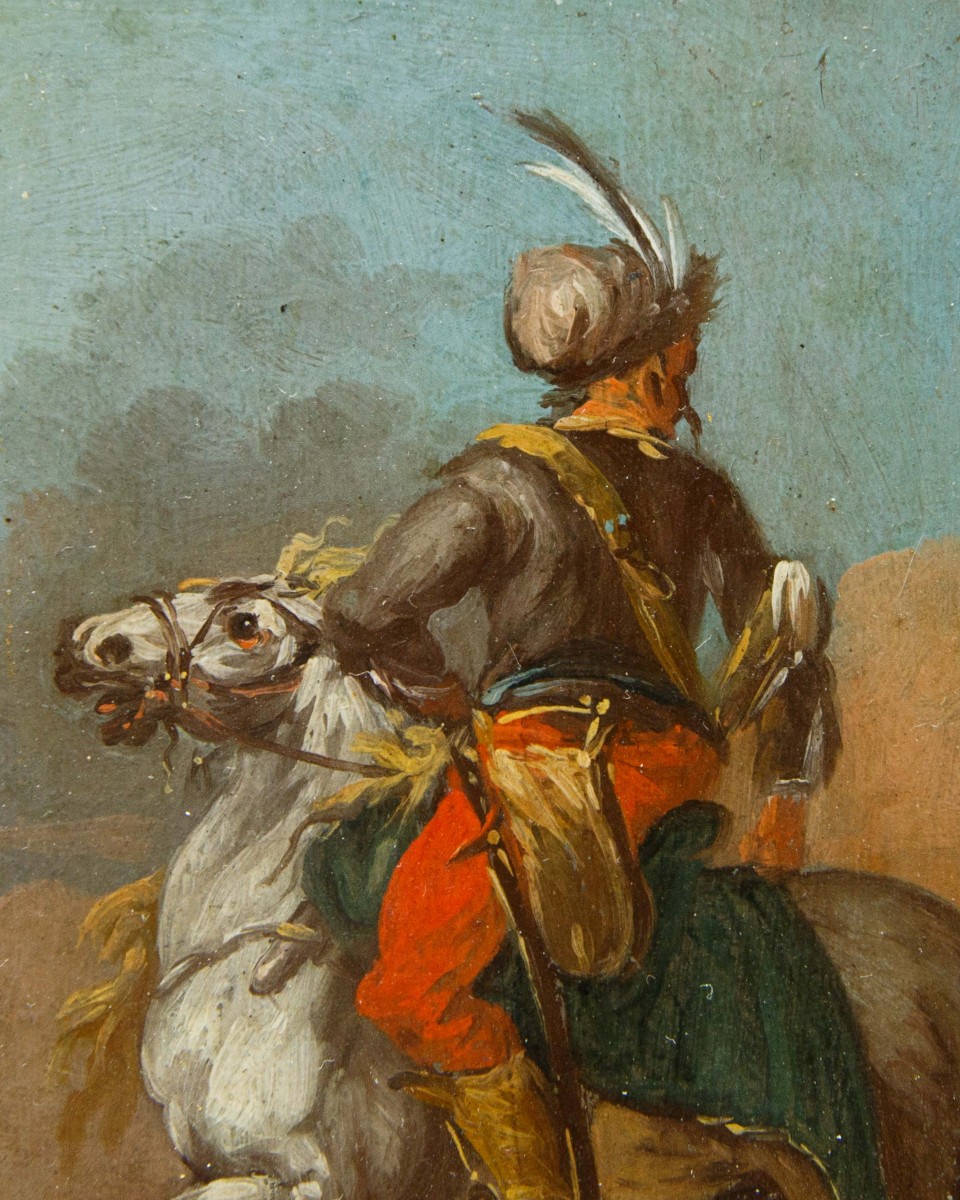
Compositions with Horsemen
Oil on paper laid down on cardboard, 9.5 x 6.5 cm – framed, 11 x 8 cm
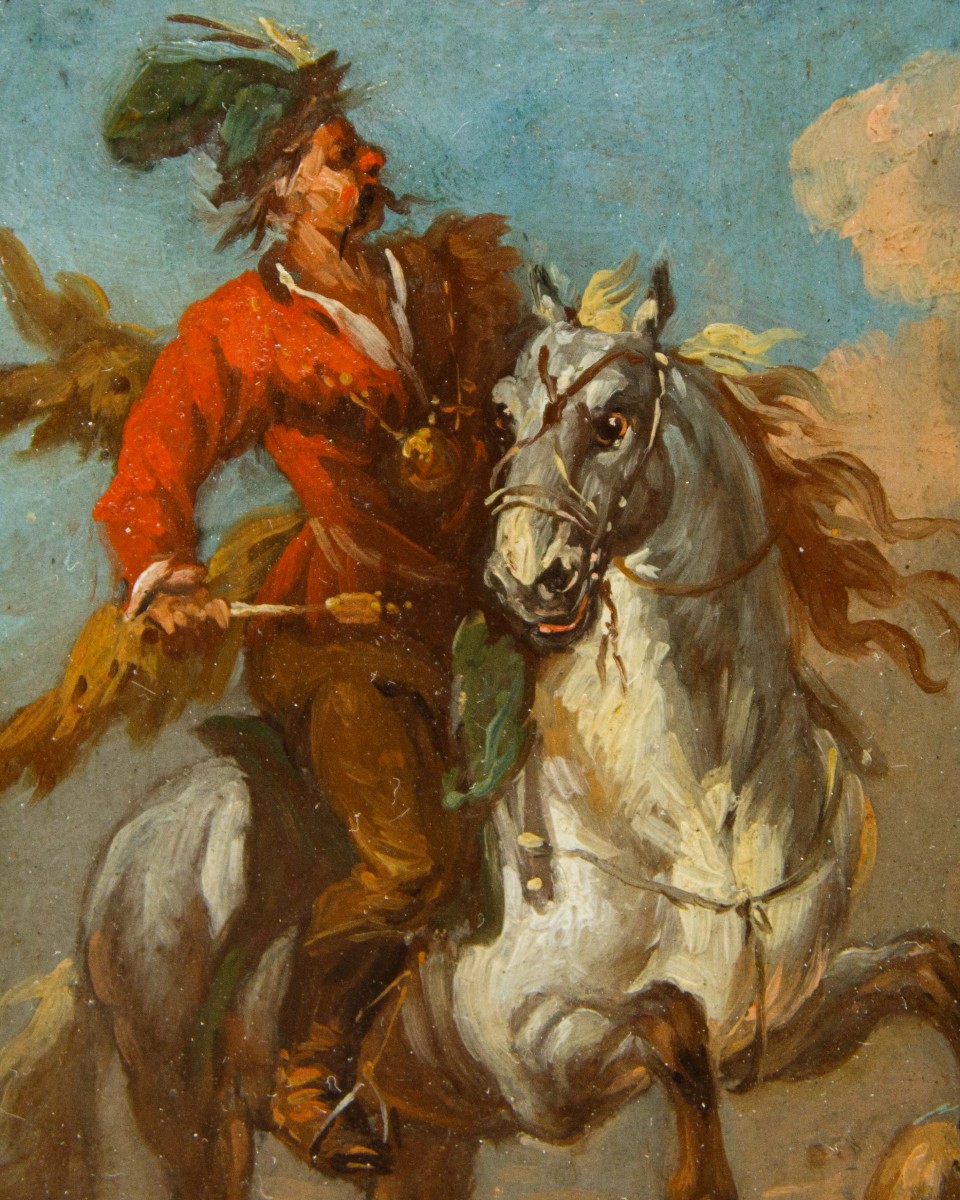
This group of six oil paintings on paper laid down on cardboard forms a cohesive set of equestrian sketches attributable to the hand of August Querfurt. Their small dimensions, rapid execution, and the fragmentary nature of the scenes—isolated horsemen captured in dynamic poses, silhouetted against a cloudy sky or a barely hinted landscape—suggest that these are not finished, standalone works, but rather preparatory studies. They functioned as a repertoire of figures and horses kept in the workshop to be reused, with variations in pose or attire, within larger compositions depicting major cavalry battles. In at least two vignettes, Ottoman horsemen appear, recognizable by their plumed turbans, curved scimitars, and Orientalist garments—a recurring motif in his works depicting conflicts with the Turks. One composition, by contrast, appears to derive from a hunting scene or a genre painting, as the foreground horse moves at a walk while a female figure on horseback is visible in the background.
A comparison with the artist's known catalogue reveals precise correspondences. In the Battle Scene at the Hermitage Museum in St. Petersburg, the horseman viewed from behind on the left side of the canvas, with his horse shown in three-quarter view, corresponds directly to one of our sketches. Even more telling is the large canvas depicting The Turks Besieging Vienna, now in a private collection, where the multitude of horsemen arranged across multiple planes clearly illustrates the artist's working method: drawing upon a vast repertoire of figures and horses to populate densely crowded battle scenes. Similar typological parallels can be found in the Battle Against the Turks at the Palace on the Isle in Warsaw, the Horse Market with River Landscape at the Landesmuseum in Oldenburg, and the Two Scenes of Horsemen attributed to Querfurt at the Museo Correr in Venice. All of these paintings feature the same horse postures, identical highlights on the harnesses, and the same agitated poses of the riders, confirming a practice based on combining proven figurative models.
August Querfurt was born in Wolfenbüttel [translator's note: original text states Augusta/Augsburg, but the header specifies Wolfenbüttel] and initially trained under his father Tobias before refining his craft with Georg Philipp Rugendas, in whose workshop he developed a taste for battle painting. He specialized in equestrian subjects, preferring isolated cavalry skirmishes, military encampments, and hunting scenes. His stylistic vocabulary was heavily influenced by Jacques Courtois, from whom he derived his realistic animation and dynamic compositions, though his training was truly eclectic: echoes of Wouwerman, van der Meulen, the Parrocel family, and Rugendas himself recur throughout his oeuvre. He likely spent time in Italy as well, aligning with Venetian battle painters with whom critics occasionally confused him. Nonetheless, his distinct typological and painterly characteristics have made it possible to reconstruct a substantial catalogue, further enriched by signed works resurfacing on the art market.
Delevery information :
Les frais d'expédition seront calculés au moment de la commande en fonction de la destination, des dimensions et du poids du tableau, ainsi que de l'assurance couvrant la valeur totale de l'œuvre.
For paintings purchased from abroad: following payment, the application process to obtain the export license (ALC - Attestato di Libera Circolazione) will be initiated. All antiques shipped abroad from Italy require this document, which is issued by the Ministry of Cultural Heritage. The procedure may take 3 to 5 weeks from the date of request; therefore, the painting will be shipped as soon as the document is obtained