Offered by Ars Antiqua

Old Masters paintings, furniture, sculptures and modern art
Giambettino Cignaroli (Verona, 1706 – 1770)
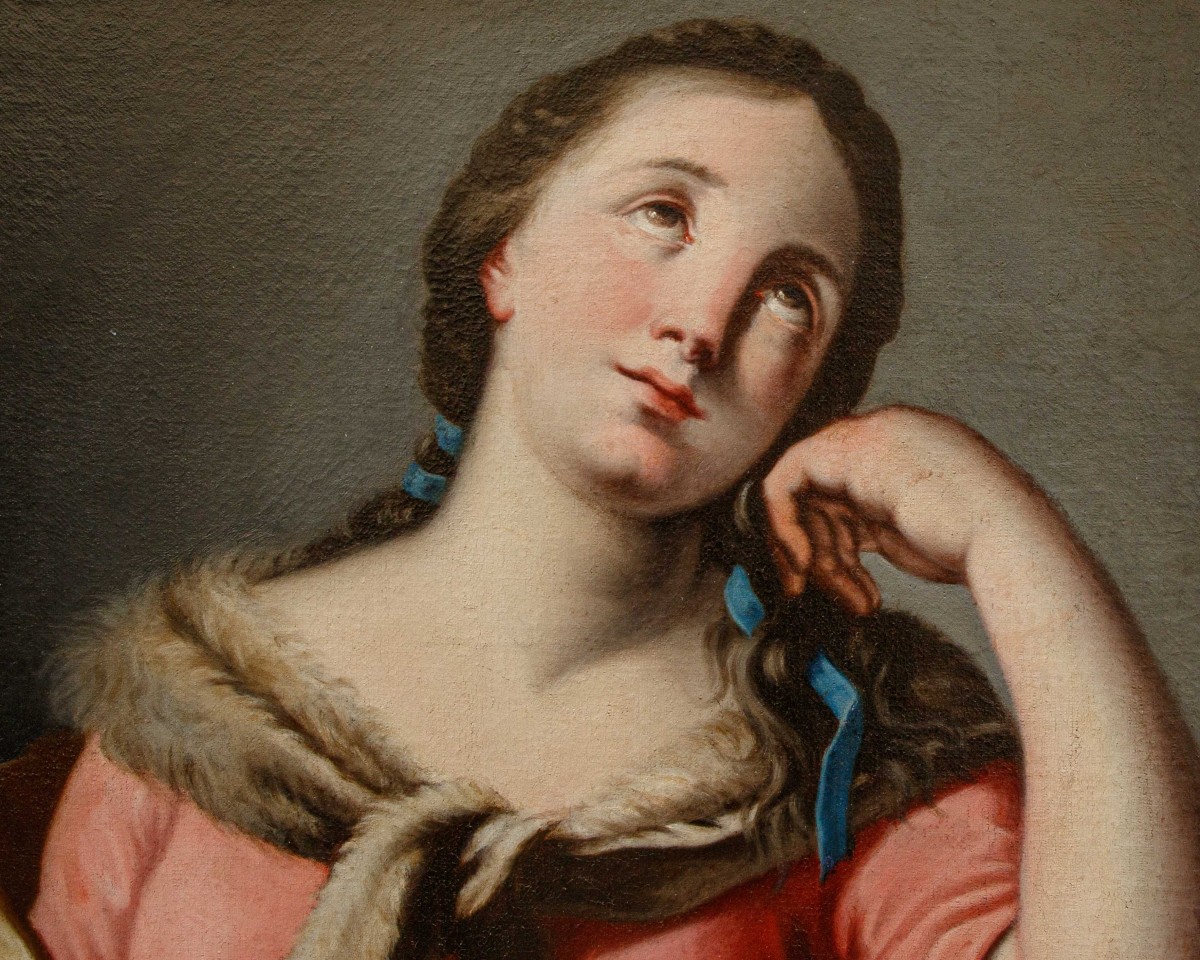
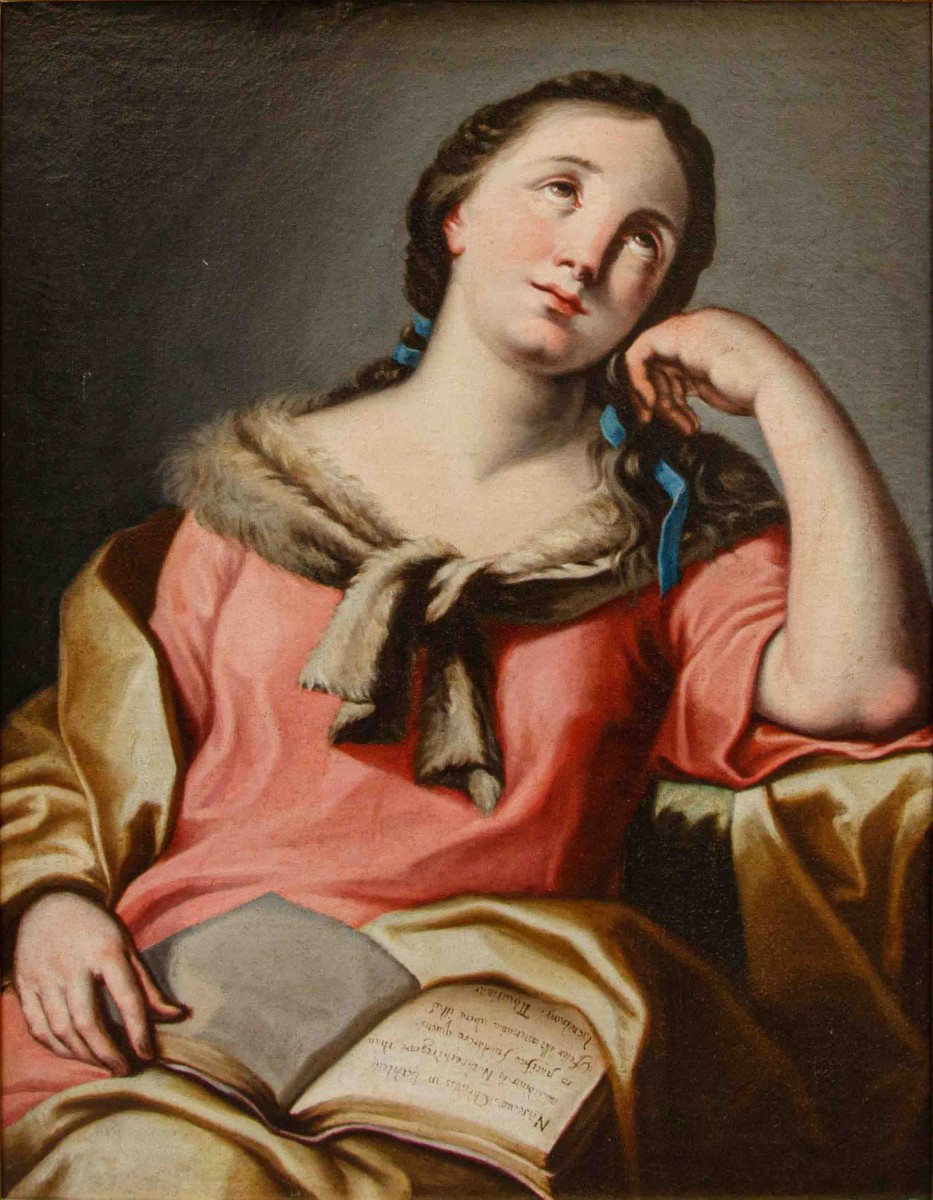
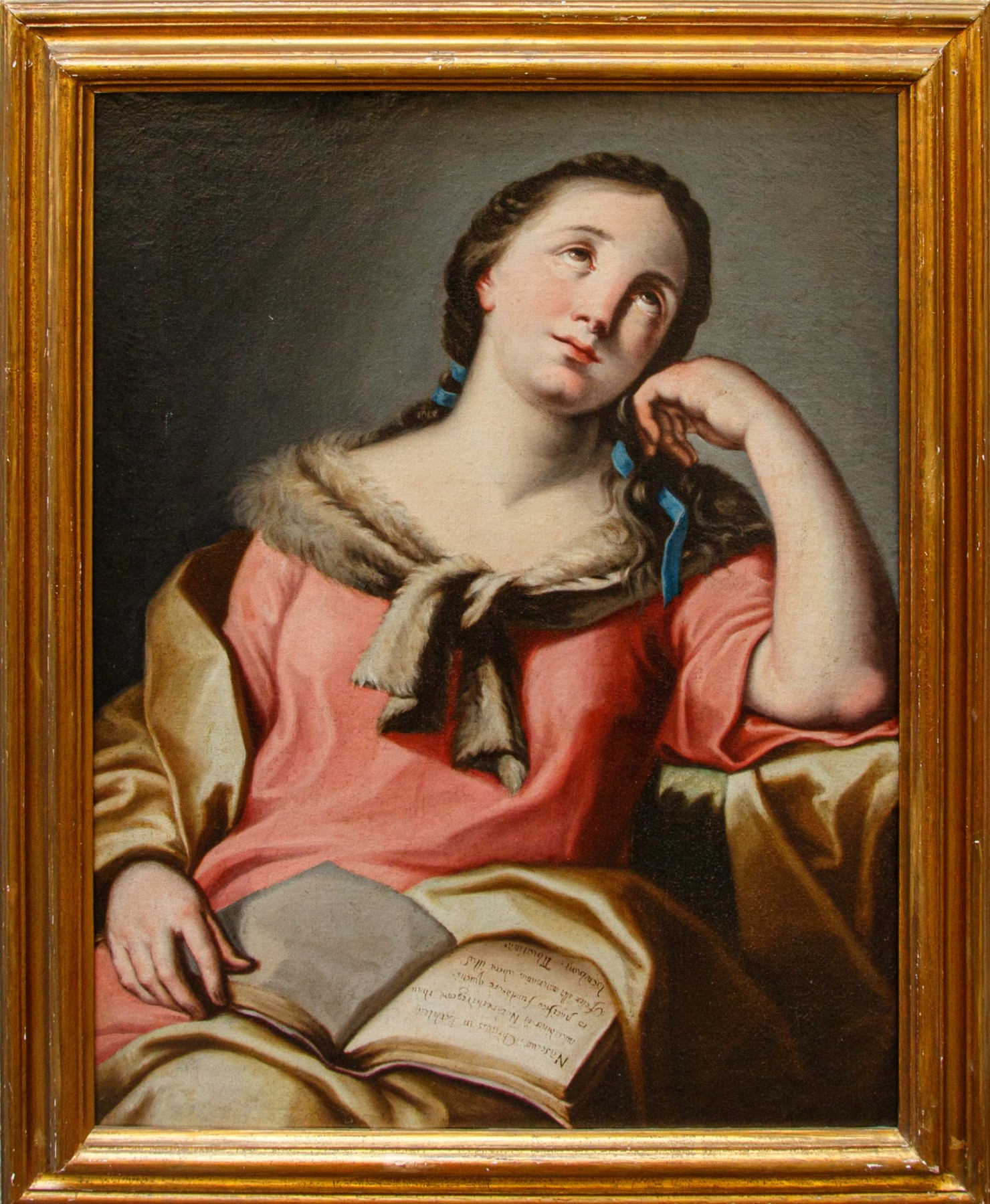
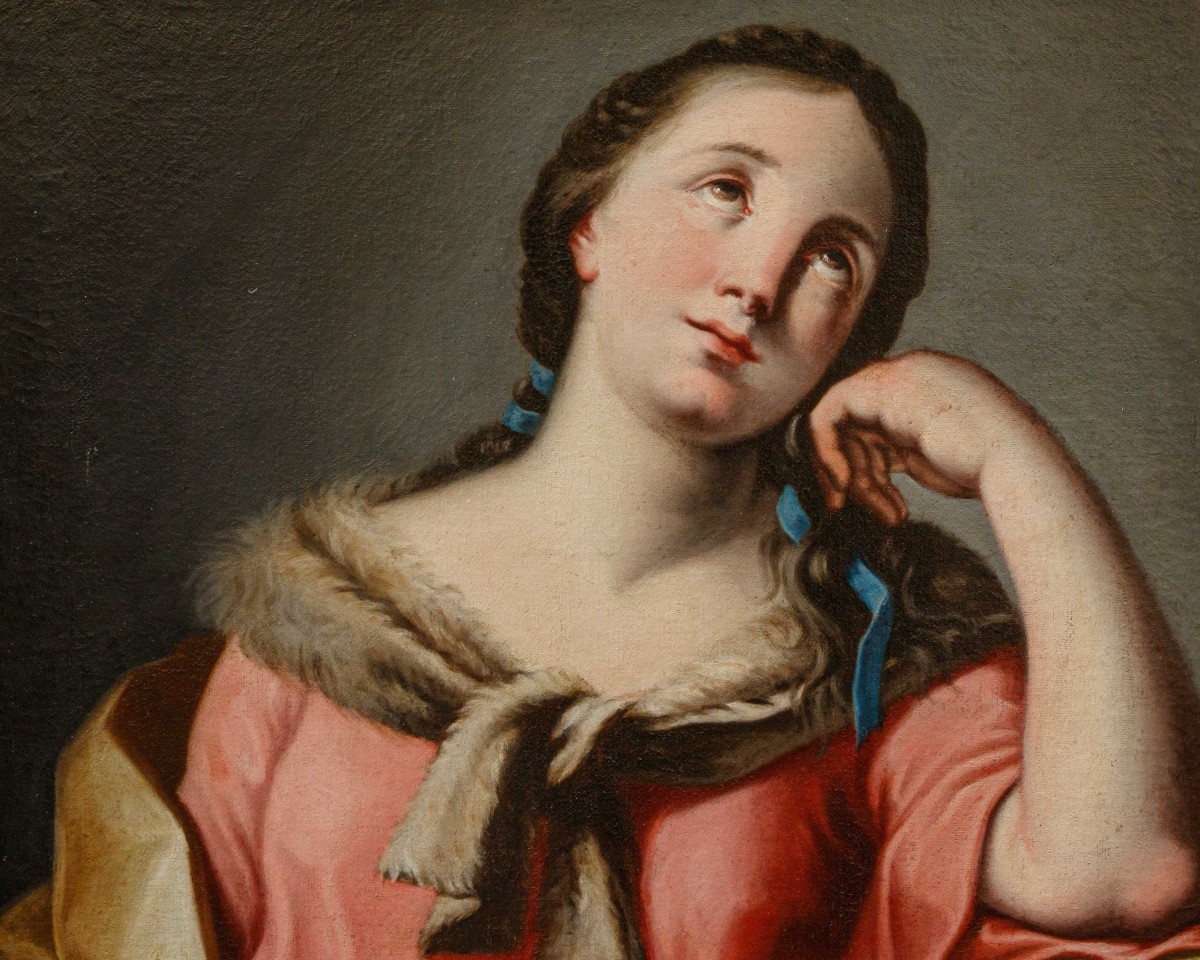
Tiburtine Sibyl
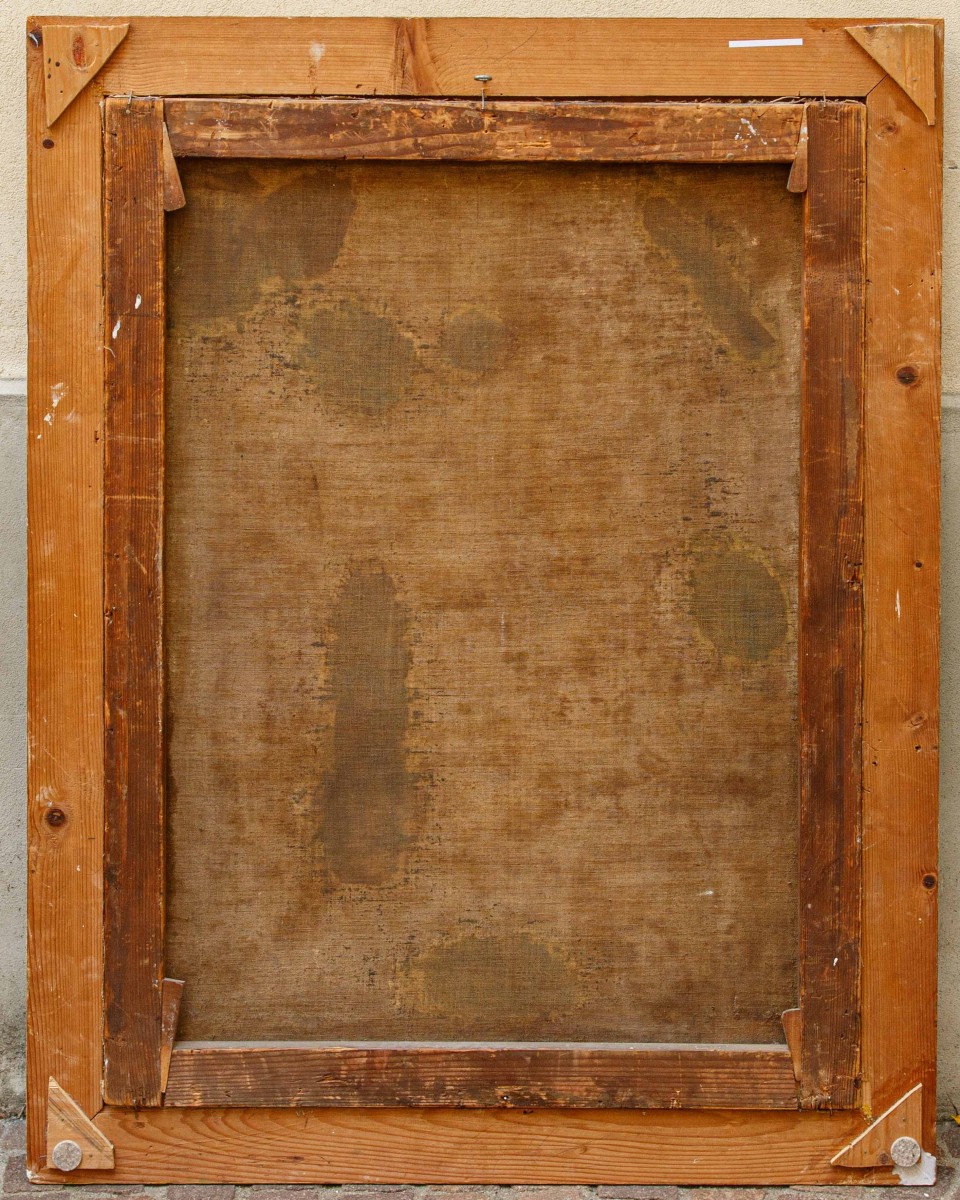
Oil on canvas, 95.5 x 70.5 cm
With frame, 113.5 x 88.5 cm
Critical report by Prof. Stefano Agresti
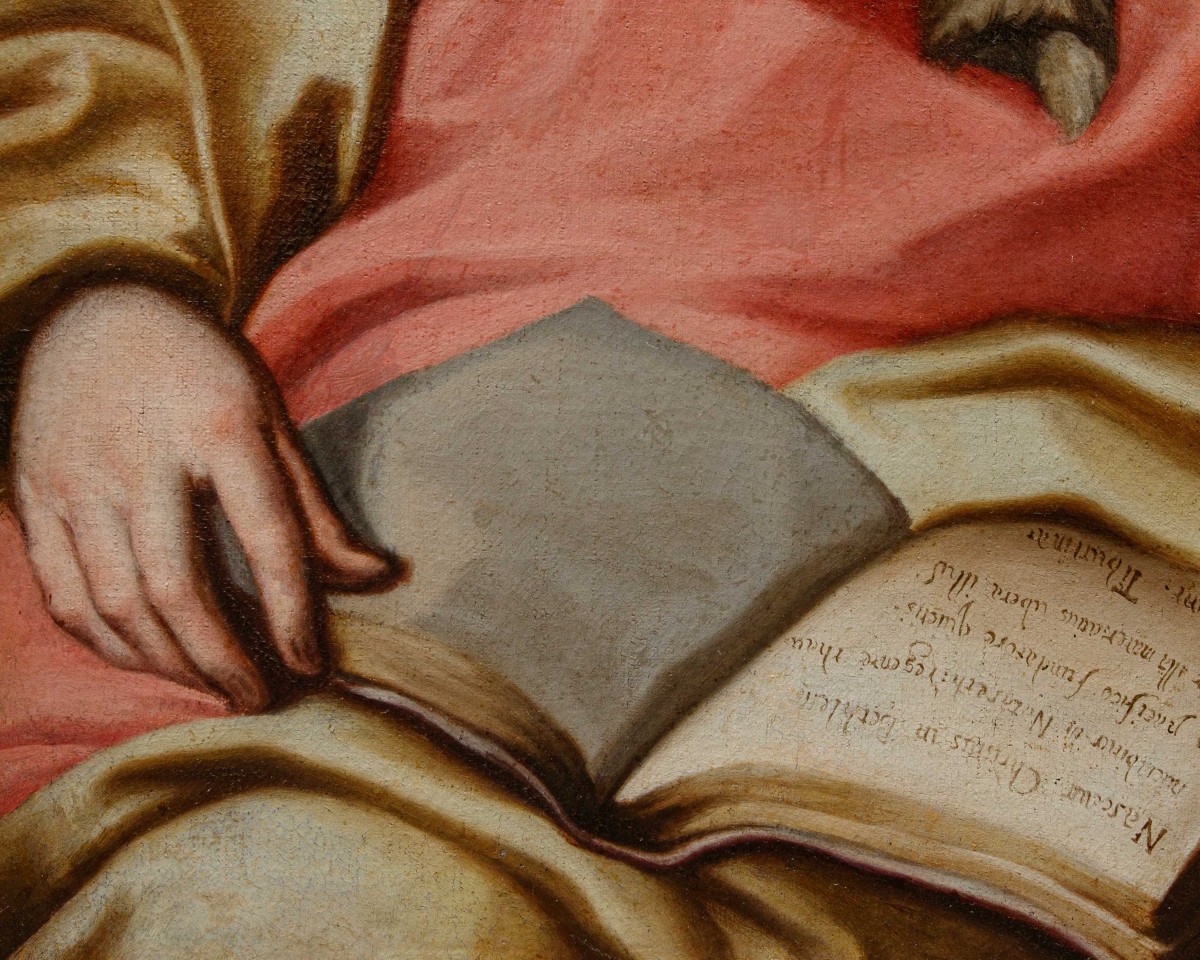
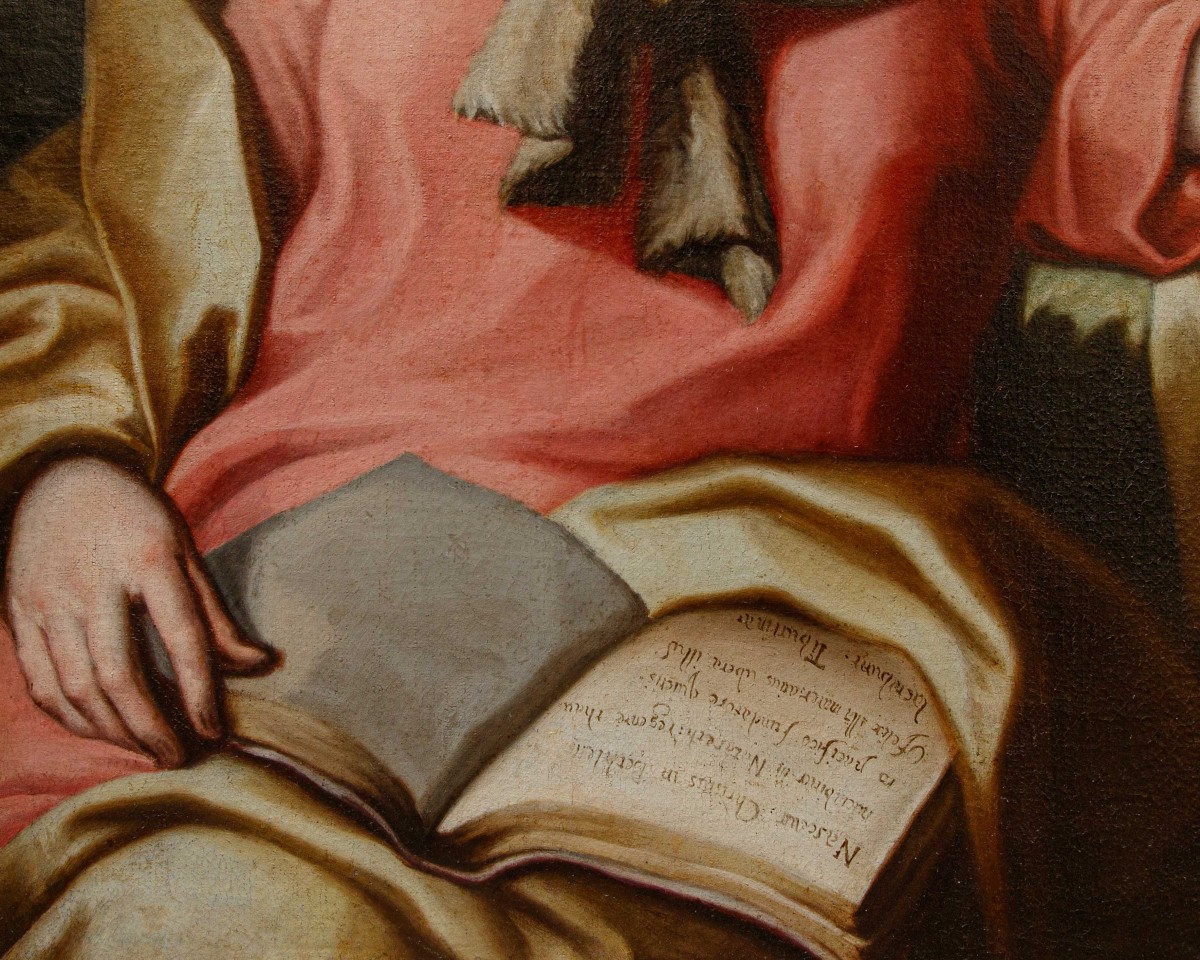
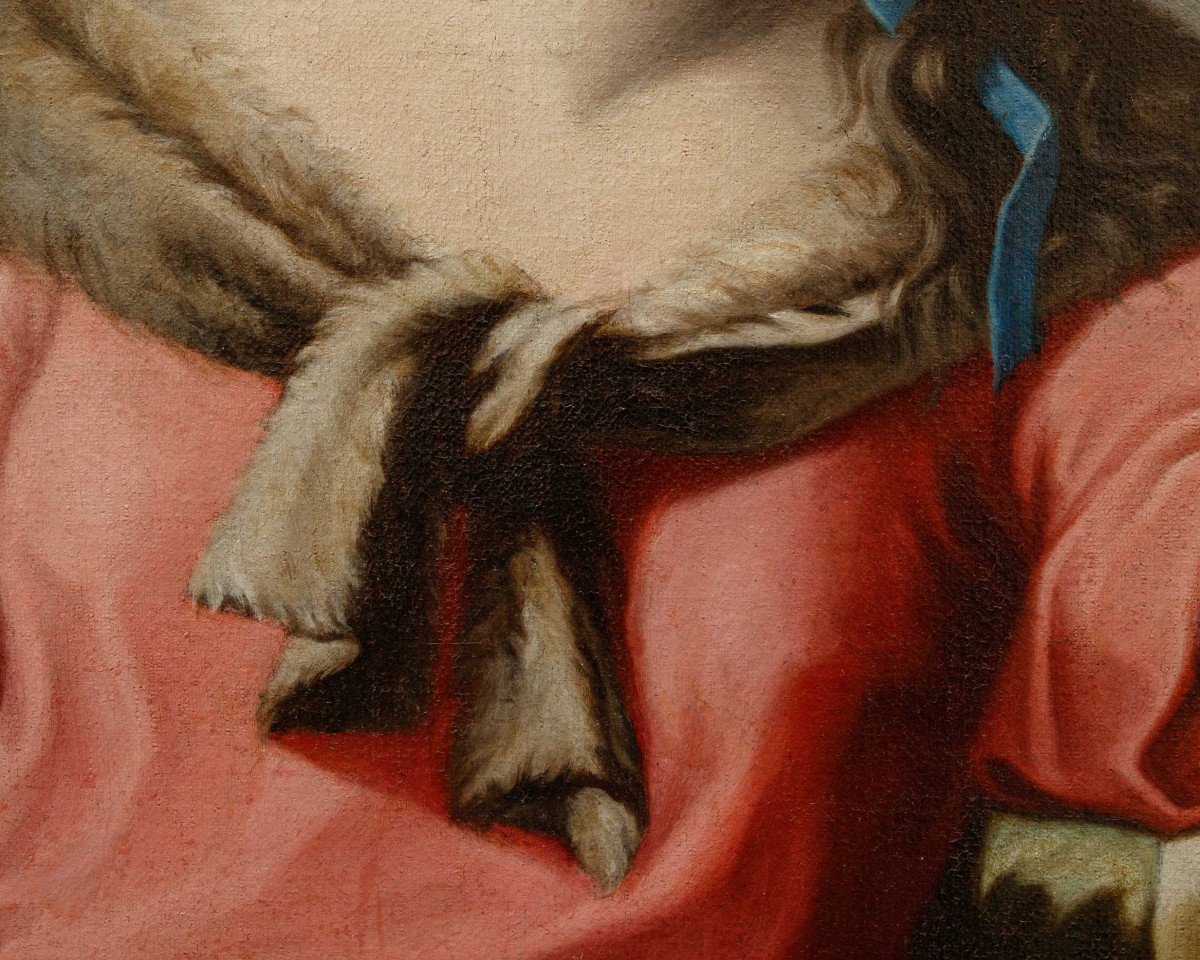
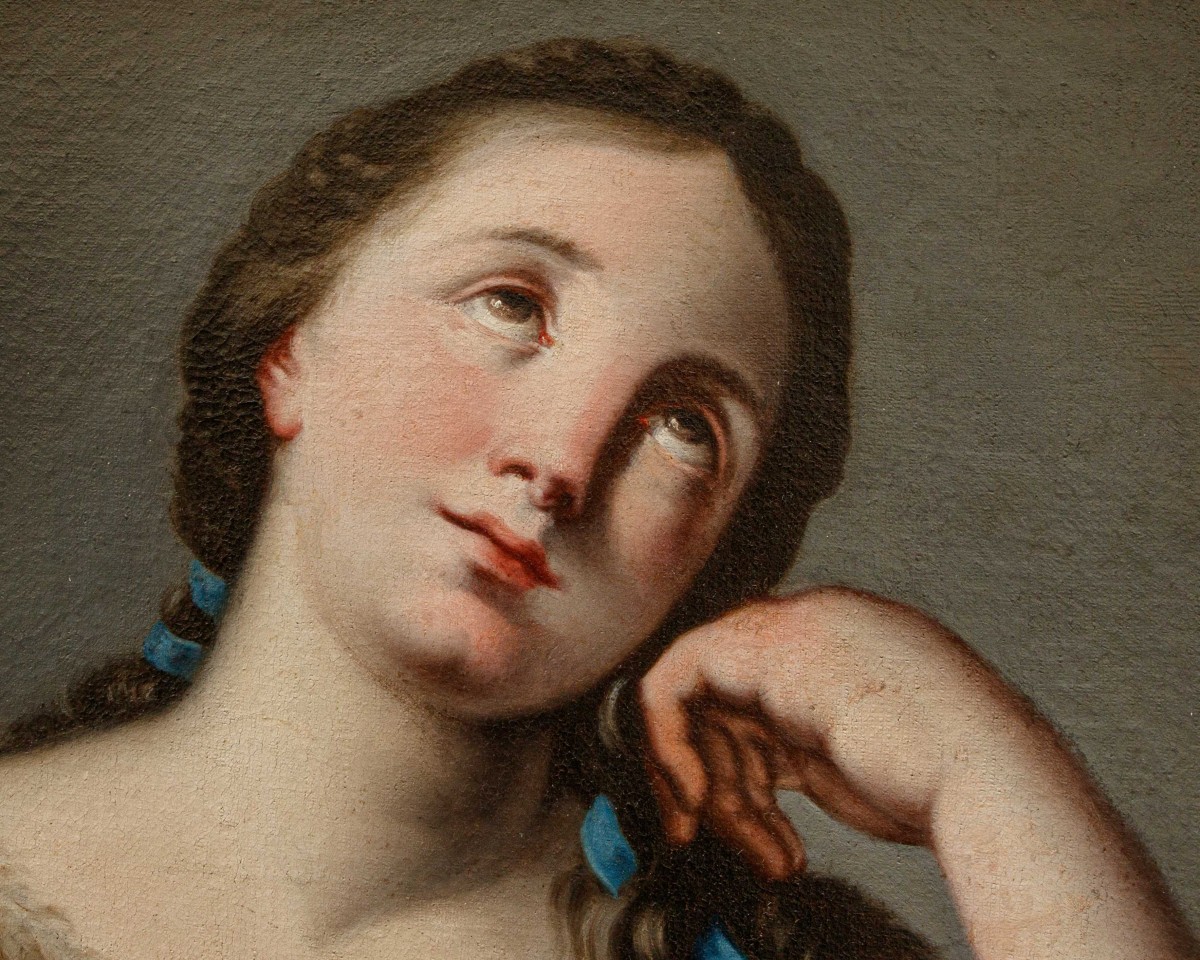
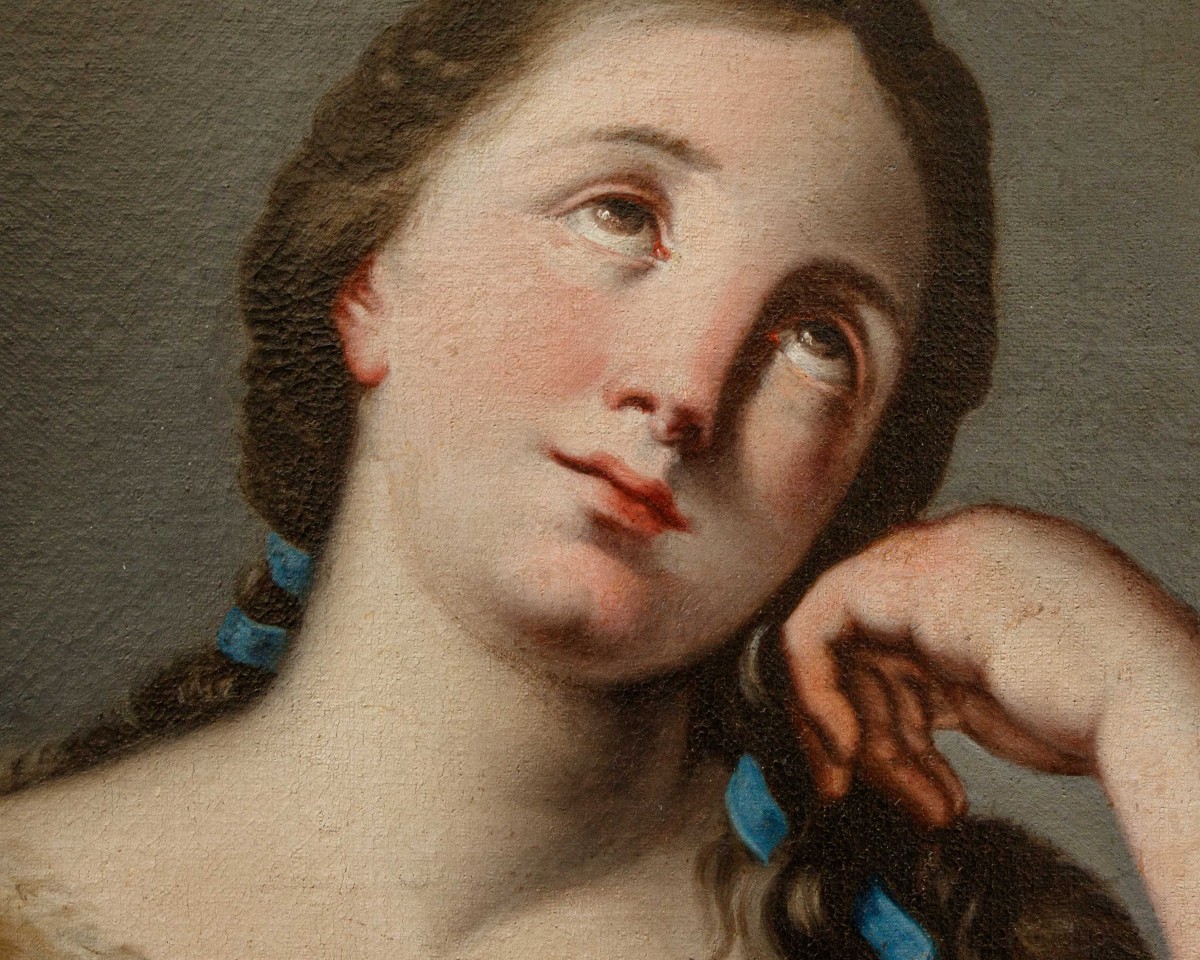
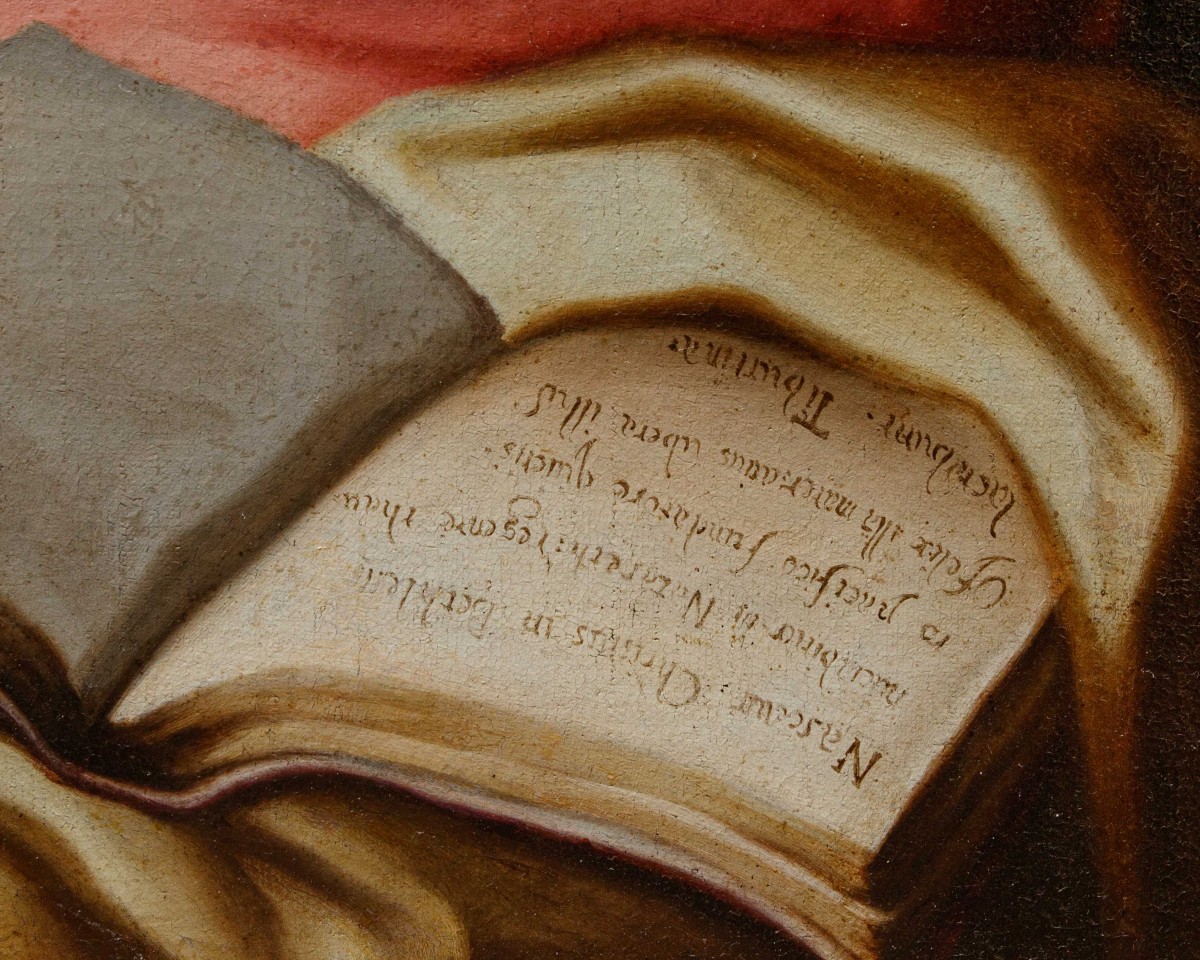
The female figure is portrayed in a half-length view with her gaze turned upwards, in an attitude of contemplative ecstasy typical of the sibyls of the eighteenth-century iconographic tradition. The woman wears a coral-pink dress with wide sleeves, layered beneath a golden cloak and embellished with a fur shawl knotted at her chest with a blue ribbon—the same color echoed in the bow tying back her hair, which is styled in elaborate braids. Her raised right arm supports her face in a pensive gesture, while her left hand rests on an open book bearing a prophetic inscription referring to the birth of Christ—an element that clearly identifies the subject as the Tiburtine Sibyl, herald of the Advent. The dark, neutral background focuses attention on the figure, which is enhanced by a warm light that models her face, flesh tones, and drapery with great softness, following an elegant and luminous pictorial execution.
It is precisely the text appearing in the book that allows her to be identified as the Tiburtine Sibyl. A well-known figure during both the Middle Ages and the modern era, although she was not depicted by Michelangelo in the Sistine Chapel, she is frequently cited in ancient texts, and her pictorial representations are far from few—the most famous of which is an inlay set into the floor of Siena Cathedral. It is no coincidence that the text faithfully transcribed in the painting illustrated here for the first time refers to the birth of Christ: in fact, that very prophecy is the most famous among those handed down from antiquity.
There is a whole literary tradition, dating back even to the Roman era, in which the prophecies of the Tiburtine Sibyl are reported—a character for whom it is very unlikely a genuinely identifiable historical counterpart ever existed. Marcus Terentius Varro should be mentioned as the first author to compile a list of these wise women of antiquity, also recording their respective prophecies—with the sole and significant exception of the Tiburtine Sibyl, whose tradition was handed down separately.
Legend has it that she arrived in Rome, astonishing everyone with her beauty, summoned by Augustus to interpret a dream that a hundred Senators reportedly had at the very same time. She invited them to follow her to the Aventine Hill, where they experienced a vision of nine suns, all differing from one another in both size and shape. The Tiburtine Sibyl interpreted these suns as future generations: the fourth, populated by non-believers, would witness the birth of the Virgin, her future husband Joseph, and her son Jesus. The legend further relates that, accompanied by Emperor Augustus to the Capitoline Hill, she pointed to the sky, where the Virgin and Child appeared; on that site, the basilica of Santa Maria in Ara Coeli—which still stands today—was later built. It is therefore no coincidence that the text inscribed on the canvas represents a foretelling that specifically concerns the birth of Jesus.
Giambettino Cignaroli was born in Verona in 1706. After studying rhetoric with the Jesuits, he turned to painting, training first under Sante Prunati and later, alongside his peer Pietro Rotari, in the school of Antonio Balestra. In 1728, he opened his own workshop and subsequently moved for a time to Venice, where he studied firsthand the works of Titian, Veronese, and Palma il Vecchio—an experience that profoundly influenced his color palette. Upon returning to Verona, his career enjoyed growing success, expanding to numerous Italian cities such as Milan, Parma, Turin, Bologna, and Ferrara, driven by intense patronage from Emilian religious orders.
Although he never left Italy, he worked for important European courts: from the Elector of Saxony to the King of Poland, from the Tsarina of Russia to the Prince-Bishops of Brixen, and ultimately for the Spanish Crown, for which he created the large altarpiece of the Madonna and Child with Saints, now in the Prado. He was also a central figure in the cultural life of Verona, acting as promoter and first director of the Art Academy that today bears his name, as well as authoring theoretical writings on painting. His style is generally positioned in a balance between late-Raphaellesque echoes and the early signs of Neoclassical taste.
This Sibyl fits seamlessly into Cignaroli's catalog, demonstrating affinities with several works by the Veronese master. The luminous execution and softness of the drapery recall the monumental Transfiguration of Christ in Verona Cathedral, where light plays an equally central role in the construction of the sacred figures. The compositional framing, centered on a graceful female figure with her gaze turned upward, finds a parallel in the Saint Agatha in the Basilica of San Martino in Alzano Lombardo, where similar attention is devoted to the facial expressiveness and the rendering of precious fabrics. Likewise, the Madonna and Child in a private collection and the Madonna and Child in the church of Santa Maria Formosa in Venice share with our Sibyl that sense of lightness and spiritual rapture translated through open poses and upward-directed glances. Different, yet useful for comparison, is the Danaë in a private collection—a work that attests to Cignaroli's ability to tackle more sensual and mythological subjects, demonstrating a thematic versatility that coexists with the same technical mastery in the rendering of flesh tones and drapery.
Delevery information :
Les frais d'expédition seront calculés au moment de la commande en fonction de la destination, des dimensions et du poids du tableau, ainsi que de l'assurance couvrant la valeur totale de l'œuvre.
For paintings purchased from abroad: following payment, the application process to obtain the export license (ALC - Attestato di Libera Circolazione) will be initiated. All antiques shipped abroad from Italy require this document, which is issued by the Ministry of Cultural Heritage. The procedure may take 3 to 5 weeks from the date of request; therefore, the painting will be shipped as soon as the document is obtained