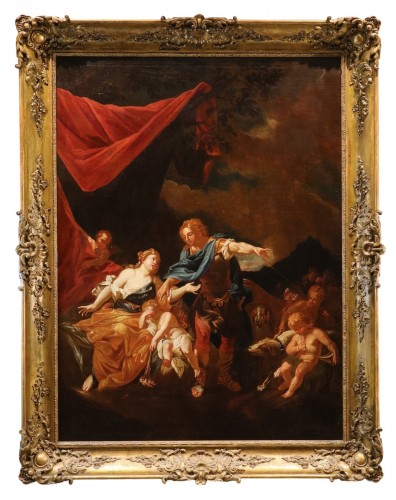
Offered by Poncelin de Raucourt Fine Arts
REQUEST INFORMATION

Paintings and drawings, from 16th to 19th century
Noël-Nicolas Coypel
(Paris, 1690–1734)
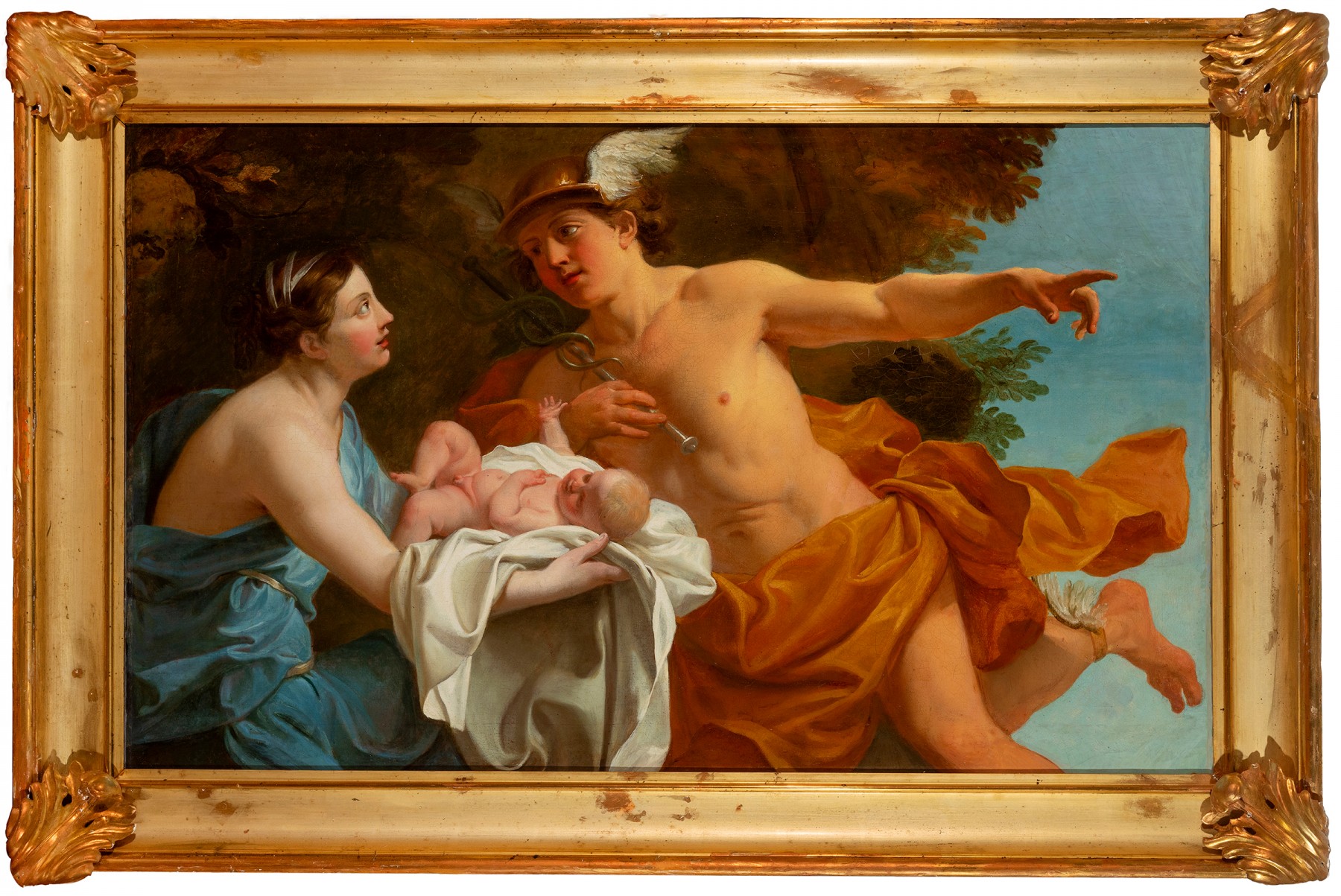
The Infant Bacchus Entrusted to the Nymphs of Nysa
Circa 1715
Oil on canvas, unsigned.
Unframed dimensions: 73.1 × 118.7 cm; 28¾ × 46¾ in.
Framed dimensions: 91.7 × 138.6 cm; 36? × 54? in.
An important rediscovery in eighteenth-century French painting
Unpublished until its recent reappearance, this impressive mythological painting constitutes a major addition to the rare œuvre of Noël-Nicolas Coypel. The attribution has been confirmed by François Marandet, who describes the work as a “fundamental rediscovery” enriching a corpus that has remained largely unchanged since the publication of Jérôme Delaplanche’s monograph in 2004.
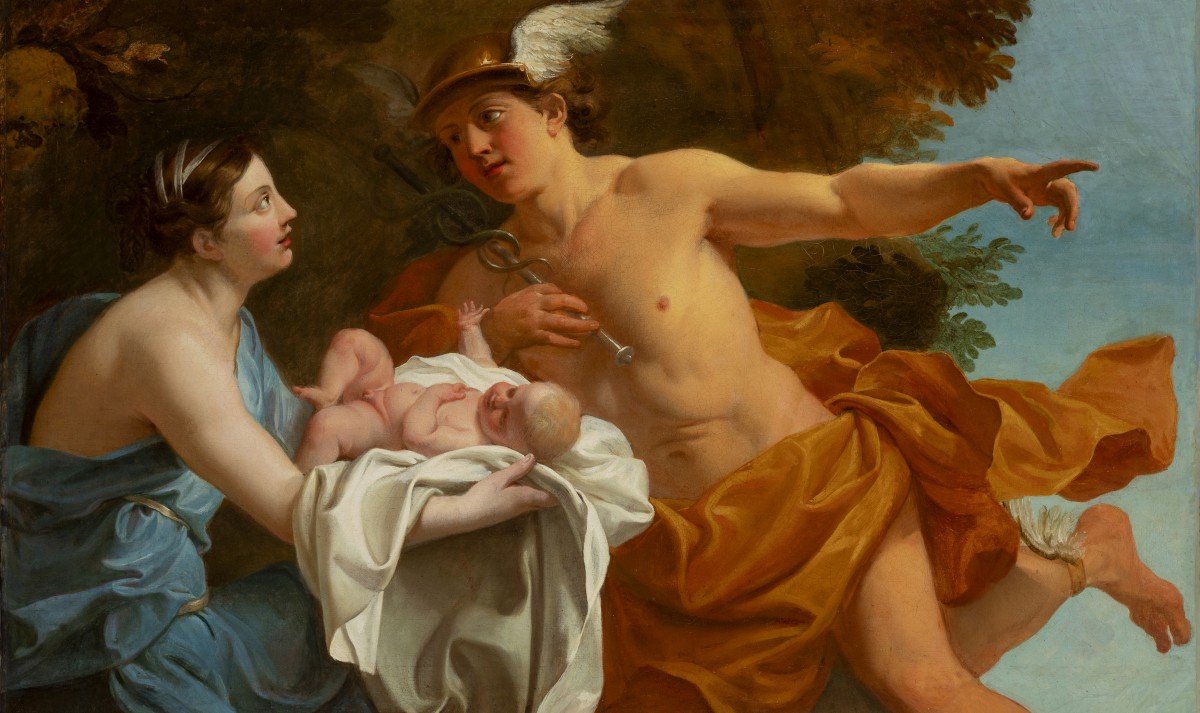
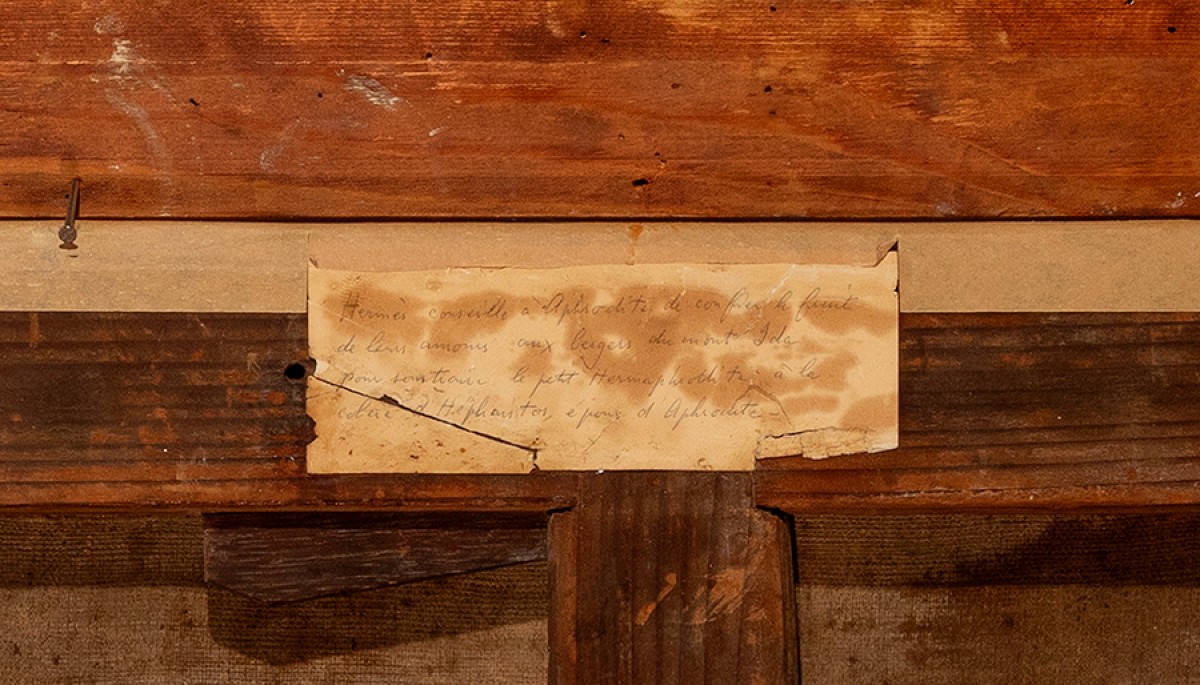
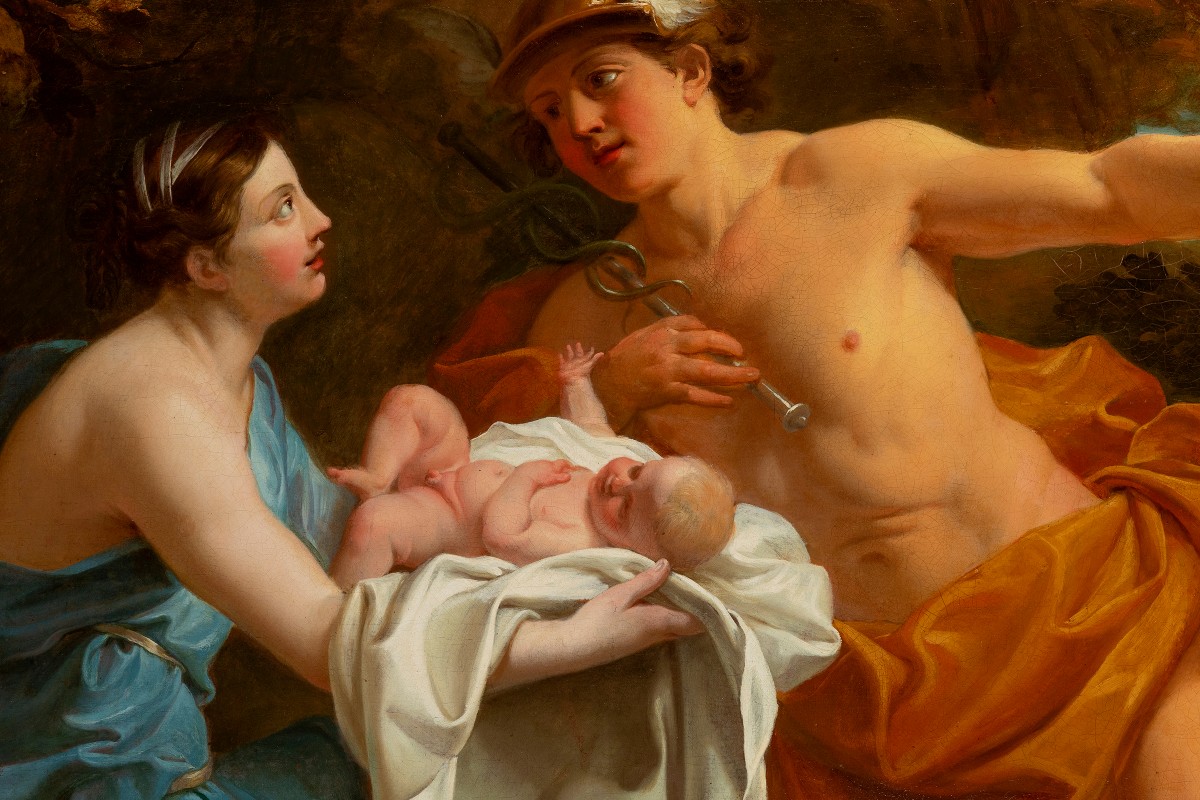
The composition depicts Mercury entrusting the infant Bacchus to the Nymphs of Nysa, who were charged with raising the young god beyond the reach of Juno’s anger. Descending from the clouds, Mercury presents the child to a nymph who receives him with a gesture of protection and wonder. The monumentality of the figures, the measured rhythm of the scene and the richness of the draperies give the painting a particularly commanding decorative presence.
The canvas may be dated to the mid-1710s, shortly before Noël-Nicolas Coypel was accepted into the Académie Royale de Peinture et de Sculpture on 31 December 1716. It therefore documents a particularly important, yet still insufficiently understood, period in the artist’s early development.
The luminous palette, especially the lavender-blue drapery worn by the nymph, is characteristic of Coypel’s work. Mercury’s powerful modelling and the dramatic use of chiaroscuro still recall the art of the painter’s father, Noël Coypel, while the classical elegance of the nymph may be compared with the female figures in The Gathering of Manna, Coypel’s signed and dated altarpiece of 1713 in the church of Saint-Nicolas-du-Chardonnet in Paris.
François Marandet has also emphasised the influence of Rubens and, more specifically, the celebrated Marie de’ Medici cycle. Mercury’s presentation of Bacchus appears to echo The Birth of Marie de’ Medici, in which the goddess Lucina entrusts the newborn queen to the personification of Florence. This Rubensian reference is entirely consistent with the artistic context of the Coypel family, since Noël-Nicolas’s half-brother, Antoine Coypel, had himself profoundly renewed his style through his study of the Flemish master.
The arrangement of the figures and the partially interrupted body of Bacchus suggest that the surviving canvas may originally have formed part of a considerably larger composition, possibly intended for a monumental decorative scheme. This hypothesis might explain the possible identification of the work with a large Birth of Bacchus attributed to Coypel and recorded in a series of Paris and London sales during the early nineteenth century.
Ambitious in scale, learned in its artistic references and highly appealing in its luminous colouring, this painting offers a rare opportunity to acquire an important rediscovery from the French Regency.
Provenance
Possibly anonymous sale, Paris, Hôtel Corberon, 28 November 1810, lot 110, as Naissance de Bacchus;
Possibly Thomas Rowlandson (1756–1827), London;
Possibly his sale, London, 26 June 1828, lot 510, as The Birth of Bacchus, acquired by Hull;
Possibly Michael Tijou, London;
Possibly his posthumous sale, London, 13 April 1836, lot 133, acquired by Herrman;
Giovanni Meggiolaro Antiquités, Montecchio Maggiore, Italy;
Anonymous sale, Brest, Thierry & Lannon, 22 February 2024, lot 300, as French School, eighteenth century;
Acquired at the above sale by the present owners.
Accompanied by a study by François Marandet, dated 24 July 2025.