Offered by Dei Bardi Art
REQUEST INFORMATION

Sculptures and works of art from the Middle Ages and the Renaissance
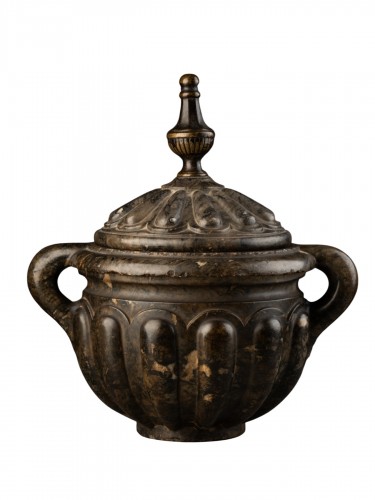
Covered Pot with Gadrooned Decoration
Green marble, bronze
Venice, 16th century
Height: 26 cm; Diameter: 21.5 cm
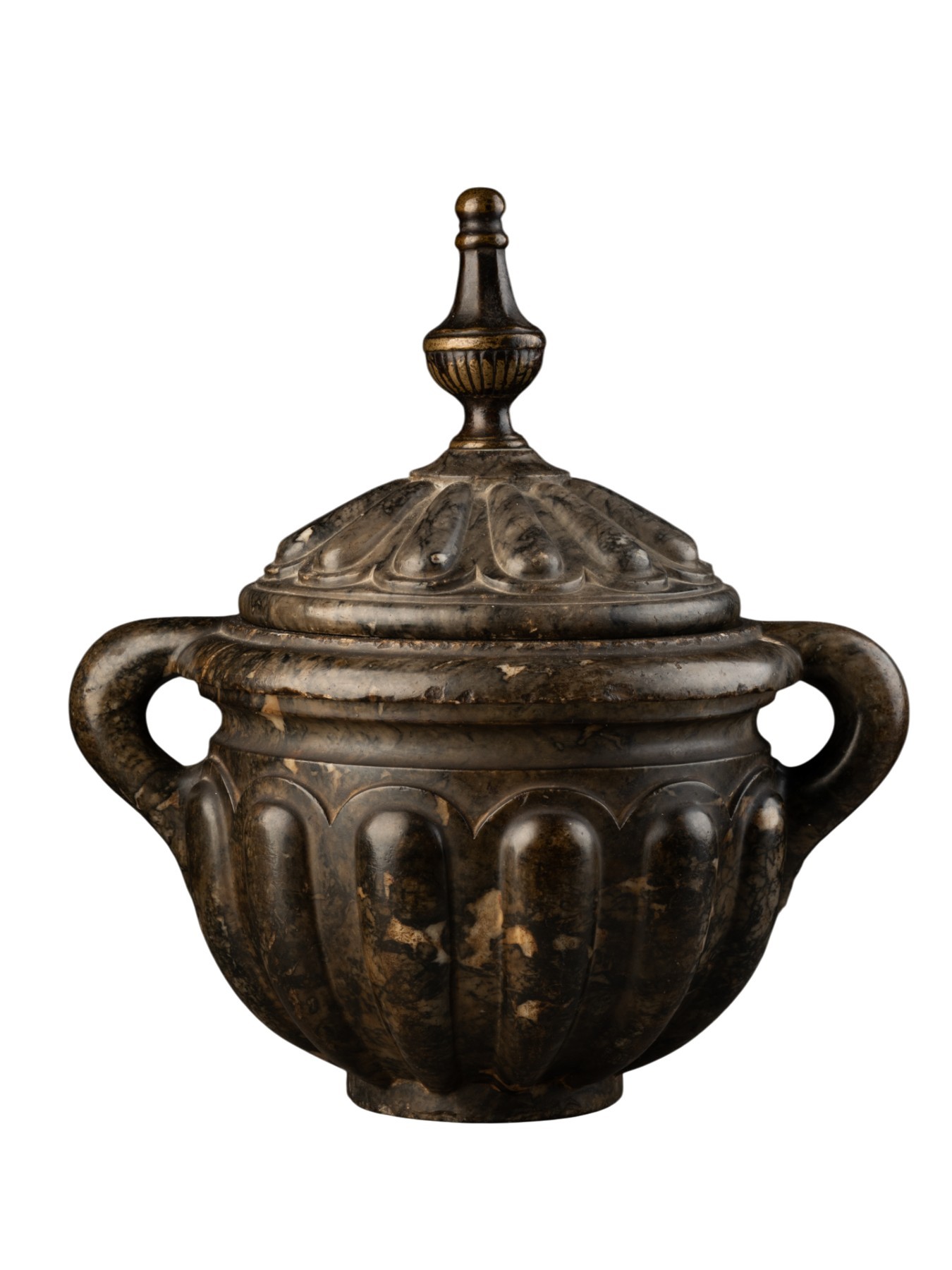
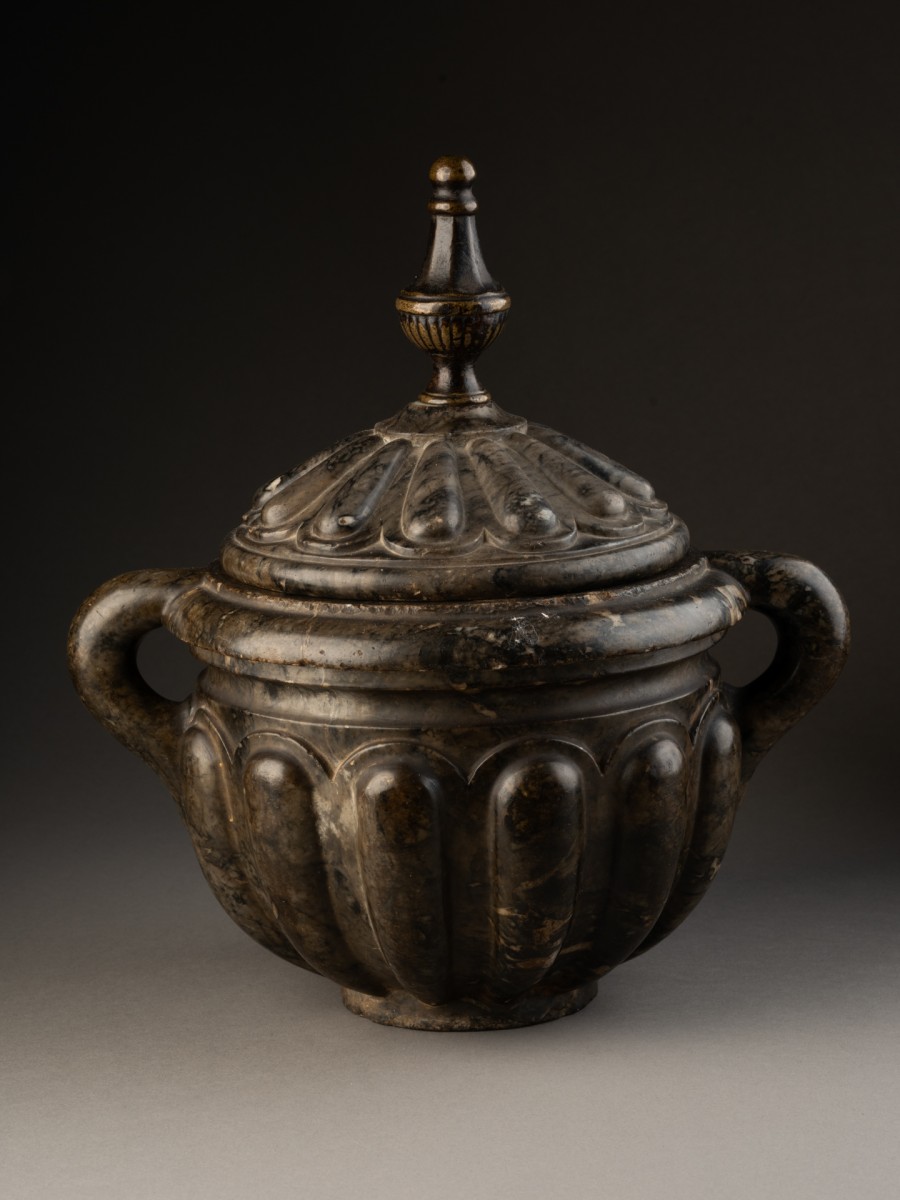
An elegant covered pot carved from richly veined green marble, characteristic of Venetian hardstone production during the Renaissance.
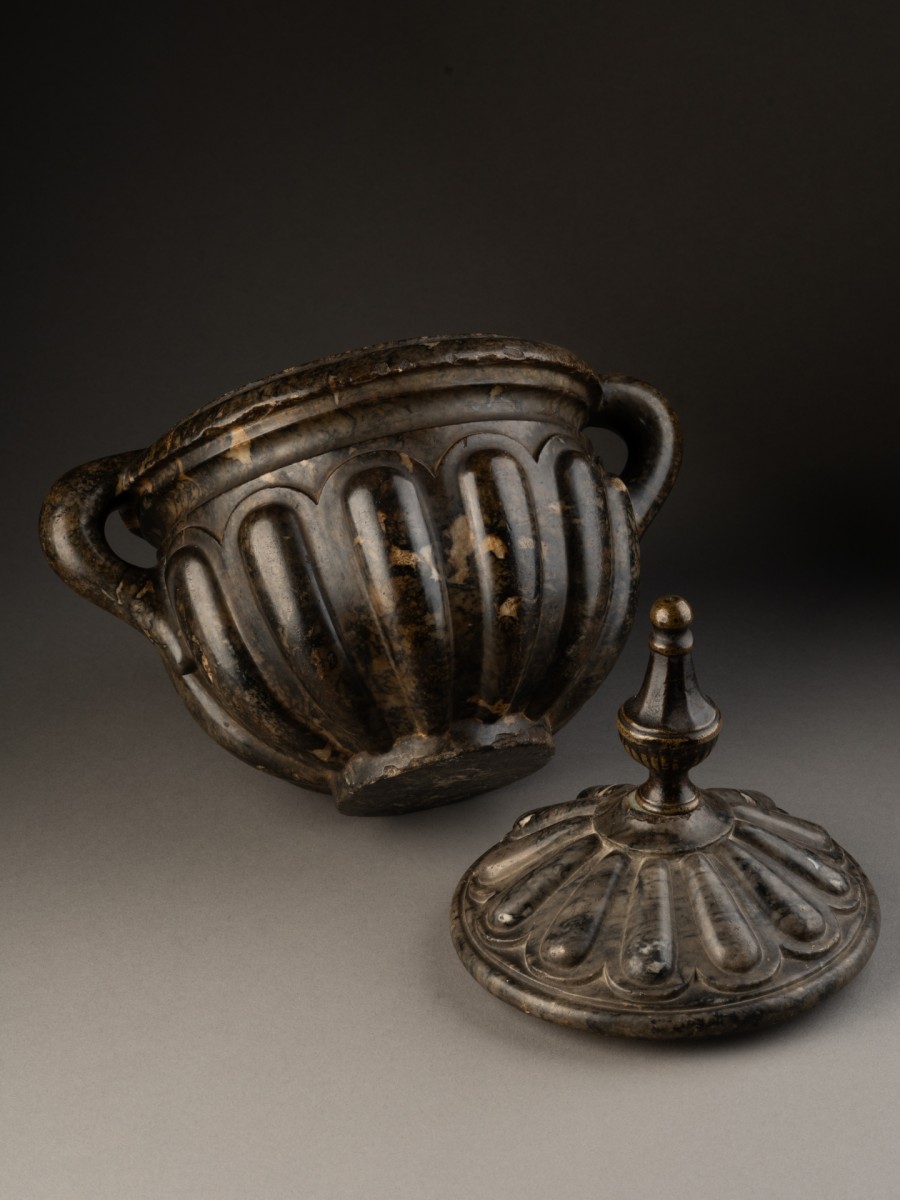
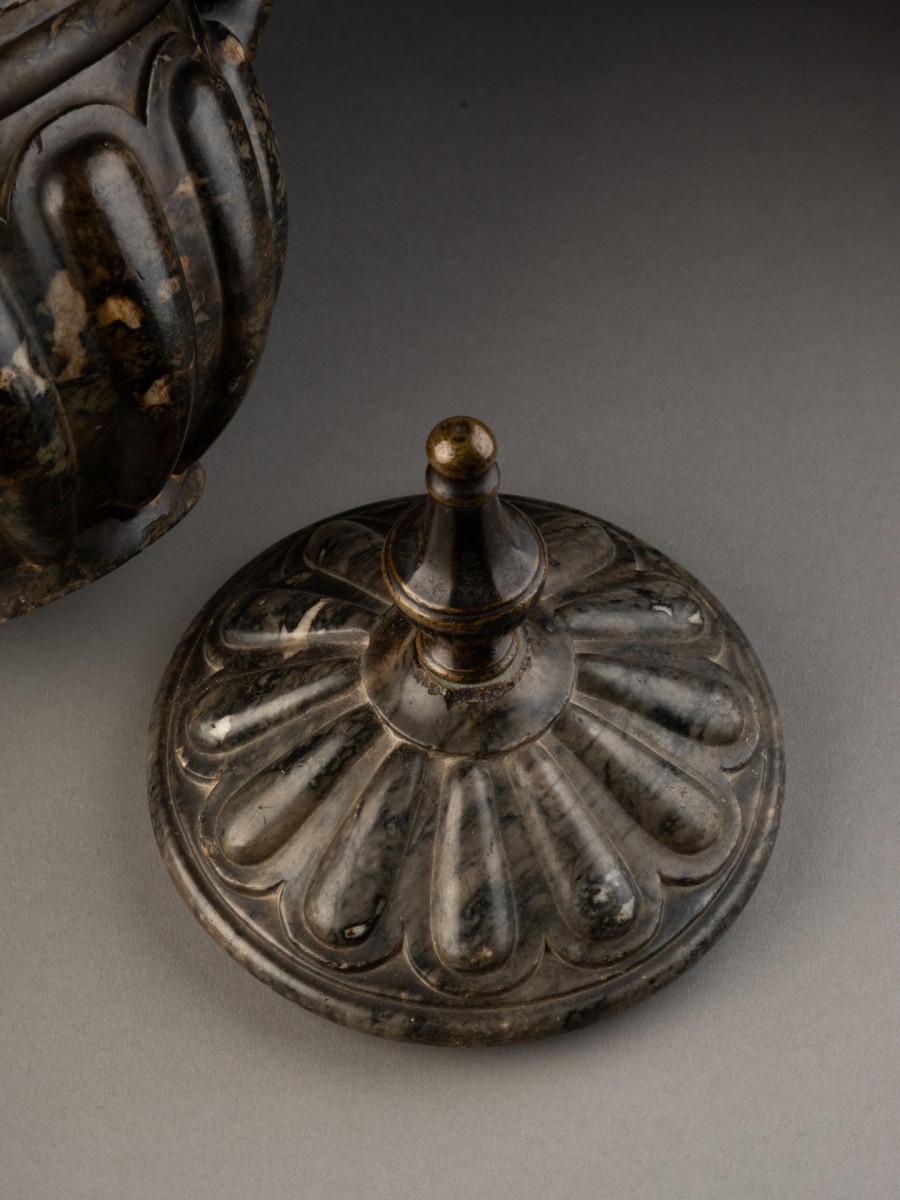
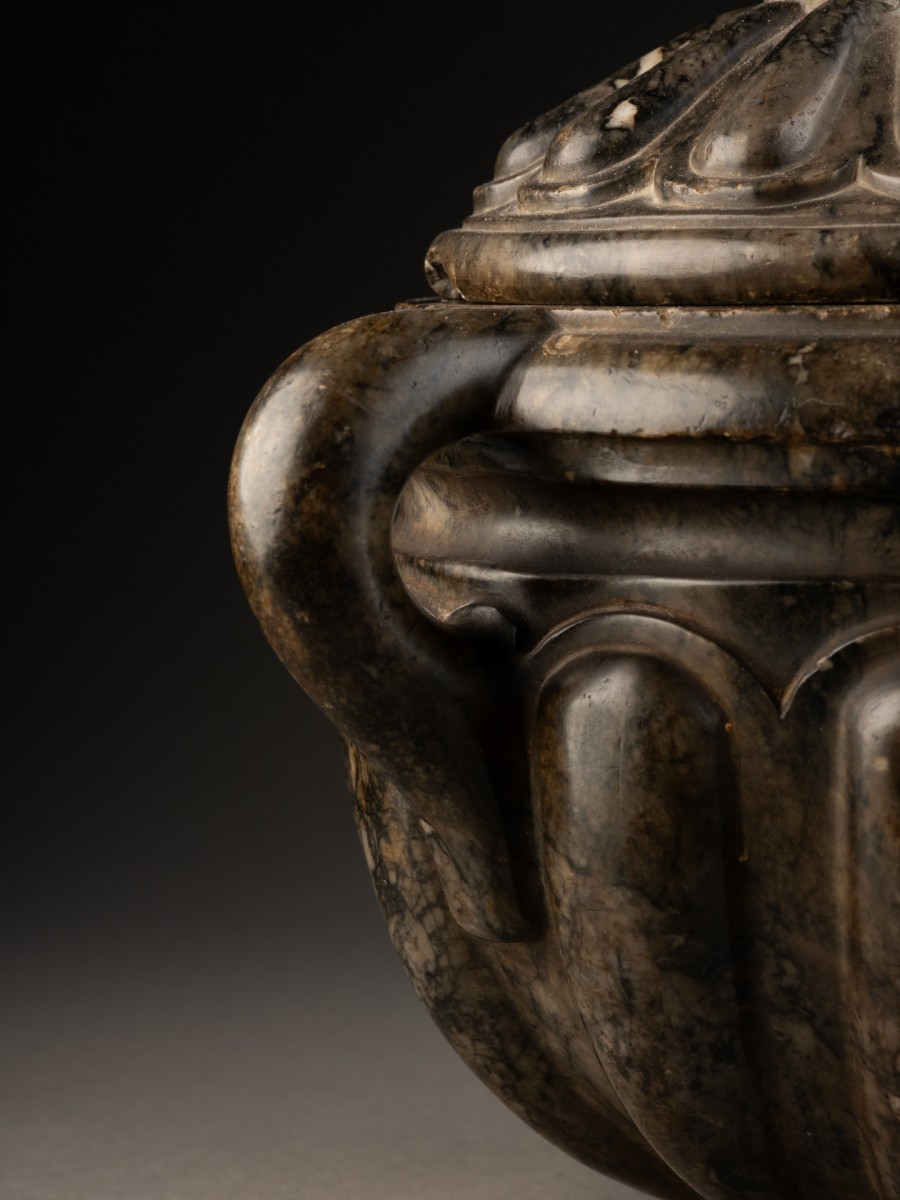
The ovoid body rests on a small circular pedestal foot and expands into powerful vertical gadroons, lending the piece remarkable plastic energy. This gadrooned ornament, inherited from the repertoire of ancient and medieval goldsmithing, underwent a decisive revival in the Italian Renaissance, notably in the wake of the vasi designed by Raphael and Giulio Romano and disseminated through the pattern books of Serlio. Applied here to marble, it testifies to a formal translation between the art of metalwork and that of hard stone — revealing the permeability of techniques within Venetian workshops of the Cinquecento.
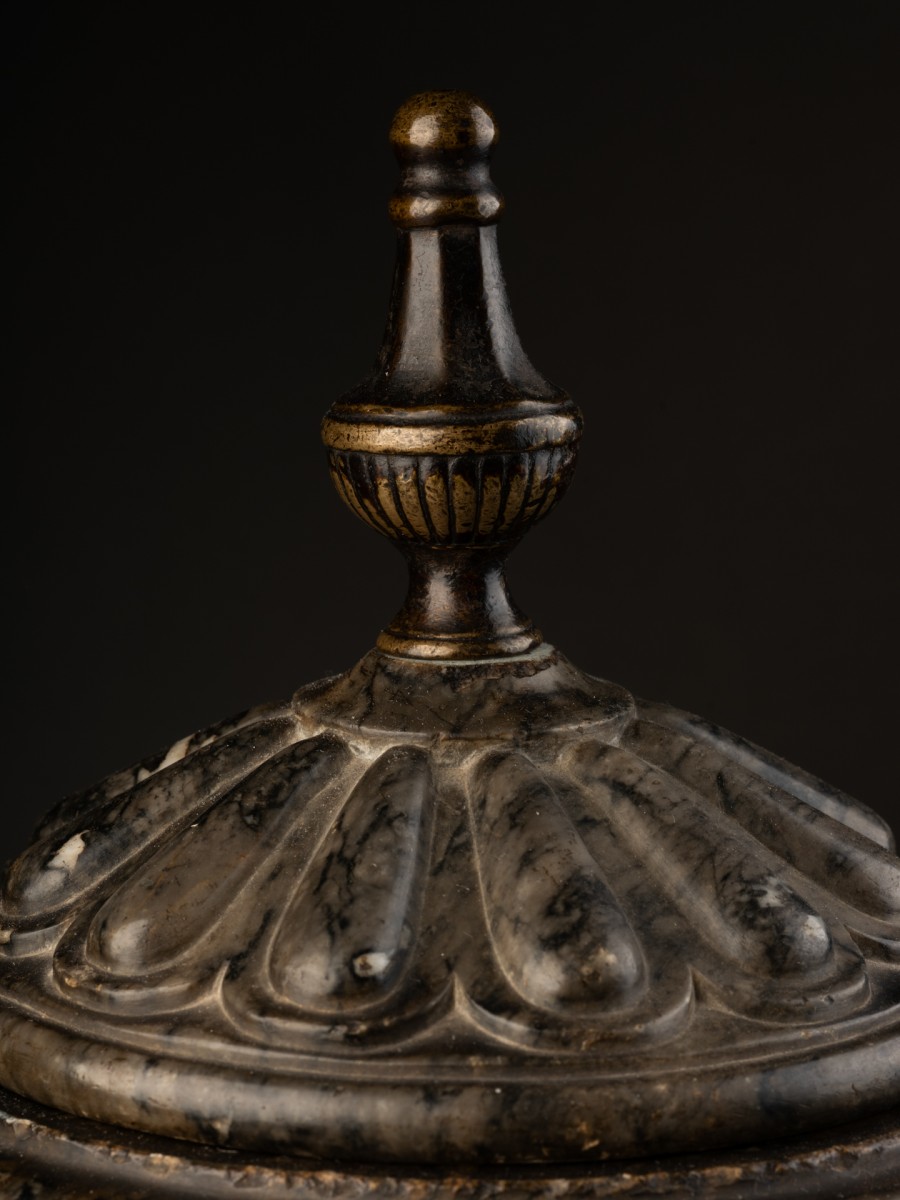
Two lateral scroll handles balance the composition and underscore the architectonic symmetry of the form. Their volute profile evokes both the handle of Greek amphorae and that of contemporary bronze brocche, inscribing the object in a constant dialogue between ancient sources and the craft production of its time. The lid echoes the gadrooned rhythm in a radiating version — an inverted umbrella interpretation — and is crowned by a gilt bronze finial turned in the form of a baluster.
The interplay between polished surfaces, sculpted relief gadroons, and the natural play of the veining animates the material with painterly effects particularly sought after in Venetian marble art. This sensitivity to the pittoresco of stone — a concept that would be theorized later but was already fully operative in practice — reflects the influence of the Venetian pictorial tradition itself, where colour and material matter as much as drawing.
Venice occupied a singular position in the European lapidary landscape during the fifteenth and sixteenth centuries. As the essential redistribution hub for precious marbles arriving from Greece, Asia Minor, and Egypt, the Serenissima allowed its craftsmen — the tagiapiera, or stone-carvers — access to a diversity of materials unmatched elsewhere on the peninsula. Where Florentine workshops developed the polychrome inlay of the commesso di pietre dure, Venetian pietrari excelled in monolithic carving: drawing a complete form from a single block, in the closest possible dialogue with classical sculptural practice. This pot is an accomplished expression of that approach.
The small Venetian and Paduan bronzes at the Museo Correr, attributed to the circles of Riccio and Sansovino, serve as a reminder that the same humanist clientele commissioned these lapidary pieces and these table sculptures: collectors from the merchant patriciate, circles gravitating around the Aldine Academy, or great families such as the Corner, Grimani, and Barbaro, whose antiquarian tastes are well documented. As demonstrated by the landmark exhibition Art of the Royal Court at the Metropolitan Museum (2008), the pietre dure tradition feeds constantly on formal circulation between goldsmithing, architectural sculpture, and precious furniture, the same motifs travelling from one discipline to another according to the patron's needs.
Intended to adorn cabinets, studioli, or display tables, these covered vases and pots belong to the category of oggetti di virtù — precious objects which, placed in the representational spaces of the nobility and merchant bourgeoisie, signalled the erudition of their owner, his familiarity with Antiquity, and his social standing. The collections of the Este, Gonzaga, and Medici preserved comparable examples, frequently catalogued in inventories under the generic designation vaso di pietra.
This Venetian pot, through the sobriety of its form, the nobility of its material, and the precision of its mount, stands as one of the most eloquent testimonies to this humanist taste for ancient forms reinterpreted in a fully Renaissance idiom — a silent dialogue between the Rome of the Caesars and the Venice of the Doges.