Offered by Gregory Redding
REQUEST INFORMATION
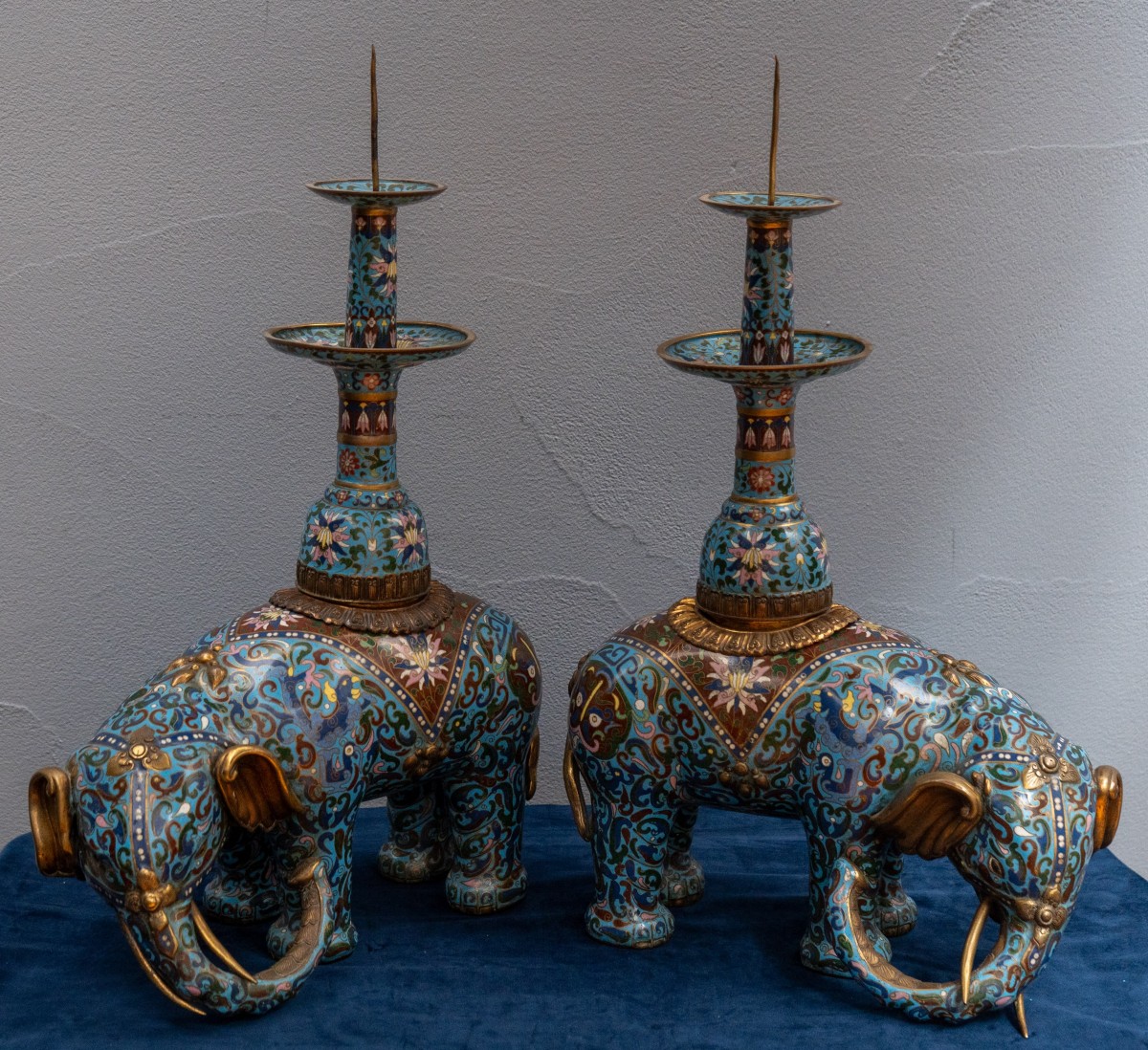

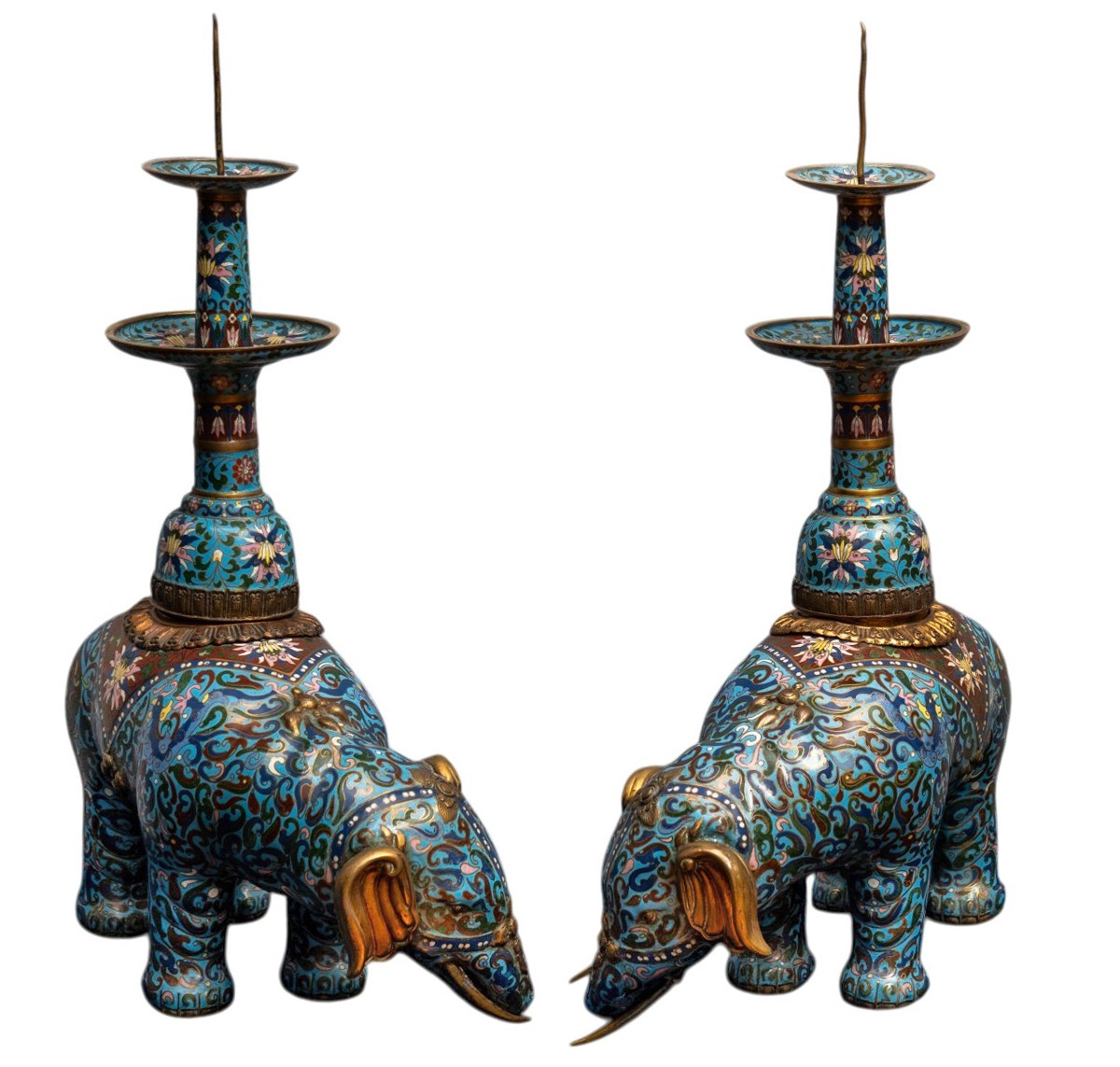
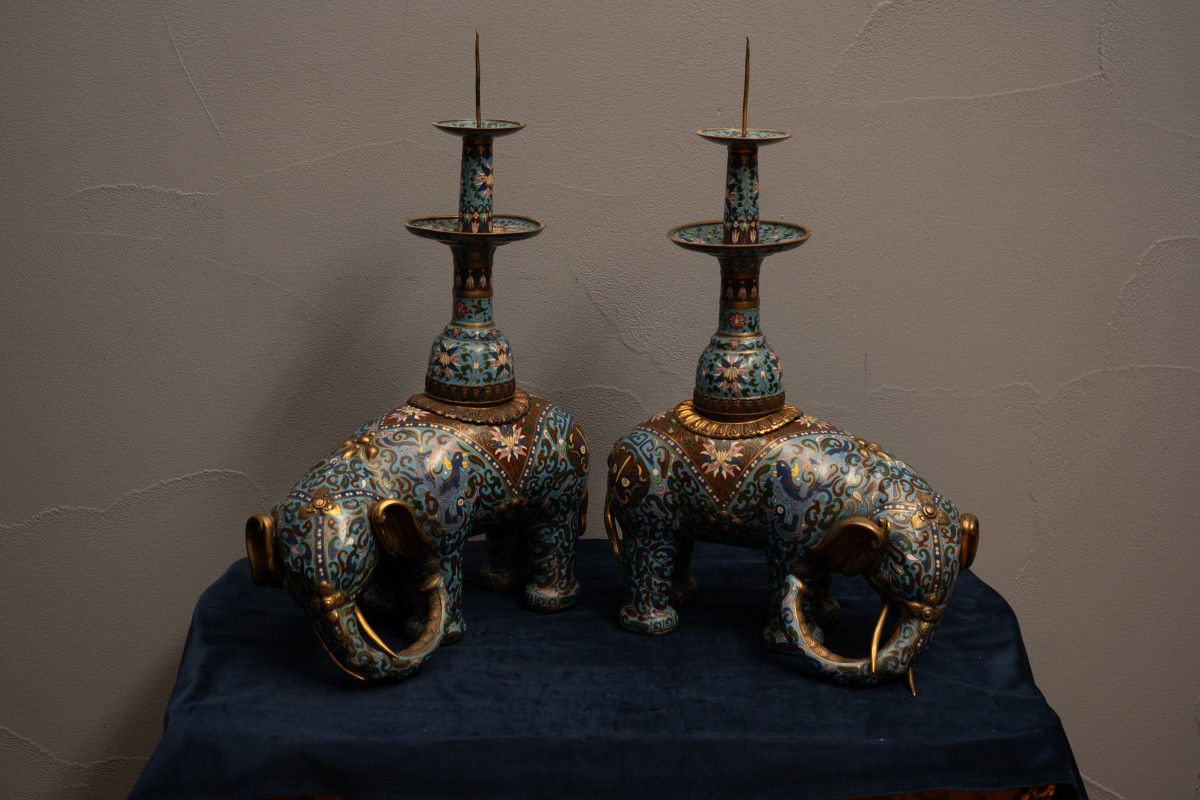
A Pair of Chinese Cloisonné Enamel Elephant-Form Pricket Candlesticks
Late Qing Dynasty, circa 1880–1910
Each modelled as a kneeling elephant with trunk curled downward, the body entirely worked in cloisonné enamel on a turquoise ground with dense scrolling lotus and foliate arabesques in polychrome enamels — navy blue, aubergine, sage green, pink, white and yellow — the caparison reserved with lotus medallions on a dark blue ground. Gilt bronze details throughout: cast tusks, chased ear and trunk tips, and a repoussé foliate collar separating the elephant from the removable candlestick shaft above. The tall shaft of waisted form, enamelled en suite with lotus and cloud motifs, issuing two tiered drip-trays and terminating in an iron spike pricket. Shafts original to bases.
The elephant-form pricket candlestick belongs to a well-established tradition of Buddhist altar furniture in China. Such candlesticks typically formed part of a w?gòng (??, "five offerings") altar garniture comprising a central incense burner, a pair of flower vases, and a pair of candlesticks. As noted by Béatrice Quette (Cloisonné: Chinese Enamels from the Yuan, Ming and Qing Dynasties, Yale University Press / Bard Graduate Center, 2011), altar sets were kept in stock in the palace storerooms and assembled into sets when needed, while the w?gòng comprised a central incense burner with two flanking flower vases and candlesticks Bard — a format that was equally adopted for temple and aristocratic interiors throughout the Qing period. The technique of cloisonné itself — creating designs on metal vessels with coloured glass paste placed within enclosures made of copper or bronze wires, bent or hammered into the desired patterns The Metropolitan Museum of Art — was brought to its most elaborate expression during the 18th and 19th centuries. For comparable examples, see Helmut Brinker & Albert Lutz, Chinese Cloisonné: The Pierre Uldry Collection (New York: Asia Society, 1989).
Height: 56 cm | Width: 34 cm | Depth: 15 cm
Condition: One tusk repaired; otherwise intact