Offered by Galerie Léage
REQUEST INFORMATION

France, Louis XV period, circa 1750
Ebony and gilt bronze
Similar examples:
- Japanese lacquer inkstand, 1745-1749, London, Wallace Collection (inv. F.109).
- Japanese lacquer inkstand, Louis XV period, private collection.
- Rosewood and amaranth veneer inkstand, Louis XV period, former Dillée collection.
Provenance:
- Former Henry Kravitz collection
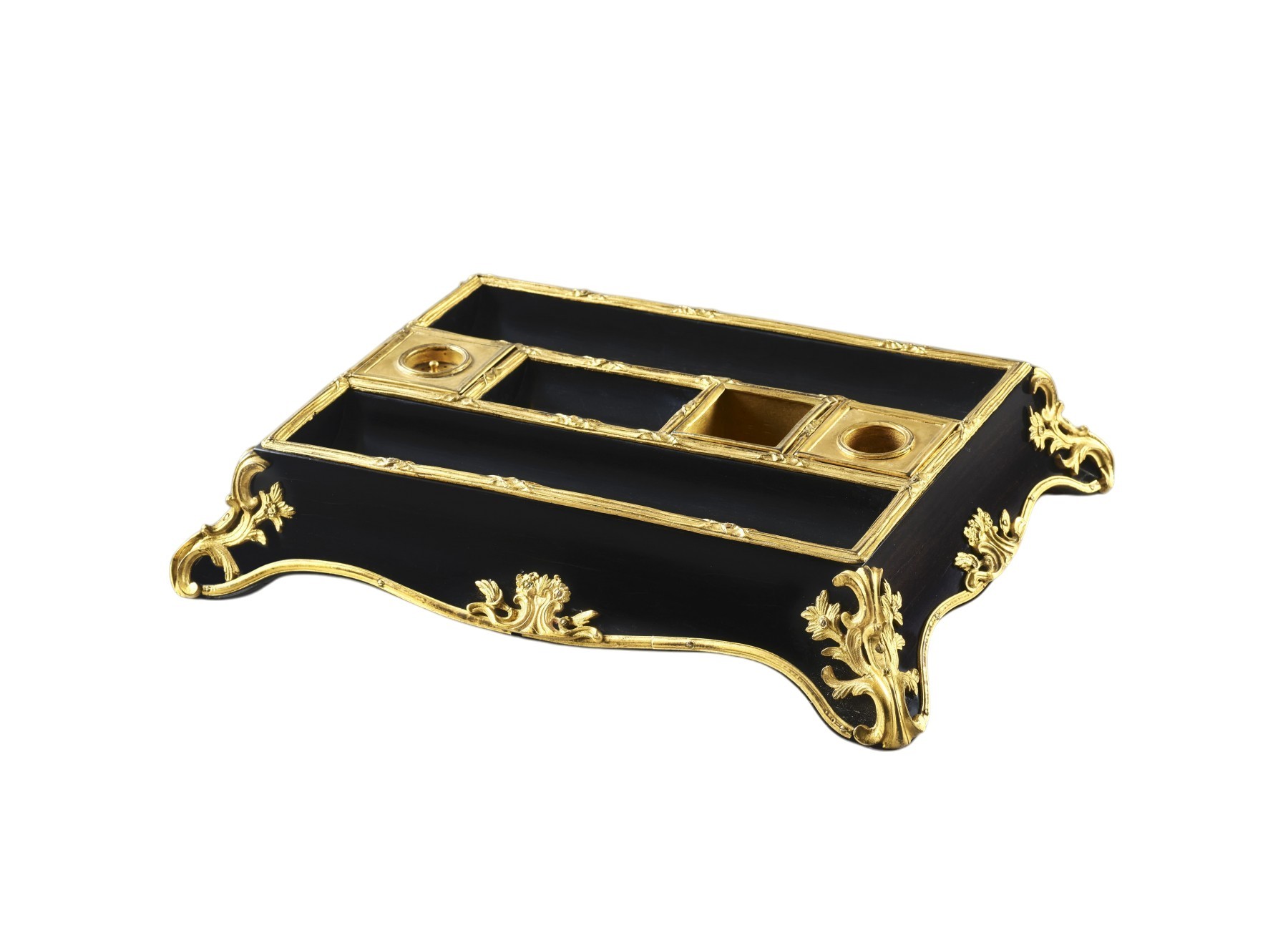
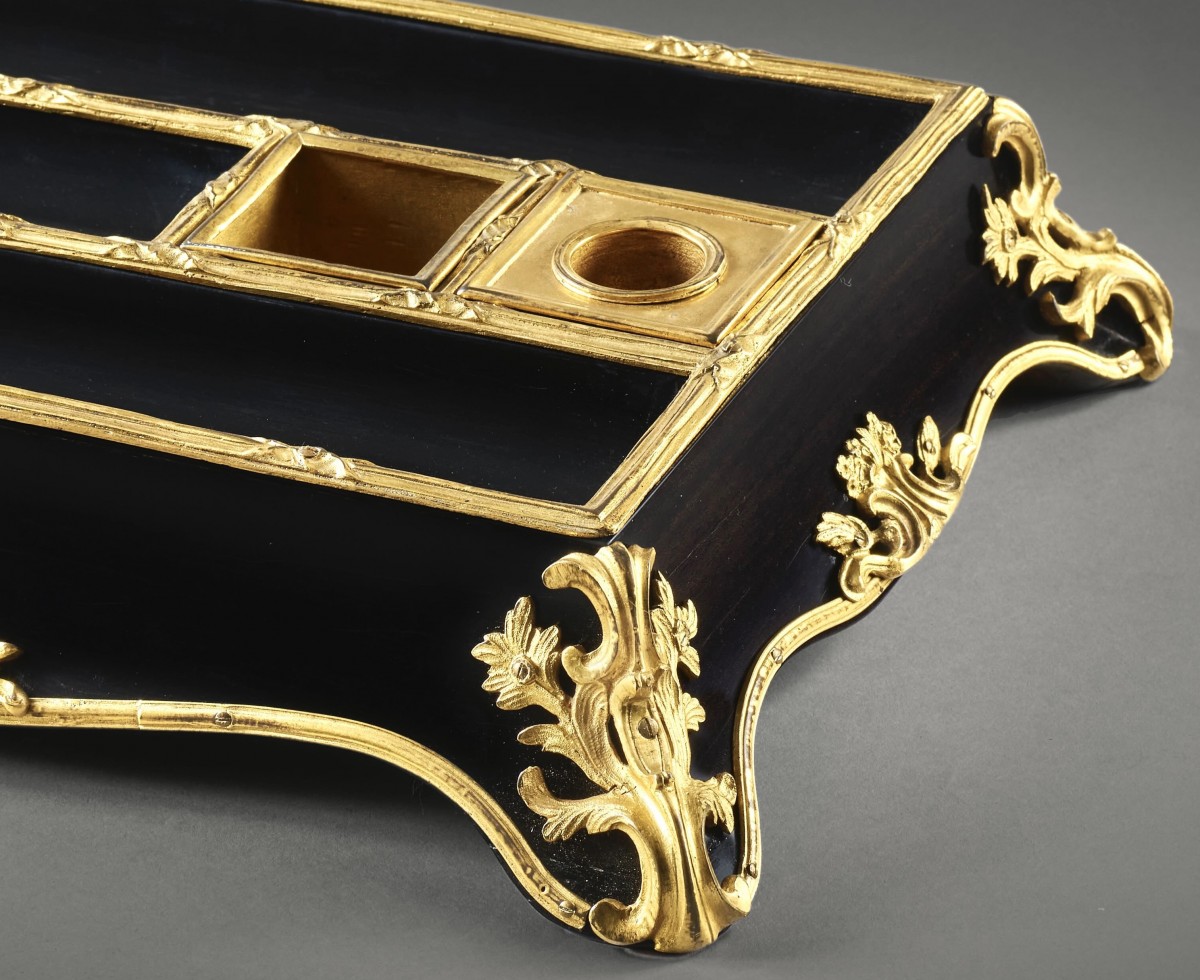
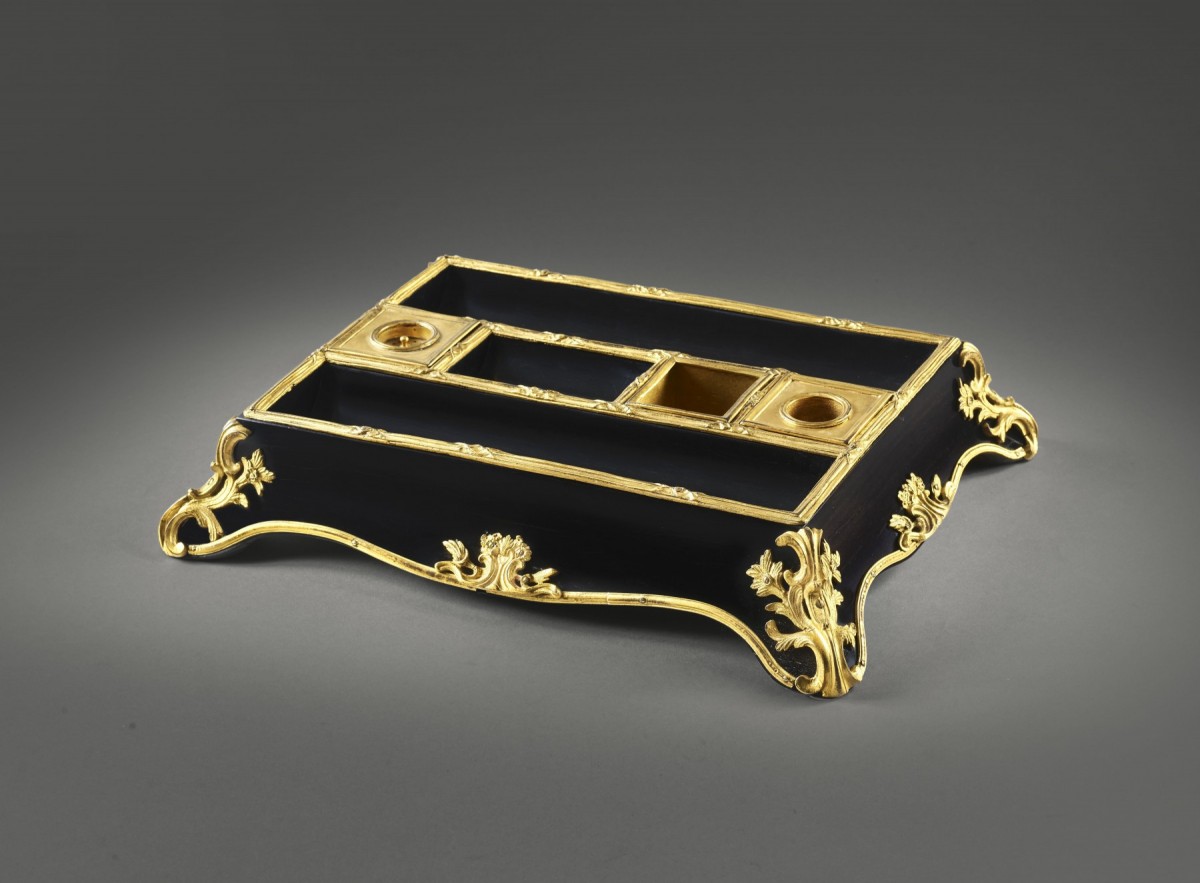
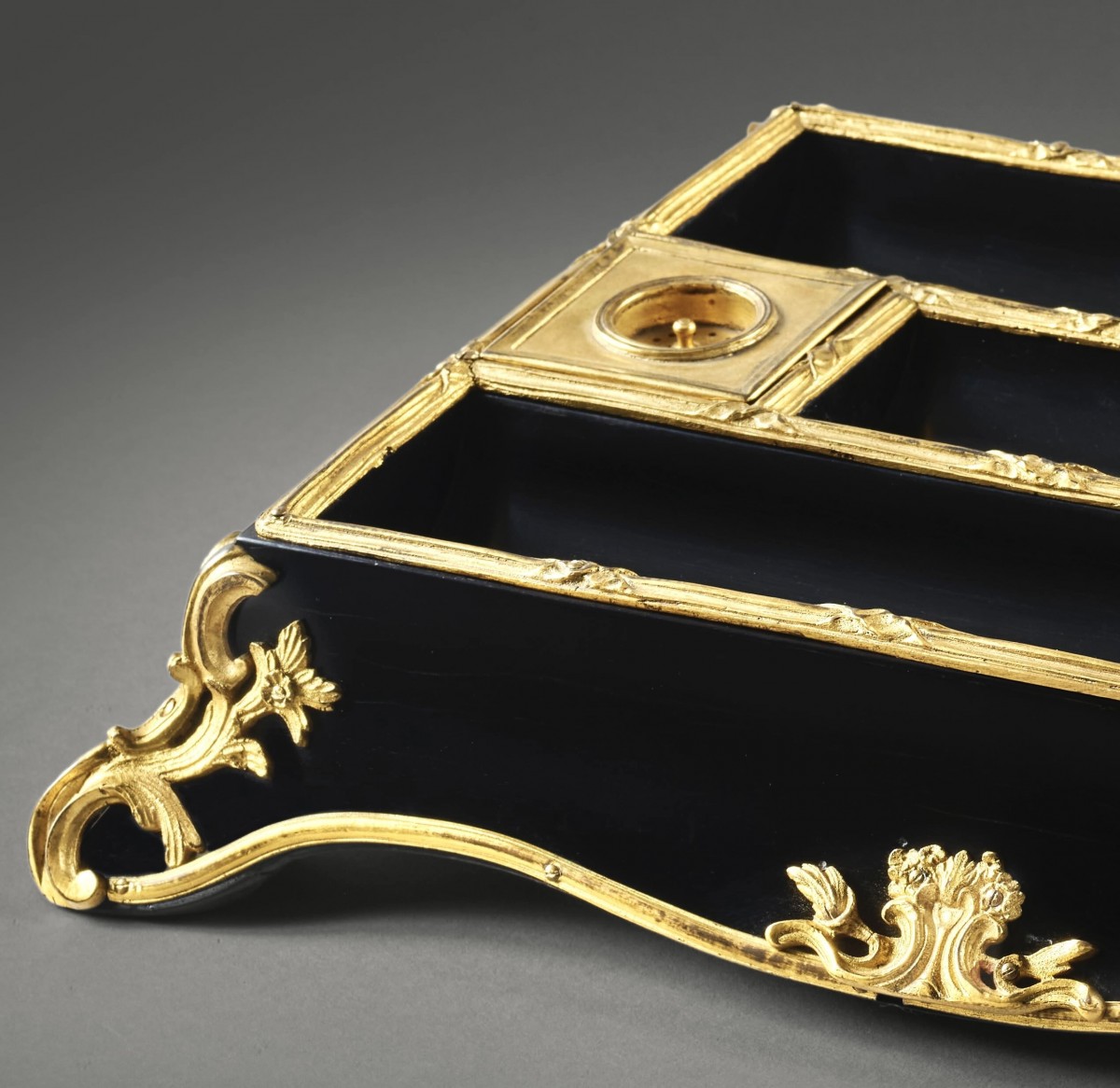
This rectangular ebony and gilt bronze inkstand resting on four flared feet includes three compartments designed to hold writing instruments.
The two concave ebony side compartments serve as pen trays. They frame a central compartment subdivided into four sections: an inkwell, a sponge container, a small concave ebony compartment, and a sand box.
The four ebony sides and each compartment have their borders enhanced with gilt bronze. Scrolling foliage decorates the four corners. Each side is adorned at the center with a floral gilt bronze motif. Molded strips highlight the sinuous contours of the lower rims on each side. On the upper surface, ribbon-tied bundles frame each compartment and element of the writing set.
The Art of Writing
In a society shaped by Enlightenment scholars and men of letters - and punctuated by salons and evening gatherings hosted by influential figures - writing was the most common mean of expressing and conveying ideas, desires, or ambitions. Rooms, furniture and dedicated objects were created to support the practice of this activity, elevated by some to the status of an art form. Commonly referred to as the “Age of Enlightenment,” the 18th century saw its intellectuals serve as emblematic figures of the period. Writing, the principal medium of thought, was their privileged means of expression and among their primary pursuits. Two forms of writing coexisted during this time: correspondence, the primary means of communication— often practiced several times a day—and scholarly writing in the form of novels or essays. These two practices were frequently intertwined, as authors engaged in rich epistolary exchanges through which they developed new ideas and shared them with their peers. The extensive correspondences of Louise d’Épinay, Voltaire, and Jean-Jacques Rousseau bear eloquent witness to this vibrant intellectual culture.
Writing, and above all epistolary writing, reflects the growing pursuit of intimacy that characterizes the 18th century. Apartment layouts became increasingly complex, allowing their inhabitants to retreat into private inner rooms, far from the formal rooms where sociability was an obligation. It was in the privacy of a boudoir or a cabinet that letters—often of a deeply personal nature—were written, intended to be read by the recipient alone. For some, correspondence rose to the value of an art, governed by various conventions: calligraphy, letters of varying degrees of clarity, writing utensils revealed the author's social status. The paper — on which thoughts were written—was often a large double sheet, rather than a single sheet, signifying both respect for the correspondent and the rank of the writer.
The custom and necessity of writing at various times throughout the day prompted cabinetmakers to equip many types of furniture—regardless of their primary function—with inkwells or writing surfaces. Toilet furniture, essential for moments of intimacy, and jewel caskets were sometimes fitted with writing utensils, including inkstand or small leather-covered tablets, allowing their owners to reply hastily to urgent notes received during the morning toilette. In addition to dedicated piece of furniture, objects incorporating everything required for writing were also created, such as inkstands.
The inkstand, a utilitarian object
Both utilitarian and decorative, inkstand allowed the writer to store and access all necessary tools to write letters. It generally consisted of an inkwell, a sand container for absorbing excess ink, a compartment for the sponge, or even one or more pen trays on which quill pens —used to form elegant letters with contrasting thick and thin strokes—were placed.
Easily portable, often made from lightweight materials, some inkstands were even fitted with a handle. Others, however, were crafted from luxurious materials, like the one studied here, which combines ebony with gilt bronze.
Placed on a desk or a table, the inkstand is a refined object that reflects the taste of its time and serves as a platform for original creations made possible by the marchands-merciers (merchants). It is a true work of art on which bronziers exercise all their talent.
This writing desk echoes the contemporary taste - typical of the Louis XV era - where Rocaille bronze ornaments decorate and embellish a sinuous structure, highlighting the curvature of its edges.
Gilt Bronze Mounts
The practice of mounting precious objects to enhance their brilliance and prestige is centuries old. As early as the Middle Ages, cups and vases made of rare stones—and, from the 15th century onward, porcelain—were adorned with gold or silver to emphasize both their beauty and exceptional character.
Although gold and silver were still used during the 17th century, gilt bronze mounts experienced a remarkable rise at the end of the reign of Louis XIV, in response to the period’s growing need for economy. Throughout the 18th century, exceptional pieces were entrusted to the hands of the finest bronze craftsmen who, often through commissions from wealthy marchands merciers, created exquisitely refined mounts using exceptional materials. These dealers, with resources exceeding those of most artisans, acquired technically or materially valuable objects—hardstones, porcelain, ivory, coconut shell, mother of pearl, lacquer, and rare woods such as ebony—and had them mounted in elaborate gilt bronze ornaments. This ebony and gilt bronze inkstand is a remarkable example of a practical, everyday object elevated to the status of an objet d’art through the preciousness of its materials and the refinement of its mounting.
Bibliography
-Charissa Bremer-David, Paris, Life and luxury in the 18th century, Los Angeles, Getty Editions, 2011.
-Pierre Kjellberg, Objets montés du Moyen Age à nos jours, Paris, Les Éditions de l’Amateur, 2000, p. 34.
-Gérald de Montelau, L’esprit du XVIIIe siècle, le désir de créer, Paris, Méroé, 2018. Pierre Verlet, Les bronzes dorés français du XVIIIe siècle, Paris, Picard Editions, 1987.
-Giacomo and Rozenn Wannenes, Les bronzes ornementaux et les objets montés, de Louis XIV à Napoléon III, Milan, Vausor Editions, 2004, pp. 94-95.