Offered by Galerie Lamy Chabolle
REQUEST INFORMATION

Decorative art from 18th to 20th century
Bronze
Japan
Bunka (1804-1818)
11 x 25 x 20 cm (4,33 x 9,84 x 7,87 in.)
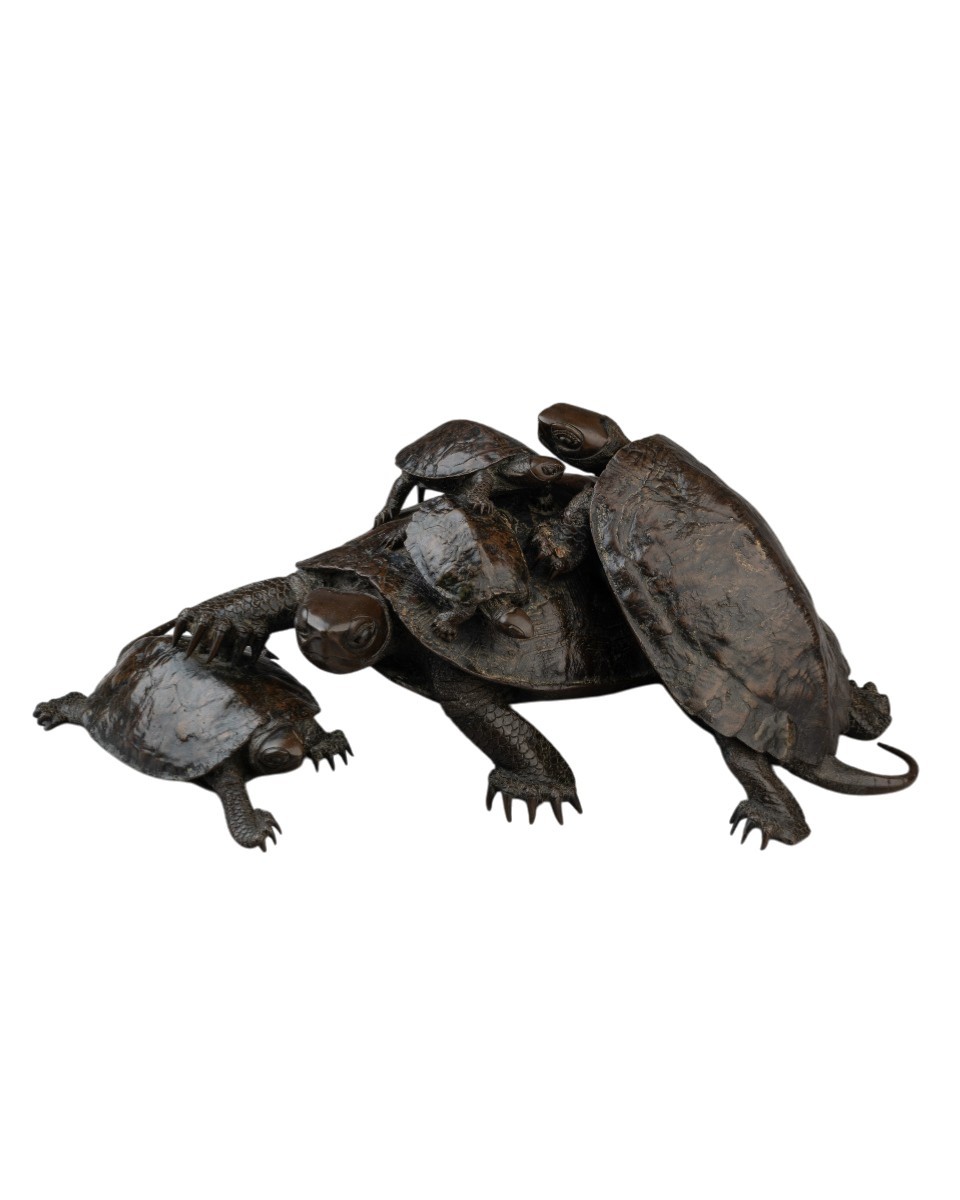
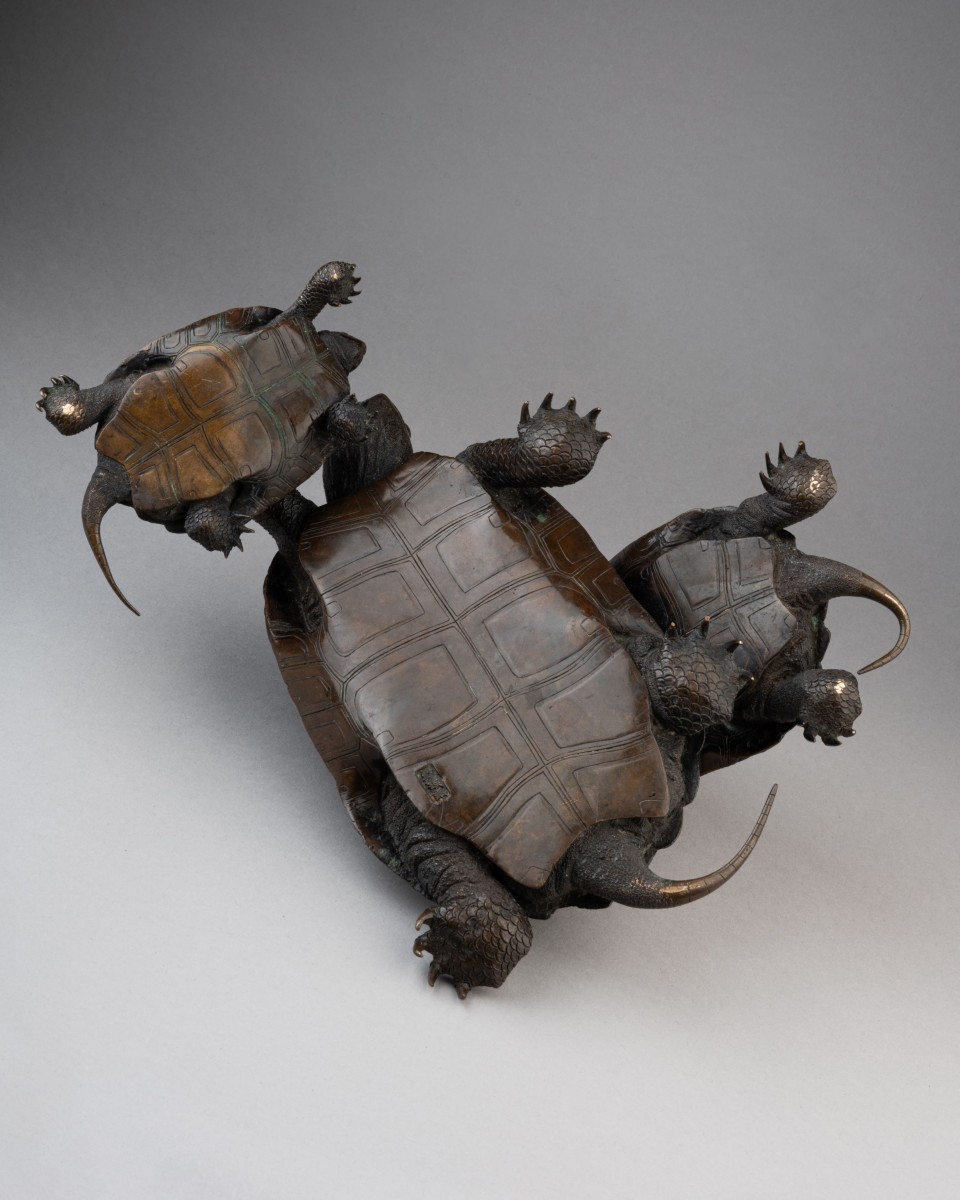
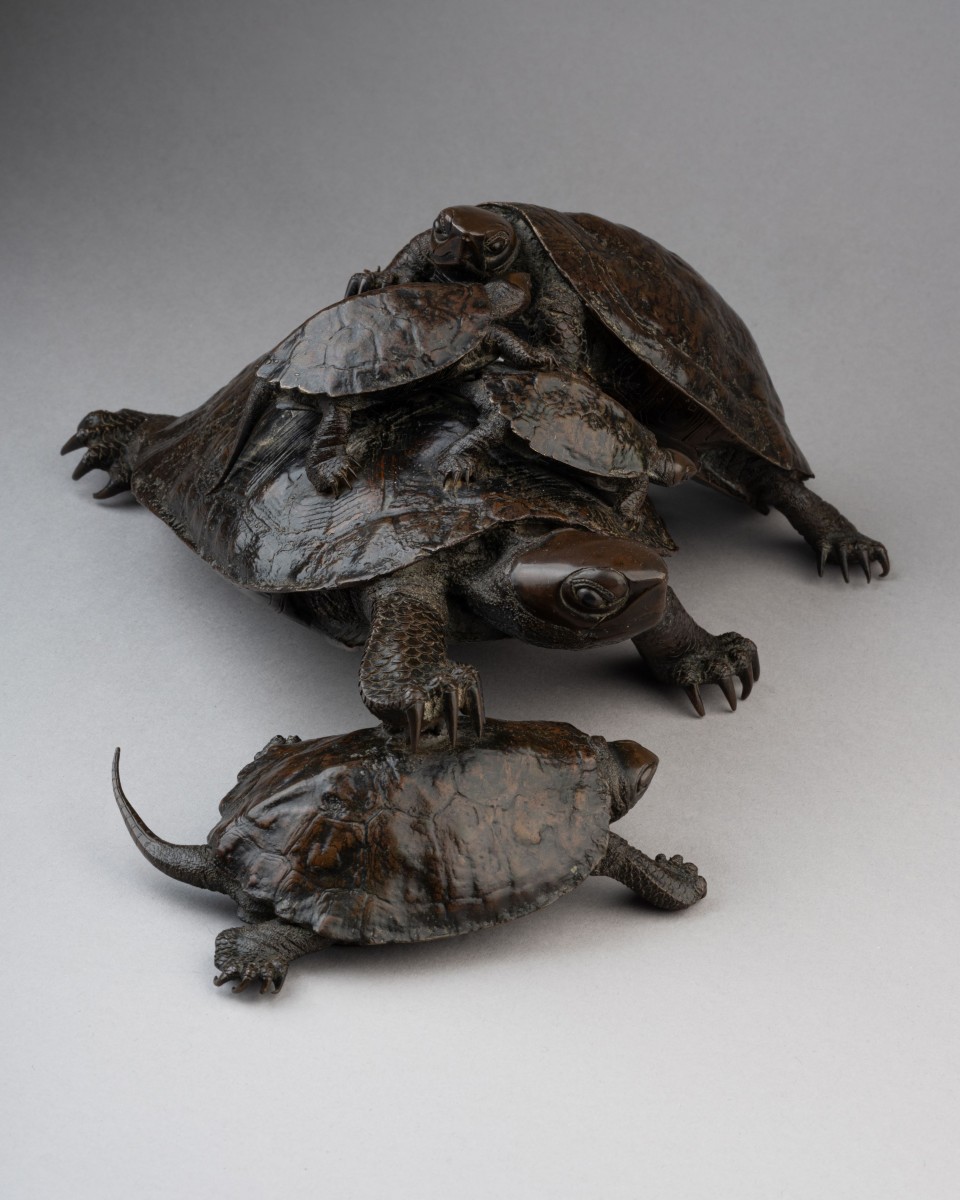
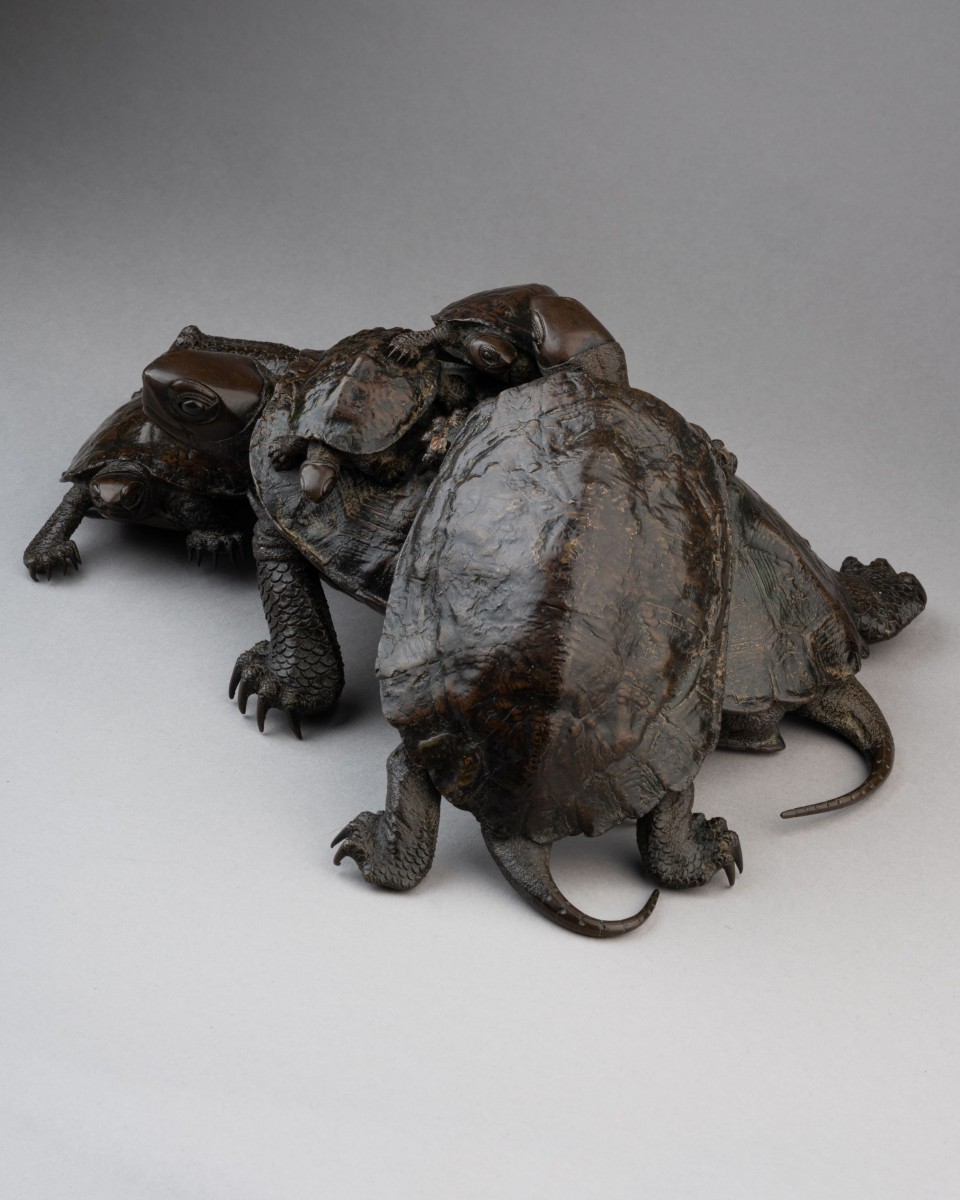
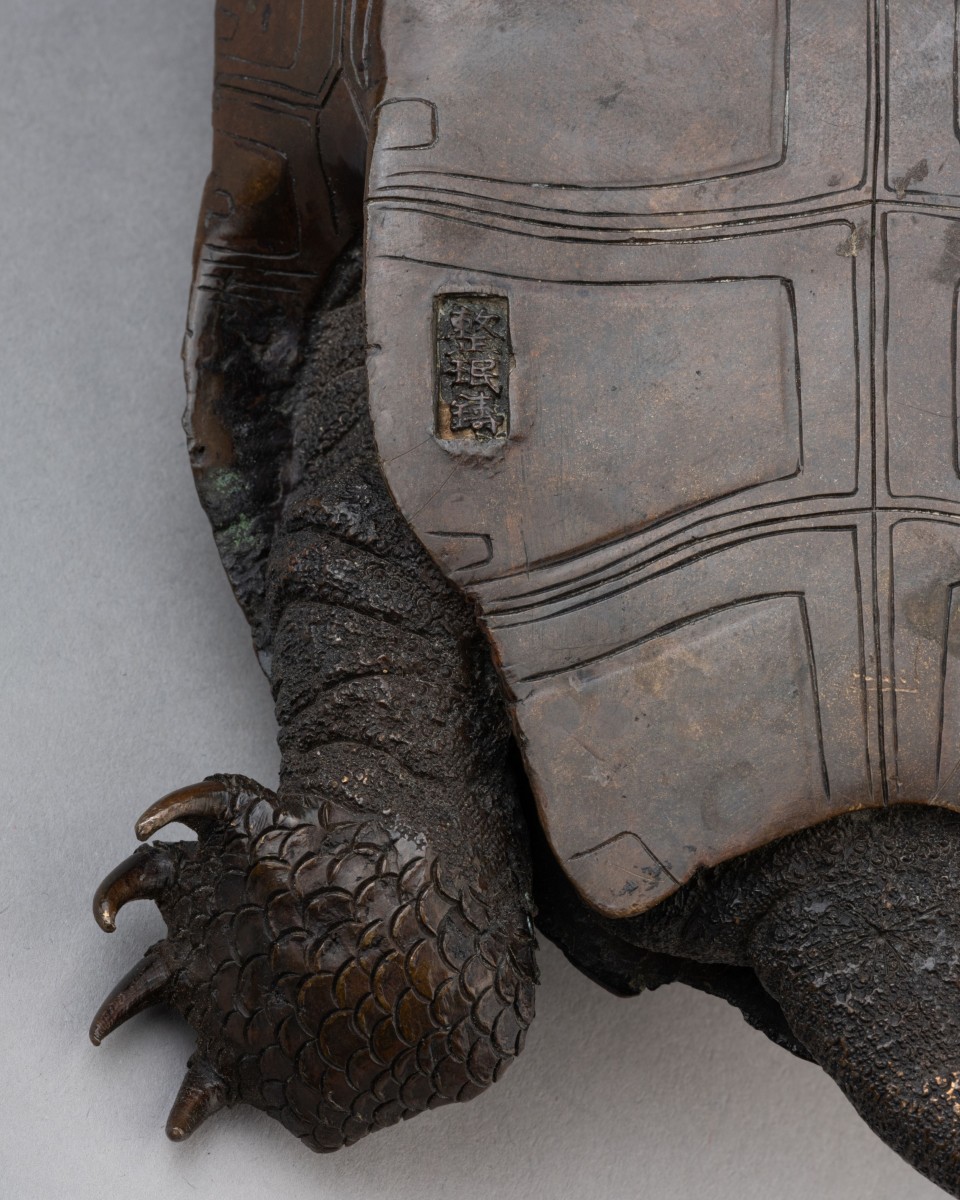
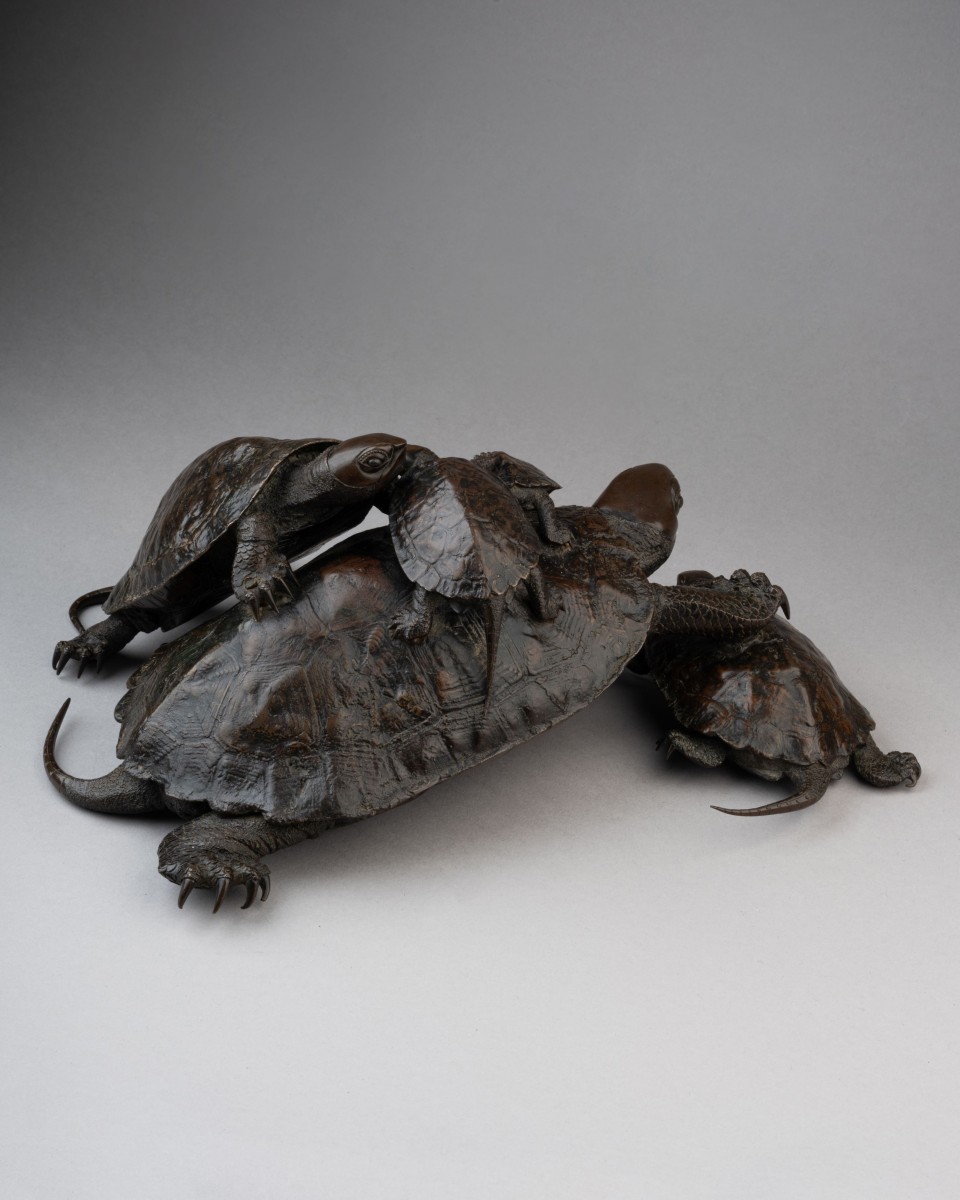
The signature on this group of five tortoises is also found on the back of the bronze Bodhidharma in the Tokyo National Museum. It reads: ???, that is, ‘cast by Seimin,’ that is Murata Seimin (??, 1761–1837), one of the most distinguished metalworkers of the late Edo period (1603–1868), celebrated for his consummate mastery of rogata (??), or lost-wax casting, and above all for his renderings, of a reputedly flawless naturalism, of the anatomy of both juvenile and adult land tortoises.
The idea of a domestic sculpture, purely decorative and devoid of any utilitarian function, appears to have remained largely foreign to Japanese customs until the bummei-kaika (????), the era of openness towards the West, inaugurated in the early years of the reign of Emperor Meiji (1867–1912). Seimin’s oeuvre, far predating the Meiji era, thus belongs to a period when the strictly decorative art of the okimono (??) — a decorative sculpture placed on a table or in a dedicated alcove — was still in its infancy. The greater part of Seimin’s work is indeed concerned with monumental or ritual Buddhist sculpture: his most notable works, besides the aforementioned Bodhidharma, are the bronze lion at the Hanazono Shrine in Tokyo, the Five Hundred Rakan at Kench?ji Temple in Kamakura, and the Gogusoku at the Tokyo National Museum, a set of five ritual Buddhist bronze implements adorned with mythical animals and, naturally, tortoises.
Seimin’s rare okimono bronzes though, are not absent from public collections. A bronze tortoise signed Seimin is preserved at the British Museum, alongside an okimono of a crab bearing the same signature as the present group of tortoises. A small tortoise, marked, as for our own group, ‘cast by Seimin’ followed by ‘an old man of 72 years,’ is likewise held, among four bronzes by the master, at the Musée Cernuschi in Paris. A group depicting two bronze tortoises, also signed by Seimin and from the collection of Heinrich von Siebold, is at the Weltmuseum in Vienna while another group, this one very large, with five tortoises, is held at the Walters Art Museum in Baltimore. From the collection of William Walters, it is by far the closest known example of a signed Seimin bronze, compared to the present group.
The dating of the British Museum bronze tortoise by Lawrence Smith, between the late eighteenth and early nineteenth century, seems to be the most cautious. It must indeed be noted that the signature on the Weltmuseum group in Vienna specifies that it was cast during the Bunsei era (??), that is, between April 1818 and December 1830; accordingly, the bronze tortoise at the Musée Cernuschi, bearing, as noted above, the mark ‘an old man of 72 years,’ must have been executed in 1833. The master tended to date his bronzes himself, so it seems, from the beginning of the new era, that is from 1818. It is therefore plausible that the British Museum bronze, like the present group and the Baltimore group, predate 1818 and may even go back to the eighteenth century. Insofar, however, as Seimin does not appear to have settled in Tokyo — then called Edo — until after 1805, and since his activity prior to his settling in Tokyo is very poorly documented, it is preferable, as a matter of prudence, to date this bronze after his arrival in Tokyo and before the beginning of the Bunsei era, that is, between 1805 and 1818, which corresponds almost exactly to the Bunka era (??).