Offered by Poncelin de Raucourt Fine Arts
REQUEST INFORMATION

Paintings and drawings, from 16th to 19th century
Giacomo Cavedone (Sassuolo 1577 – Bologne 1660)
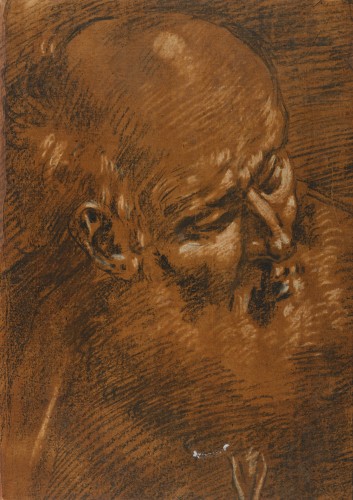
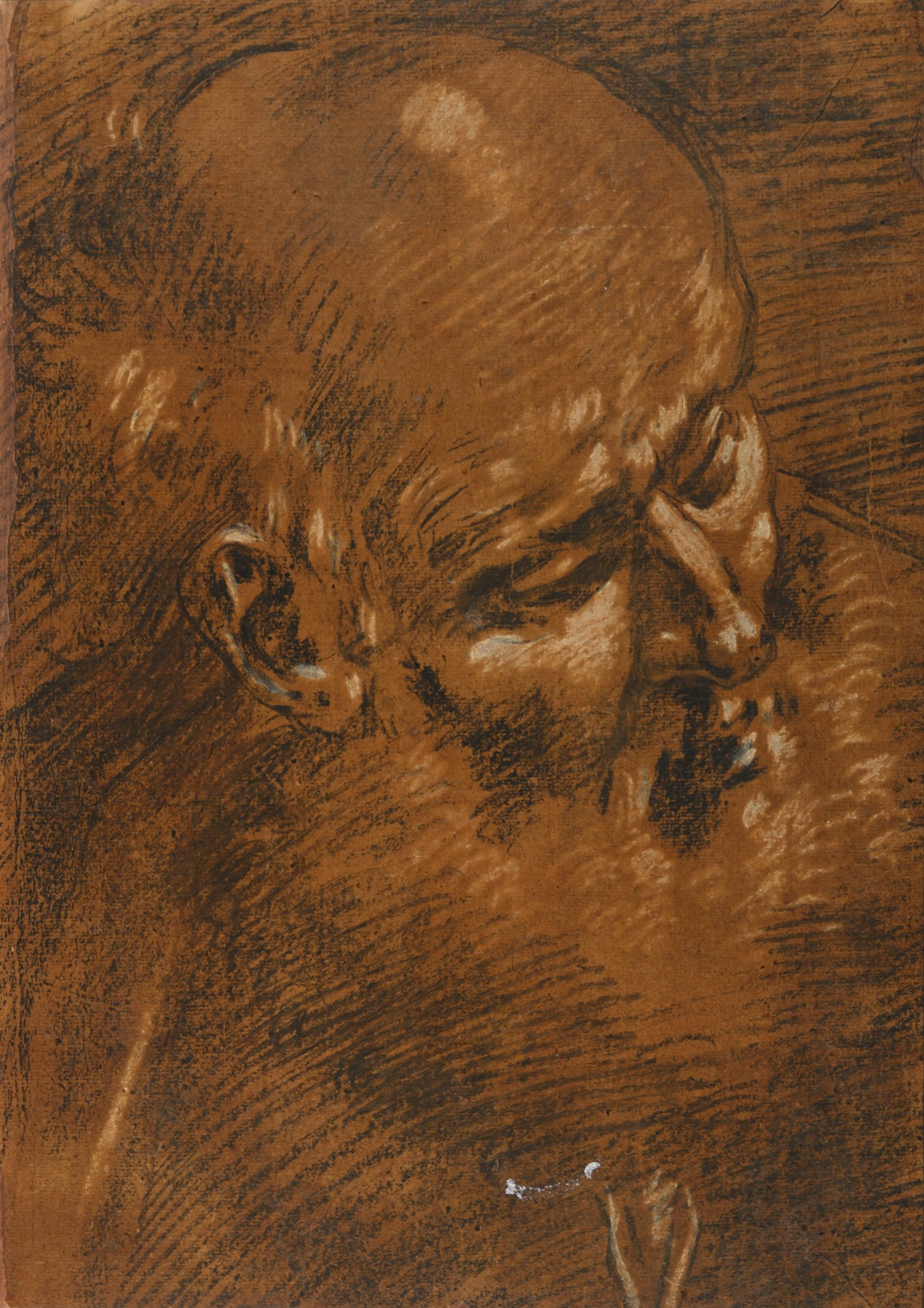
Head of an Old Man, probably Saint Joseph
Black chalk with white heightening on brown prepared paper
381 × 273 mm (15 × 10¾ in)
Provenance
Probably Pierre-Jean Mariette, Paris, traces of his characteristic blue mount;
His sale, Paris, F. Basan, 15 November 1775 – 30 January 1776, lot 361;
Sale, London, Christie's, 1 July 1986, lot 83;
Acquired on that occasion by Jeffrey E. Horvitz;
His sale, New York, Sotheby's, 23 January 2008, lot 57.
Exhibition
Italian Old Master Drawings from the Collection of Jeffrey E. Horvitz, Gainesville, Samuel P. Harn Museum of Art, and other venues, 1991–1993, no. 18.
Giacomo Cavedone was one of the significant painters and draftsmen of the early seventeenth-century Bolognese school. Born in Sassuolo in 1577, he trained in the artistic milieu of Bologna, then one of the major centres of the Italian pictorial renewal initiated by the Carracci. He worked notably in the circle of Ludovico Carracci, whose influence can be seen in the solidity of the drawing, the expressive sensitivity of the figures and the careful attention to light.
In both his drawings and paintings, Cavedone demonstrates a remarkable ability to capture human presence. This study of a head provides a particularly eloquent example. The elderly man, shown in profile and slightly leaning forward, is rendered with powerful modelling and strong psychological intensity. Deep wrinkles, a full beard and the volumes of the skull are suggested with great economy of means yet striking precision.
The technique—black chalk on brown prepared paper with white heightening—allows the artist to construct the form through a subtle interplay of shadow and light. Soft hatching structures the surface, while touches of white emphasize the illuminated areas of the forehead, nose and beard. The result is a sculptural sense of relief characteristic of seventeenth-century Bolognese draftsmanship.
The meditative character of the face and the dignity of the model have led scholars to identify this type of study as a possible preparation for the figure of Saint Joseph. Artists of the period frequently produced such head studies to establish expression and physiognomy before integrating them into a larger religious composition.
Beyond any preparatory function, the sheet possesses an evident artistic autonomy. The inward gaze of the old man, the density of the line and the warmth of the brown paper give the work a striking presence, revealing the deeply human sensibility that characterizes Bolognese art of this period.