Offered by Galerie Gabrielle Laroche

ORIGIN : FRANCE, SCHOOL OF FONTAINEBLEAU
PERIOD : SECOND RENAISSANCE – SECOND HALF OF 16TH CENTURY
Height: 205 cm
Width : 136 cm
Depth : 63 cm
Walnut Wood and Green Marble Inlay
Good State of Preservation
After his military campaigns in Italy, King Francis I quickly dedicated himself to commissioning some of the most remarkable ornamental works in France, executed by Italian architects.
The School of Fontainebleau, with Rosso Fiorentino (known as Il Rosso), a pupil of Raphael, and Primaticcio, responsible for the creation of the Great Gallery of François I, laid the foundations for the decorative arts introduced from across the Alps. The fabulous stucco sculptures surrounding the central frescoes served as models during this period.
At this time, the structure of furniture was evolving, drawing inspiration from the revival of Greek and Roman architecture. Furniture also adopted a new decorative style, known as the "Bellifontaine Mannerism", marked by the study of the antique. The ornamental vocabulary evolved in line with antique tastes, featuring motifs such as palmettes, pilasters, small columns, cherubs, and ram’s heads.
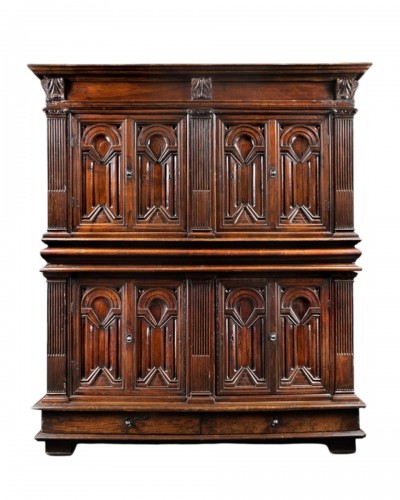
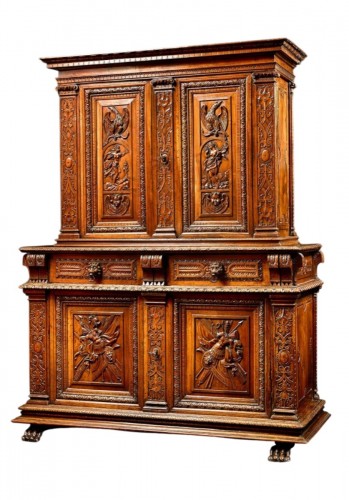
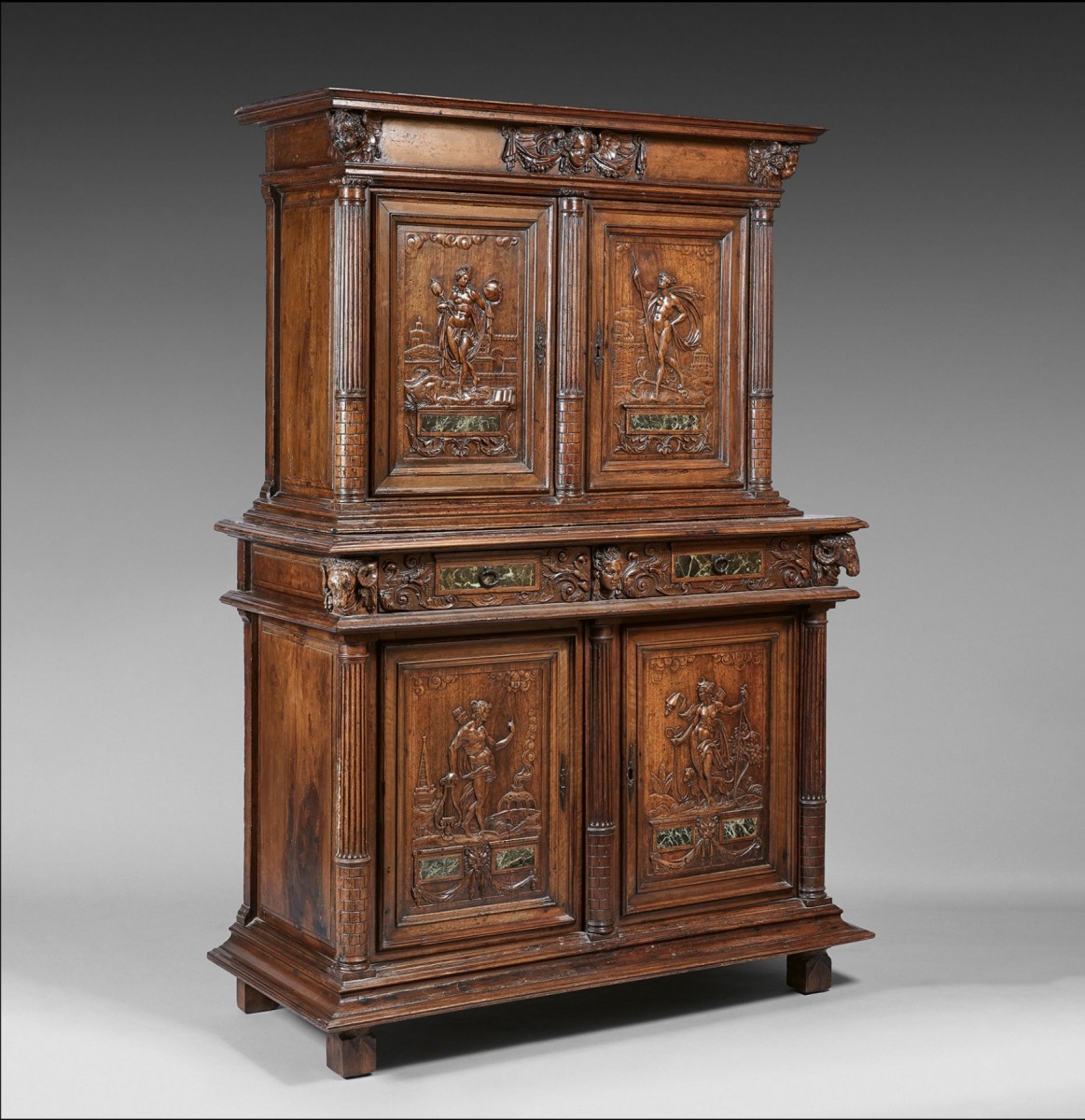
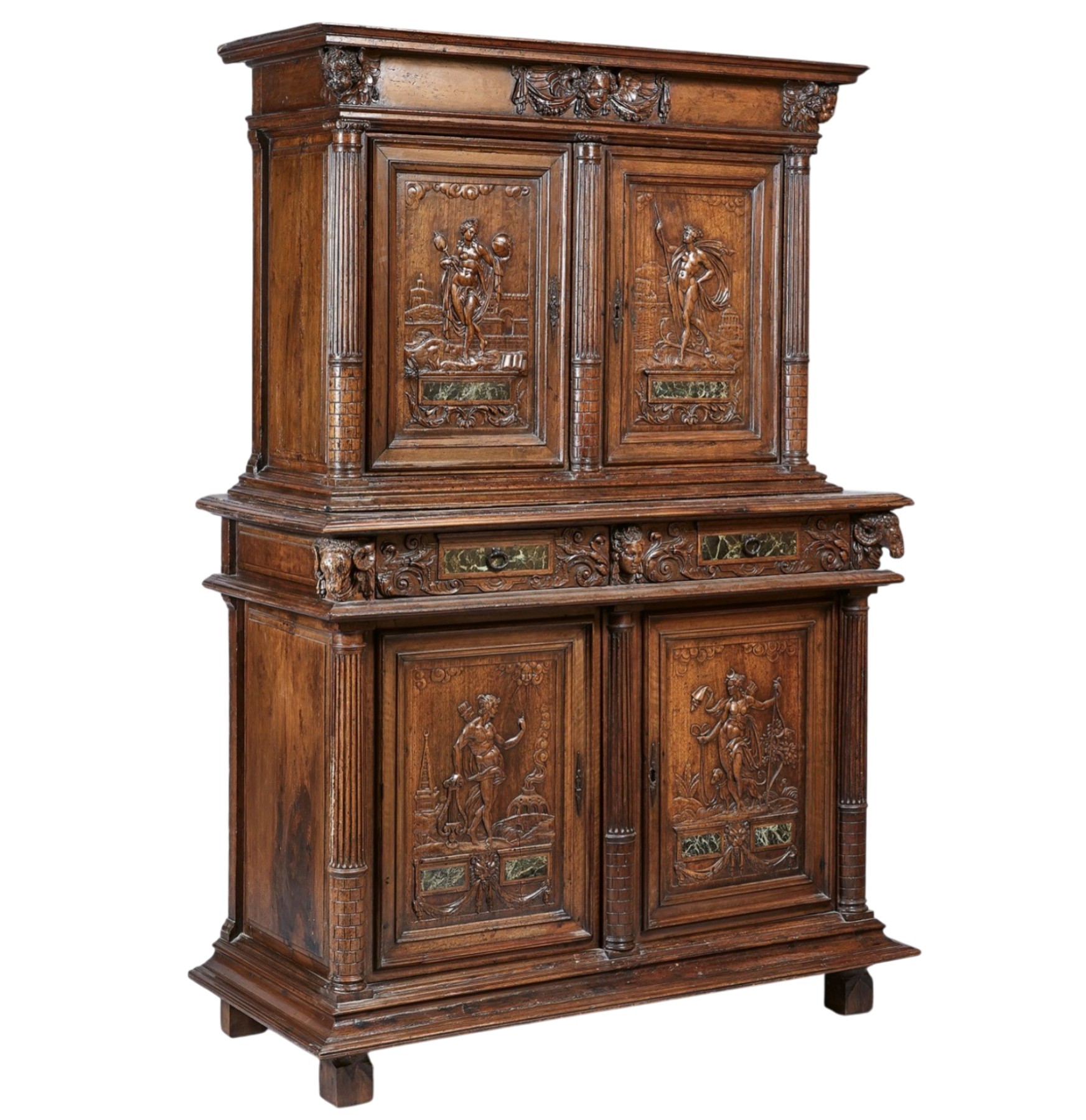
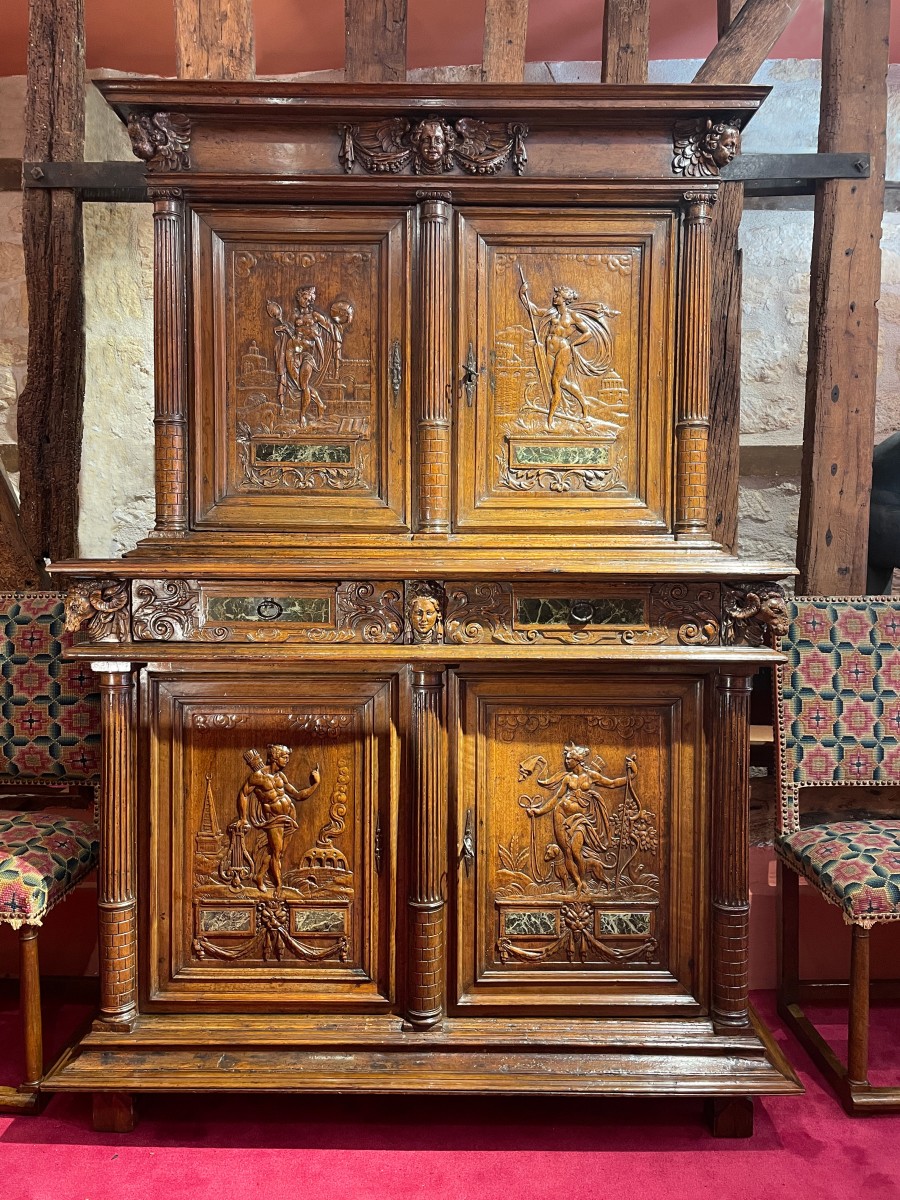
This two-body cabinet, with slight recess, is crafted from beautiful walnut wood. Its four doors are adorned with mythological figures, collectively evoking a well-known theme from mythology: Hera’s Jealousy of Leto, who was forced to sail and anchor on an island to give birth to Apollo and Artemis.
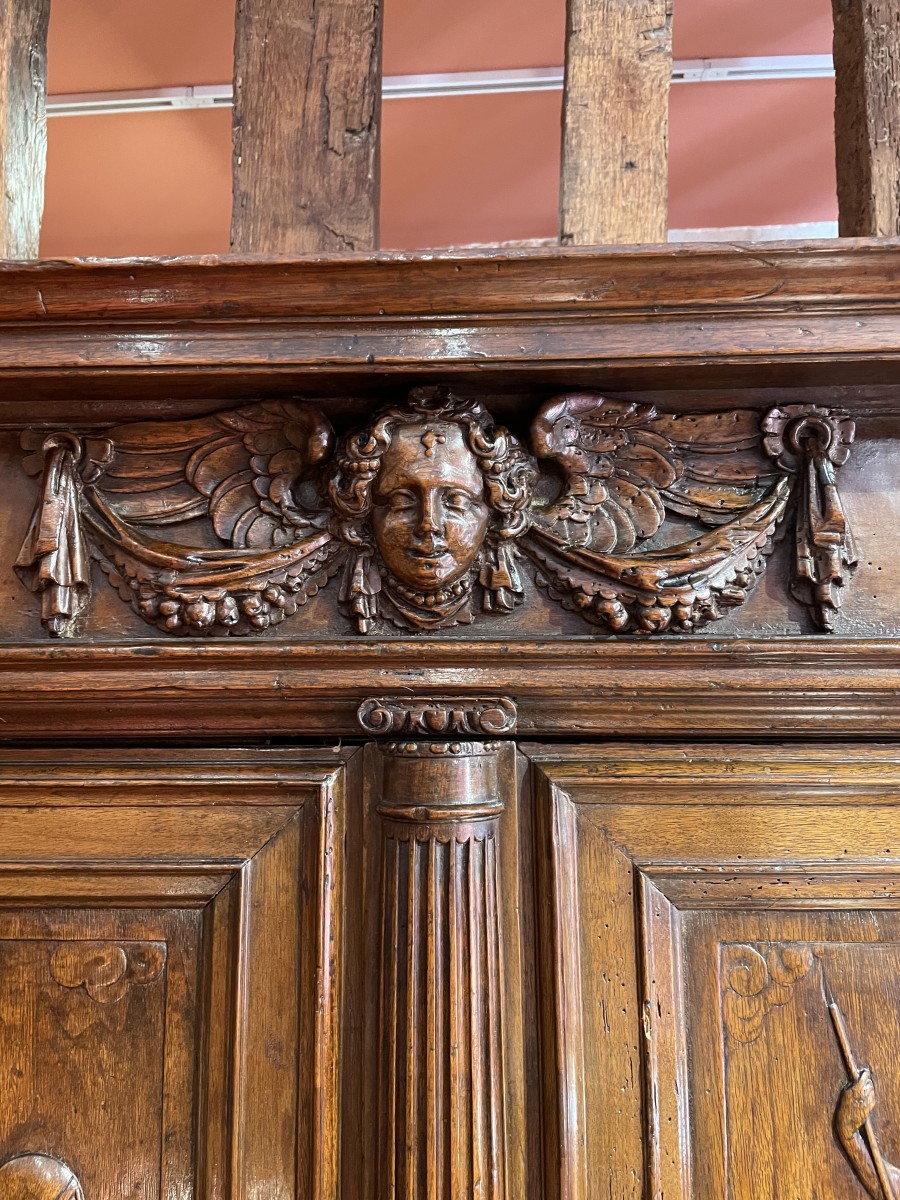
The upper body opens with two molded doors, hinged into the frame and divided by three fluted columns on a base with a bracket.
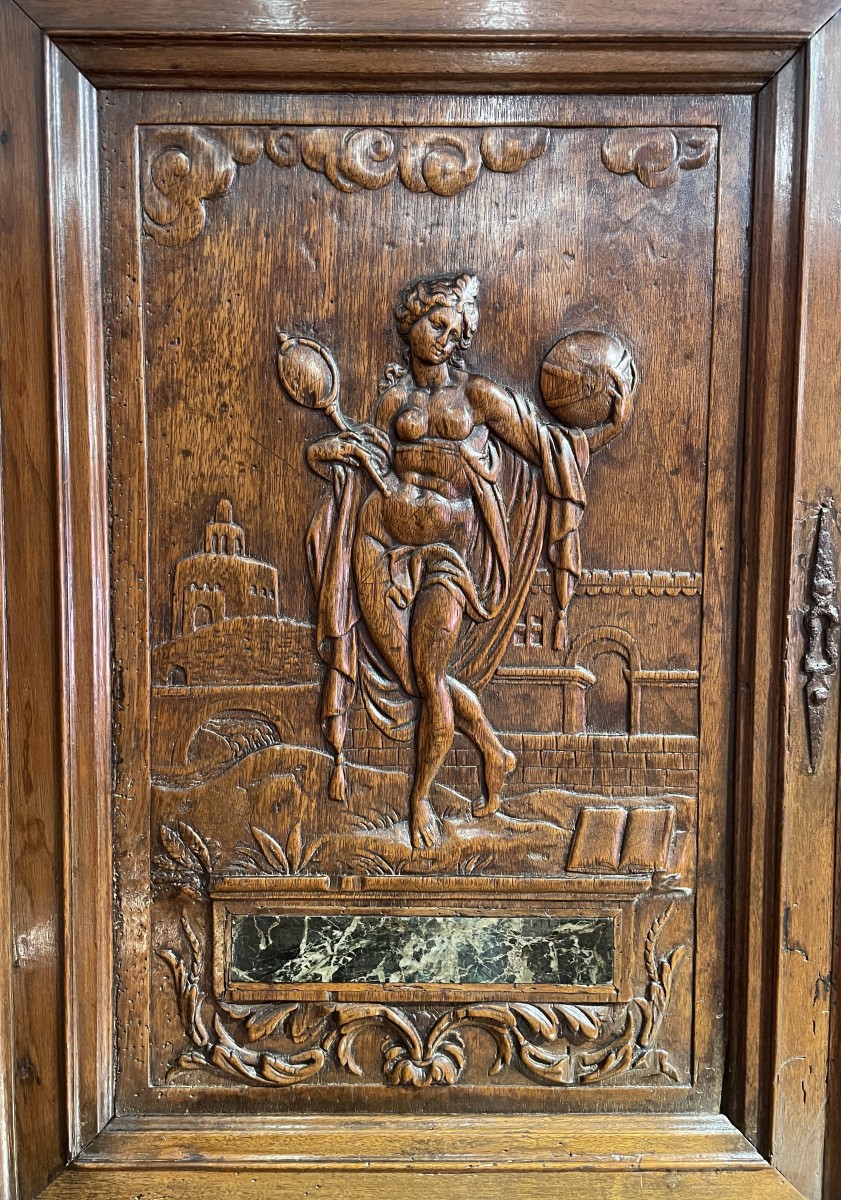
The left door depicts Hera, the wife of Zeus and the mother of all the gods. In Olympian myth, Hera is Zeus’ wife and sister. She is the protector of marriage and family but is also a powerful and vengeful woman who punishes Zeus’ many lovers, including Leto. Often portrayed with a mirror, she is shown here holding an orb that symbolizes the world.
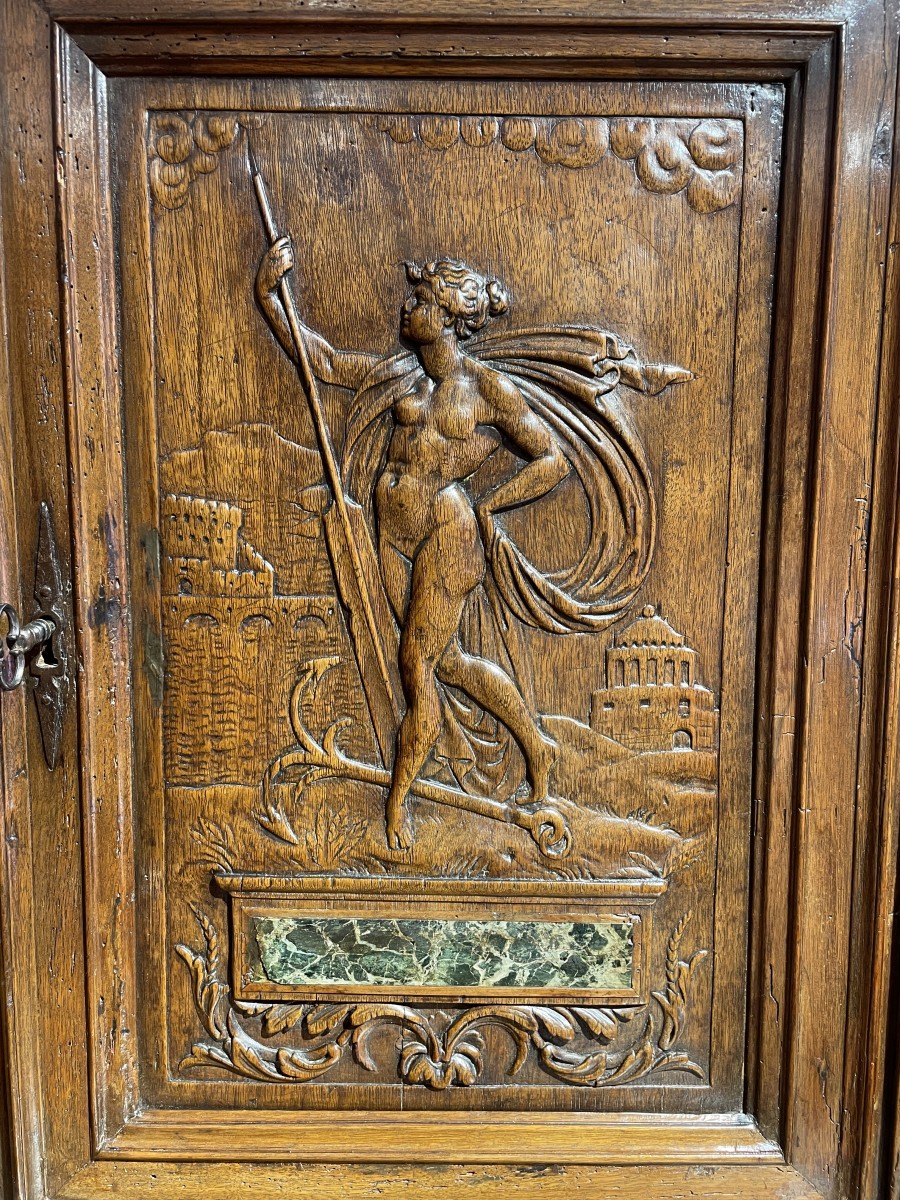
Facing her, on the right door, Leto, Zeus' first wife according to tradition (or a lover, according to some sources), is represented nude, her drapery blowing in the wind. She proudly holds an oar in her right hand, stepping over an anchor—her second attribute. When Zeus united with the goddess Leto, Hera, filled with jealousy, was forced to hide away in a place not bound to the earth, where she gave birth to Artemis (the Moon) and Apollo (the Sun) on the island of Delos.
These figures are depicted in a flat relief amidst a backdrop of citadels, above a plaque inlaid with green marble, enhancing the wooden construction.
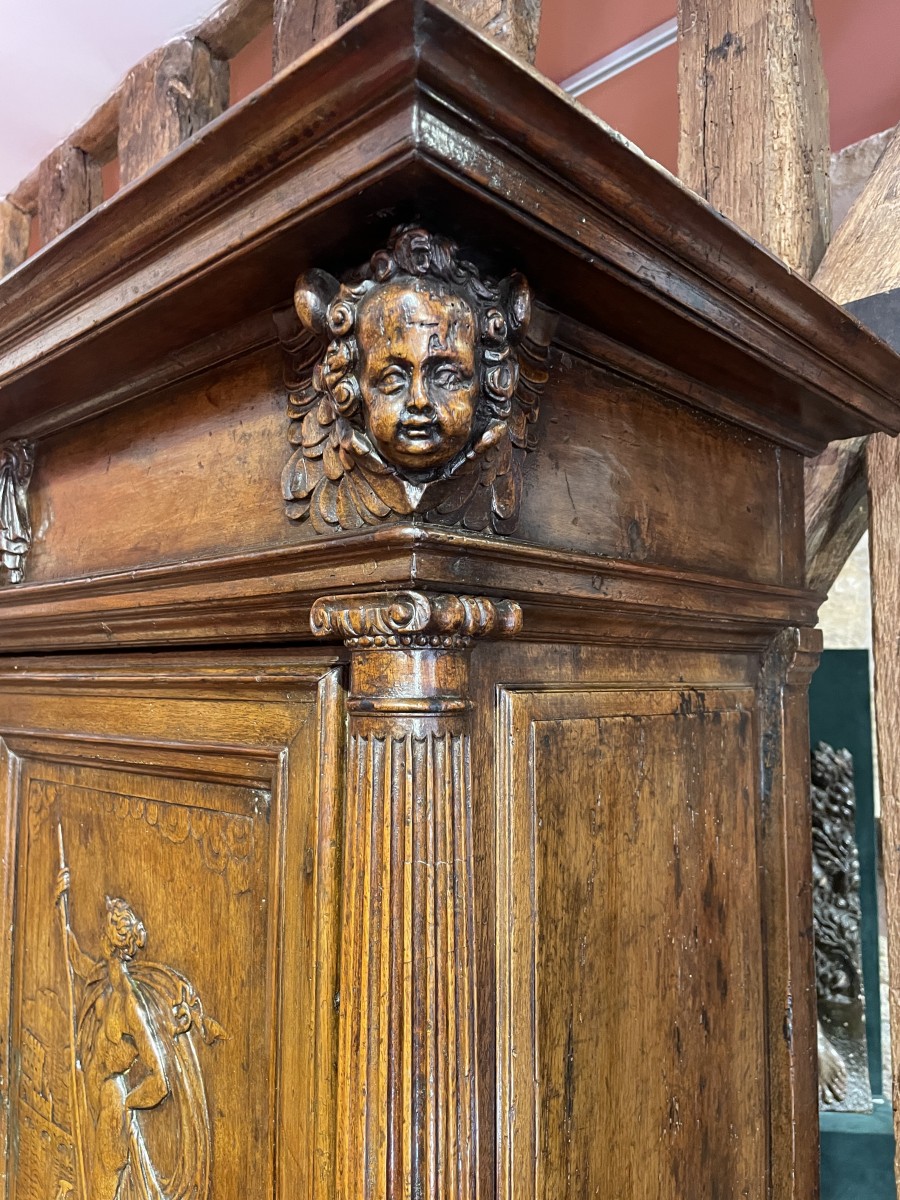
An entablature crowns the cabinet, featuring a beautiful winged female figure with an angelic demeanor, her brow adorned with a fibula, set within a draped garland typical of the Renaissance style. At the corners of the cabinet are two cherubic heads with rounded cheeks and curly hair, delicately sculpted with striking finesse and emotional sensitivity.
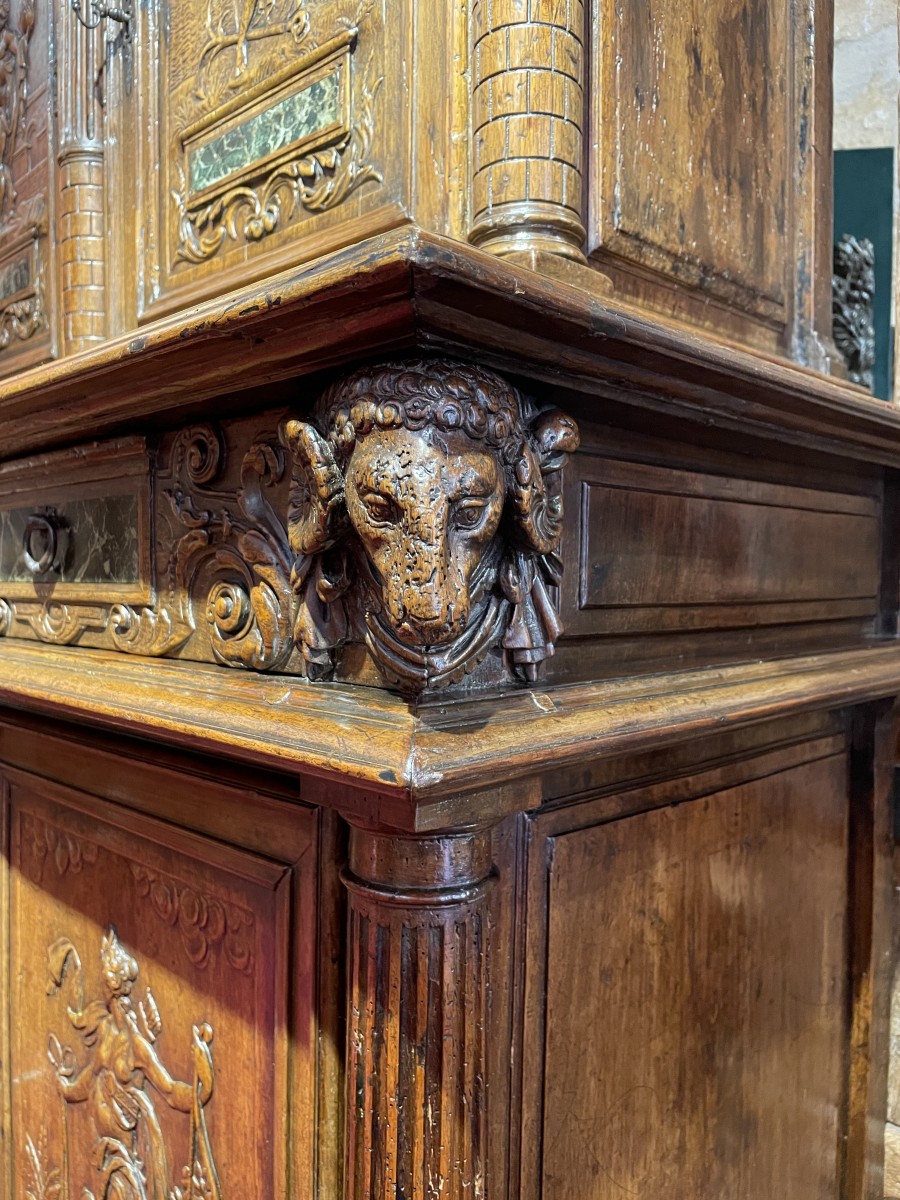
The belt is also ornately decorated. Two drawers inlaid with green sea marble plaques, framed by leafy scrolls, are separated by the face of a woman, crowned with a braided string of pearls. Two beautiful ram’s heads, with intricately curled horns and boldly carved in the characteristic Bellifontaine style, decorate the angles.
The lower body mirrors the upper body in layout. Two doors are framed by three fluted columns. The children of Zeus and Leto are depicted here.
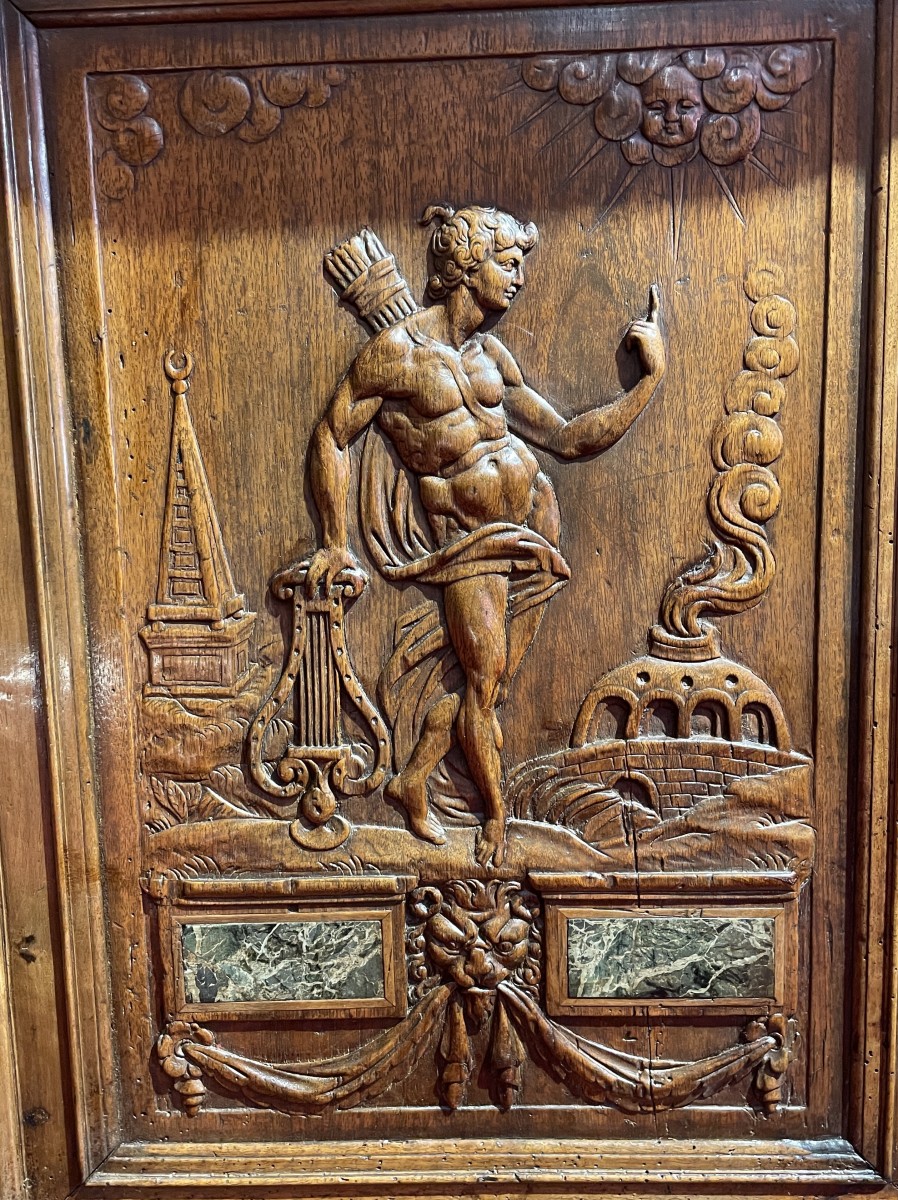
On the left door, Apollo, the god of the arts, song, music, poetry, and light, is shown with his attributes. Poised with a lyre in his right hand, he is depicted in a fanciful antique setting, with an odalisque under a crescent moon. With his finger, he points to the Sun, personified within voluptuous clouds. From a cottage, smoke rises in beautifully drawn spirals.
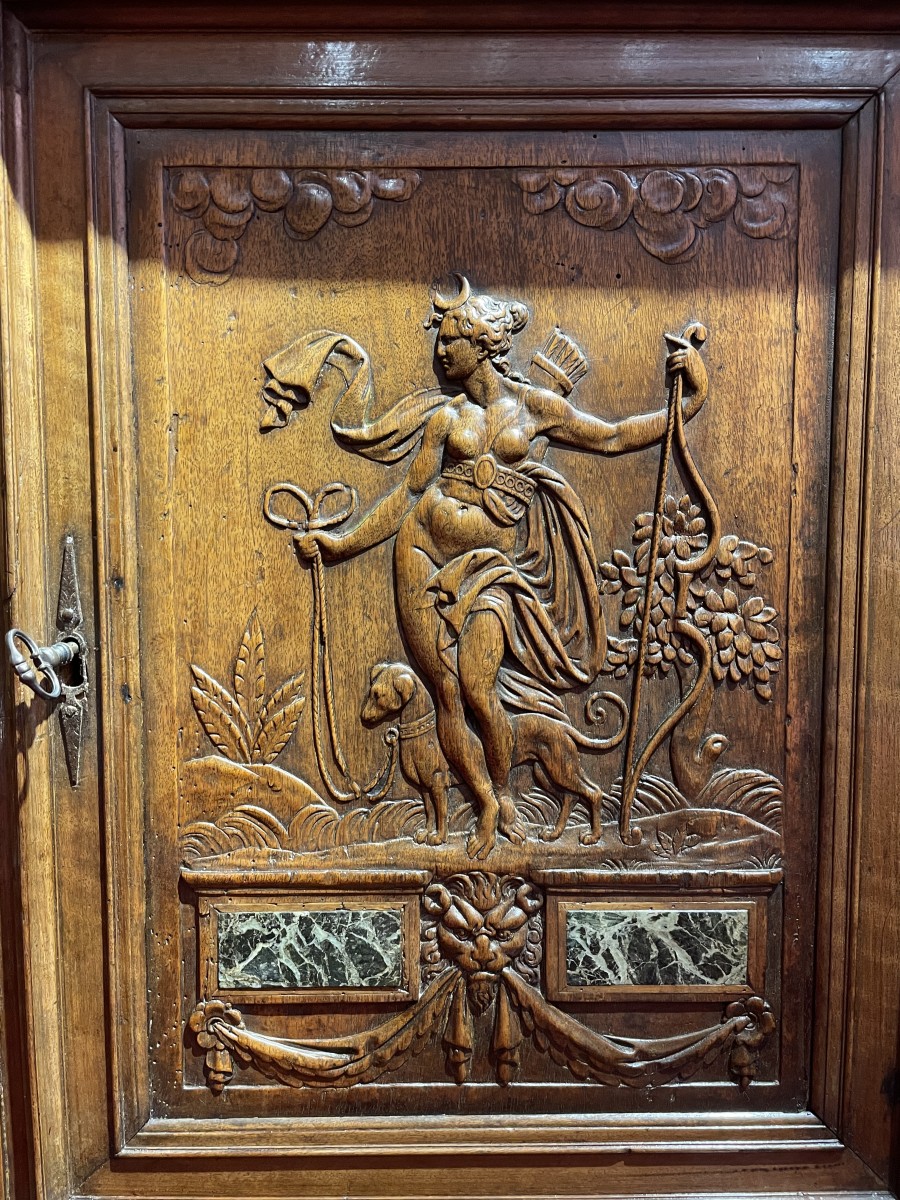
On the right door, Artemis, the huntress, is depicted. The twin sister of Apollo, daughter of Zeus and Leto, Artemis is the protector of animals. Holding a dog on a leash, she is crowned with a crescent moon, one of the goddesses associated with the Moon, in contrast to her brother, who is associated with the Sun.
At the lower part of the doors, two green marble cartouches are centered with a leonine mask, from which two tied draperies emerge—another typically Renaissance motif.
More than just an ornamental piece, this cabinet is a hymn to Love and its tribulations. With its original iconographic theme and the presence of these various mythological figures, it may have been commissioned for a marriage celebration.
The sculptural craftsmanship, the precision of the composition, and the respect for proportions make this architecturally structured piece a perfect example of Bellifontaine Renaissance furniture.