Offered by Galerie Thierry Matranga
REQUEST INFORMATION
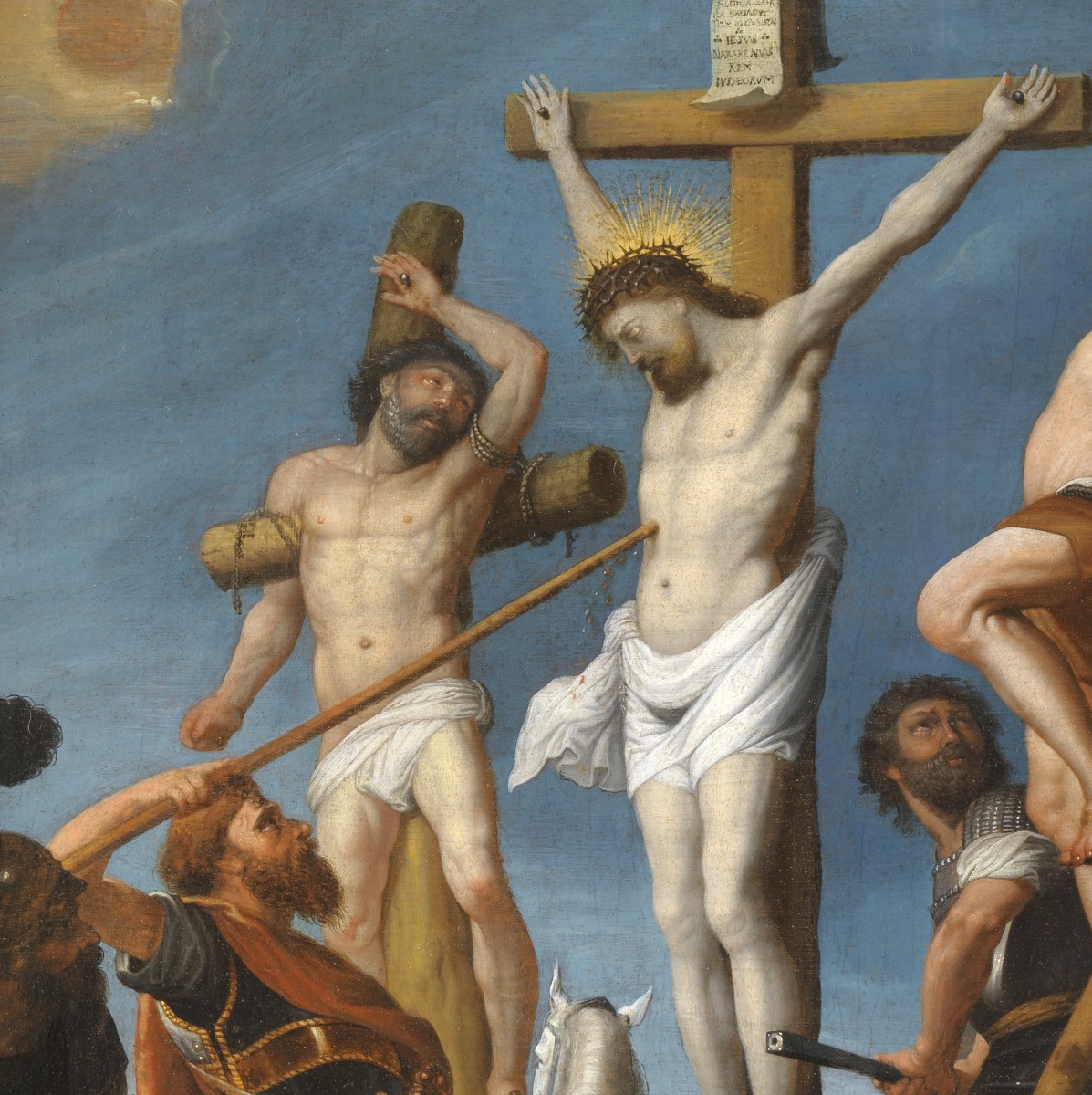
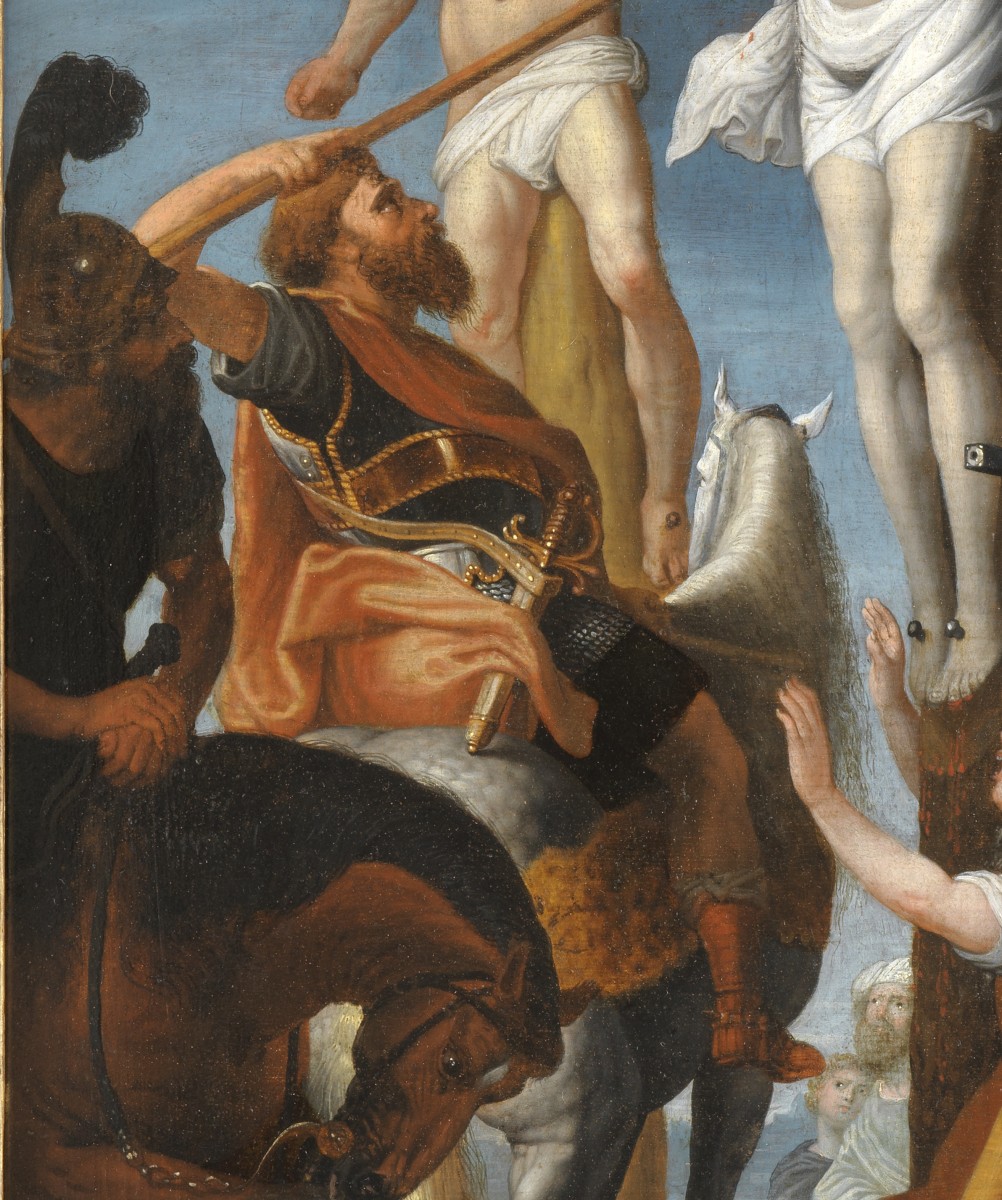

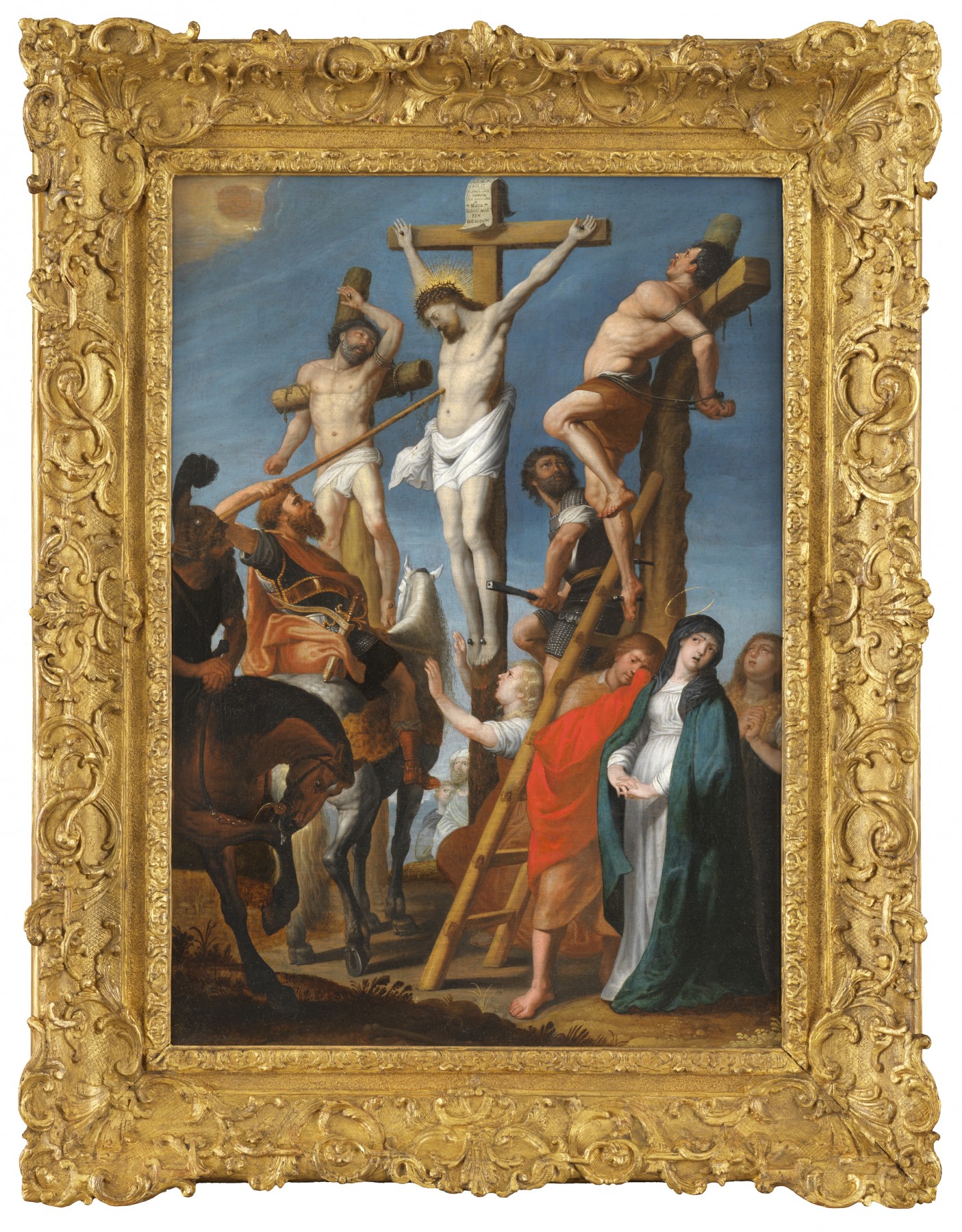
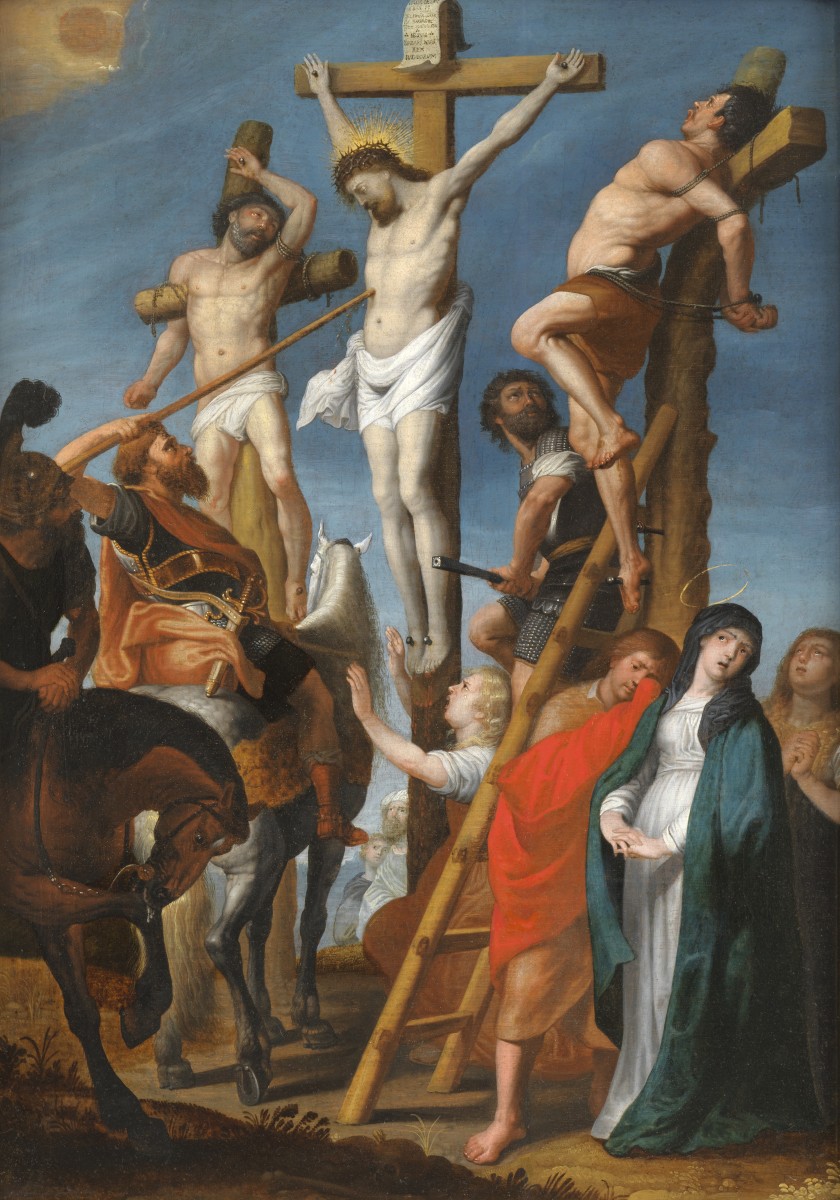
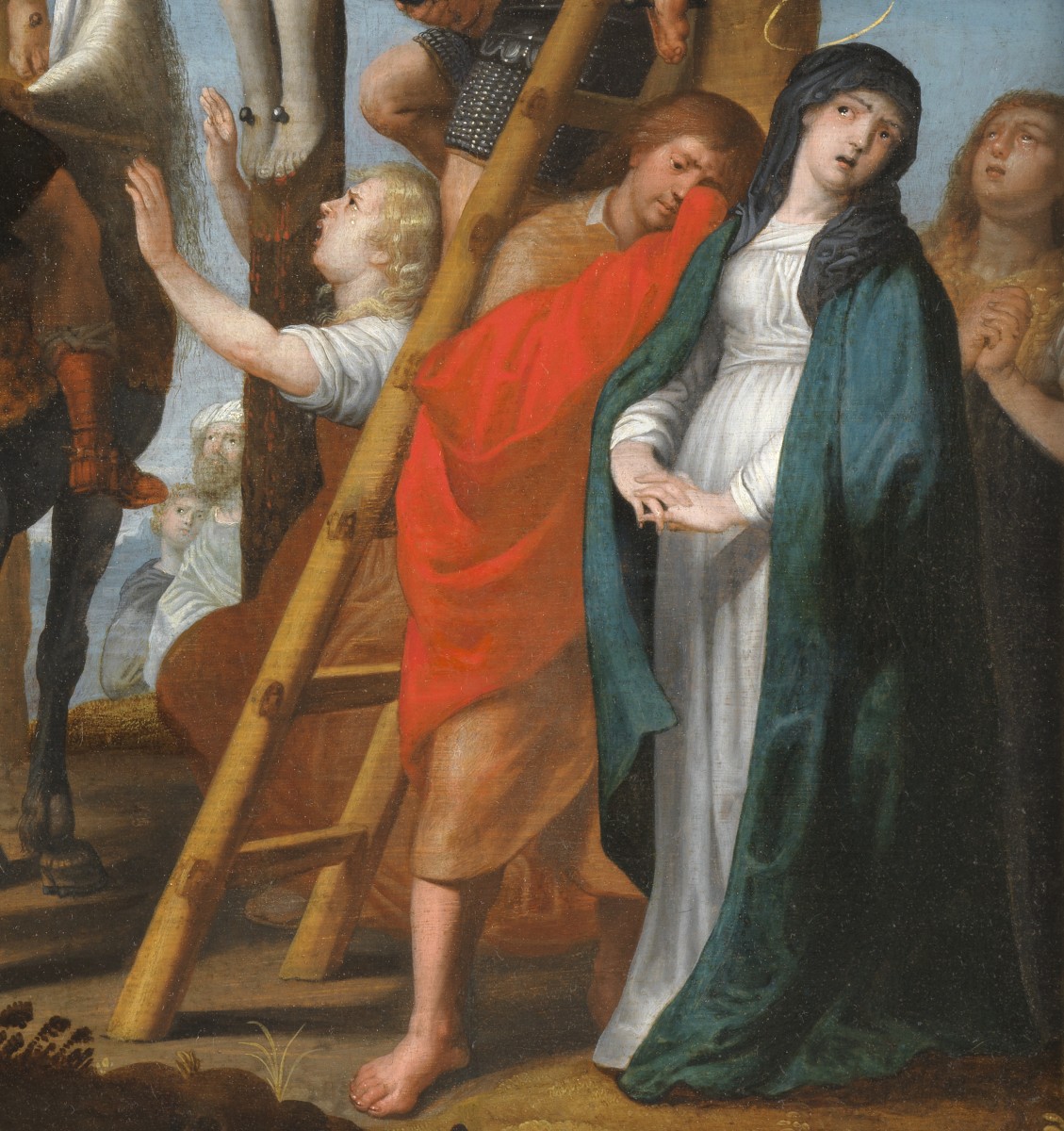
Oil on prepared panel. Lorraine School, first third of the 17th century, attributable to Jean Le Clerc (Nancy 1586/88 – ibid. 1633), after the large panel painted in 1620 by Antoon van Dyck, now preserved at the KMSKA in Antwerp.
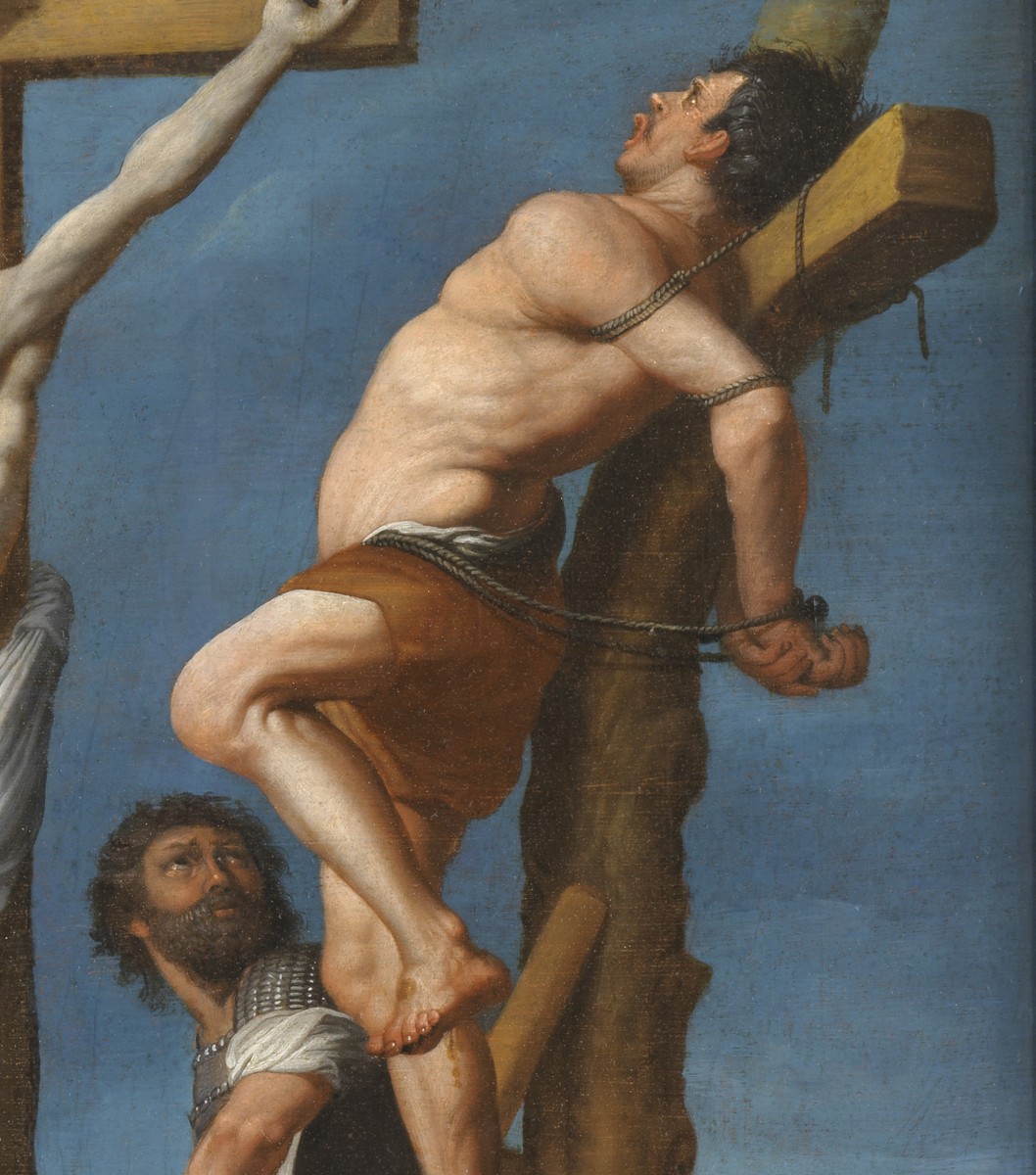
Our composition, tightly focused on the Crucifixion of Christ and the two thieves, follows a scheme inherited from the Antwerp tradition: the three crosses arranged along an ascending diagonal, amplifying the dramatic intensity of the scene. The soldier in chain mail standing on the ladder brandishes a metal club, an action explicitly referring to the Johannine account of the breaking of the legs, a choice that shifts the emphasis toward the very moment of the execution rather than the Lamentation. At the foot of the central cross, the holy figures—Mary, Mary Magdalene, John, and other disciples—express their anguish, while on the left the mounted Roman soldiers introduce a narrative counterpoint, with Longinus thrusting his lance into Christ’s side. The blue sky, crossed by a veil of clouds, opens the composition and reinforces its overall clarity.
While the general structure and several secondary motifs clearly derive from van Dyck’s prototype preserved at the Royal Museum of Fine Arts in Antwerp, the painterly execution differs noticeably: the paint layer is thin, the transitions soft, and the flesh tones clear and rosy. The faces, simplified and only lightly individualised, reveal a desire for unity rather than heightened drama. The palette, dominated by softened browns and luminous blues, together with a light distributed evenly across the surface, evokes the religious production of provincial workshops in north-eastern France, and more specifically Lorraine, a region in direct contact with the Spanish Netherlands. The choice of support—a prepared panel, common in Lorraine workshops—reinforces this hypothesis.
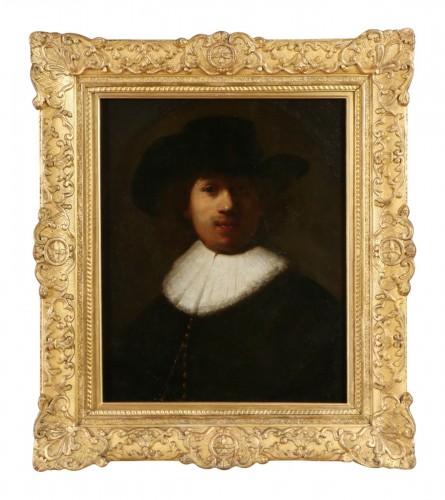
The treatment of Christ—an elongated silhouette, softened musculature, and moderated anatomical tension—moves away from both Rubensian vigour and Van Dyckian robustness. This expressive restraint, combined with marked narrative clarity, corresponds to the sensibility of Jean Le Clerc, who assimilated Flemish models while softening their impact. It should be noted that Le Clerc met van Dyck in Rome shortly after the latter completed his Lance Blow (1620). It was there that the Antwerp master portrayed his Lorraine colleague in 1622, shortly before Le Clerc’s return to Nancy. Could our painting, intended for private devotion, be a tribute by Le Clerc to his fellow painter and friend?
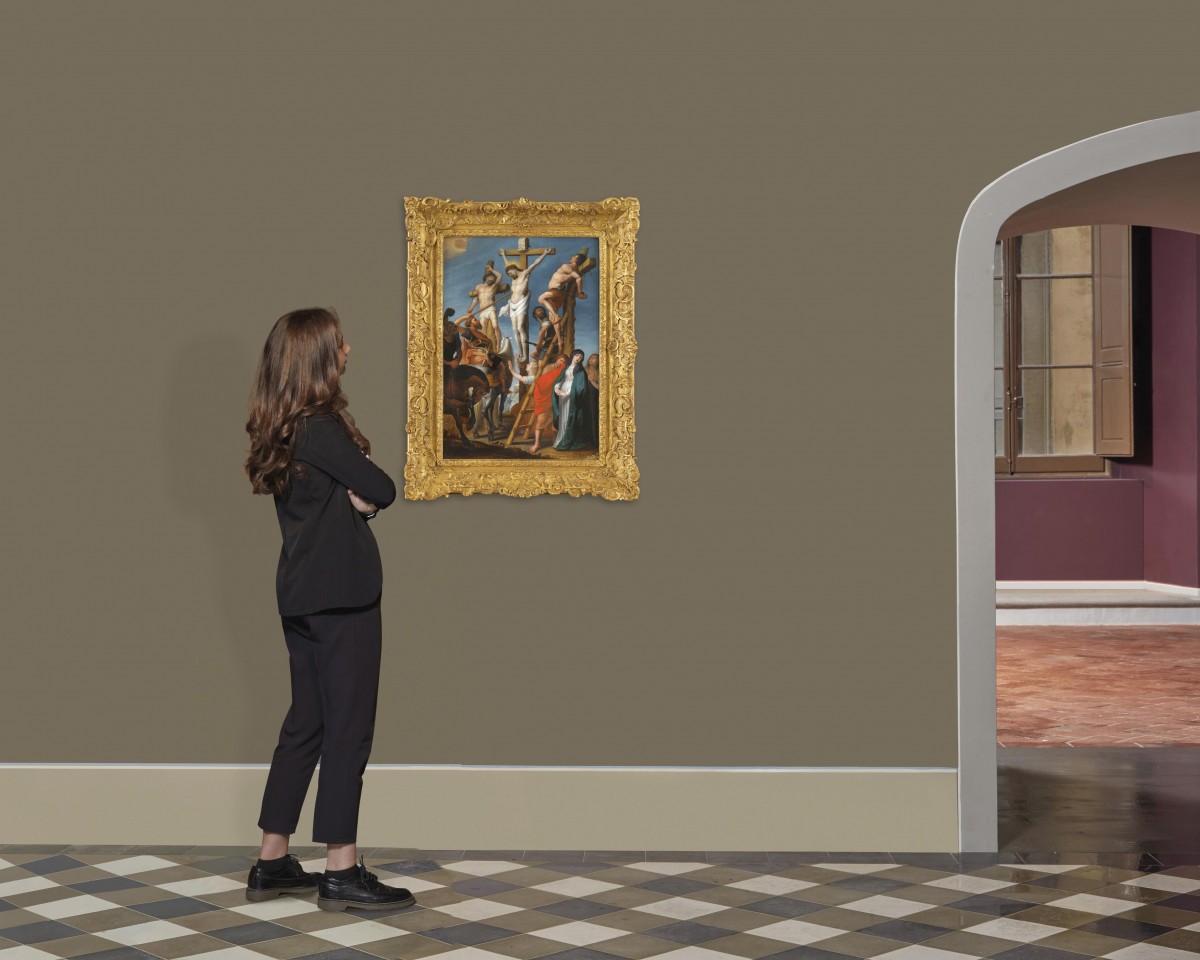
Our Crucifixion is enhanced by its French carved and gilded wood frame from the Louis XIV period.
Dimensions: 62 × 45 cm (panel) — 78 × 60 cm (with frame).
Sold with invoice and certificate of authenticity
Biography:
Jean Le Clerc (Nancy 1586/1588 – ibid. 1633) was one of the most significant Lorraine painters of the early 17th century. In his Histoire de Lorraine, published in 1919, Robert Parisot described him as “the greatest Lorraine painter of that period.” At a young age, Le Clerc travelled to Italy, where he trained first in Rome and then in Venice, becoming a disciple and collaborator of Carlo Saraceni. Upon Saraceni’s death in 1620, he completed several unfinished works, notably the large composition of Doge Dandolo in the Doge’s Palace in Venice.
Returning to Nancy in 1622, he became the official painter to Duke François of Lorraine and helped introduce a new aesthetic to the region, combining Caravaggesque influences with the Venetian heritage. His work, sometimes difficult to distinguish from that of Saraceni, occupies an essential place in the circulation of artistic styles between Italy and Lorraine at the beginning of the 17th century.
Bibliography:
- Vlieghe Hans, Corpus Rubenianum Ludwig Burchard, Phaidon Press, 1972–.
- Balis Arnout, Rubens: Copies and Adaptations from Renaissance and Later Artists, Harvey Miller Publishers, 2006.
- Thuillier Jacques, La peinture française au XVIIe siècle, Flammarion, 1982.
- Mérot Alain, La peinture française au XVIIe siècle, Citadelles & Mazenod, 1994.
- Foucart Jacques, Peintres provinciaux en France au XVIIe siècle, Réunion des Musées Nationaux, 1985.
- Fagnart Laure, Artistes et commanditaires entre Lorraine et Pays-Bas espagnols, Presses Universitaires de Nancy, 2012.
- Choné Paulette, L’art en Lorraine au XVIIe siècle, Éditions Serpenoise, 1991.
- Jacquot Dominique (dir.), Peindre en Lorraine au XVIIe siècle, Musée des Beaux-Arts de Nancy, 1998.
- Fagnart Laure, Jacquot Dominique, La Peinture religieuse en Lorraine, Presses Universitaires de Nancy, 2005.