Offered by Kolhammer & Mahringer Fine Arts
REQUEST INFORMATION

Specialised with sculptures and old master paintings
Rhineland
Around 1330
Wood carved & polychrome painted
Height 35 cm
Seat of wisdom: a depiction from around 1330
The Madonna as Sedes Sapientiae (“Seat of Wisdom”) is one of the central iconographic representations of Mary in medieval art, the origins of which probably lie in the Byzantine tradition. This particular motif of the enthroned Virgin with the Christ Child on her lap emphasizes her role as the Mother of God and as the embodiment of divine wisdom. Such images were highly valued for their devotional function, as their symbolic, frontal depiction drew the viewer’s attention to Mary and Christ in equal measure. Sculptures of this kind often formed the focal points in churches and chapels and invited people to pray and worship, especially in monastic and religious communities in which Marian devotion played a central role. As Sedes Sapientiae , Mary appears not only as the mother, but above all as the throne of Christ – an image that emphasizes her unique position in the divine order.
Materiality & composition
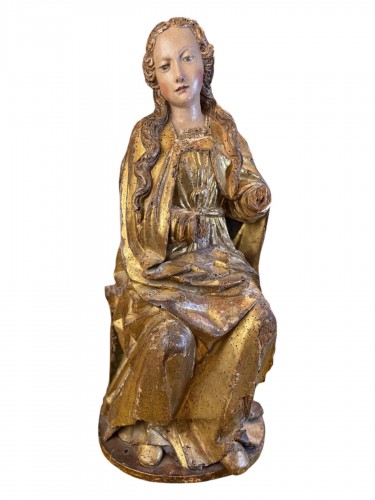
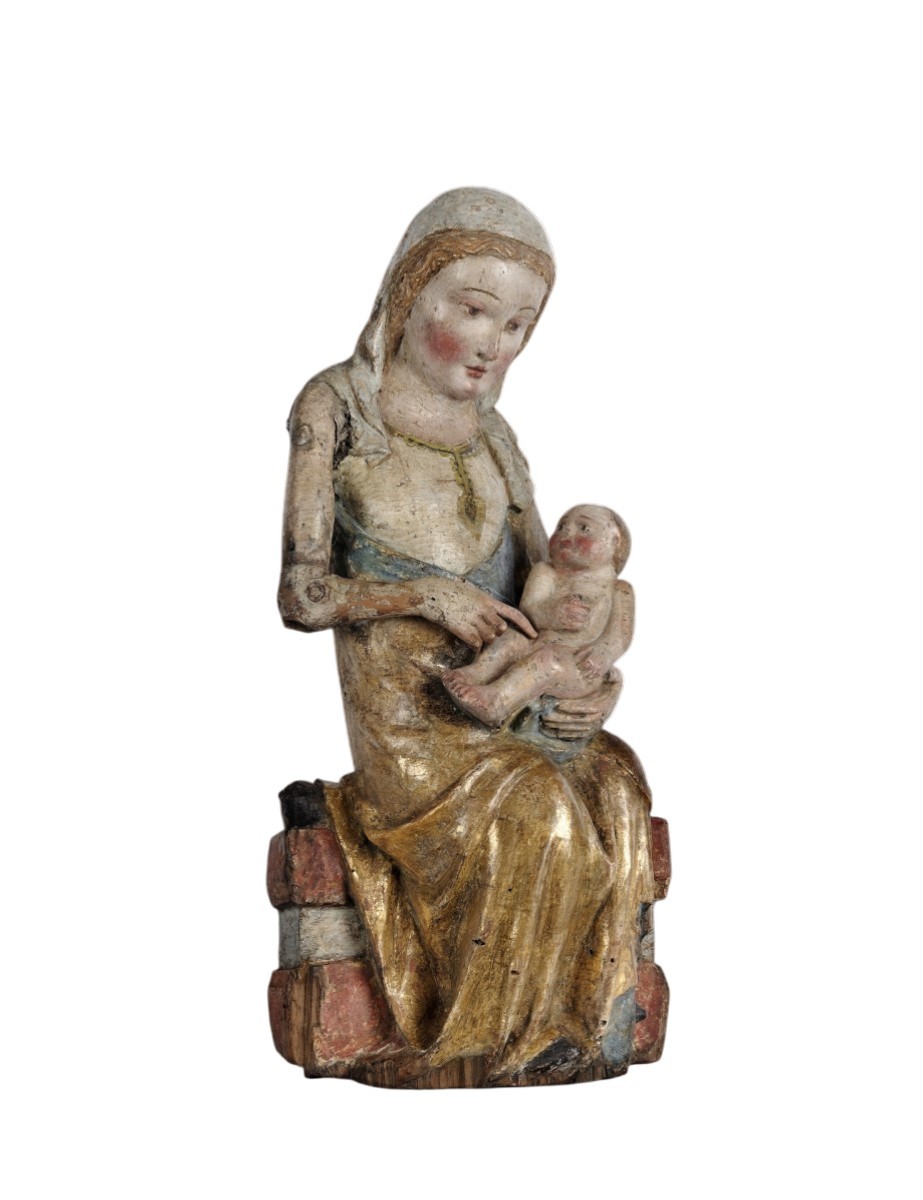
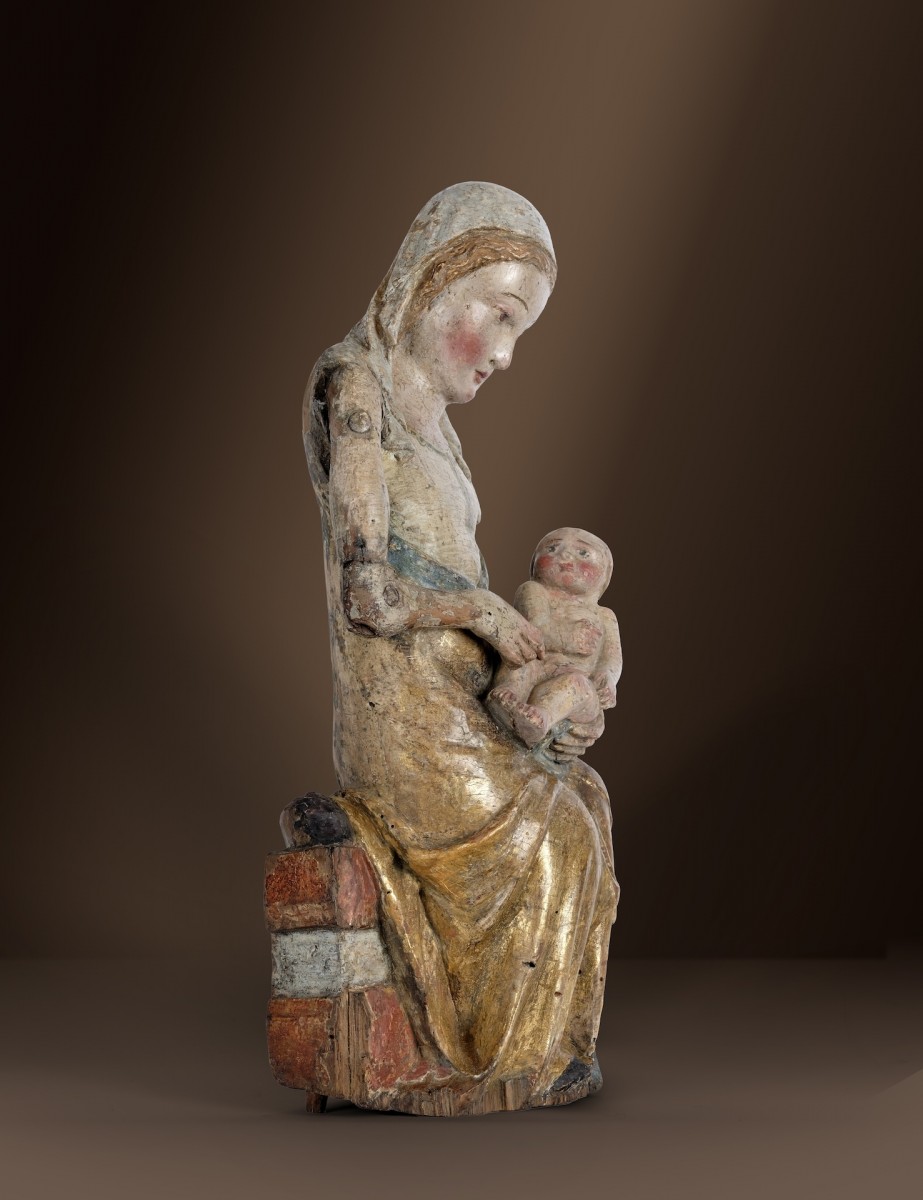
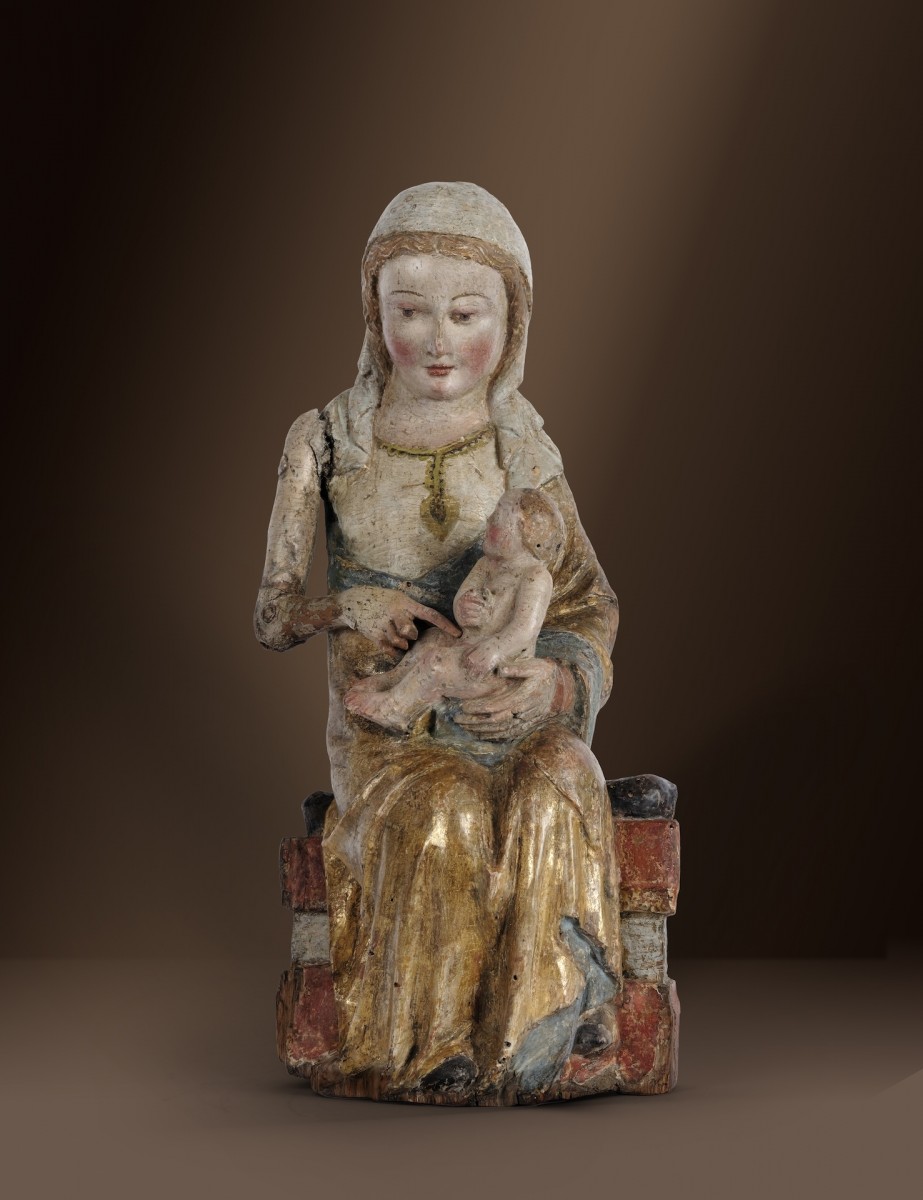
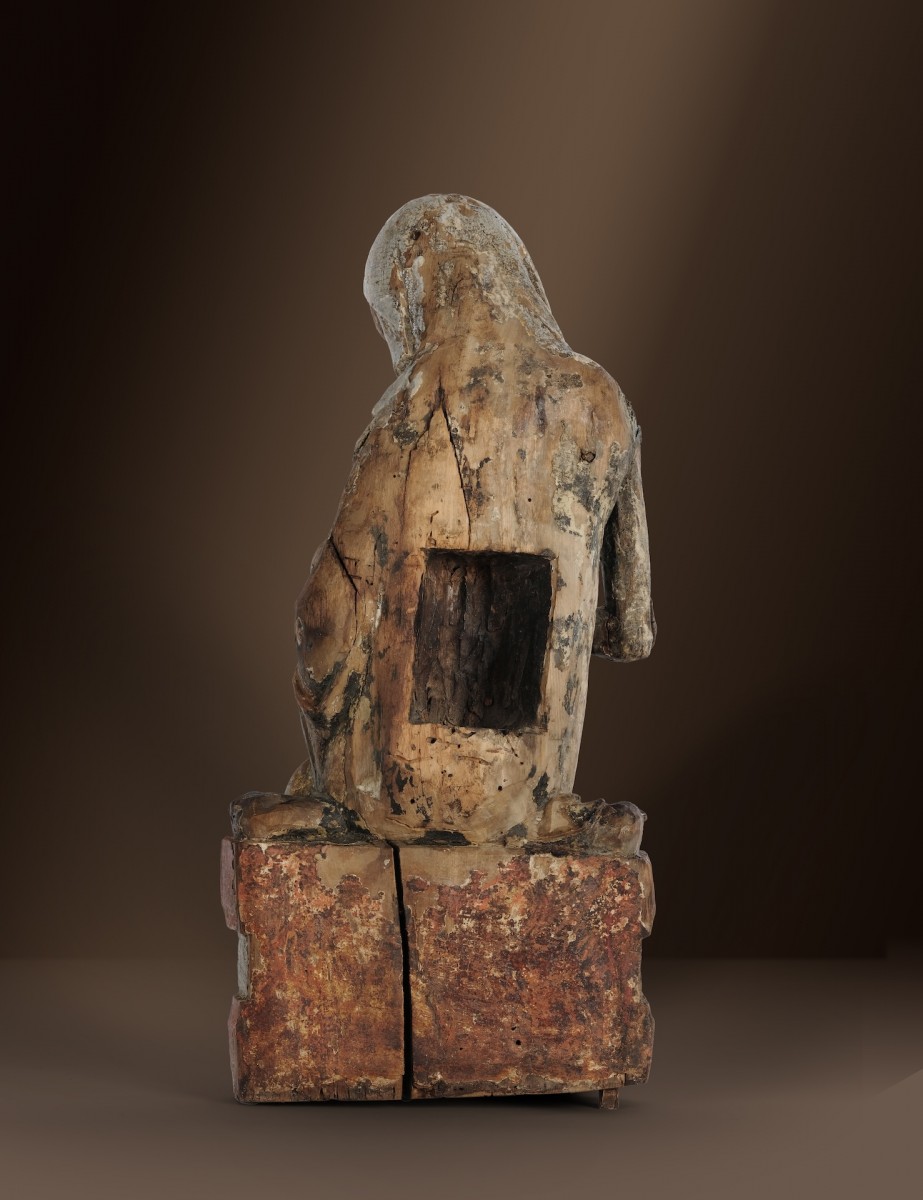
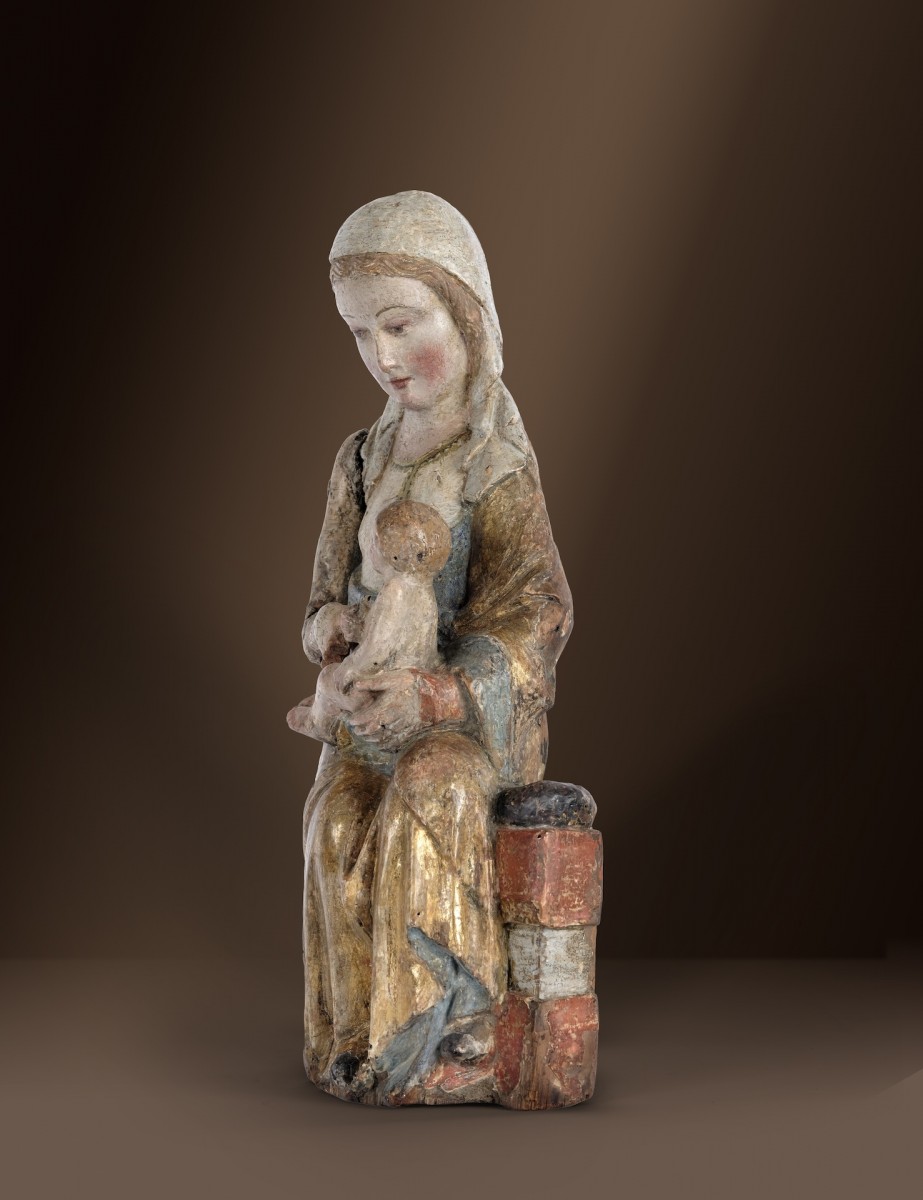
The present sculpture was created around 1330 and is carved from wood, with remnants of its original polychromy. Mary is seated on an expansive throne chair; the back is partially hollowed out in a rectangular shape, giving an indication of the production technique. Mary’s elongated torso is typical of this period and probably indicates that the figure was raised in a sacred space.
Posture & gaze
In her left arm, she holds the infant Jesus, who is also clothed and looking up at his mother. With her right hand, Mary appears to be reaching for the child and at the same time presenting it to the viewer. Although Mary is shown in a frontal position, her body is turned slightly to the side. Her gaze is directed downwards, slightly past the child – probably towards the intercessors. This breaks up and loosens up the strictly frontal position of the Romanesque depictions of this type, giving the mother and child a more naturalistic, lifelike expression. Mary thus also appears as a figure of identification for the viewer.
Technique & polychromy
The figure is carved almost in half relief. The right arm is original, movably attached. The original color scheme is also very well preserved: Mary’s dress appears in white, over which she wears a golden cloak. A white veil lies over her head, draped in folds over her shoulders and framing her shoulder-length hair.
Drapery & style around 1330
The drapery is characteristic of this period: it combines the strict and clearly structured formation of the upper body with a drapery on the lower body that is already loosening up. Angular breaks around the crook of the left arm and the flat, yet carefully laid sections of the lower body soften the austerity and lend the figure a restrained liveliness.
Regional context
It is possible that the sculpture originates from the Rhineland region. This is supported by the stylistic features of the drapery – the overall flat drapery with calmly guided lines, which are condensed on the lower body in carefully staggered, sometimes angularly broken sections (for example on the left crook of the arm) – as well as physiognomic details: deep-set, almond-shaped eyes with slightly lowered lids and a fine smile playing around the mouth. This elaboration lends the depiction the mild expression that can be characteristic of 14th century works from the Rhineland.
Literature
Ilene H. Forsyth, The Throne of Wisdom: Wood Sculptures of the Madonna in Romanesque France, Princeton 1972.