Offered by Galerie Thierry Matranga

Oil on panel, Antwerp school, first third of the 17th century
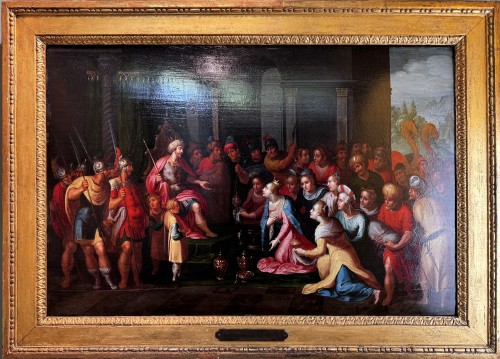
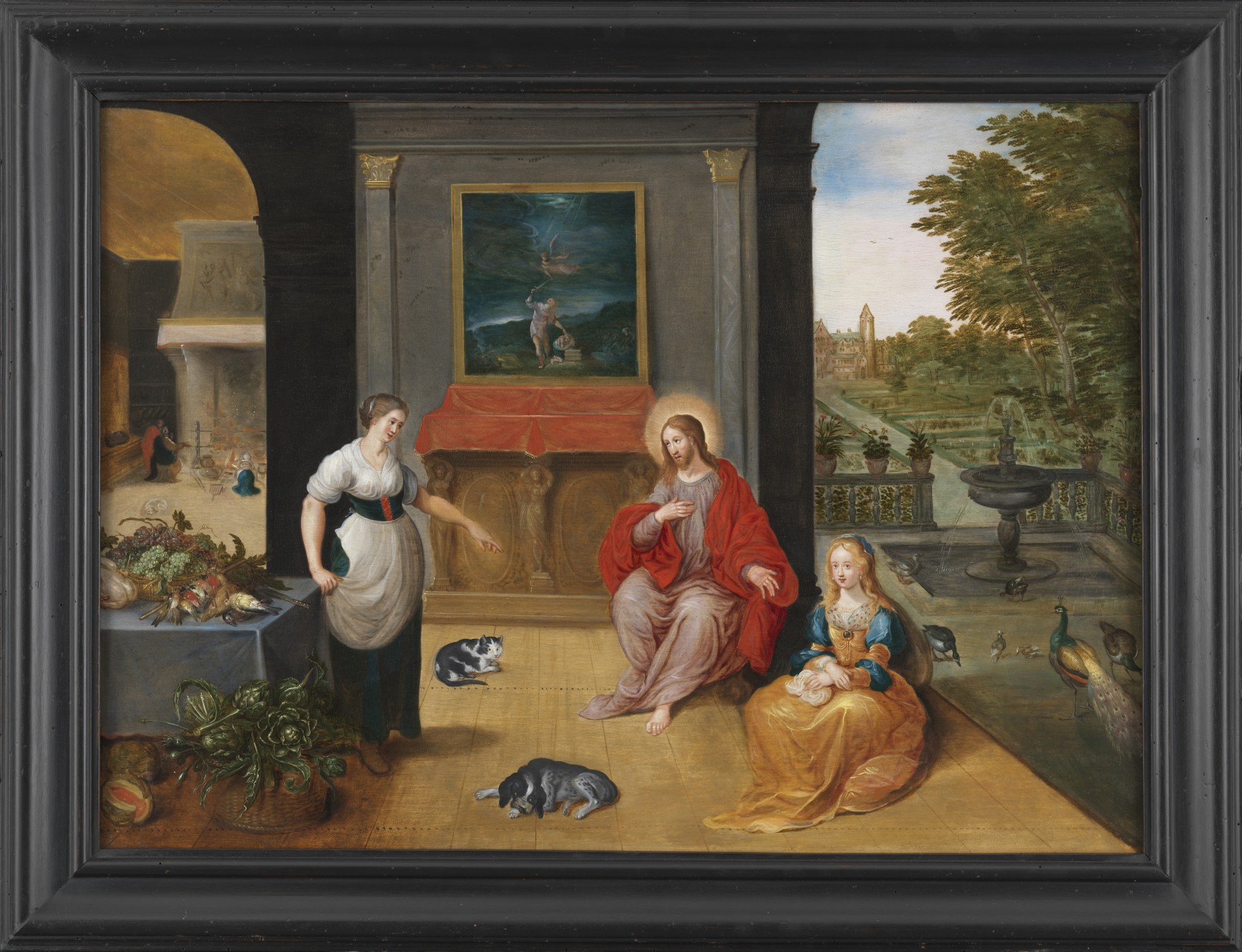
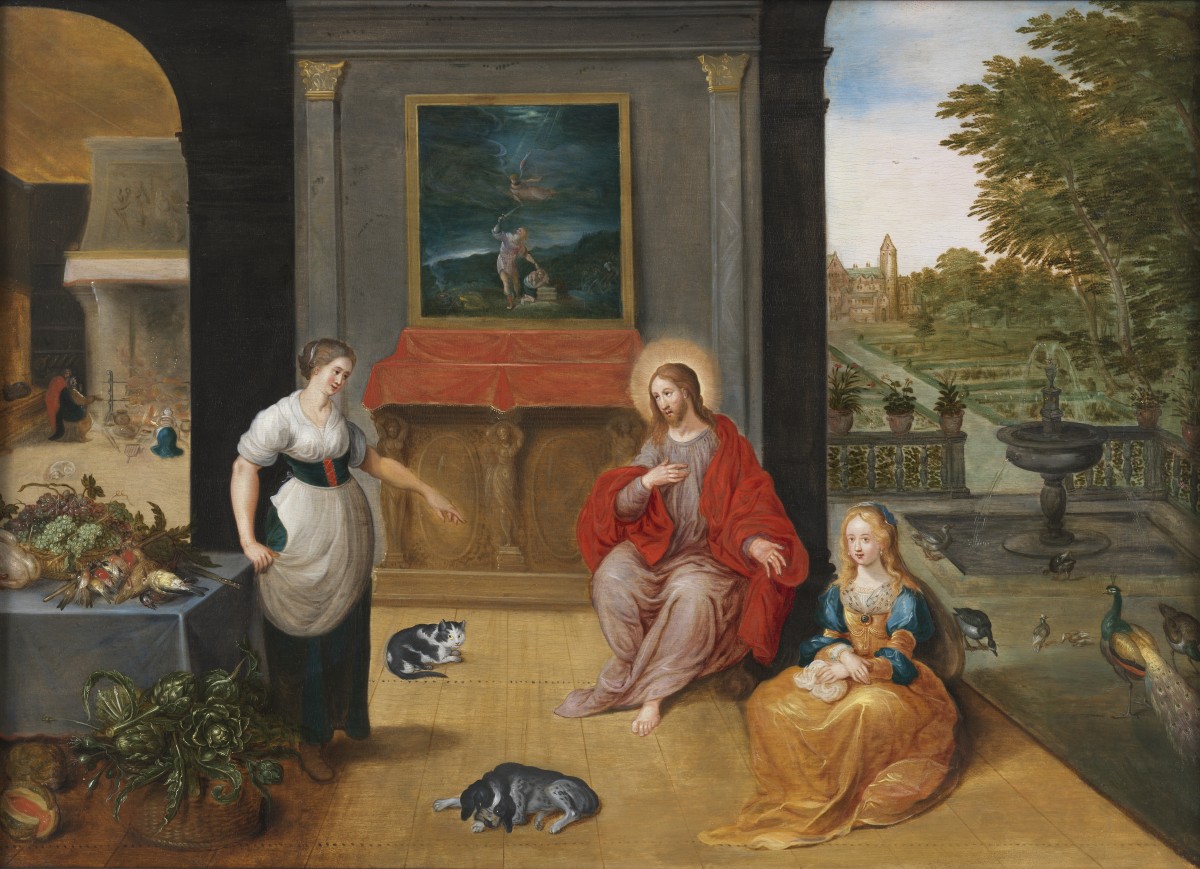
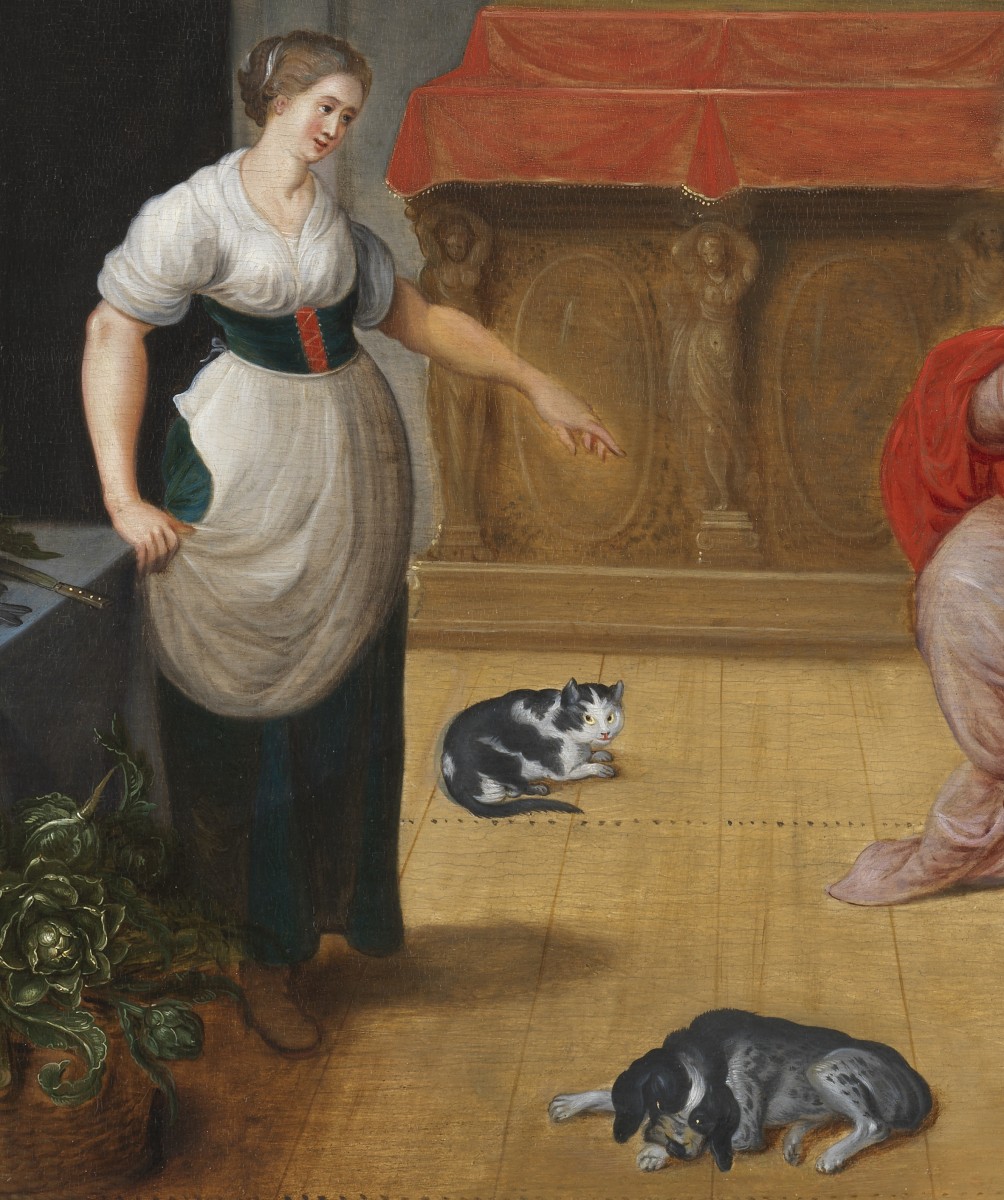
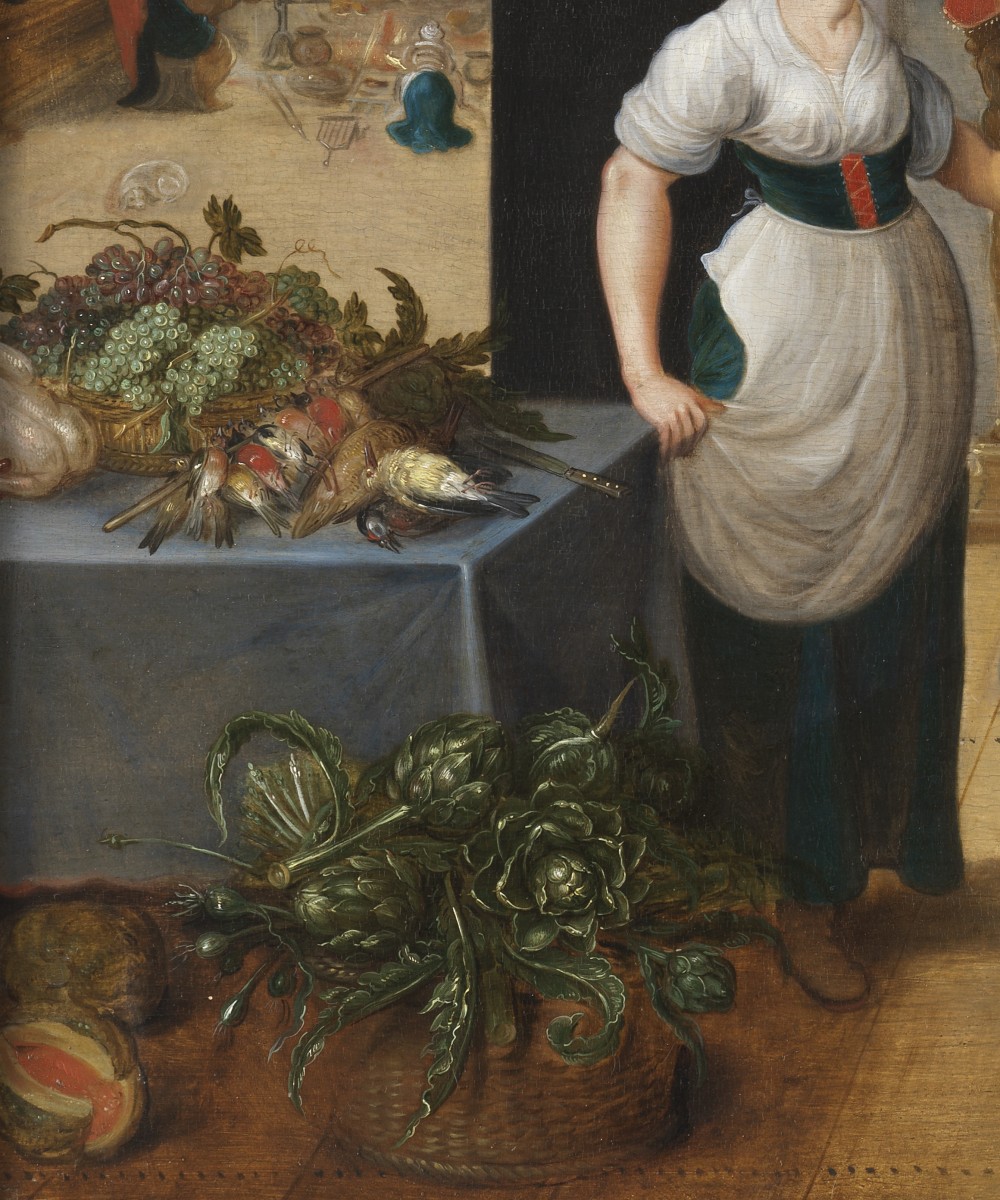
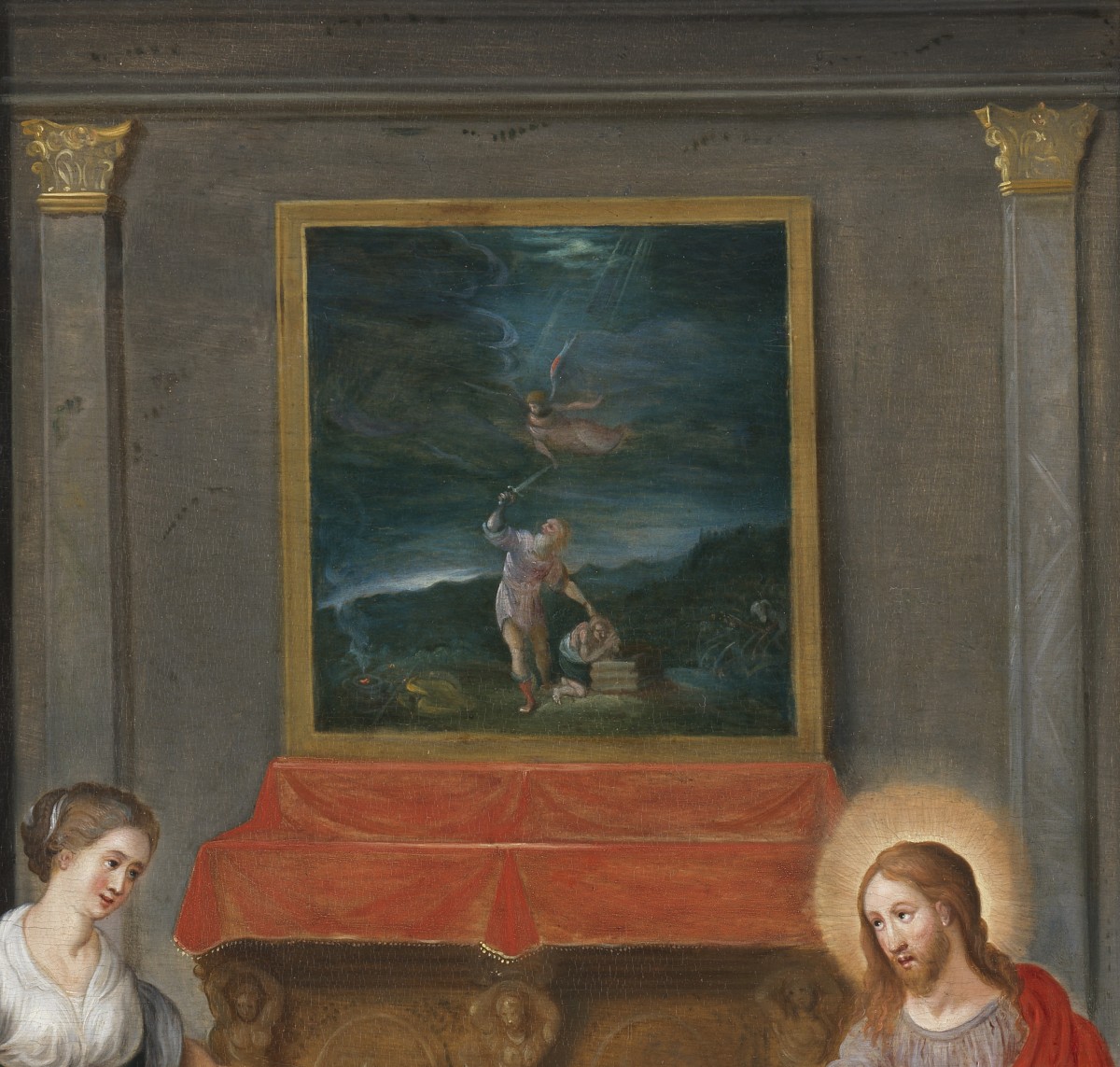
Our composition depicts one of the most popular subjects of domestic devotion in Antwerp painting of the first third of the 17th century: Christ in the House of Martha and Mary (Gospel of Luke 10:38–42). Frans Francken and a collaborator from his workshop offer here an interpretation characteristic of the Francken family’s visual culture: clear narrative, sumptuous setting, abundance of objects and animals, and a pronounced taste for theatrical staging.
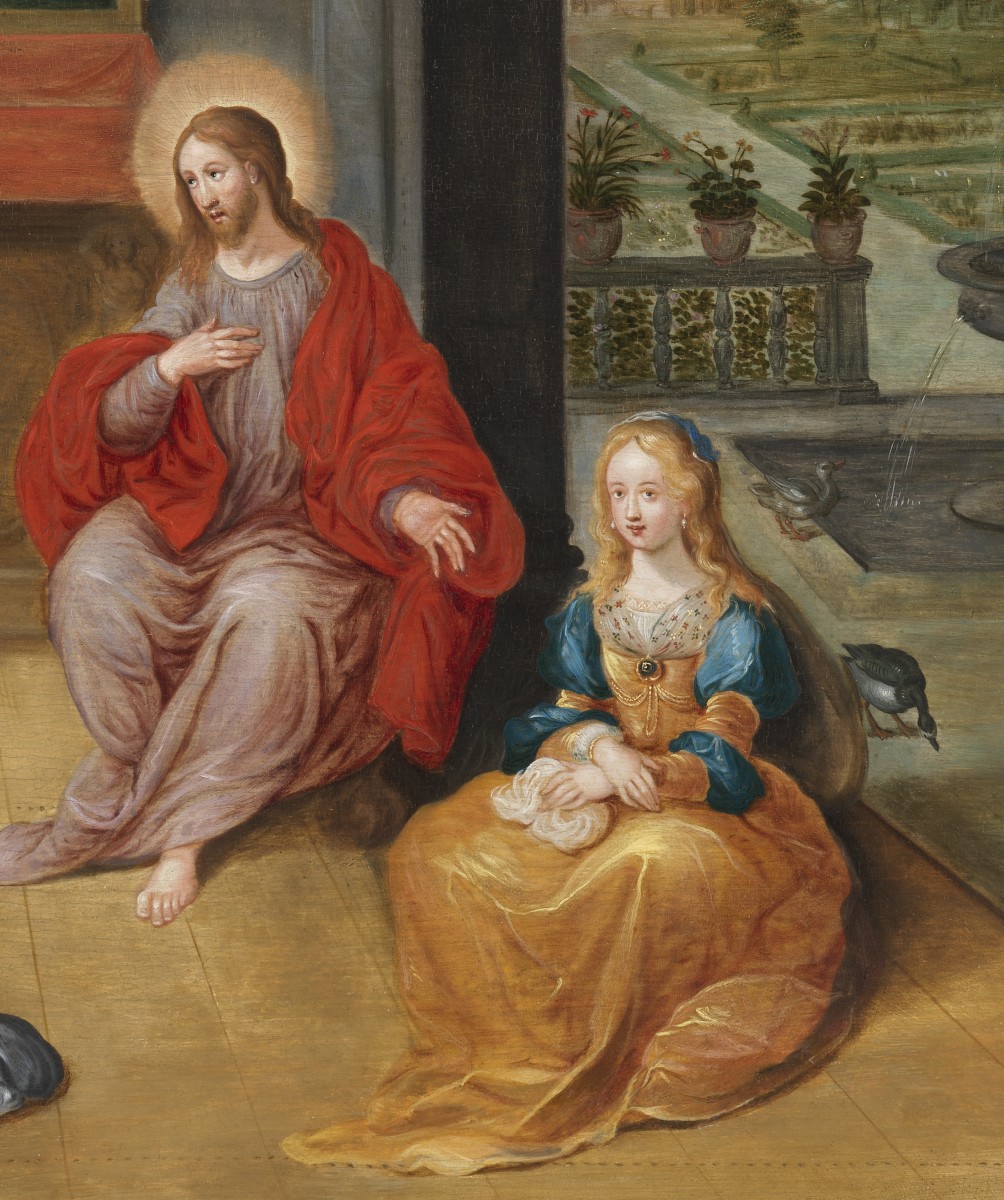
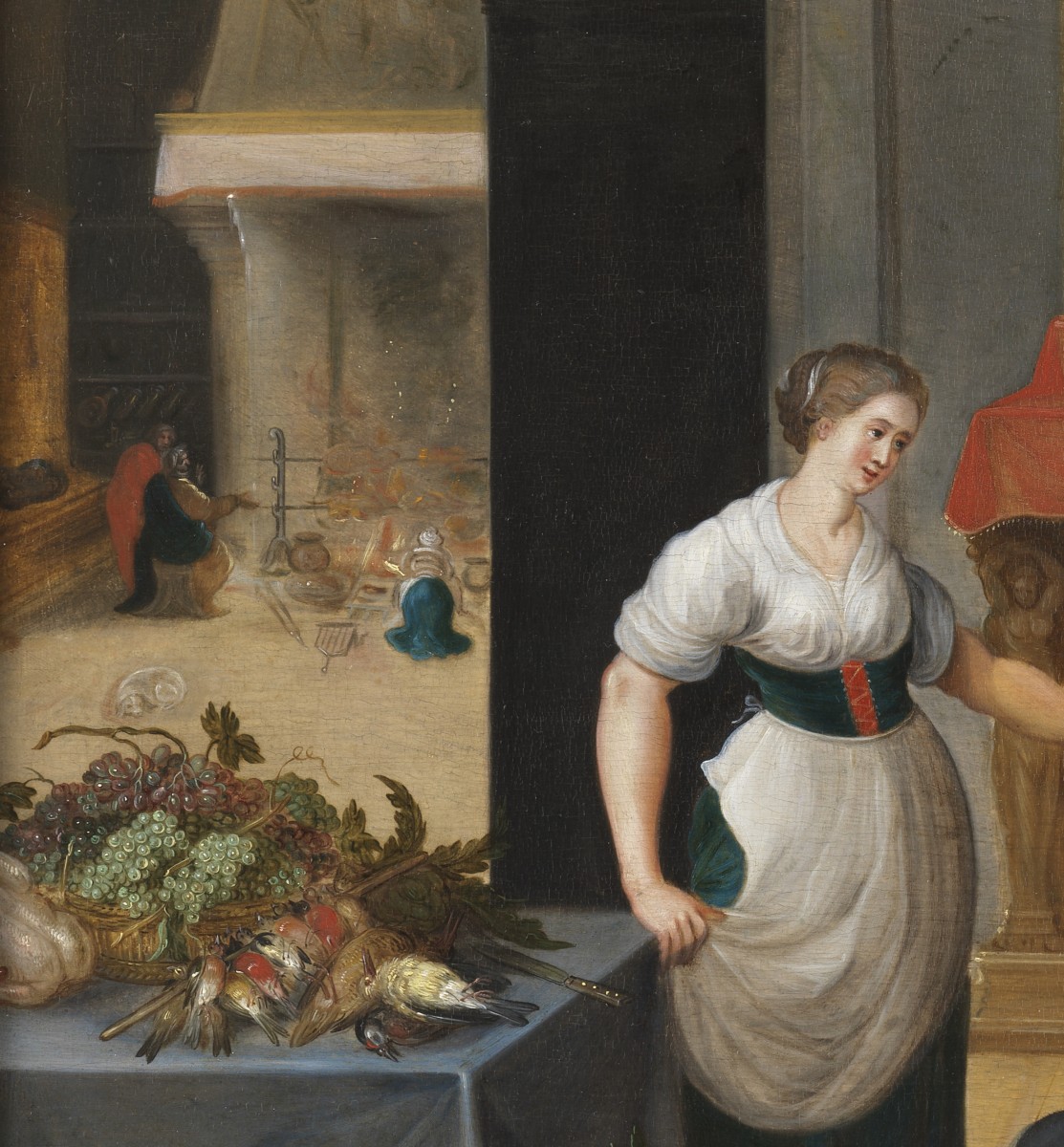
At the center, Christ, seated before an altar covered with a carpet and surmounted by a painting representing the Sacrifice of Isaac, welcomes the two sisters of Bethany. Martha, standing on the left, interrupts her culinary preparations to complain about the lack of assistance. Her lively, almost impatient gesture contrasts with the contemplative posture of Mary, seated at Christ’s feet and absorbed in his teaching. Thus the agitation of domestic service is opposed to silent contemplation—a moral and spiritual theme particularly appreciated by Antwerp artists.
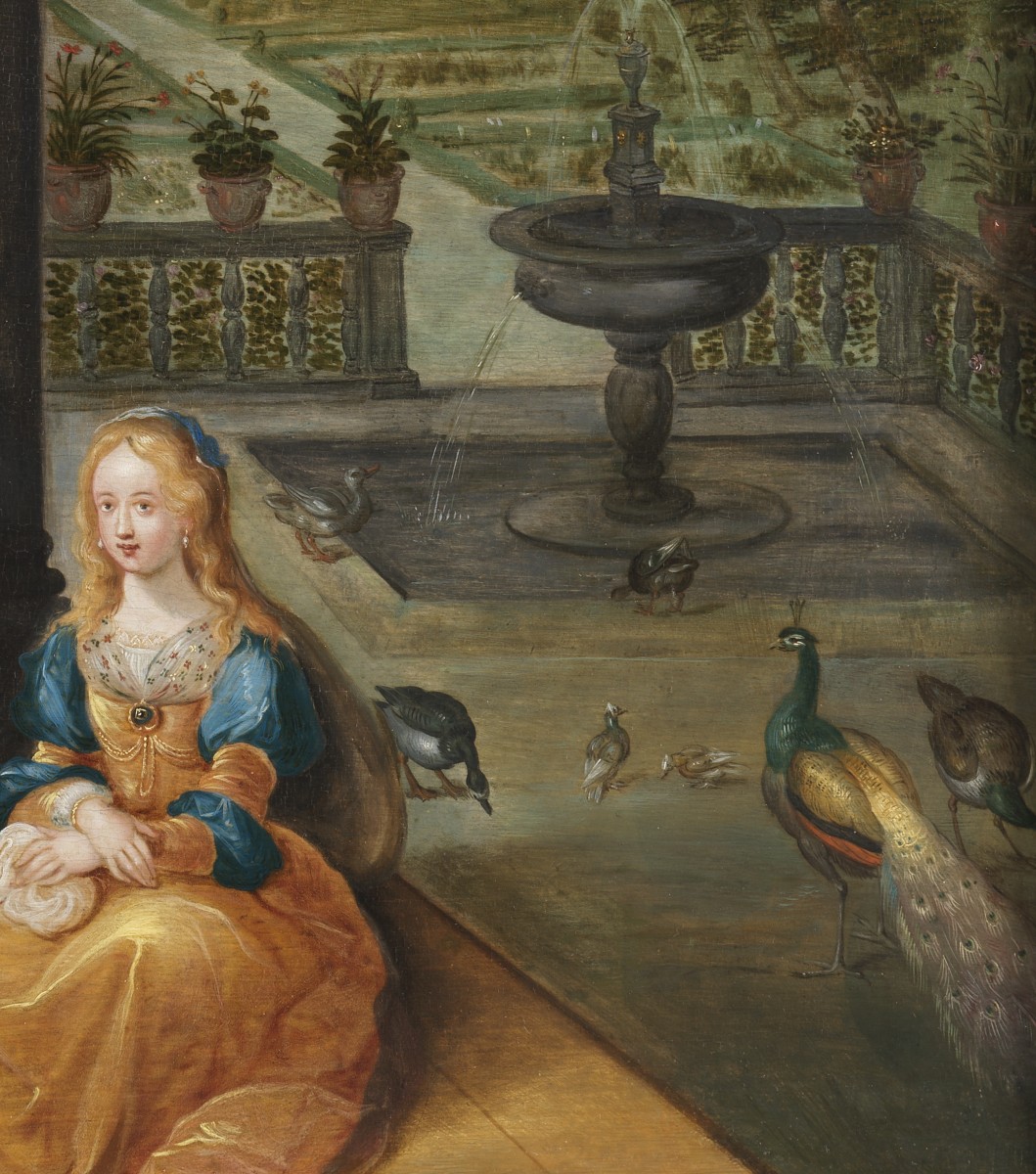
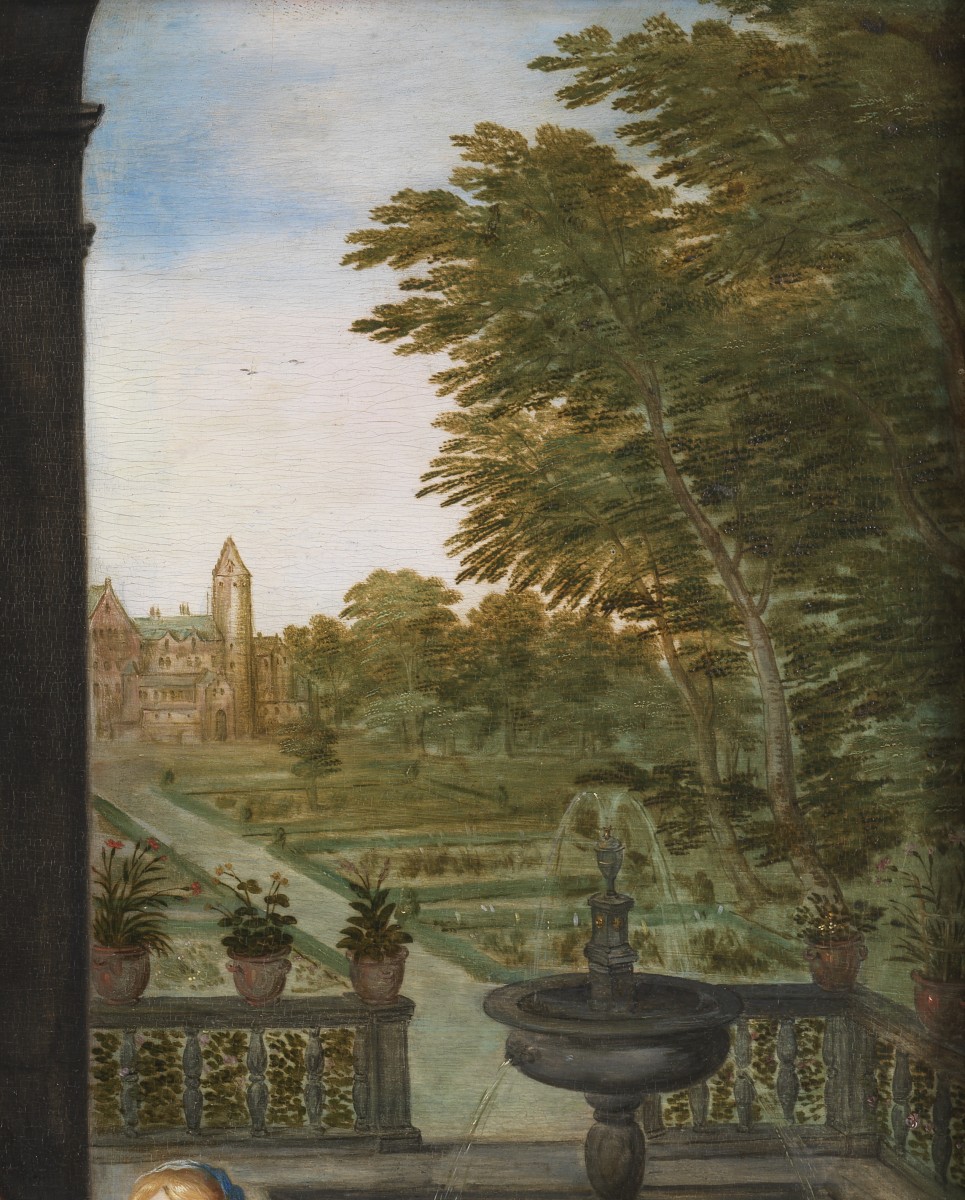
The architectural setting, with its columns, the painting-within-the-painting, and the opening onto a park populated with birds, reflects the taste for “enriched” interiors typical of the Francken workshop. Domestic animals—dogs and a cat—reinforce the familiar atmosphere, while the table laden with food, a veritable still life, recalls the tradition of Flemish “kitchen pieces,” often incorporated by the Franckens into their religious compositions to anchor the sacred in everyday life.
The handling—precise yet fluid—the attention paid to textiles, still-life elements, and anecdotal details, as well as the spatial construction, directly relate to the practices of Frans II Francken’s workshop. Certain passages, particularly in the animals and garden elements, suggest the participation of a collaborator or painter from his immediate circle, consistent with the collective production of the workshop in the years 1620–1640. A composition almost identical to ours, illustrated on page 252 of Ursula Härting’s catalogue raisonné, was likewise executed by two hands: Frans II Francken and Abraham Govaerts.
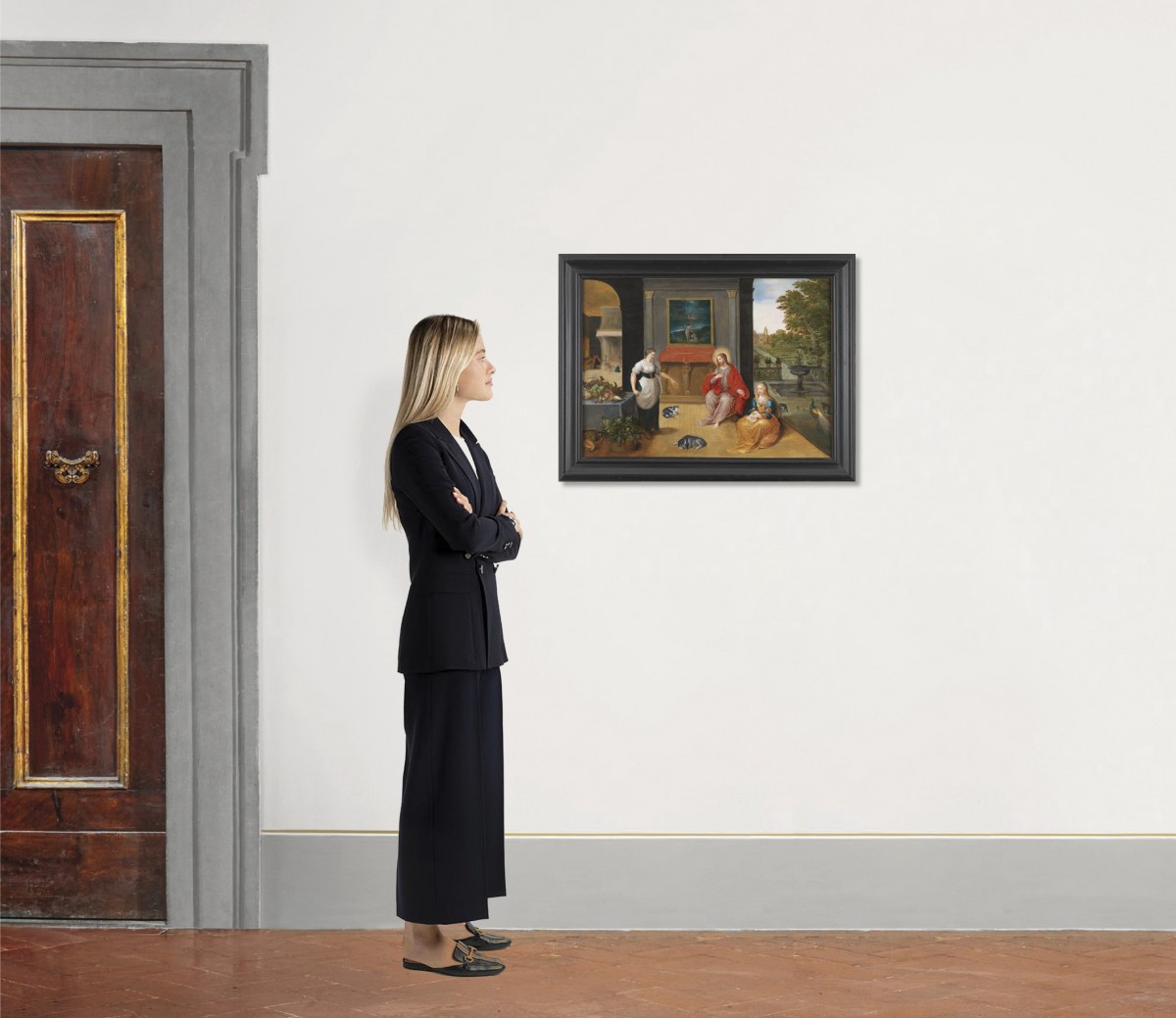
We have chosen to present this composition in a sober molded frame in blackened wood.
Dimensions:
Panel: 54 × 74.5 cm
With frame: 67 × 87 cm
Biography:
Frans II Francken, or Frans Francken the Younger (Antwerp 1581 – Antwerp 1642), son of Frans I and brother of Hieronymus II and Ambrosius II, is the most renowned member of the Francken dynasty. Excelling in a wide variety of genres, he specialized in small- and medium-format paintings—so-called cabinet paintings—which Rubens referred to as “cose piccole.”
He painted numerous biblical, mythological, and historical scenes in which he depicted compact crowds according to the principle of isocephaly. Perfect clarified glaze techniques allowed him to achieve delicate tonal nuances and fluid effects that give particular interest to background figures. The greatest Flemish artists called upon his talent; Francken’s virtuoso groups appear in the landscapes of Abraham Govaerts, Joos de Momper, and Jan Brueghel I and II, in the architectural settings of Bartholomeus van Bassen, Pieter Neeffs I, and Hendrick van Steenwijck, among others.
Bibliography:
– HÄRTING, Ursula, Frans Francken der Jüngere (1581–1642): die Gemälde mit kritischem Oeuvrekatalog, Freren, Luca, 1989.
– La Dynastie Francken, ed. Sandrine Vézilier-Dussart (exh. cat., Cassel, Musée de Flandre, Sept. 4, 2021 – Jan. 2, 2022), In Fine, 2020.