Offered by Galerie de Crécy
REQUEST INFORMATION
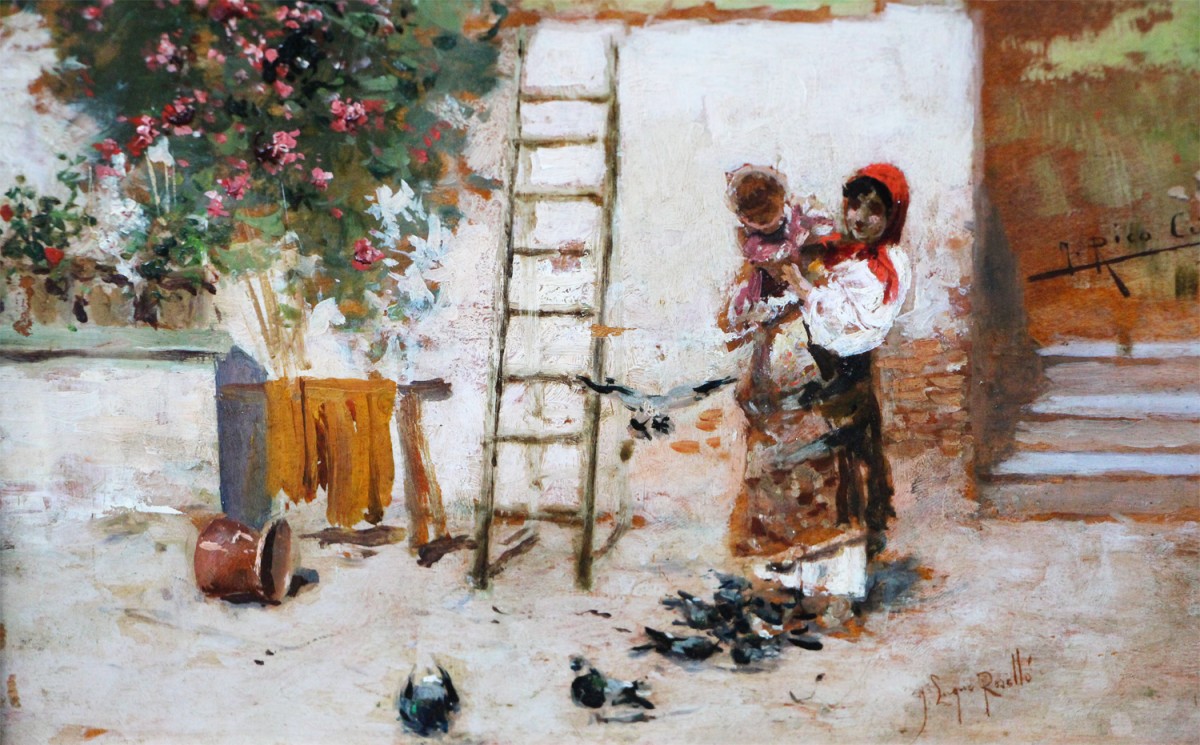

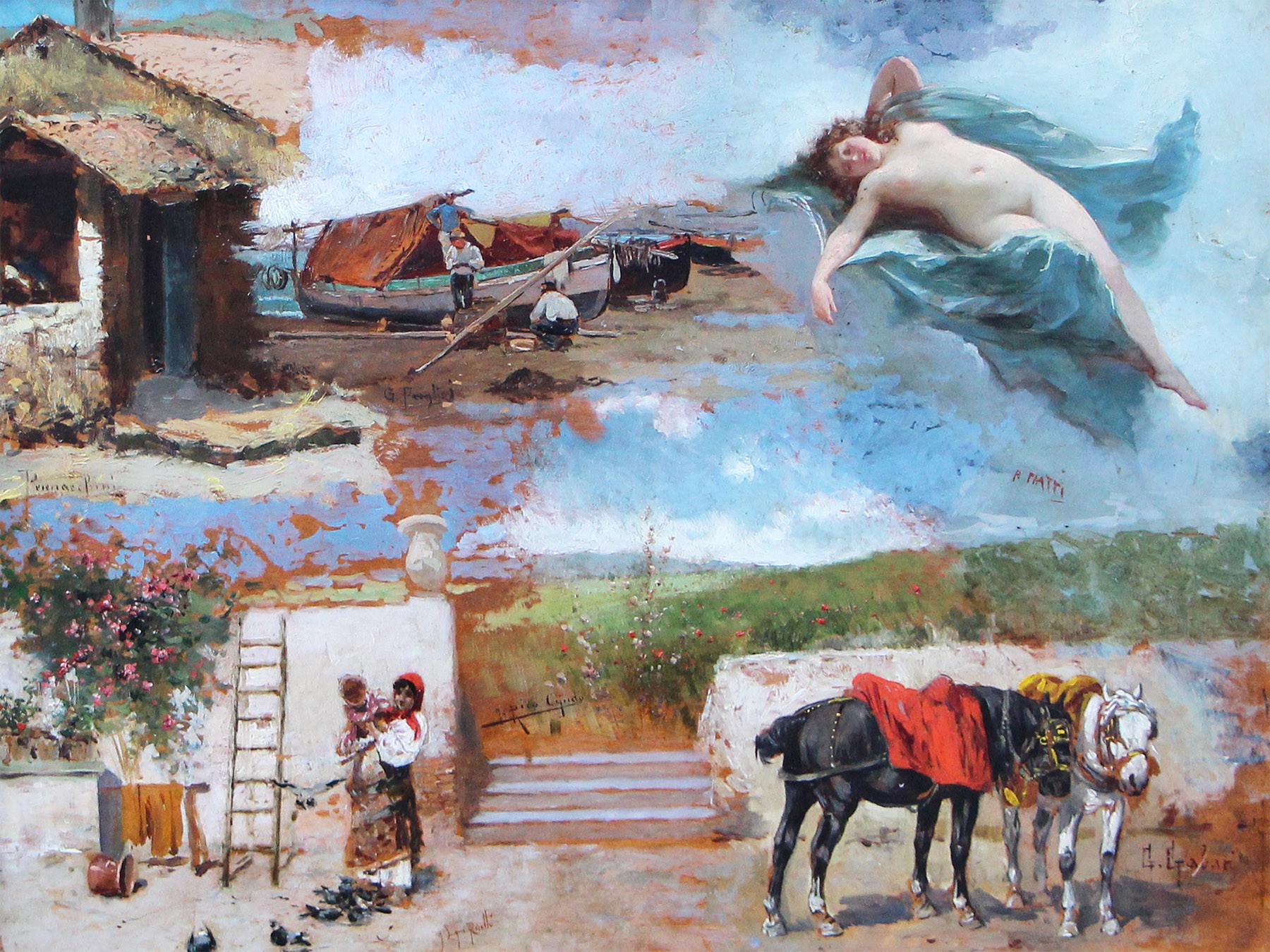
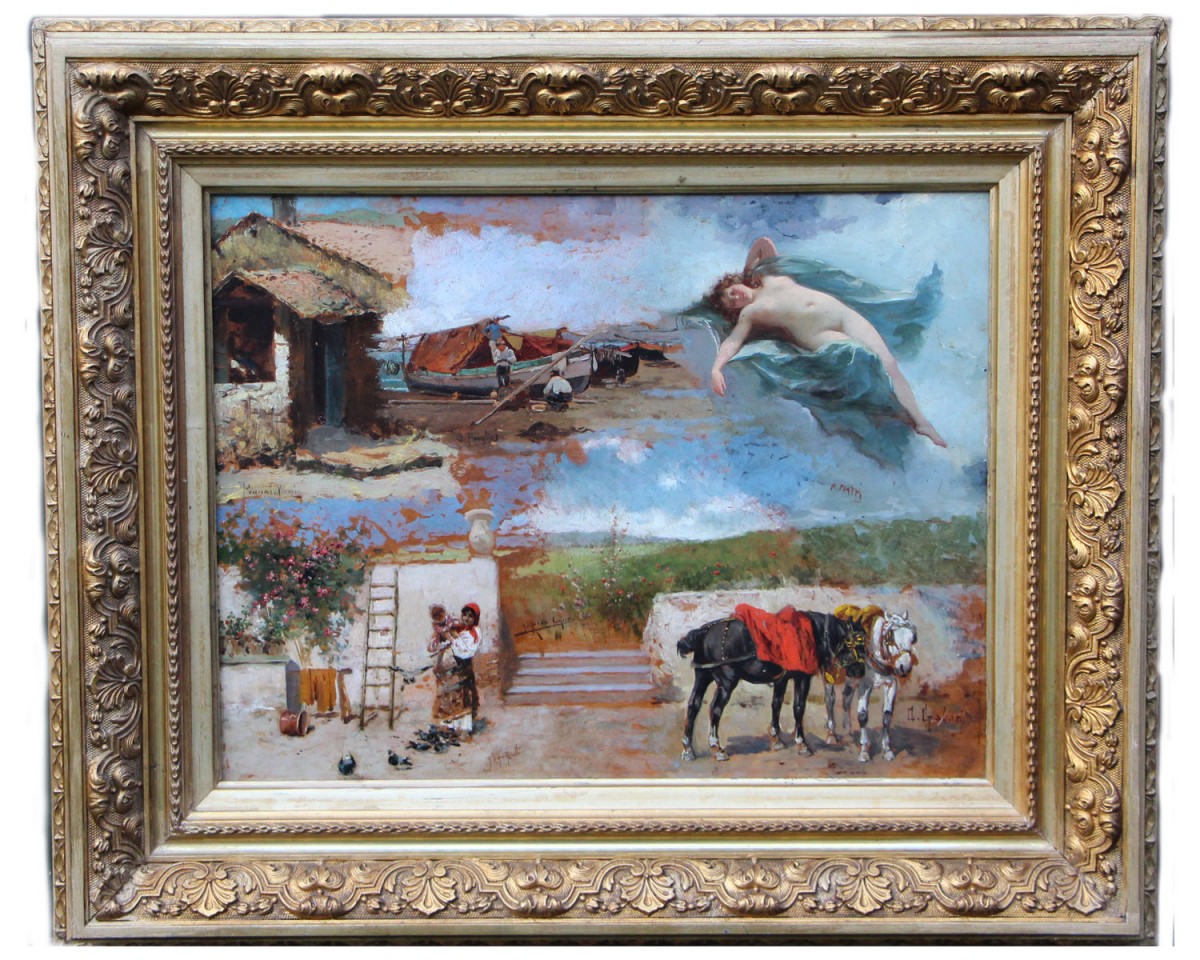
(circa 1893-1895) Oil on mahogany panel including several scenes created by six artists, each scene signed
H. 32.5 cm W. 42 cm very nice condition
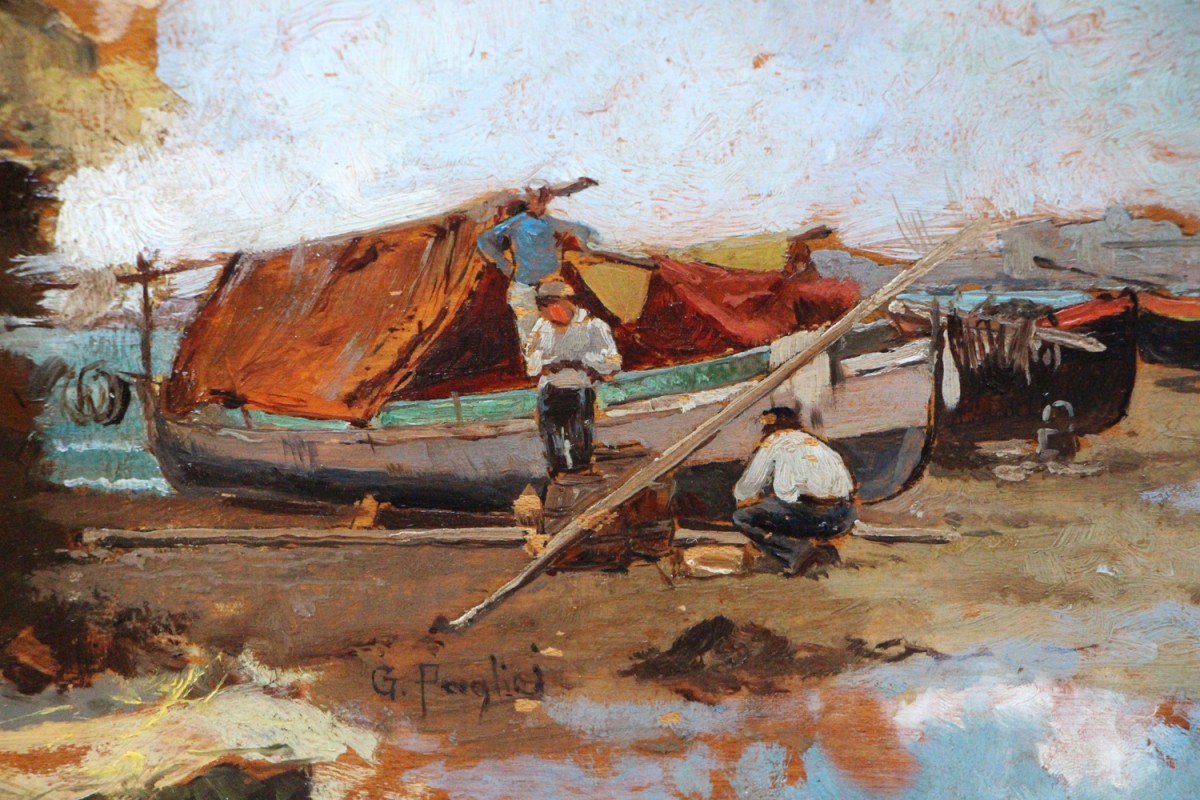
Giaocchino (1852-1896) « Fishermen " (middle top) Pagliei studied in Rome, at the Accademia di San Luca, where in 1871 he won a prize for drawing and essay. In 1875, he wins the Clonani competition.Roman workshop: six-handed composition, (circa 1893-1895) Disciple of F. Grandi, he works on the decoration of the church of San Lorenzo in Damaso. He also works at the Palazzo del Quirinale and the Villino Gamberini. His style of oil painting follows the Neo-Pompeian style. It was presented at the Società degli Amatori e Cultori delle Belle Arti in the 1880s, where he exhibited A Costume of the Empire, 1882; L'Embarras, 1884; and Nella scala, 1895-1896
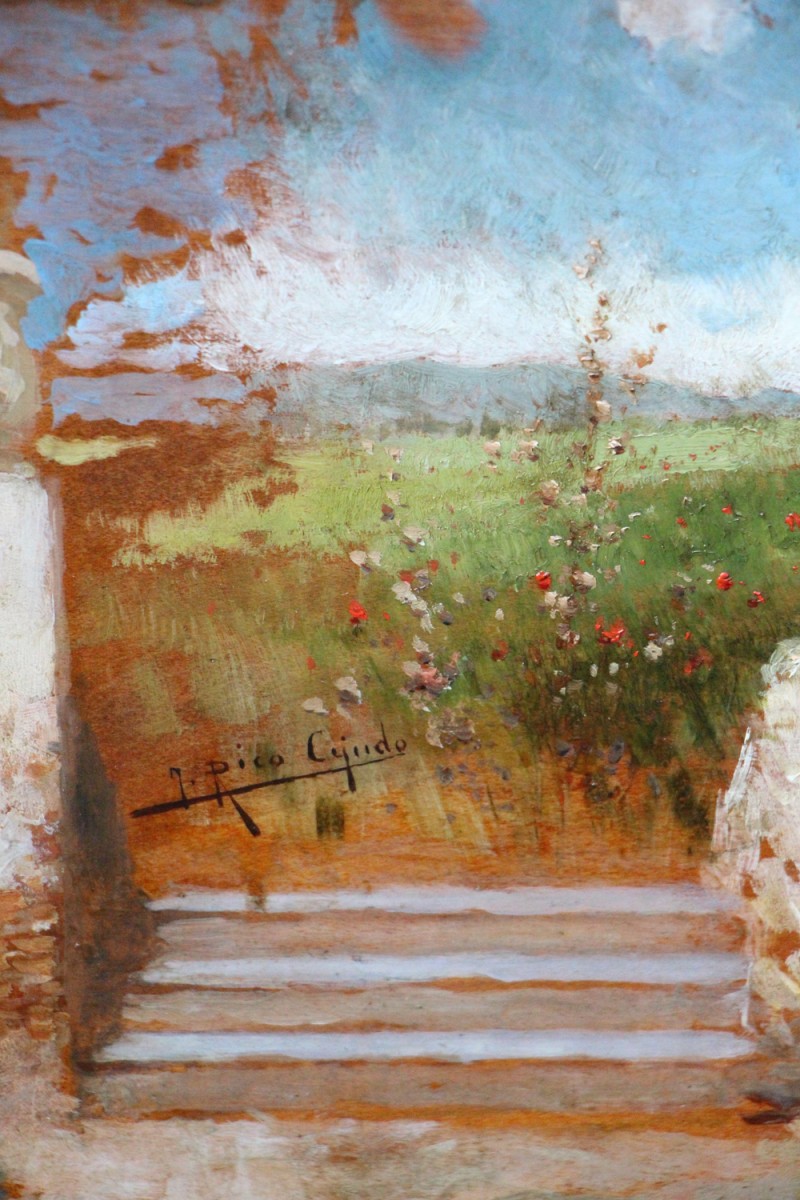
Jose Rico Y Cejudo (1864-1939) «Summer landscape» (center) Spanish painter from the classical school of Seville. Born on March 27, 1864 in Seville, he was the son of Manuel Rico y Mellado and Ana Cejudo y Martín. Almost as a child, he entered the School of Fine Arts in Seville, training with painters Manuel Wssel, Eduardo Cano and José García Ramos. In 1887, while still a student at the school, he won his first silver prize for his painting The Boy with a Dove. In 1888 he received a scholarship to the Spanish Academy of Rome, staying seven years in Italy, visiting Venice and other cities. From this period are Una pompeiana (1889) and The Easter Blessing in Rome (1893). In 1895, he returned to Seville, where he lived the rest of his life, becoming an academician of the Royal Academy of Fine Arts of Santa Isabel of Hungary.?
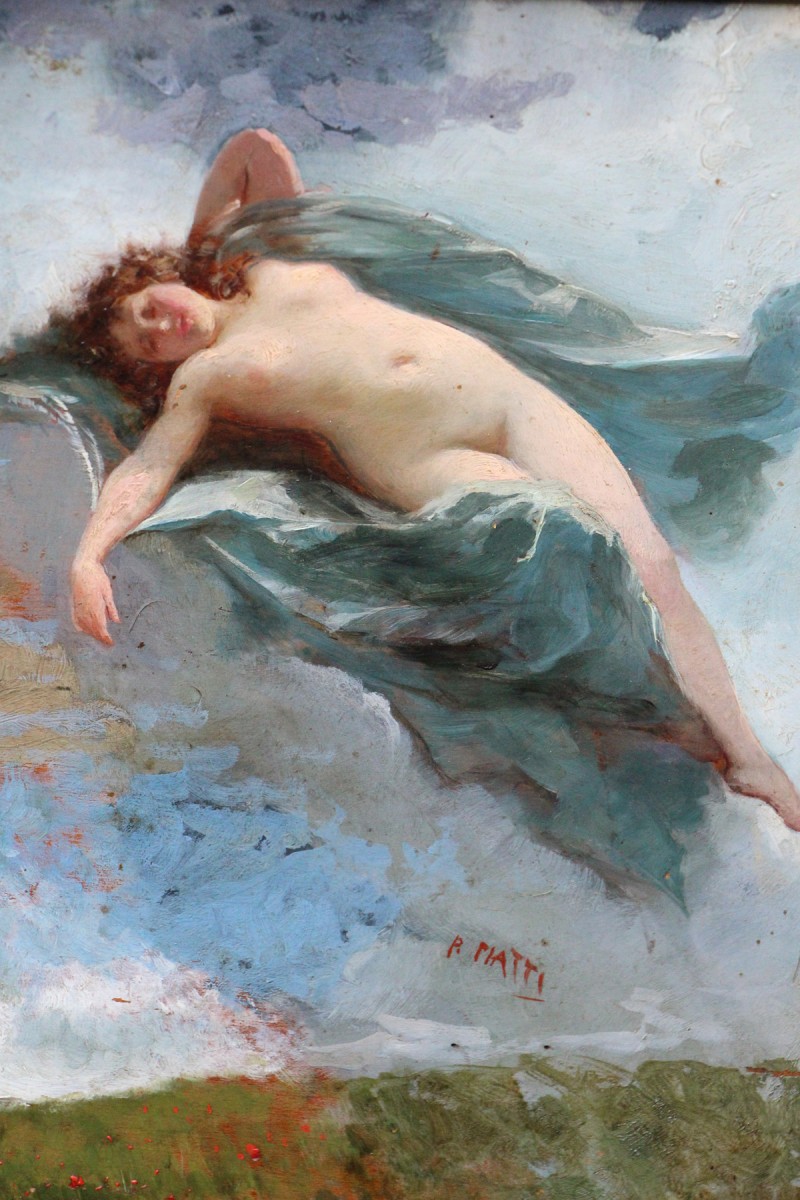
Prosper Patti (1842-1902) 'Nu' Italian painter known for his representations of neo-Pompeian and sacred subjects. He was born in Ferrara and died in Rome. As a child, his family had moved to Rome and he learned his trade with Alessandro Mantovani, who was in charge of the fresco of the Vatican loggias. He then studied at the Accademia di San Luca with Tommaso Minardi and, for one year, with Friedrich Overbeck. This gave him the declining styles of purism that circulated in Rome. In 1865, he obtained one of the commissions to decorate San Paolo fuori le Mura, more precisely the choir chapel, where he represented the Life of Pope Gregory VII. He painted pieces for the Villa Torlonia in Rome. He painted an altarpiece depicting the Baptism of Christ (1879) for the cathedral of Ferrara. He also painted frescoes for the sanctuary of Our Lady of Buon Consiglio in Genazzano. In 1894, he painted a triptych of Adoration for the apse of the church of the Addolorata at Mosciano Sant'Angelo. He painted two large canvases: Funeral of Caesar and Caton leaves the Theatre during Floralia (1900), currently displayed at the Sala de Presse Fray Camilo Henríquez, Biblioteca Nacional du Chili.
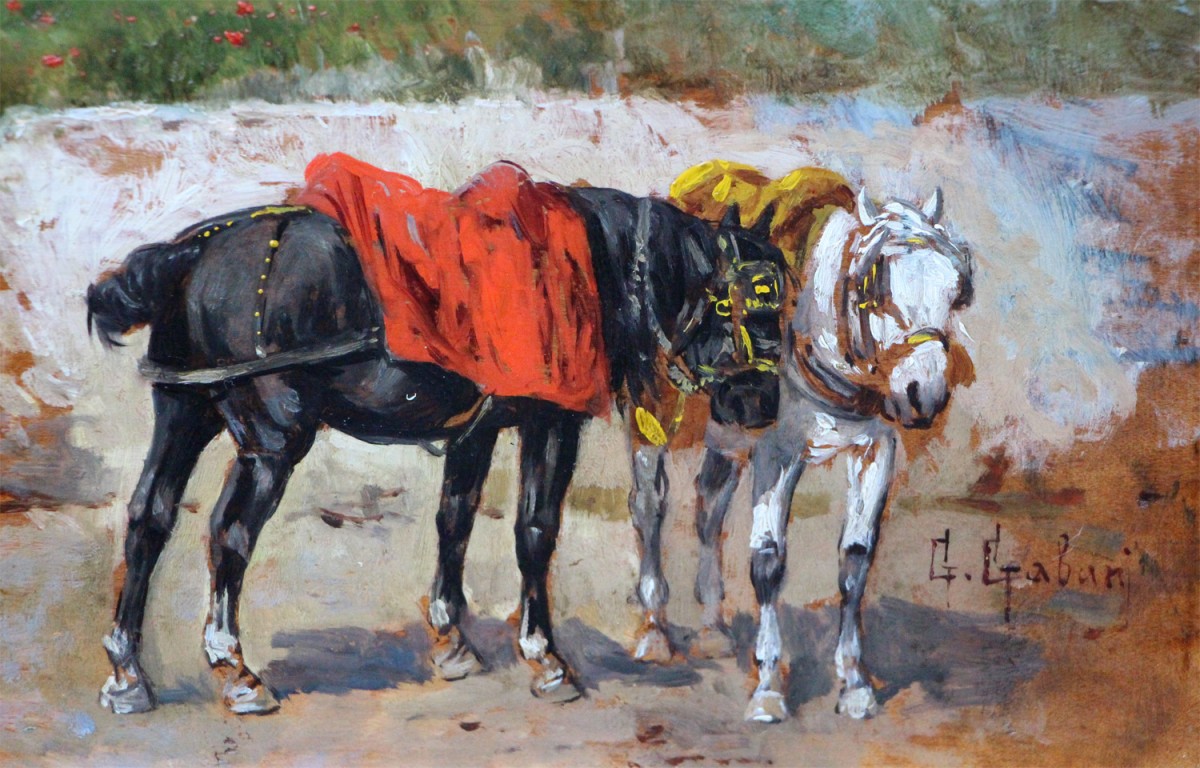
Giuseppe Gabani (1846-1899) 'Horses' (bottom right) Cavalry officer, he participated in the third war of Independence, in the 4th cavalry regiment of Genoa and in the military campaign of 1870. Orientalist and painter, he made a name for himself thanks to his equestrian views, in the context of Roman painting of the late 19th century. At the Gallery of Modern Art in Roma Capitale is his painting Verrons del 24 giugno 1866, which depicts an episode from the Battle of Custoza, exhibited in 1890 at the exhibition of Amateurs and Enthusiasts of Rome and purchased by the municipality of Rome. On the same subject, Giuseppe Gabiani painted two other paintings, Count Barattieri di San at the head of his regiment on June 24, 1866, which are now in the Historical Museum of the Cavalry Corps of Pinerolo and in the Club of Cavalry Officers in Codroipo.
Joaquim Luque Rosello (1865-1932) 'Mother and child' (bottom left) Spanish painter born in Malaga in 1865 and died in Buenos Aires in 1932. He completed his artistic studies at the School of Fine Arts in Malaga, where he was a disciple of José Villegas, Emilio Ocón and Ferrandiz. Subsequently, he obtained a scholarship to study at the Academy of Fine Arts between 1884 and 1909; there, he was a classmate of Pío Collivadino, Carlos Ripamonte and Francisco Villar. He was an excellent draughtsman and painter of figurative style, who distinguished himself by the work of the human body and by obtaining a luminous vibration in his works. His work as an artist was accompanied by intense teaching at the National Academy of Fine Arts, the National College and other educational institutions. He exhibited both locally and internationally and received numerous distinctions. Among them, in 1893, the gold medal at the Vienna International Exhibition and, in 1901, the first prize at the Berlin International Exhibition. Three of his works make up the collection of the National Museum of Fine Arts.
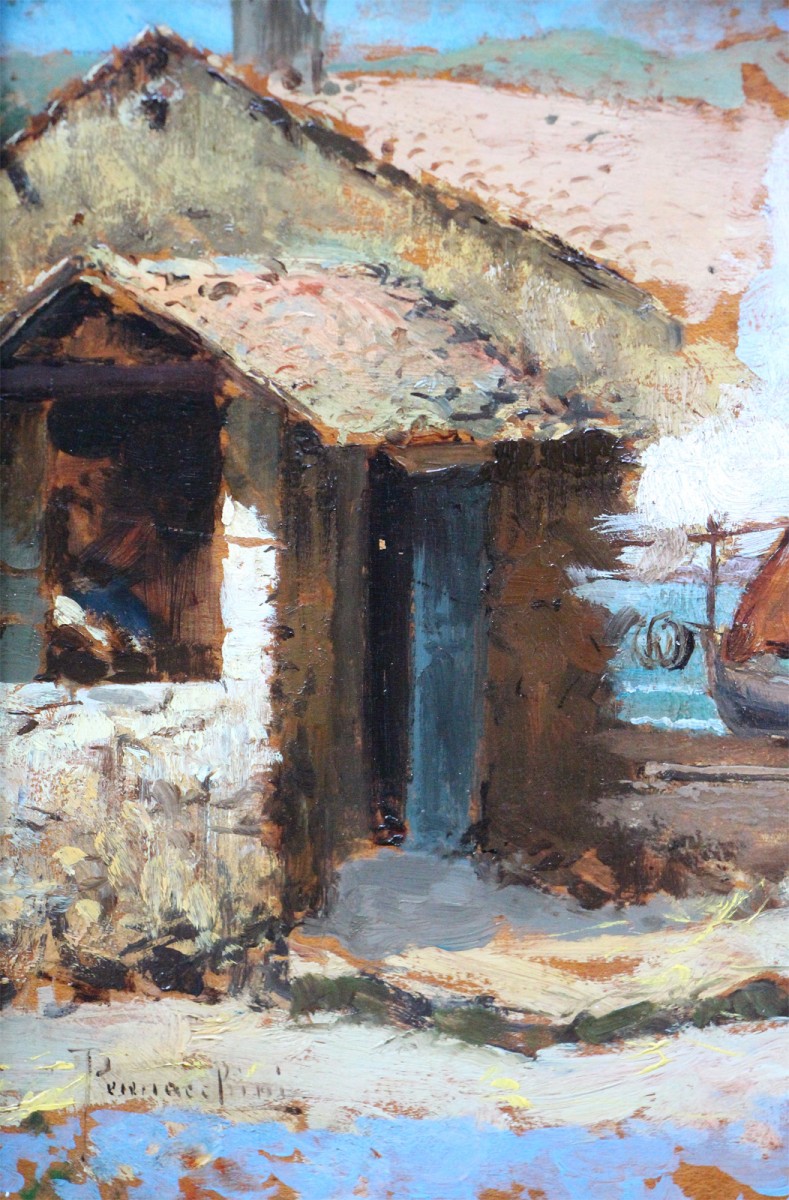
Domenico Pennacchini (1860-1917) 'Architecture' (top left) Born in Rome in 1860, Domeico Pennacchini studied at the Academy of Fine Arts in Rome. Oil painter and watercolourist, he first devoted himself to the landscapes and rural scenes of Latium, before turning to reconstructions of everyday life in ancient Rome, notably genre scenes in neo-Pompeian costumes, highly sought after on the international market. In 1913, he participated in the 8th exhibition of the Association of Italian Artists, which was held at Palazzo Strozzi in Florence. His painting combines academic rigor, attention to detail and a narrative sense of great visual strength.
Delevery information :
We deliver free of charge in the Paris region and in the provinces within a radius of 200km, beyond and worldwide, we ask for participation. Our workshop takes care of the packaging in accordance with the standards of the carriers and insurers.