Offered by Subert



Pocket Globe
Lane
London, 1815
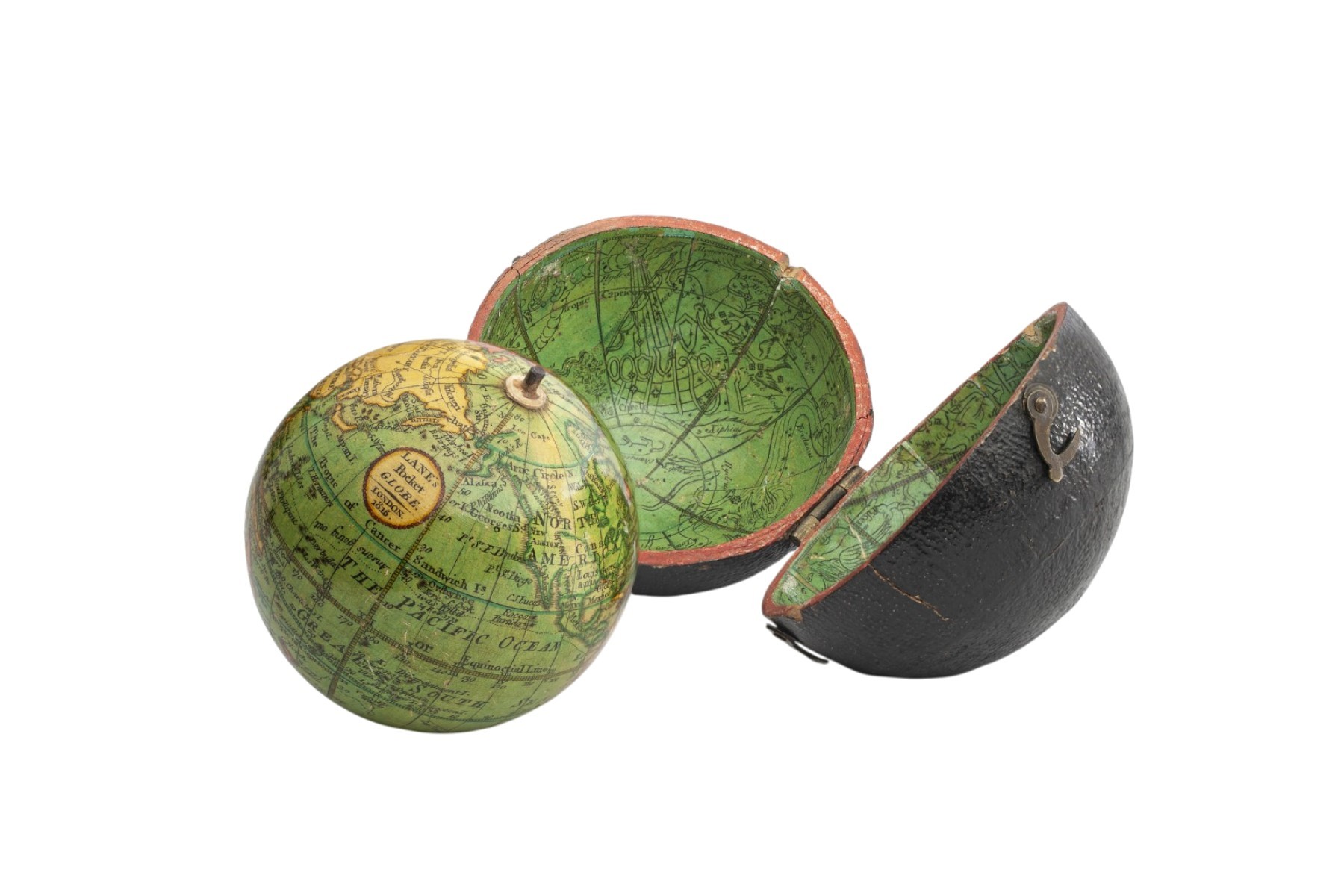
The globe is contained in its original black leather case.
The sphere measures 2.76 in (7 cm) whereas the case measures 3.15 in (8 cm).
State of conservation: almost excellent. The slightly deformed case has a few minor abrasions and some internal signs of use.
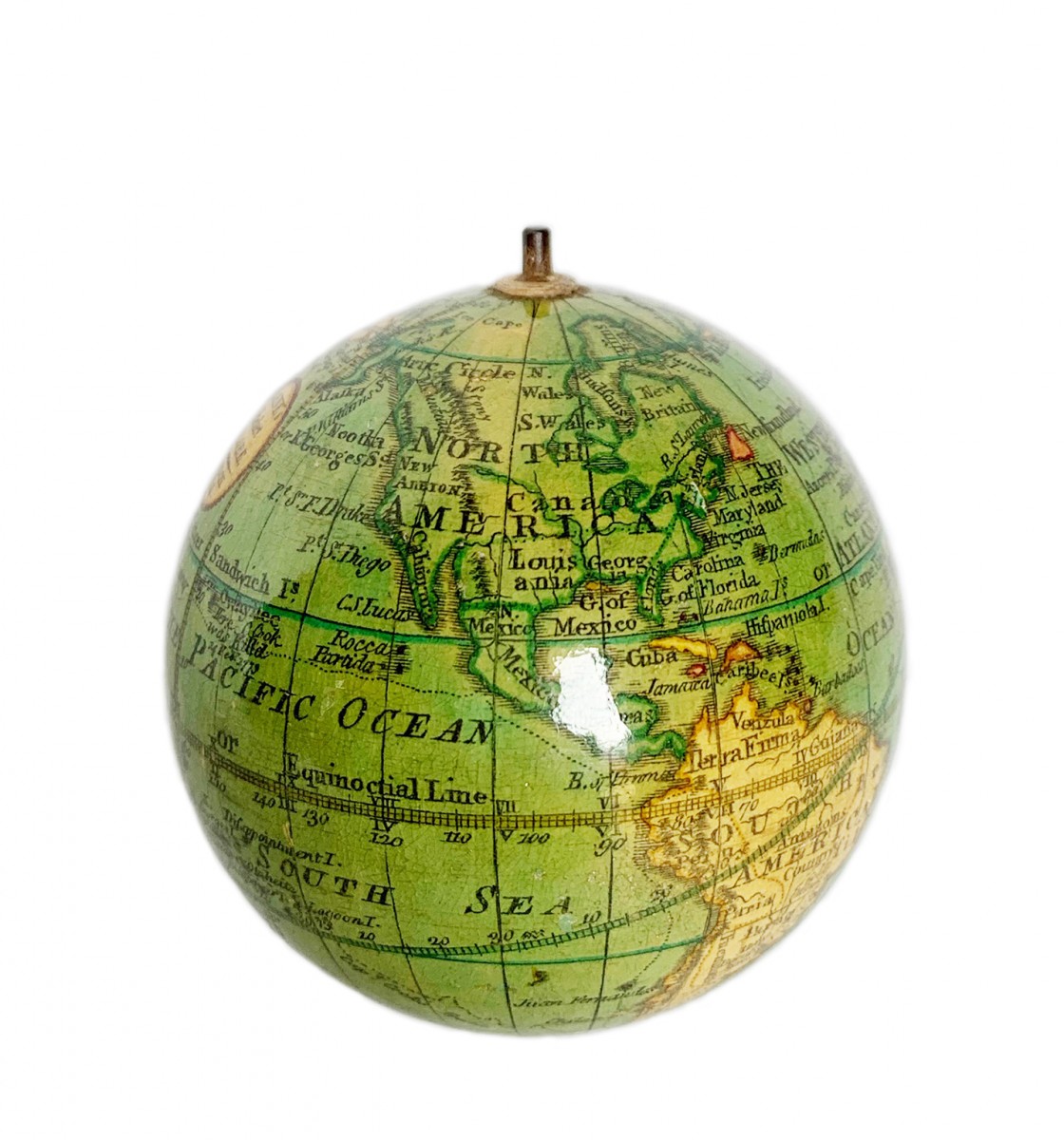
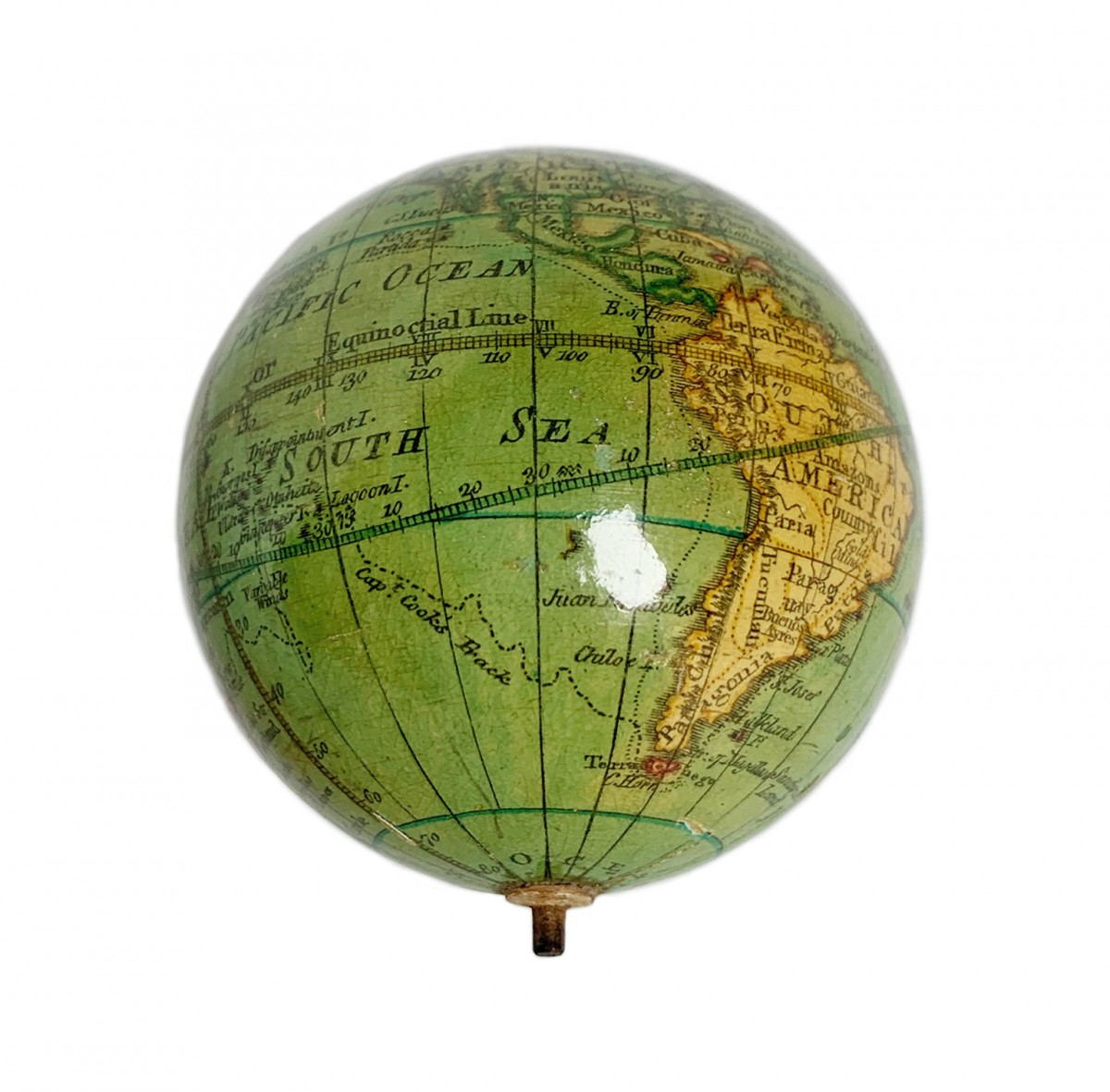
The globe is made up of twelve printed paper gores aligned and glued to the sphere. Two pins are inserted on the poles.
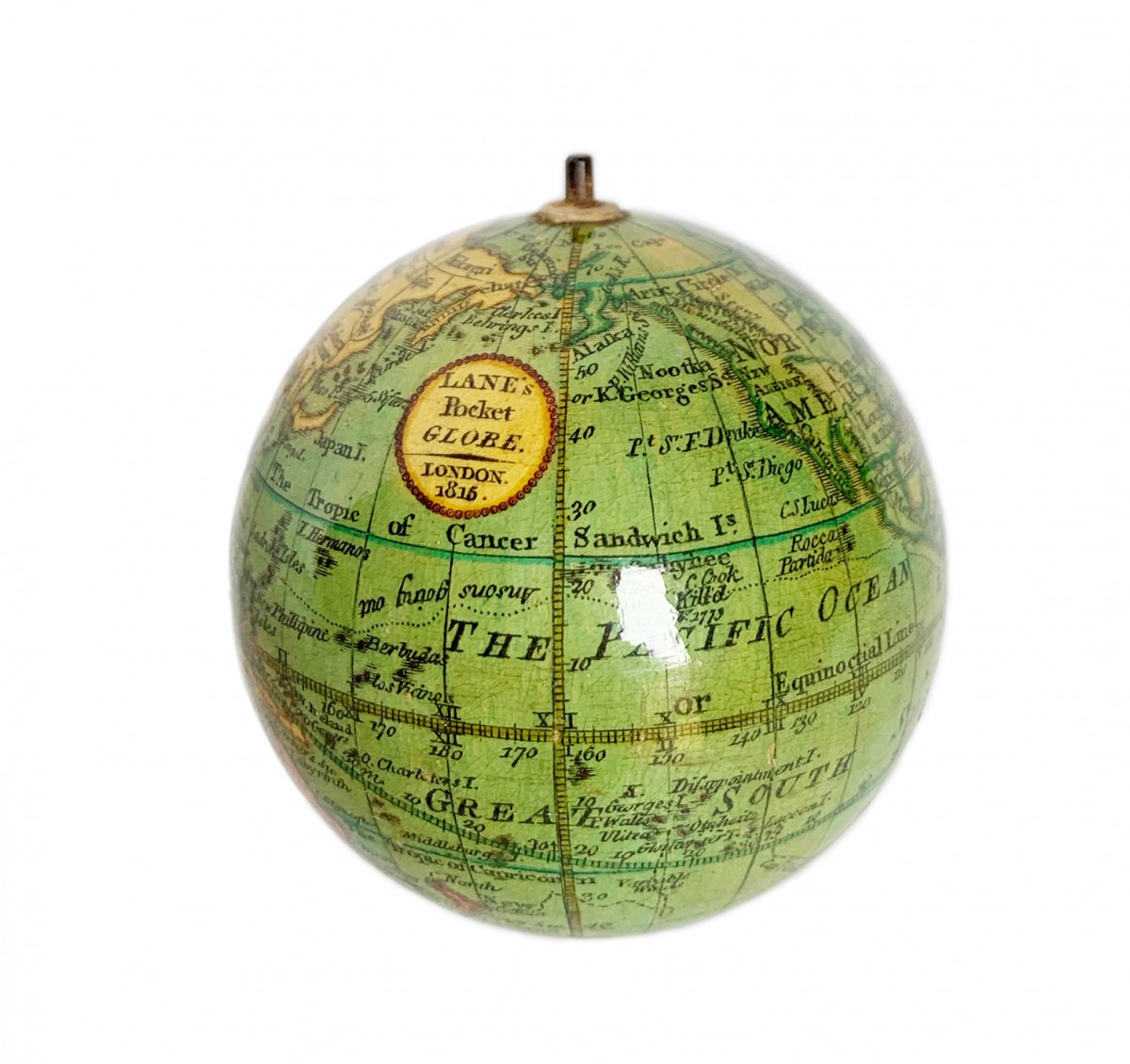
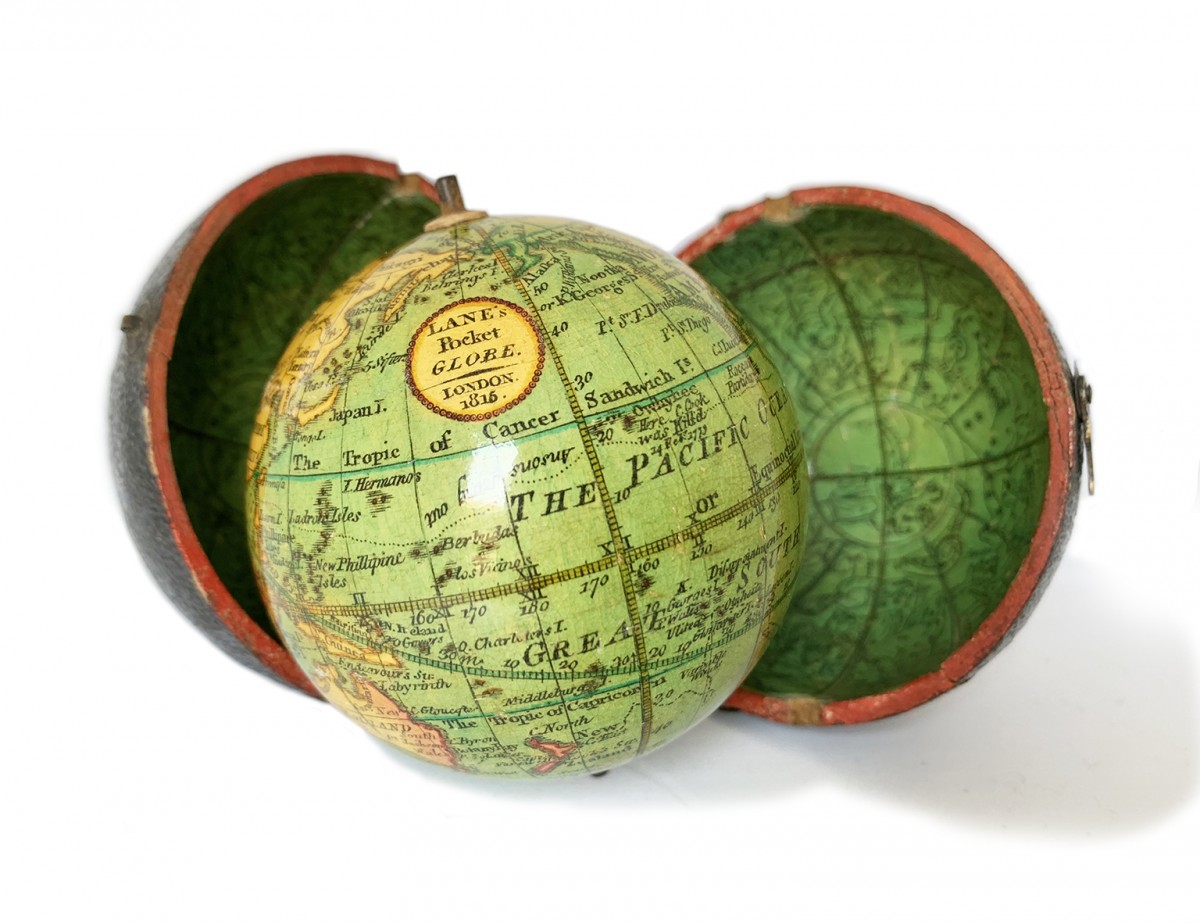
In the North Pacific Ocean, above the Tropic of Cancer, the globe bears a cartouche with the inscription:
LANE’s
pocket
GLOBE
LONDON
1815
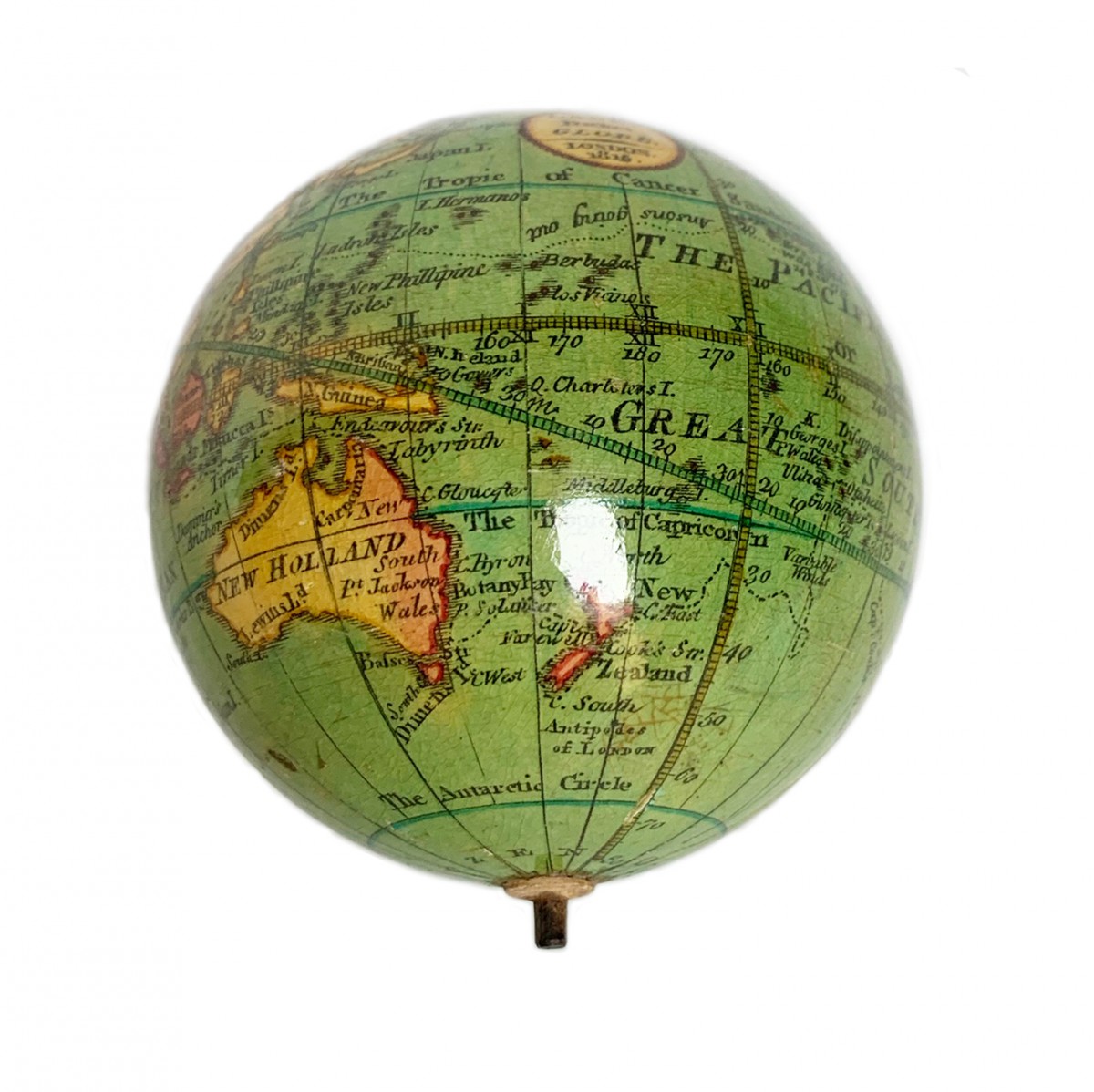
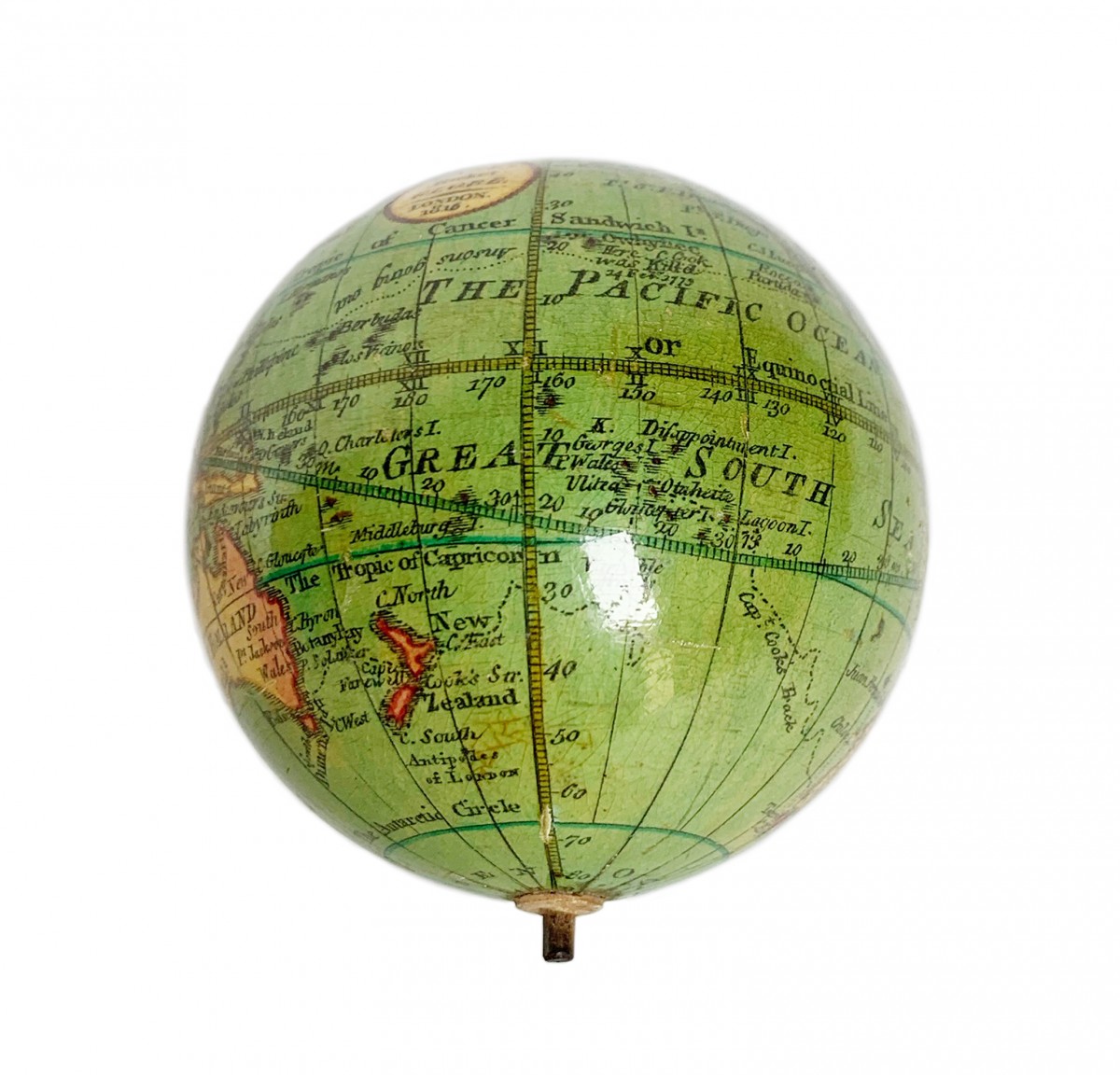
On the terrestrial globe, a large part of Africa is empty, and the Great Lakes Tanganyika and Victoria (which Europeans would begin to explore after 1858) are not marked. Australia bears the old name of New Holland (the new name would be introduced after 1824); Tasmania is already reported as an island (Matthew Flinders circumnavigated it in 1798).
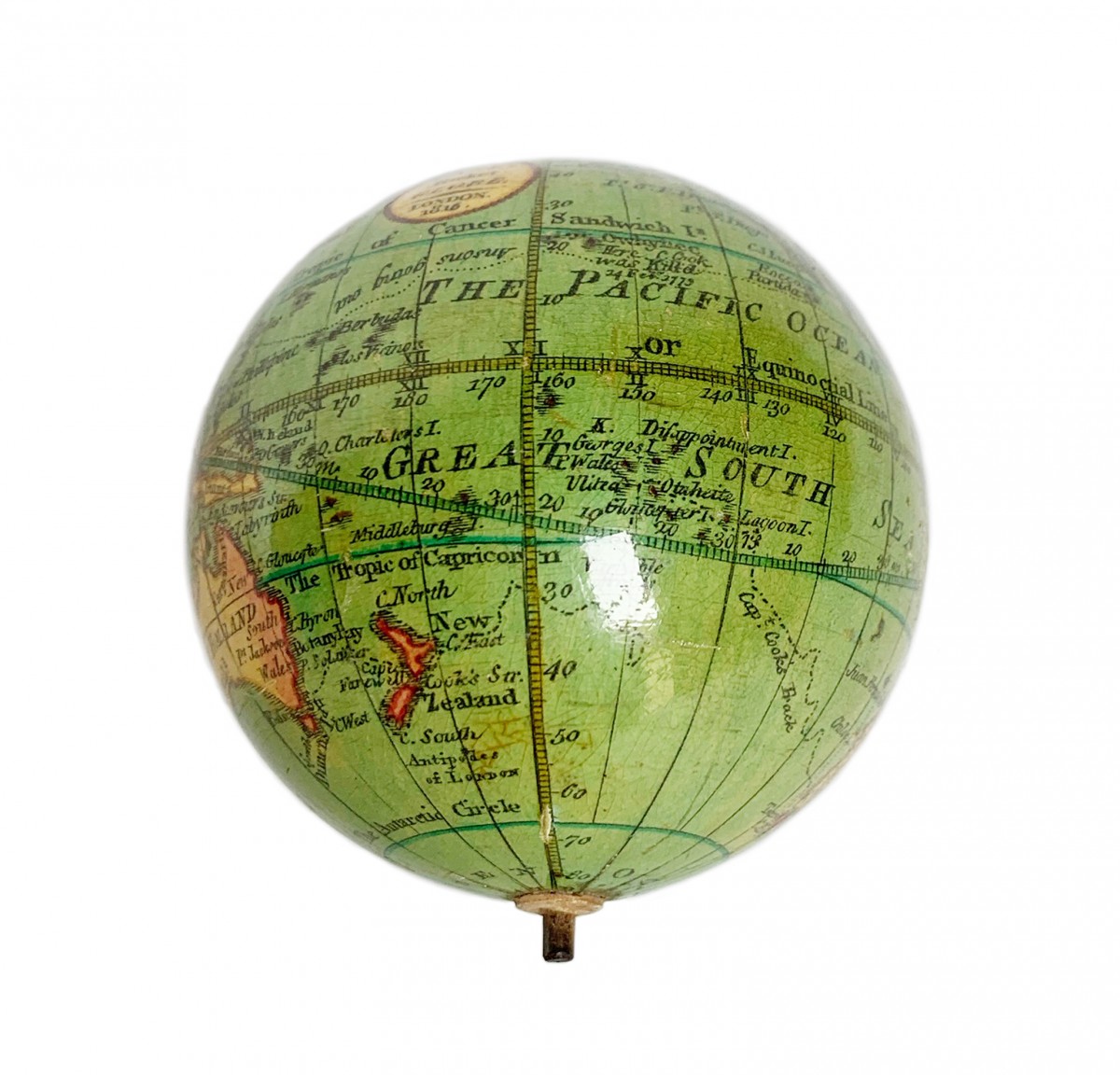
Some of the routes of the voyages of Anson and Cook are traced on the map. The pocket globe was likely created after the death of Captain Cook on February 14, 1779, as his place of death, Kealakekua Bay in the Hawaiian Islands, is marked on the map.
South of New Zealand is marked the antipode point of London.
In the South China Sea and the Indian Ocean, the directions of the monsoons are indicated. The Great Wall of China is also depicted on the map.
The pocket globe was published in 1815 (as inscribed in the cartouche) using the plates - with some updated details - of earlier publishers.
The reconstruction of the story is due to Elly Dekker (Dekker, E., Globes at Greenwich, Oxford 1999, pp. 128-129).
Around 1757 James Ferguson began publishing his own pocket globe, of which few surviving copies are known, in at least six different editions. In that same year Ferguson sold his production workshop to Benjamin Martin. The sale almost certainly did not include the engraved plates used to print his pocket globe, because no specimens published by Martin are known. A few decades later these plates came into the possession of Dudley Adams who published the same globe, updating it and replacing Ferguson's name with his own.
Adams went bankrupt in 1817 and the plates were purchased by Lane's workshop, which again updated the maps and replaced Adams' cartouche with the one we find on our specimen. The fact that our pocket globe is dated 1815 probably proves that Adams had already entered into financial difficulty two or three years before he went bankrupt and thus decided to sell some of the engraved plates from his business.
The case consists of two hinged half-spheres covered with black leather; three hooks ensure closure.
Inside the two hemispheres is the celestial vault, on which stars and constellations are indicated in Latin. Many of these are represented by the corresponding mythological figures.
The current state of the research does not allow for the reconstruction of the entire history of the Lane family. They were manufacturers of globes - especially pocket-sized ones - and the founder of the company in the 1770s was almost certainly Nicholas (perhaps a relative of John I, John II or James, all of whom were active in manufacturing scientific instruments for other entrepreneurs, starting from 1733); his son Thomas continued the business until at least the early decades of the nineteenth century. Then it is not clear which family members took over the management of the company. The sources have so far provided the names (George, John), but not the kinship relationships between them; the only certain fact is that the production of Lane-branded globes continued until about the middle of the 19th century.
Bibliography:
P., Van der Krogt, Old Globes in the Netherlands, Utrecht 1984, pp. 180-182;
G., Clifton, Directory of British Scientific Instrument Makers 1550-1851, London 1995, s. v.;
E., Dekker, Globes at Greenwich, Oxford 1999, pp. 393-394.
Delevery information :
to be agreed with the customer depending on the object and the place of destination