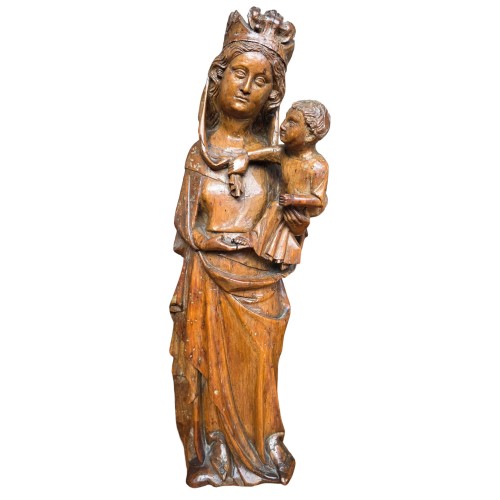
Offered by Kolhammer & Mahringer Fine Arts


REQUEST INFORMATION


Specialised with sculptures and old master paintings
Master workshop in Bohemia
Circle Master Theoderich, Prague
Around 1410/20
Carved limewood
Originals, polychrome finish
Height 107 cm
St. John the Baptist – sculpture between asceticism and courtly art
This monumental wooden sculpture of St. John the Baptist was created in Bohemia shortly after 1400. The sculptural elaboration, the vivid incarnation and the virtuoso treatment of hair and folds suggest an influence from the workshop of Master Theoderich – the famous artist who worked as a court painter under Charles IV and whose workshop is considered to have had a formative influence on the style of Prague art around 1380-1400.
Depiction and iconography
John appears here as an exalted preacher of penance, equipped with his typical attributes: The robe of camel hair – symbolizing the ascetic way of life – is carved with astonishing delicacy. The hair is curled almost symmetrically and thus arranged in a heart shape. Above it is a golden cloak with a red lining, held together with a brooch, the splendor of which forms an exciting contrast to the saint’s simple way of life. The saint stands barefoot on the floor slab – an emphasized grounding that refers to his desert existence. The sinewy feet with elongated toes once again point to his asceticism. In his left hand he carries a book, presumably the Holy Scriptures, as a sign of his role as a preacher. His right hand is raised in a classic preaching gesture: The middle and index fingers as well as the thumb are pointing upwards, a telling expression of his prophetic mission. The long-limbed fingers show naturalistically shaped fingernails and notches on the palm, giving the figure an impression of closeness.
Finest carving
Particularly noteworthy is the finely sculpted head and beard hair, which was carved densely and symmetrically falling down with a striking, single forelock; a characteristic feature that can also be found in the depiction of St. Vitus in the Chapel of the Cross in Karlstein. These parallels to the Theoderich workshop – both in the hair style and in the naturalistic facial design – indicate a stylistic proximity to this circle of artists. Johannes’ facial features are modeled in an extremely lively manner: Reddened cheeks and alert eyes with prominent, raised brows lend the figure a dialogic presence. His gaze seems to be directed at a viewer standing lower down – probably a reference to the fact that he was once placed in an elevated position, presumably within an altar or the larger spatial structure of a church.
Pleating style and flow of movement
The pleating of the golden cloak combines body-hugging modeling with the typical voluminous style of Bohemian art around 1400: tight-fitting on the upper body, the fabric falls away in an elegant bowl pleat that opens downwards into generous, dynamic borders. A striking triangular bowl pleat with multiple creases provides lively movement. The so-called “doughy” softness of the drapery refers to the transitional period to the so-called soft style, as it was particularly richly developed in the Bohemian context.
A work of the Prague court circle?
The stylistic proximity to works by the Theoderich workshop suggests that the figure of St. John could have been made by a master carver in this environment. The workshop, which was involved in the decoration of Prague Cathedral and Karlstein Castle under the patronage of Emperor Charles IV, was a place of intensive artistic collaboration between painters, sculptors and barrel painters. Works from this circle were not only an expression of religious piety, but also served the representational needs of the aspiring Prague court, which staged itself as the “new Rome”.
Why John the Baptist?
John the Baptist played a central role in the religious culture of Bohemia around 1400. As a preacher of repentance and a pioneer of Christ, he was a key figure in the reform movements that were articulated in Prague even before the Hussite unrest. His admonishing message of repentance and purification appealed in particular to an urban-academic audience, including Prague University as a center of theological debate. The depiction of the saint as a teaching prophet in conversation with the viewer fits perfectly into this intellectual context.
Summary
This sculpture of St. John the Baptist is far more than a devotional image: it combines spiritual depth with the highest level of artistic elaboration. The stylistic connection with the Theoderich workshop lends it additional significance as a testimony to Bohemian art. The haunting presence of the saint, the virtuoso treatment of the robe, hair and face as well as the doctrinal aura make it a masterpiece of Bohemian sculpture at the beginning of the 15th century – created in a place where art, piety and power were closely interwoven.
Literature
Ji?í Fajt & Jan Royt, Magister Theodoricus. The court painter of Emperor Charles IV. The artistic decoration of the sacral rooms at Karlštejn Castle, Prague 1997.
Gustav E. Pazaurek, “Theoderich”, in: Allgemeine Deutsche Biographie 37, Leipzig 1894, pp. 708-710.