Offered by Galerie Francesco De Rosa
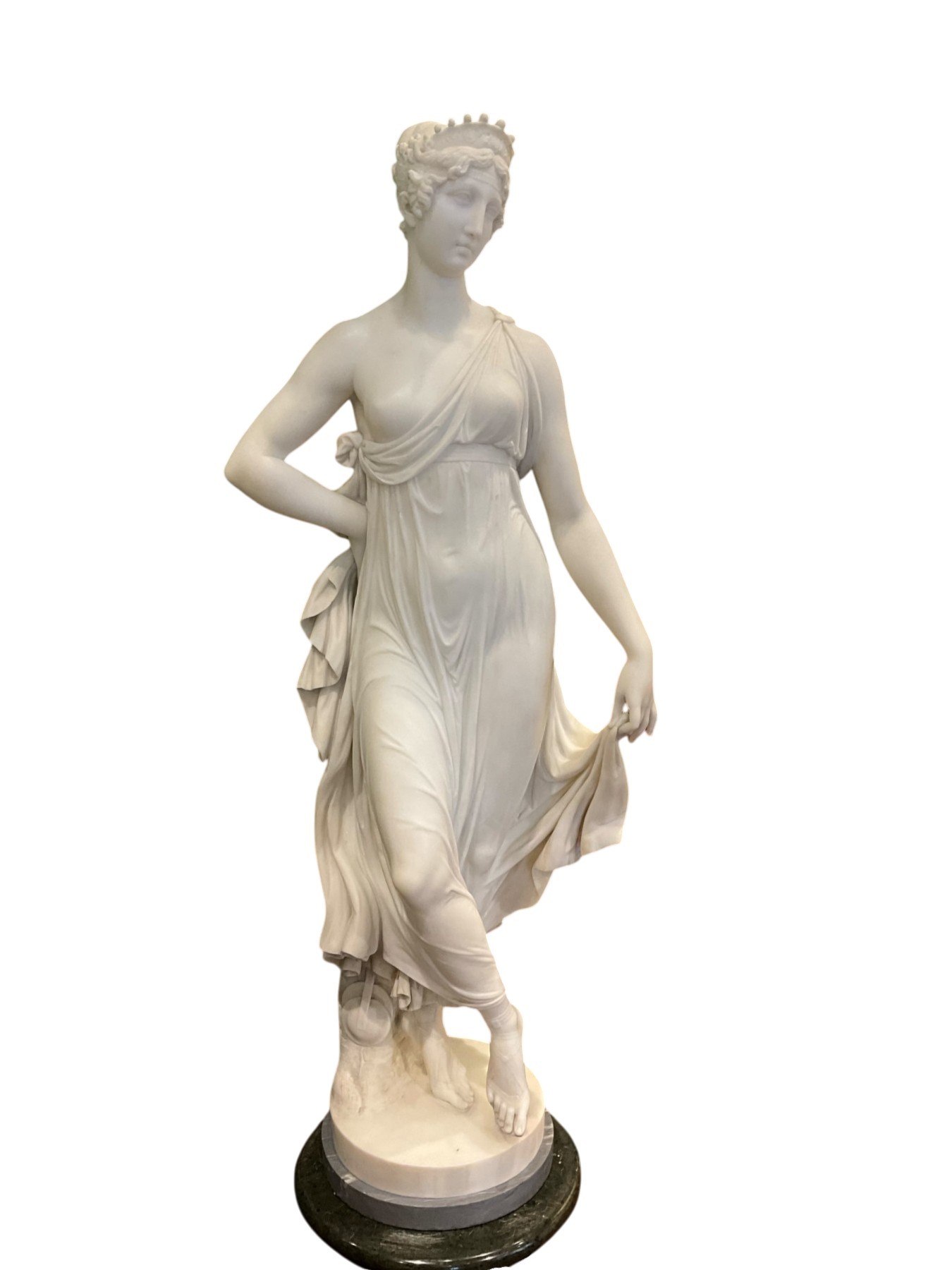


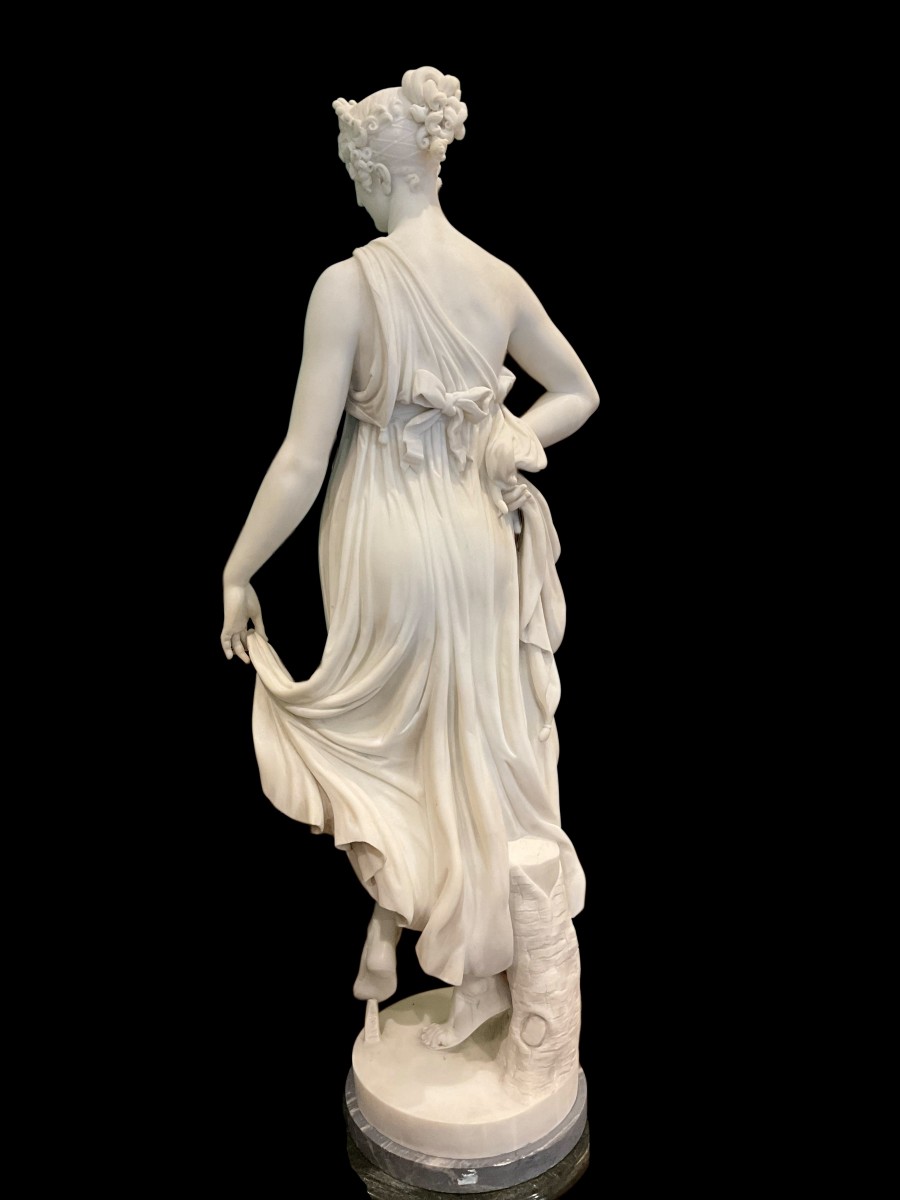


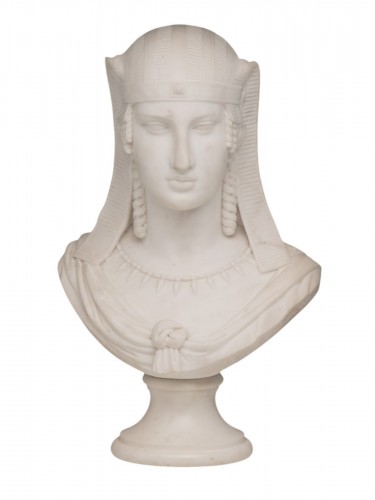
White statuary marble sculpture depicting the muse Terpsichore, protector of dance. Italy. Height: 98 cm. Base diameter: 23 cm.
The work presented here is based on a famous sculpture by Gaetano Matteo Monti, commissioned by Gaetano Bolzesi of Cremona, who wished to adorn his home with an object that would unmistakably express his familiarity with the international tastes of the time. Only later did the work find its way to the Diocesan Seminary of Cremona, through his will, following a typical pattern of mobility for 19th-century collections. Monti's close observation of Canova's work is almost a declaration of intent: and the memory of the Terpsichore that the Venetian sculptor had given to Sommariva in 1811 returns, filtered, in this muse of quiet charm, in which the elegance of the gesture becomes a stylistic signature. The meticulous attention to minute details—the flowing hair, the satin band that encircles the head—as if the marble, docile, were called upon to convey the softness of fabrics and surfaces.
The figure's dancing gait, calibrated to the tinkling of cymbals, finds its internal balance in the interplay of the arms: a restrained dynamism, one of the cornerstones of Monti's poetics. In 1830, when Monti was accepted as an honorary member of the Academy of Sciences, Letters, and Arts of Brescia, the artist donated a plaster cast of the same Terpsichore to the university. Since then, the cast has accompanied the institution's moves: first to the assembly hall of the Queriniana Library, then to Palazzo Martinengo, and finally to Palazzo Tosio, according to a geography of memory that is an integral part of the work's very history.