Offered by Galerie Lamy Chabolle
REQUEST INFORMATION

Decorative art from 18th to 20th century
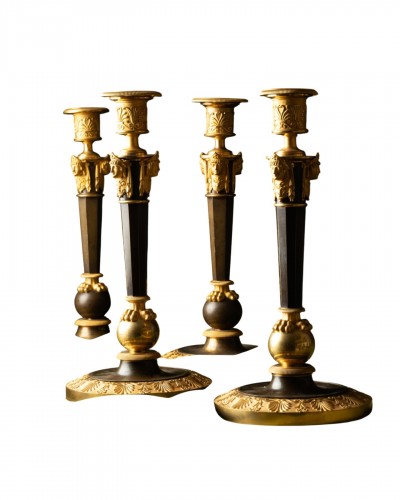
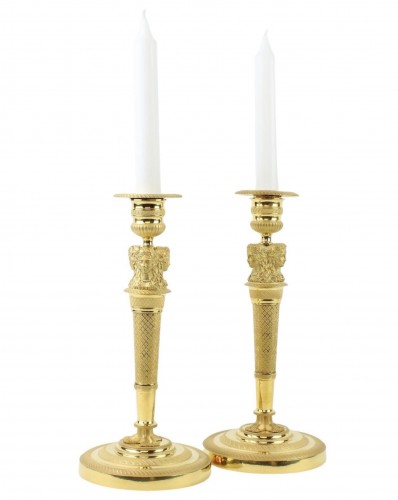
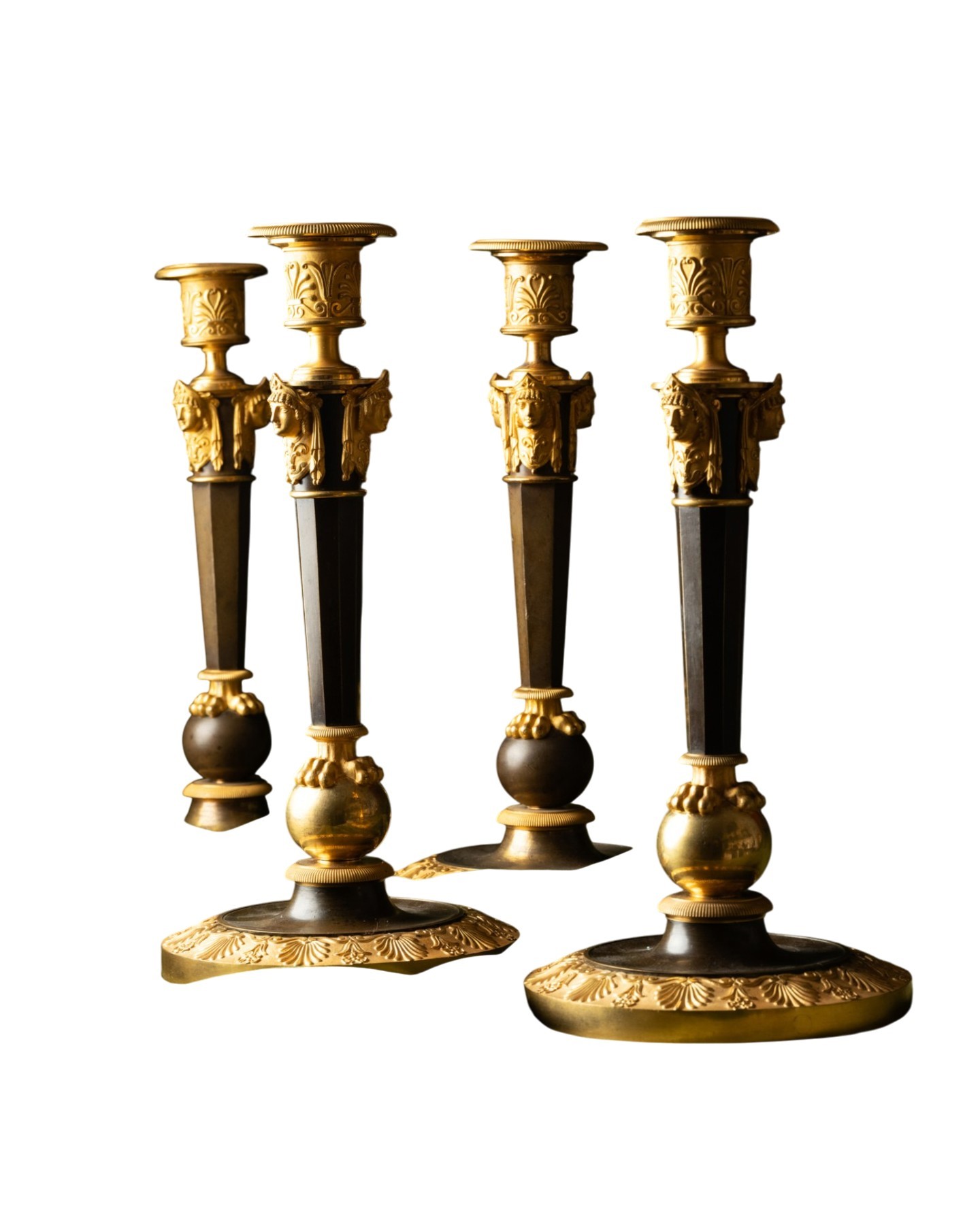
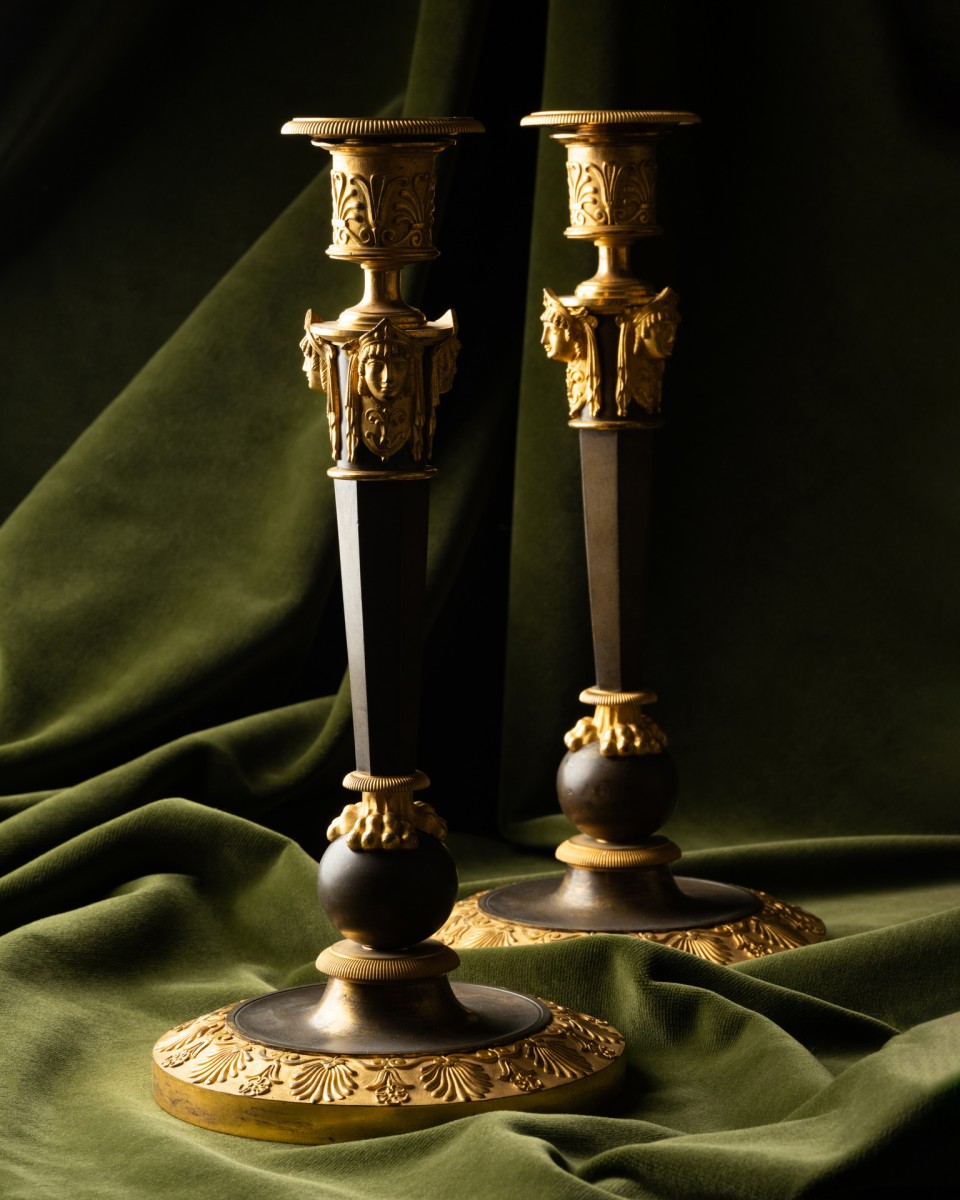
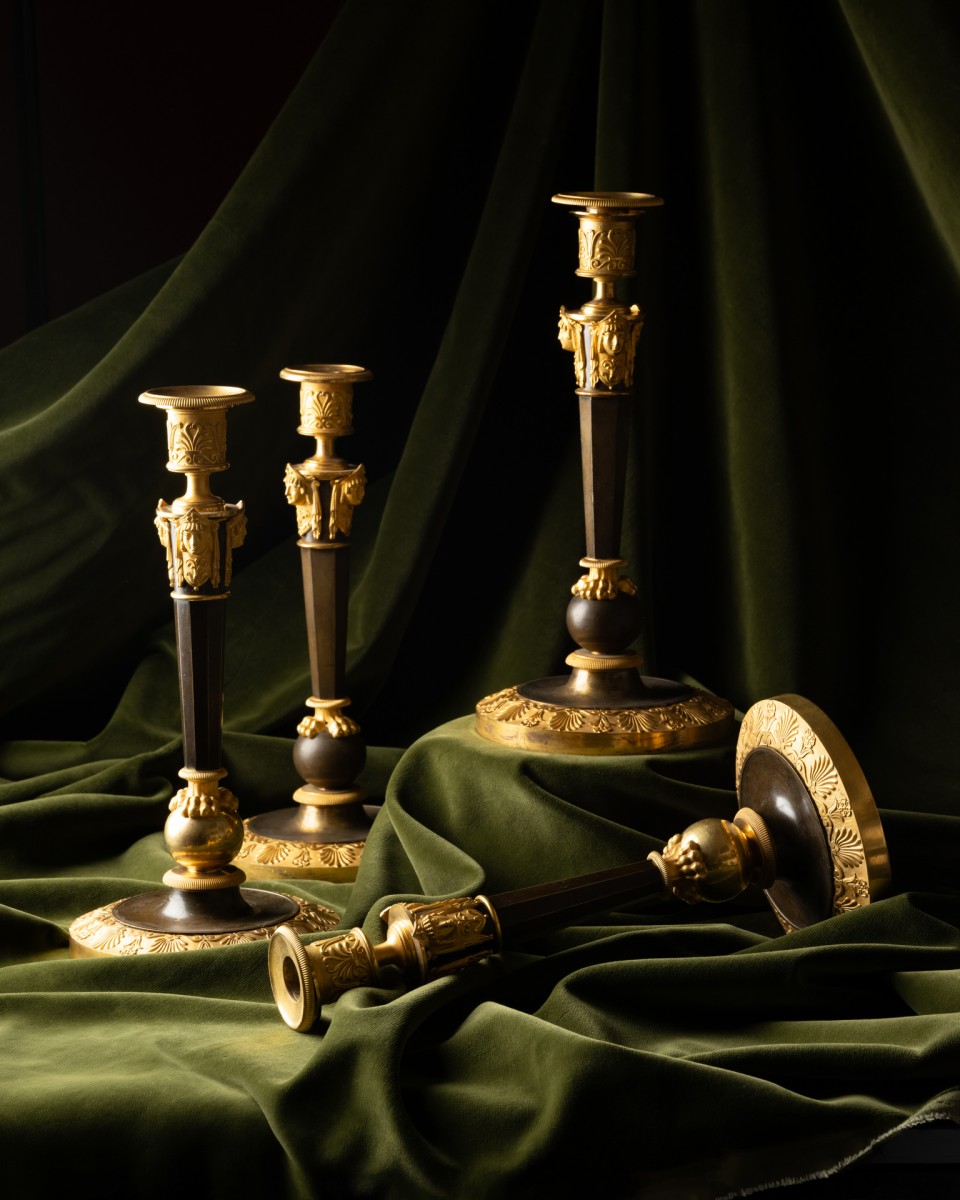
A Set of Four Empire Parcel-Gilt “Claw-Foot” Candlesticks with Antique Masks, attributed to Claude Galle
Parcel-gilt bronze
France
ca. 1809-1810
h. 33 cm (13 in.)
The existence of comparable candlesticks in Russian collections—notably a pair in the State Historical Museum, Moscow—long lent weight to the hypothesis of a Russian origin. The quality of their casting and chasing, however, together with their ornamental vocabulary, makes a French attribution equally plausible on grounds of style, and more probable still on grounds of execution.
The French case is strengthened by an order placed in 1810 with Claude Galle for a “pair of candlesticks, with claws, a bronzed faceted shaft, matte-gilt,” intended for a room above the apartments of the Grand Marshal at the Grand Trianon. Neither Ledoux-Lebard nor Ottomeyer and Pröschel, however, appears to have noticed that these candlesticks—recorded in the inventories from 1818 to 1894 and still at Versailles—do not form a true pair: only the octagonal faceted shaft is common to both, while the bases, claws, mouldings, and bobèches all differ. The candlestick bearing inventory number T 1040.1 must be the original delivered in 1810—its claws are more finely chased, the junction more carefully finished, the proportions more harmonious. Its companion, by contrast, bears numerous signs of restoration—ill-fitting friezes of beading and gadrooning, truncated claws, an oversized collar masking the junction—carried out, in all likelihood, before the inventory of 1818, since the altered elements already bear its mark.
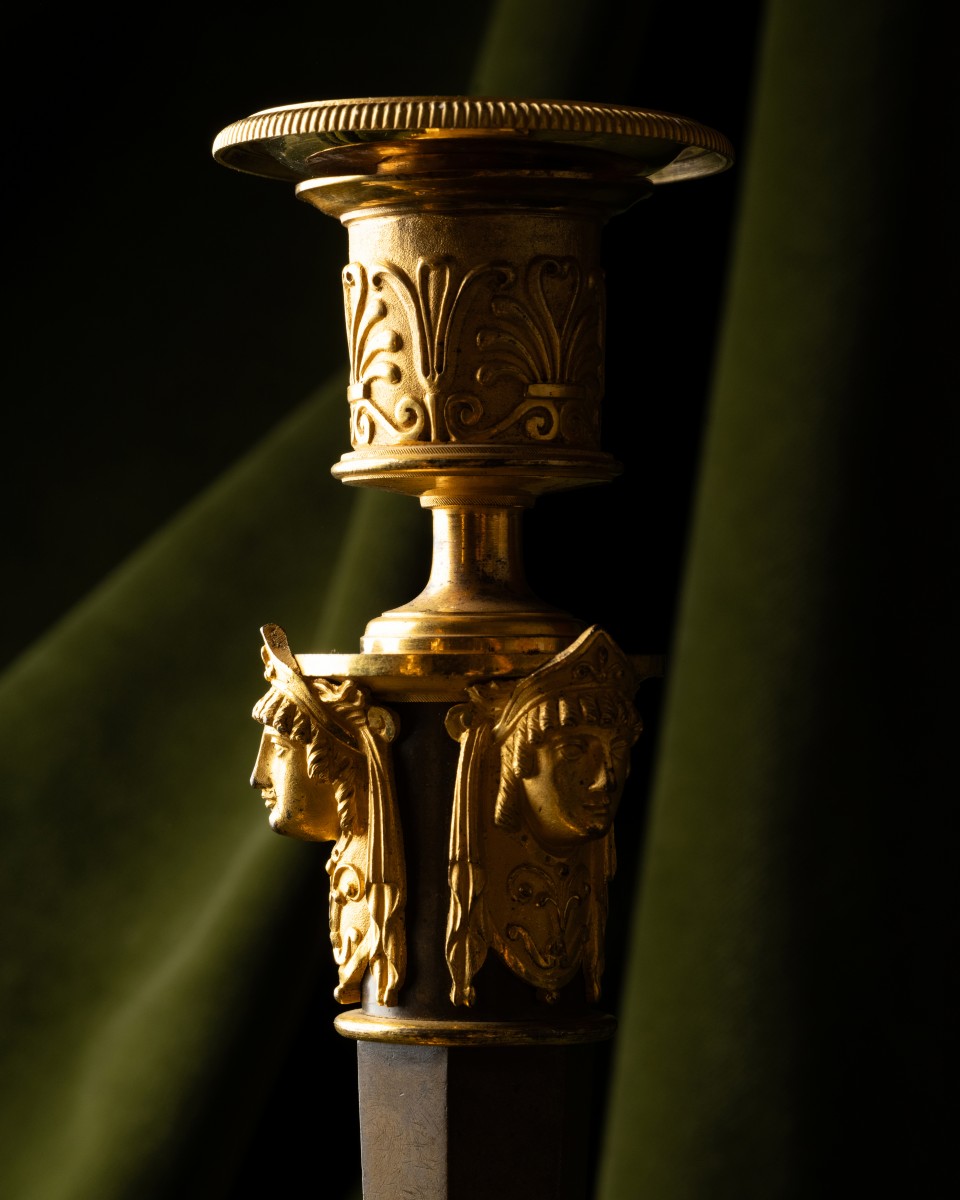
The only elements likely to be untouched—the claws and the octagonal “bronzed,” that is, patinated, shaft—are identical to those of the two octagonal candlesticks in the present suite, whose chasing bears comparison even with the original parts delivered by Galle. The antique female masks, moreover—a rarer motif, absent from the Grand Trianon candlesticks—recur in other deliveries by Galle.
A further model—closely related, faceted but hexagonal, and in that respect nearer to the two hexagonal candlesticks of the present suite—delivered by Antoine-André Ravrio to the Garde-Meuble in 1809, together with a pair acquired through the dealer Darrac for the apartments of Marie-Louise of Austria at the Palais Rohan in Strasbourg, leads Dupuy-Baylet to remark that “candlesticks of this kind, with plain or faceted shafts borne on claws, existed in many variants.”
Several variants of these claw-and-facet candlesticks were thus devised and supplied by the foremost Parisian bronziers; Ottomeyer and Pröschel have indeed published closely related models from a trade catalogue—regrettably anonymous—datable to around 1810. The present suite brings together the two principal versions, octagonal and hexagonal, in their most richly ornamented form, as against the far plainer variant of the Palais Rohan. This diffusion, while it does not wholly dispel the doubt surrounding the attribution to Galle, tends to set aside a Russian origin: it coincides almost exactly with the ????????? ???????, the “bronze prohibition” on French bronzes decreed under Alexander I between 1810 and 1815. It is therefore unlikely that these models were known during the prohibition, or that—having fallen from fashion after the collapse of the Empire—they should suddenly have been imitated by Russian bronziers, whose own style was shifting in the late 1810s and the decade that followed.
The candlesticks vary slightly, as noted above: the shaft of two of them is hexagonal rather than octagonal, and on these the ball supporting the claws is patinated rather than gilt.
See Denise Ledoux-Lebard, Le Grand Trianon. Meubles et objets d’art, Paris, 1975 ; Hans Ottomeyer and Peter Pröschel, Vergoldete Bronzen, Munich, 1986 ; Arcadi Gaydamak, Empire russe. Architecture, arts appliqués et décoration intérieure. 1800-1830, Moscow, 2000 ; Igor Sychev, The Russian Chandeliers. 1760–1830, Saint-Petersburg, 2003 ; Marie-France Dupuy-Baylet, De Bronze et de cristal, Dijon, 2020.