Offered by Galerie Thierry Matranga
REQUEST INFORMATION

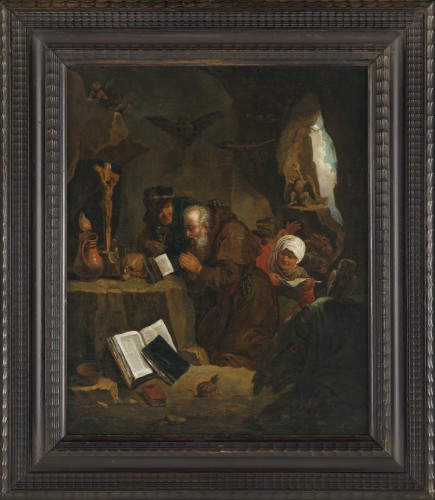
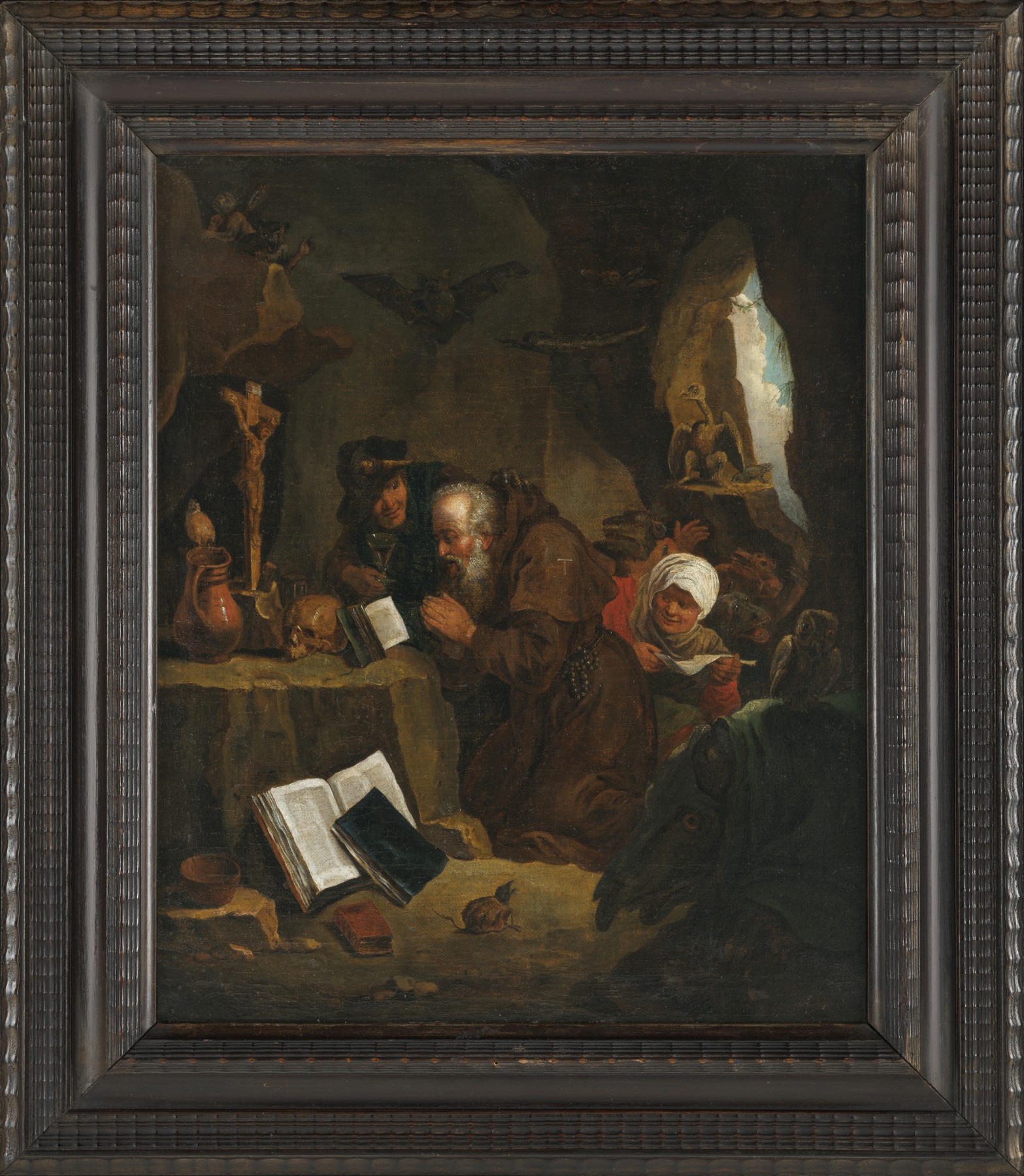
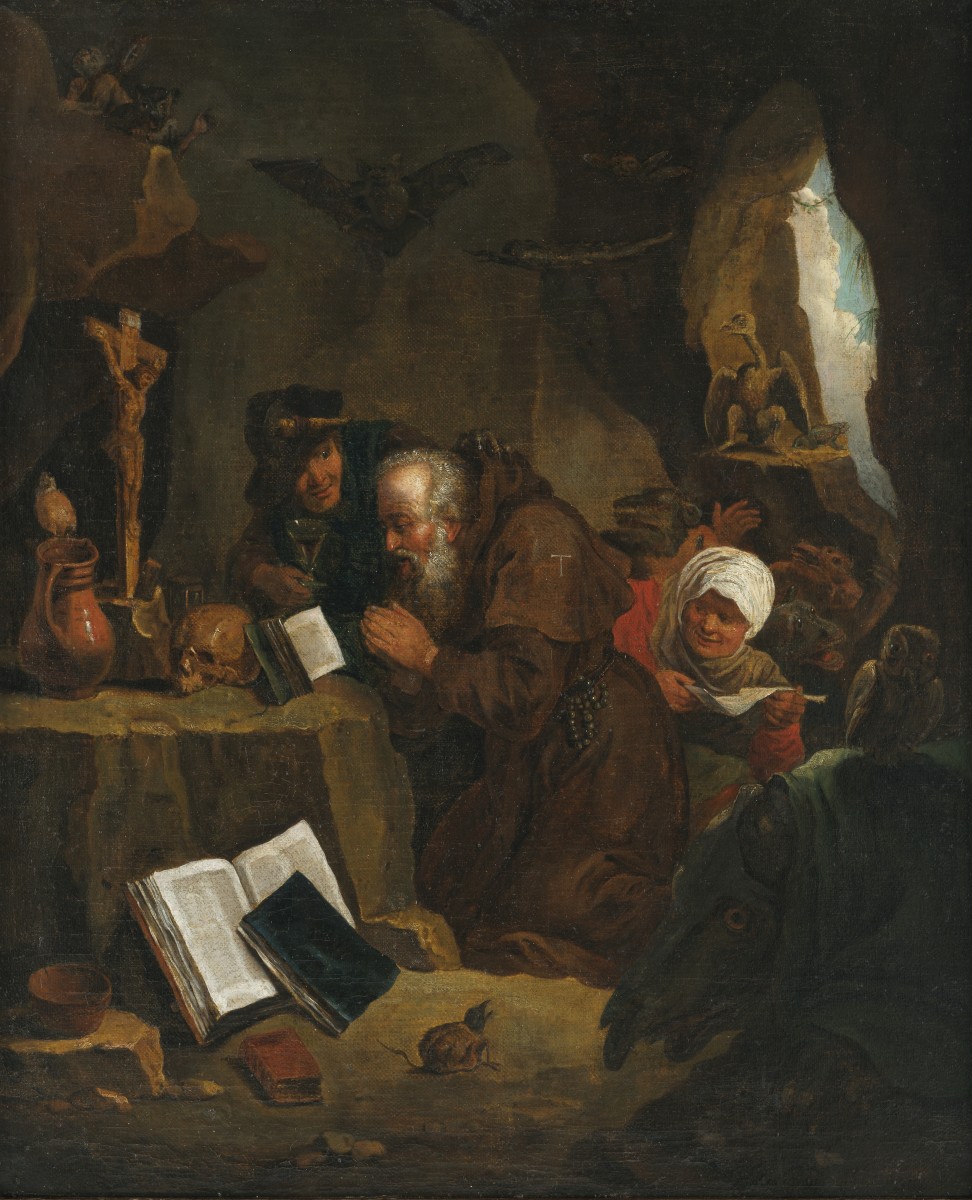
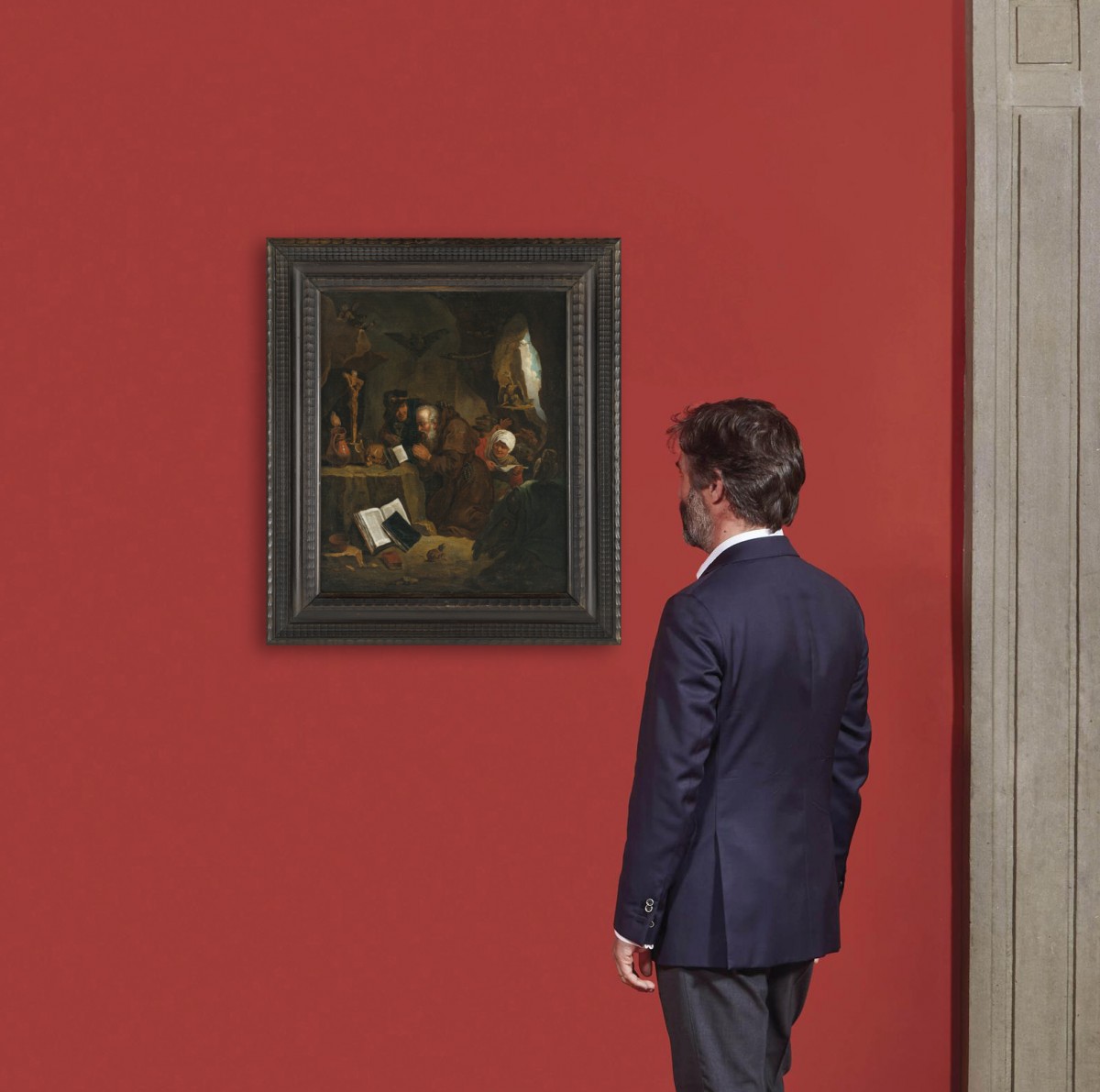
Oil on canvas. 17th century Flemish School, follower of David II Teniers (1610–1690).
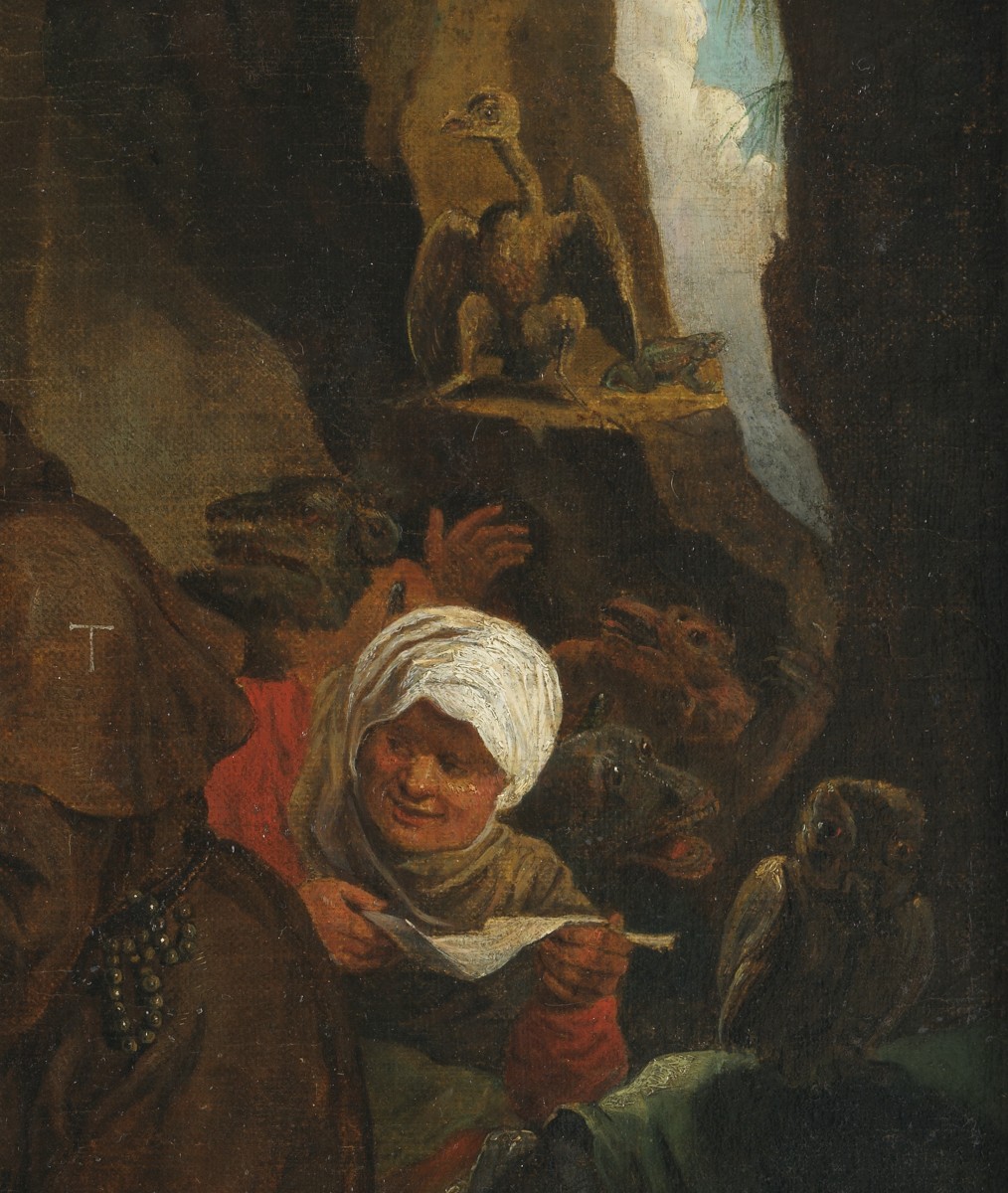
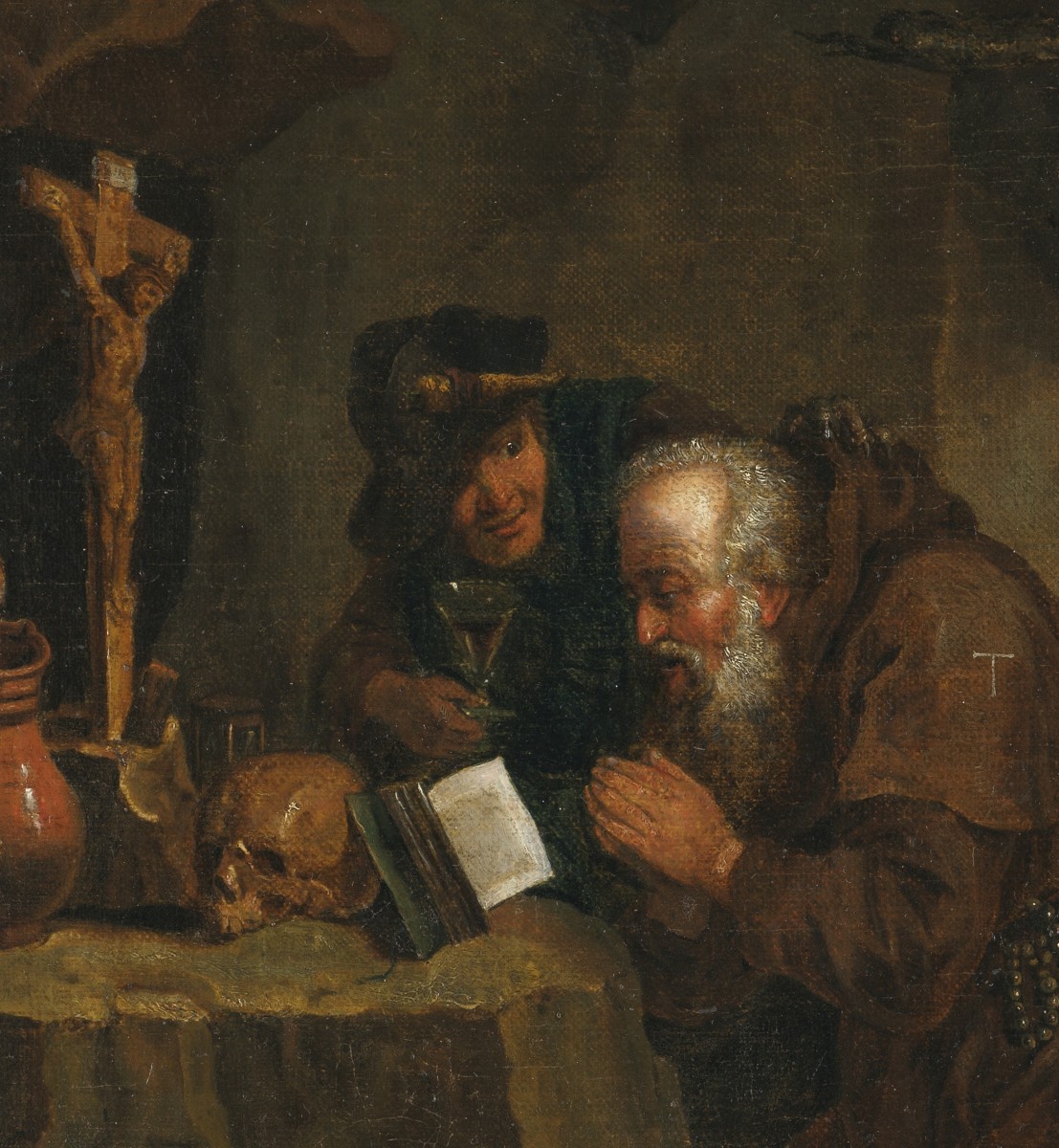
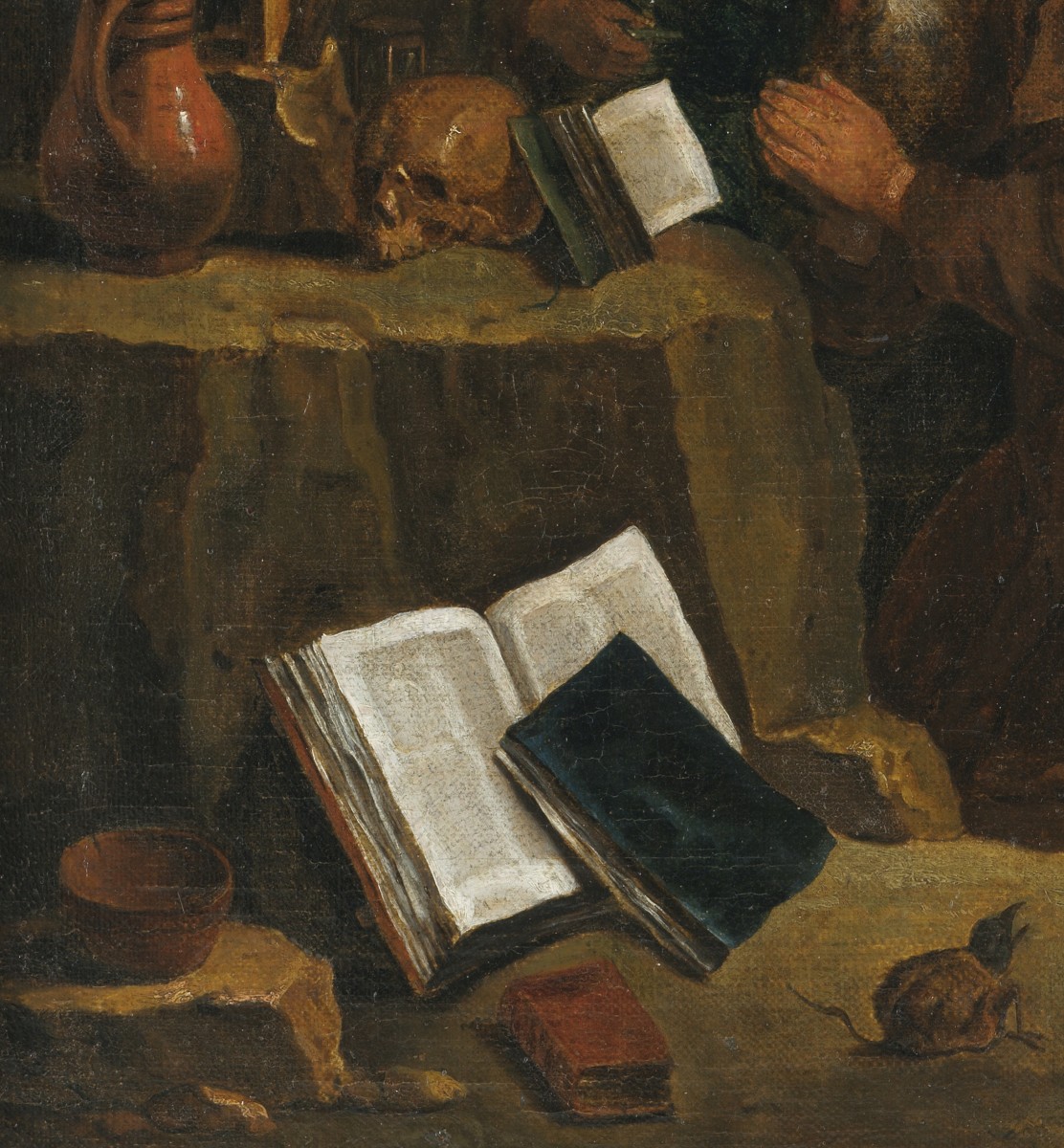
In the darkness of a cave inhabited by a multitude of creatures, Saint Anthony meditates before the Holy Scriptures. Surrounded by the attributes of penitence — the skull, the crucifix, and open books — serving as so many defenses against inner turmoil, the holy man struggles against the fantastic beings attempting to distract him from his pious occupation. These disturbing and noisy monsters bustle and flutter around him: in the foreground, perched on the back of an animal with an equine skull, an owl stares at the viewer. In the background, other creatures, some with rodent-like snouts, others with reptilian jaws, add to the commotion. Above the holy man, a bat, a flying fish, and a winged creature with a human face appear suspended in the air. But the true temptation takes human form: a man wearing a hat offers Saint Anthony a glass of wine, while the woman approaching behind him brings a secular text, a worldly thought.
Our composition, inspired by the work of David Teniers the Younger preserved at the Louvre Museum, takes up the dramatic structure of the scene while reversing its orientation. It was therefore produced after an engraving, of the kind that circulated widely during the second half of the 17th century. The handling, narrative and slightly dry, is characteristic of the workshops and followers who helped disseminate Teniers’s inventions throughout Northern Europe.
Our painting is presented in a guilloché reverse-profile frame in ebonized wood.
Dimensions: 55.5 × 46.5 cm – 72 × 62 cm with the frame.
Biography:
David II Teniers, known as Teniers the Younger (Antwerp 1610 – Brussels 1690), was the son of David I Teniers the Elder, painter and friend of Peter Paul Rubens. The eldest of six children, he was introduced to painting from an early age in his father’s workshop. His brothers Julien, Théodore, and Abraham followed the same path. The young David spent some time copying the greatest Flemish and Italian masters, which greatly enriched his artistic knowledge. From this he acquired great ease in composition, assimilated the finest technical methods, and developed a legendary speed of execution.
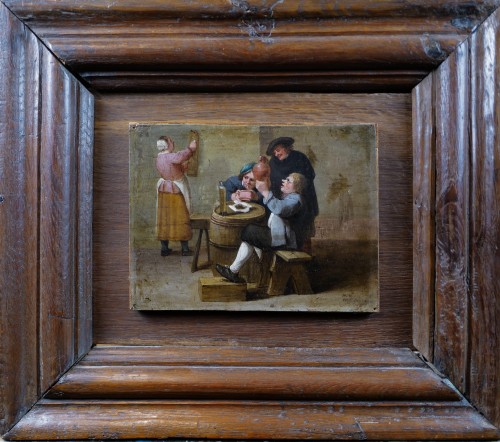
A master of genre scenes set in cottages and taverns, he painted numerous scenes of drinking and smoking, lively conversations, and amorous encounters. By marrying Anne Brueghel, daughter of Jan Brueghel the Elder, he secured considerable social standing and became a notable figure in the city of Antwerp. Like the wealthy bourgeois of Antwerp, he rented a country manor at Perk: Dry Toren (“Three Towers”), whose silhouette he repeatedly depicted in the backgrounds of his paintings and where he enjoyed playing the country gentleman. Confident in his talent, legend has it that he may have uttered these words: “I owe my genius to nature, my taste to my father, and my perfection to Rubens.”
Bibliography:
- Vermoelen (Maria Huibert) John, Notes historiques sur David Teniers et sa famille, Belleuvre et Dolbeau, 1870
- Peyre Roger, David Teniers, biographie critique, 1913
- Bocquet Léon, David Téniers, Editions Nilsson, 1924
- Klinge Margret, Waterfield Giles, Methuen-Campbell James, David Teniers and the Theatre of Painting, exhibition catalogue, Courtauld Institute of Art Gallery, 2006