Offered by Galerie Nicolas Lenté
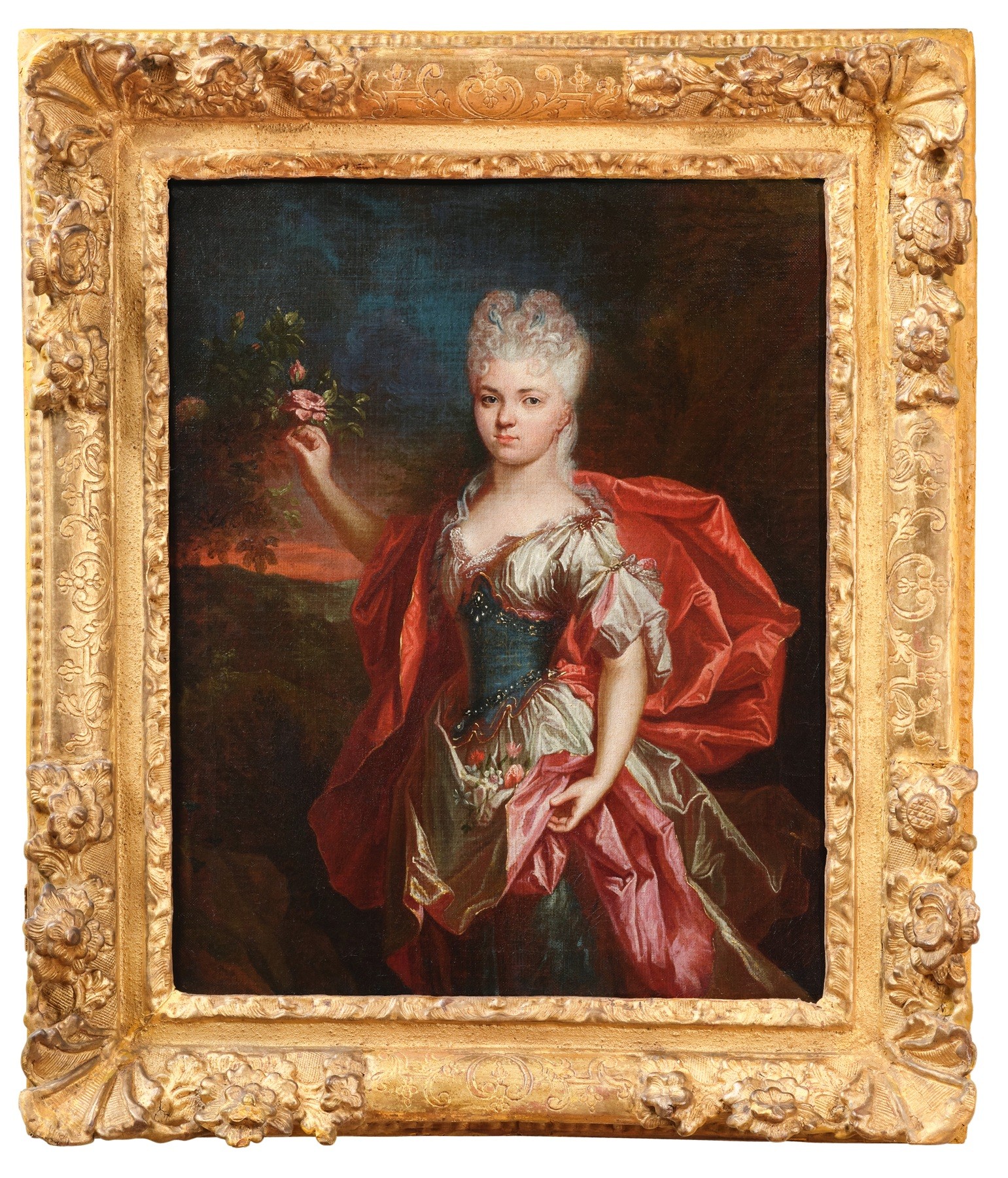
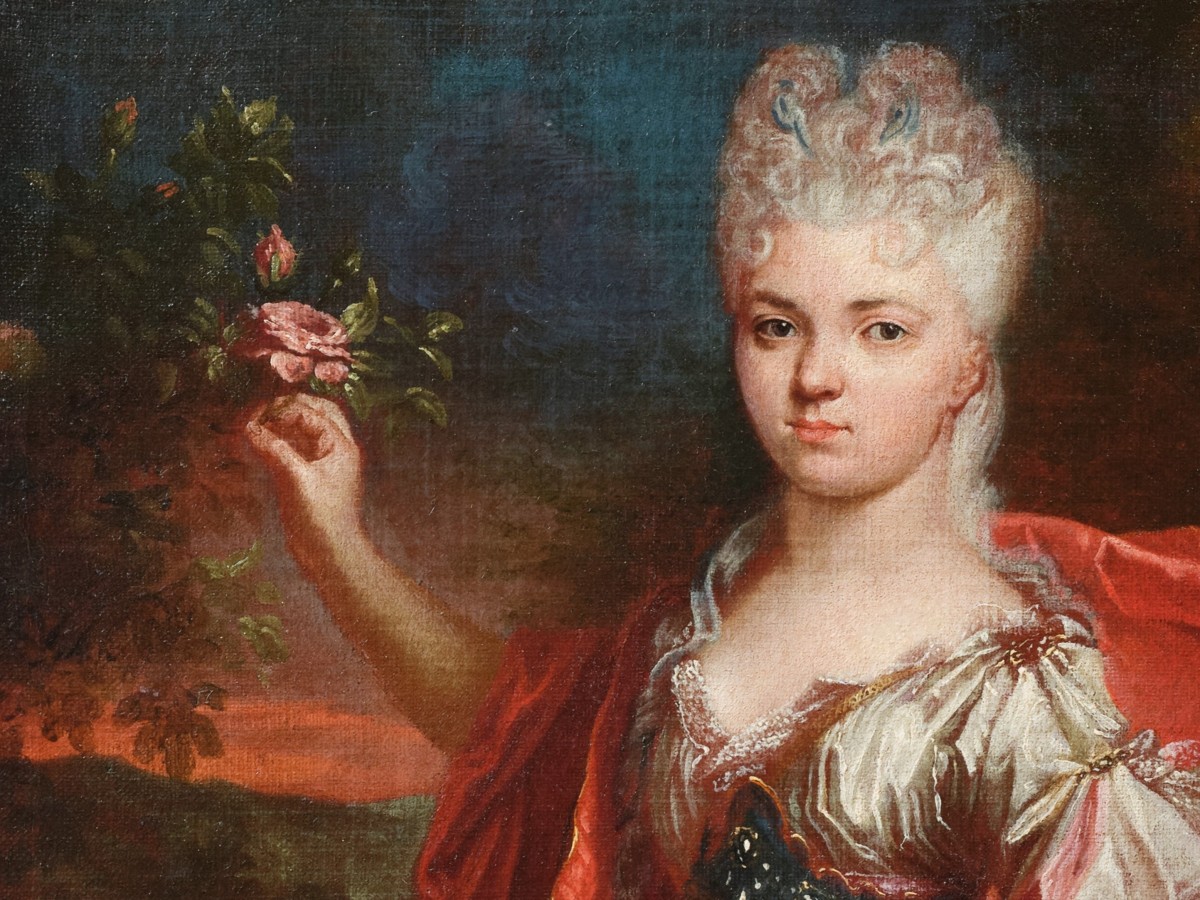

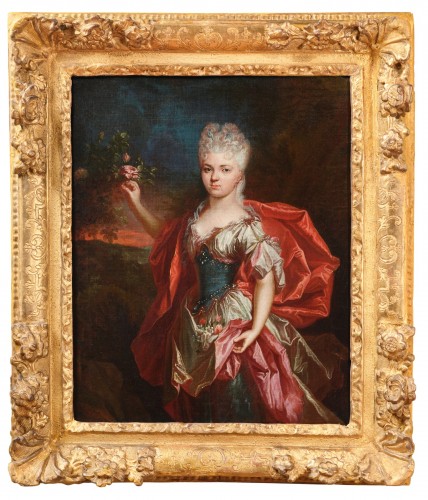
A young Lady as Flora
Attributed to Jacob van Schuppen (Fontainebleau, 1670 – Vienna, 1751)
Paris, circa 1710
Oil on canvas: 46 × 36 cm
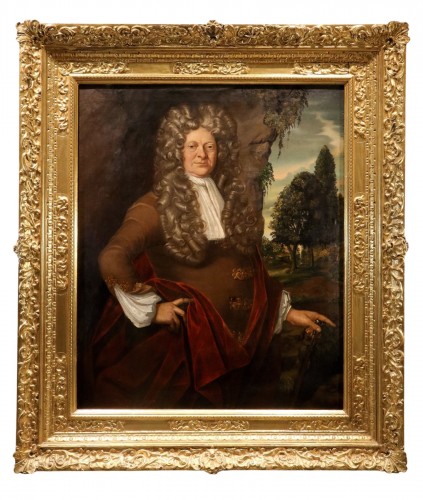
Louis XIV-period carved and giltwood frame with floral corner ornaments
Framed: 62 × 52 cm
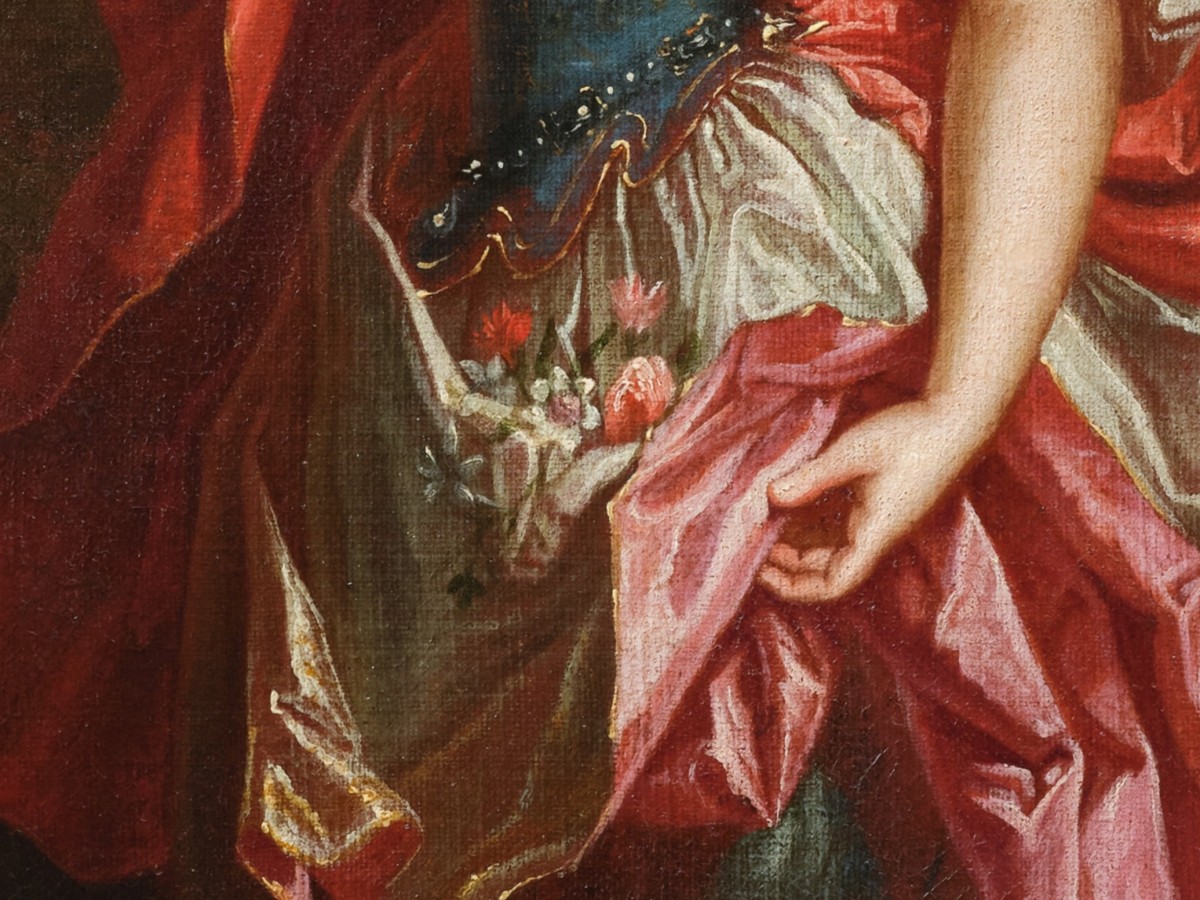
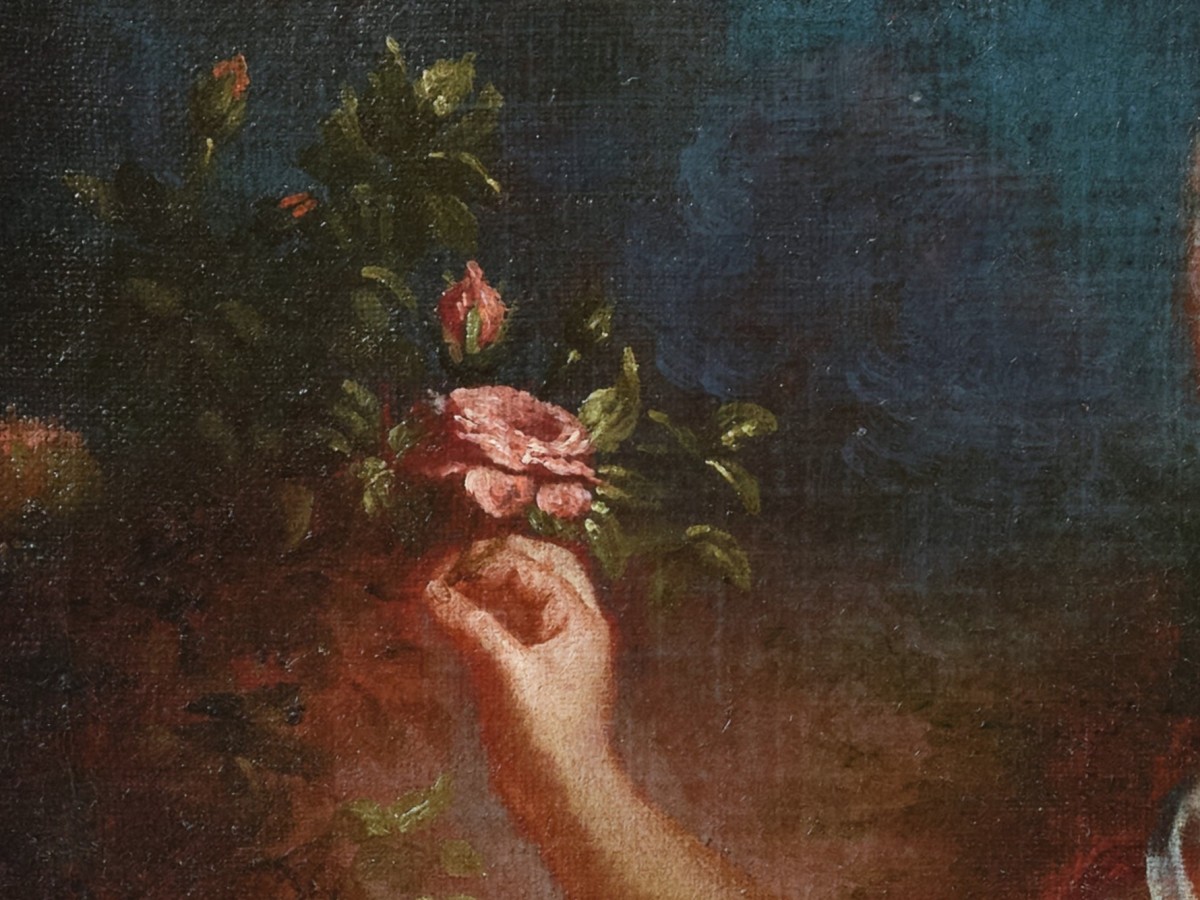
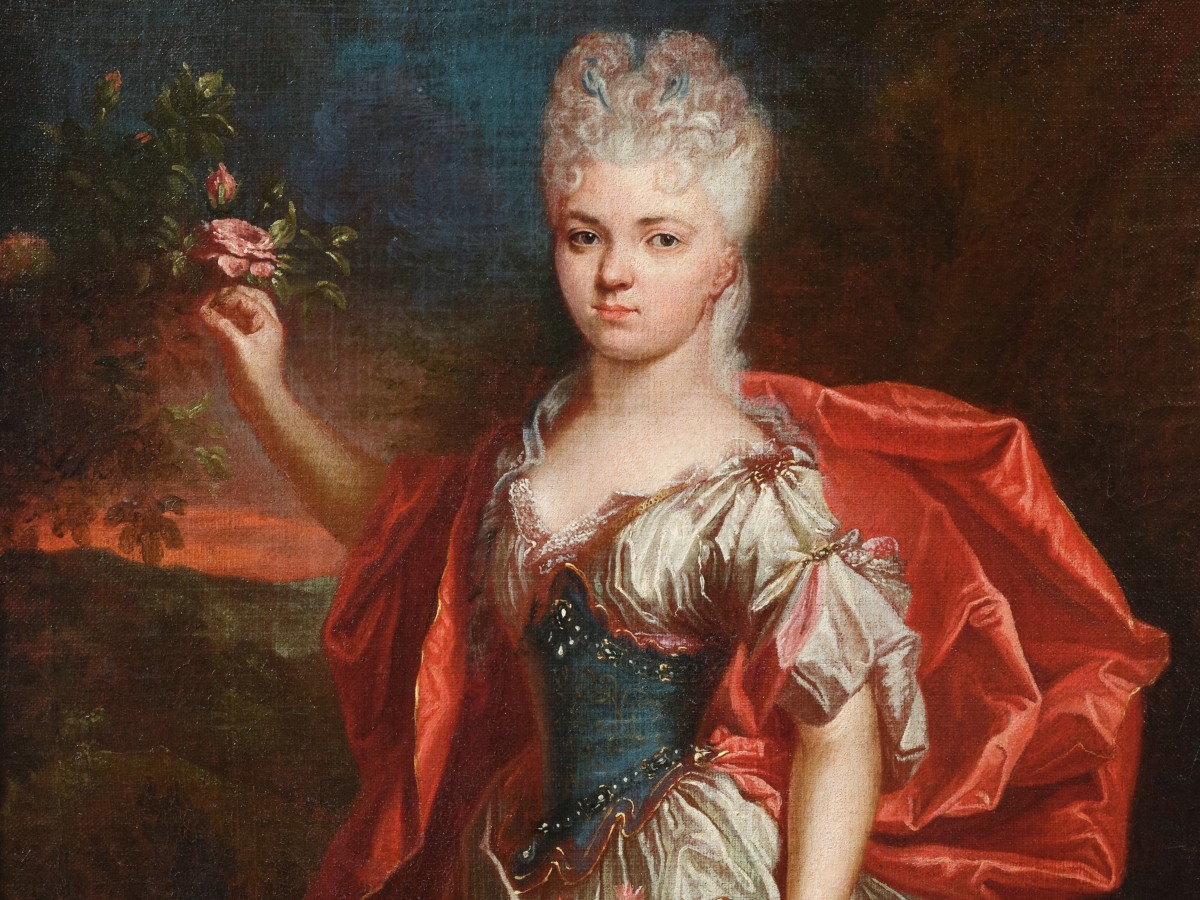
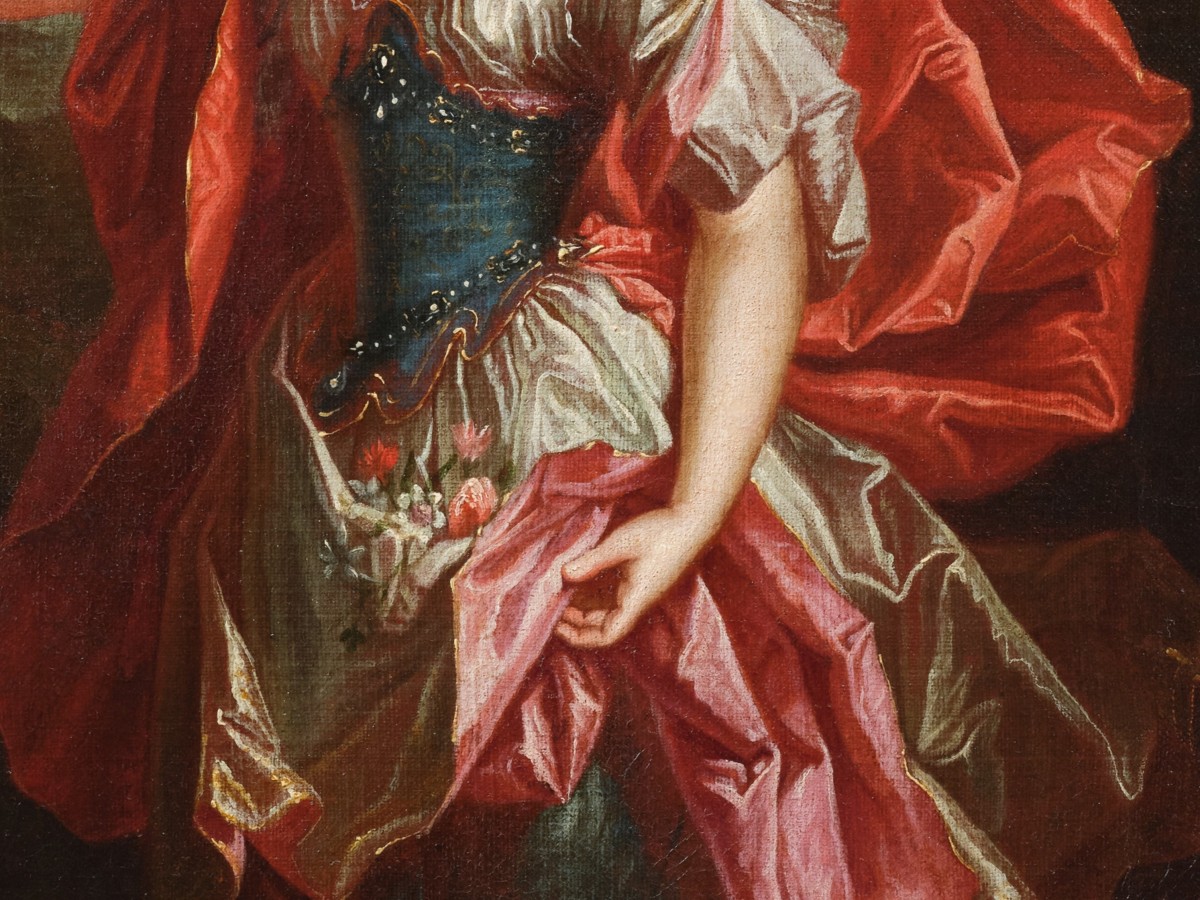
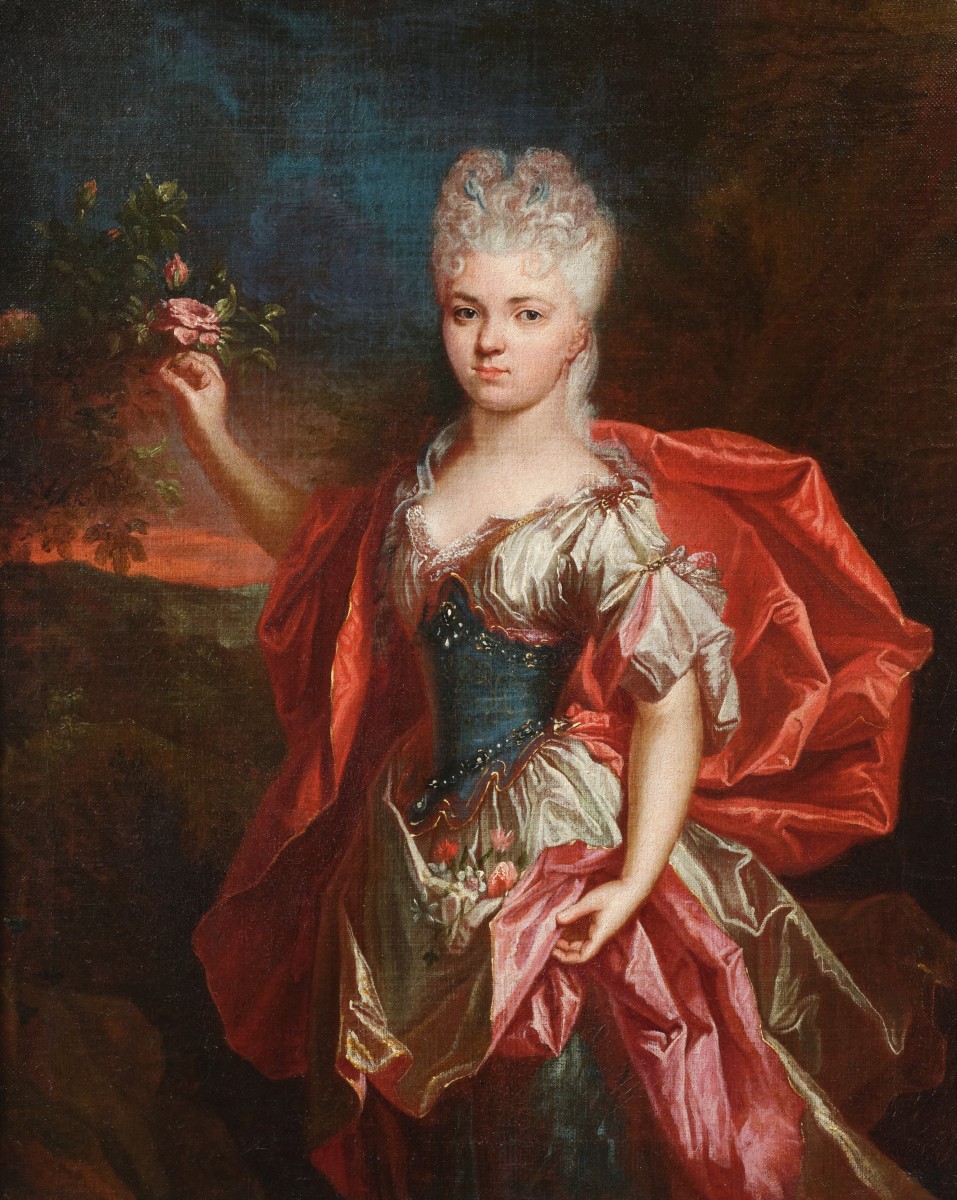
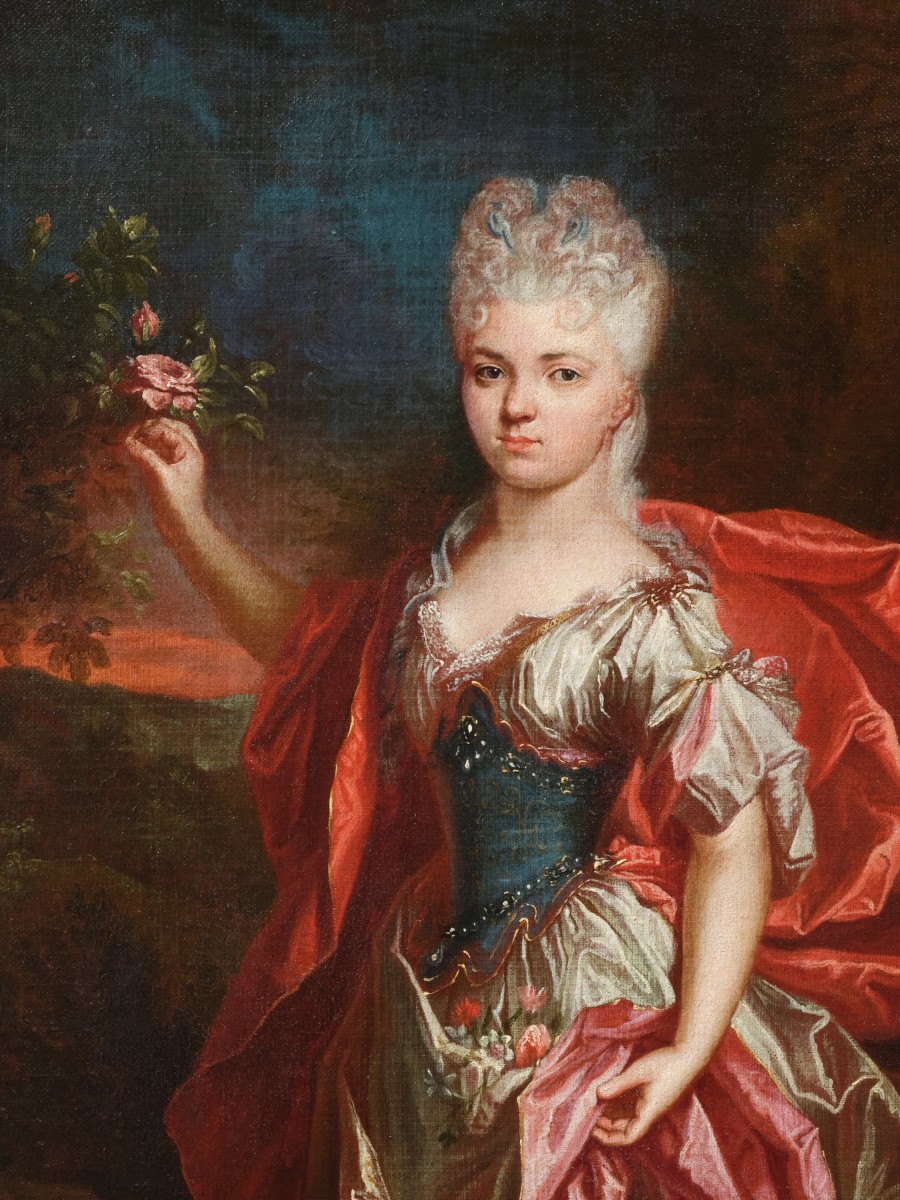
This elegant female figure, depicted as Flora, the ancient goddess of flowers and spring, reflects the refined taste for French allegorical portraiture that emerged in the early 18th century. The young woman is shown at three-quarter length in a twilight landscape, gathering flowers. She delicately holds a rose between her fingers, while with her other hand she gracefully gathers up the skirt of her dress, forming a small basket.
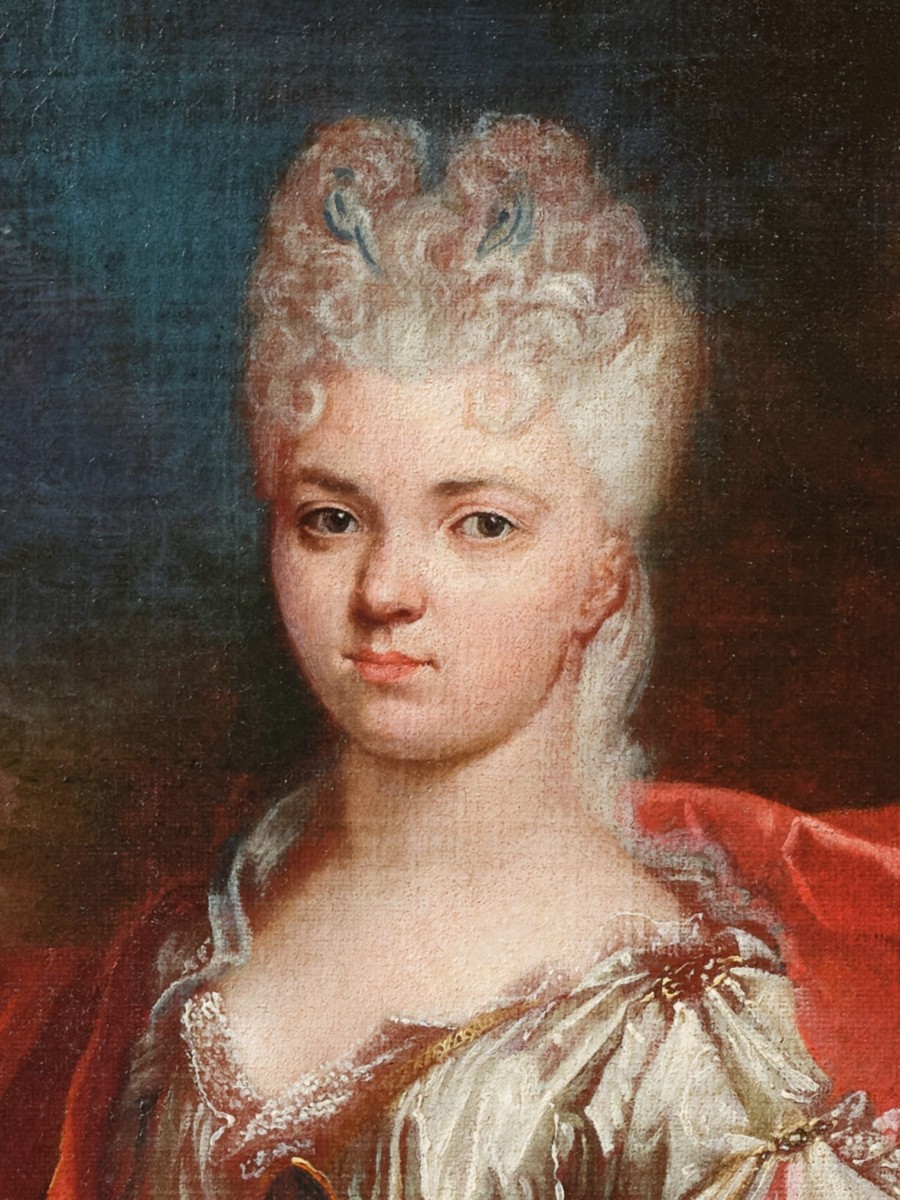
The face is treated with particular care: a fair complexion, a calm gaze turned slightly towards the viewer, fine lips and a restrained expression combine to create an idealised physiognomy, in keeping with the aristocratic elegance of the period. Her high powdered coiffure, carefully arranged and adorned with curls, is enhanced by a blue ribbon tied in her hair.
The costume is one of the principal attractions of the composition. The dark blue bodice, richly embellished with gold embroidery, contrasts with the ivory tones of the dress and its full sleeves. The pink satin lining of the gathered skirt animates the lower part of the figure, while a spectacular red satin mantle, swept back behind the shoulders, envelops her in a broad and theatrical movement. The painter pays particular attention to the rendering of textures: the folds and creases of the satin form luminous ridges and more intensely coloured recesses. Strings of pearls, jewelled clasps and embroidery catch the light, rendered through successive, rapid brushstrokes that lend the costume its relief and brilliance.
The small format of the portrait is particularly noteworthy in this respect. Primarily a portrait painter, Jacob van Schuppen also worked on a small scale: at the Paris Salon of 1704, he exhibited exclusively paintings of reduced dimensions, favouring a variety of compositions.
At such a reduced scale, the painter required considerable precision of draughtsmanship in order to preserve the presence and definition of the face, hands, coiffure, flowers and fabrics. This practice reflects the Northern European tradition of small-format portraiture, linked to his Flemish origins and artistic heritage, while also benefiting from his Parisian training under Nicolas de Largillierre, whose pupil he was in the early 1700s.
In the present work, Largillierre’s influence is particularly evident in the overall construction of the figure and composition: the woman is shown at three-quarter length, her face almost frontal, following a formula characteristic of certain female portraits by the Parisian painter. Comparable solutions can be found in portraits preserved at the Kunsthalle Karlsruhe, the Musée de Grenoble, and in the portrait of the Countess of Castelblanco in Montreal.
The particularly vibrant palette, by contrast, is more characteristic of Van Schuppen: the reds of the mantle, the pinks of the flowers and skirt, the deep blue of the bodice and the ivory tones of the fabrics are set against one another with great vitality. The landscape contributes to this chromatic richness: a mass of trees in autumnal tones stands out against a sky ablaze with the setting sun, bringing the deep blues into dialogue with orange and pink hues. This contrast helps set off the figure and heighten the brilliance of the fabrics, an element directly borrowed from Largillierre’s compositions, known for his autumnal landscapes and shaded skies.
Thus emerges an image of grace and femininity, in which the serene face, sophisticated coiffure, interplay of textures and, above all, the delicate gestures of both hands, each associated with the flowers, contribute to the harmony of the composition. Flora becomes at once an allegory of spring and a demonstration of the painter’s skill in the art of small-format grand manner portraiture, an image whose refinement, intimacy and richness of textile rendering unite the delicacy of the sitter with the luxuriance of the flowers and fabrics.
JACOB VAN SCHUPPEN (Fontainebleau, 1670 – Vienna, 1751)
Born in Fontainebleau in 1670 into a family of Flemish origin, Jacob van Schuppen received his early training from his father, the painter Pieter van Schuppen, before entering the Parisian studio of his uncle, Nicolas de Largillierre. Admitted to the Académie royale de peinture et de sculpture in 1704, he continued his career in Lunéville, where he worked for Duke Leopold of Lorraine. In 1713, at the request of the future Emperor Charles VI, he moved to Vienna and became painter to the imperial court and chamber. Appointed director of the Vienna Academy in 1726, he contributed to its organisation on the model of the Académie royale in Paris. He died in Vienna in 1751.
Delevery information :
We organize the shipping and delivery of our artworks worldwide, working with specialized fine art carriers as well as DHL Express for the secure shipment of small and medium-sized works (up to 120 cm).
Each artwork is carefully packed and shipped in a custom-made transport crate to ensure optimal protection. All shipments are fully tracked and insured.
We pay the utmost attention to every stage of the shipping process to ensure fast, reliable delivery. Shipments via DHL Express are generally dispatched within approximately 7 days of purchase.
All of our artworks can be viewed at our Paris gallery and may also be collected in person.