Offered by Galerie Pellat de Villedon

Furniture, works of art and paintings
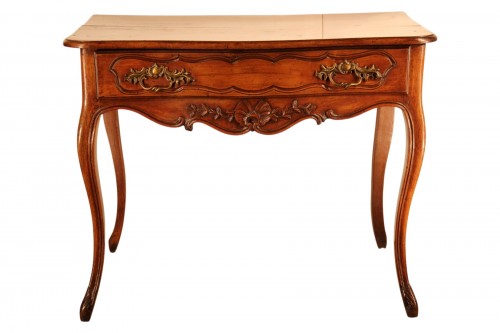
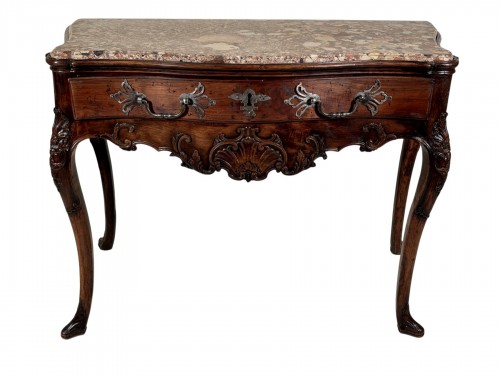
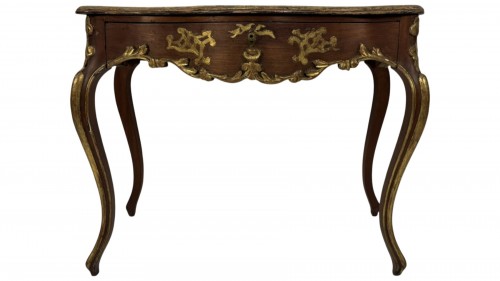
Pair of console commodes resting on two cabriole legs. The console commodes each open with a drawer revealing a leather-lined writing surface, itself opening to reveal a compartment. They are richly inlaid with amaranth, sycamore maple, and stained woods. The impressive frieze, of the so-called “crossbow” form and also curved at the sides, is decorated with motifs of flowering tree branches set within a cartouche. The pair of console commodes is mounted with chased and gilt bronze escutcheons, corner mounts, and sabots.
Stamped Carel and with the JME mark.
Louis XV period.
Restorations consistent with age, leather probably replaced.
H. 85.5 × W. 80.5 × D. 45.5 cm
It is likely that the pair of console commodes we present today are the first you have ever encountered. Indeed, in addition to being a very rare form of furniture, the stamp they bear is not commonly seen, as we shall explain.
The console commode is a relatively episodic type in the history of 18th century furniture. The Metropolitan Museum even states that it corresponds to a fairly short period of production, covering the 1750s, when this type of furniture was fashionable. The Dauphin, for example, ordered a pair from the marchand-mercier Lazare Duvaux, who recorded their delivery in his daybook on February 3, 1757. The Metropolitan Museum preserves an example of a console commode in Coromandel lacquer made by BVRB II, a piece that illustrates the elite taste for this type of fanciful furniture, often intended to support a mirror or trumeau in a dining room. Our pair of console commodes is therefore a rare testimony to the extraordinary inventiveness of 18th century cabinetmakers.
The pair of consoles bears the stamp of the cabinetmaker Carel on the left rail of each console. Jacques-Philippe Carel was received as a master cabinetmaker in 1723. During his early years, he worked in Grenoble in the workshops of Thomas Hache. From this experience, he retained great dexterity in the art of veneering and, particularly in his Louis XV production, showed a clear predilection for floral marquetry. Ours features a broad and vigorous motif of flowering branches gracefully spreading along the frieze. The bronzes on our consoles are recurring motifs in Carel’s work, as the same sabots and corner mounts can be found on a bureau plat sold at Christie’s on April 27, 2021, lot 259.
More interesting still is a wall console sold at Artémisia Auction on May 28, 2014, lot 190. The console is very similar to ours, with a comparable choice of woods and the same crossbow-shaped movement. We may therefore assume that Carel, whose corpus of identified works is relatively limited, produced a small number of these distinctive consoles.
We should also note a delivery made in 1757 by the marchand Duvaux for the Dauphin at Versailles: “Two types of commodes with a single drawer, whose legs are in the form of consoles, veneered in floral kingwood, mounted throughout with ormolu...”
Carel’s wealthy clientele included the Swedish royal household — Drottningholm Palace still preserves one of his commodes — the French royal household, through Gaudreaus, who subcontracted work to Carel, and the Prince of Württemberg. His furniture was admired for its refined elegance, the consistently high quality of its bronzes, and the finesse of its forms and veneers. The Louvre thus preserves a two-door commode by him. The Frick Collection in New York also preserves a commode with floral end-grain marquetry, while the Palace of Versailles includes a pair of slant-front desks among its collections.
Carel left relatively few stamped pieces of furniture, which increases the value of our ensemble. Rarity is therefore perhaps the defining word for this pair of console commodes.