Offered by Galerie PhC

REQUEST INFORMATION

European paintings from the 17th, 18th and 19th centuries.
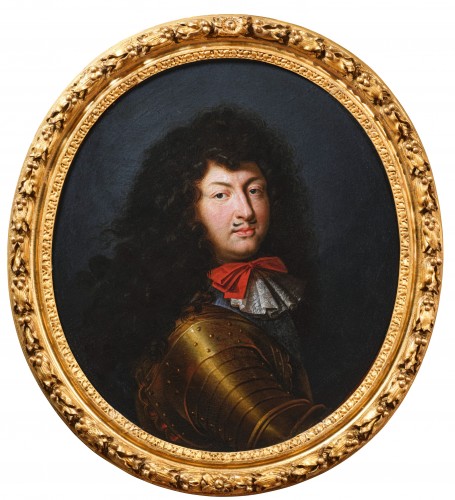
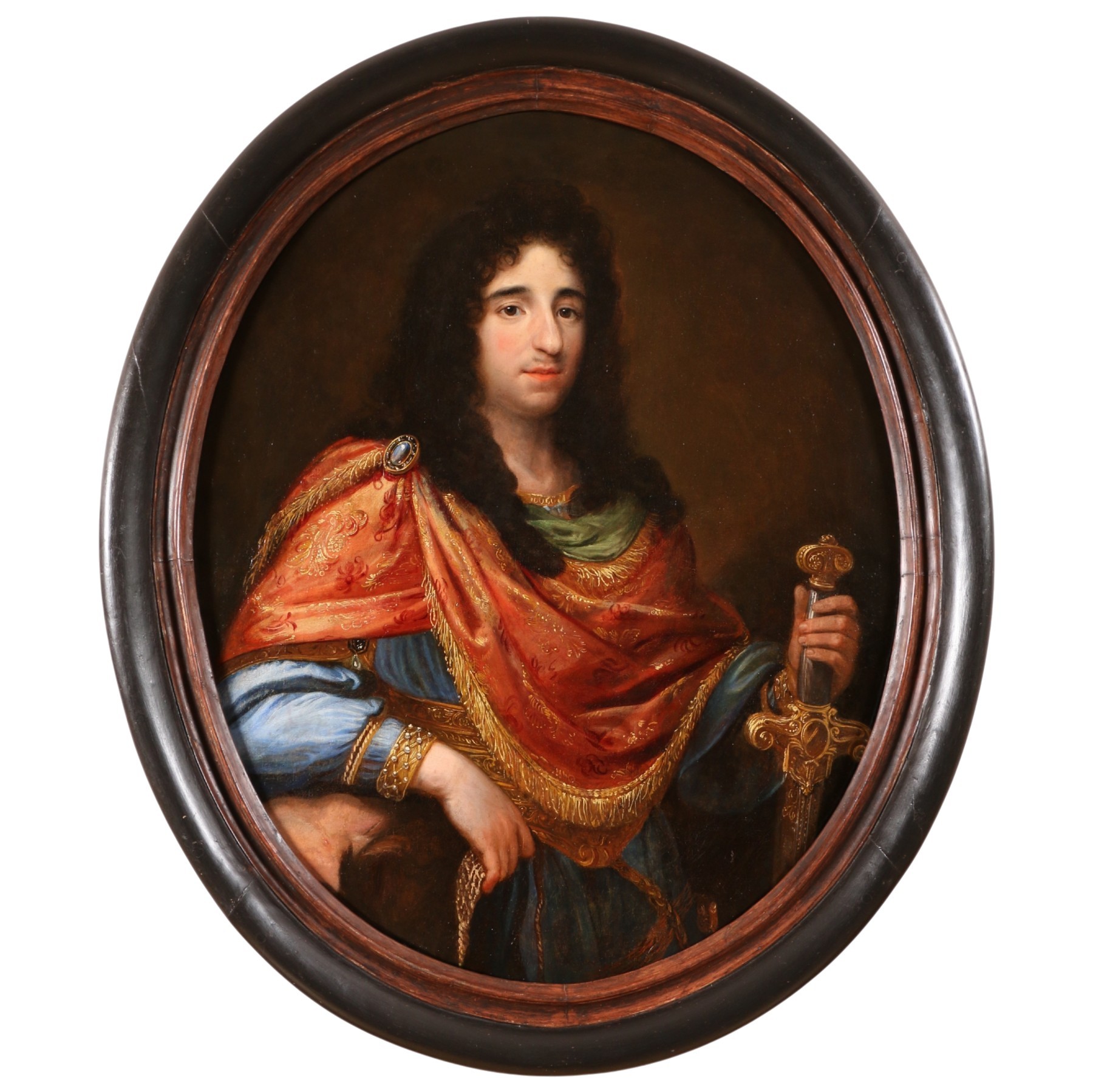
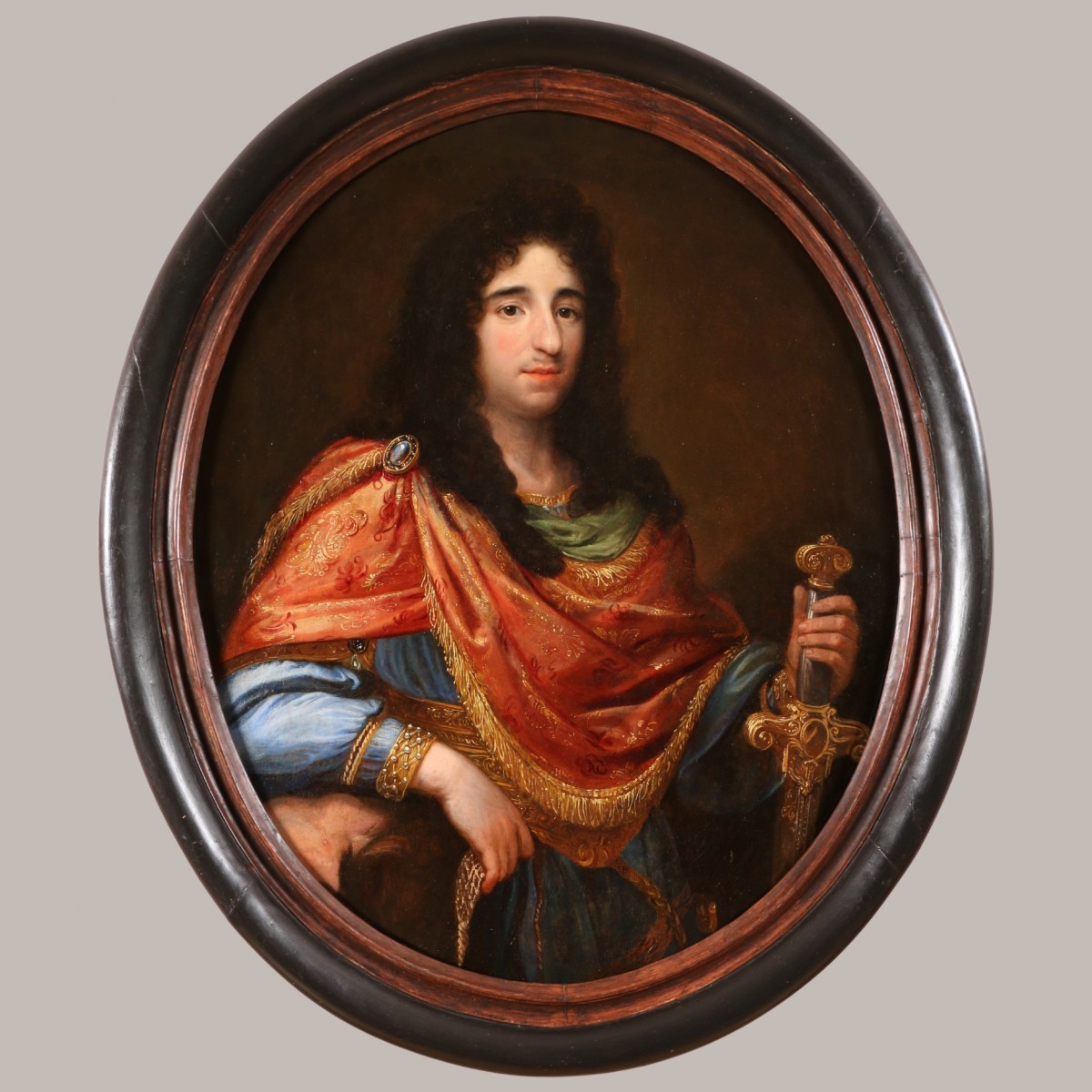
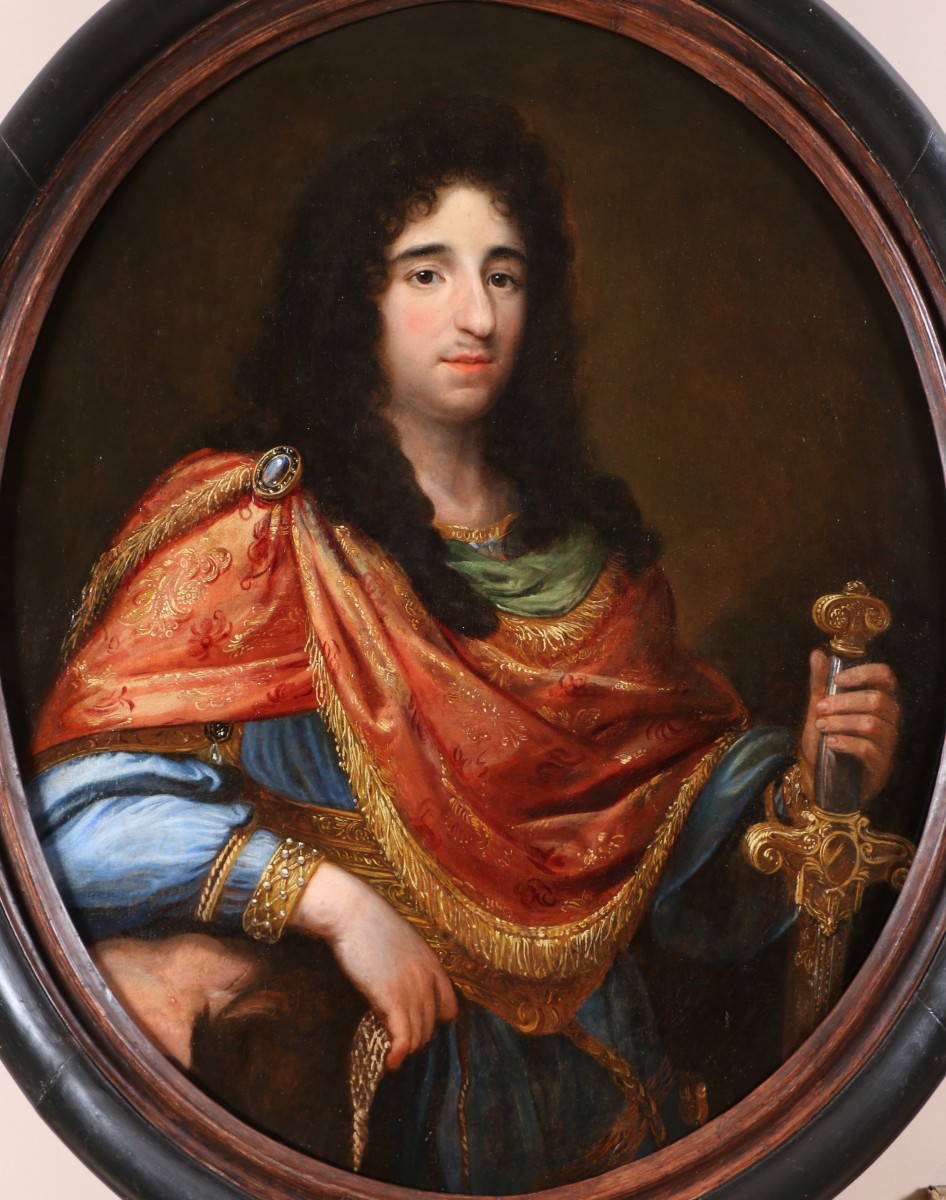
François-louis De Bourbon, Prince Of Conti, Known As The Grand Conti (1664–1709), Circa 1685.
Workshop of Pierre Mignard, circa 1685
François-Louis de Bourbon, Prince of Conti, known as "le Grand Conti" (1664–1709)
The young prince is depicted here around 1685, in his twenties.
Related work: a painting at the Palace of Versailles showing him as a Roman emperor, evidently created a few years prior to the present work:
https://pop.culture.gouv.fr/notice/joconde/000PE007143?utm
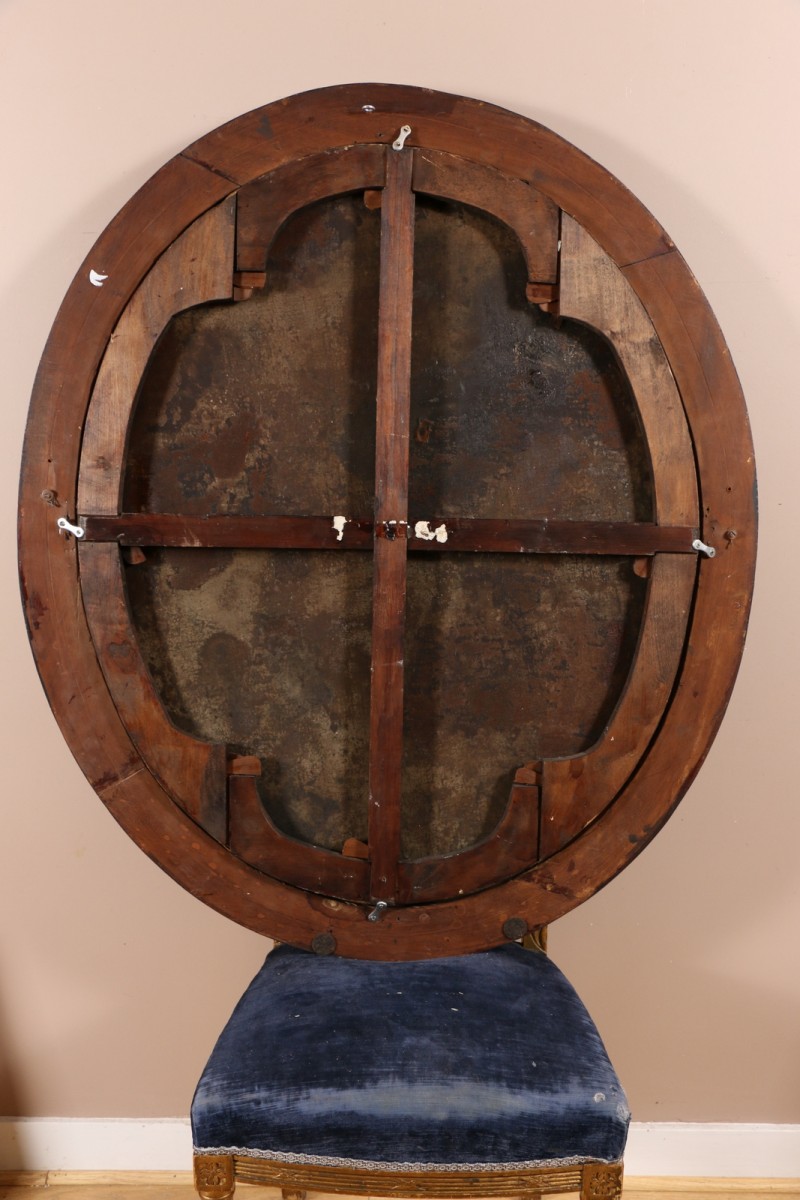
Oil on original canvas, 91 cm by 75 cm.
Period frame, 109 cm by 91 cm.
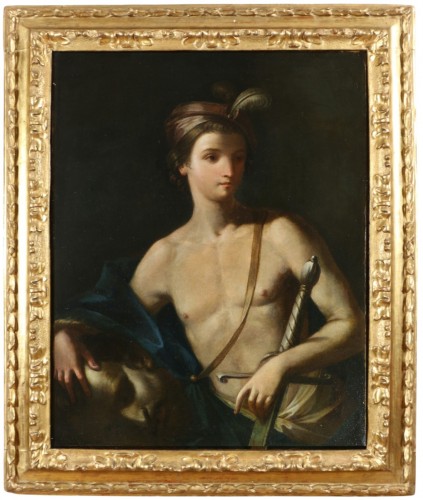
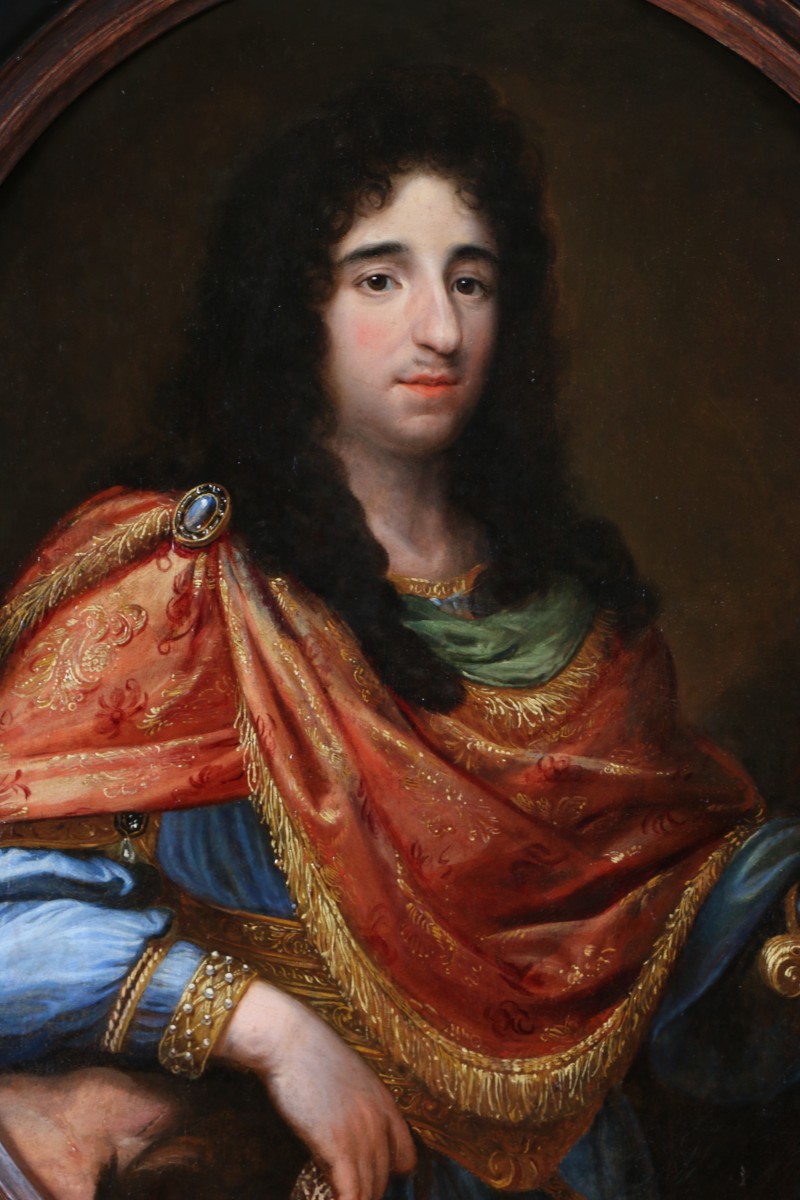
The painting depicts François-Louis de Bourbon as a young man, shown in a half-length portrait against a dark brown background. His fair face, framed by abundant brown hair, stands out softly from the background.
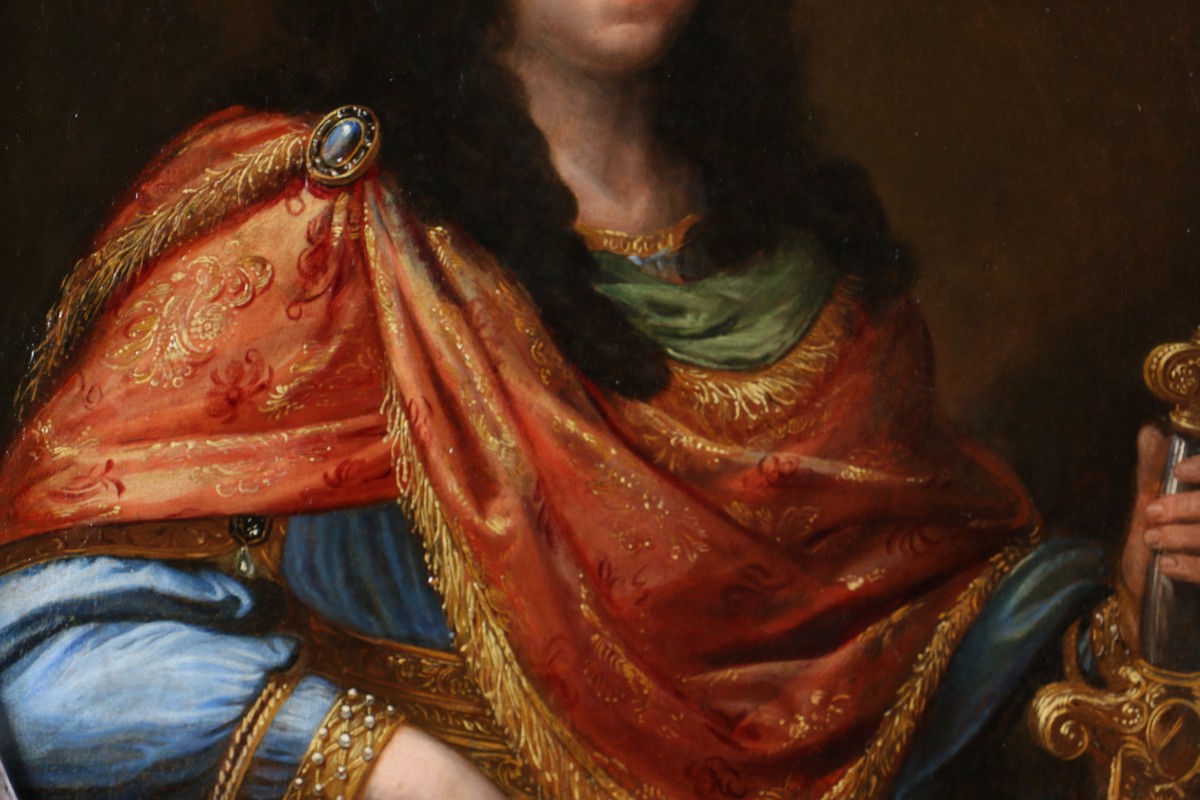
The prince wears an elaborate costume inspired by antiquity. A voluminous orange-red drape—embroidered with gold and edged with fringe—covers a blue tunic and a green cloth knotted around his neck. It is fastened at the shoulder by a large oval clasp set with a blue stone. A narrow gold band at the neckline appears to bear several characters, though their reading remains uncertain.
His right hand holds a sword with a gilded hilt—an attribute of his rank and military calling—while his other arm rests naturally across his body. The composition creates a heroic image of a young Prince of the Blood destined for a military life.
The painting technique is characterized by the contrast between the soft, blended modeling of the flesh tones and a much freer brushwork in the fabrics. The gold embroidery and fringe are suggested by small, spirited, luminous strokes—almost calligraphic in nature—while the hair blends gradually into the brown background.
François-Louis de Bourbon, Prince of Conti
François-Louis de Bourbon, Prince of Conti—better known as the "Grand Conti"—was born in Paris on April 30, 1664, and died in the same city on February 22, 1709. A *prince du sang* (prince of the blood) of the House of Bourbon-Condé, a brilliant military man, and a particularly charming figure at the court of Louis XIV, he remains one of the most distinctive figures of the French high aristocracy in the late 17th century. The Bibliothèque nationale de France confirms these dates as well as his initial titles: Prince of La Roche-sur-Yon and Count of La Marche.
Origins and Youth
François-Louis was the son of Armand de Bourbon, Prince of Conti (1629–1666), and Anne-Marie Martinozzi (1637–1672), a niece of Cardinal Mazarin. Through his father, he belonged to the cadet branch of the Bourbon-Condé family and was a direct descendant of the "Grand Condé"—Louis II de Bourbon—whose younger brother his father had been.
He lost his father when he was only two years old, and his mother when he was eight. His elder brother, Louis-Armand I de Bourbon, Prince of Conti, then became the head of the family branch.
During his youth, François-Louis held the title of Prince of La Roche-sur-Yon.
The young prince received the education befitting a *prince du sang*. Contemporary and later accounts attribute to him a keen intellect, great wit, social ease, and remarkable physical courage. His personality contrasted with that of certain more austere members of the House of Condé.
The Young Prince at the Court of Louis XIV
François-Louis grew up just as Versailles was becoming the permanent center of the monarchy; Louis XIV established the court and the seat of government there, primarily from 1682 onwards.
The young François-Louis thus belonged to that first generation of princes who lived fully within the Versailles society created by Louis XIV. He was also very close to his cousin Louis III de Bourbon-Condé—the future Prince de Condé—who was born in 1668. In 1685, the latter married Louise-Françoise de Bourbon, known as *Mademoiselle de Nantes*, the legitimized daughter of Louis XIV and Madame de Montespan.
François-Louis thus found himself at the heart of the dynastic network linking the Condé and Conti lines with the royal family.
A Prince Born for War
It was primarily in his military career that François-Louis earned an exceptional reputation at a very young age.
He took part in Louis XIV’s wars, distinguishing himself through a personal bravery that greatly contributed to his legend. This reputation as a warrior-prince is essential to understanding his iconography: the sword, heroic drapery, and costumes inspired by Antiquity were not merely portraitist’s flourishes; they helped shape the image of a young *prince du sang* (prince of the blood) destined for a life of arms.
However, his independent temperament also led to difficulties. In his youth, he and his brother were implicated in an affair concerning the Hungarian campaigns against the Ottomans. His taste for military action did not always sit well with the political discipline Louis XIV imposed upon princes.
He Becomes Prince de Conti
The year 1685 marked a turning point.
His older brother, Louis-Armand, died without issue. François-Louis inherited the title and became Prince de Conti.
This date serves as a particularly useful reference point for dating his portraits: before 1685, he held the title of Prince de La Roche-sur-Yon; after his brother's death, he became Prince de Conti.
Marriage and Reconciliation with the "Grand Condé"
In 1688, François-Louis married Marie-Thérèse de Bourbon-Condé (1666–1732).
She was the daughter of his cousin Henri-Jules de Bourbon, Prince de Condé, and the granddaughter of the famous "Grand Condé." This union further strengthened the ties between the two branches of the House of Bourbon-Condé.
The marriage produced several children, including Louis-Armand II de Bourbon-Conti (1695–1727), who would succeed his father as Prince of Conti. The BnF confirms his dates as November 10, 1695, to May 4, 1727.
One of the finest generals of his time
In the 1690s, the Prince of Conti played an active role in the War of the League of Augsburg.
He distinguished himself particularly during the campaigns in the Low Countries and took part in major French military operations of the era. He gained a formidable reputation for courage and military acumen.
However, this success presented a problem typical of the monarchy under Louis XIV: an extremely popular, brilliant, and ambitious Prince of the Blood could also become a political liability.
Louis XIV valued his qualities but was wary of his independence.
"Le Grand Conti" thus occupies a paradoxical position: close to the throne by birth, indispensable due to his military talent, and admired at court, yet never fully in the King's favor.
The extraordinary Polish adventure
The most spectacular episode of his career occurred in 1697.
Upon the death of John III Sobieski, the throne of the Republic of the Two Nations—Poland and Lithuania—fell vacant. As the Polish monarchy was elective, several European princes put themselves forward as candidates.
François-Louis de Bourbon was proposed as a candidate for the throne with the backing of Louis XIV.
A significant portion of the Polish nobility elected him king. However, his main rival, Frederick Augustus of Saxony—the future Augustus II the Strong—enjoyed other sources of support and acted swiftly.
Conti left France by sea and arrived off the coast of Danzig (Gda?sk). Yet, the political and military situation had already shifted in his rival's favor. He failed to secure the kingdom and was ultimately forced to return to France.
For a few weeks, the destiny of "Le Grand Conti" could thus have been radically different: a prince of the House of Bourbon came close to becoming King of Poland.
The episode was significant enough to immediately enter the political iconography of the time; the BnF collections, for instance, hold visual records linking François-Louis de Bourbon to Poland.
"Le Grand Conti"
It is the combination of these qualities and adventures that explains the figure's enduring legacy.
François-Louis embodied several traits highly prized within the 17th-century aristocratic ideal: illustrious birth, good looks, elegance, wit, bravery, military talent, and an independent spirit.
His reputation thus far surpassed that of a mere secondary member of the royal family.
The nickname "Le Grand Conti" also served to distinguish him from the dynasty's many other Princes of Conti.
Nevertheless, his position remained ambiguous until the end of his life. Louis XIV continued to acknowledge his abilities without ever placing full political trust in him. Conti was one of those princes whose individual personality somewhat resisted the highly regimented system of the Versailles court.
Final years and death
During the War of the Spanish Succession, his military experience could have secured him further major commands; however, his health was in decline.
François-Louis de Bourbon died in Paris on February 22, 1709, at the age of just 44. This date is confirmed by the authority record from the Bibliothèque nationale de France.
His son, Louis-Armand II, succeeded him as Prince of Conti.
The passing of the "Grand Conti" occurred during the difficult final years of Louis XIV's reign, a time when an entire generation of princes and courtiers—who had dominated Versailles since the 1680s—was gradually disappearing.
A personality that explains his portraits
To understand the portraits of François-Louis, one must distinguish between three successive images of the same man.
The first is François-Louis de Bourbon, Prince de La Roche-sur-Yon: an adolescent and then a young man of high birth, a member of the House of Condé-Conti. This is the image primarily associated with the period before 1685.
The second is the Prince de Conti as a military hero, spanning the years from 1685 to the mid-1690s. During this time, the sword, armor, and heroic motifs took on particular significance.
The third is the mature "Grand Conti"—a candidate for the Polish throne and a prince renowned throughout Europe. It is this final image that was widely disseminated through portraits and prints created during the latter part of his life.
Send feedback
Delevery information :
All our paintings benefit from careful and secure packaging. No geographic restrictions.