Offered by Artimo
REQUEST INFORMATION
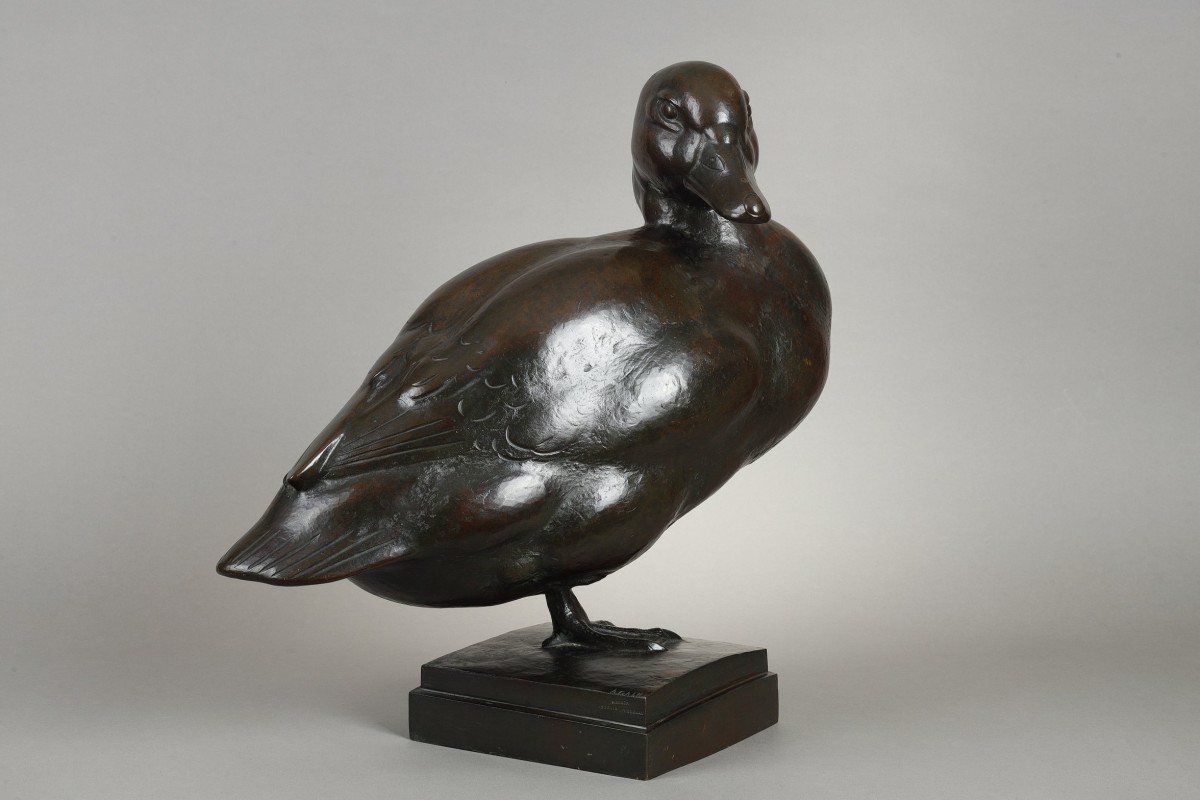
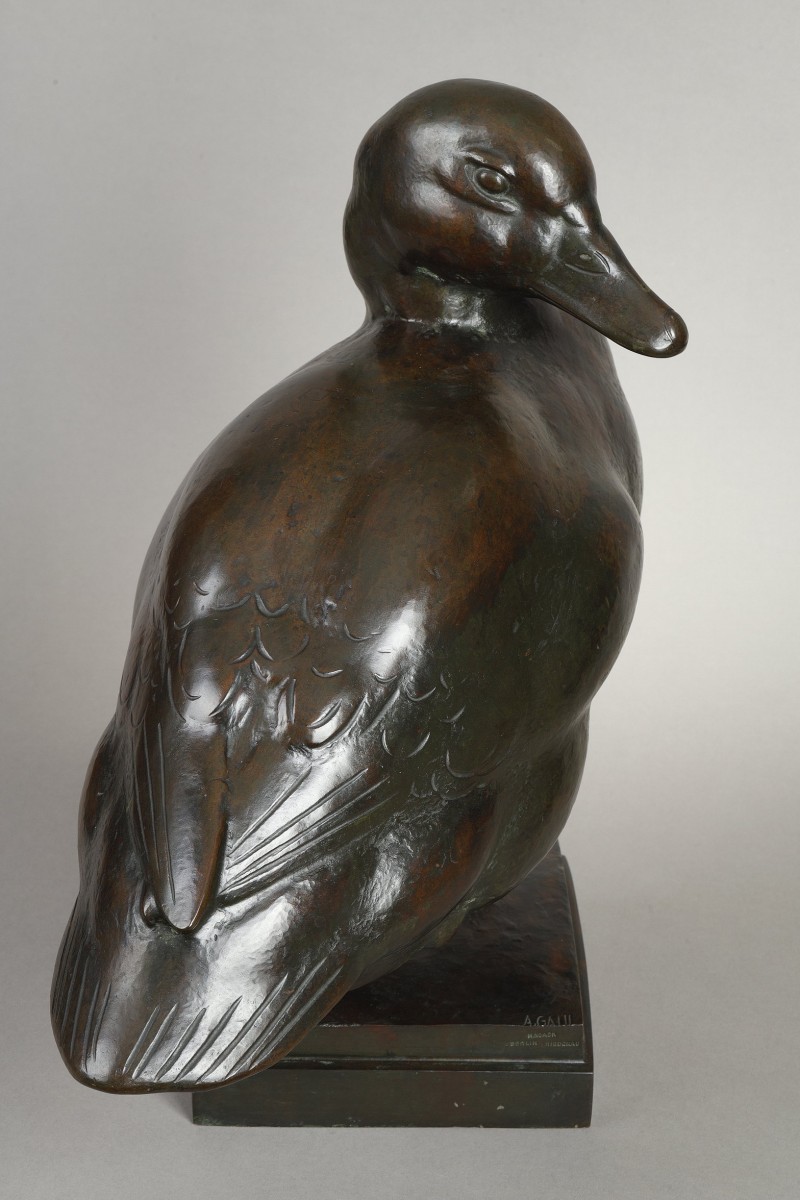

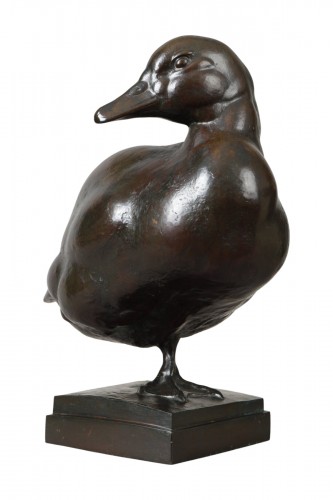
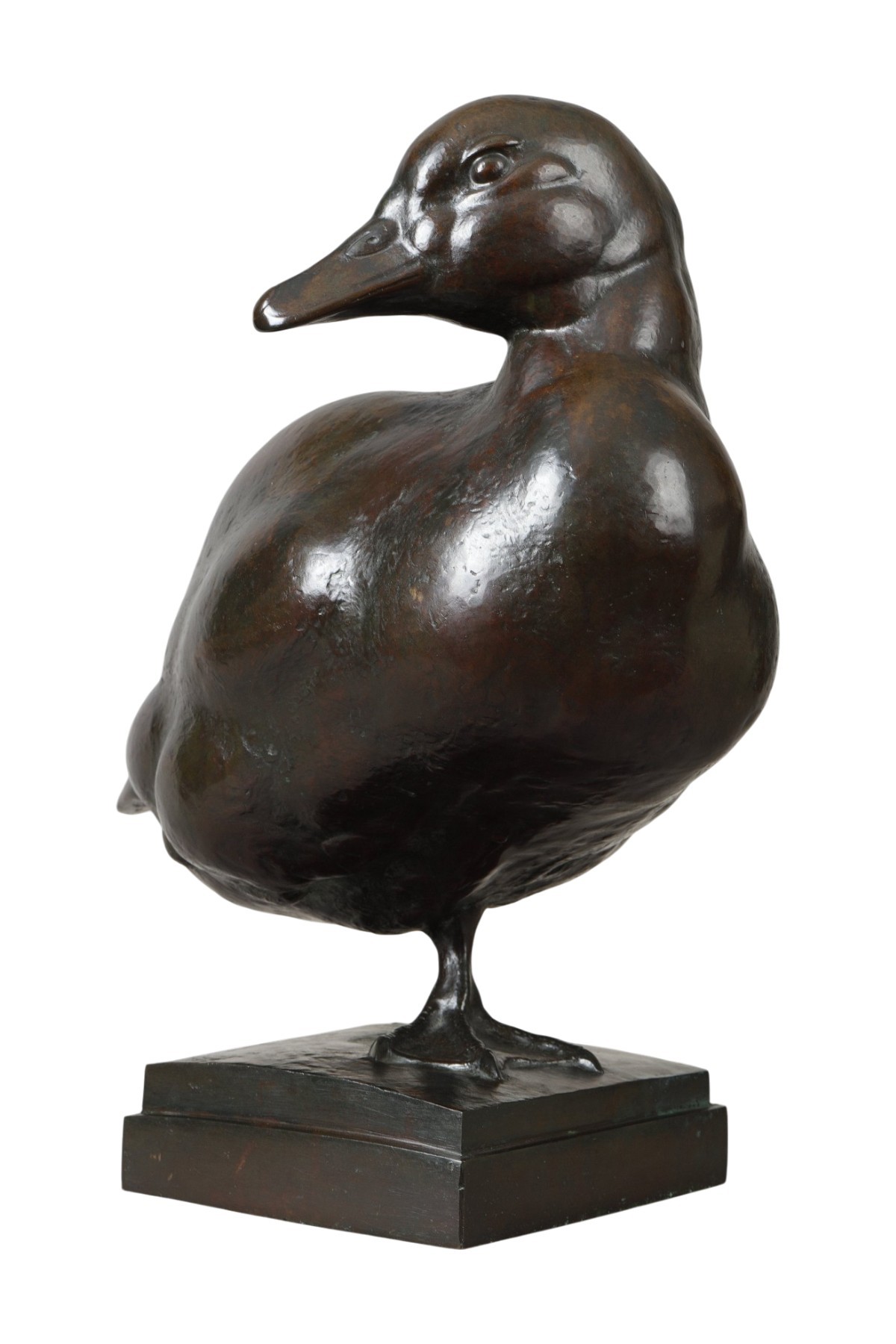
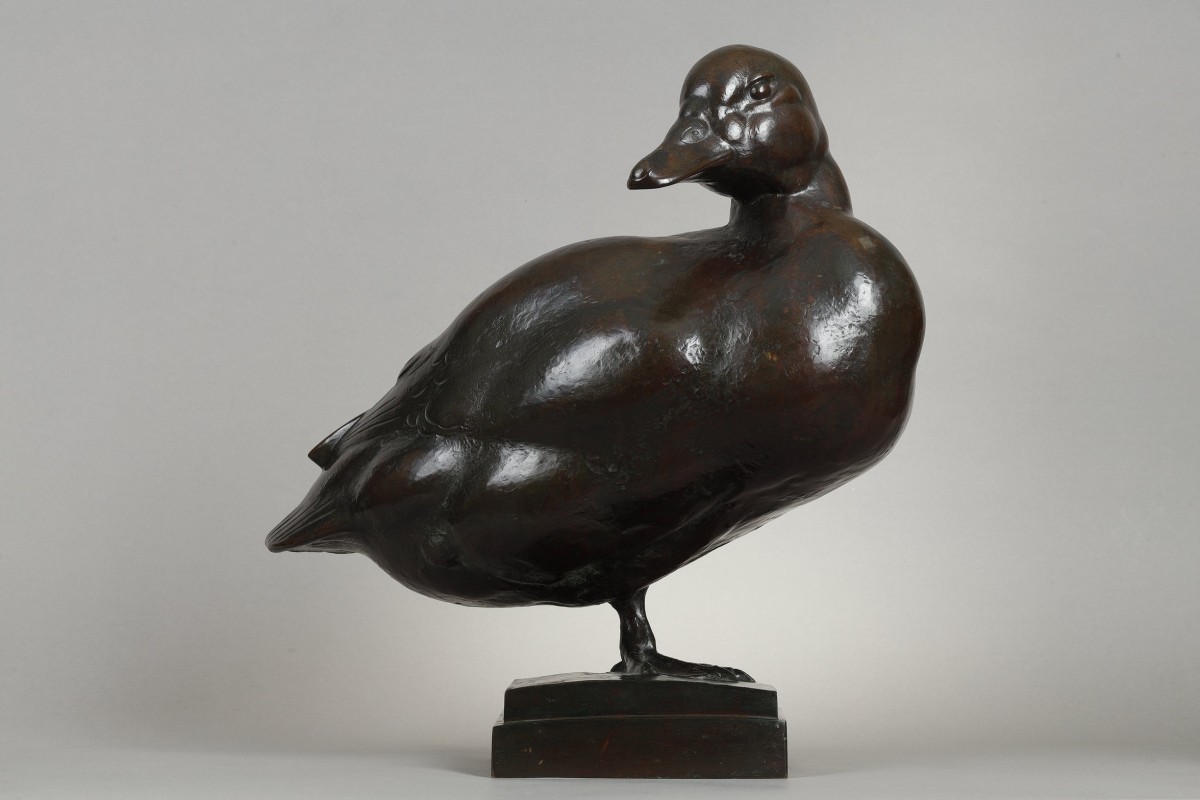
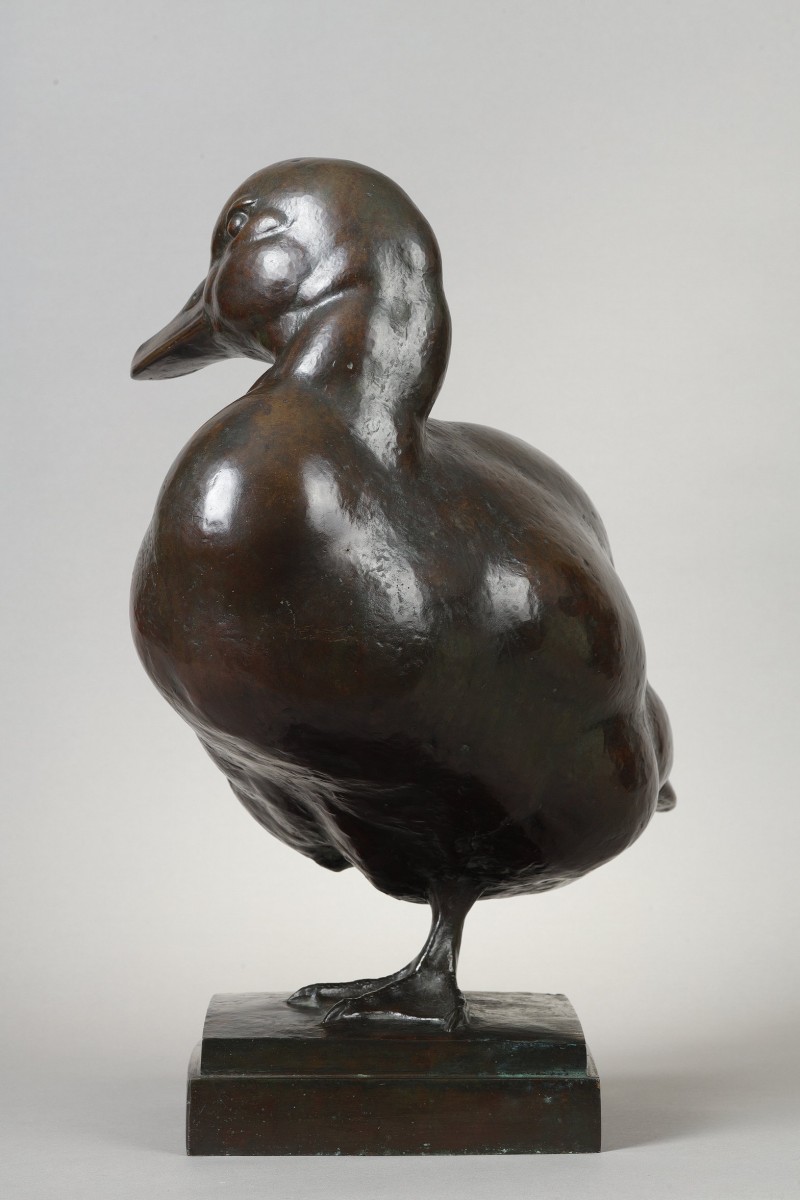
This elegant bronze sculpture by August Gaul depicts a duck in a moment of absolute calm, perfectly illustrating the sculptor’s singular approach in his treatment of the animal world. Far removed from any descriptive or anecdotal naturalism, the work is based on a masterful synthesis of observation and formal construction.
The body is conceived as a compact and unified volume, structured around a continuous curve, which gives the whole a stable and balanced presence. The delicately turned head, together with one raised leg, introduces a subtle variation, infusing the composition with discreet life without disrupting its harmony.
Rather than detailing the plumage, Gaul favors modeling in broad, supple planes, allowing the light to reveal the richness of the volumes. The surface, deliberately refined, suggests the material without ever describing it, in constant respect for the intrinsic qualities of bronze.
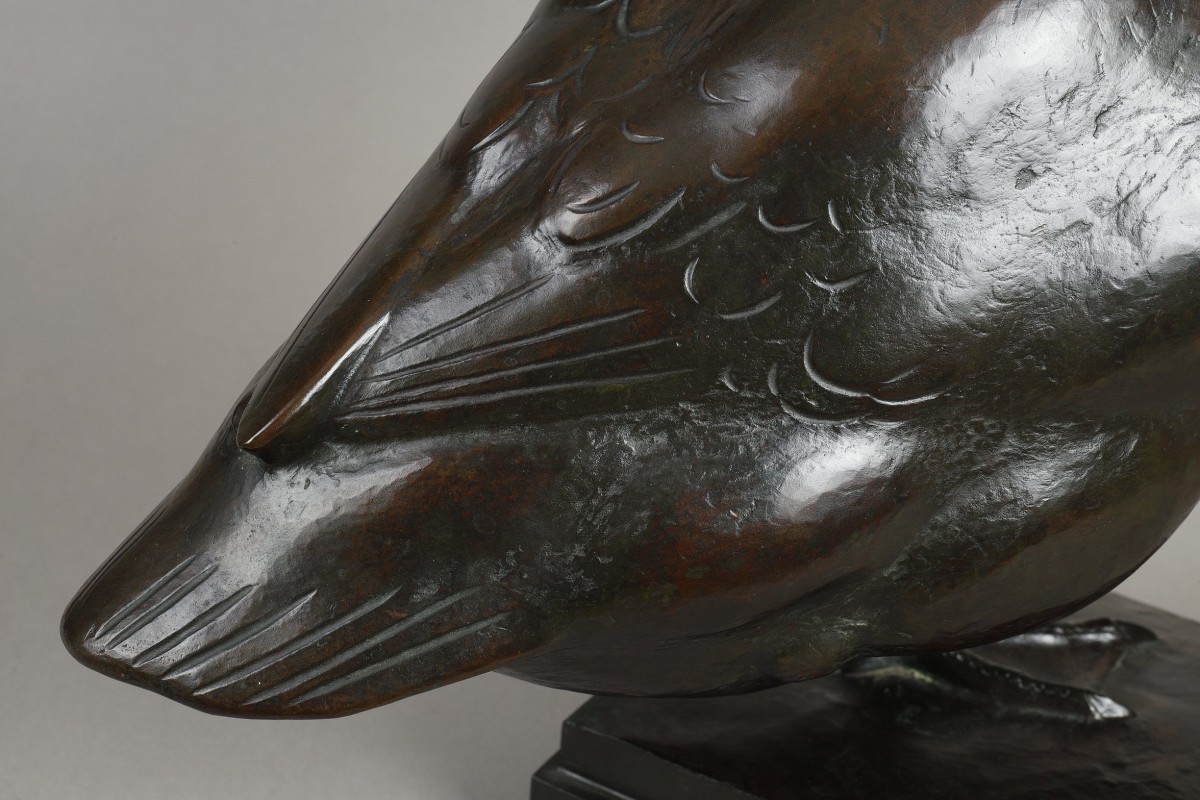
In the treatment of the surface, Gaul intervenes after casting with highly controlled chasing work: fine incisions, discreetly distributed, animate the bronze and suggest the plumage without ever falling into descriptive detail. These late interventions, almost instinctive, fully contribute to the final shaping of the work, gradually revealing the vibration of the surface while preserving the unity of the volume.
This model belongs to the series created by the artist for the fountain located in front of the “Renaissance-Theater” in Berlin in 1911, where several duck figures were arranged as a composition. Original figures from this same ensemble are also preserved at the Giersch Museum of Goethe University in Frankfurt, testifying to the importance of this motif in Gaul’s work.
This work fully reflects the artist’s essential quest: to go beyond simple imitation in order to achieve a synthetic, almost timeless form. Through this peaceful representation, devoid of any narrative effect, Gaul succeeds in expressing the very essence of living beings and anticipates certain directions of 20th-century animal sculpture, notably that of François Pompon.
With its apparent simplicity, this duck thus reveals a remarkable mastery of form and balance, characteristic of the artist’s finest achievements.
August Gaul was one of the leading German animal sculptors of the late 19th and early 20th centuries, recognized for having profoundly renewed the representation of animals through a synthetic and structured approach to form.
Born on October 22, 1869, in Großauheim (near Hanau), he was the son of a stonecutter, a background that permanently shaped his relationship with materials. He began his training with a goldsmith while also taking drawing classes at the Hanau Academy, before continuing his studies in Berlin at the School of Arts and Crafts and then at the Academy of Fine Arts.
Between 1894 and 1899, he worked as a practitioner in the studio of the sculptor Reinhold Begas, a major figure of official German sculpture, notably participating in the modeling of the lions for the Monument to Wilhelm I. At the same time, in 1897, he was awarded the Rome Prize of the Berlin Academy, which enabled him to stay in Rome, where he met Louis Tuaillon and absorbed the ideas emerging from Adolf von Hildebrand’s circle.
Upon his return, Gaul gradually moved away from academic naturalism in order to develop a personal language based on the simplification of volumes and the search for an essential form. In 1899, he presented his lions at the Berlin Secession exhibition, of which he became a member in 1902, quickly establishing himself as one of the most important animal sculptors of his time.
His work is distinguished by a desire to synthesize the characteristic attitudes and volumes of animals, generally depicted at rest, in order to express their permanence rather than anecdote. This approach aligns him with Hildebrand’s theoretical research in Germany and, later, with the directions developed by François Pompon in France.
Alongside his more intimate-format sculptures, Gaul created several monumental ensembles and fountains, notably a swan fountain in Krefeld, a bison fountain in Königsberg, and a penguin fountain on a private property in Wannsee, near Berlin.
August Gaul died in Berlin in 1921. His work, at once rigorous and refined, is now preserved in numerous public collections, notably in Berlin, Bremen, and Hamburg, and remains a major reference in the history of modern animal sculpture.
Signature: “A. GAUL”
Founder: “H. NOACK-BERLIN FRIEDENAU”
Delevery information :
Deliveries are offered in Belgium and Northern France.
All other deliveries are subject to a charge.