Offered by Tobogan Antiques
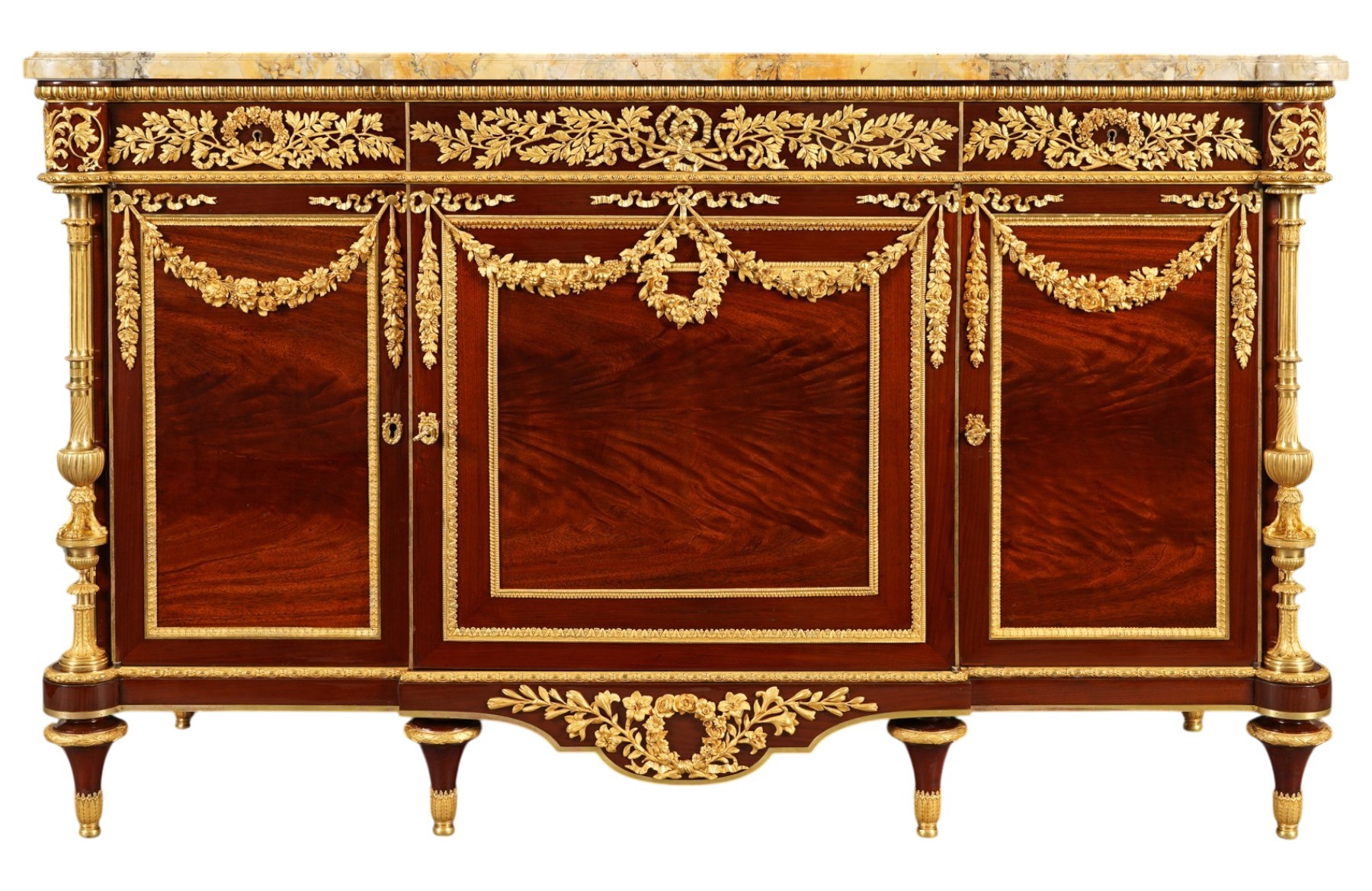
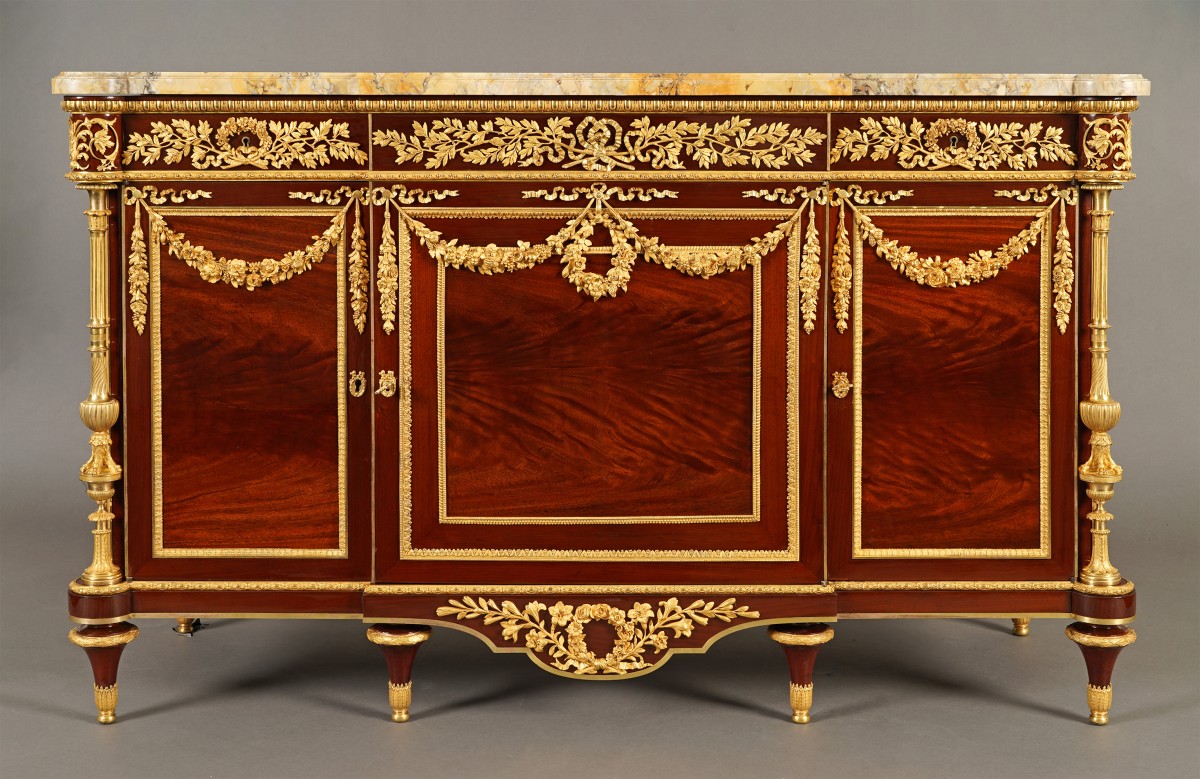
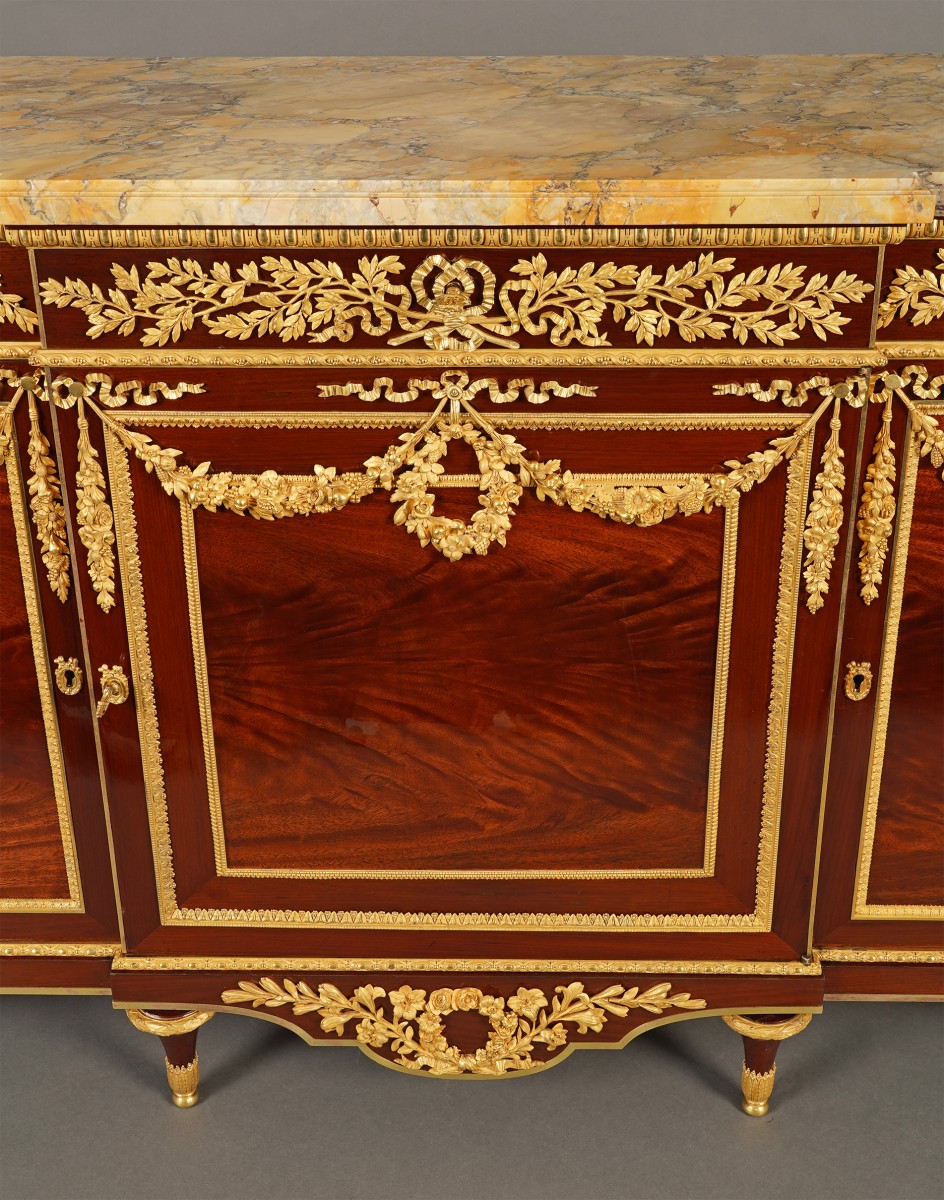

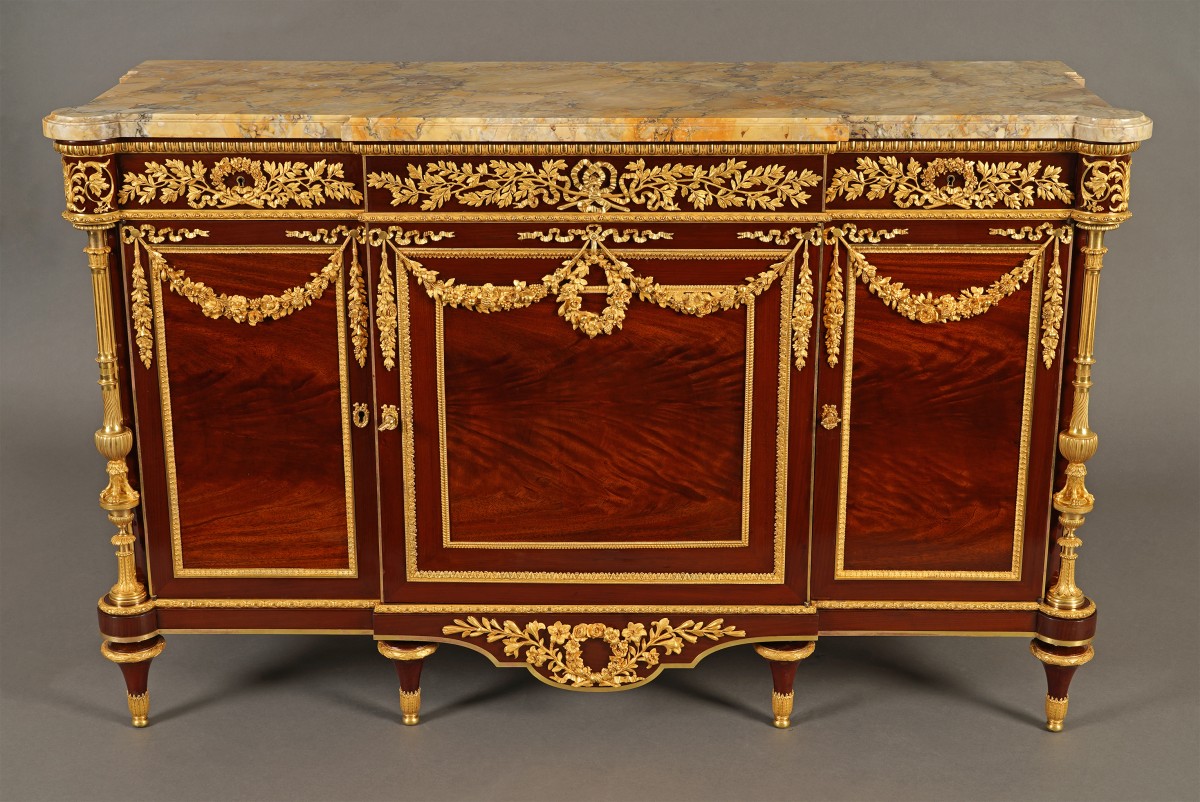
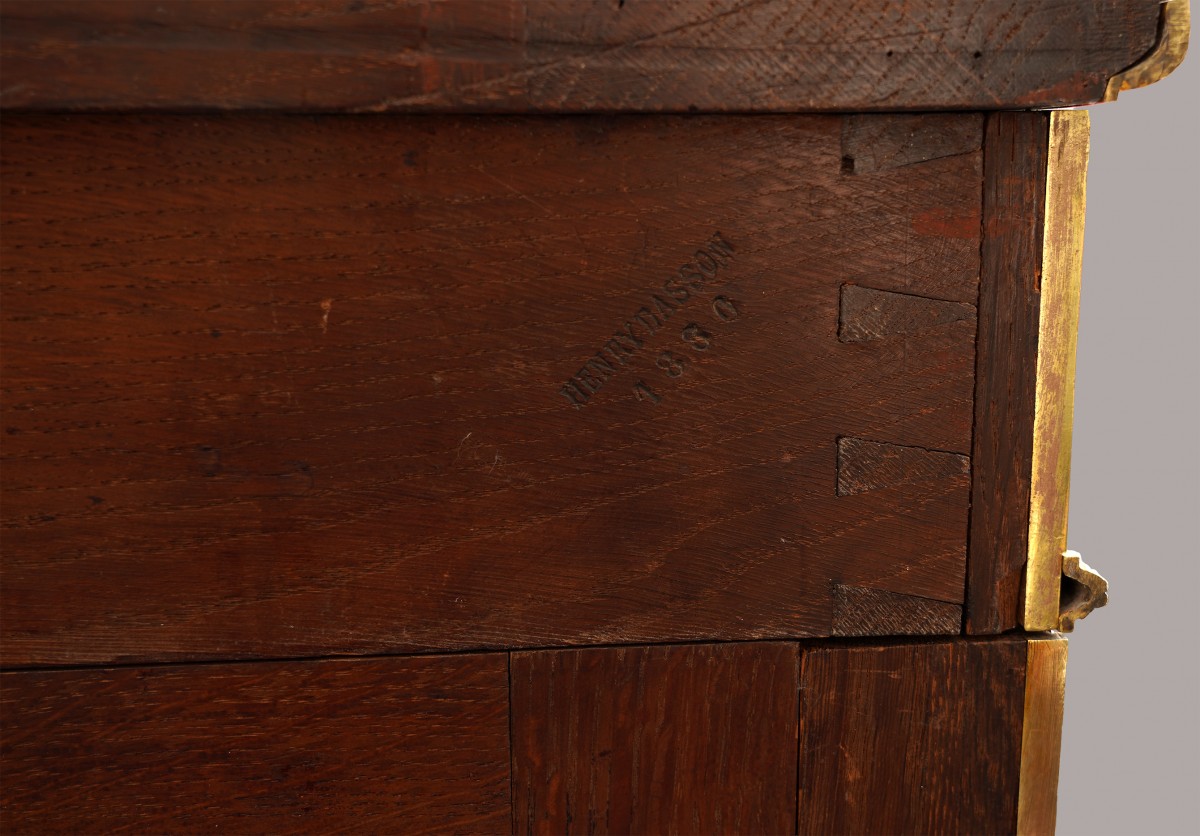
Stamped H. DASSON and dated 1880
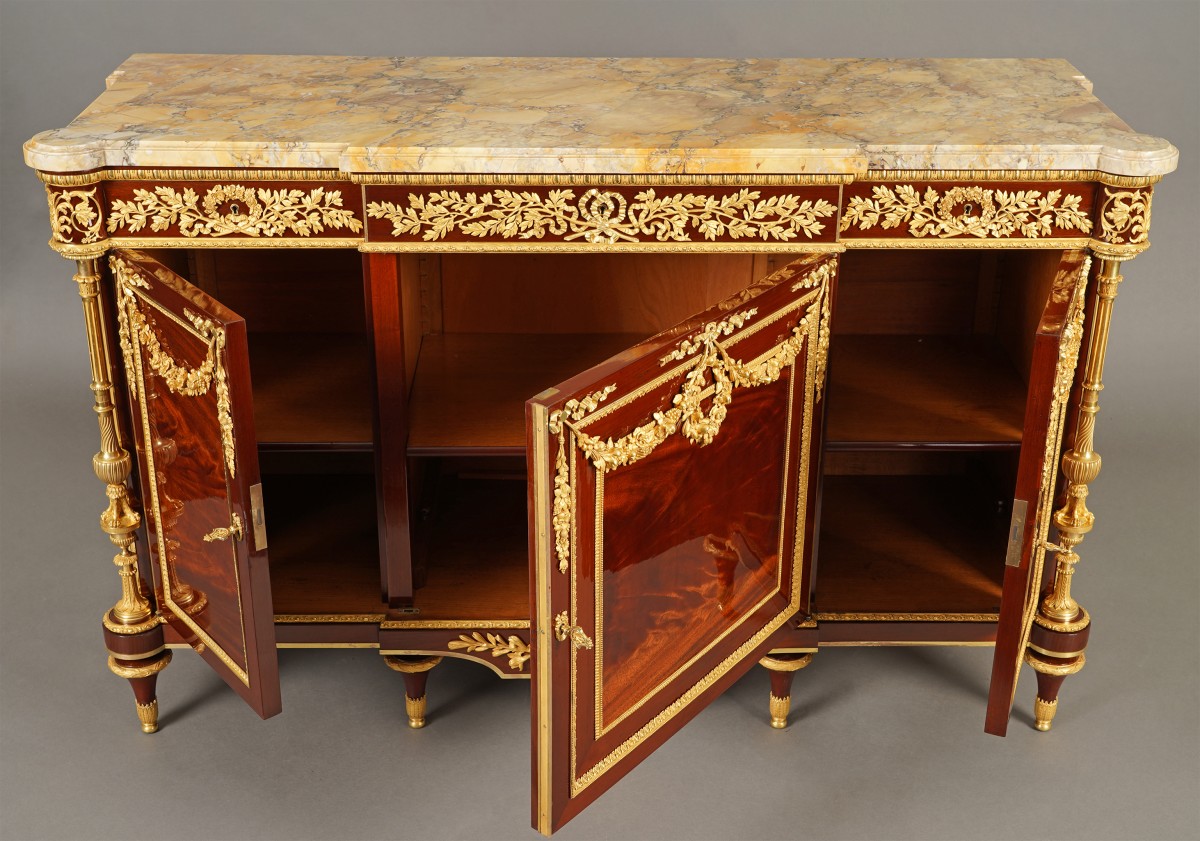
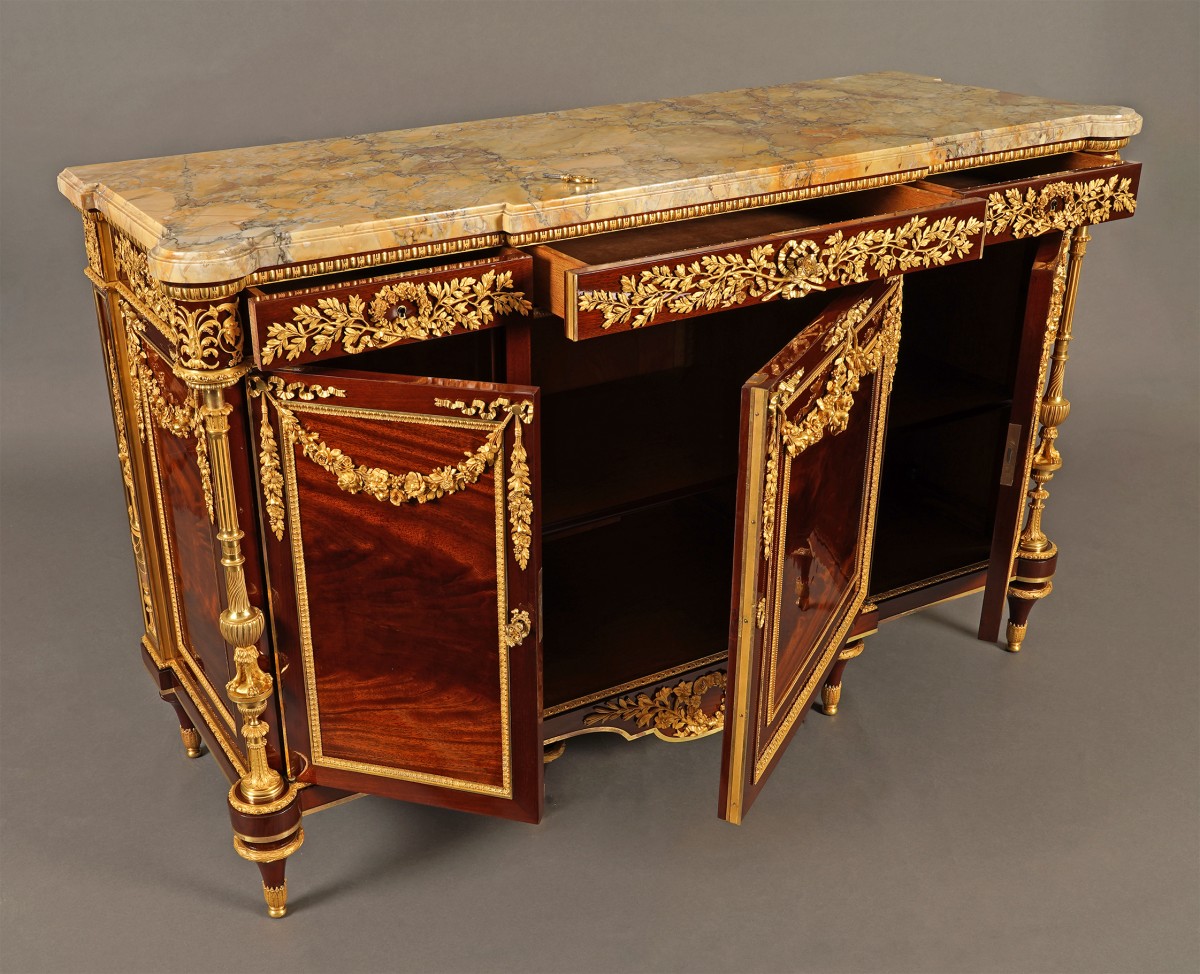
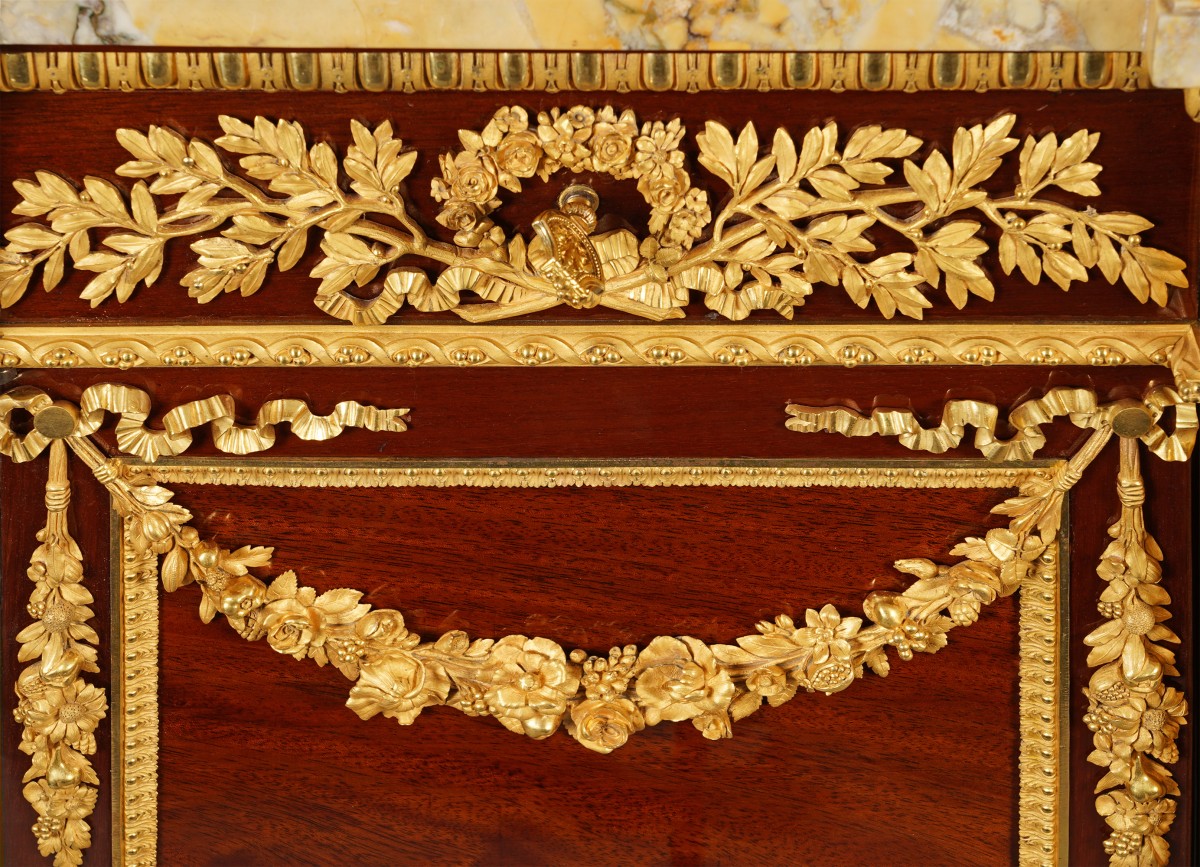
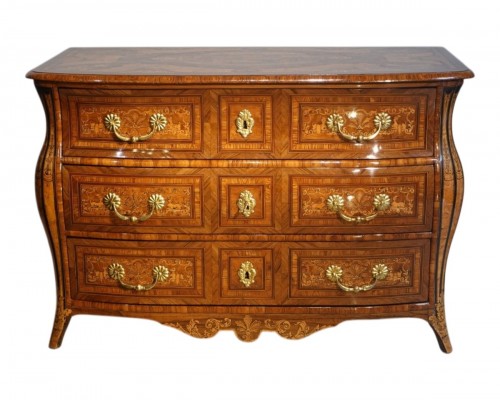
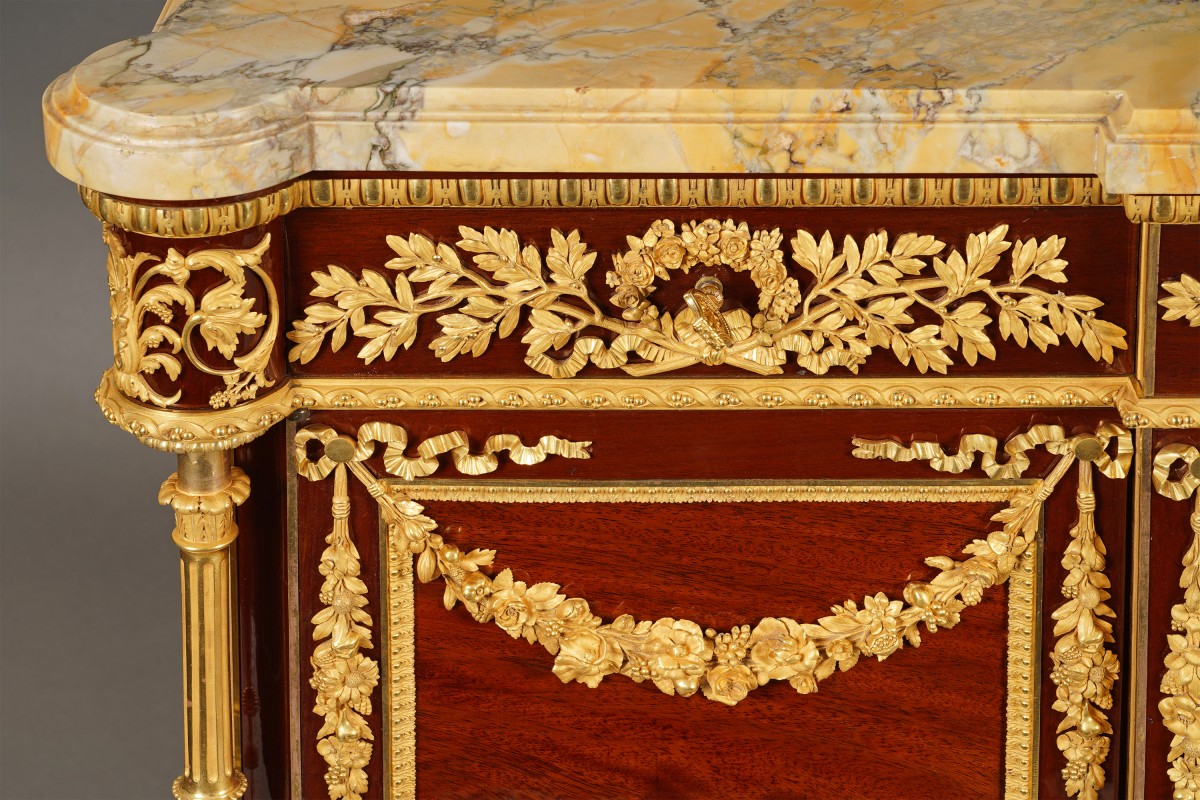
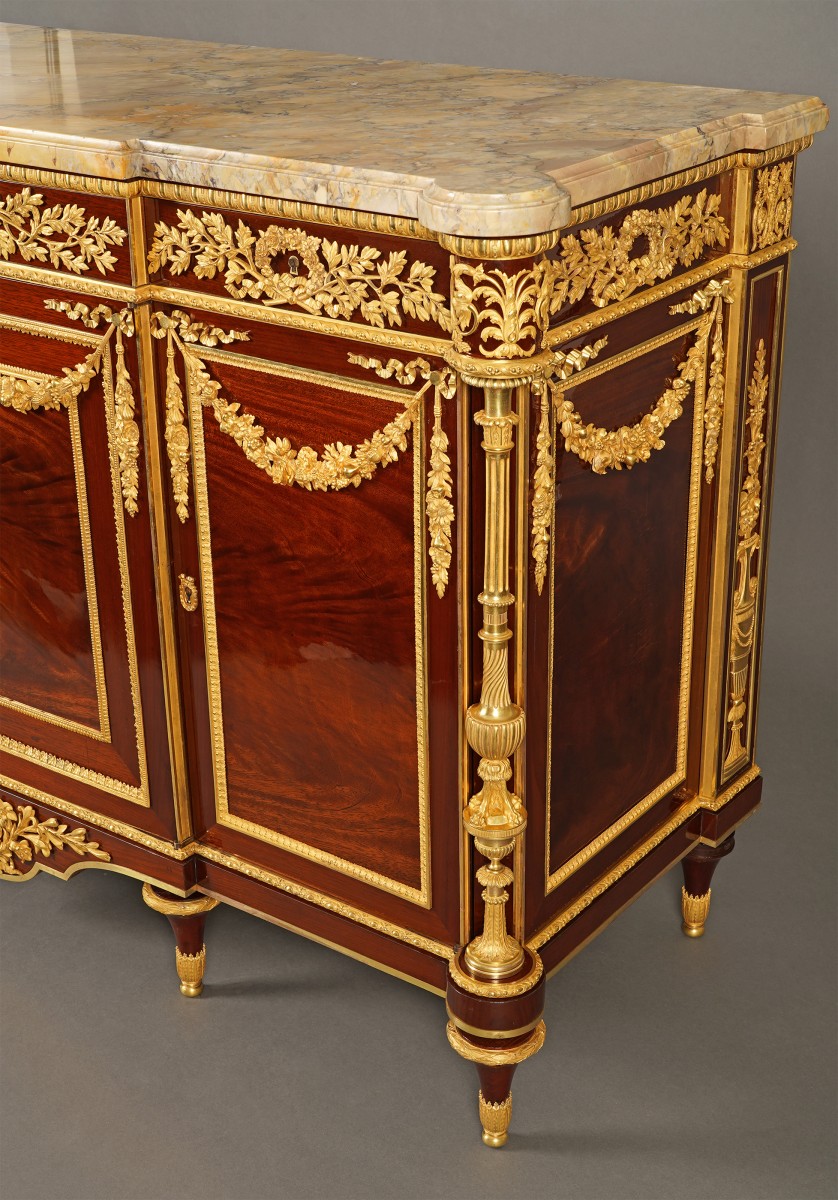
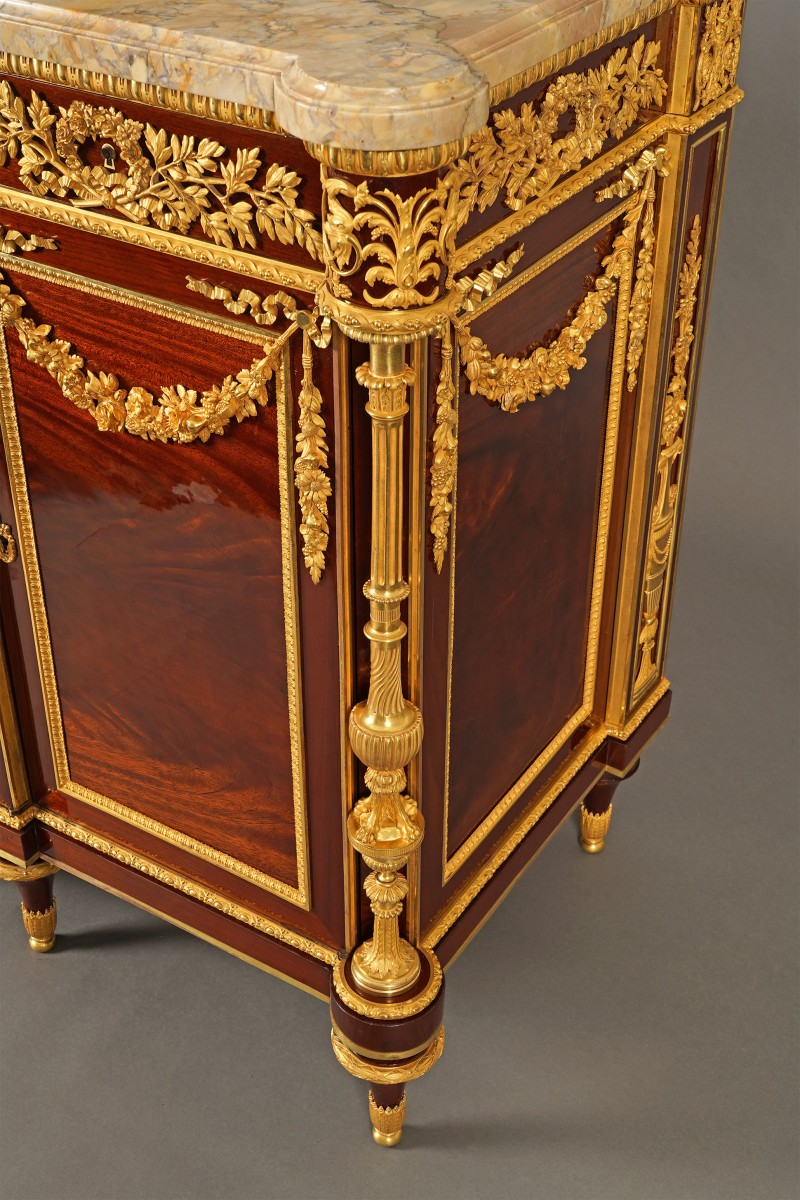
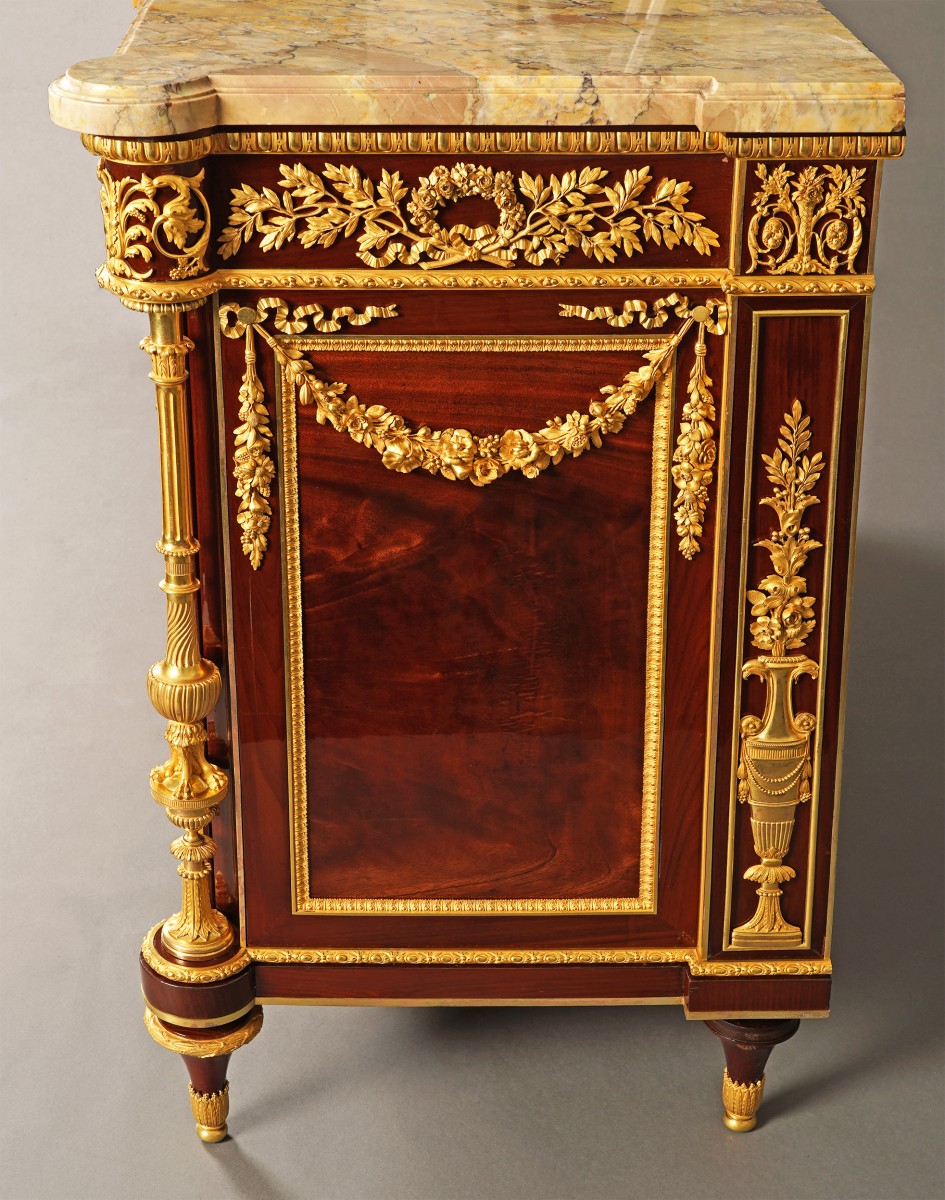
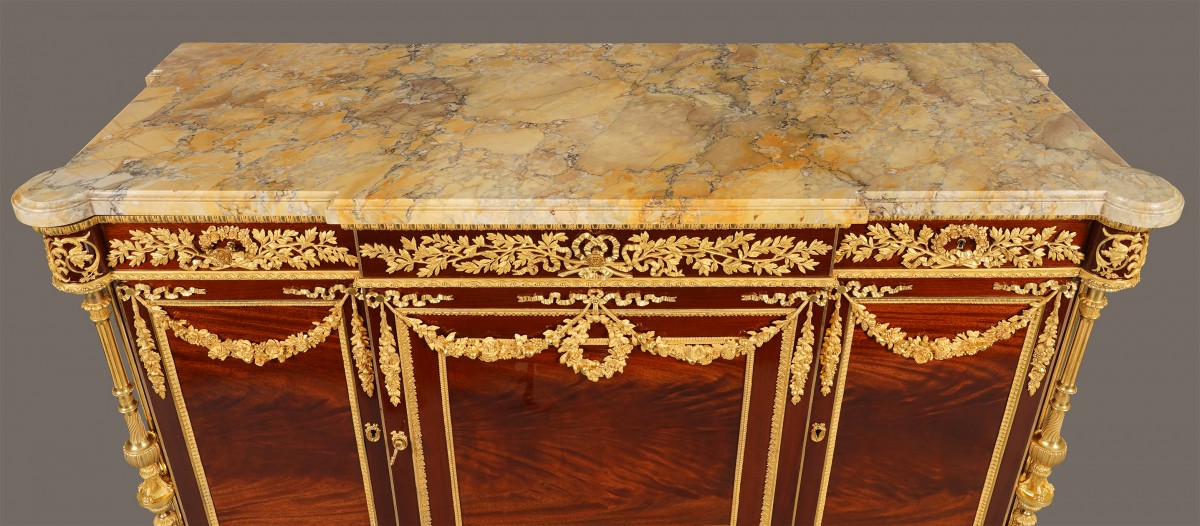
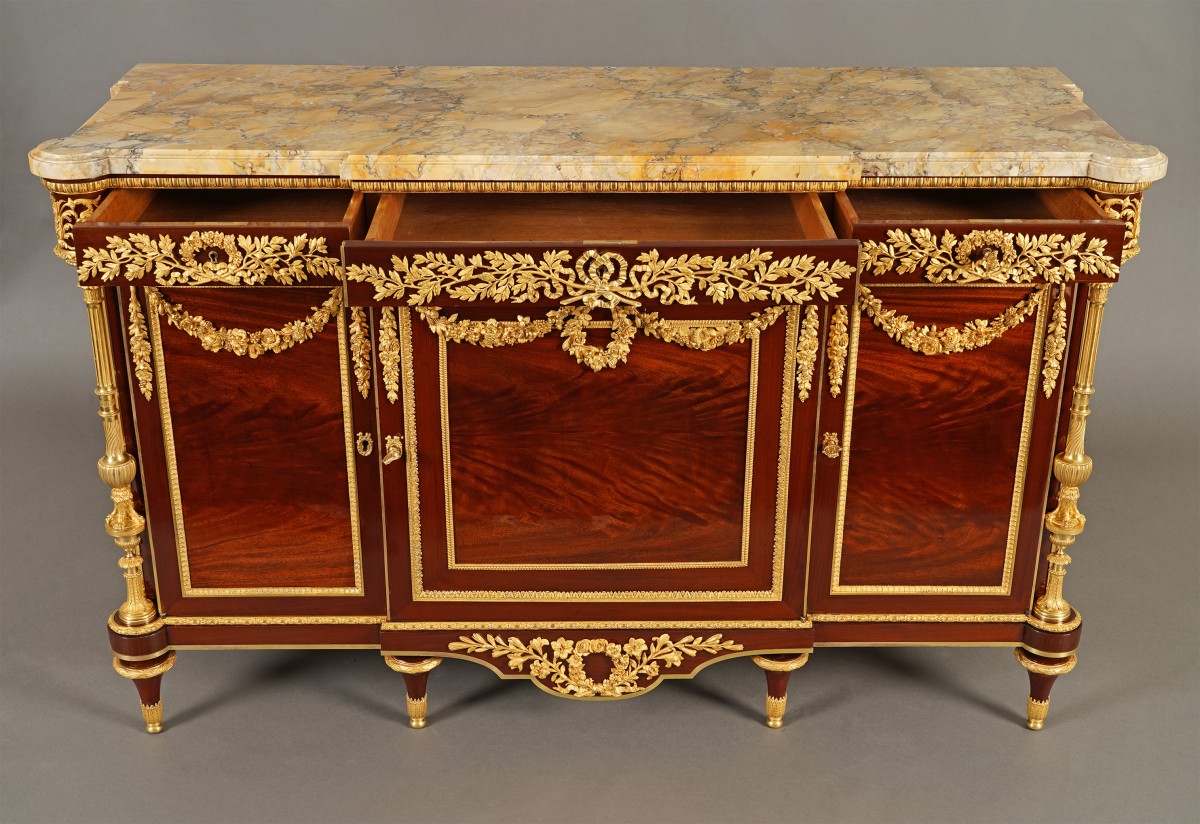
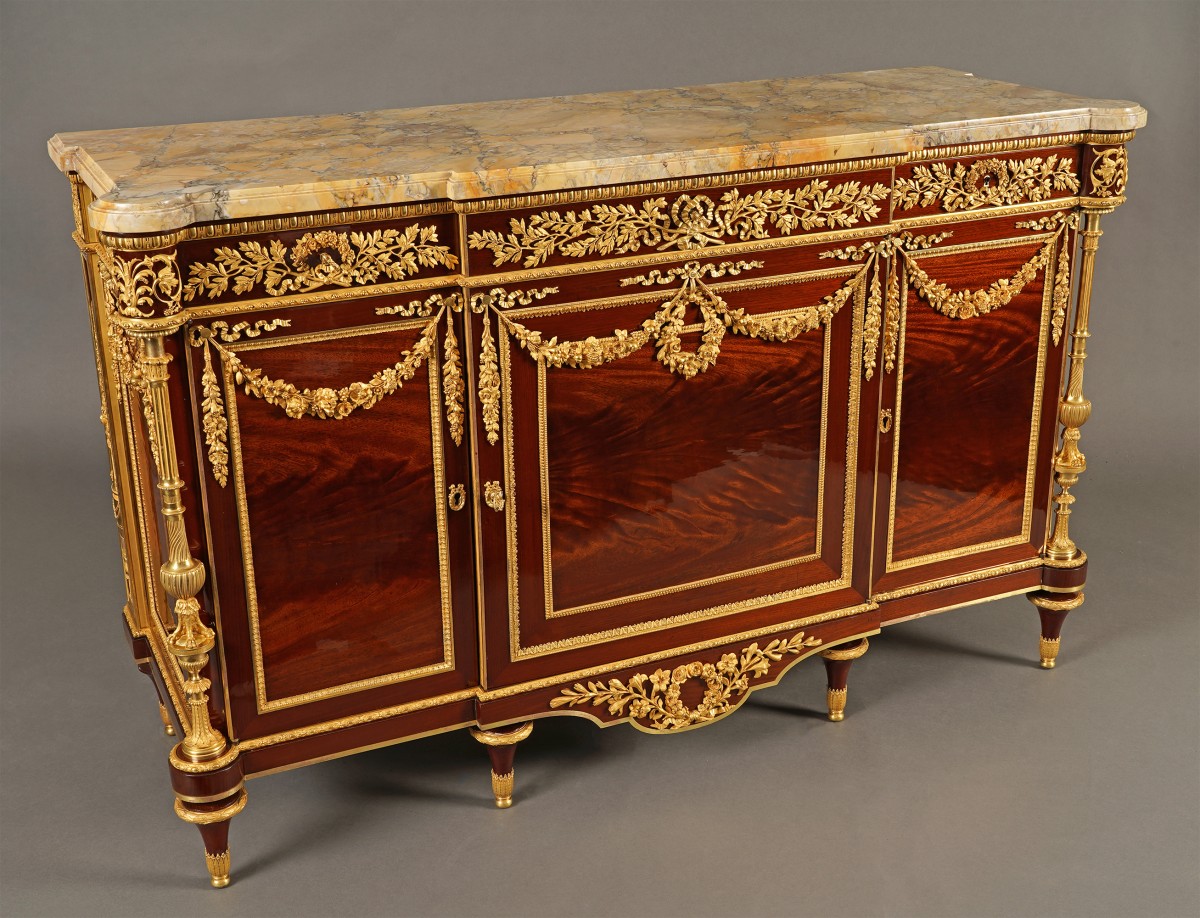
Exceptional Louis XVI-style commode in flamed mahogany veneer with a slight central bulge, featuring three doors topped by drawers adorned with rich chiseled and mercury-gilded bronze ornamentation depicting ribbon-wrapped branches and garlands of roses. The doors, framed by gilded bronze foliage moldings, are adorned with festoons of flowers, fruits, and leaves suspended from ribbons. The corners are supported by elegant and intricate fluted columns with foliage motifs and lion’s paws, topped with Corinthian capitals. The same decorative motif continues along the sides, which are also adorned with pilasters featuring floral motifs of antique-style vases. The apron is adorned with a wreath of roses surrounded by lily branches. The entire piece rests on six toupie feet with leaf-motif bases and is topped with a Sarrancolin marble top underlined ed by a frieze of ovals.
This commode by Henry Dasson, with its remarkably well-preserved original bronze mounts, brilliantly illustrates the virtuosity of the great Parisian workshops of the late 19th century, where cabinetmaking and bronze work for furniture reached a level of perfection rarely equaled. The quality of the chiseling on the gilded bronze is much more than a mere decorative embellishment : it plays a full part in the piece’s architecture and stylistic language.
Related work :
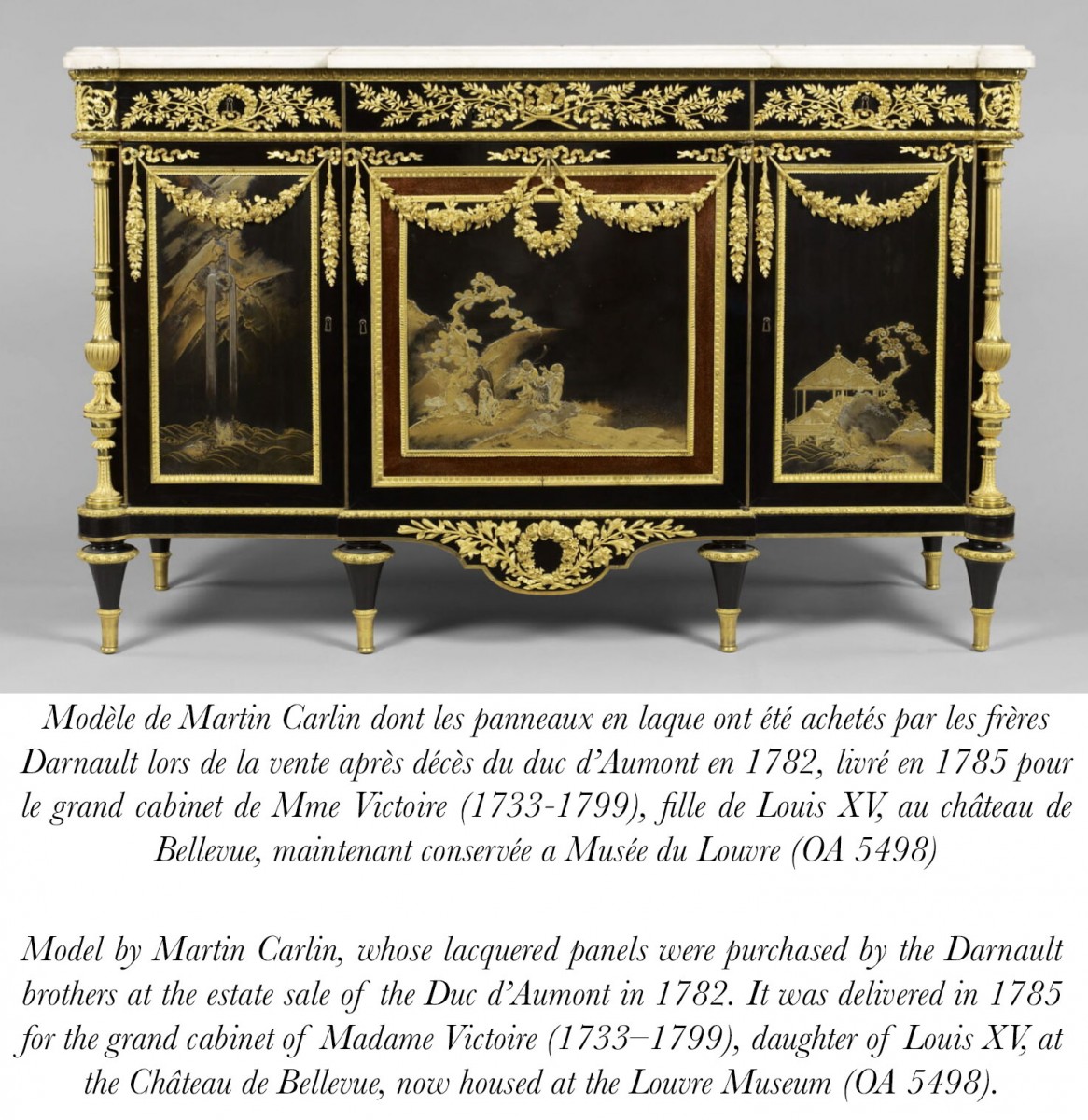
This commode by Henry Dasson, also reproduced by other great 19th-century cabinetmakers such as Joseph Emmanuel Zwiener and François Linke, is inspired by a model by Martin Carlin, whose lacquered panels were purchased by the Darnault brothers at the estate sale of the Duc d’Aumont in 1782. It was delivered in 1785 for the grand cabinet of Madame Victoire (1733–1799), daughter of Louis XV, at the Château de Bellevue, now housed at the Louvre Museum (OA 5498). (see photo attached)
Biography :
Cabinet-maker and bronze-caster, Henry Dasson (1825-1896) executed in his Paris workshop sumptuous copies of royal 18th century models and some pieces of his own modified 18th century design. For his pieces of furniture, he used the very finest ormolu mounts with high quality mercurial gilding. He mainly produced in the Louis XV and Louis XVI style. His participation at the Paris 1878 Universal Exhibition was highly remarked with Louis XVI style decorative objects and a table, all made of bronze and considered as a «chasing masterpiece», as well as a copy of the famous King Louis XV desk (original piece exhibited at Versailles), which was also admired by critics. At the 1889 Universal Exhibition, he won a «grand Prix» for his outstanding furniture. Dasson closed down his business in 1894.
Martin Carlin (1730–1785) was a renowned French cabinetmaker of German origin who was granted master status in 1766. At the request of the marchands-merciers Poirier and Daguerre, art dealers based on Rue Saint-Honoré, Martin Carlin specialized in high-end furniture. In his luxurious furniture, he frequently incorporated painted porcelain plaques, lacquered panels, or semi-precious stone mosaics. He designed his furniture at the request of the social elite of the time: the royal family (Marie-Antoinette, Marie-Joséphine of Savoy, Countess of Provence, Madame Adélaïde, and Madame Victoire for their Château de Bellevue), the high aristocracy (the Duchess of Mazarin), and prominent women (Madame du Barry, the actress Marie-Josèphe Laguerre). After his death in 1785, his son, Georges-Antoine Carlin, took over the family workshop to carry on his father’s work until the early 19th century, and his widow remarried Gaspard Schneider, a cabinetmaker (who became a master craftsman in 1786), who also took over the workshop and worked for Daguerre, continuing the work of his predecessor.
Bibliography :
– D. Alcouffe, A. Dion-Tennenbaum, A. Lefébure, Le Mobilier du Musée du Louvre, T.1, Edition Faton, 1993, p 254-257.
– Alexandre Pradère, Les ébénistes français de Louis XV à la Révolution, Éditions Le Chêne, 1989, p 343-361.