Offered by Étienne de Roissart
REQUEST INFORMATION

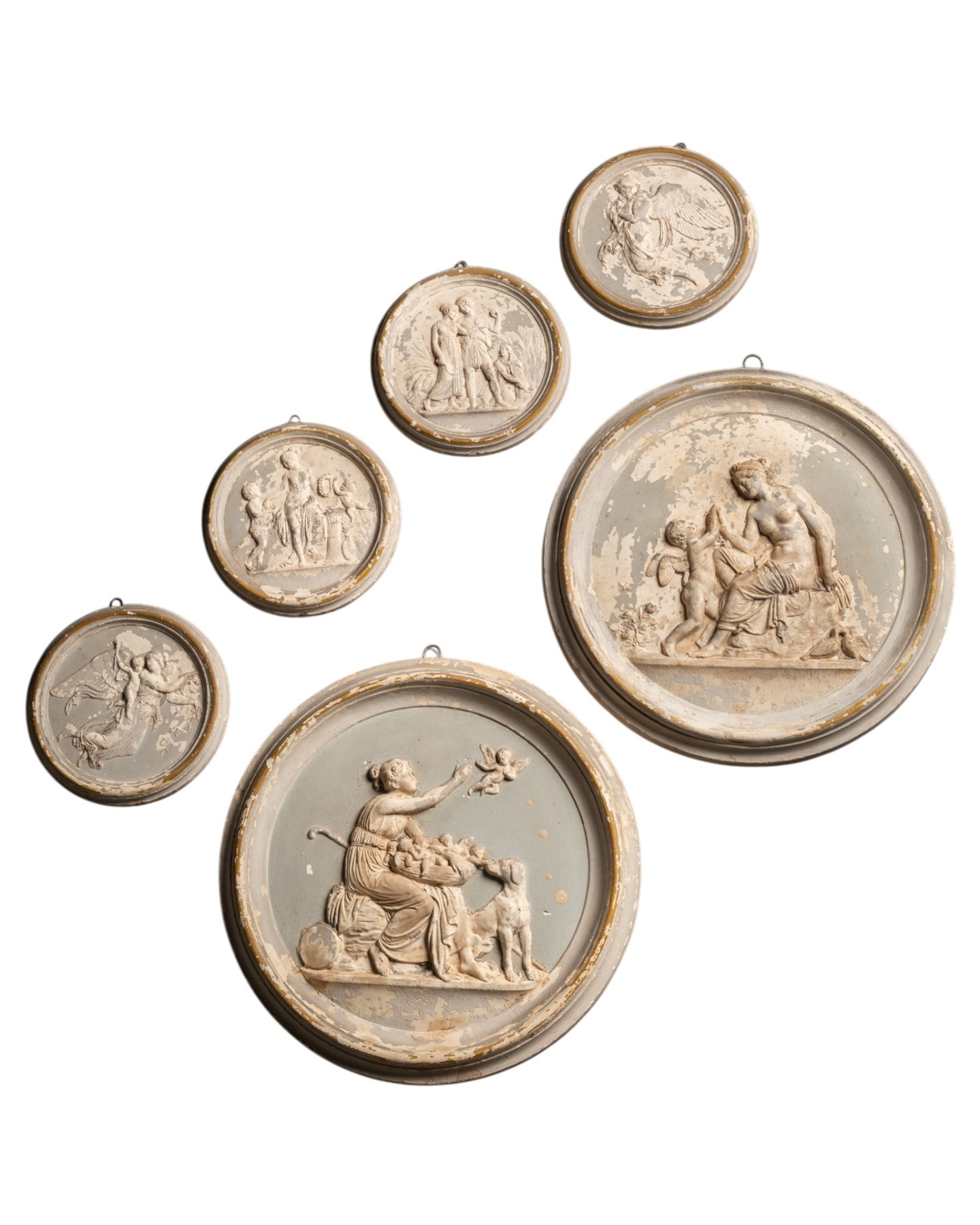
A remarkable ensemble of six plaster reliefs of outstanding quality dating from the first half of the 19th century, most likely produced in the Roman workshops of Bertel Thorvaldsen (1770–1844), one of the major figures of European Neoclassicism. Trained at the Royal Danish Academy in Copenhagen and later sent to Rome on a royal scholarship, the celebrated Danish sculptor developed in Italy an œuvre deeply inspired by Antiquity, admired by his contemporaries and notably praised by Antonio Canova himself. Residing in Rome for much of his career, Thorvaldsen played a central role in the revival of the antique language that shaped European arts at the turn of the 18th and 19th centuries.
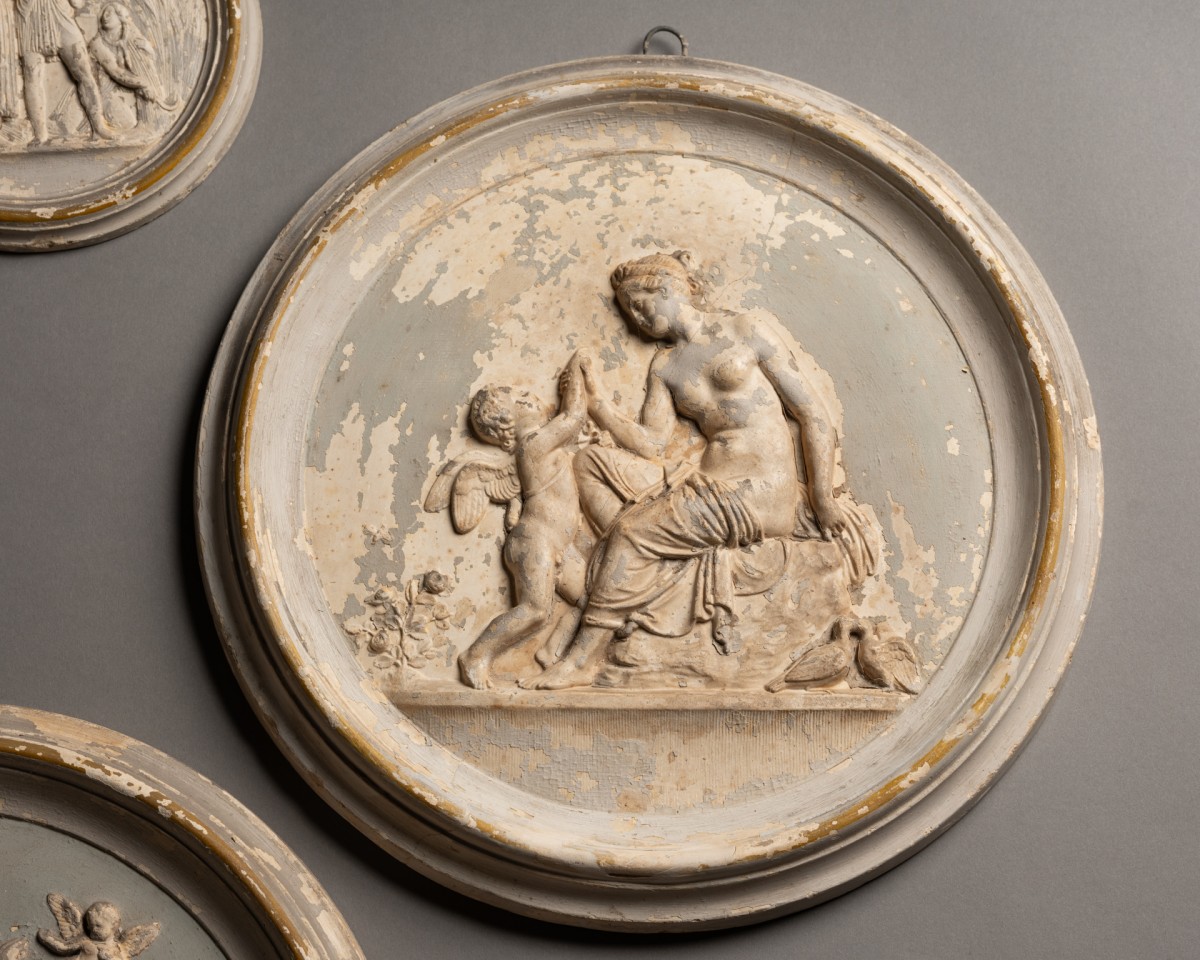
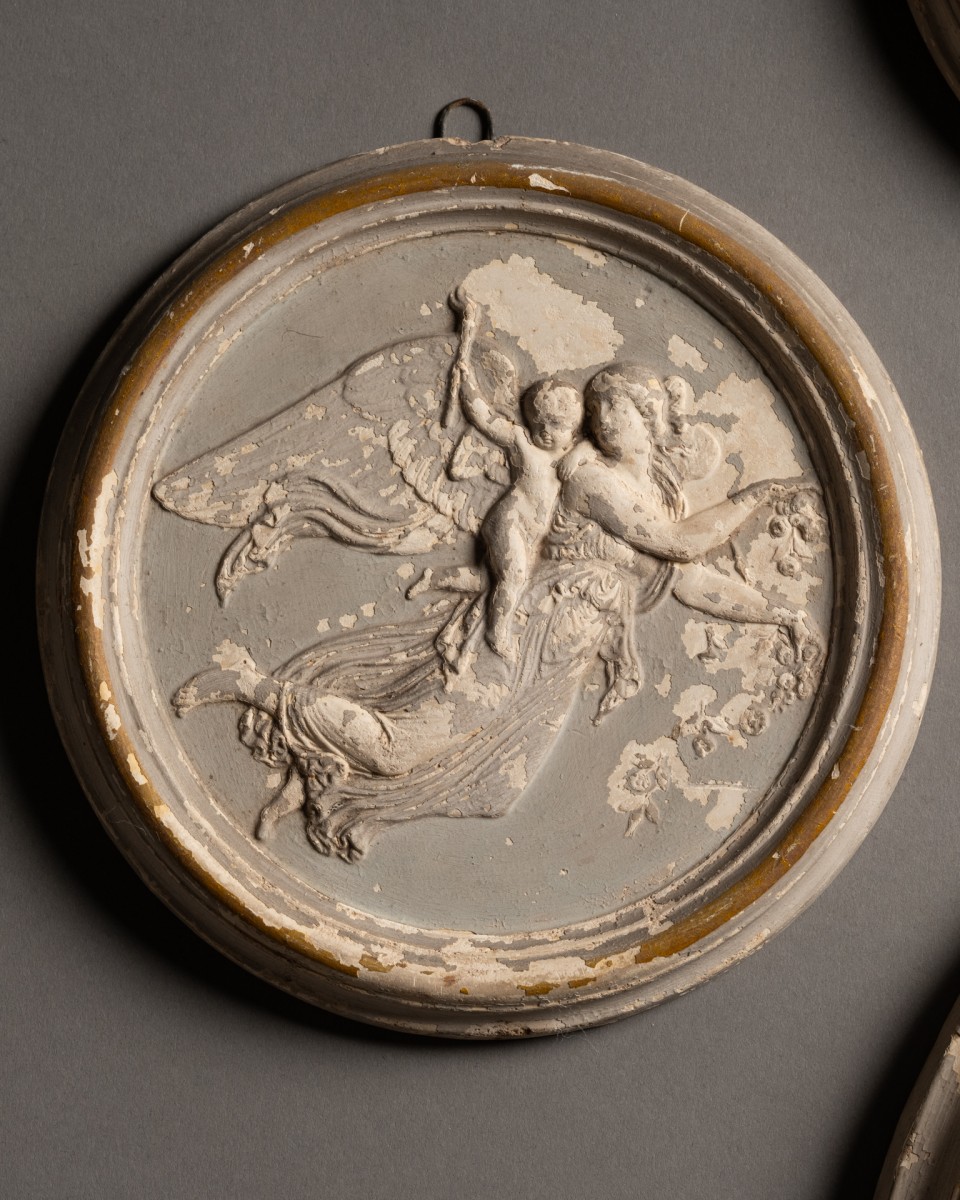
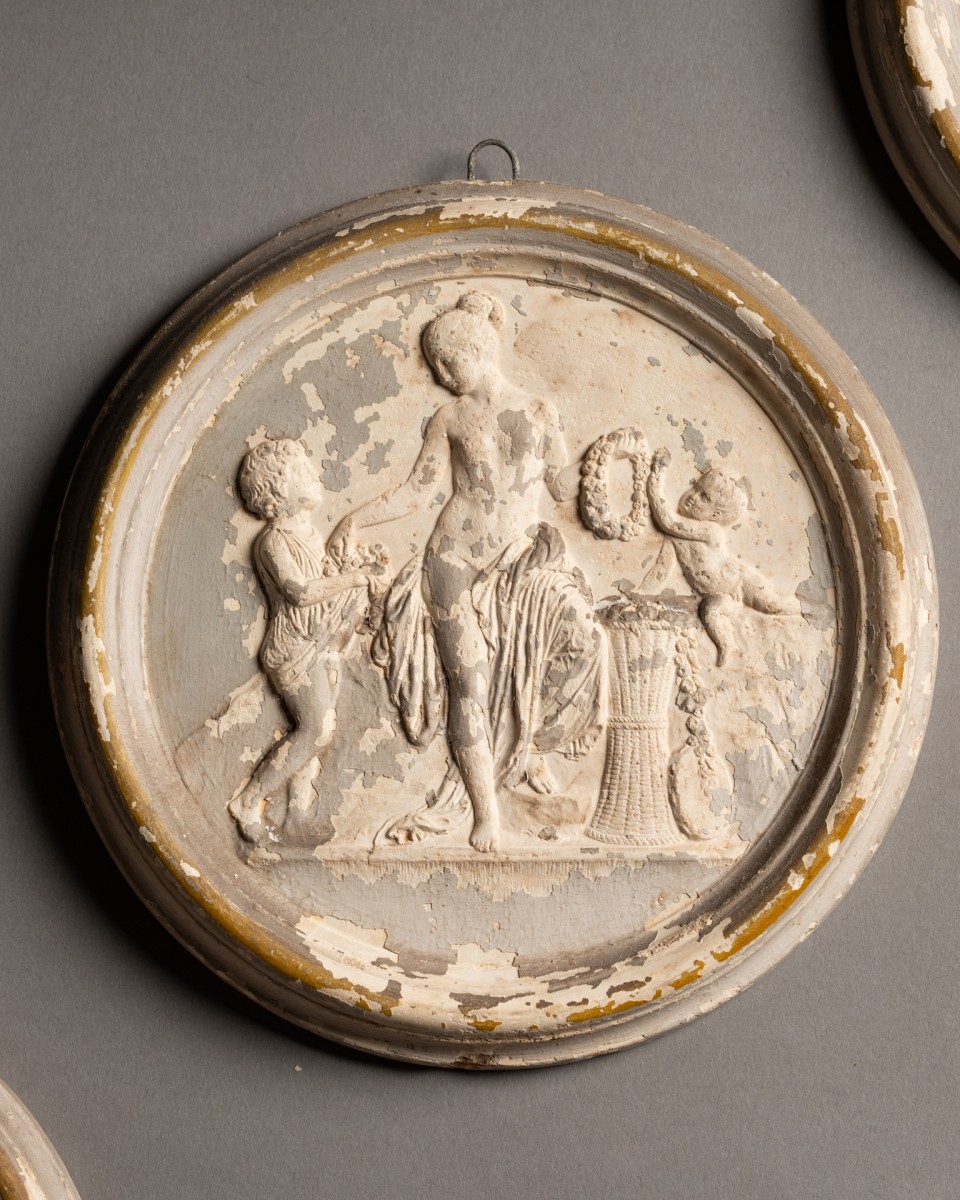
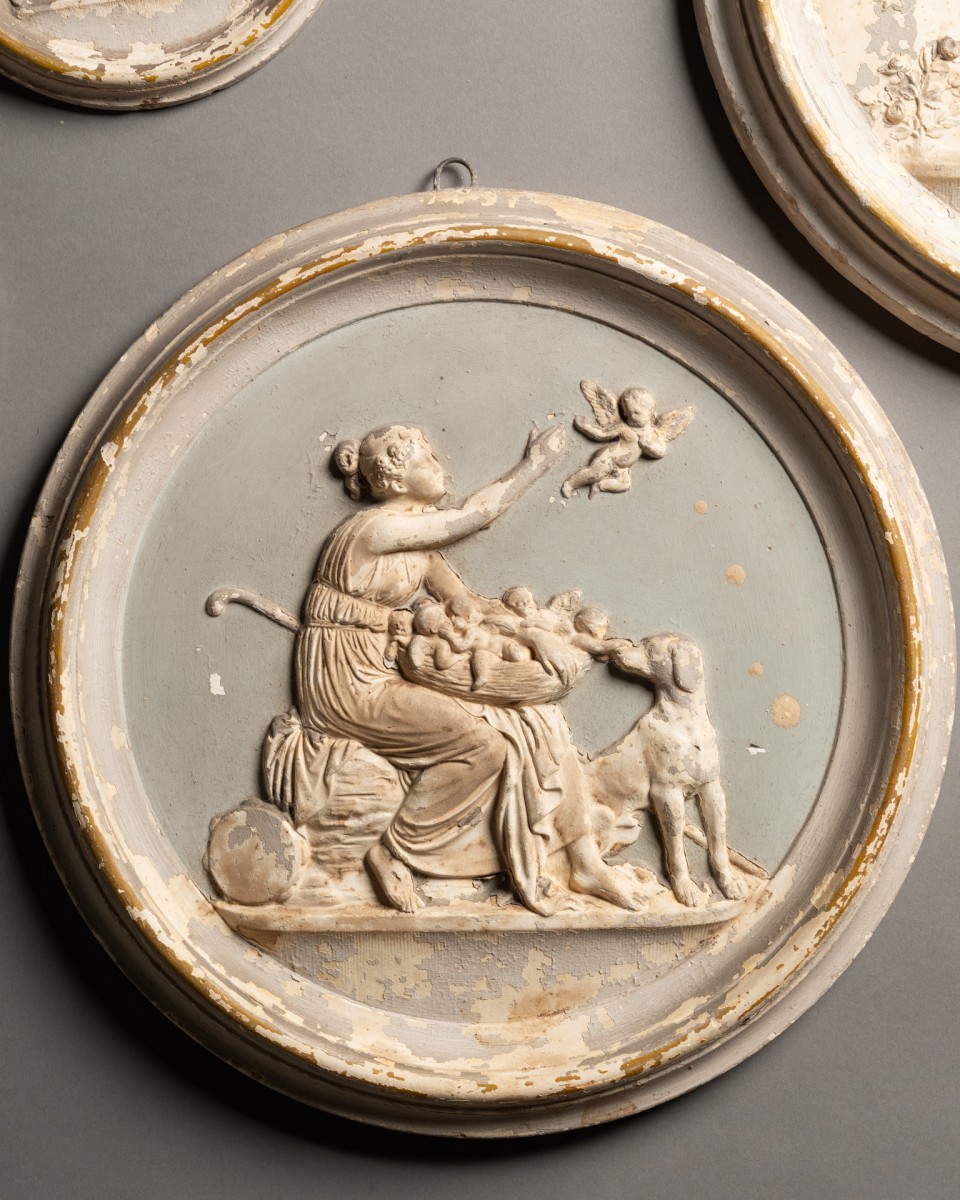
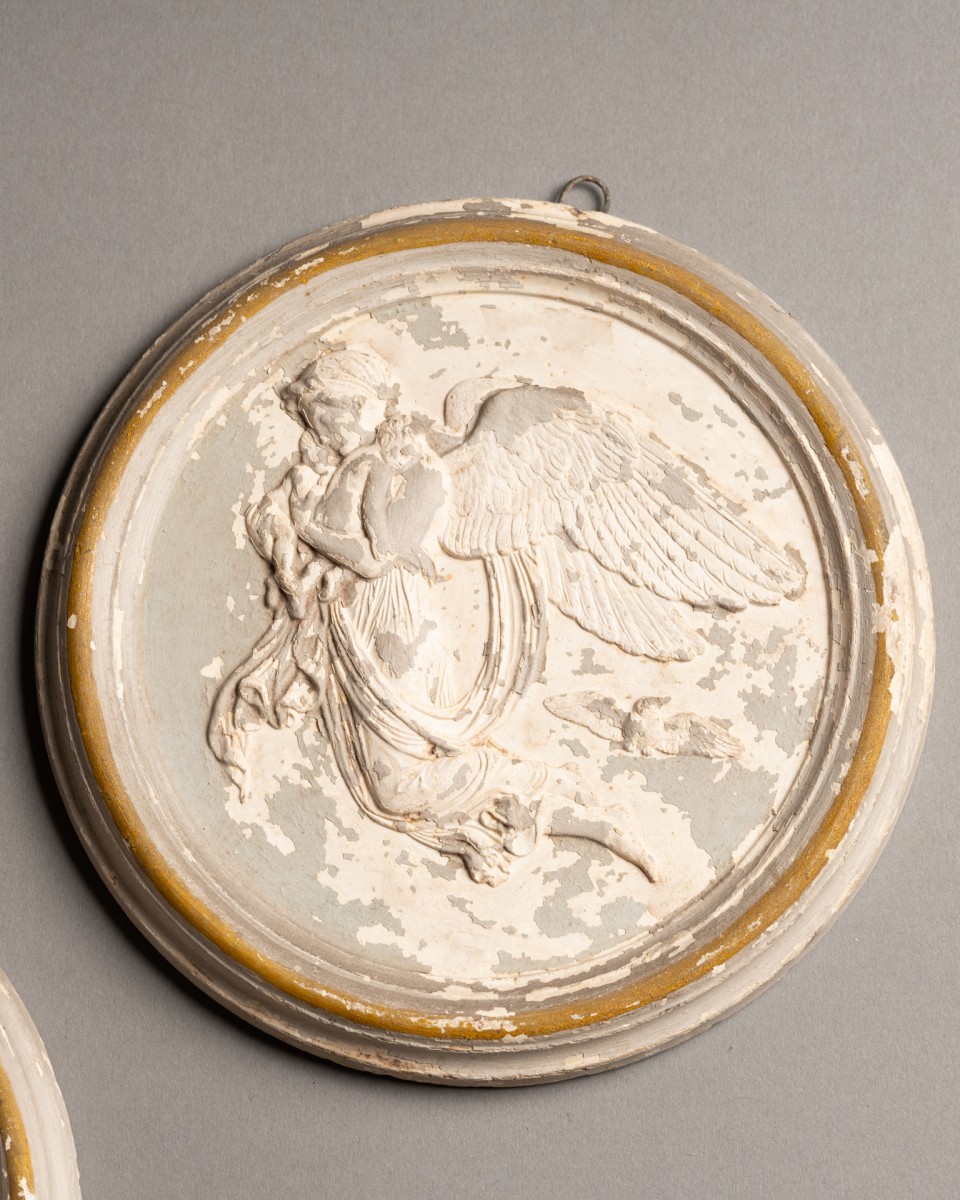
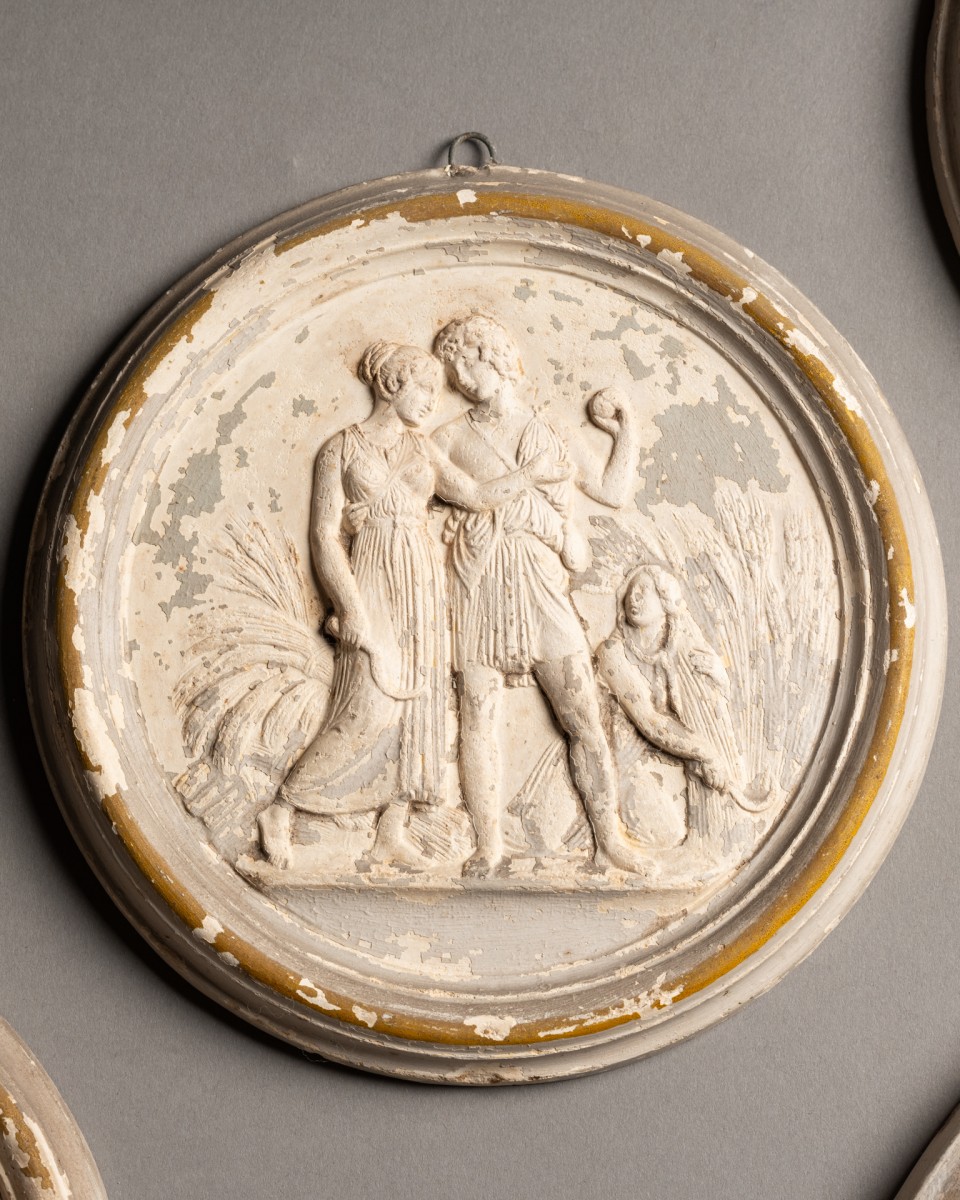
Created between 1830 and 1850, this ensemble comprises a pair of large circular medallions — one titled Cupid Complains to Venus about a Bee Sting, the other Shepherdess with a Nest of Cupids — together with four smaller reliefs: a pair titled Day and Night, as well as two medallions from the series The Four Seasons of Life, representing respectively the allegories of Childhood and Adolescence.
They are executed with remarkable finesse in plaster, their surfaces softly finished and delicately modelled. The compositions draw upon some of the most poetic themes of the Neoclassical repertoire, where the elegance of the figures, the purity of the profiles, and the balance of the lines reflect a profound admiration for Greco-Roman art.
The relief entitled Cupid Complains to Venus about a Bee Sting takes its inspiration from a poem by Anacreon recounting how Cupid, stung by a bee while attempting to pick a rose, runs weeping to his mother for comfort. Venus responds with a gentle reproach: “If the sting of a bee causes you such pain, imagine the suffering of those pierced by your arrows.”
The relief entitled Shepherdess with a Nest of Cupids depicts a young shepherdess carrying upon her lap a “nest” filled with winged putti, each symbolising a different form of love.
The four smaller reliefs elegantly complete the ensemble, creating a particularly harmonious decorative dialogue. The pair entitled Day and Night was a motif widely employed in the ornamentation of Northern European palaces, notably in Saint Petersburg and Berlin.
The series The Four Seasons of Life derives from a conception rooted in Classical Antiquity, first formulated by Pythagoras, who distinguished four ages of life: childhood, adolescence, maturity, and old age. According to the physician Claudius Galen (2nd century AD), these four ages correspond respectively to the four seasons of the year and the four elements.
Through their quality of execution and their direct inspiration from Thorvaldsen’s great models, these works bear witness to the 19th-century fascination with rediscovered Antiquity — renewed through the excavations of Pompeii and Herculaneum — as well as to the refined aesthetic of European Neoclassicism.
Two large reliefs: 33 cm diameter; four smaller reliefs: 16 cm diameter.