Offered by Antiquités Philippe Glédel

18th Furniture, country french furniture
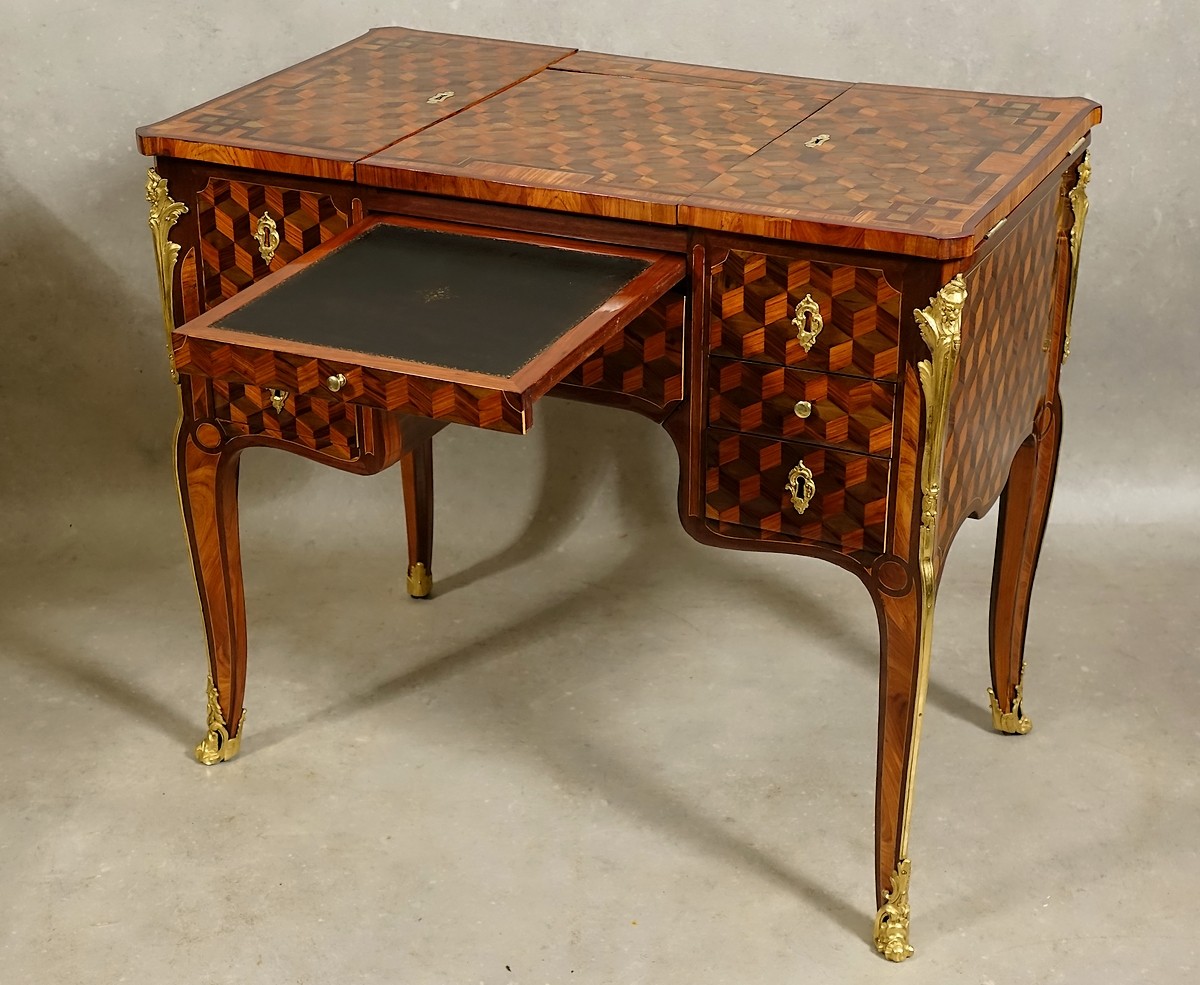
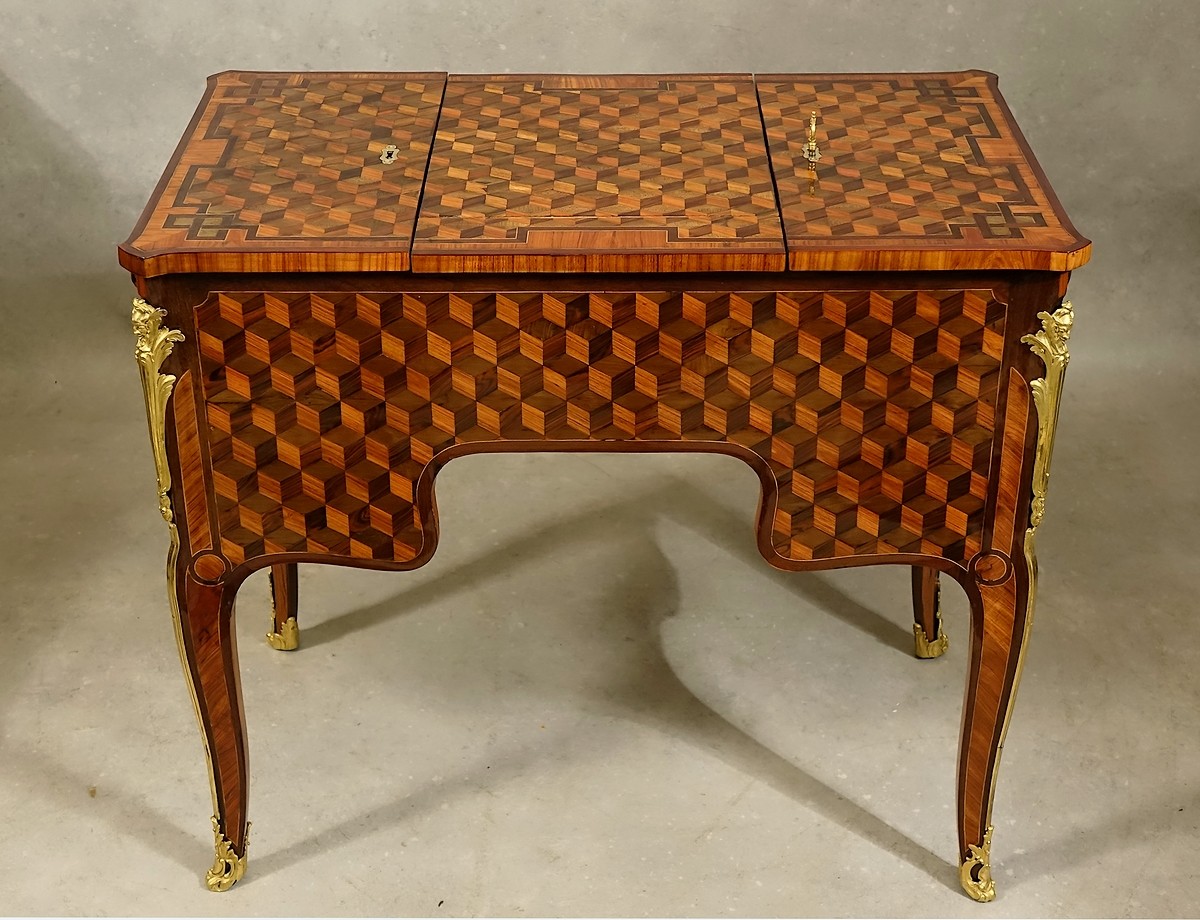
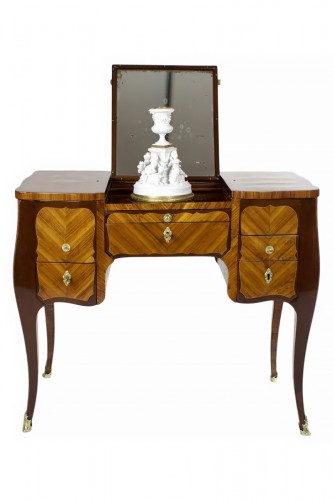
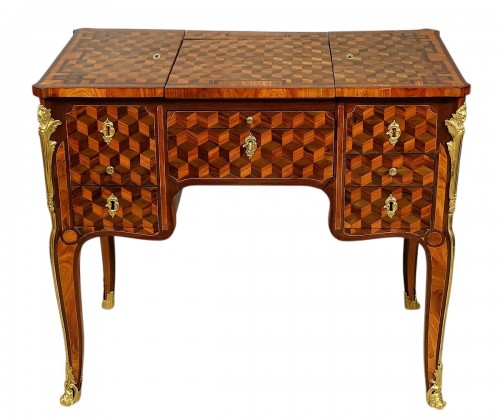
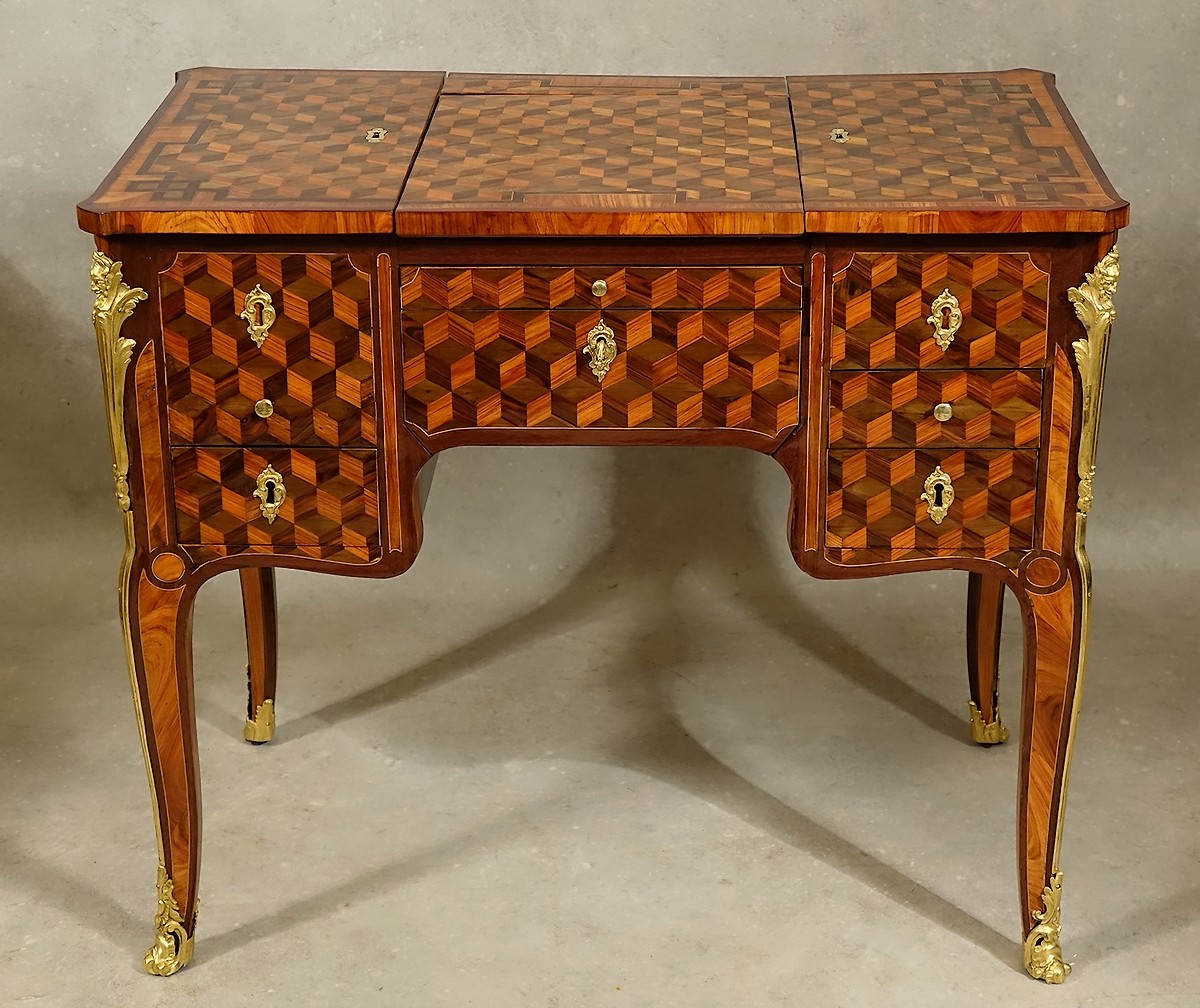
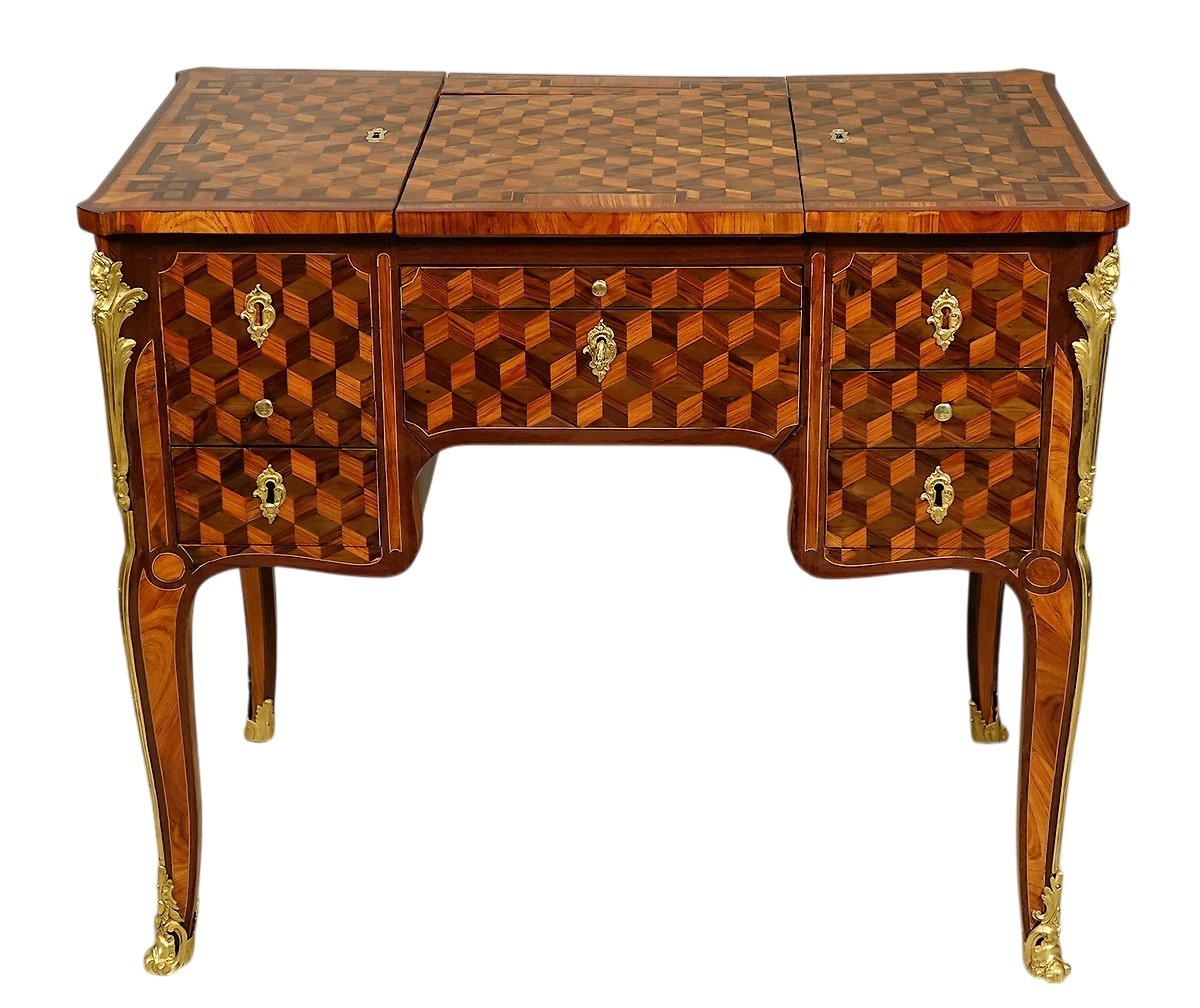
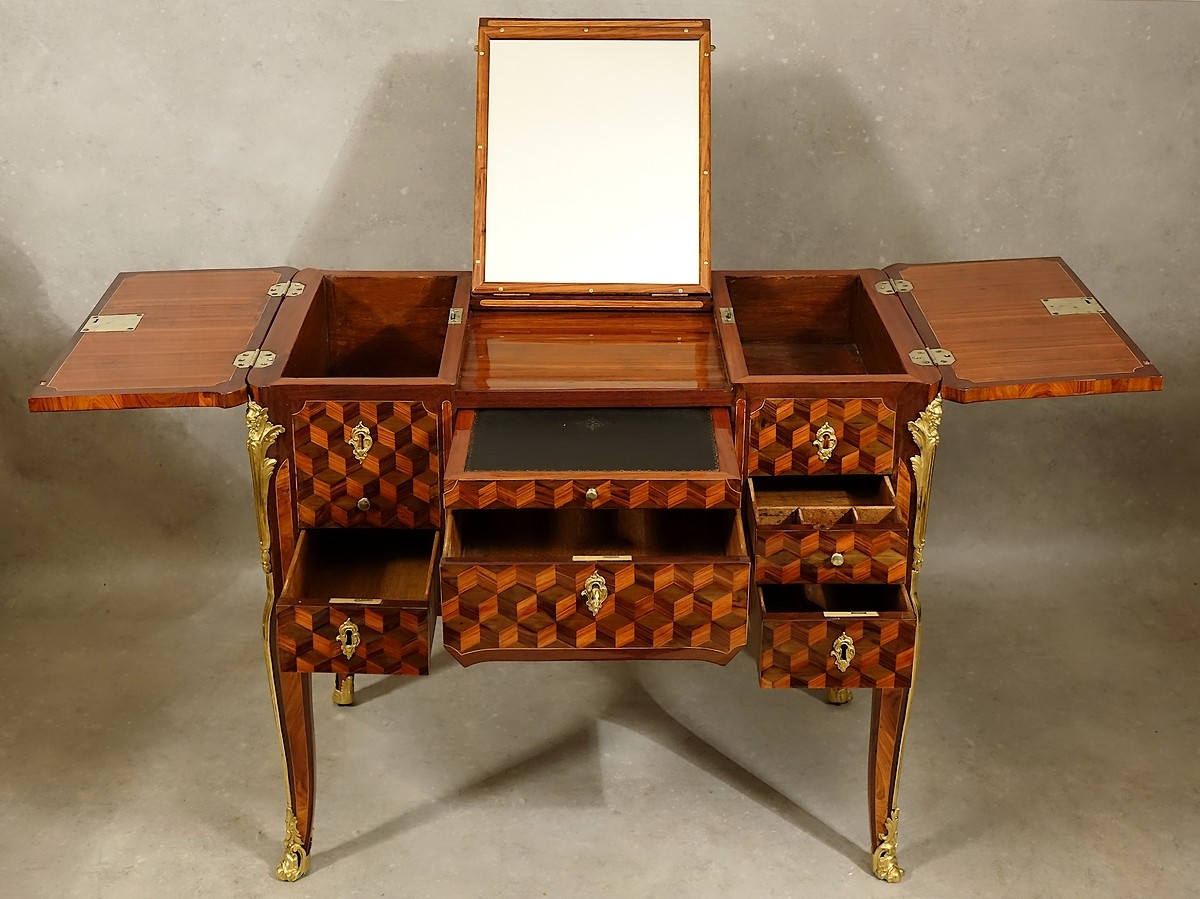
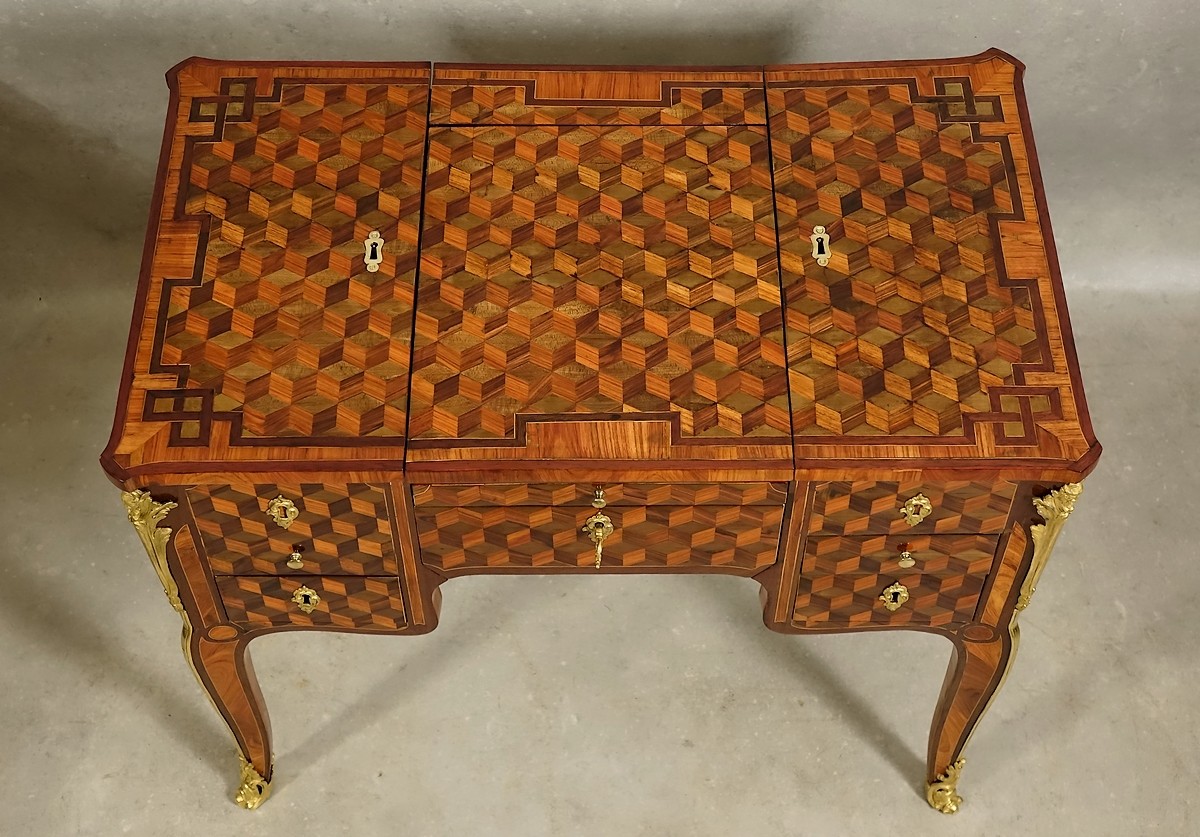
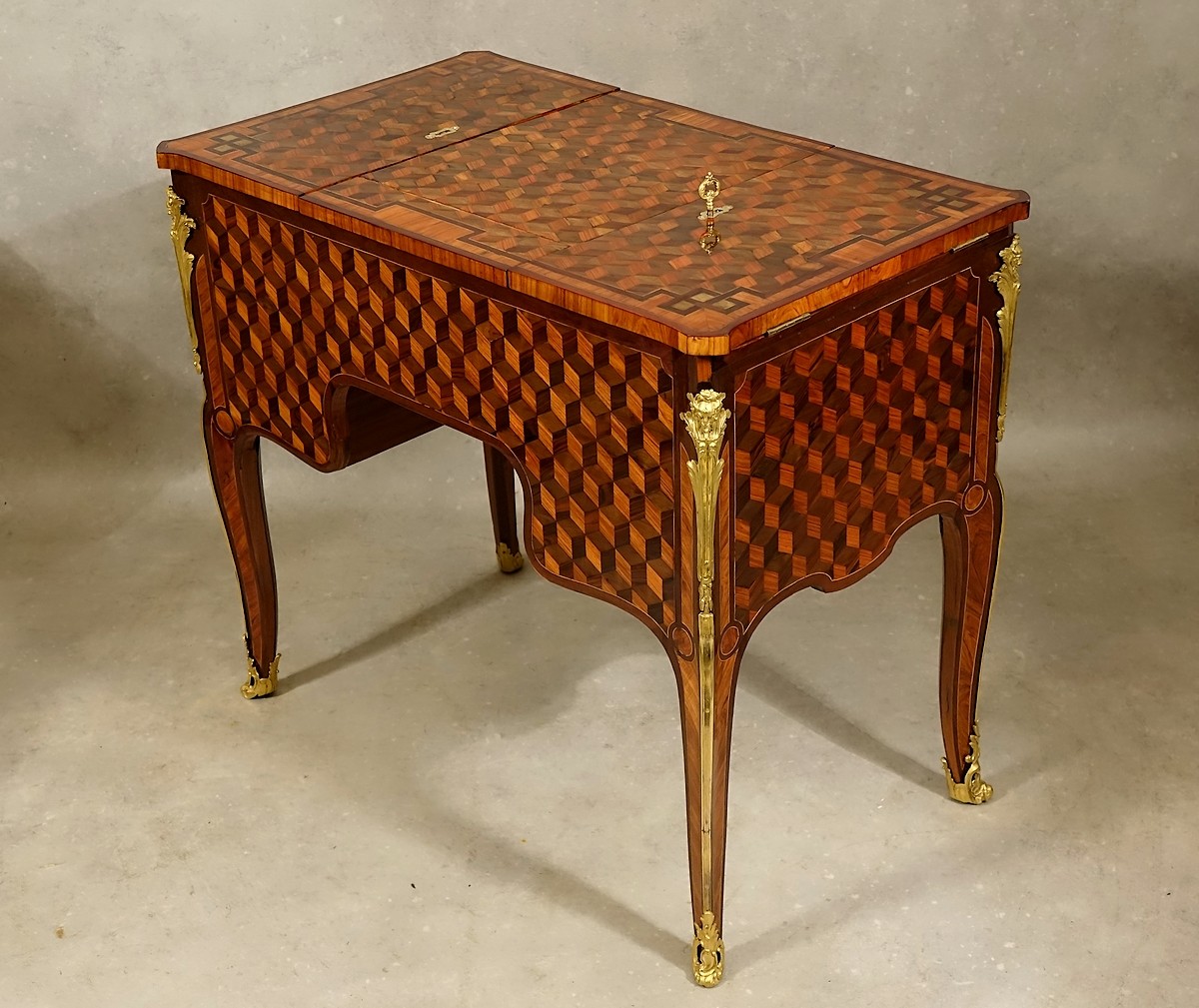
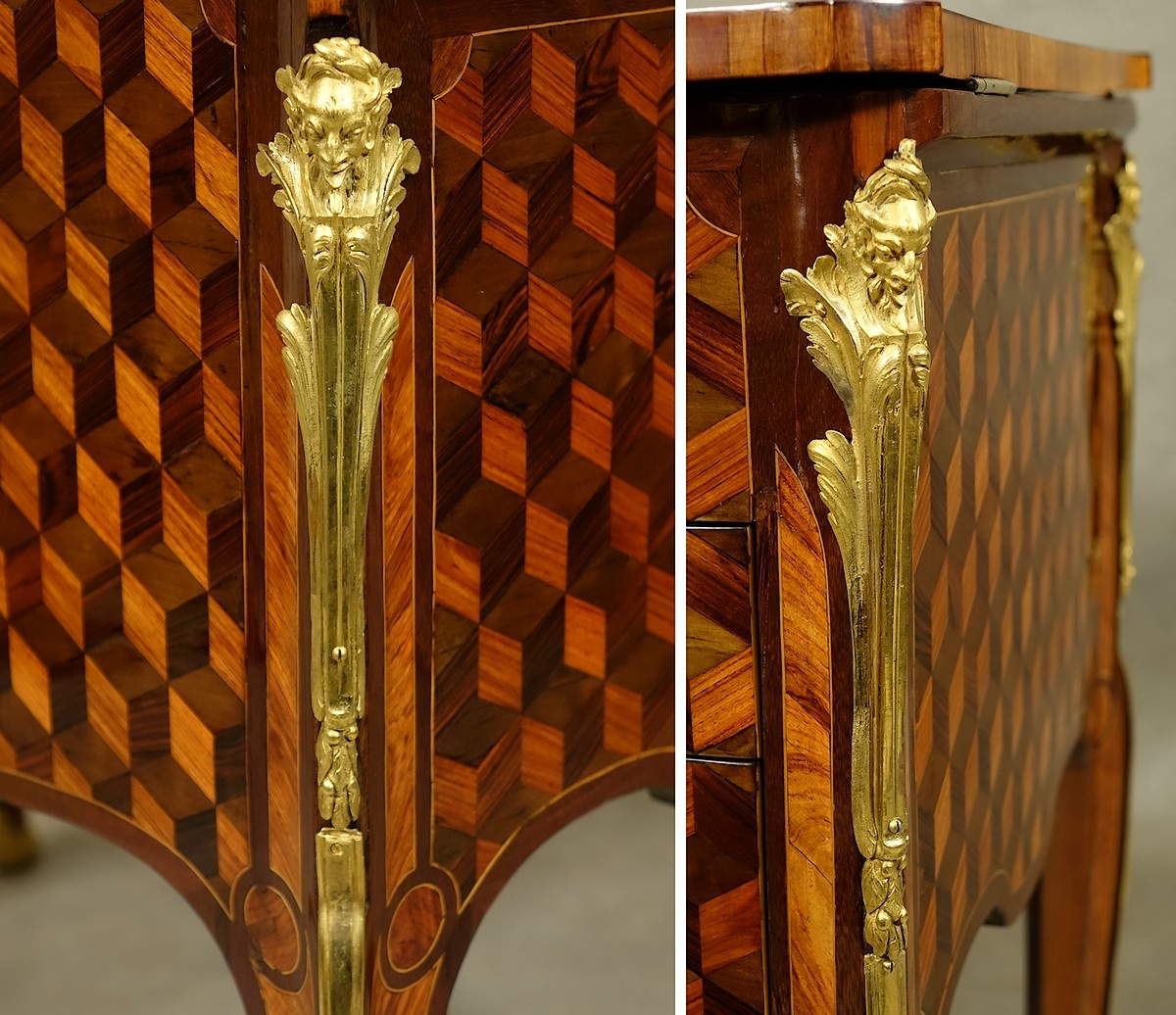
Rare Transition powder table or dressing table with compartments, in marquetry of trompe-l’œil cubes and precious gilt bronze mounts with satyr masks.
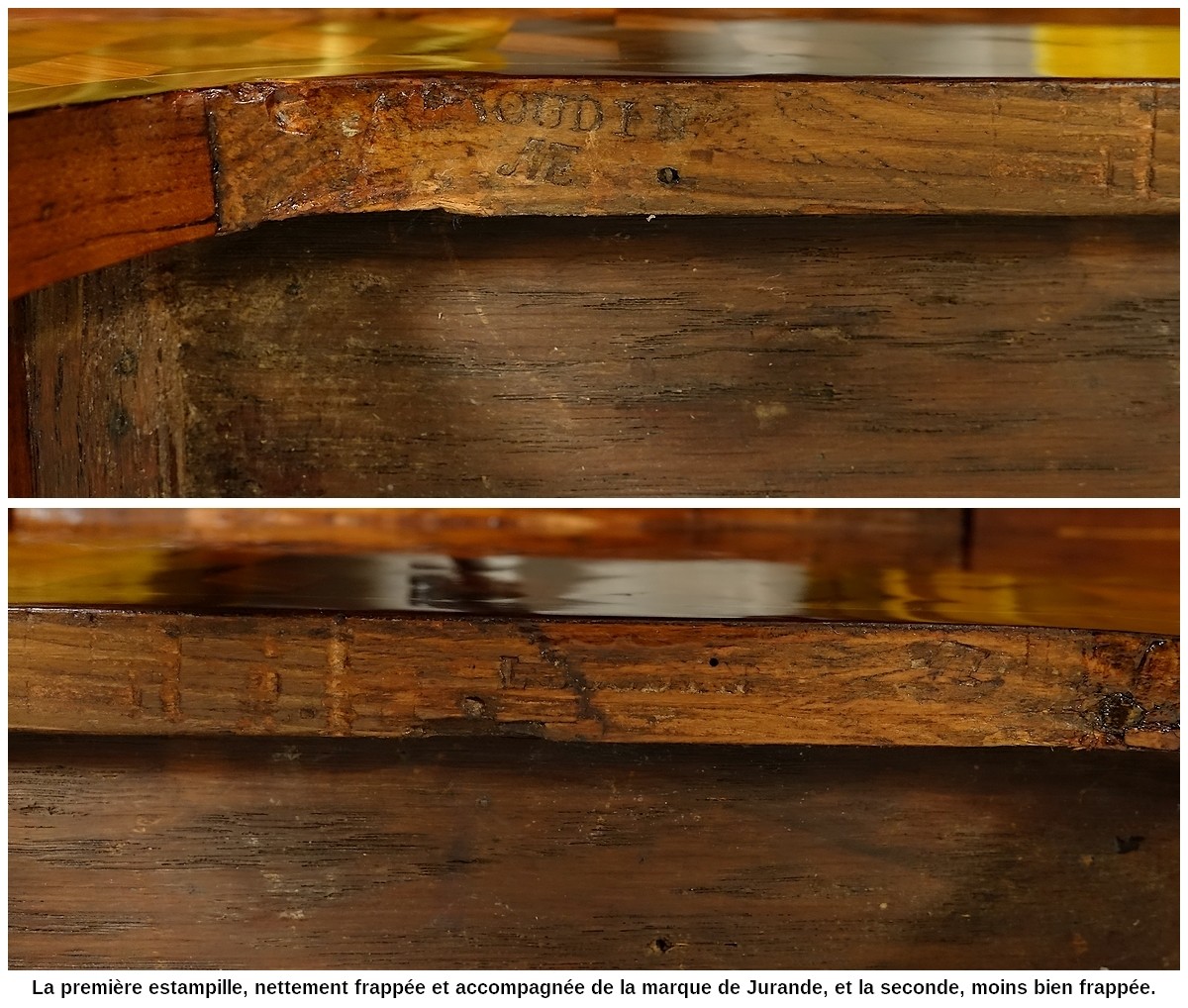
It bears the double stamp of Léonard Boudin.
Parisian work from the late Louis XV period, circa 1765–1770.
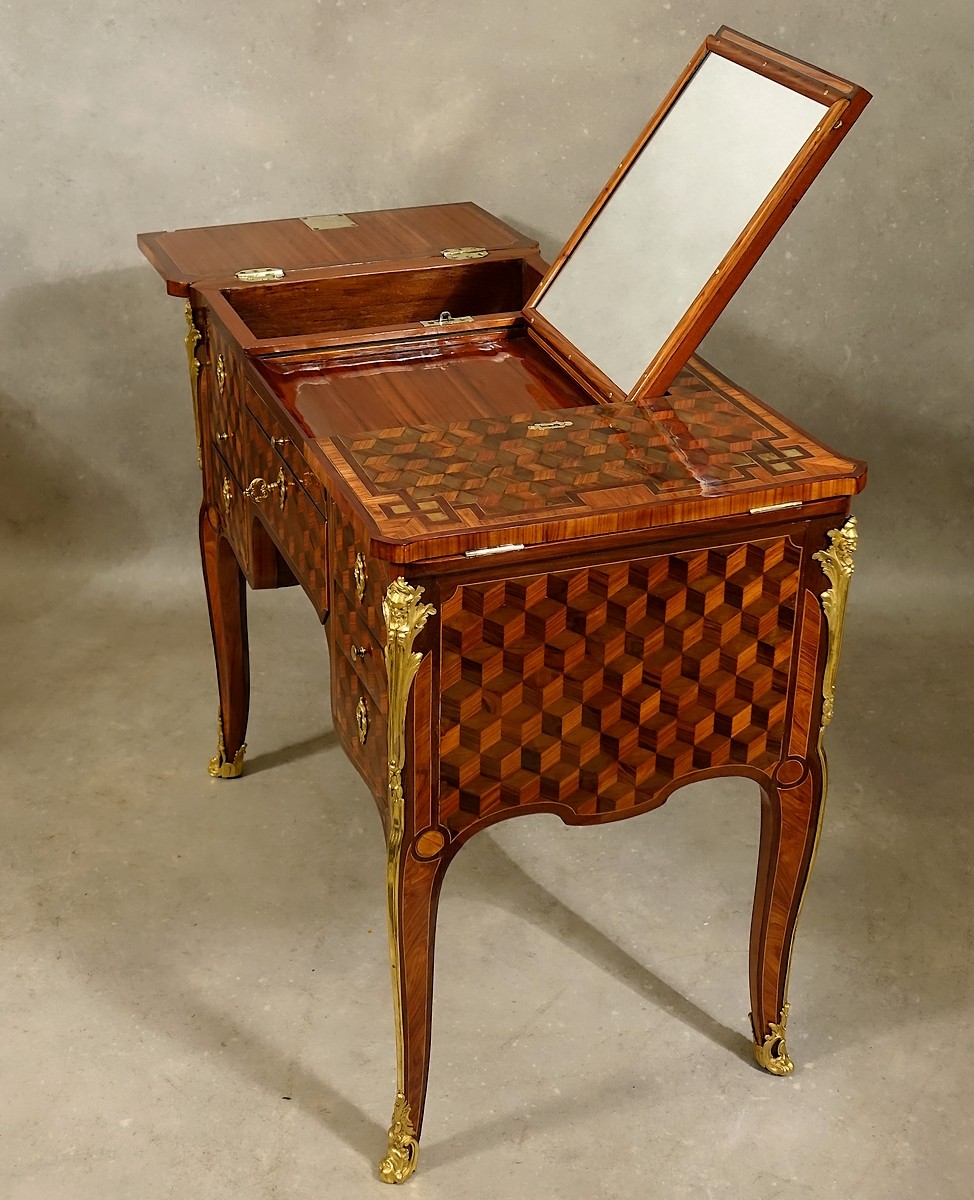
The front opens with four drawers without crossbars and a leather-lined pull-out writing slide for additional use as a writing table, while the top follows the tripartite opening common to Louis XV and Louis XVI dressing tables, with the central flap fitted with a mirror and the side compartments equipped with locks.
This so-called “à la grecque” model is veneered on all sides with five different woods, principally kingwood, framed by boxwood stringing and amaranth borders, with reserves decorated in a rich trompe-l’œil cube marquetry in tobacco-stained sycamore maple, kingwood, and violet wood, all outlined by fine boxwood stringing or wide Greek-key marquetry in amaranth.
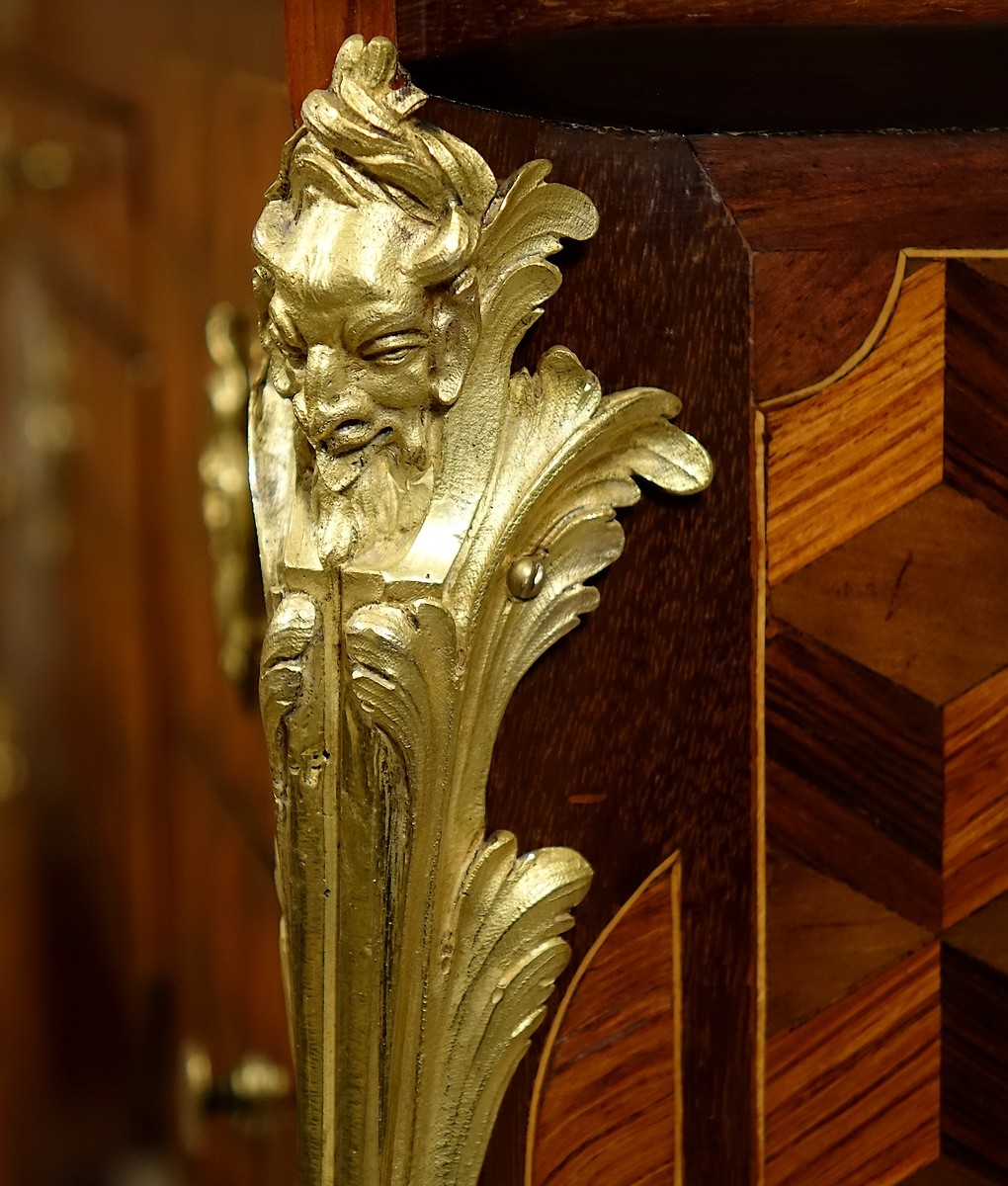
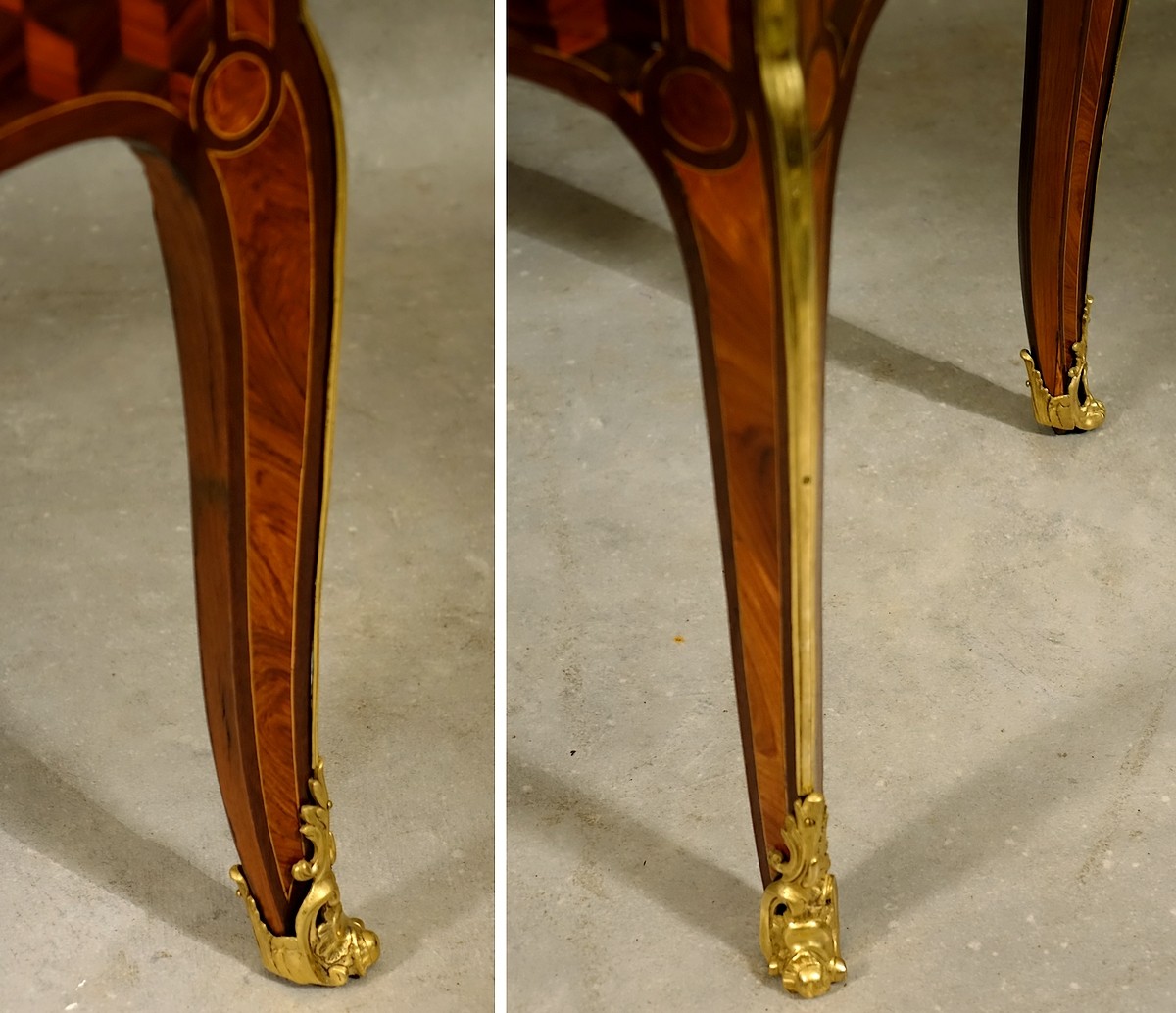
In addition to its tall, pierced, and enveloping sabots, the piece is adorned with a luxurious and very rare set of gilt bronze mounts with satyr masks of remarkable chasing, a bronze astragal linking the mounts and sabots, as well as five elegant escutcheons, two smaller escutcheons, and three bronze knobs, all retaining their original gilding.
A gilt bronze-headed key operates the five locks.
The entire carcass of the furniture is made of oak.
It bears, beneath the front rail, the JME mark of the Paris guild and the double stamp L. BOUDIN of the master cabinetmaker Léonard Boudin.
If Jean-François Oeben and Roger Vandercruse dit Lacroix are considered the spearheads of the Transition style, Léonard Boudin, even more so than Pierre Roussel discussed below, is known as one of its principal propagators.
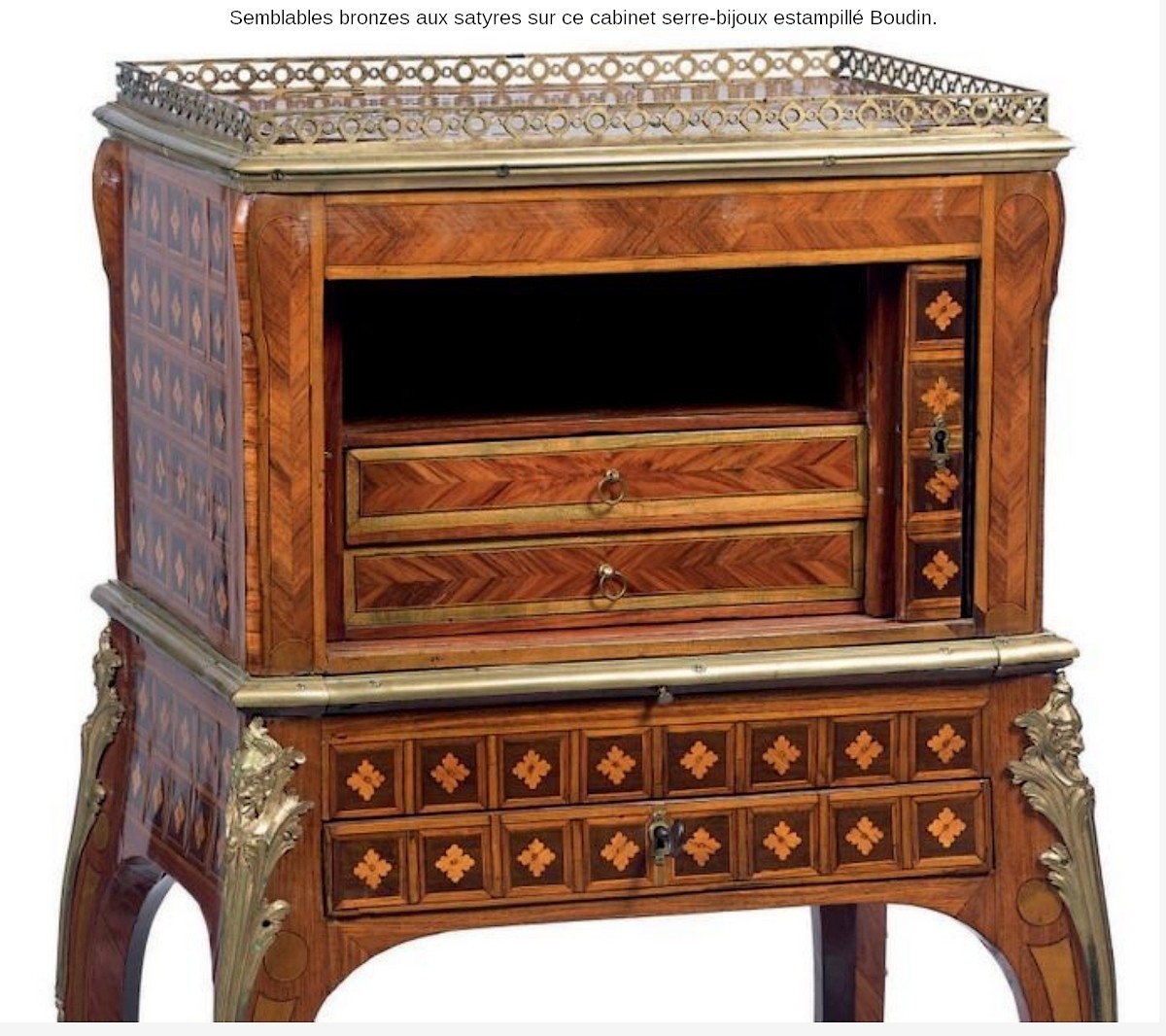
Regarding the satyr-mask mounts: this bronze model is among the most elite and appears only on a corpus of high-quality furniture produced by a restricted circle of the most celebrated cabinetmakers. François Quéré established a list of masters who used it, beginning with Oeben, Roussel, Cosson, Dautriche, Foullet, Leclerc, Dubois, and Montigny, and finally Topino, who, we are told, sourced his mounts from the master founder and chaser Jean-Baptiste Dubuisson.
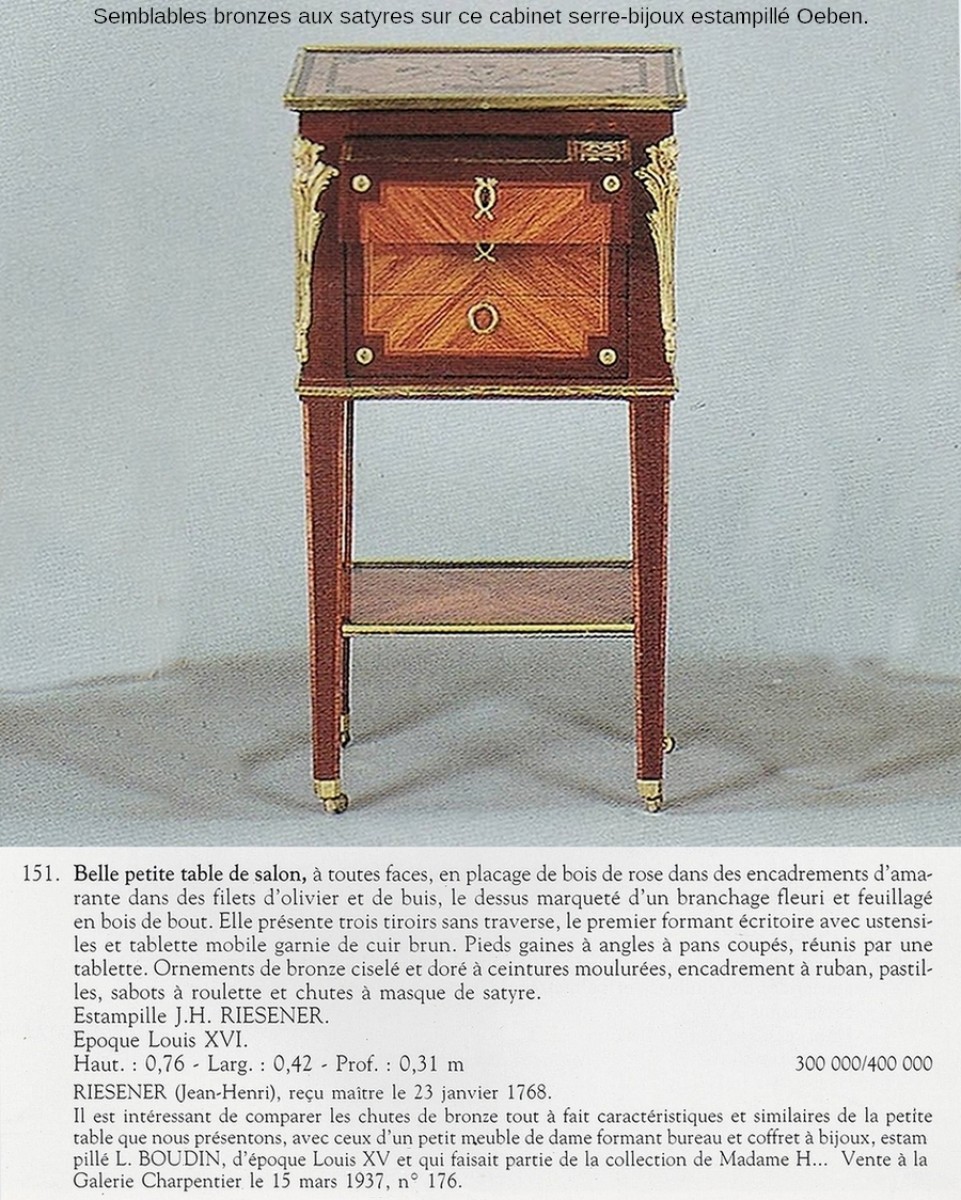
To this list we may add Jean-Henri Riesener himself, as demonstrated by a Louis XVI table bearing his stamp sold at Hôtel Georges V on April 3, 1996 (see documentation), for which the Tajan auction house noted:
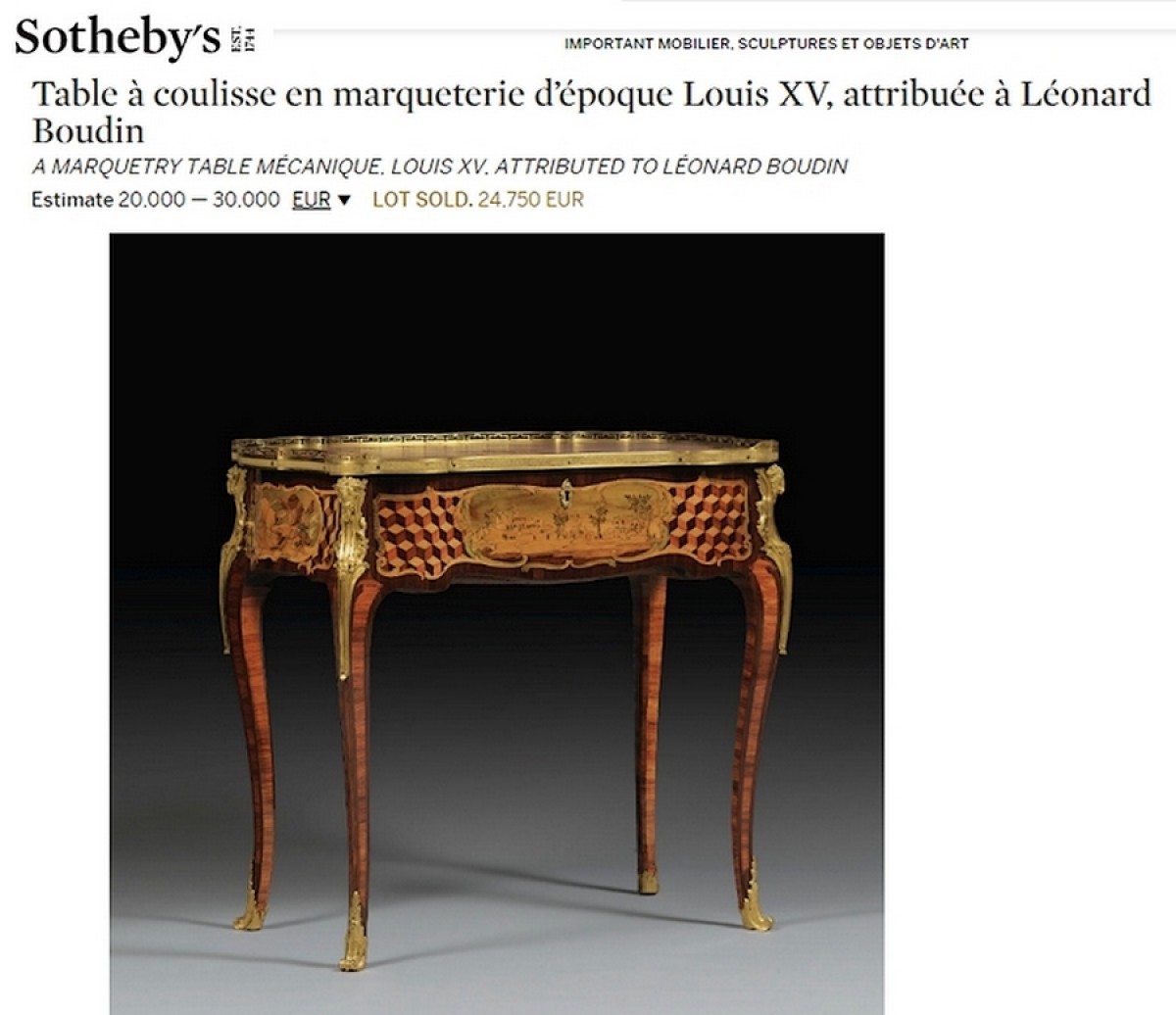
“It is interesting to compare the highly characteristic and similar bronze mounts of the small table we present with those of a lady’s piece forming a desk and jewel cabinet, stamped L. BOUDIN, Louis XV period, formerly in the collection of Madame H... Sale at Galerie Charpentier, March 15, 1937.”
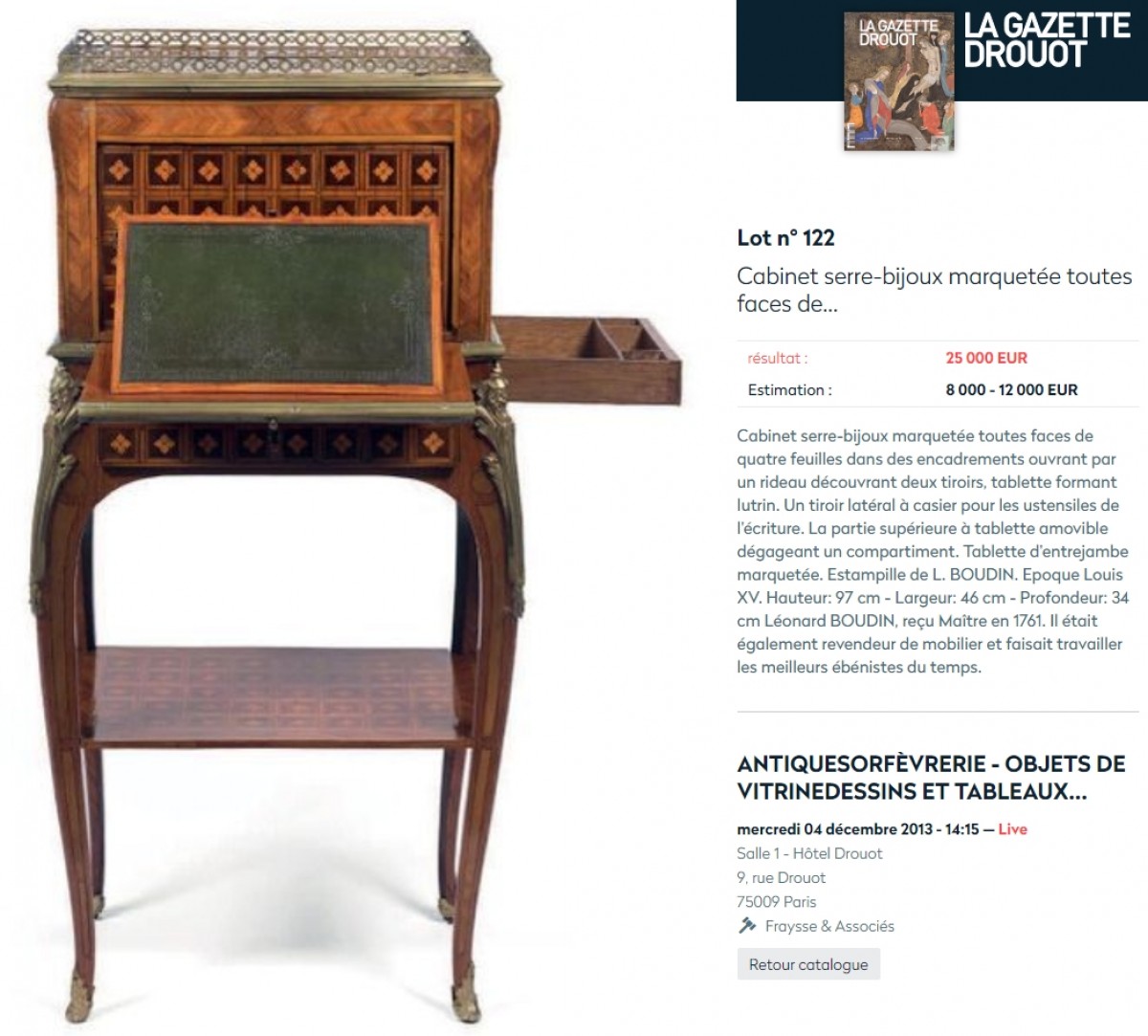
Could this be the piece sold at Drouot in 2013 (which we include in the documentation)? This is entirely probable. In any case, apart from that example and our dressing table, we have not seen another piece by Léonard Boudin fitted with such bronzes sold at public auction during the past twenty years.
This furniture of outstanding quality is presented in exceptional condition, retaining its original gilt bronze mounts, and having benefited from high-level restoration and French polishing by a master cabinetmaker.
Dimensions: 77 cm high × 88.5 cm wide × 52 cm deep.
Provenance: Christie’s Monaco sale, June 19, 1999, then a Parisian private collection.
Léonard Boudin (Paris 1735 – 1804). Master in 1761.
A skilled cabinetmaker and marquetry craftsman, Boudin first worked in the Faubourg Saint-Antoine and later on Rue Saint-Nicolas, where he attracted the attention of the Migeon family, who commissioned marquetry work from him for some of their most important clients (such as the Marquis de Castelmore and the Chevalier d’Arcq). Granted his mastership in March 1761, he soon established himself on Rue Traversière and became one of the most renowned craftsmen in the capital. As commissions multiplied, he opened a marchand-mercier establishment between the Palais Royal and the Louvre and, in turn, employed other cabinetmakers such as Evald and Denizot, Gilbert, Foullet, Pioniez, and Topino. In 1771, at the height of his career, he received a commission from Gilles Joubert, supplier to the Crown, for a suite of furniture intended for the Comte de Provence.
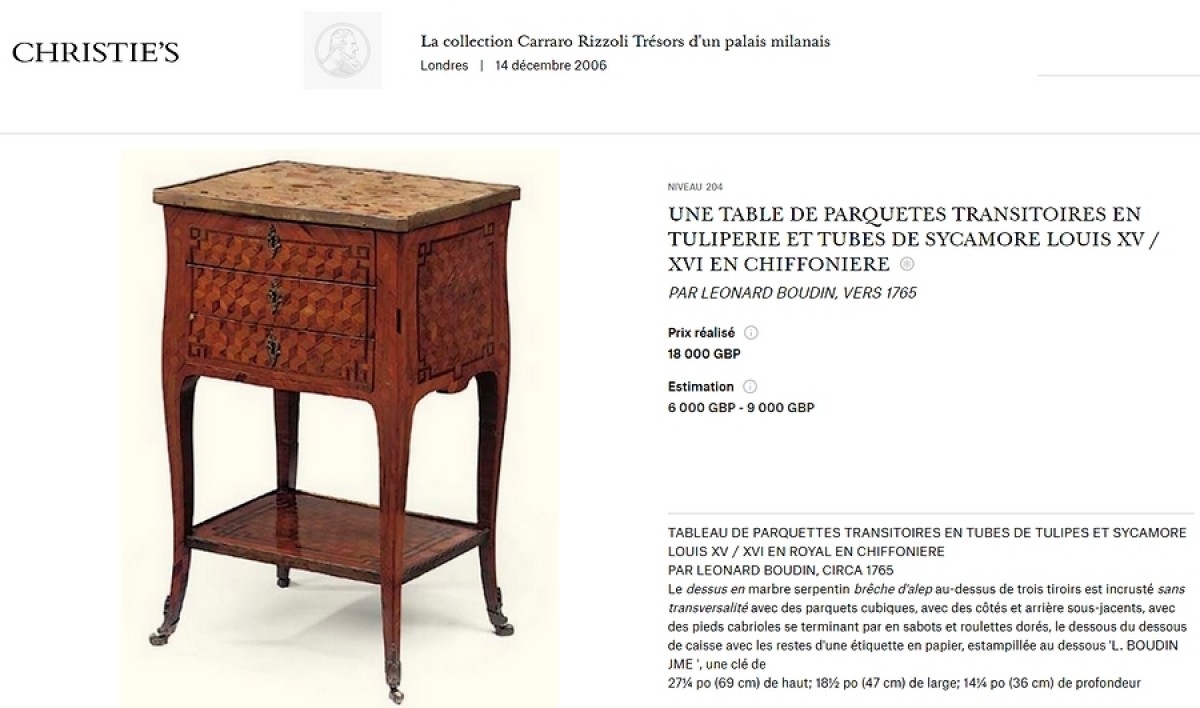
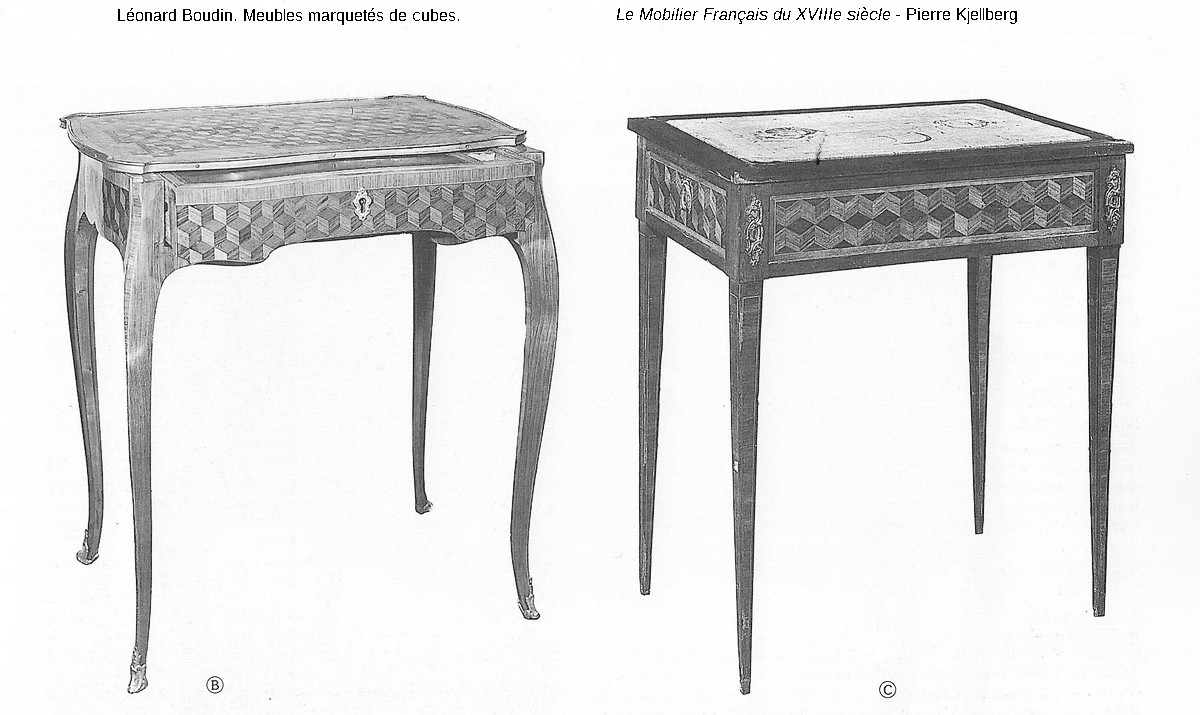
Although Léonard Boudin occasionally stamped furniture executed by fellow craftsmen, he is known for his predilection for cube marquetry. As Pierre Kjellberg notes, his work can be recognized by “large radiating rosettes” and also, as on our dressing table, by “small circles enclosed within sinuous framing.”
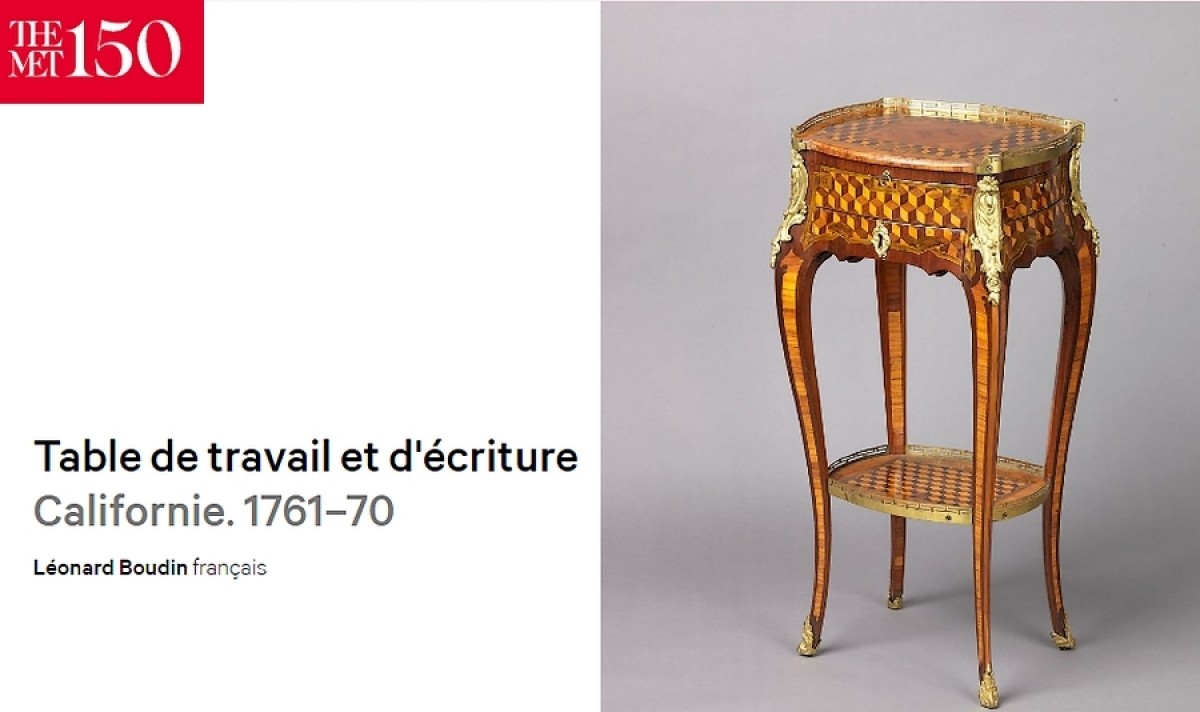
Léonard Boudin is regarded as one of the greatest French cabinetmakers. Some of his furniture may be seen in major museums such as the Musée du Louvre, Musée Carnavalet, and Palace of Versailles, as well as in leading international museums including the Metropolitan Museum of Art, the Cleveland Museum of Art, and the Kunts Husgeradskam of Stockholm.