Offered by Desmet Galerie
REQUEST INFORMATION
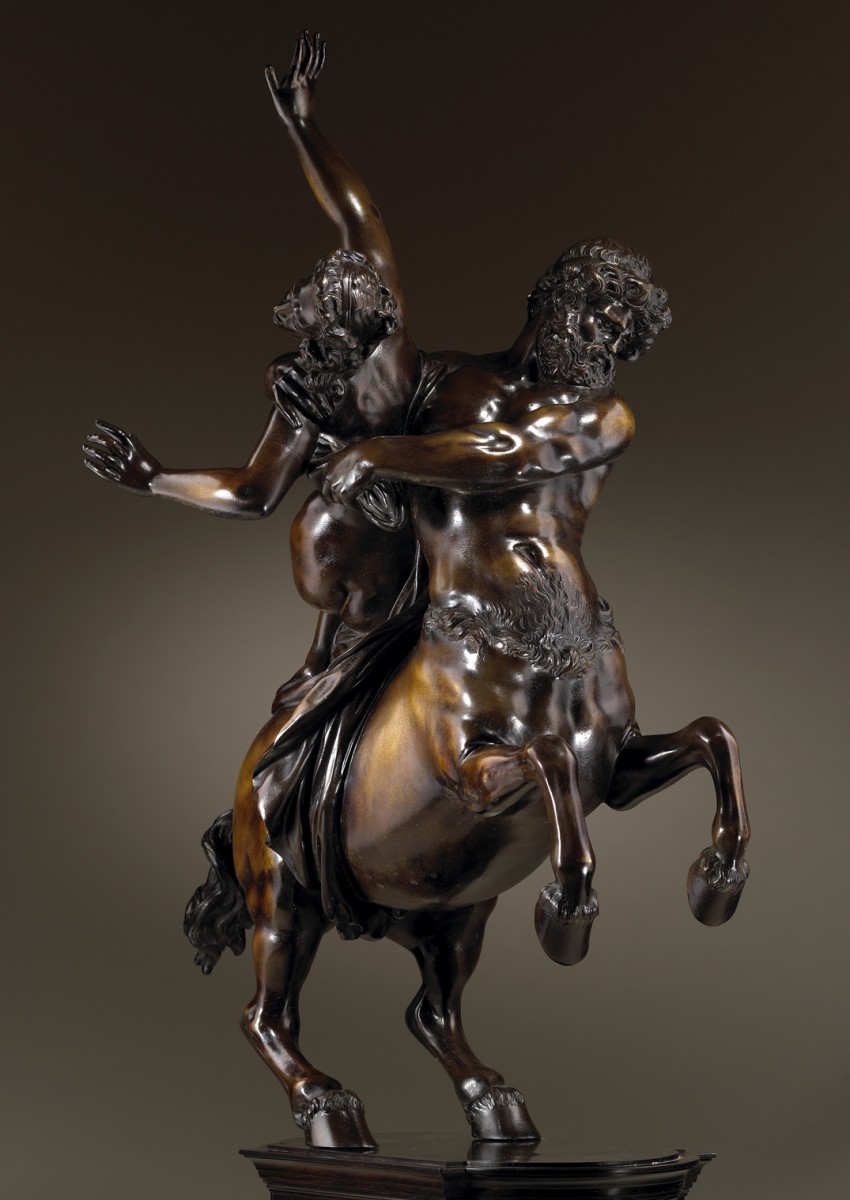

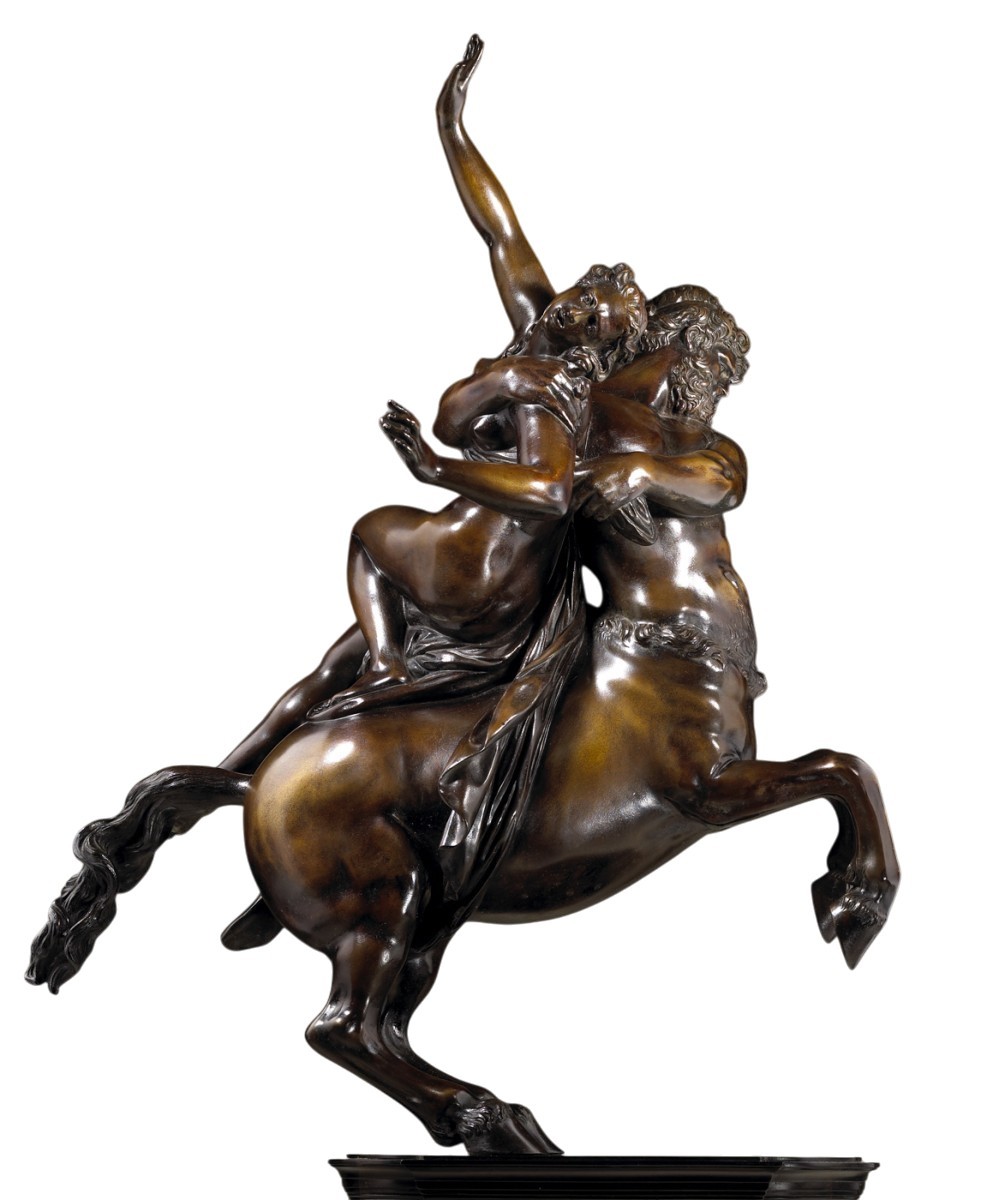
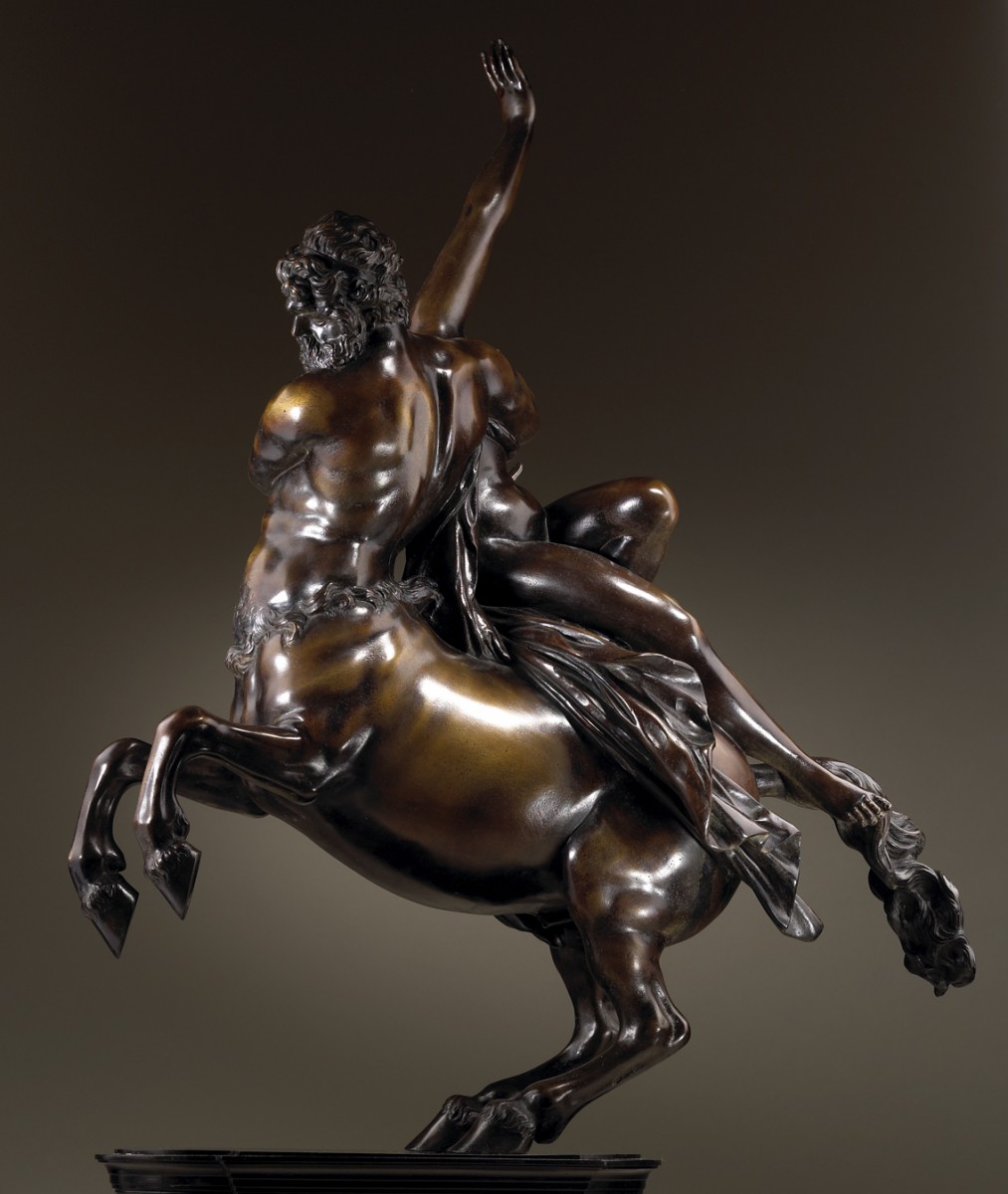
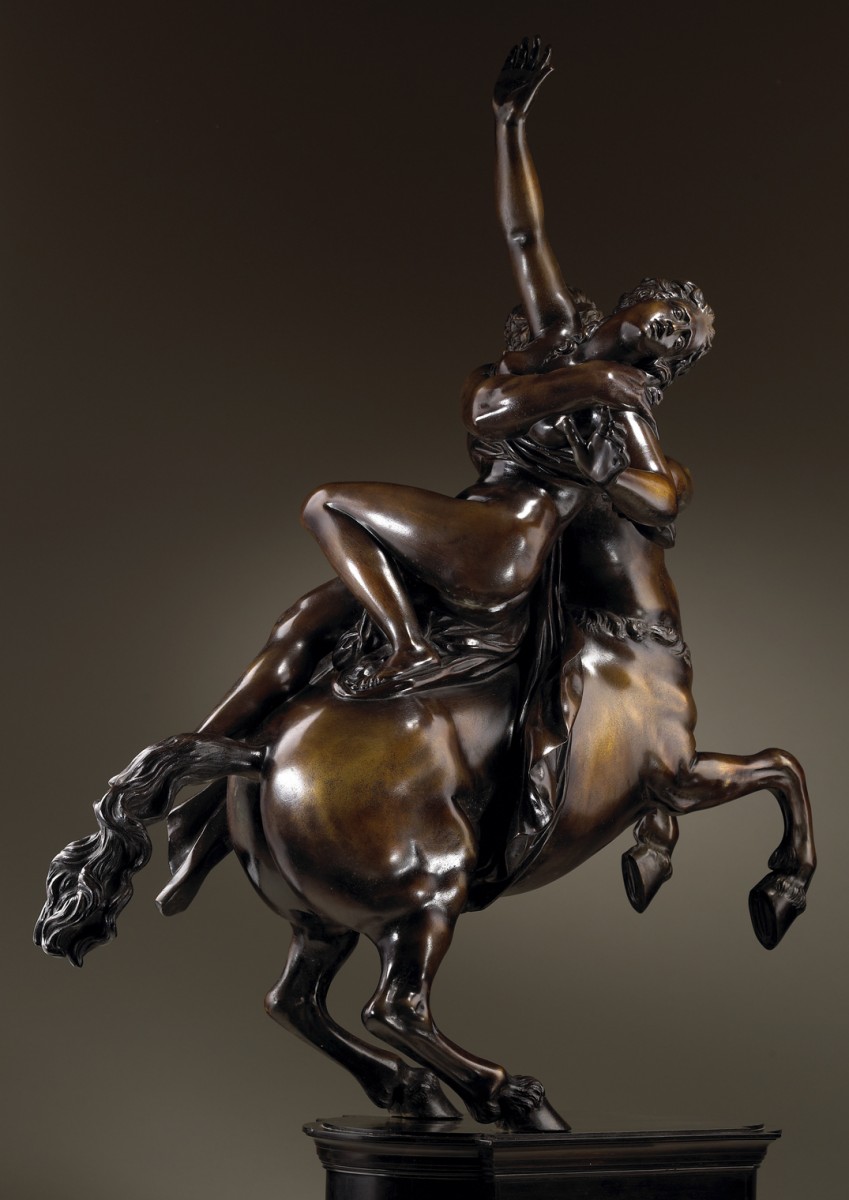
This exquisite Florentine bronze group, dating to the 18th century, depicts the abduction of the Deianira, the wife of Hercules, by the centaur Nessus. The composition shows Nessus’ brief moment of triumph as he attempts to carry off Deianira, only to find himself slain by Hercules the very next instant. It is a scene of great drama, which is emphasized by Nessus' rearing and the trailing drapery to his sides, while the struggling Deianira is thrown across his back. The latter is depicted in torsion, stabilizing herself with one foot on his back, with flailing arms and her head thrown back in desperation. The group is a radically complex and dynamic composition, displaying a perfect understanding of both human and equine anatomy as well as an uncanny mastery of compositional balance. The whole is cleverly balanced about a fulcrum at the rear hoofs of the centaur, with the weight of Deianira carefully positioned in such a way that the foreparts of the centaur do not make the group tumble forward. Visually the bent raised forehooves and the rearing, forward motion of the centaur is counteracted by the heaving, rearwards movement of Deianira’s arched body and the diagonal thrust of her right arm into space.
The subject of this story was taken from Book IX of Ovid's Metamorphoses where Ovid recounts that as Hercules and Deianira are journeying back to Tyrins, they arrive at a swollen river. The centaur Nessus, who is helping people to cross the river, sees them and offers to carry Deianira to the other bank. However, half way through he turns around and attempts to abduct Deianira. On seeing this, Hercules draws a poisonous arrow drenched in the Hydra's blood and lethally wounds the centaur. Just before his death, however, the dying Nessus convinces Deianira that his blood is a powerful love potion. Deianira collects the centaur’s blood and sends Hercules a cloak soaked in Nessus’s blood. Putting it on, Hercules is subsequently poisoned and dies. Tormented by grief and remorse Deianira eventually takes her own life.
From the very moment it had been created by Giambologna, the composition became extremely beloved and sought-after. The fact that there are no fewer than three known signed examples of the group demonstrates its popularity as well as the artist’s pride in this model. One of these was given some time before 1587 by the Grand Duke of Tuscany to the Elector Christian I of Saxony and it has been part of the collection at Dresden ever since. The other two examples can be found at the Louvre and the Huntington Art Gallery in San Marino, California. The signatures were applied to distinguish them from the many other excellent bronzes based on this model by Antonio Susini, many of which found their way in the most celebrated European art collections.
In fact, after he had left Giambologna in 1600, Susini and his workshop produced such fine versions and reproductions that according to Baldinucci even Giambologna was so admired one of Susini’s versions that he sent his chief assistant Pietro Tacca to purchase it from him for the hefty sum of 200 scudi and that afterwards Susini was able to sell many more versions of that bronze at a similar price.
The version of the bronze statuette offered here is what Avery and Radcliffe described as the Type A cast. According to the sources Giambologna started working on it in 1575 with the assistance of Susini and it is also known that the latter continued to produce casts of this model - as well as his own variants - after he left Giambologna’s studio. Taking into consideration the casting, the high quality of its finishing and particular colour of its patina, it is very likely that the present bronze is precisely one of the 18th century casts made in Florence.
Delevery information :
We can arrange shipping.