Offered by Galerie PhC

European paintings from the 17th, 18th and 19th centuries.
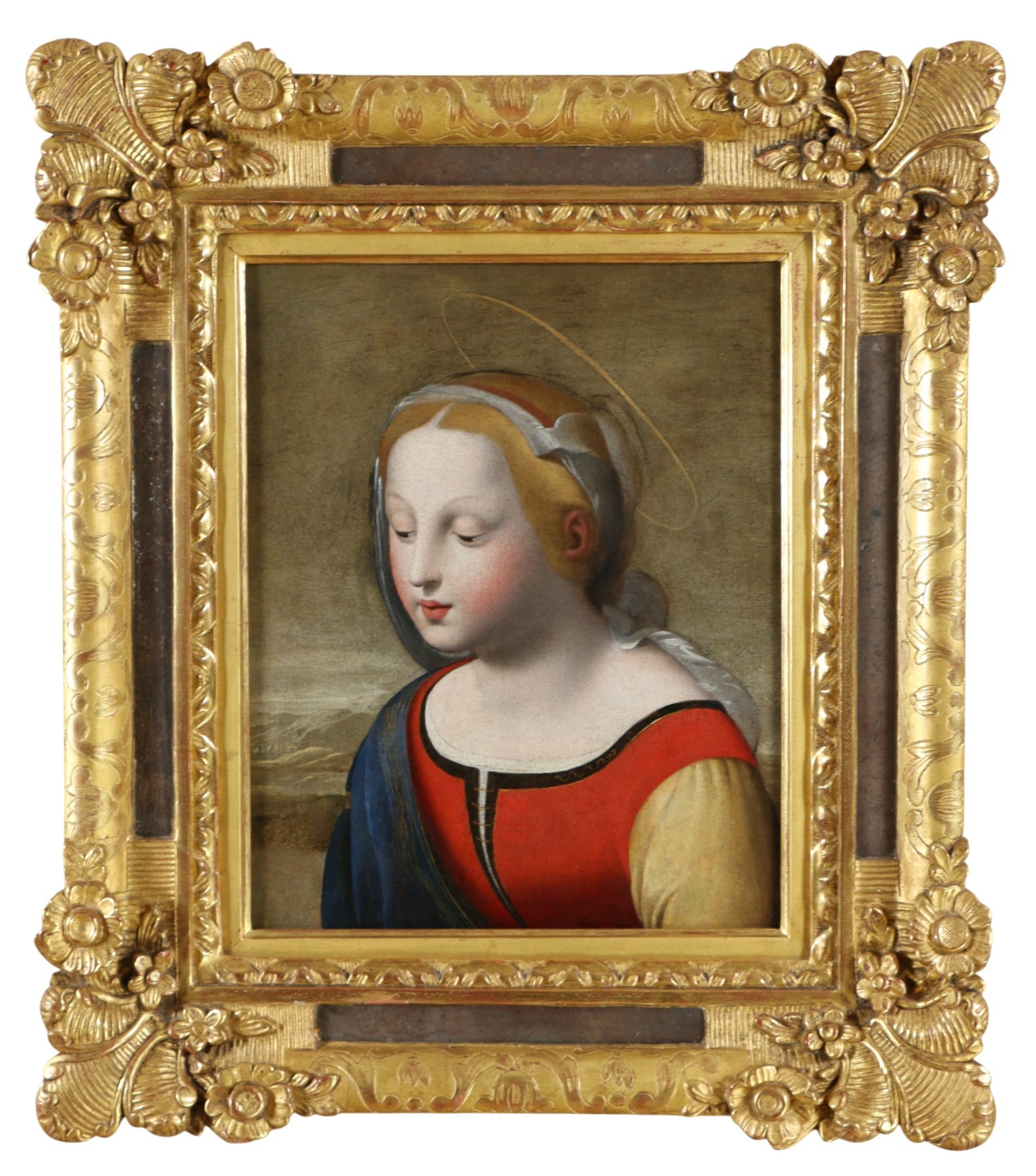
Relined canvas, 41.5 cm x 33 cm.
Antique frame, 63 cm x 55 cm.
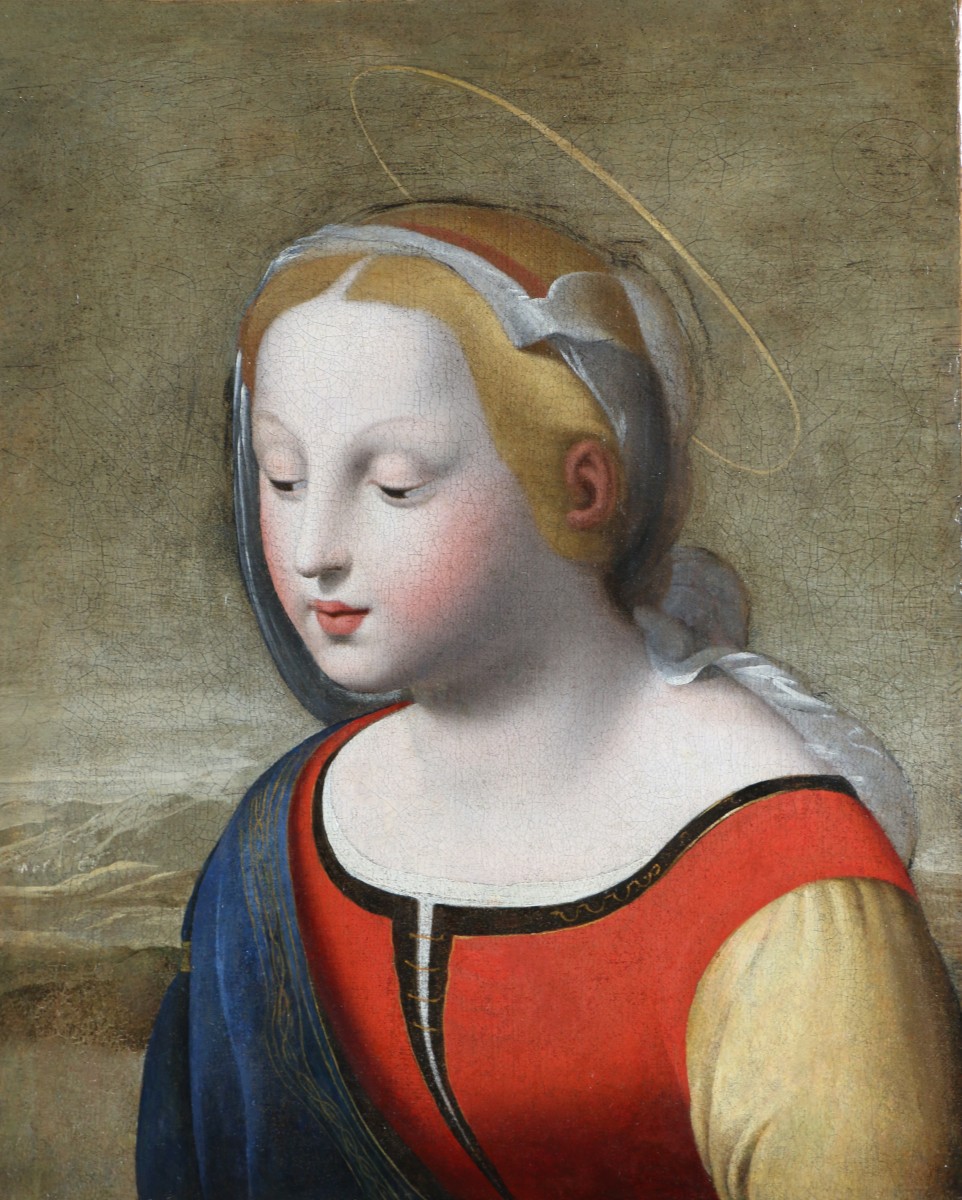
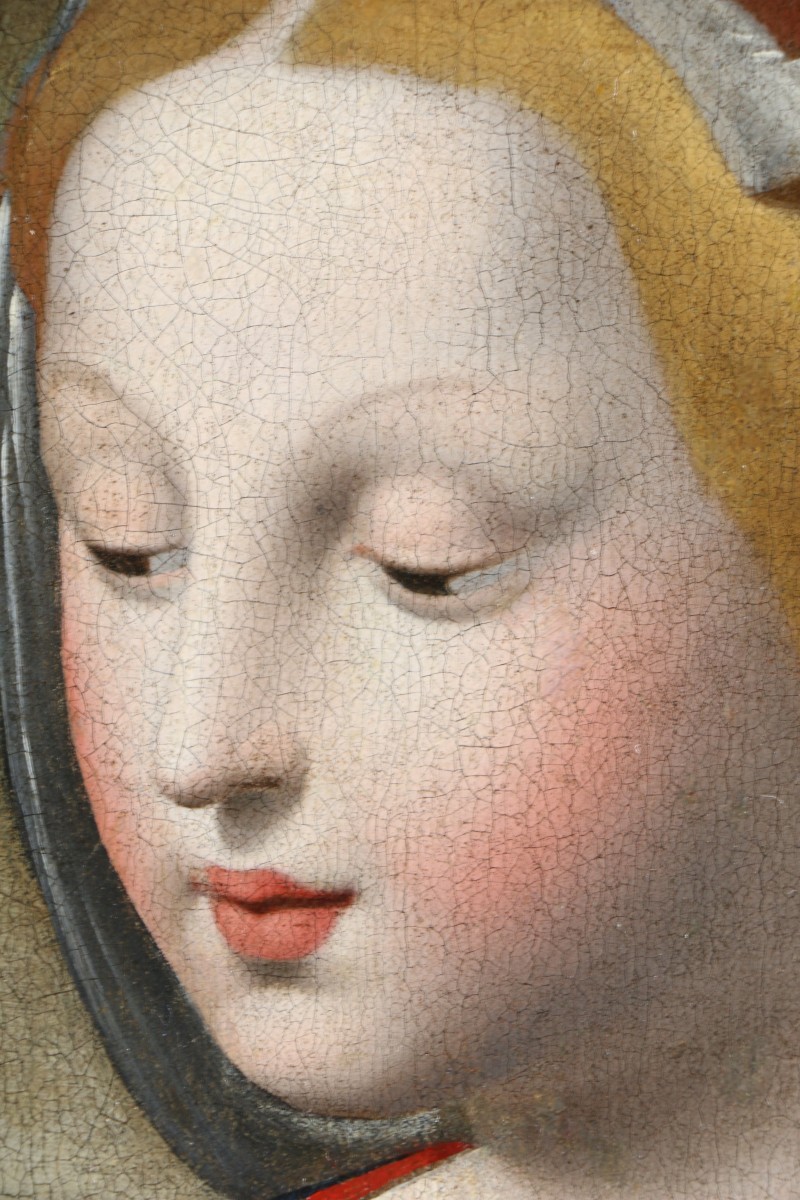
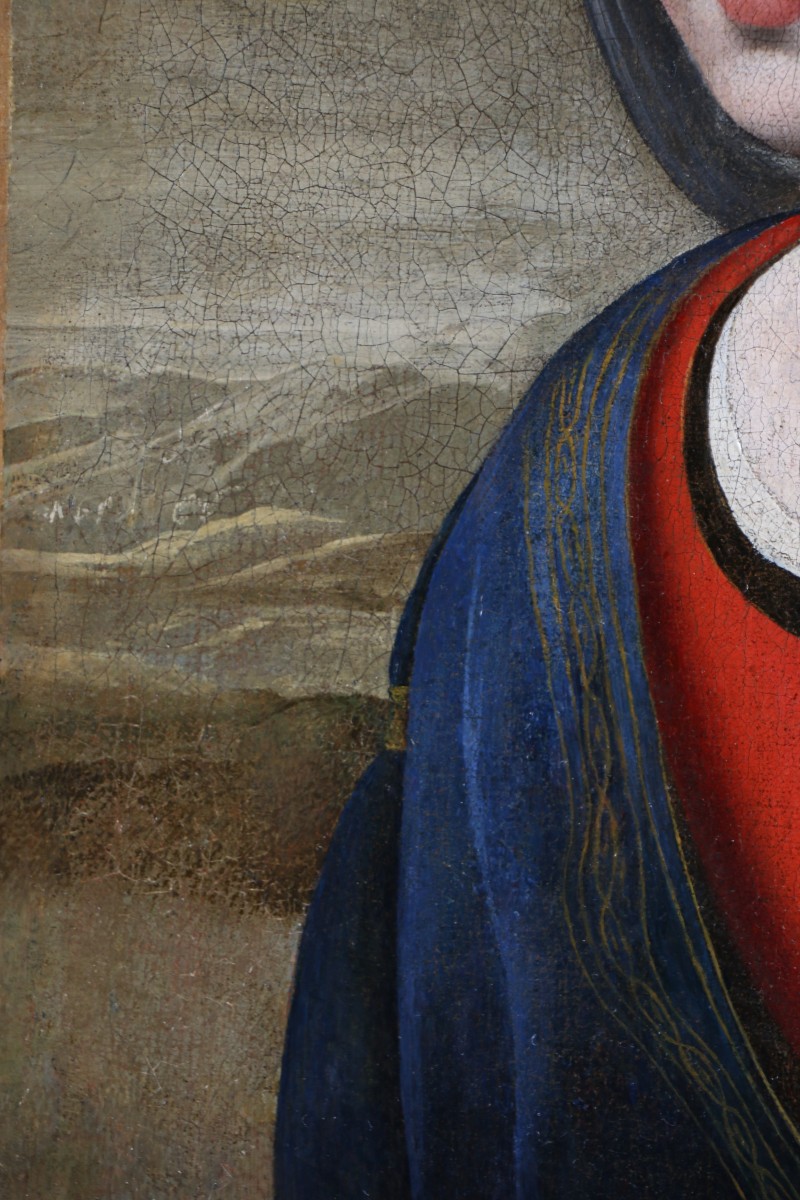
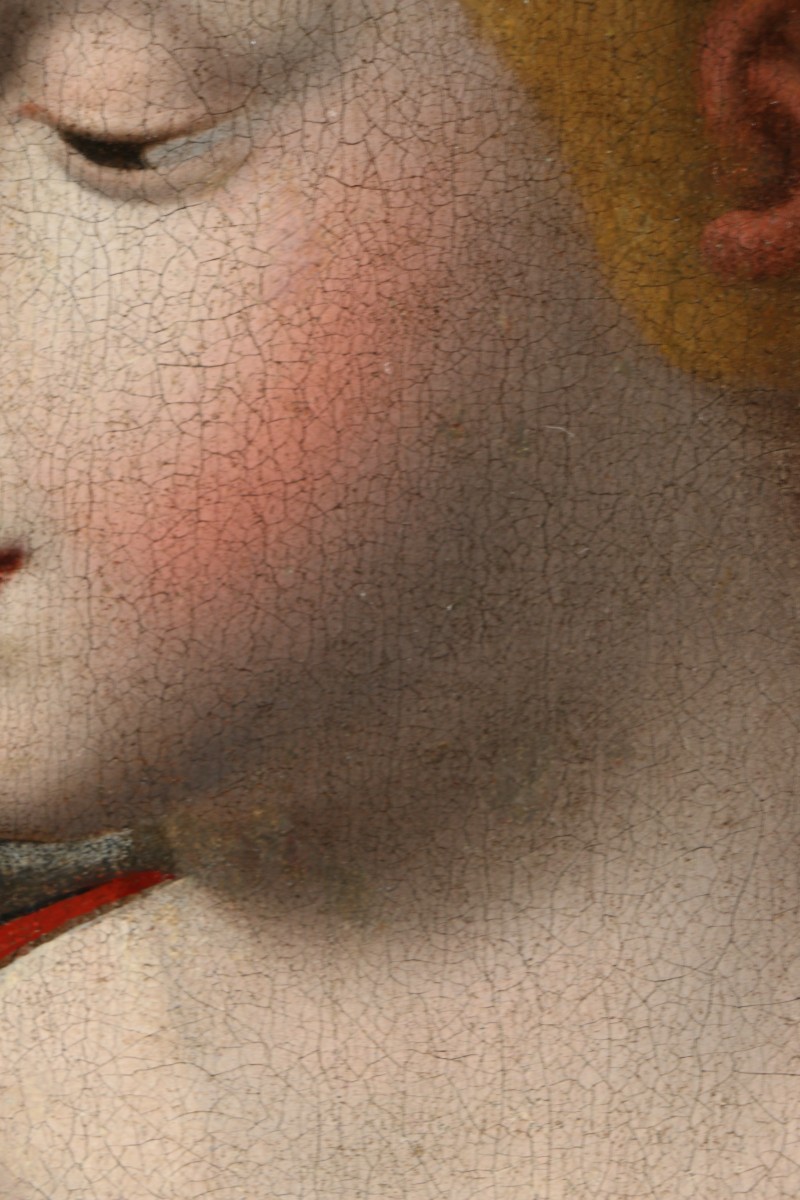
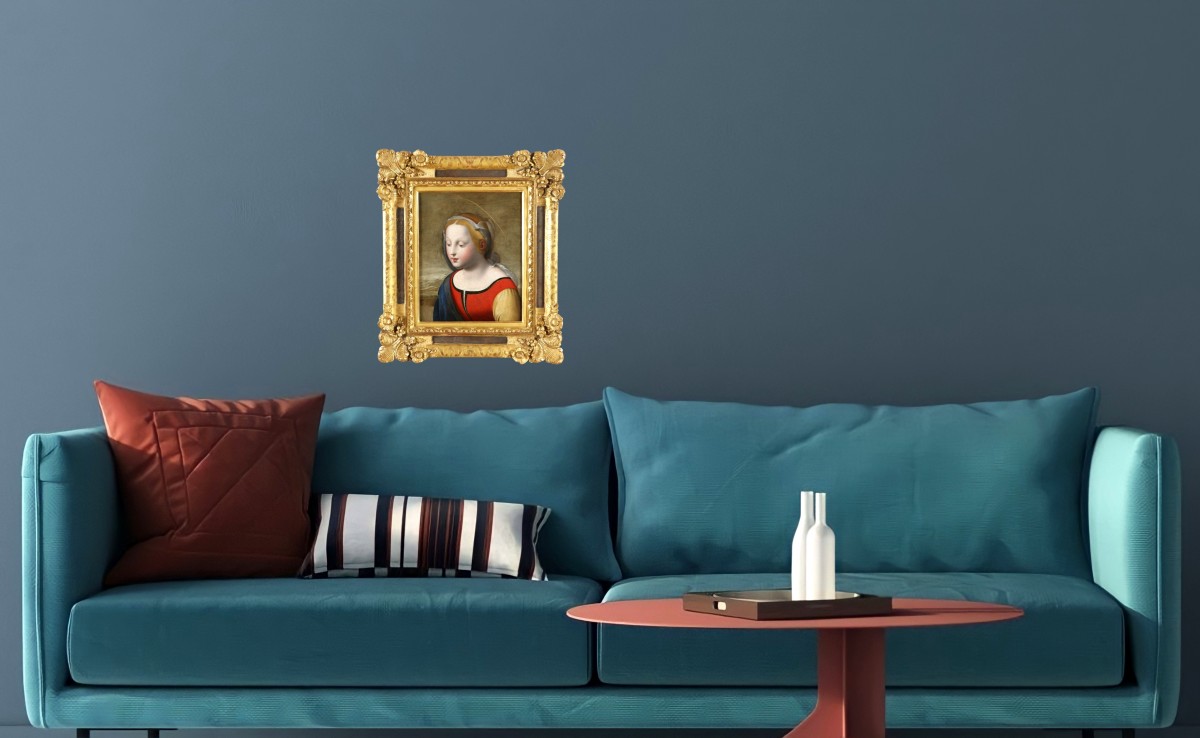
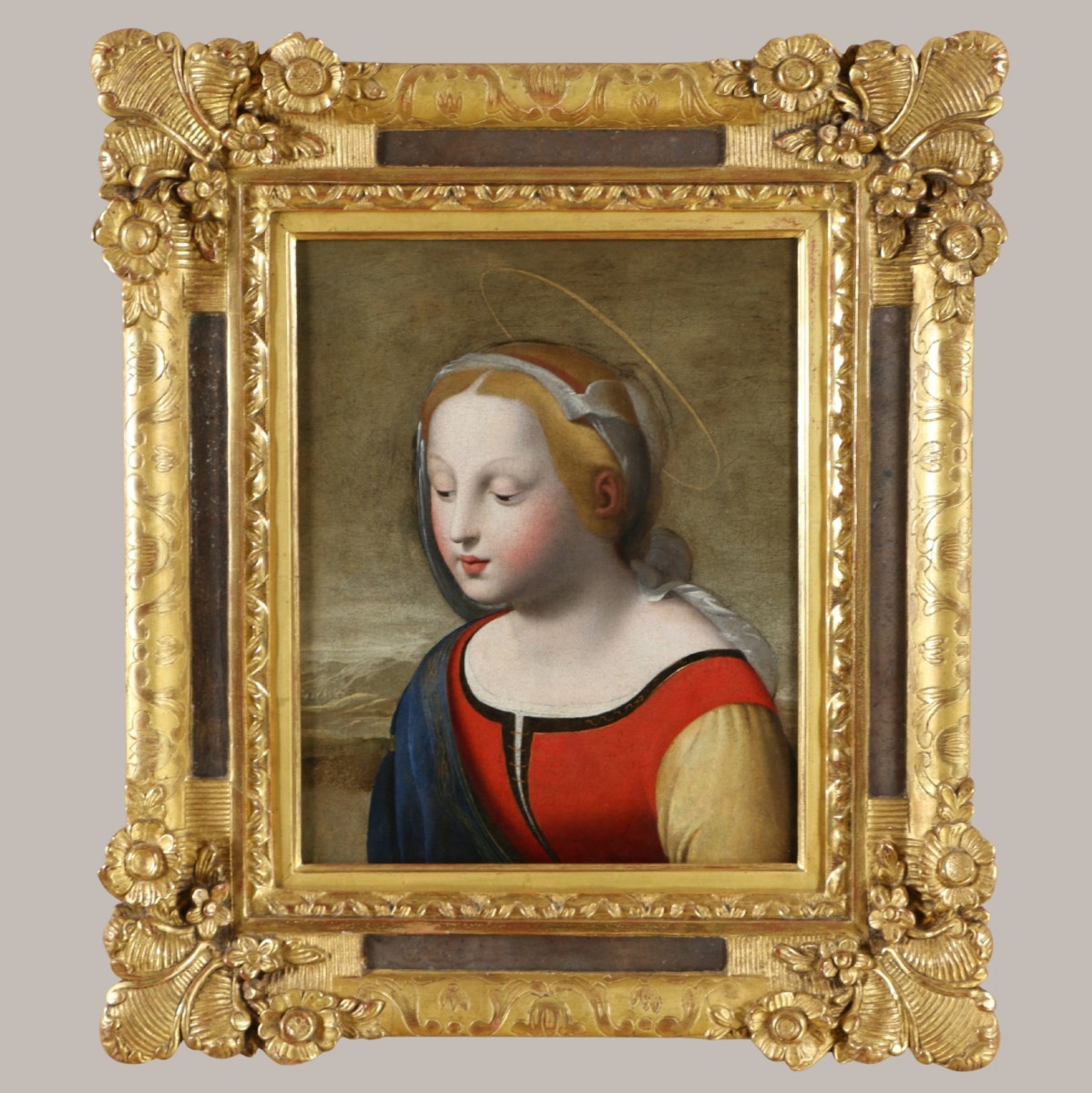
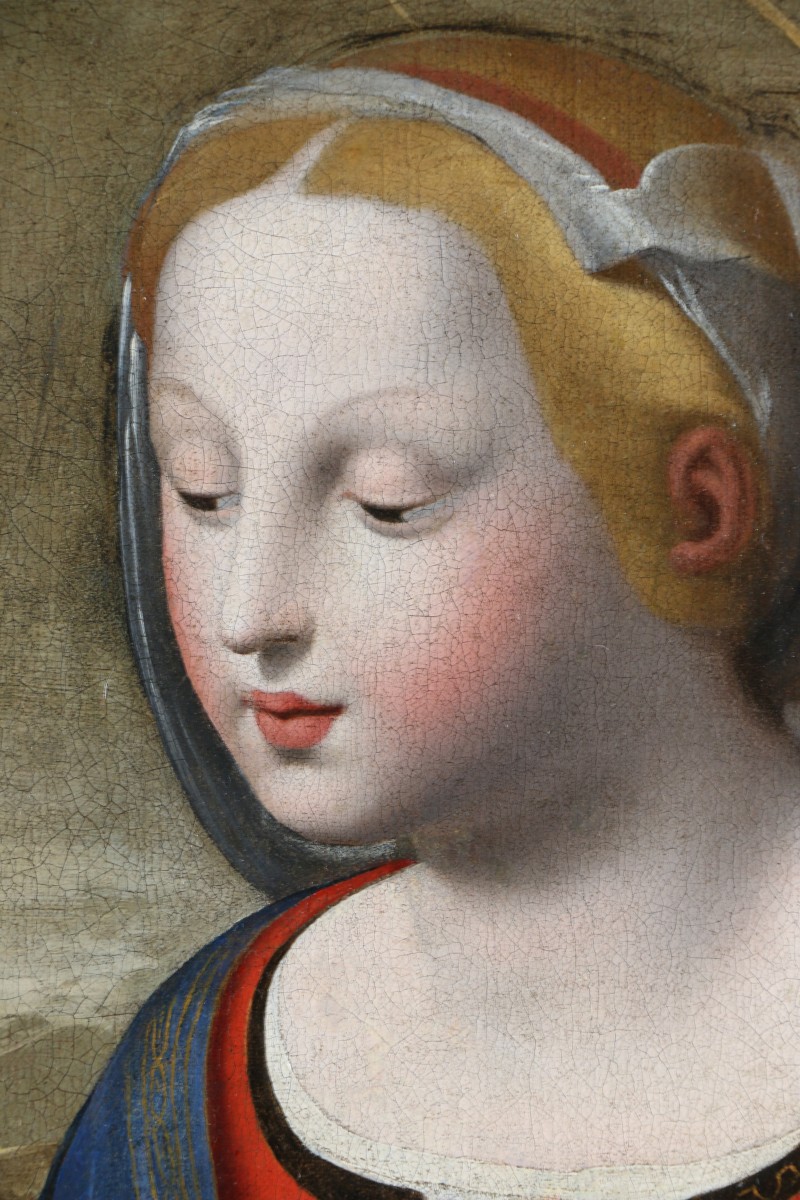
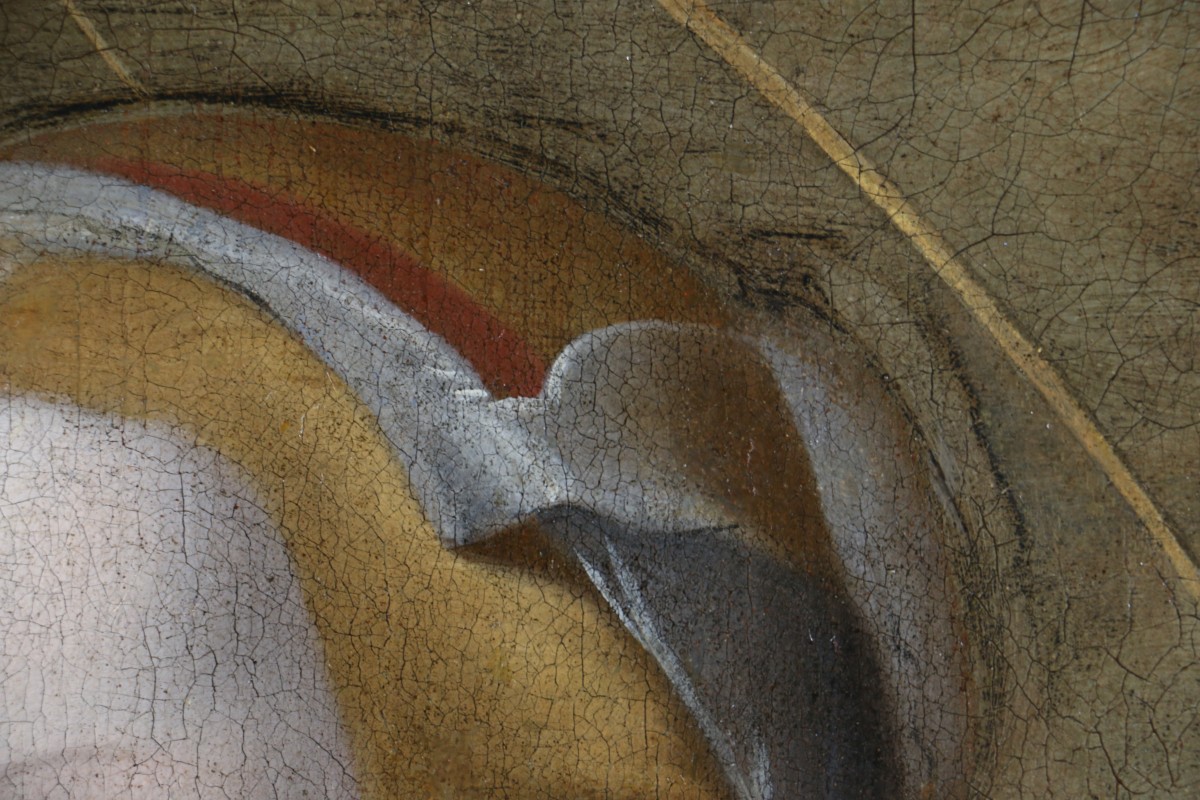
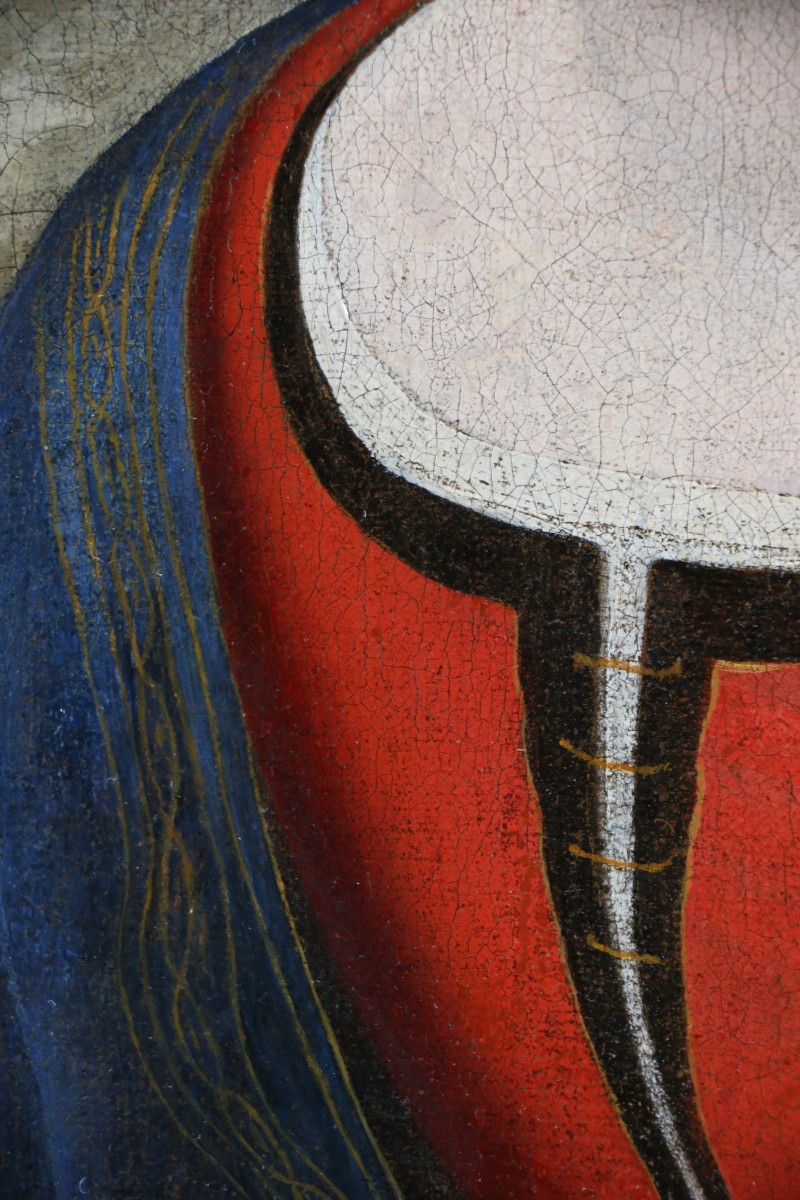
This beautiful painting is a reinterpretation of Raphael's The Beautiful Gardener (painted circa 1507–1508). The Virgin is portrayed half-length, facing left, her gaze lowered, in a gentle pose. She wears a red dress and a blue mantle adorned with gold motifs, with an ochre sleeve. A light veil frames her blond hair, while a delicately sketched halo emphasizes the sacred nature of the figure. The background presents a landscape rendered in successive planes, in a harmonious range of tones. Stylistic and technical analysis places the work within the current of dissemination of Raphaelesque models in 17th-century Italy. The thin, meticulously applied paint layer reveals a technique based on transparent glazes and a blended modeling of flesh tones, characteristic of a practice inherited from the Italian classical tradition. The flesh tones exhibit subtle, seamless transitions achieved through the superimposition of thin layers, while the shadows are rendered in brownish-gray halftones, a technique typical of Italianate workshops of this period. The drawing, precise yet not rigid, demonstrates sound academic mastery and a genuine understanding of Raphael's model. The treatment of the landscape, constructed in successive planes and enlivened by a nuanced atmospheric perspective, confirms this Italian pictorial tradition, distinct from the more descriptive or linear approaches of the Northern schools. The reddish-brown ground visible in transparency, as well as the ancient and homogeneous network of craquelure, consistent with the structure of the paint layer, reinforce the hypothesis of an early execution. All of these elements place the work within the sphere of Italian classicism, more specifically within the circle of the Carracci and their followers, who contributed significantly to the dissemination and interpretation of Raphael's models in the 17th century. Consequently, the work can be attributed to a workshop painter active in central Italy (probably Rome or Bologna) in the first half of the 17th century, around 1620–1640.
The Original Raphael
Painted around 1507–1508 during Raphael's Florentine period, La Belle Jardinière is one of the most emblematic works of High Renaissance painting. Now housed in the Louvre Museum, it embodies an exceptional moment of equilibrium between tradition and innovation, marking the culmination of pictorial research conducted in central Italy at the beginning of the 16th century. In this work, Raphael masterfully synthesizes the influences of Leonardo da Vinci and Michelangelo. The delicate modeling of the faces and flesh testifies to his assimilation of Leonardo's sfumato technique, while the monumentality of the figures recalls Michelangelo's explorations. However, Raphael transcends these influences by imposing a clarity of composition and a harmony all his own. The pyramidal arrangement of the Virgin, the Christ Child, and Saint John the Baptist thus becomes a model of stability and balance, destined for immense posterity. The work also embodies a profoundly innovative ideal of classical harmony. The figures are set within a landscape that is no longer merely a backdrop, but fully participates in the poetic and spiritual construction of the image. The gentleness of the expressions, the unity between the figures and nature, and the fluidity of the pictorial transitions convey a vision of the world where the sacred and the natural are perfectly in accord. From the 16th century onward, La Belle Jardinière enjoyed widespread popularity and became an essential reference for European painters. It was copied, studied, and interpreted in numerous workshops. In the 17th century, within the context of the Classical Revival driven in particular by Annibale Carracci and the Bolognese school, Raphael was rediscovered as the embodiment of an artistic ideal based on restraint, clarity, and grace. The work fully participated in this movement and contributed to defining the foundations of European Classicism. Thus, La Belle Jardinière established itself as a true archetype of classical beauty. Through its formal perfection, its balance, and the gentleness of its expression, it transcended the realm of devotional imagery to become a universal model. It exemplifies Raphael's ability to transform the achievements of his predecessors into an artistic language of lasting significance, one that would profoundly mark the history of Western art.
Delevery information :
All our paintings benefit from careful and secure packaging. No geographic restrictions.