Offered by Desmet Galerie
REQUEST INFORMATION

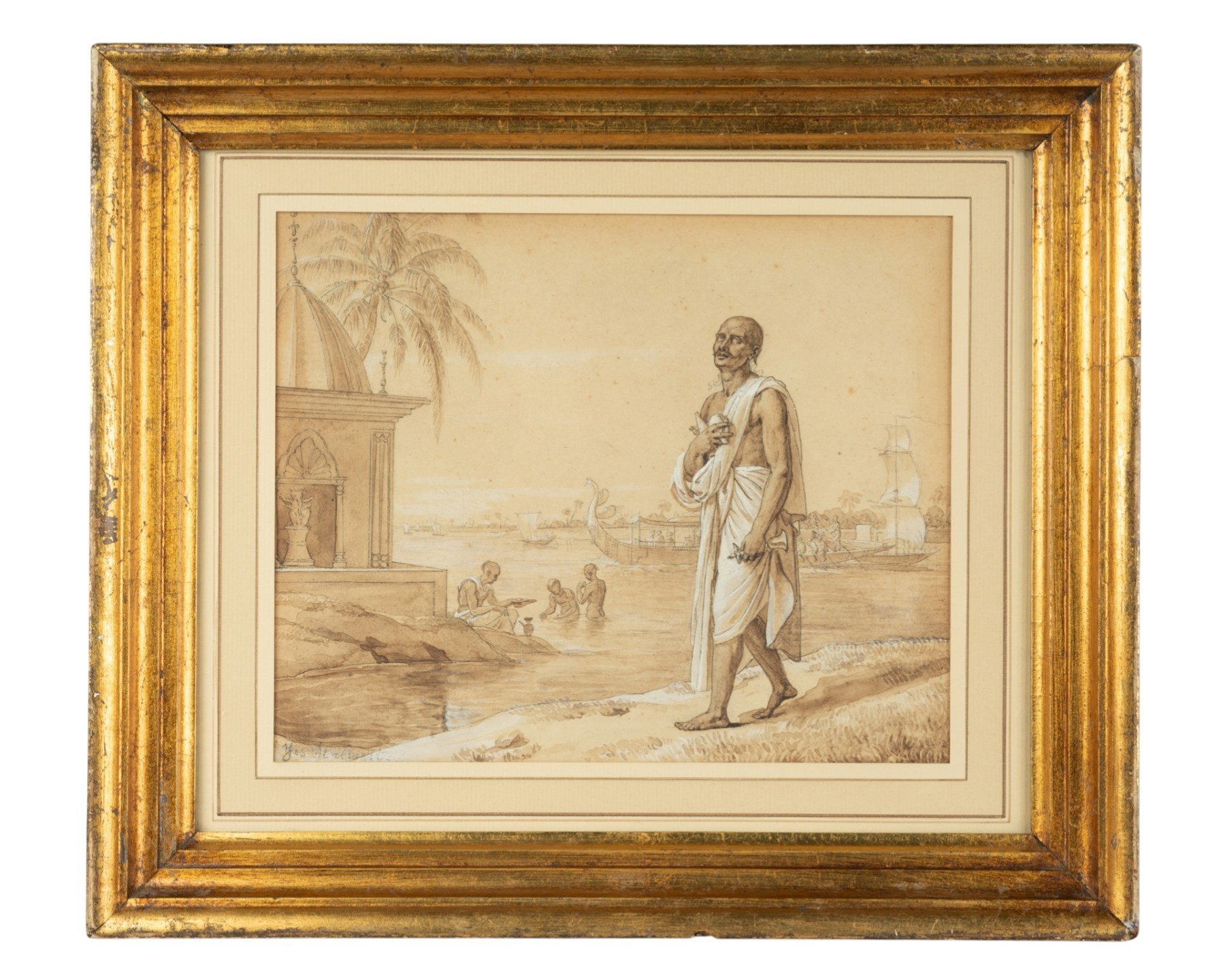
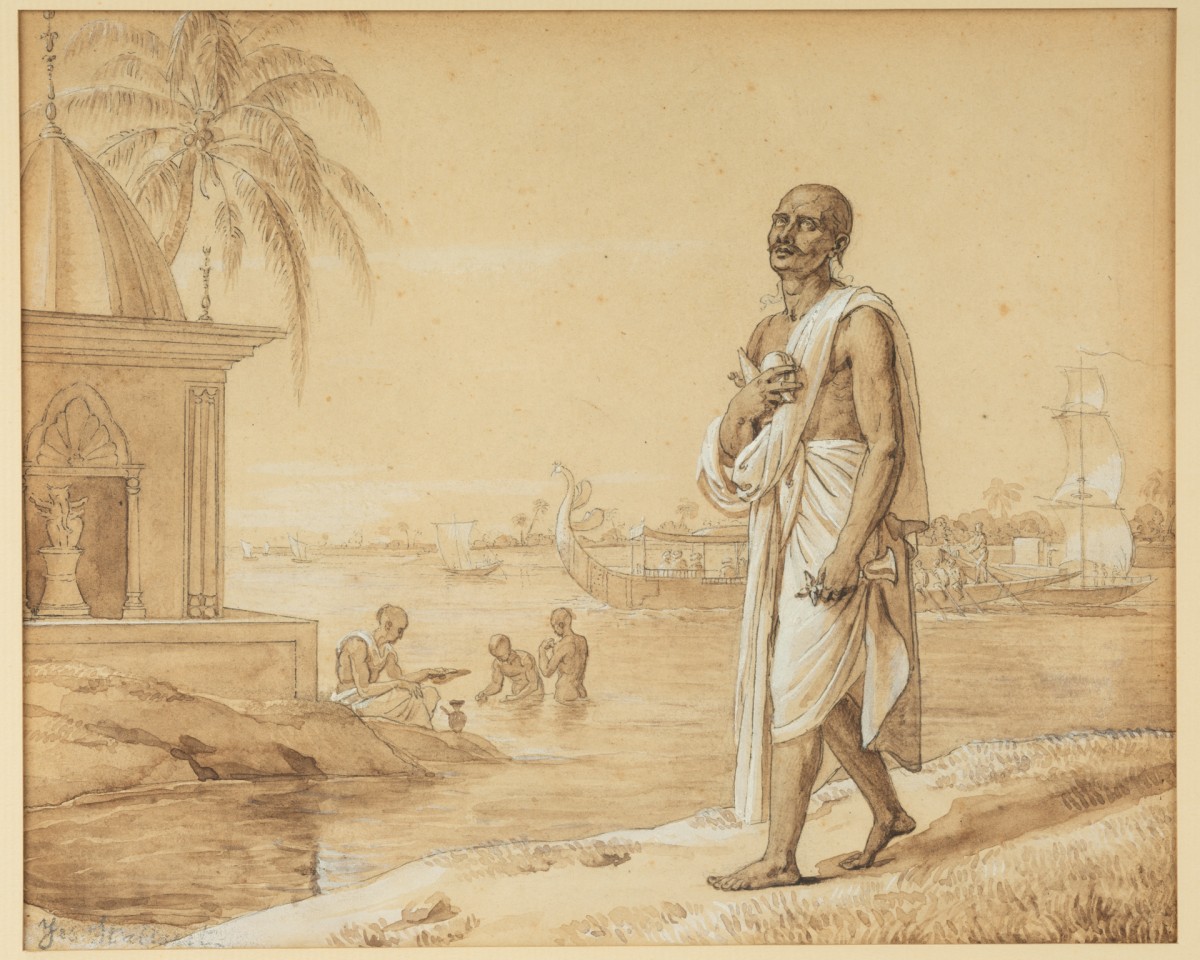
This delicately rendered ink wash drawing presents a tranquil scene on the banks of the Ganges, India’s sacred river. In the foreground, an Indian man draped in a traditional dhoti walks pensively along the riverbank, his right hand resting on his chest in a gesture suggesting devotion and contemplation. To the left rises a small temple structure with a niche containing a Ganesh - statue, while further figures perform ritual ablutions in the river. In the distance, boats and sailing vessels animate the placid surface of the water, enveloped in a softly diffused light.
The composition conveys serenity and harmony. Through a refined use of line and a restrained sepia palette, Stallaert evokes an exotic landscape that combines careful observation with poetic idealisation.
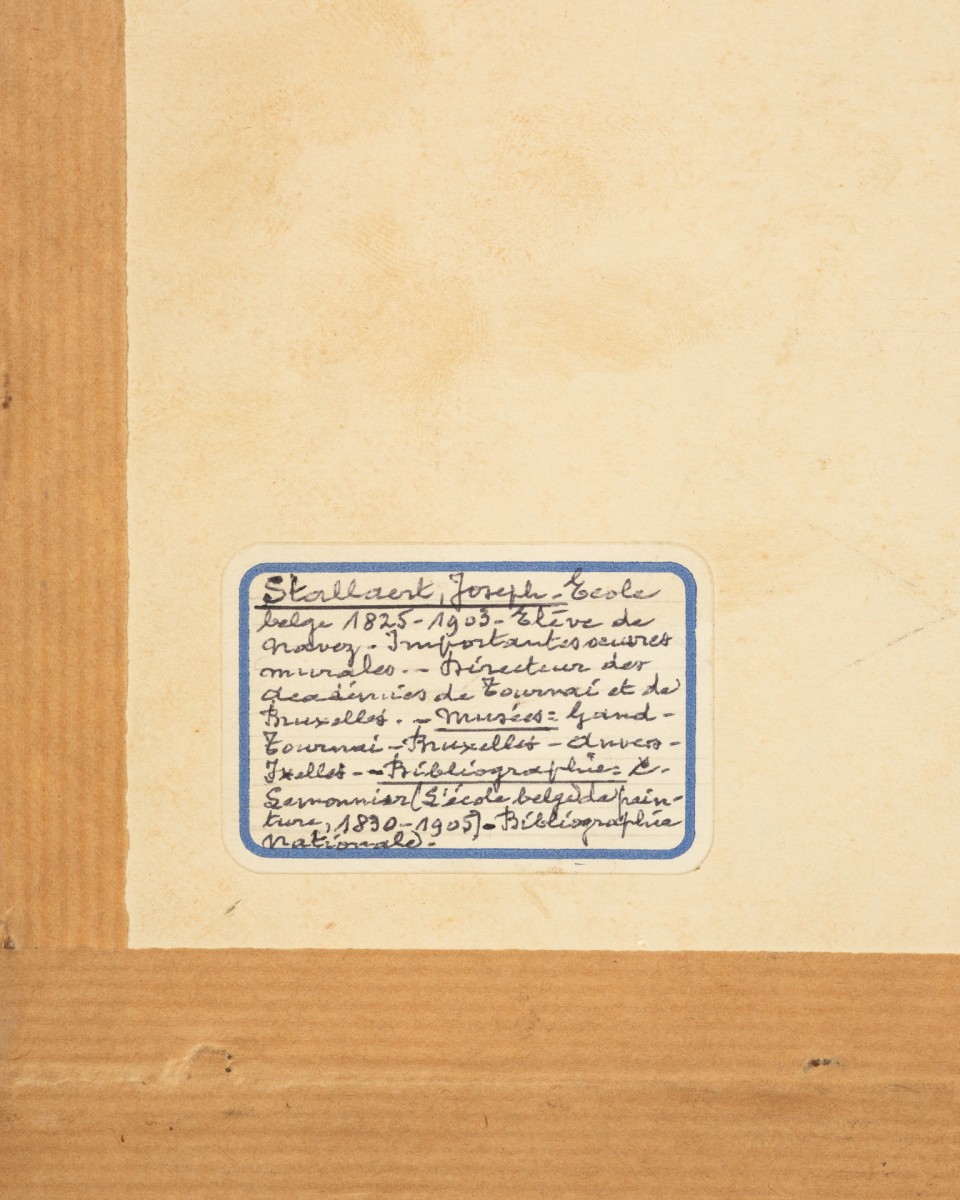
Joseph Stallaert was born in Merchtem in 1825 and he trained at the Royal Academy of Fine Arts in Brussels under François-Joseph Navez, a leading figure of Belgian Neoclassicism and pupil of Jacques-Louis David. Although primarily known for his historical and mythological compositions, Stallaert also engaged with Orientalist themes - a genre that captivated many European artists during the mid- to late nineteenth century.
This scene reflects both an aesthetic fascination with distant and “mystical” cultures and the broader intellectual context of Orientalism, in which the East was imagined as a realm of spirituality and moral purity. In Hindu tradition, the Ganges symbolises purification and salvation, providing Stallaert with an ideal subject through which to express devotion and transcendence within an exoticised setting compatible with academic taste.
The artist’s attention to architectural details - the temple, its sculptural niche, and the careful delineation of figures along the river - suggests that he drew inspiration from engravings, travel accounts, and early photographic imagery of India that circulated widely in nineteenth-century Europe. The result is not a document of direct experience, but rather an imagined and idealised vision shaped by Western perceptions of the East.
Made in lavis (ink wash), a medium well suited to preparatory studies, the drawing demonstrates Stallaert’s mastery of controlled line and tonal modulation. The subdued monochrome enhances the contemplative atmosphere, while the precise handling of anatomy, proportion and perspective attests to his rigorous academic training. The nuanced play of light imparts depth and spatial coherence without resorting to dramatic contrasts.
The composition is carefully structured: the architectural form on the left, the standing figure in the middle ground, and the open river with vessels to the right form a harmonious tripartite arrangement. This balance reflects Stallaert’s adherence to the classical ideal of order and unity — a synthesis of realism and idealisation characteristic of the academic tradition.
Though modest in scale, the drawing holds considerable historical and cultural value. It represents a rare instance of Stallaert’s engagement with non-European subjects and sheds light on the participation of Belgian artists in the Orientalist discourse that pervaded nineteenth-century European art.
The work stands as both an artistic and a cultural document — a reflection of the Western fascination with the East as a space of spiritual purity, and of the ways in which European artists reimagined distant cultures through the prism of their own ideals. In this sense, the drawing offers a nuanced perspective on Stallaert’s oeuvre and on the complex interplay between art, travel, and cultural imagination in the nineteenth century.
Delevery information :
We can arrange shipping.