Offered by Desmet Galerie
REQUEST INFORMATION
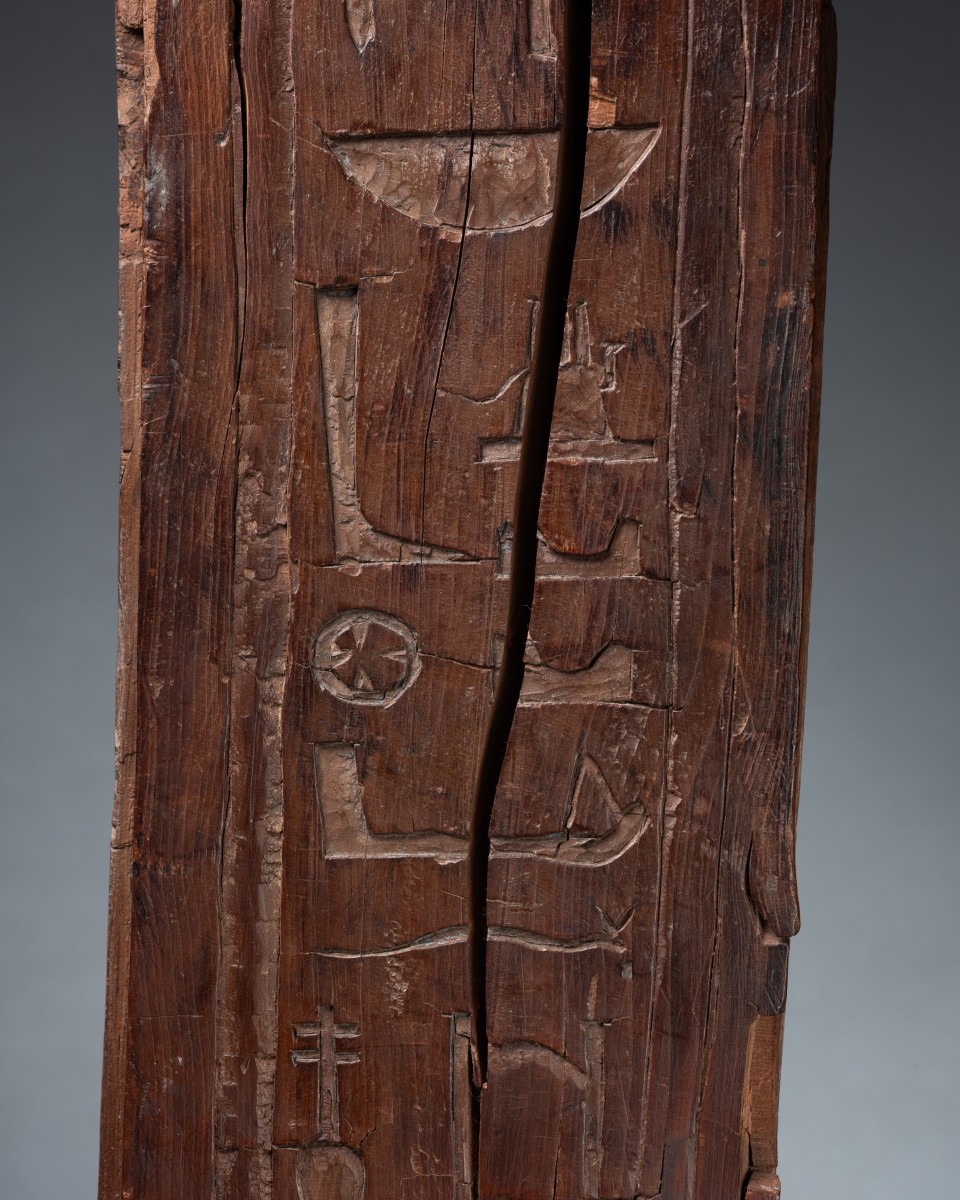
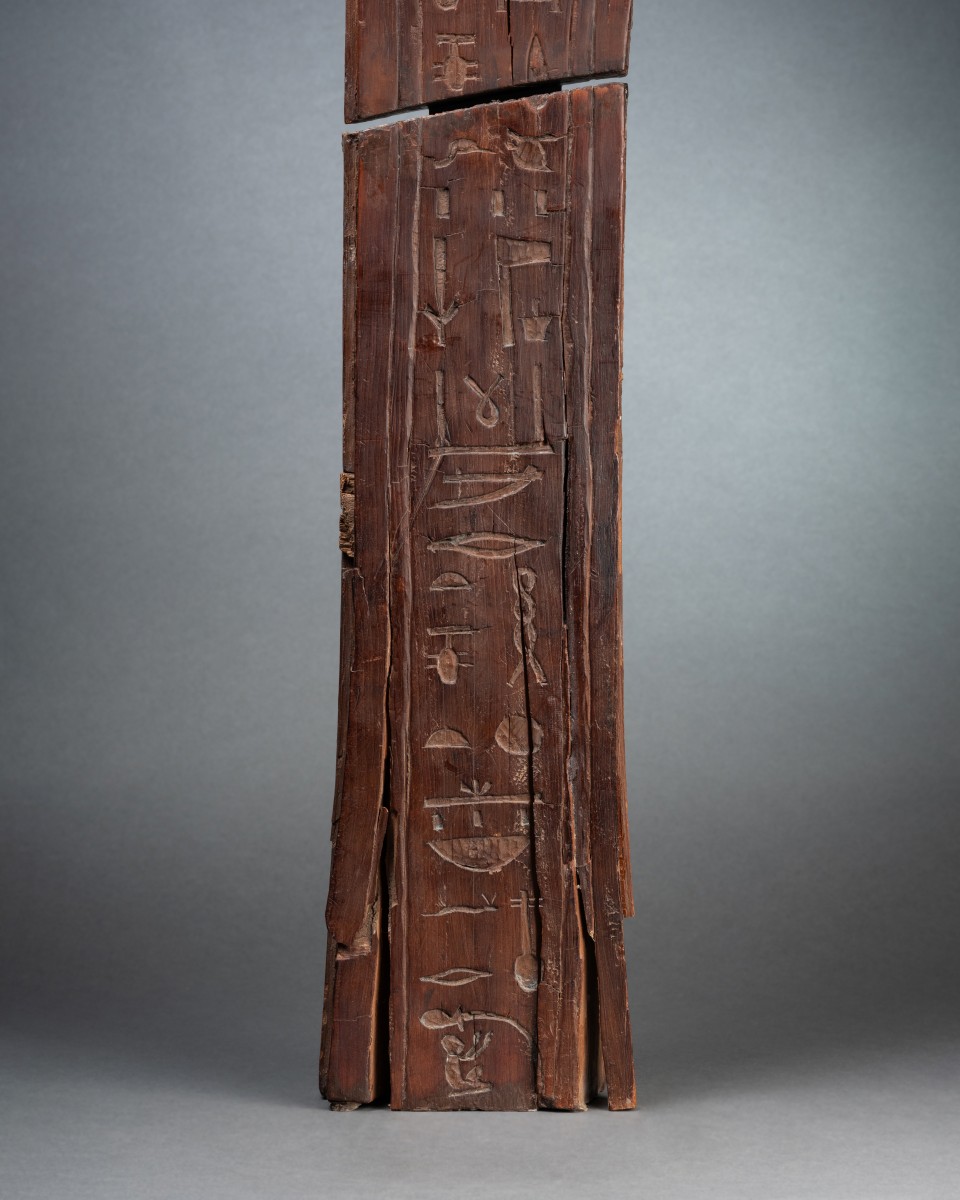
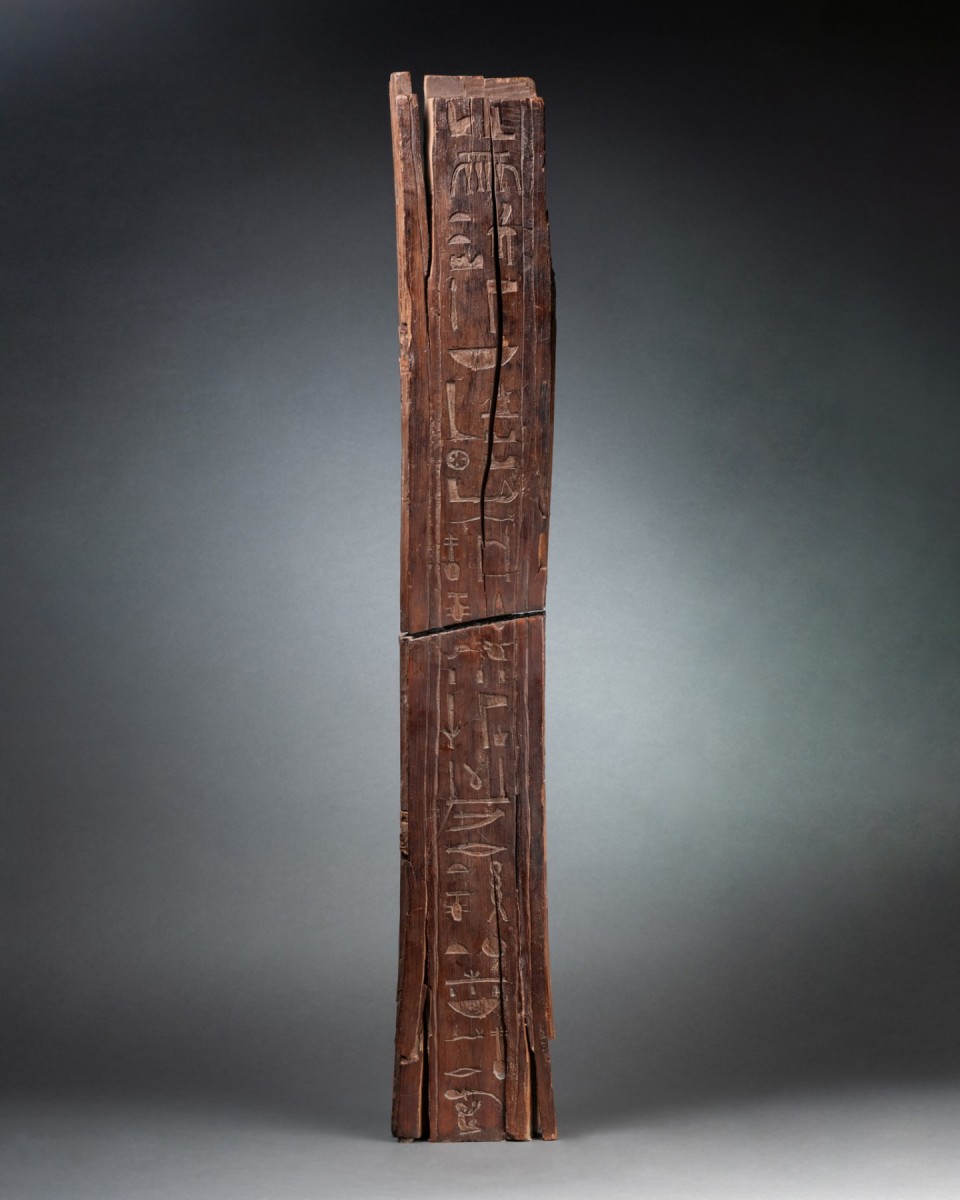

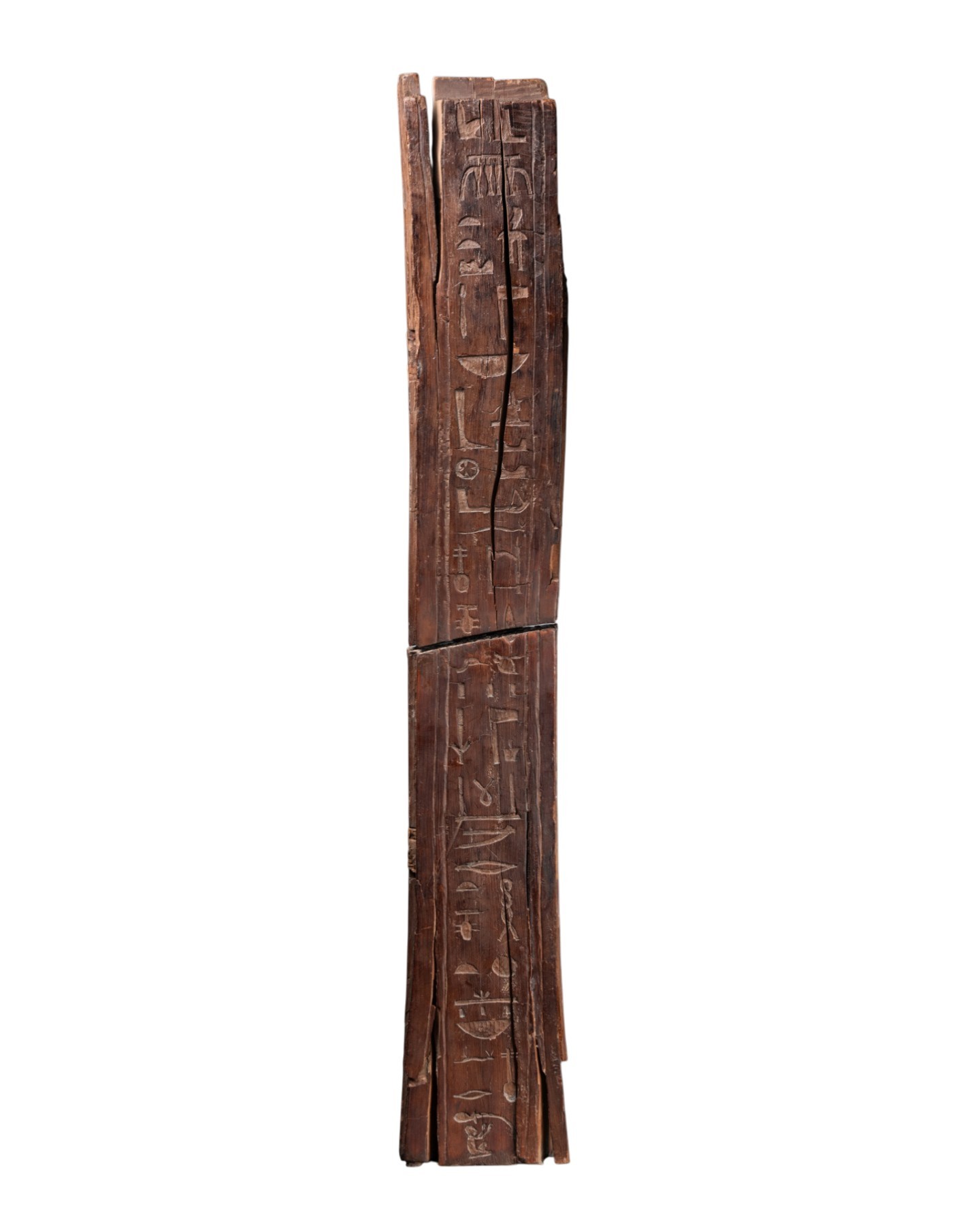
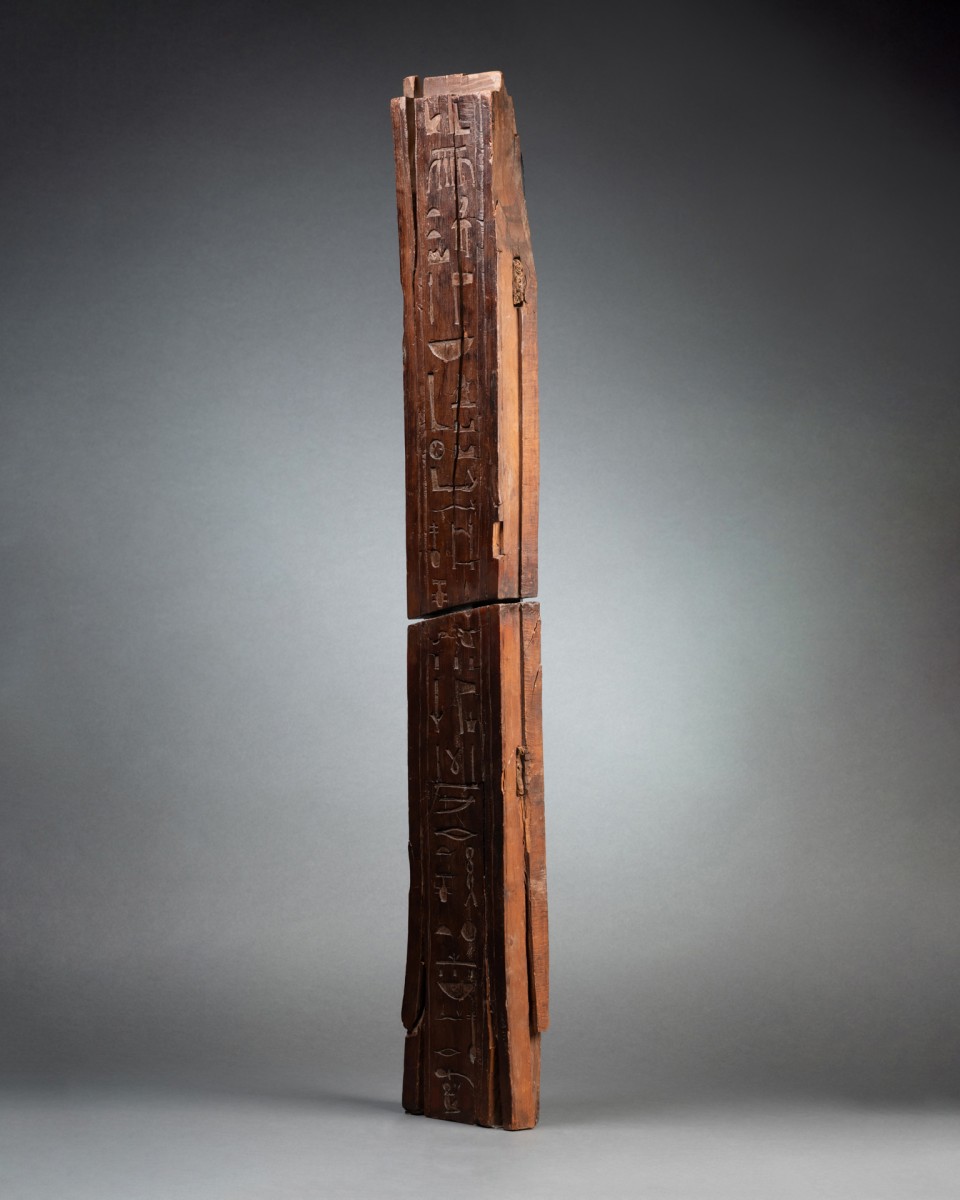
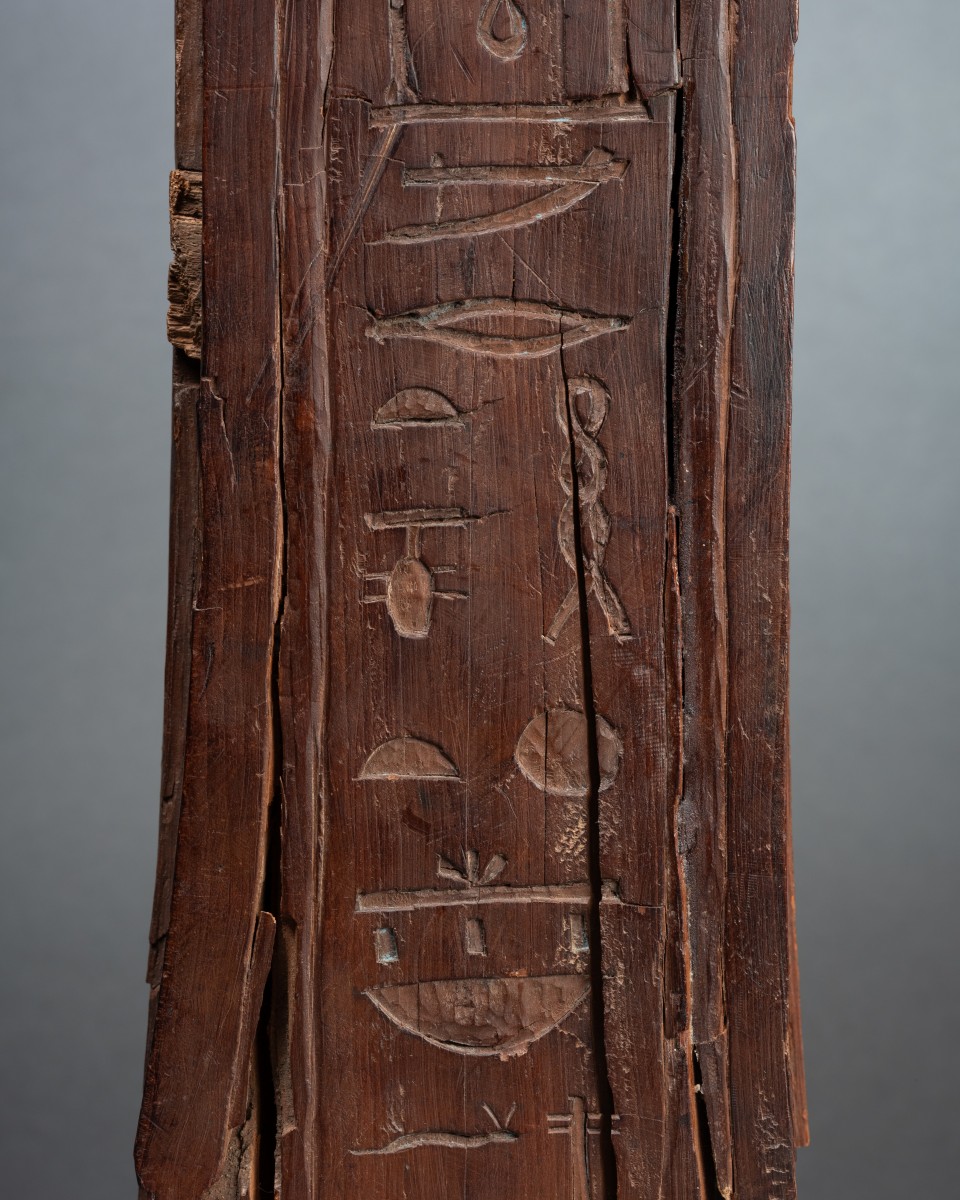
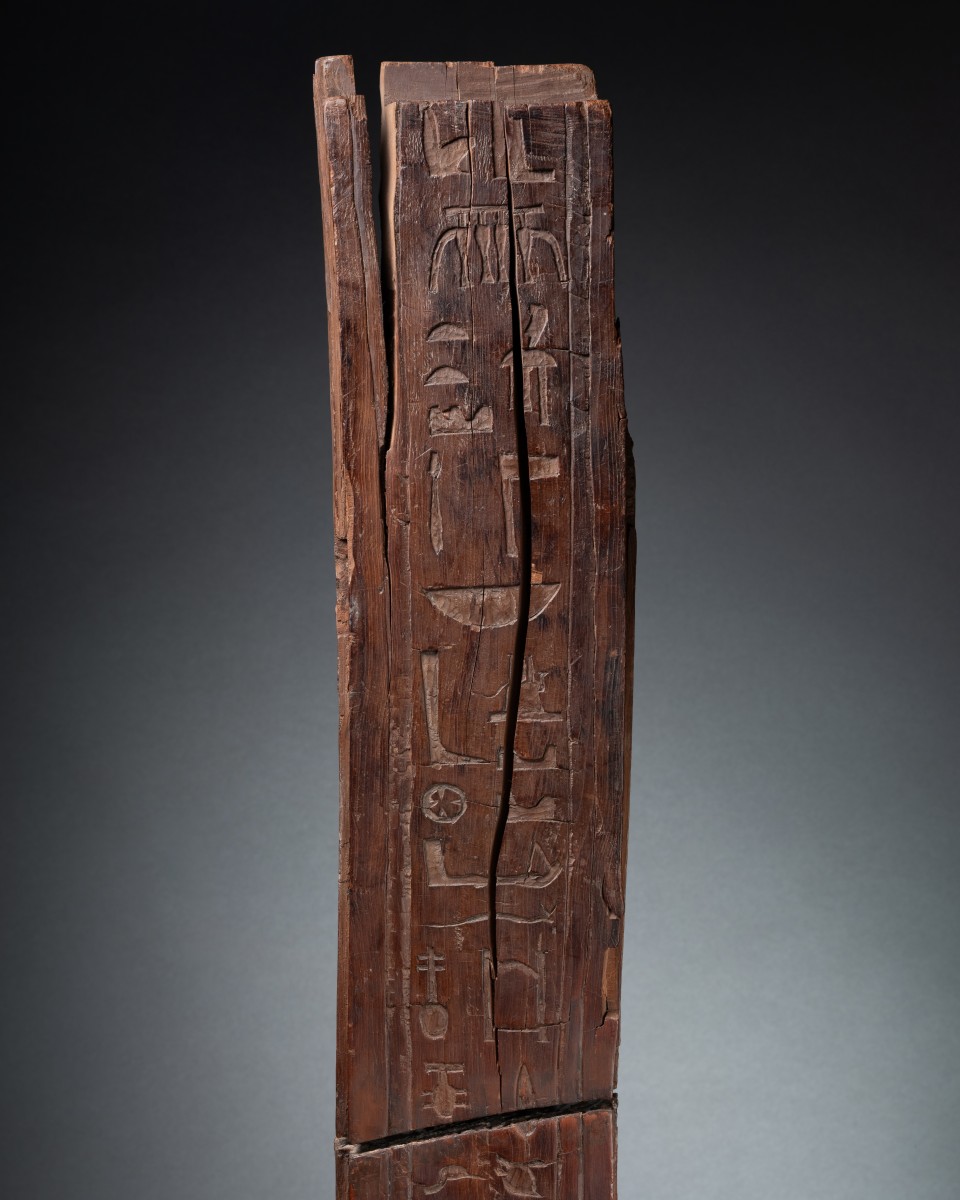
The relief is a tall, narrow wooden corner post forming part of a rectangular anthropoid sarcophagus belonging to Horudja, a Sameref priest active during the 26th Dynasty. The post is carved from a dense, reddish-brown hardwood, likely acacia or sycomore fig, and displays a single vertical register of hieroglyphic inscription incised in low relief., and black tones, now largely lost but still visible in recesses along the carved signs.
The front face is smoothly dressed and carved with careful, elegant hieroglyphs typical of the Saite Period’s revivalist classicism, reflecting the archaising tendencies of Dynasty XXVI. The back of the post is roughly chiselled, with four mortise-holes corresponding to dowels that once secured it to the wooden frame of the coffin. The post is split vertically along the grain but retains structural integrity; the surface shows fine craquelure and minor losses at the upper and lower edges.
The object represents the reunited upper and lower segments of the same vertical post, now brought together for the first time in over fifty years. The join between the two sections is purposely kept visible in the mounting. The proportions and curvature of the edges confirm its function as a corner element framing the coffin front.
The inscription:
The column of hieroglyphs, read from top to bottom, is part of a funerary invocation for the deceased Horudja, son of Iahtefnakht and Khaatirbint, whose full titulary appears on related fragments.
The text carved along the vertical register preserves the opening of the traditional offering formula (?tp d? nsw), one of the most widespread invocations in Egyptian funerary culture. It reads: “An offering given by the king (to) Osiris, Foremost of the Westerners, the great god, Lord of Abydos, that he may give bread, beer, oxen, birds, … alabaster, clothing, … and all good and pure things…” This formula expresses the belief that the deceased could partake eternally in the offerings presented to the gods. By invoking Osiris under his epithet “Foremost of the Westerners” (?nty ?mnt.t)—lord of the necropolis and ruler of the blessed dead—the text situates Horudja’s coffin firmly within the Osirian cult of resurrection. The mention of the king at the start of the formula reflects the ancient notion that all offerings to the gods were made under royal authority, even in private monuments. This invocation thus ensured Horudja’s perpetual participation in the divine cycle of renewal and his reception of the sustenance necessary for eternal life in the West.
This formula is part of the standard quartet of protective utterances by the Four Sons of Horus, traditionally placed on the sides of coffins and canopic equipment. The text parallels that recorded in the Drouot 1977 catalogue and on the larger coffin planks published by Hans Wolfgang Müller (Münchner Ägyptologische Studien 5, Berlin 1969, no. A 186, pp. 128–129). The original glass-paste inlays would have contrasted vividly against the dark wood, producing a luminous script symbolic of rebirth and divine illumination.
Context:
The post belongs to a wooden anthropoid coffin of the Late Dynastic Period, specifically the Saite Dynasty (26th Dynasty). Stylistically, the use of coloured glass inlay for hieroglyphs on dark wood relates closely to the technique observed on the coffin of Djedthutiefankh from Tuna el-Gebel (now Museo Egizio, Turin, inv. C. 2241), as well as to the famous inlaid wooden shrine of Petosiris from Hermopolis (Cairo Museum, JE 44973). (this glass inlay isn’t preserved on these fragments).
Hans Wolfgang Müller (1969, p. 128–129, A 186) describes a nearly identical wooden strip from the Kofler-Truniger Collection (Lucerne), likewise decorated with hieroglyphs of inlaid glass-paste in blue, green, black and white, forming part of a funerary shrine. Müller notes the parallels with Horudja’s coffin, emphasising the Saite revival of polychrome inlay, a hallmark of late Egyptian craftsmanship that sought to imitate precious-stone hieroglyphs.
The present post fits precisely within this group, both technically and iconographically. The use of inlaid glass-paste (instead of paint) was particularly valued in the Delta and Middle Egypt, where such work was associated with elite priestly workshops connected to Heracleopolis Magna and Fayum.
Delevery information :
We can arrange shipping.