Offered by Segoura Fine Art
REQUEST INFORMATION

Painting, furniture and works of art from the 17th, 18th and early 19th century
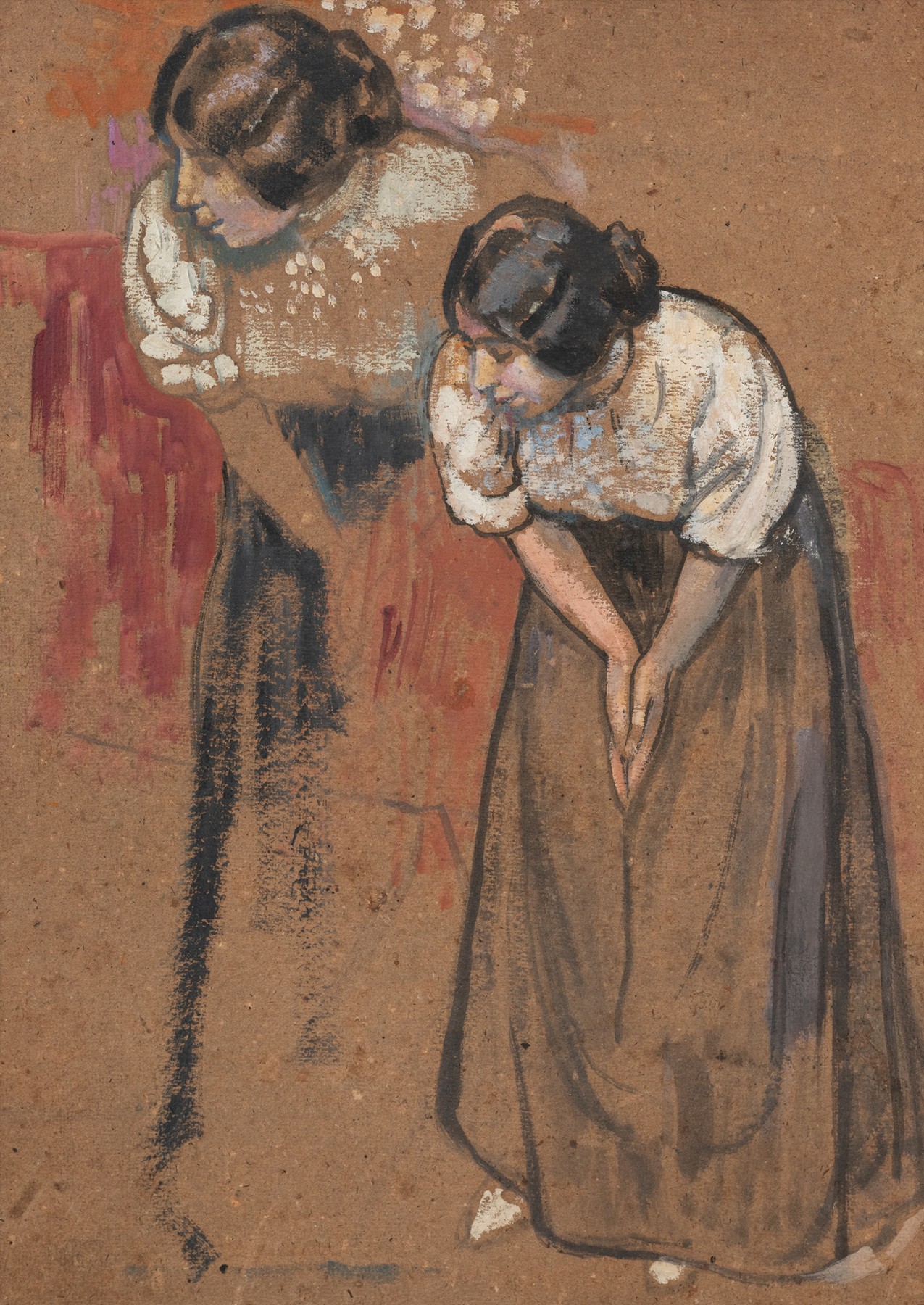
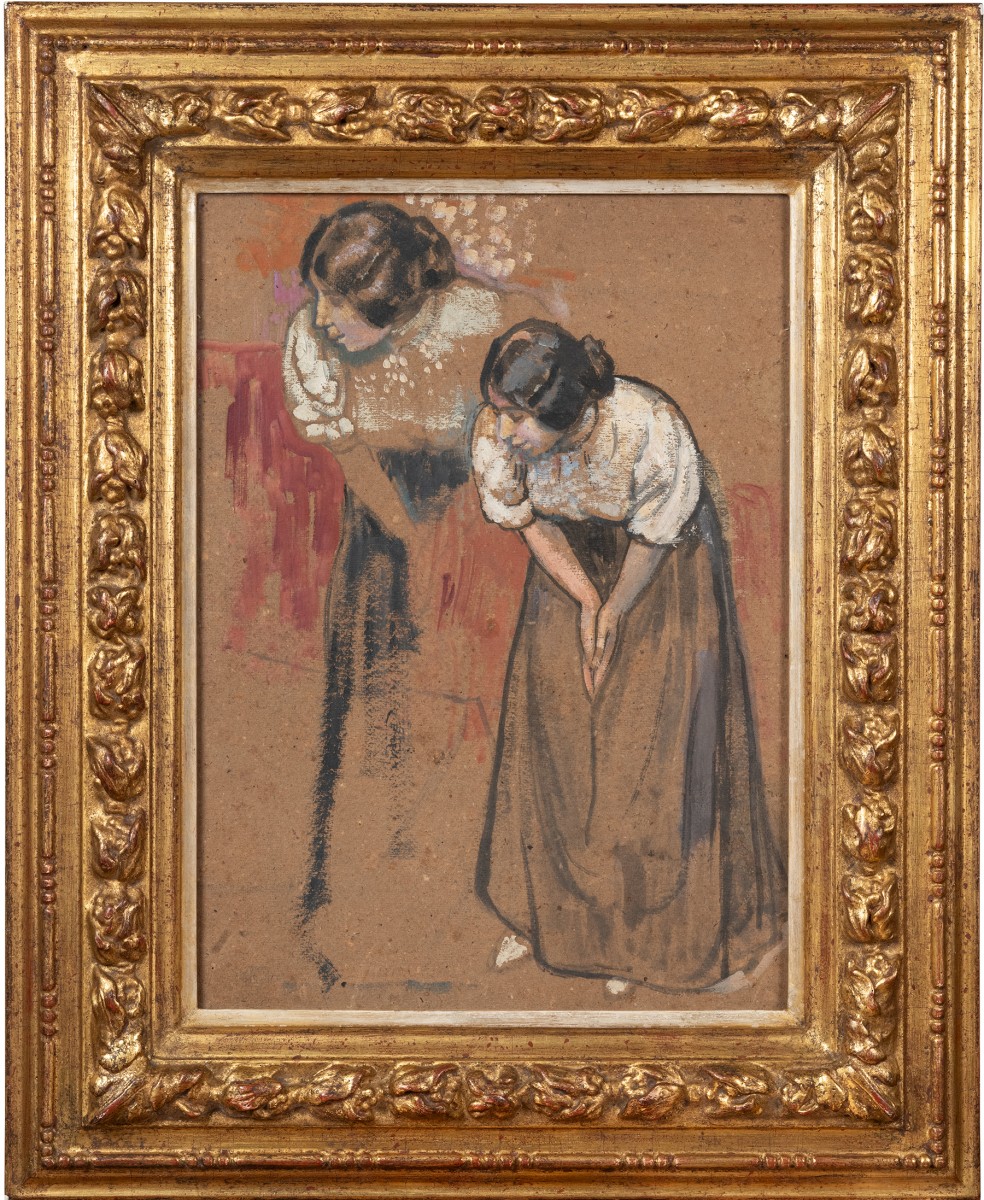
The work presents a study of two female figures treated on the same support, one repeated in the background as a variation in pose. The women are depicted standing, slightly leaning forward, their arms close to their bodies, in a quiet and introspective attitude.
The composition emphasizes the search for posture and volume rather than the individualization of facial features. The faces are rendered with restraint, while the work focuses on the articulation of the torso, shoulders, and skirt. The background remains deliberately minimal, revealing the cardboard support and areas of freely applied color.
The pictorial material remains visible, with broad brushstrokes and layered applications that underline the character of a study. The palette, dominated by brown, ochre, and muted tones, is punctuated by lighter highlights on the bodices, emphasizing the structure of the figures.
The whole conveys a sense of concentration and formal exploration, reflecting attentive observation of the female body and movement, without narrative intention, in favor of a purely plastic study.
Biography
Georges Lemmen was a Belgian painter, draftsman, and decorator born in 1865 in Schaerbeek. He studied at the Royal Academy of Fine Arts in Brussels, where he received an academic training that shaped his rigor in drawing and sense of composition.
From the late 1880s onward, he turned toward Neo-Impressionist research and adopted, for part of his work, the Divisionist technique. He became a member of Les XX, the Brussels avant-garde group that played a major role in introducing modern artistic movements in Belgium. He participated in the group’s exhibitions, which fostered dialogue between Belgian and European artists at the end of the 19th century.
Alongside his painting practice, Georges Lemmen developed significant work in drawing, illustration, and the decorative arts. He produced graphic projects, illustrations, and decorative compositions in which line played a central role, reflecting his interest in a structured and synthetic approach to form.
During the 1890s, his style gradually evolved. Without abandoning the achievements of Divisionism, he moved away from a strict application of the method to favor a more decorative and refined expression. This evolution formed part of the broader development of Art Nouveau, with which his graphic and decorative work is often associated.
Georges Lemmen died in 1916. His oeuvre reflects a coherent artistic trajectory marked by the dialogue between painting, drawing, and decorative arts, and by a constant search for balance between formal construction and modernity within the Belgian artistic scene of the late 19th and early 20th centuries.