Offered by Floris van Wanroij Fine Art
REQUEST INFORMATION

Old master painting, sculpture & works of art from the Haute Epoque period
French | Possibly Ill-de-France
Gothic | Second quarter of the 14th Century | Ca. 1325-50
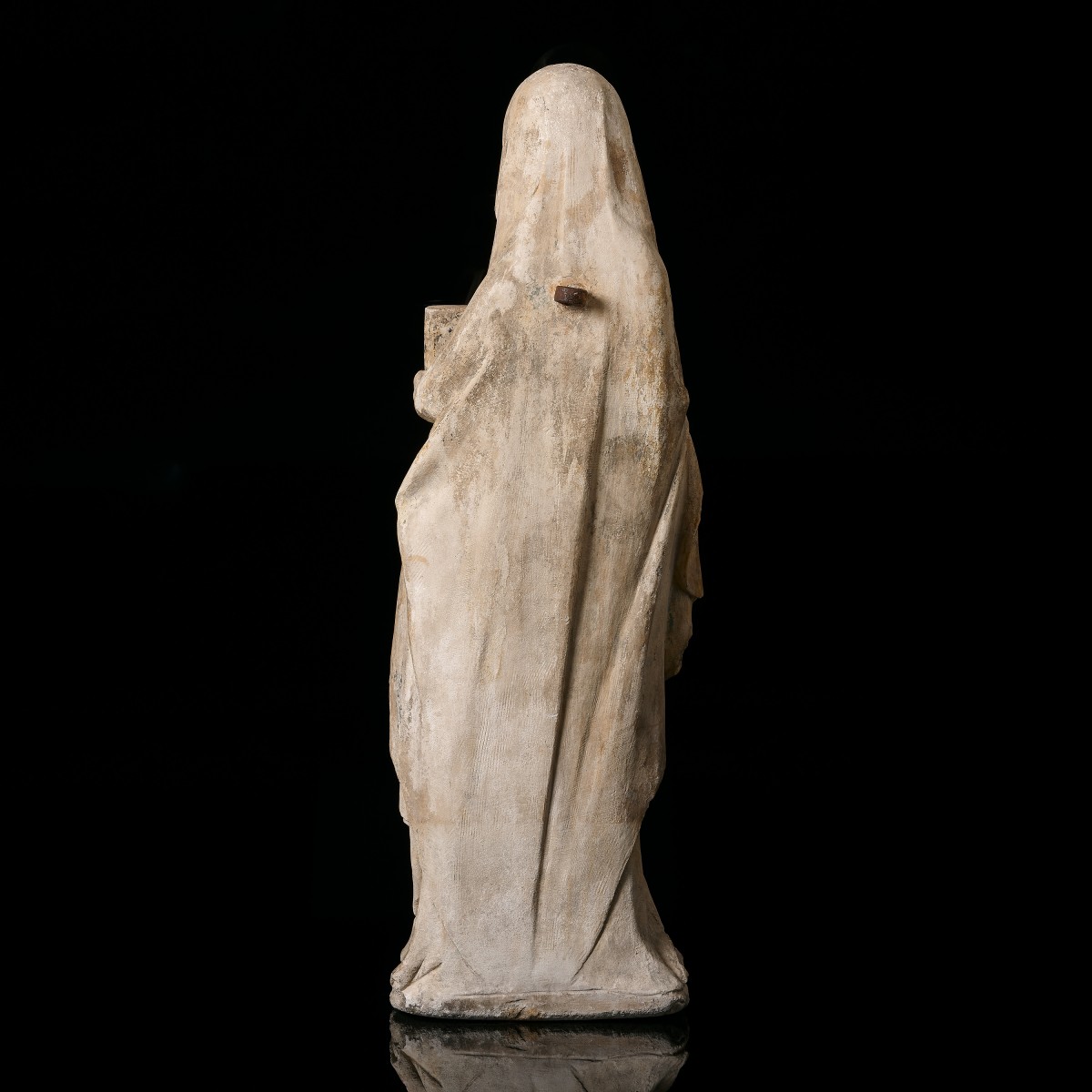
Limestone | Carved in full-round | With traces of original polychrome | With iron hook verso
H. 69 cm. W. 23,5 cm. D. 14 cm.
PROVENANCE
Collection of Junius Spencer Morgan II (1867-1932)
Thence by descent to Alexander Perry Morgan Sr. (1900-1968) and Janet Croll Morgan (1901-1985) | Constitution Hill | Princeton
Thence by descent to Margaret Croll Morgan (1926-2025) | Princeton
REFERENCE LITERATURE
Gardner, A. (1931). Medieval Sculpture in France. London, p. 378
Williamson, P. (1988). Northern Gothic Sculpture 1200-1450, London, pp. 126-129
Williamson, P. (1996). European Sculpture at the Victoria and Albert Museum. London, p. 62
CATALOGUE NOTE
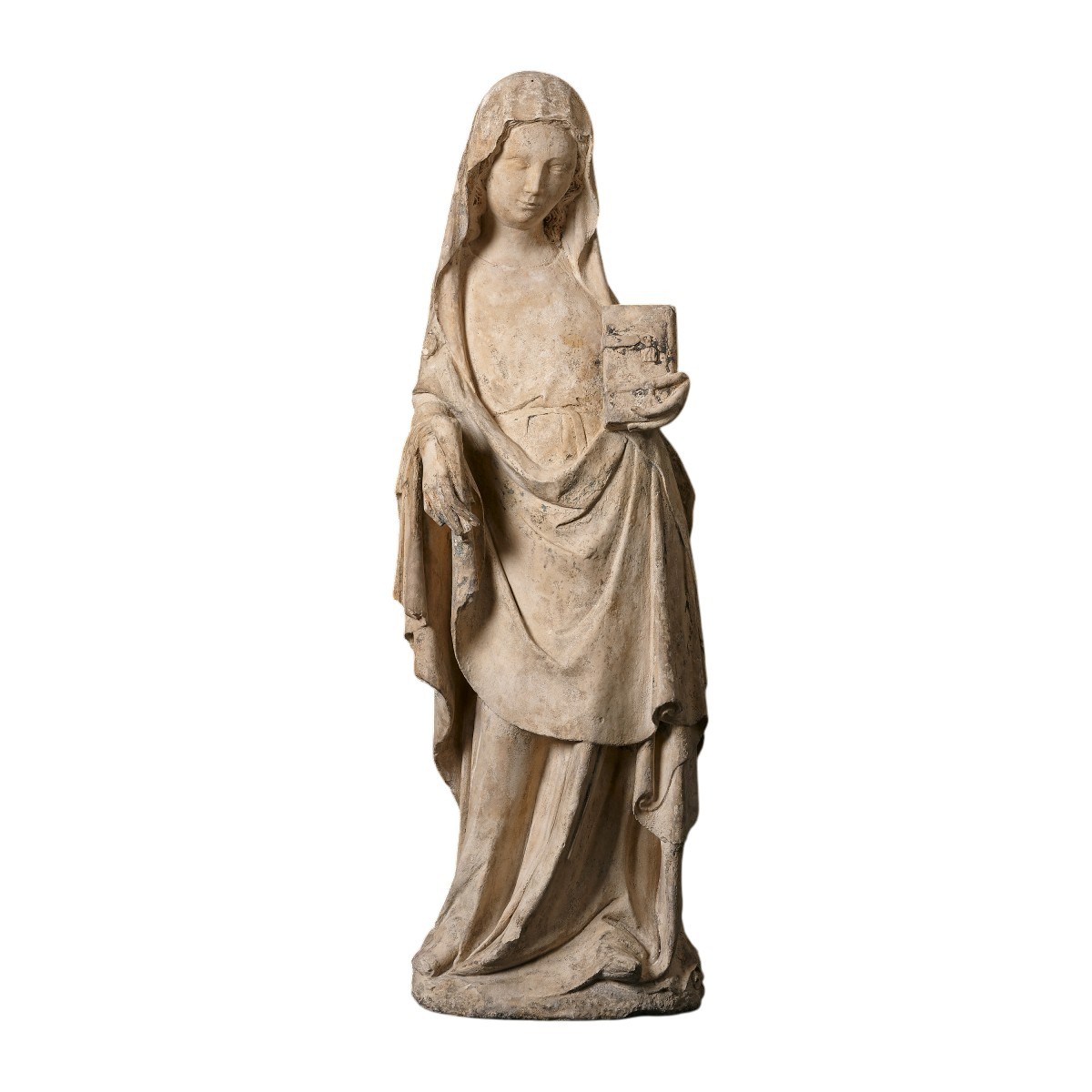
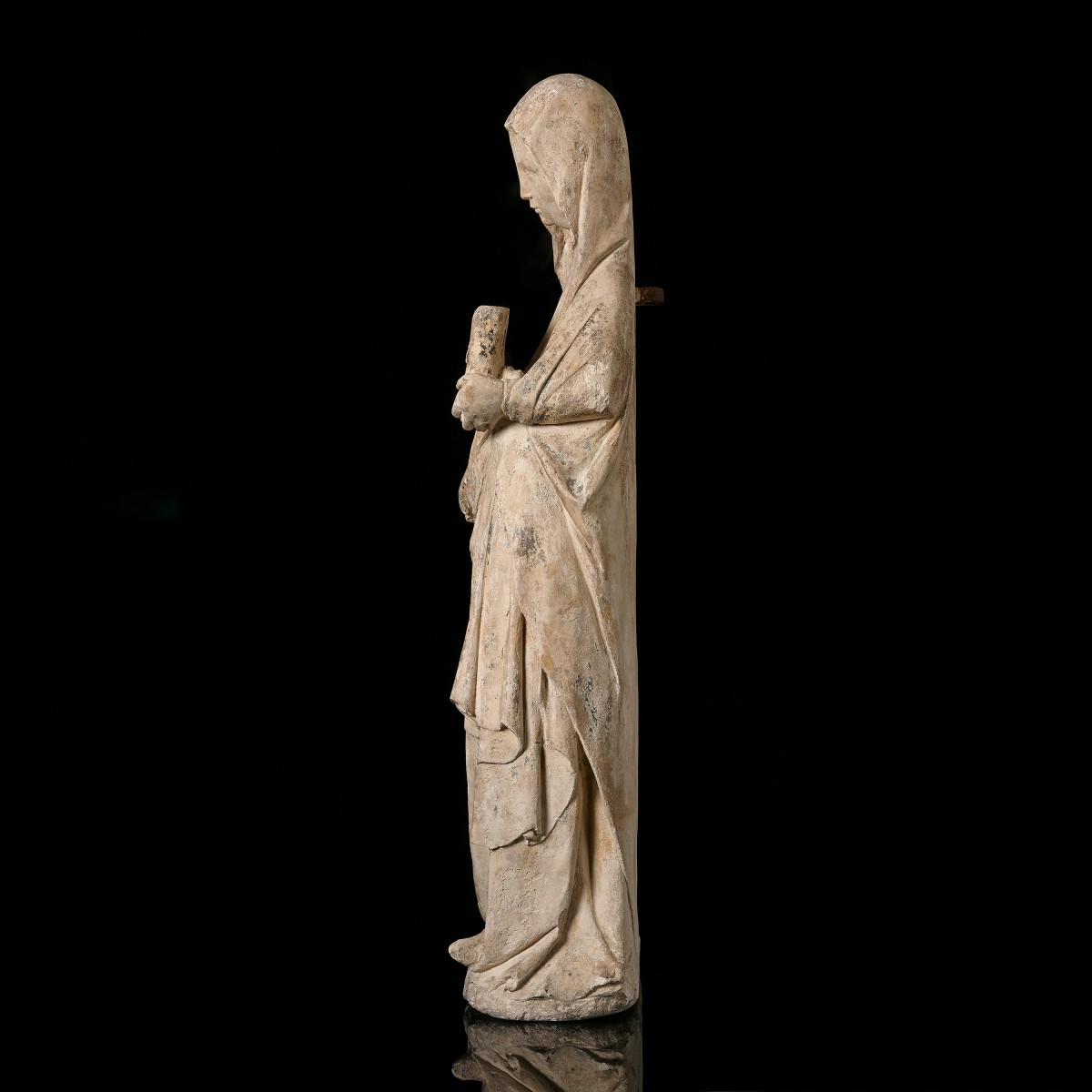
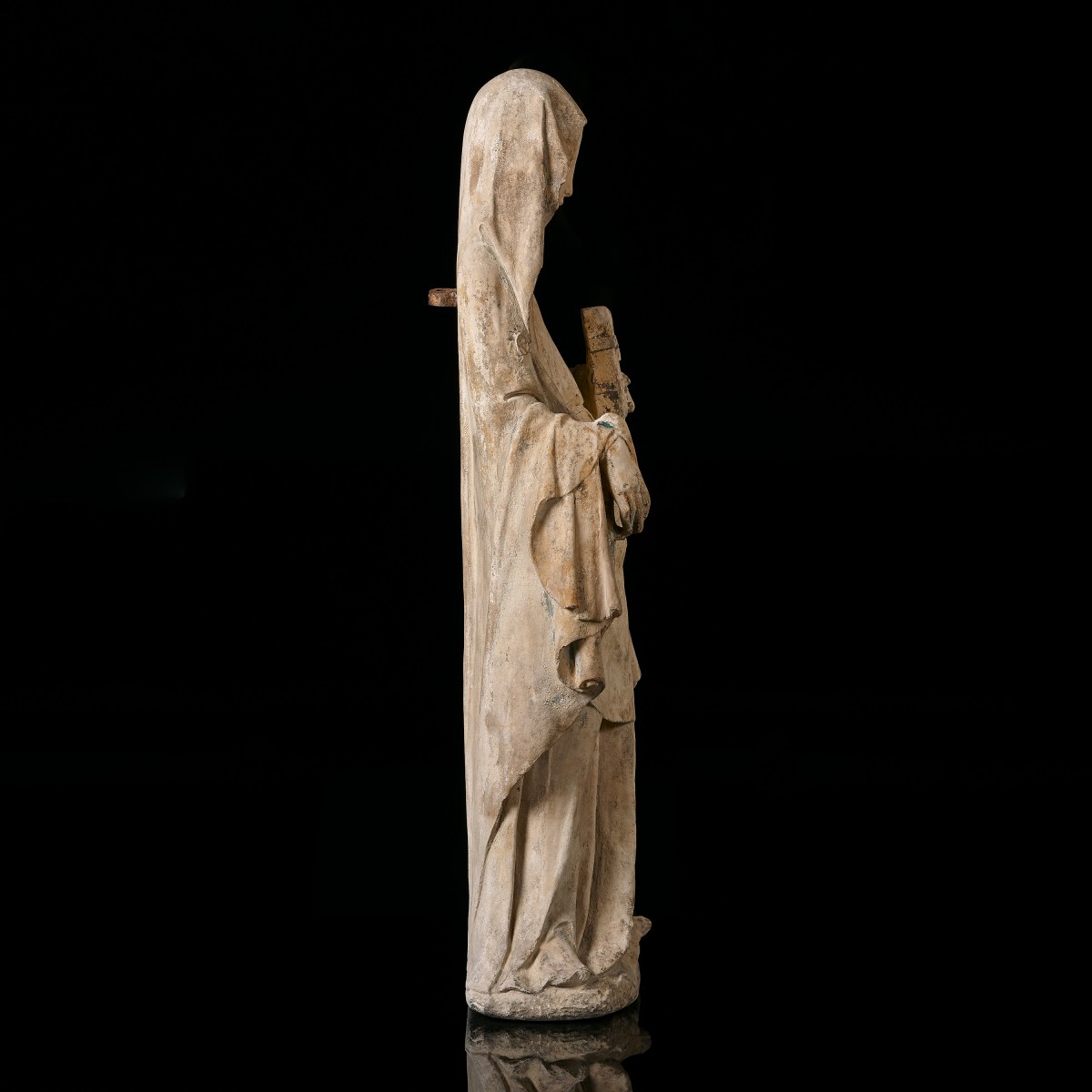
The present sculpture represent a standing female saint, wearing a long belted gown and holding a book equipped with clasps adorned with tassels in her left hand. Her heavy mantle covers her head and falls across her body with swag-like, delicately sculpted folds. Her soft wavy hair carefully protrudes from under the cloak. Her round, calm face with delicate features, almond-shaped eyes with tapered ends and finely outlined upper eyelids, long straight nose, small round chin and mouth with thin lips marked with a slight smile. By its posture, with the characteristic position of the right hand, the typical arrangement of the folds in de drapery and its sophisticated stylisation, the present sculpture belongs to the type of Virgins and female saints from the Ill-de-France region, sculpted in the mid-14th century. Comparable examples can be found in the collection of Musée du Louvre in Paris (inv.nrs. RF 1398 and RF 579). Another example is kept in the collection of the Victoria & Albert Museum in London, to which it was donated by J. Pierpont Morgan in 1911 (inv.nr. A.98-1911). This group of sculptures display comparable large vertical folds breaking on the floor and the same monumentality, facial features and hairstyle. Combining refinement and simplicity, the sculptures can be attributed to Parisian workshops. In addition, the statue’s sensitively carved features and slight smile, its rather elongated proportions and refined draperies, show stylistic analogies to courtly art in Paris and the Ill-de-France region.
ICONOGRAPHY
Formerly, this figure was interpreted as a representation of Saint Catherine of Alexandria, based on the book in her left hand and he remnants of what can be understood to be a palm branch, two iconographical attributes indeed historically associated with her, alongside with the sword and the wheel. However, this martyr saint was believed to have been of noble birth and is usually depicted wearing a crown. The present figure does not show any traces of a head adornment, nor other attributes traditionally associated with her. As such, the present figure can not be identified with certainty. However, it displays similarities with other figures of female saints, among which several representation of the Virgin of the Annunciation. The book and a lily branch are indeed typical iconographic attributes of this representation. For instance, Musée de Cluny has a comparable statue in its collection, which has been interpreted as possibly a Virgin of an Annunciation-group (inv.nr. Cl. 18931). A second example of the same dimensions as the present piece carved out of alabaster is kept in the collection of Musée du Louvre (inv.nr. RF 1661). Another limestone Virgin of the Annunciation, made in Paris in the first quarter of the 14th century in the collection of The Metropolitan Museum of Art, donated to the museum in 1917 by J. Pierpont Morgan, shows the same book with clasps adorned with tassels (inv.nr. 17.190.739), also further indicating an origin in Ill-de-France.
PROVENANCE
The sculpture comes from the collection of the wellknow banker, art collector and philanthropist Junius Spencer Morgan II (1867–1932. Junius was the son of George Hale Morgan (1840-1932) and Sarah Spencer Morgan (1839-1896), and nephew of American financier and banking magnate John Pierpont Morgan, Sr. (1837-1913). Following in his uncle's footsteps, Junius was a banker by trade, working for Cuyler, Morgan & Co. However, his passion for art and book collecting superseded his business and by 1906 he became a full time collector. Junius left Princeton and moved to Paris in 1910. Between Paris, Princeton and New York City he continued to pursue his art collections. A graduate of Princeton University and a Princeton resident, he bequeathed a large portion of his art to the Princeton Art Museum. Other works, including books and Old Master prints, were given to the New York Public Library. He was also a generous benefactor of the Metropolitan Museum of Art in New York and gave many works to the (future) Department of Drawings and Prints from a broad range, dating mainly from the sixteenth century, including 2 woodblocks and many prints by Albrecht Dürer in 1919. Perhaps his greatest achievement was serving as an art advisor and librarian for J.P. Morgan, guiding his purchases and even influencing the development and construction of the Morgan Library. Junius' son Alexander Perry Morgan, also a Princeton graduate, left Princeton at the age of 24 to study architecture at the École des Beaux Arts in Paris. Aside from designing private residences, he is known for his other commercial and institutional works including the Johnson & Johnson research laboratory in New Brunswick, New Jersey, the top of the Empire State Building, and alterations to the Morgan Library. After his death, the sculpture was passed down by descent to his daughter Margaret Croll Morgan (1926-2025), who moved to Princeton in 1953 where she raised her family first at the family home, Constitution Hill, then in a house of her own design.