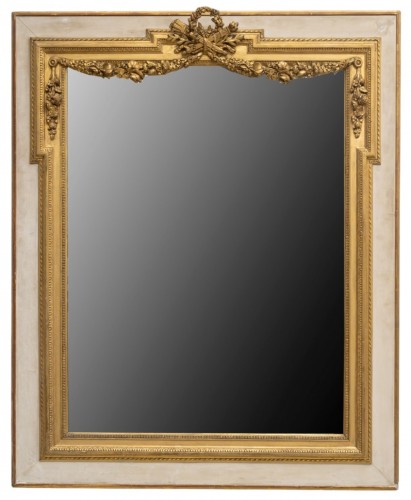
Offered by Galerie Lamy Chabolle


REQUEST INFORMATION


Decorative art from 18th to 20th century
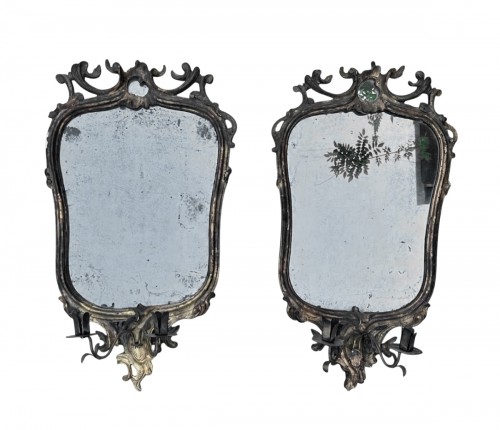
Cut glass, gilt-metal.
North Italy.
Early 20th century.
58 x 33 cm (22,83 x 13 in).
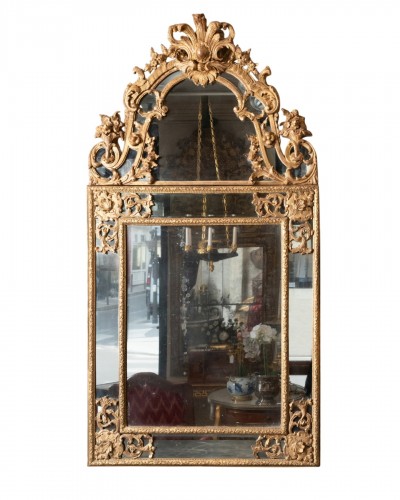
In his study of English looking-glasses, Geoffrey Wills identifies this type of mirror as characteristic of the Queen Anne period. The emergence of these “sconces” — occasionally referred to in England as “girandoles” — is almost contemporaneous with the rocaille wall-lights which, in France, from the second third of the 18th century onwards, flanked the overmantle mirrors of stately halls. They serve an identical function, namely the multiplication of light through reflection ; and yet, the more slender and functional form of Queen Anne mirrors allows them to adorn not only mantlepieces, but almost any recess or corner of the room. The Metropolitan Museum of Art, for instance, possesses a set of four Queen Anne mirrors with a single candle-harm, whose particularly thin and tall proportions were designed to decorate the four corners of a room.
In his important monograph on mirrors, Serge Roche records several similar examples of “plaques de glaces et leurs bras de lumière”, which he dates also from the late 17th to the early 18th century, though without suggesting a specific centre of production. While the present mirrors refer directly to the decorative arts of the Queen Anne reign, they are likely North Italian productions from the early 20th century. Designed for electrification, they were possibly inspired by the diffusion in Italy of British decorative arts, reflecting both historicist revivalisms and the sinuous lines of the Arts & Crafts movement.
See Geoffrey Wills, English Looking-glasses. A Study of the Glass, Frames, and Makers (1670-1820), London, 1967, and Serge Roche, Germain Courage and Pierre Devinoy, Miroirs, Paris, 1985.