Offered by Galerie Sismann
REQUEST INFORMATION
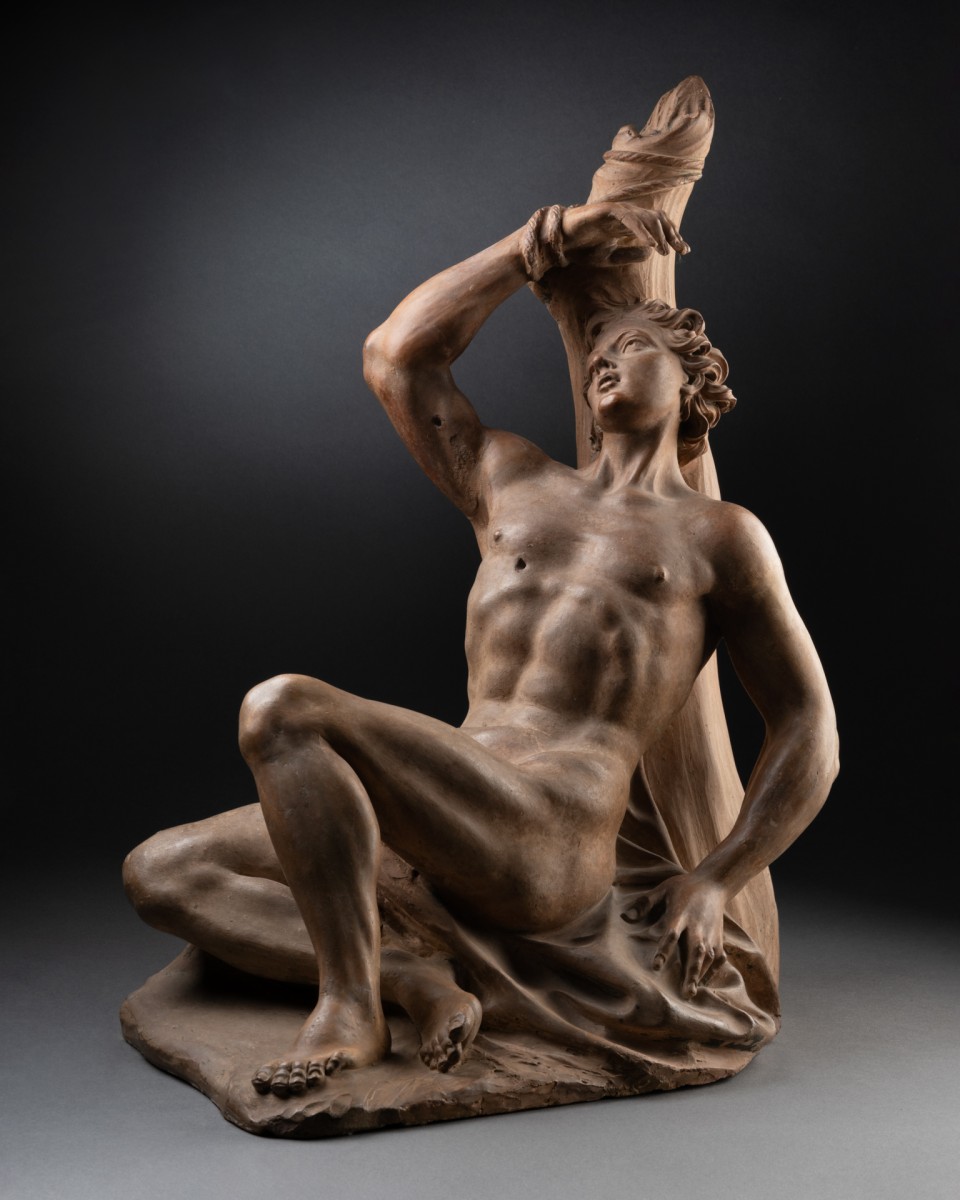
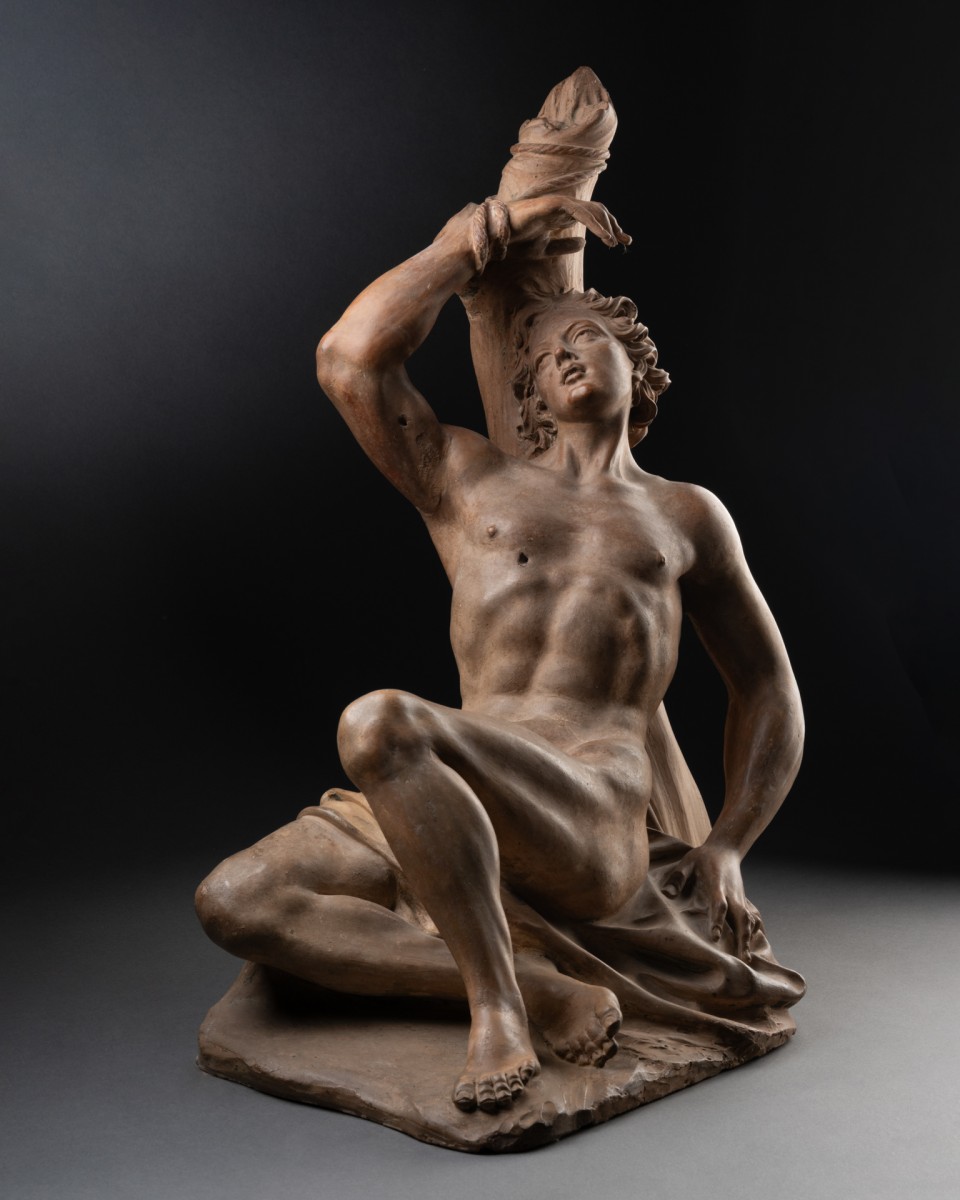
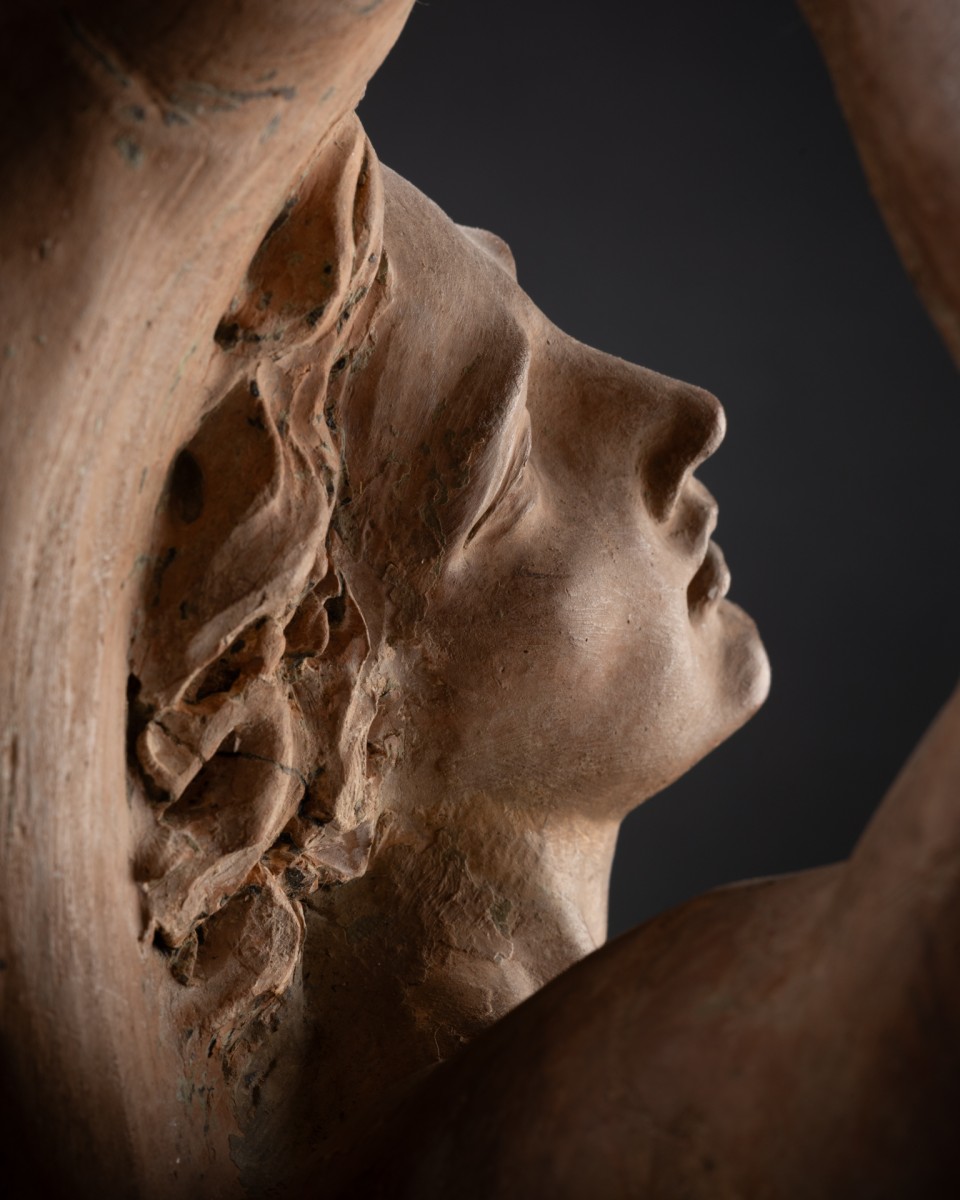
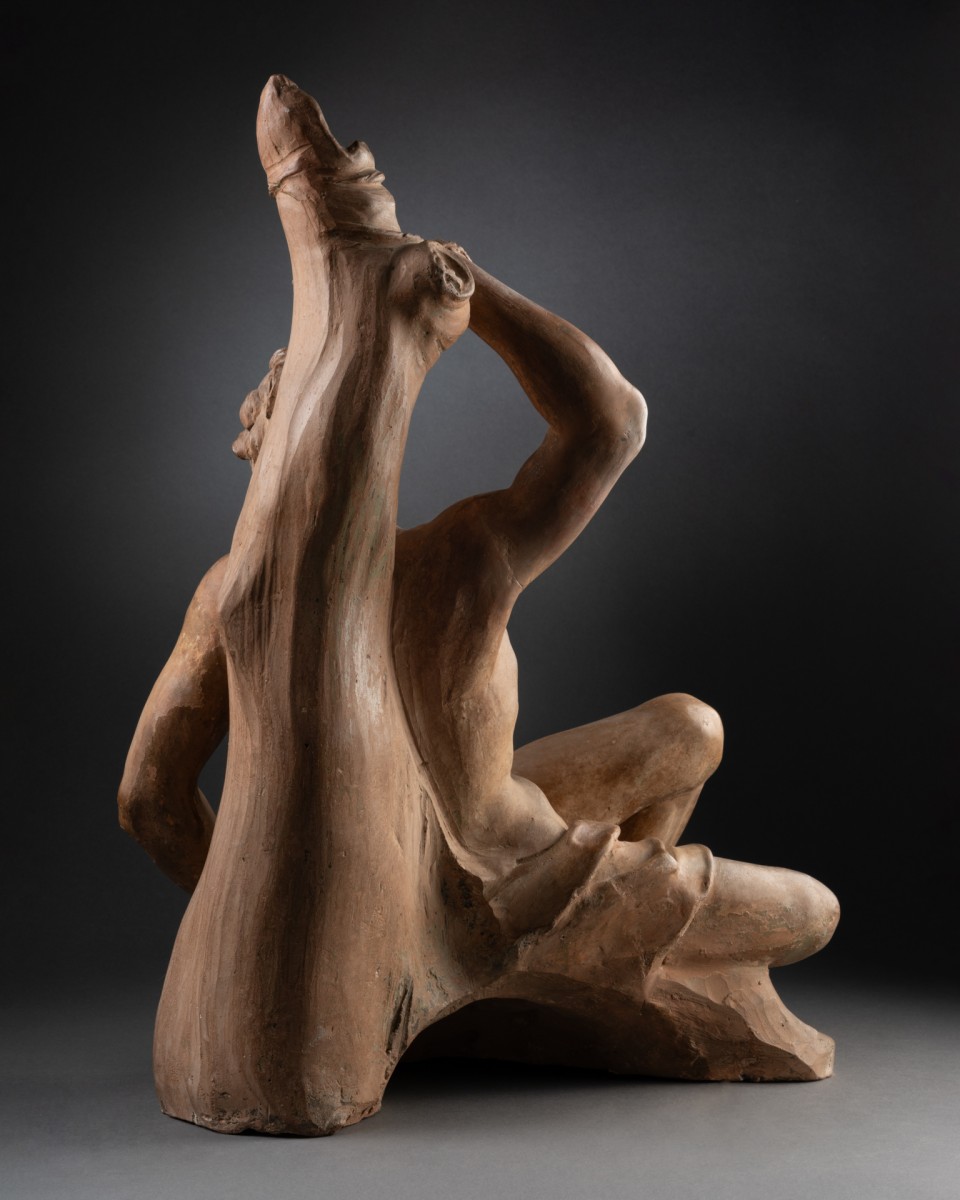

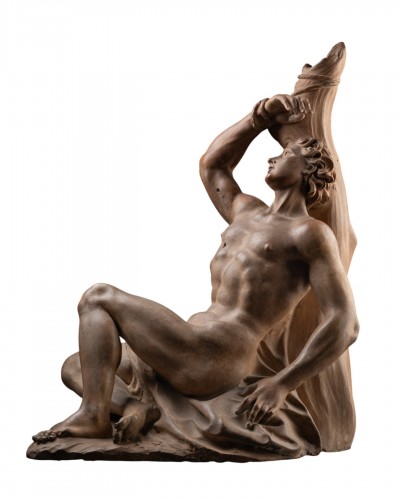
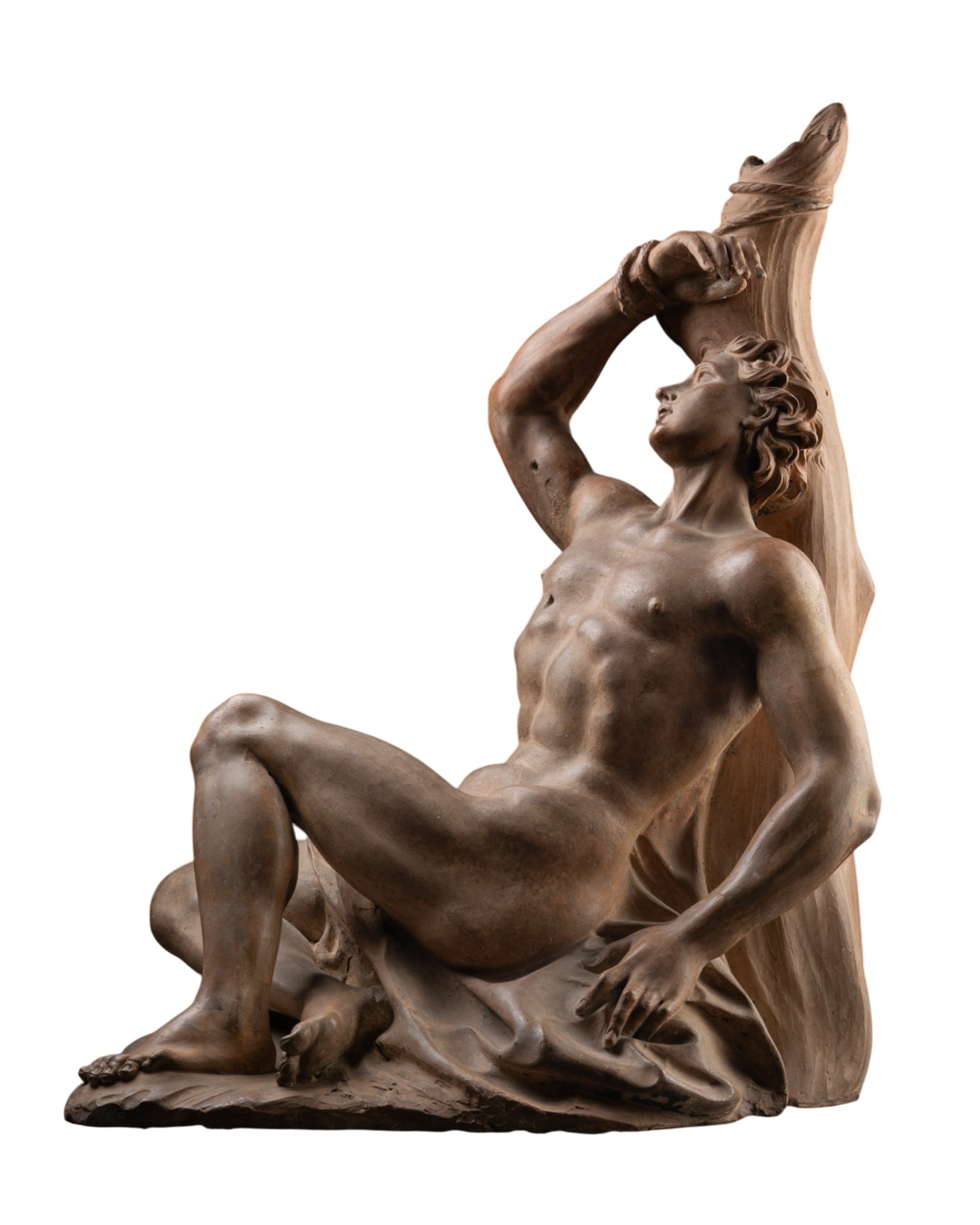
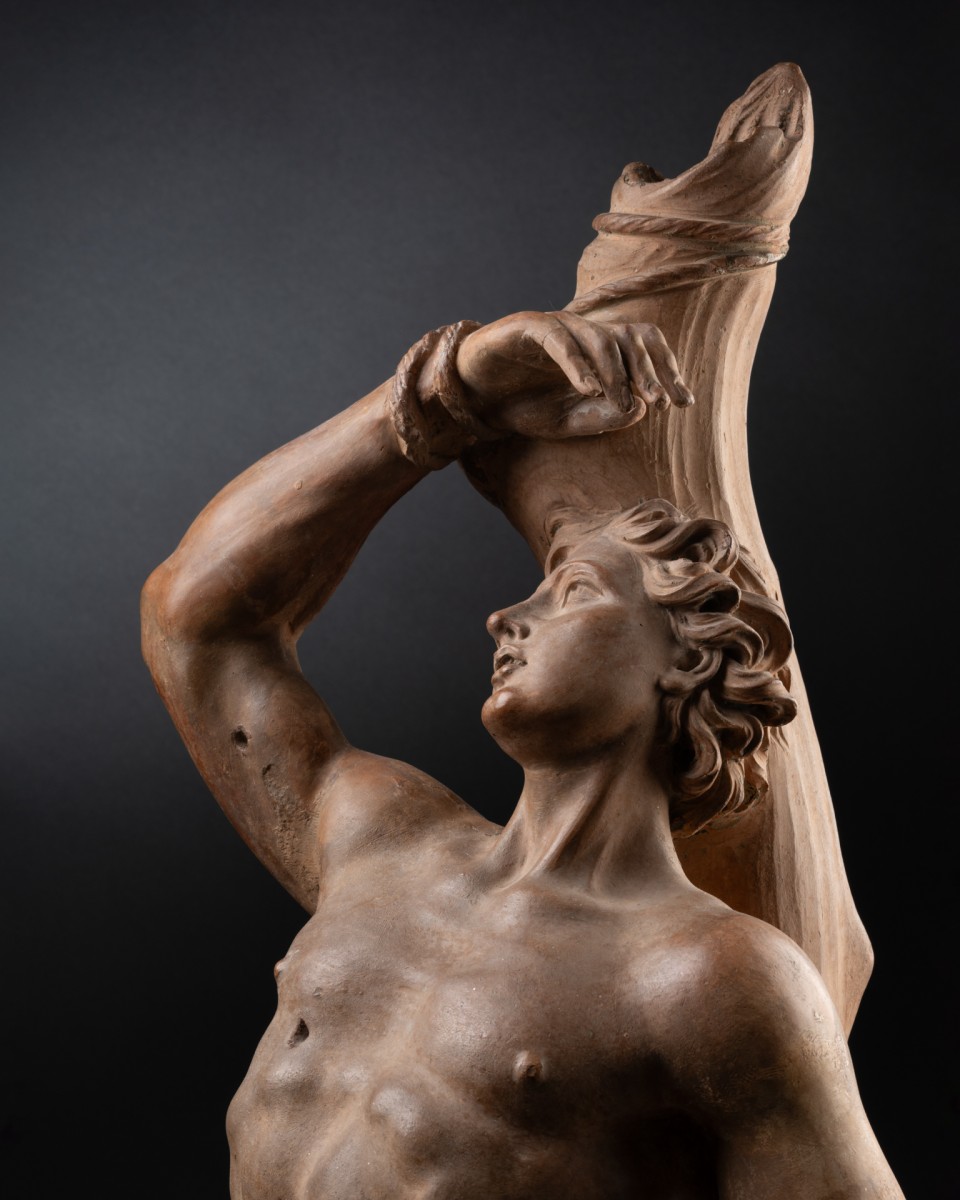
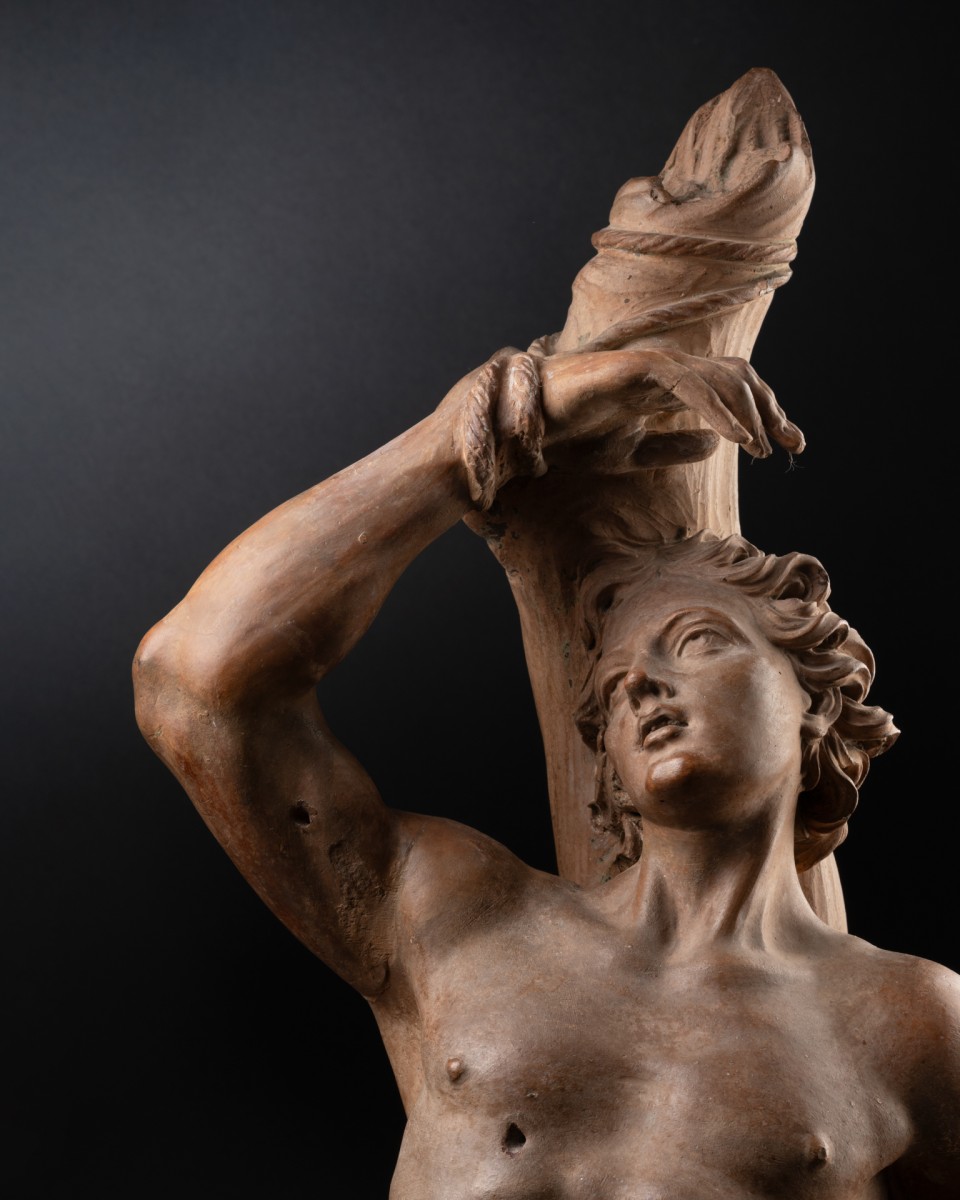
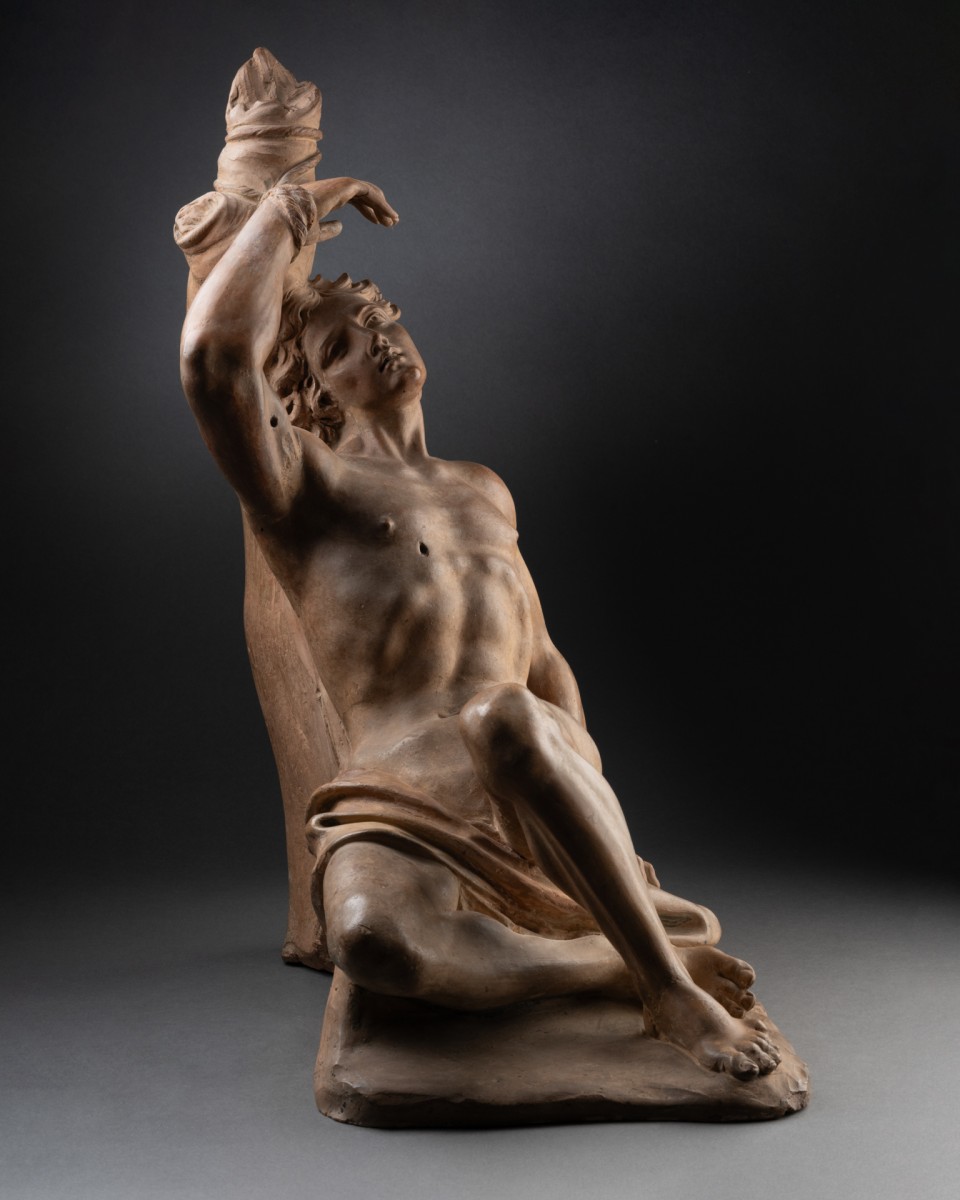
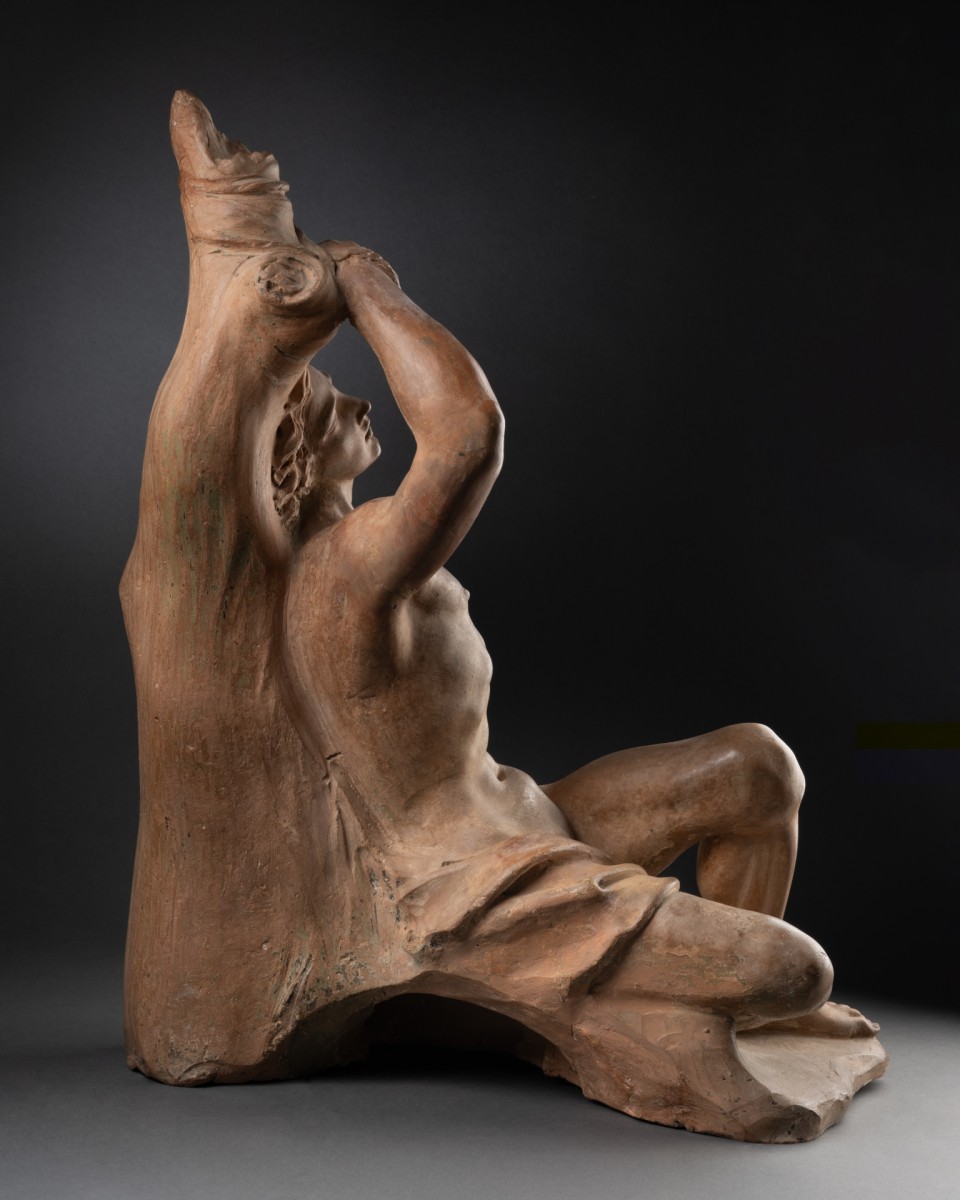
Symbol of Christian courage in the face of martyrdom, Saint Sebastian has inspired artists since the Renaissance through the striking contrast he embodies between spiritual purity and the sensuality of the nude body. A favorite subject of Baroque sculptors, he personifies a dramatic tension in which eroticism is never absent: the ideal beauty of youth becomes the instrument of divine grace. Reclining against a tree trunk to which one arm is bound, the young man arches his body in a movement of surrender that is both painful and voluptuous. His uplifted face and slightly parted lips suggest a state suspended between suffering and ecstasy. The body, masterfully modeled, breathes with life: the tautness of the muscles, the softness of the flesh, and the fluidity of the gesture convey a rare intensity of physical emotion. This sculpture, imbued with vibrant naturalism, captures the very moment when the martyr becomes the embodiment of transcendent beauty—when pain merges with desire—revealing how eighteenth-century Italian sculpture so subtly intertwined sensuality and devotion.
This sculpture was recently attributed by Davide Lipari to Andrea Ferreri. Born in Fano, trained in the Bolognese milieu, and active between Emilia and Romagna, Ferreri (1673–1744) was among the most distinctive sculptors of the early eighteenth century. His art, informed by the teachings of Mazza and shaped by a deeply personal expressive and spiritual sensibility, is characterized by the refinement of its modeling and by a highly individual interpretation of the late Baroque idiom.
Regarding this work, Lipari writes:
“The composition faithfully reproduces a famous engraving by Simone Cantarini of Pesaro (1612–1648), depicting Saint Sebastian in agony, bound at the feet of a tree (fig. 17).
Stylistically, the piece reveals the same fluidity and softness of drapery already observed in Ferreri’s terracotta works as well as in the sandstone statues of the Palazzo Belloni (figs. 2, 11, 13).
The face, with its stylized downward gaze and complex mouth, though derived from Mazza’s repertoire, seems closer to the more abstract interpretation Ferreri gave to this language. The eyes, sharply contoured and distinctly elliptical in form, strongly recall those of the Virgin preserved in the Davìa Bargellini Museum.
The highly finished modeling of Saint Sebastian’s face can also be compared to the broad gaze of the marble Vigilanza and to the still highly articulated volumes of the Virgin in Piazza San Martino (fig. 19). Here too appear the straight and slightly upturned nose, the prominent chin, and the full, bicuspid lips—features that, before weathering took its toll, must have rendered the Virgin’s visage almost indistinguishable from that of the terracotta martyr.
Although the Saint Sebastian cannot be dated with certainty, it is reasonable to situate its creation during Ferreri’s Bolognese period, or at least before the 1720s. This hypothesis is supported, on one hand, by the clear resemblance between the saint’s face and that of the Virgin in Piazza San Martino, and on the other, by its evident continuity with a creative practice already explored by Mazza and his closest followers.
Since the intended destination of Ferreri’s work remains unknown—whether for the decoration of a noble residence, or for a private or public altar—it is difficult to determine whether the reference to Cantarini’s invention originated with the patron or the sculptor himself. It is nevertheless striking that Ferreri chose not to draw upon Mazza’s own interpretations of the same subject??, but rather to return to the models offered by painters.
The newly presented terracotta demonstrates, with exceptional clarity, how Ferreri—or perhaps his patron—sought in painting the support necessary to give form to solutions that were both compositionally effective and profoundly moving in their dramatic intensity.”