Offered by Galerie Lissier

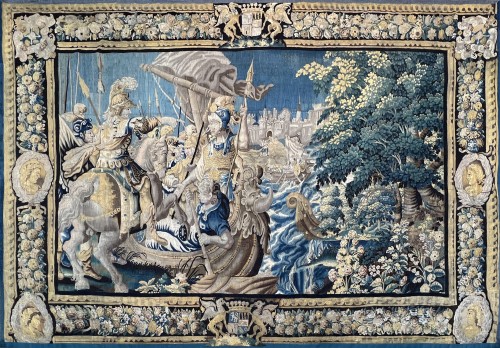
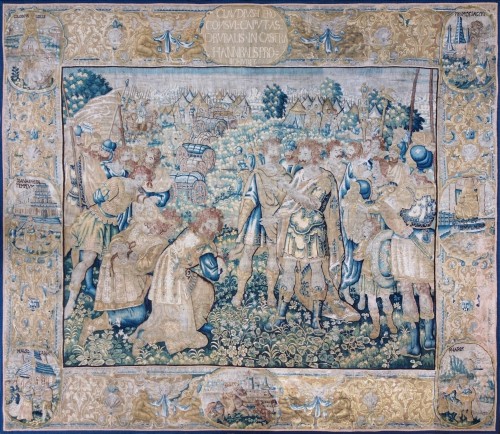
Ancient Audenarde Tapestry, circa 1600 – “Hasdrubal, Hannibal’s Brother, in the Hands of the Romans”
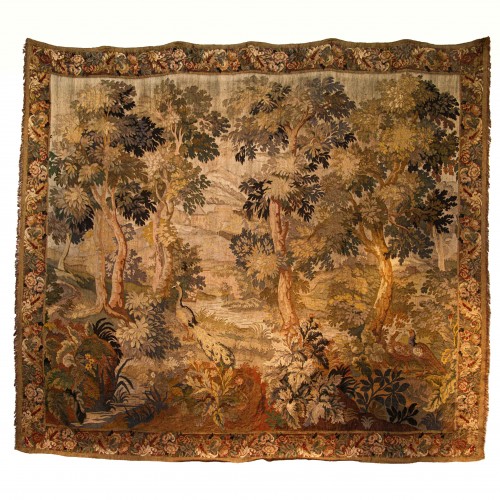
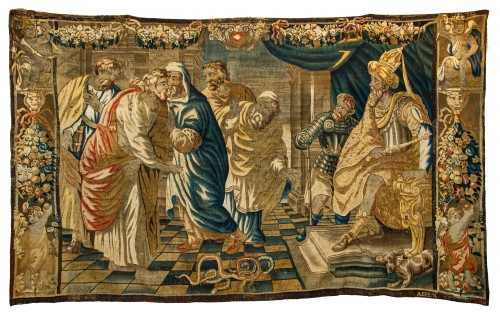
Historical scene from the Second Punic War, woven in wool and silk, richly decorated with borders featuring classical motifs.
This magnificent tapestry has undergone a thorough professional cleaning, as well as a hand-applied backing in 100% linen fabric, followed by a meticulous inspection by our experts in our traditional workshop. It is now ready to adorn your interior.
Period: 17th century
Style: Ancient Rome and Greece
Condition: Excellent condition
Material: Wool & Silk
Width: 383 cm
Height: 333 cm
Hasdrubal, Hannibal’s Brother: The Carthaginian Defeat and Roman Victory at the Battle of the Metaurus
Hasdrubal, Hannibal’s Brother, in the Hands of the Romans
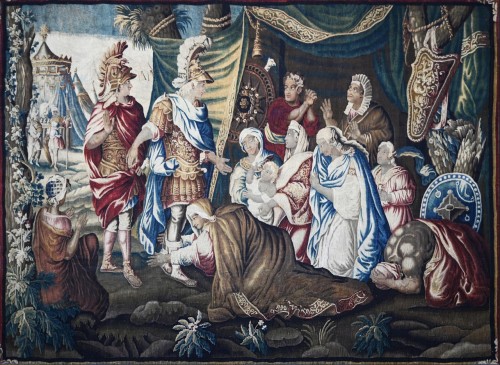
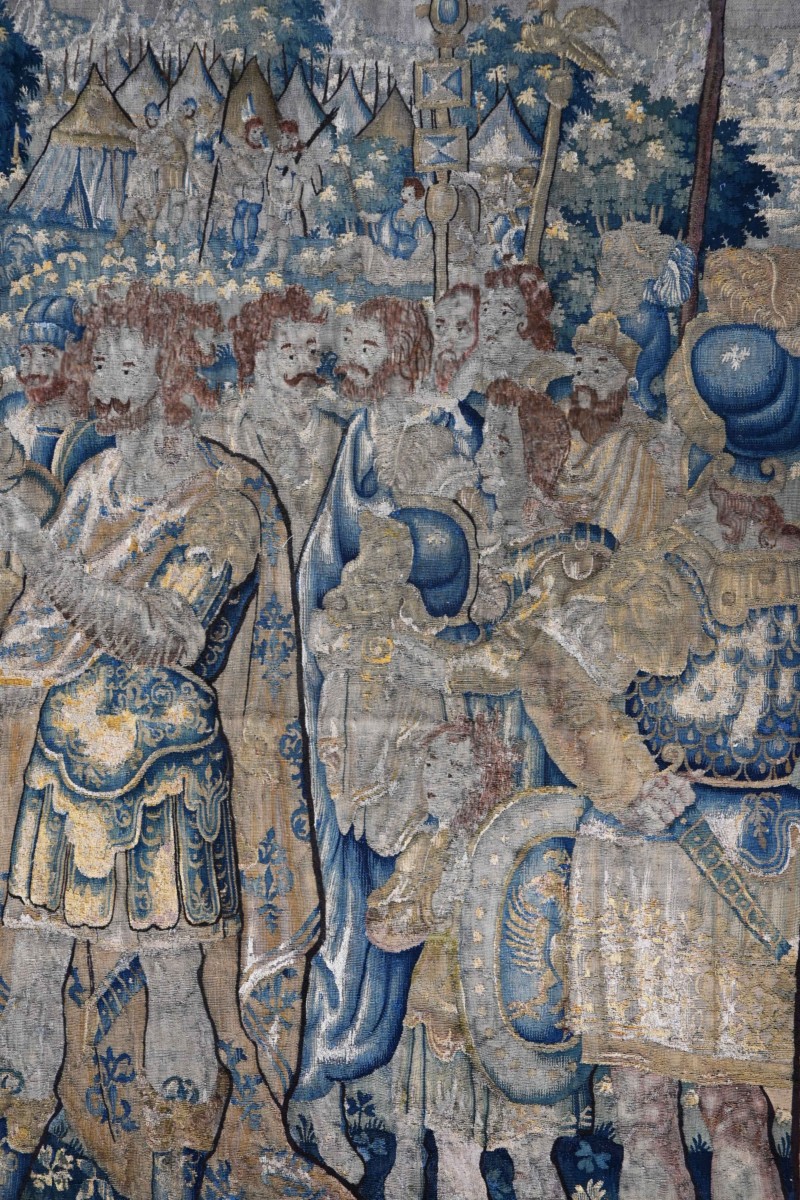
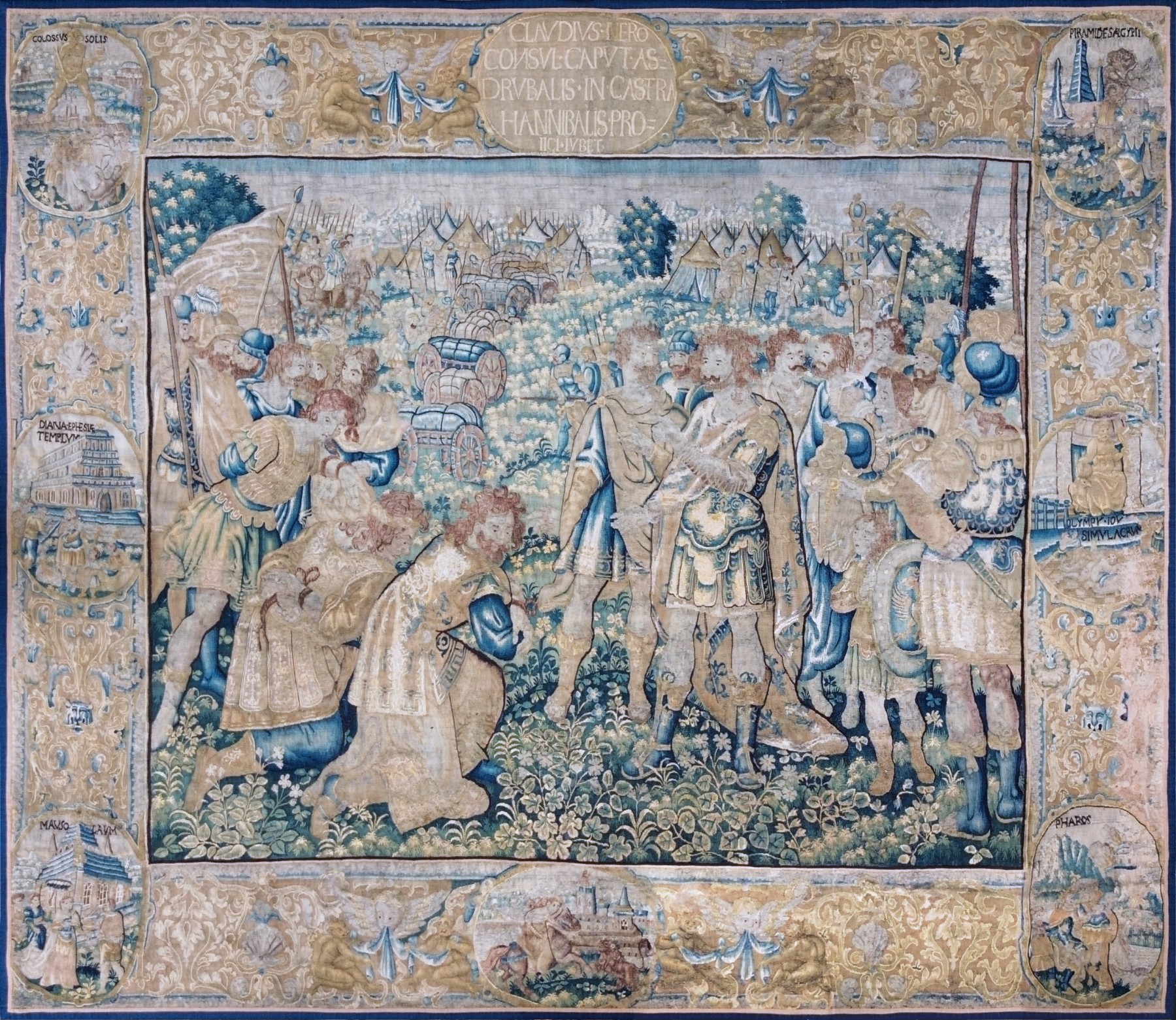
This tapestry depicts a significant episode from the Second Punic War: the defeat of Hasdrubal Barca, brother of the famous Carthaginian general Hannibal, at the Battle of the Metaurus in 207 BC. As he attempts to join his brother in Italy in order to unite their armies and reinforce the Carthaginian forces against Rome, Hasdrubal is intercepted by Roman troops commanded notably by the consuls Gaius Claudius Nero and Marcus Livius Salinator. The battle ends in a Roman victory and the death of Hasdrubal. According to the account of the Roman historian Livy, Claudius Nero has the Carthaginian general’s head cut off and orders it to be thrown into Hannibal’s camp in order to announce the defeat and death of his brother. This event represents a turning point in the war, as Hannibal consequently loses the opportunity to receive the reinforcements he had been expecting.
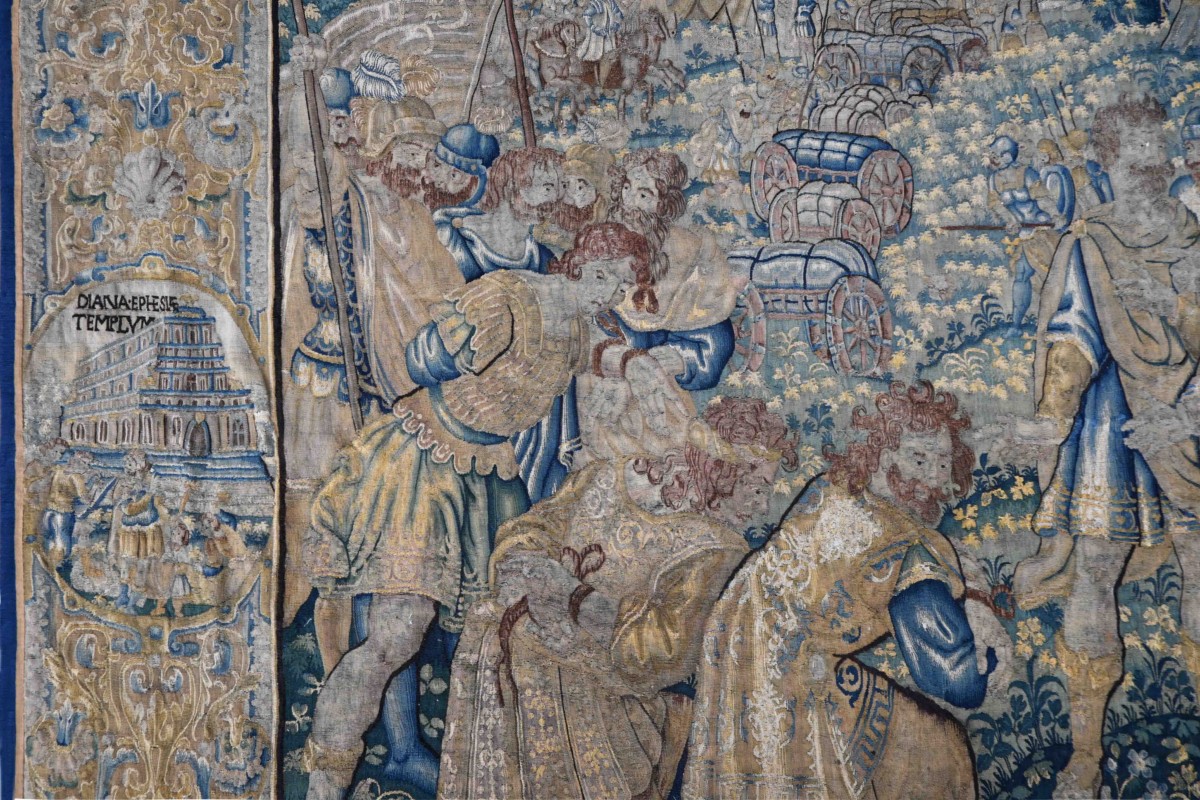
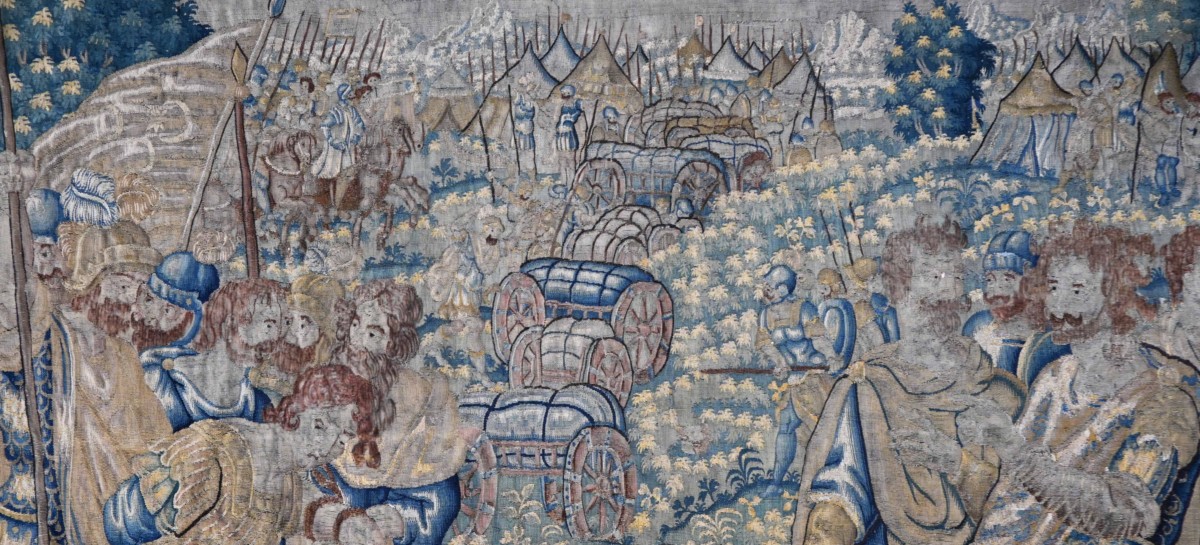
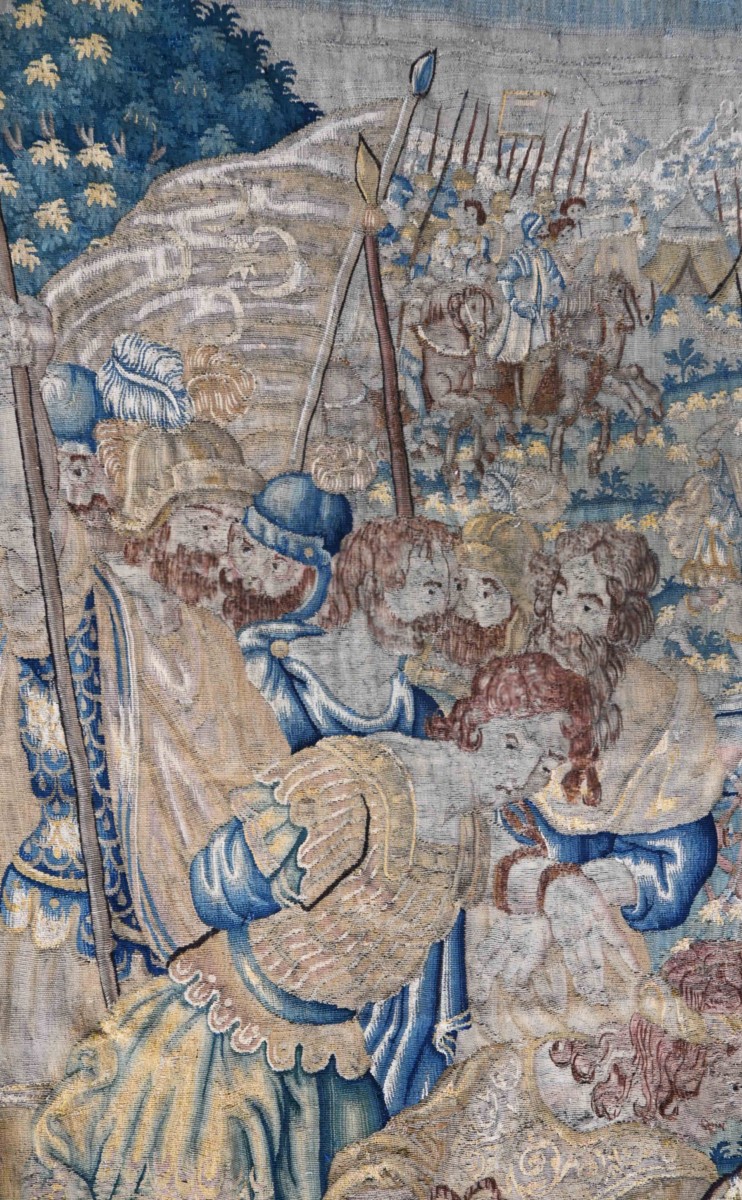
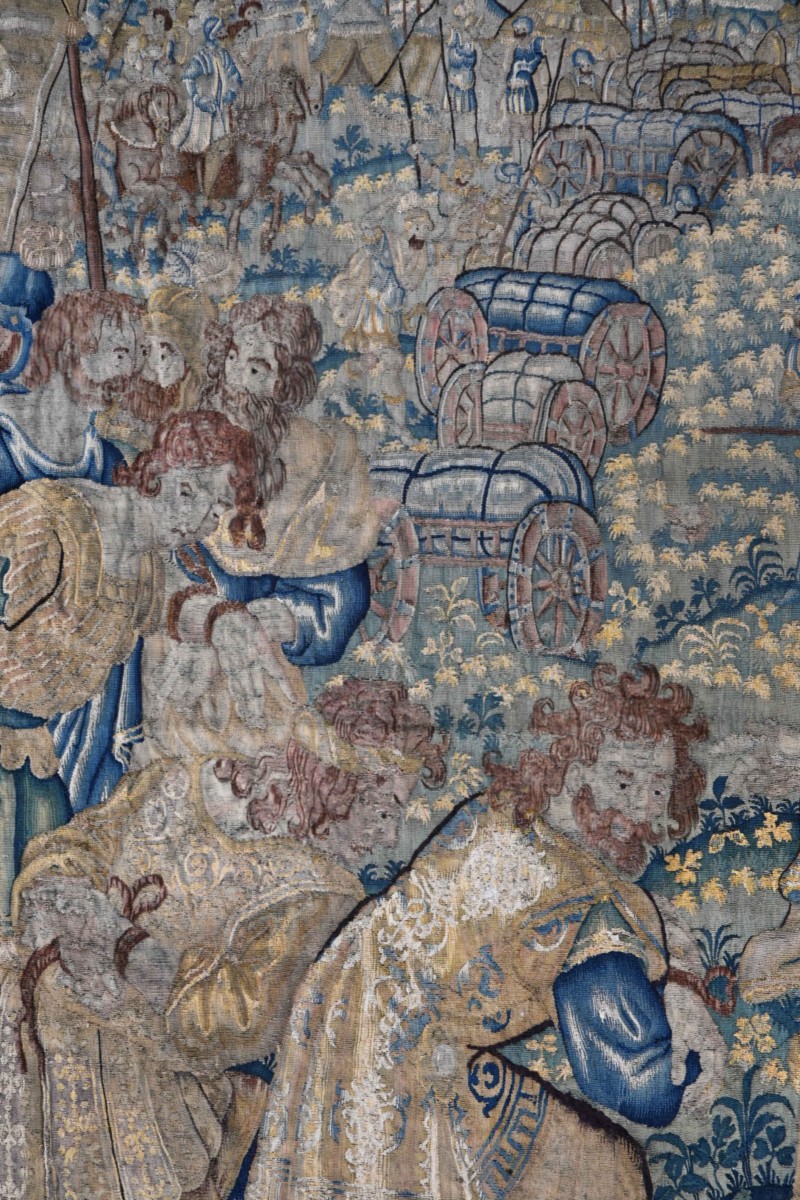
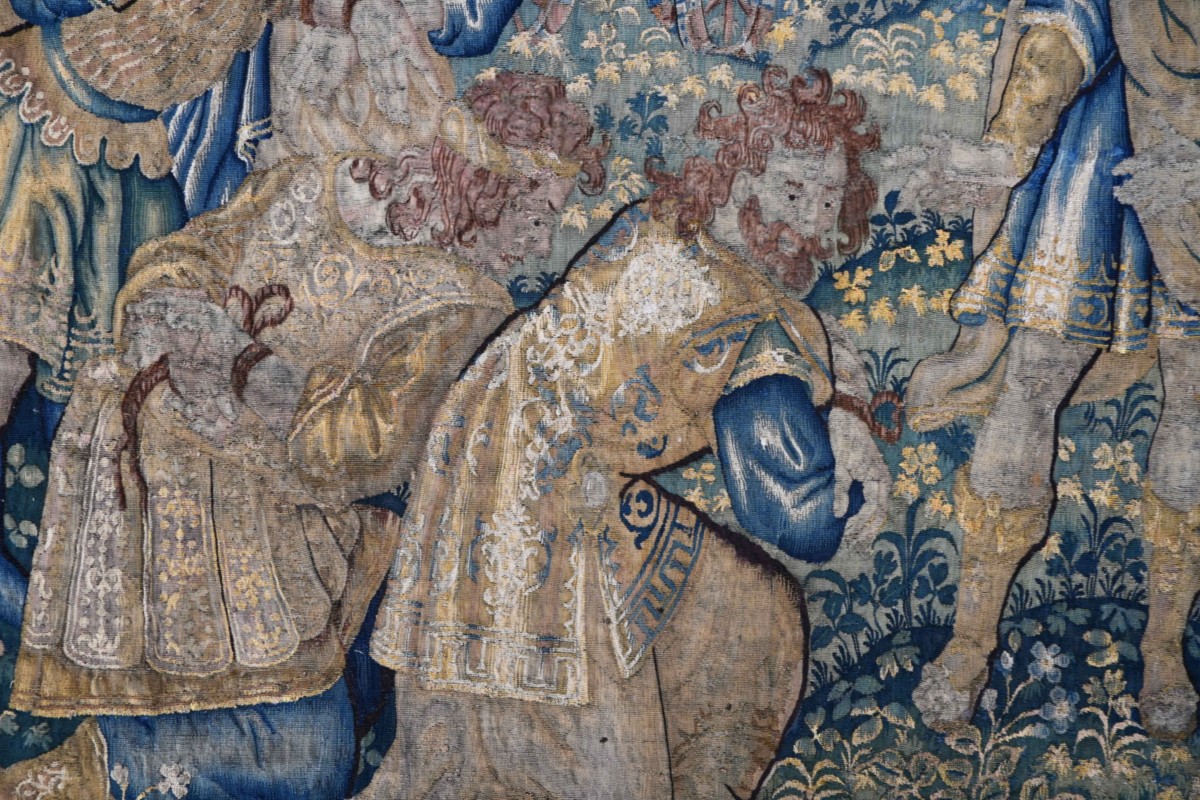
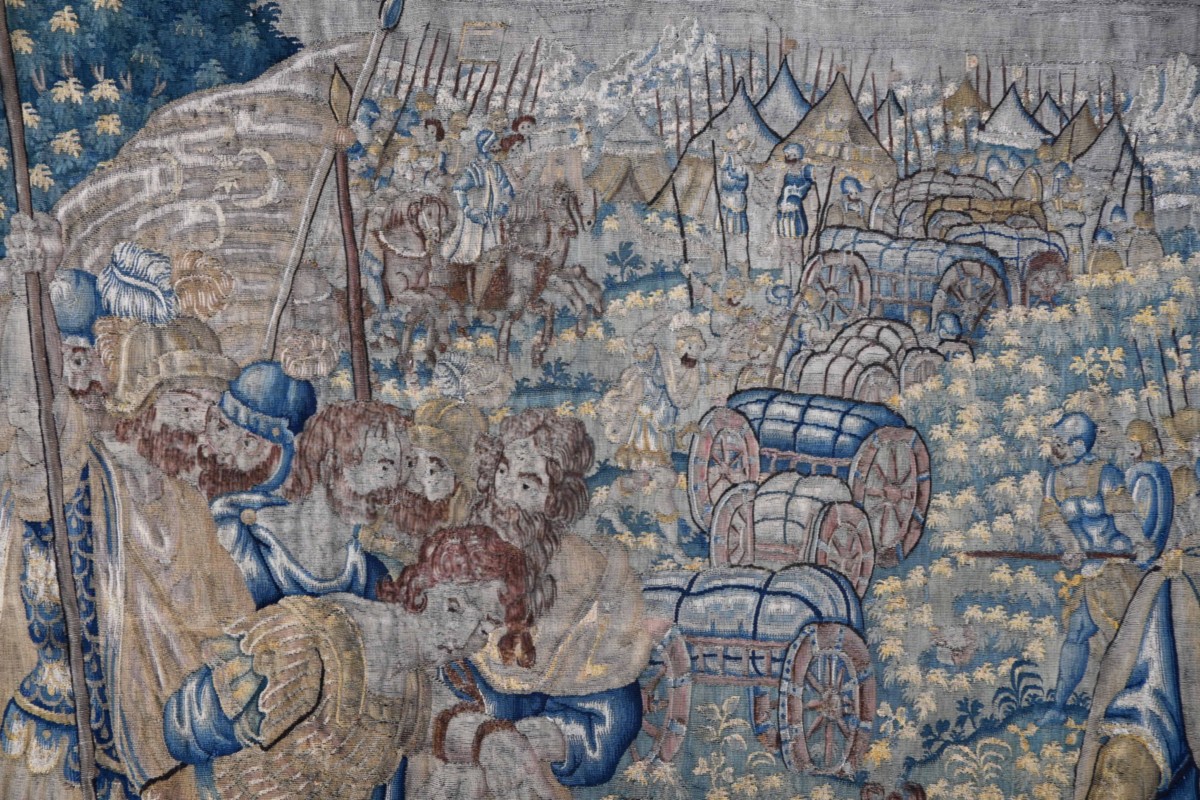
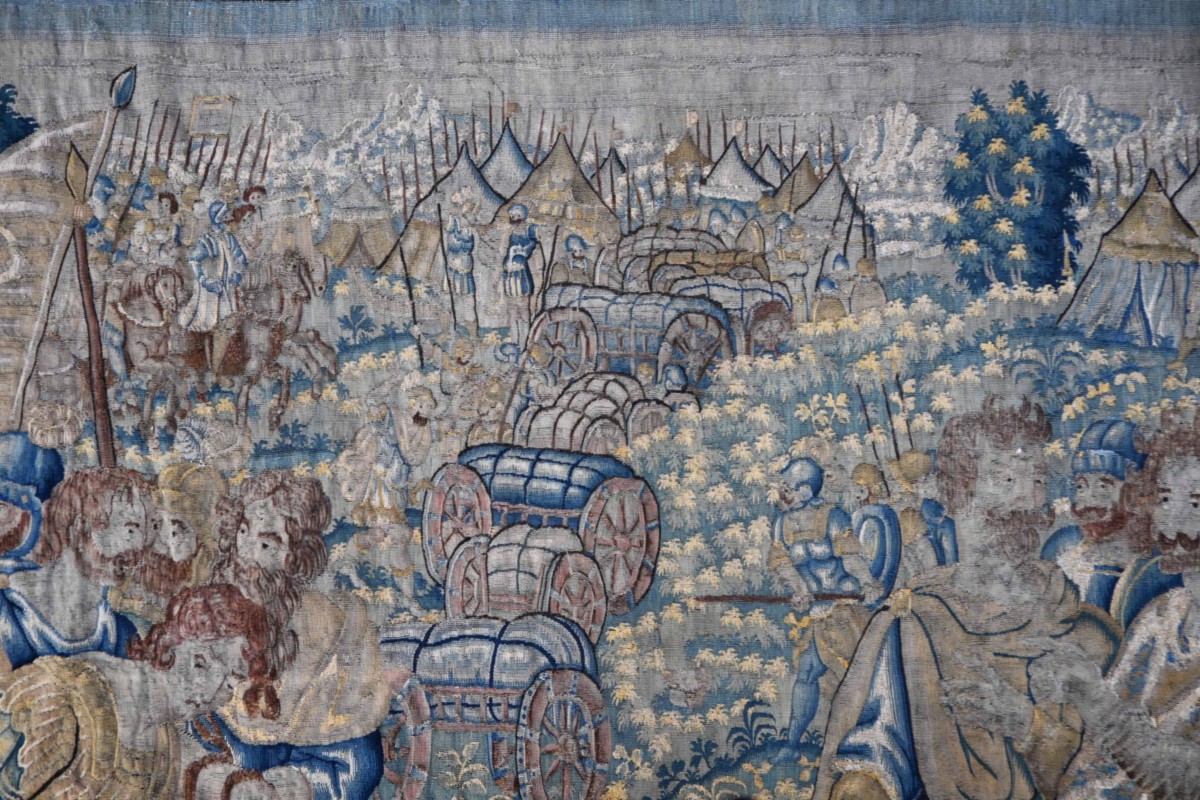
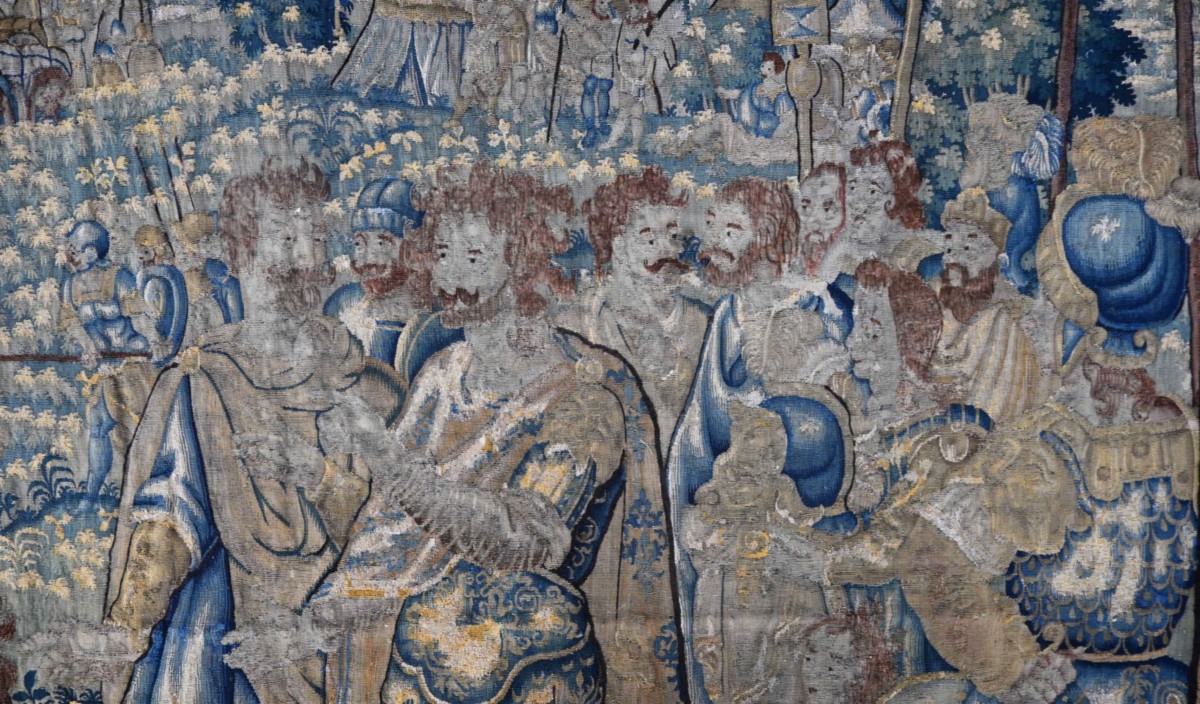
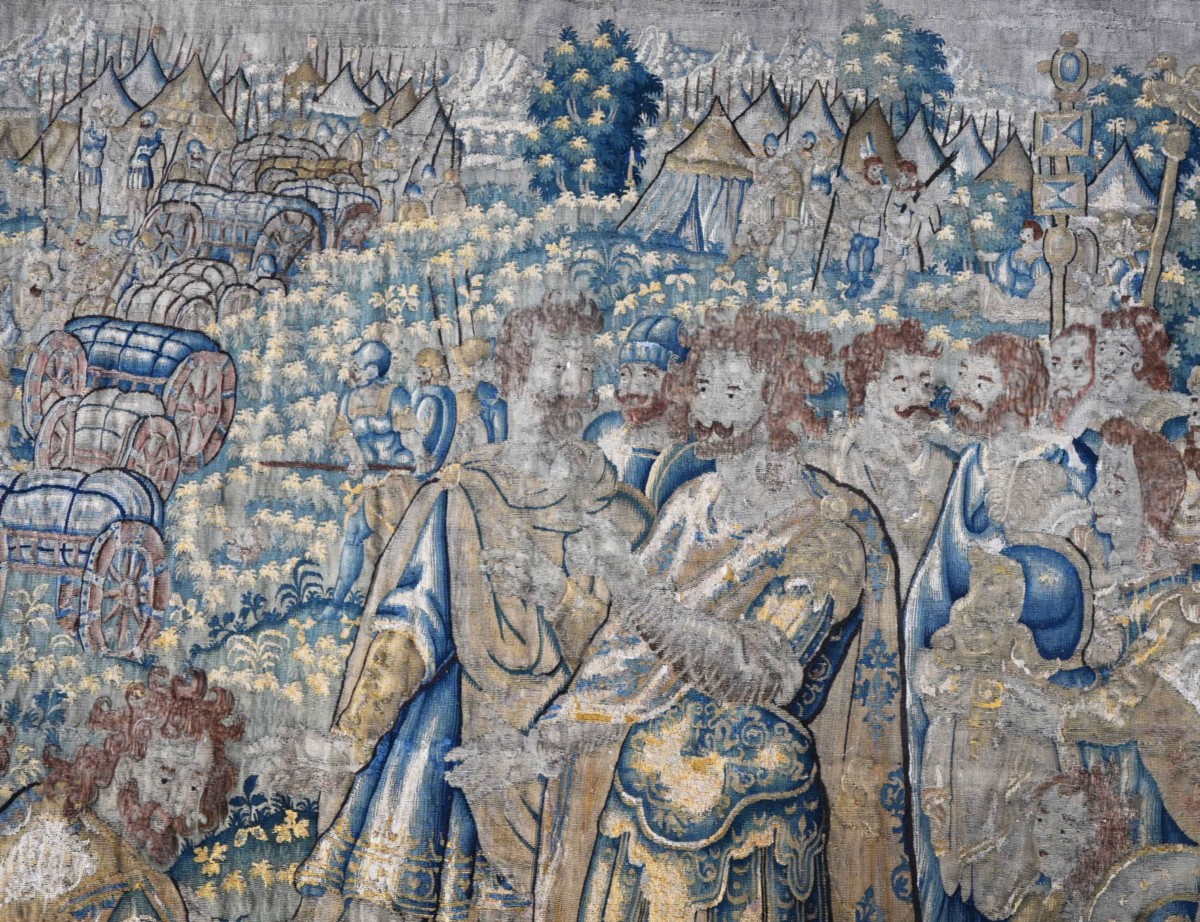
The central scene of the tapestry depicts the capture and defeat of the Carthaginians through a richly populated composition. In the foreground, several Roman and Carthaginian soldiers are portrayed in military attire, wearing tunics, cloaks, helmets and carrying shields. Some figures appear to be conversing or observing the scene, while others bend towards the ground, evoking the aftermath of the battle. At the centre, an armoured figure accompanied by soldiers draws the viewer’s attention through his position and attire. In the background, a vast military camp can be seen, composed of numerous tents, carts and groups of soldiers. Vegetation, trees and landscape details occupy an important place within the composition, creating a sense of depth and allowing the different planes of the scene to be clearly distinguished.
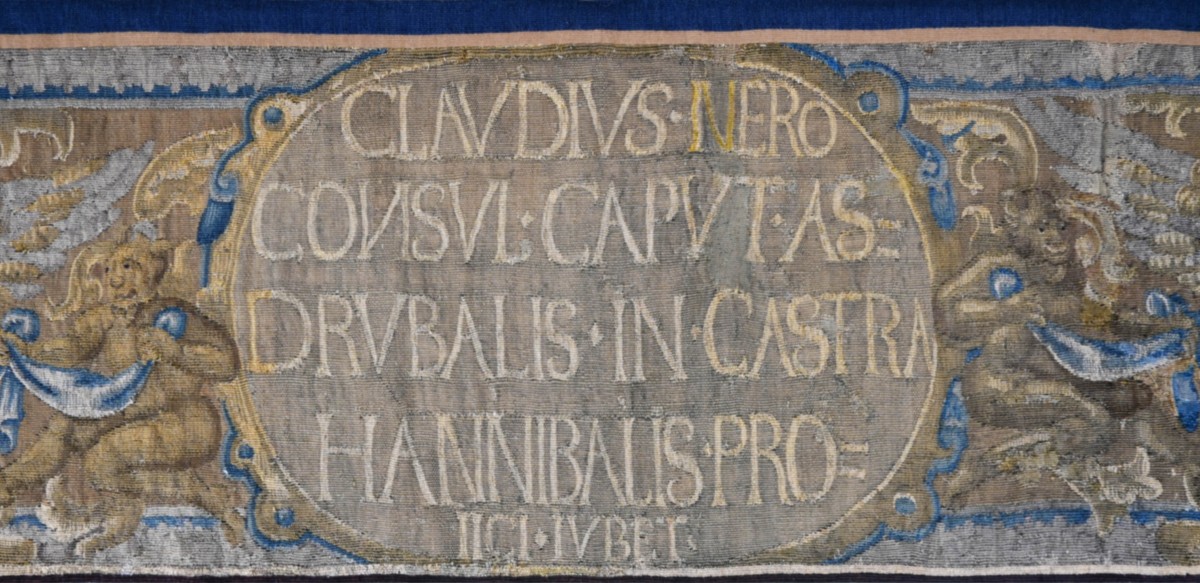
The tapestry is framed by a wide decorative border, particularly rich in vegetal motifs, gilded ornaments and architectural representations. In the upper section, at the centre of the border, a large medallion bears a Latin inscription in capital letters: “CLAUDIUS NERO CONSUL CAPUT ASDRUBALIS IN CASTRA HANNIBALIS PROICI IUBET.” This sentence means: “The consul Claudius Nero orders that Hasdrubal’s head be thrown into Hannibal’s camp.” It summarizes the historical event depicted and helps to explain the meaning of the central scene. The medallion is surrounded by symmetrical motifs, including animals, floral elements and blue draperies.
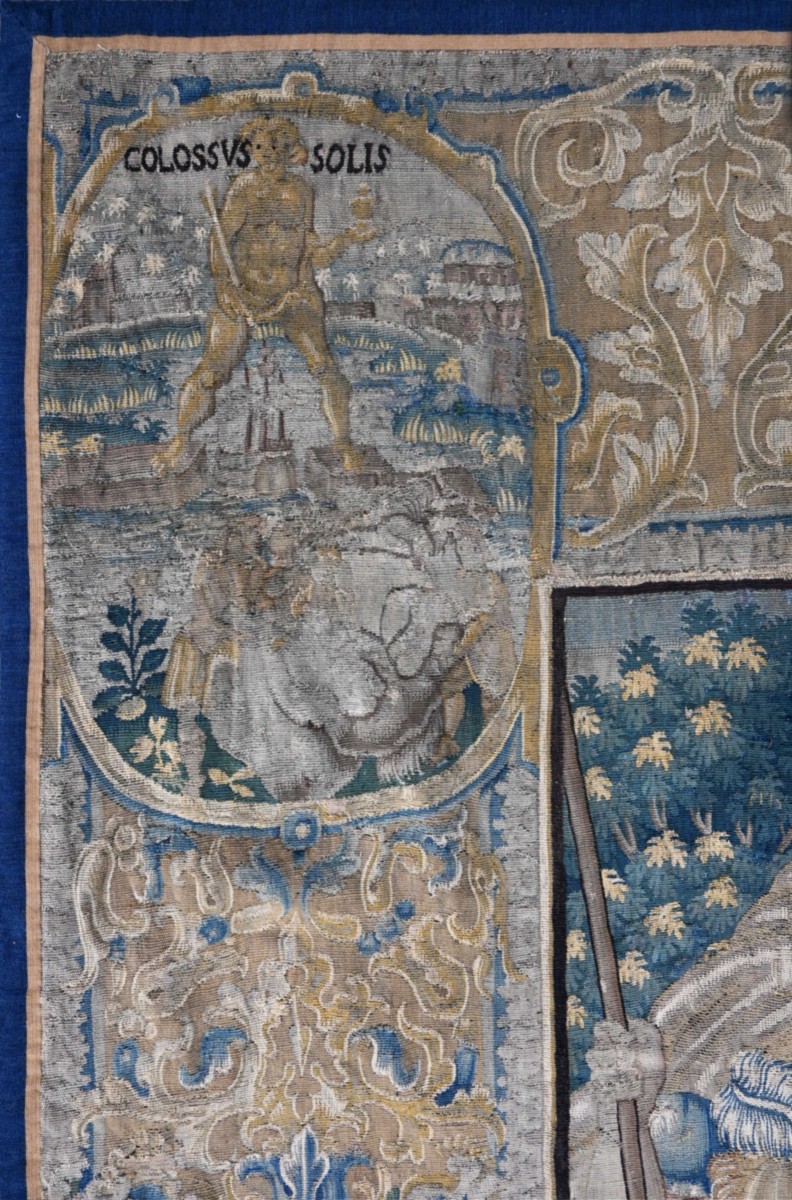
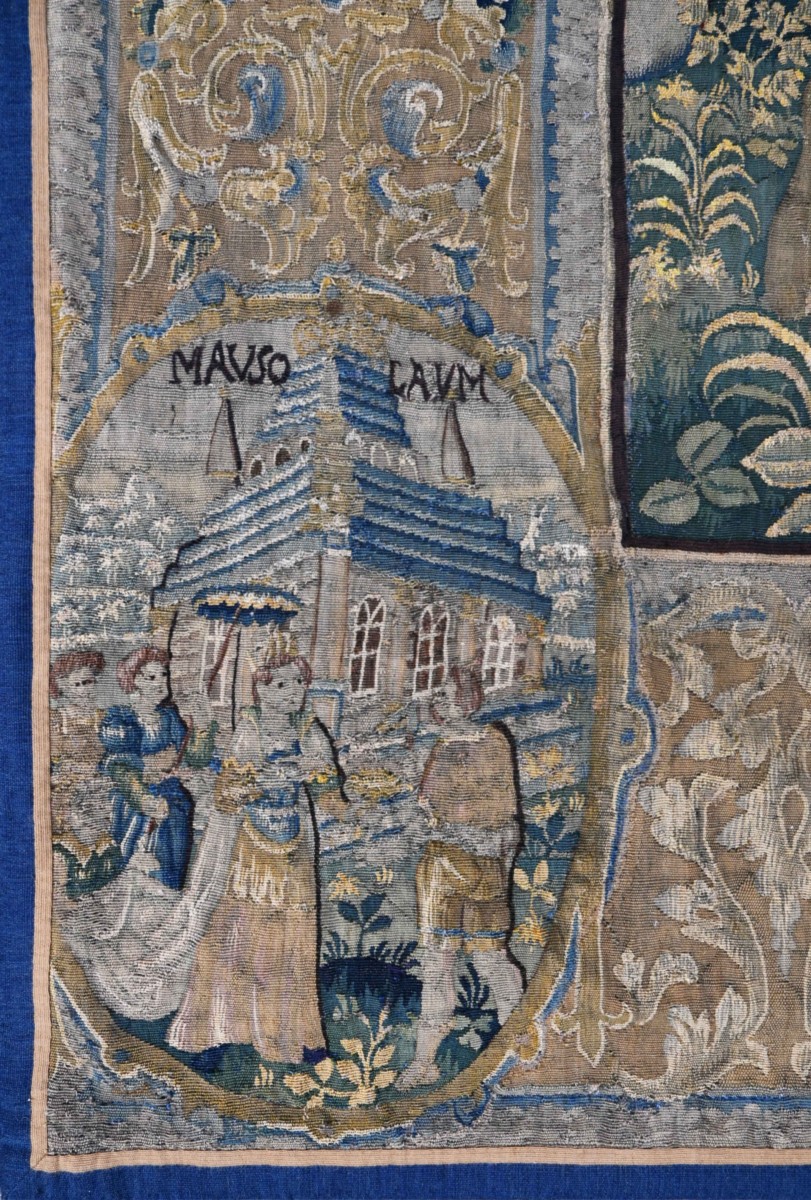
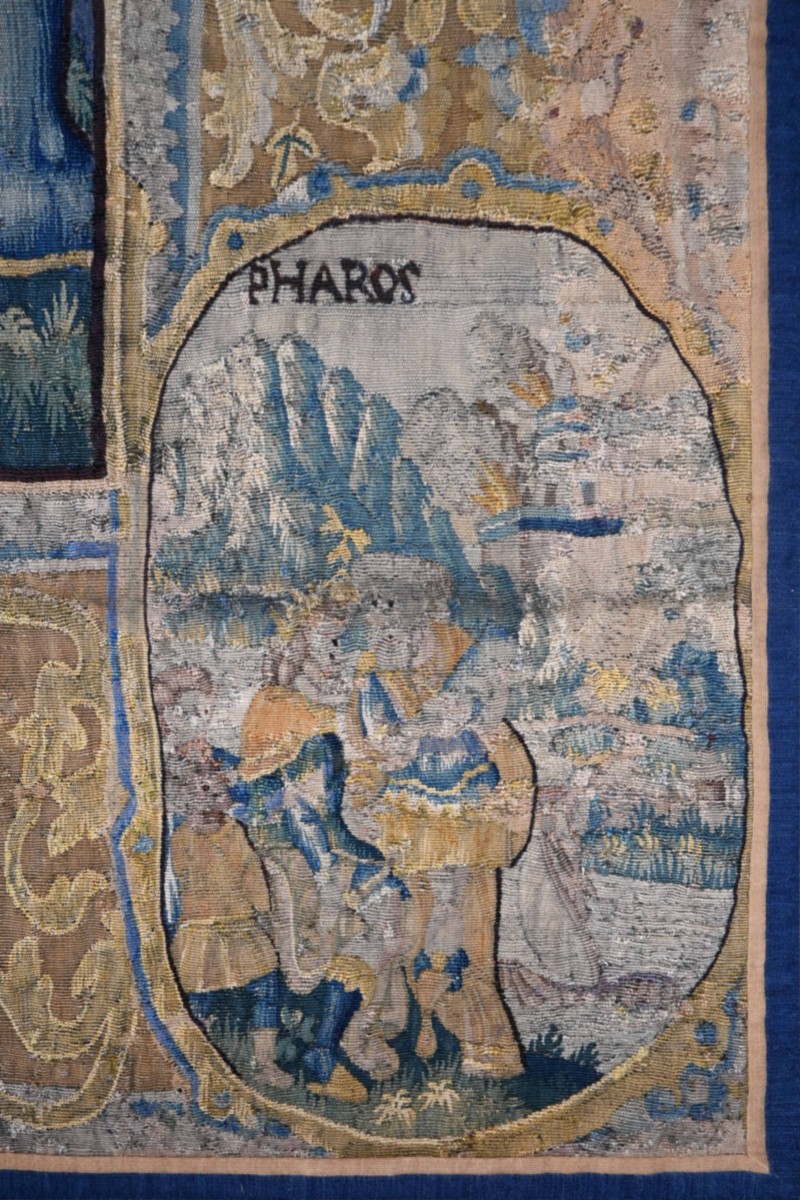
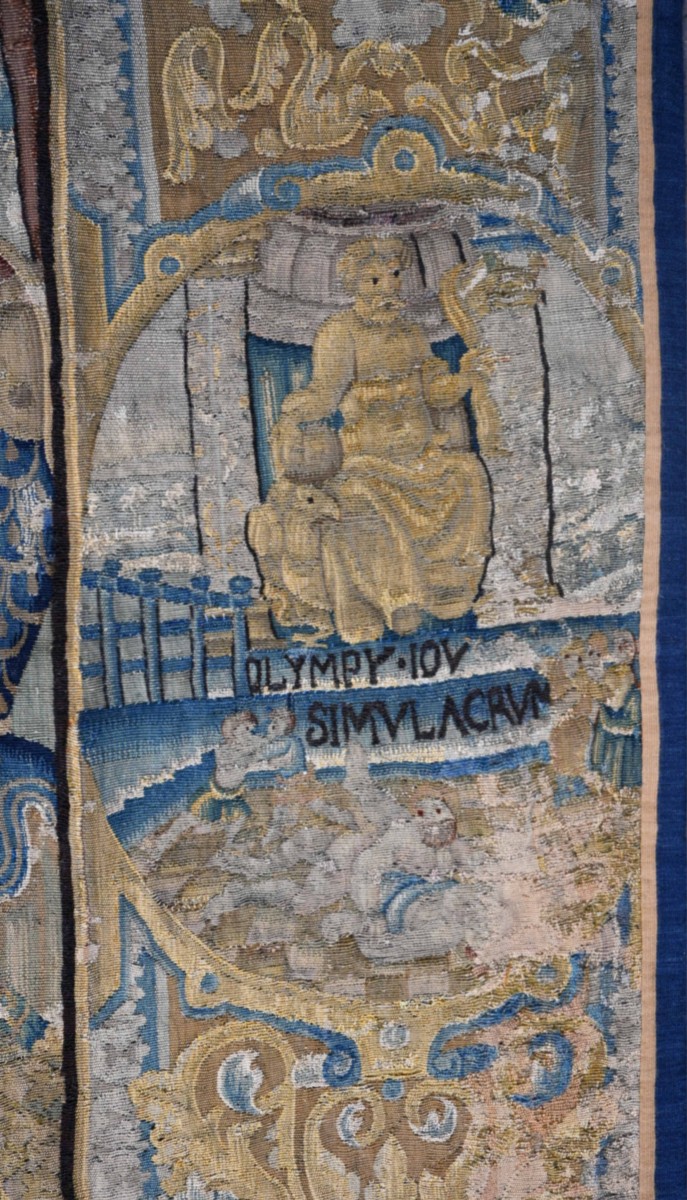
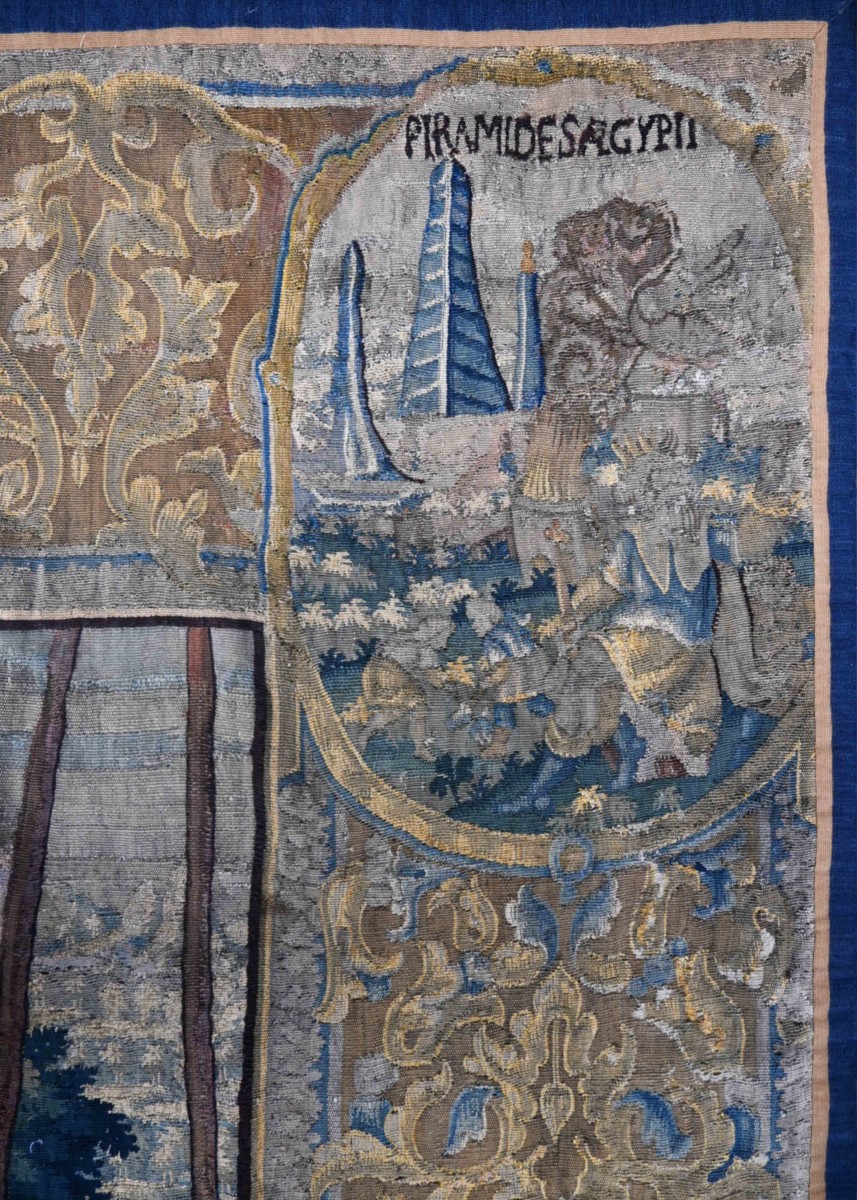
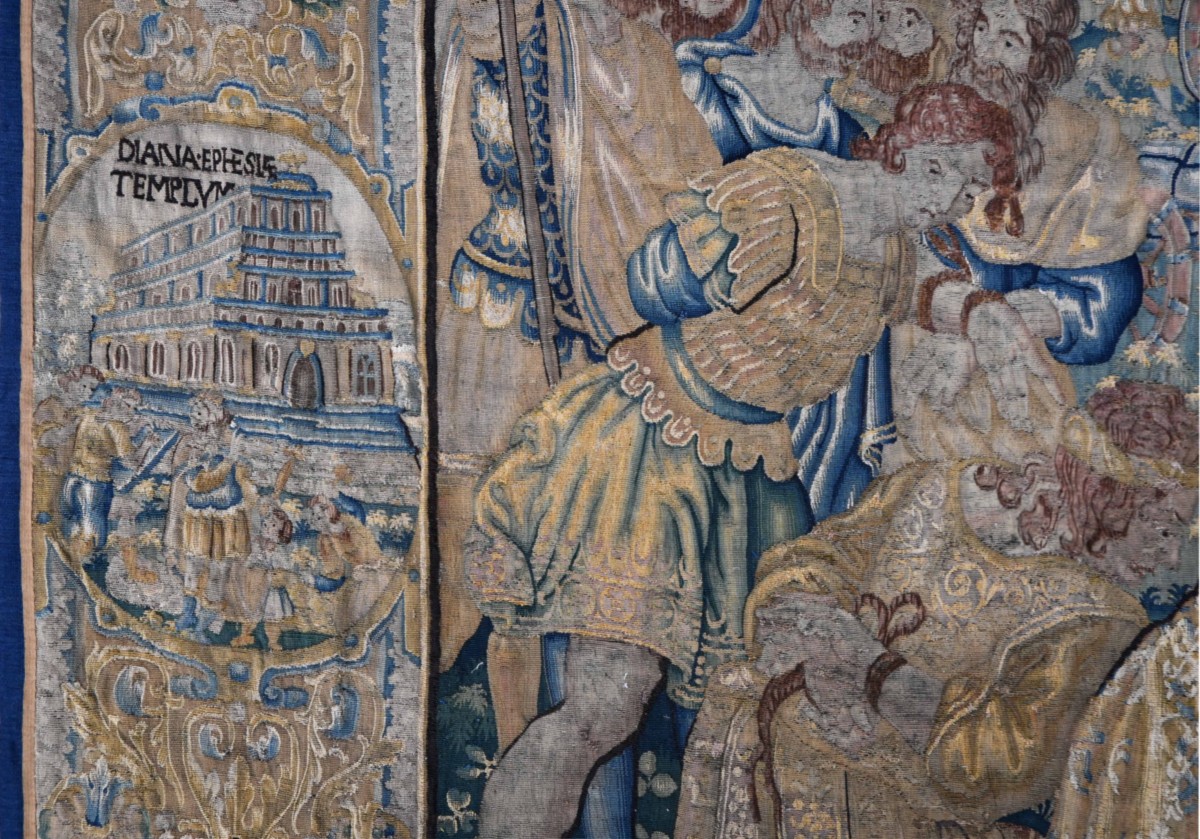
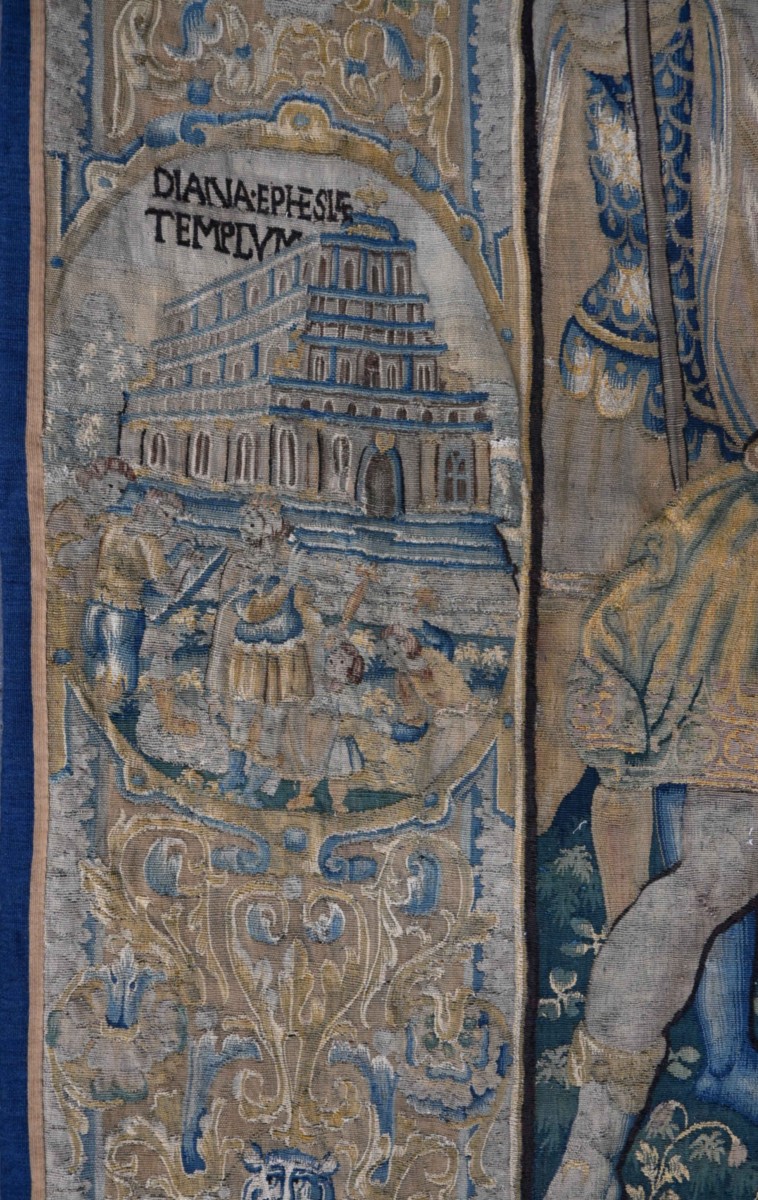
The side borders feature several medallions depicting famous monuments of Antiquity, referring to the wonders of the ancient world. Among them are the Colossus of Rhodes, the Temple of Artemis at Ephesus, the Mausoleum at Halicarnassus, the Lighthouse of Alexandria and the pyramids of Egypt. Other representations also evoke ancient monuments and structures, accompanied by small inscriptions identifying them. These illustrations transform the border into a veritable compendium of references to ancient architecture and culture.
In the lower section, the border repeats the vegetal decorative motifs and symmetrical compositions found in the upper section. A central medallion depicts an architectural landscape with buildings and elements evoking an ancient city. Together, these elements frame the historical scene and establish a connection between the narrative of the battle and the world of Antiquity.
Woven around 1600 in the tapestry workshops of Audenarde, this work belongs to the tradition of historical tapestries depicting the great events of the past. It thus combines the story of the Second Punic War with a setting inspired by Antiquity, in which Latin inscriptions, depictions of celebrated monuments and the many details of the scene contribute to recounting the story of Hasdrubal’s defeat and emphasizing its consequences for Hannibal and Carthage.
Bibliography:
- An identical tapestry is illustrated in: Ingrid De Meûter, *Tapisseries d'Audenarde du XVIe au XVIIIe siècle*, 1999, p. 185. The two tapestries do not feature the same medallion in the upper border.
- For the Battle of the Metaurus, see Geoffroy de Galbert, *Hannibal, Scipion et les guerres puniques dans l'Art et l'Archéologie*, 2013, pp. 271–278.
Delevery information :
Delivery Terms at Galerie Lissier :
We take great care to ensure that every work of art purchased on Anticstore reaches you safely and in the best possible condition.
Delivery:
All our merchandise is shipped free of charge via renowned carriers such as UPS or DHL, with full tracking, worldwide. We ensure that each tapestry or rug is delivered in secure packaging, guaranteeing its protection and integrity.
Customs Fees:
For deliveries outside the European Union, any customs duties, import taxes, or fees related to customs formalities are the responsibility of the buyer. We recommend consulting local authorities to understand the specific requirements in your country.
Our goal is to provide you with a serene and prestigious shopping experience, from our gallery to your space. Every acquisition reflects our commitment to quality, safety, and impeccable service.