Offered by Impossible Gallery - Diane Chatelet
REQUEST INFORMATION

Decorative art from 18th to 20th century
Model created in 1982.
Memphis Edition,
Milan – Toso Vetri d'Arte execution, Murano.
Transparent cobalt blue, colorless, green, yellow, amethyst-red and black polychrome blown glass.
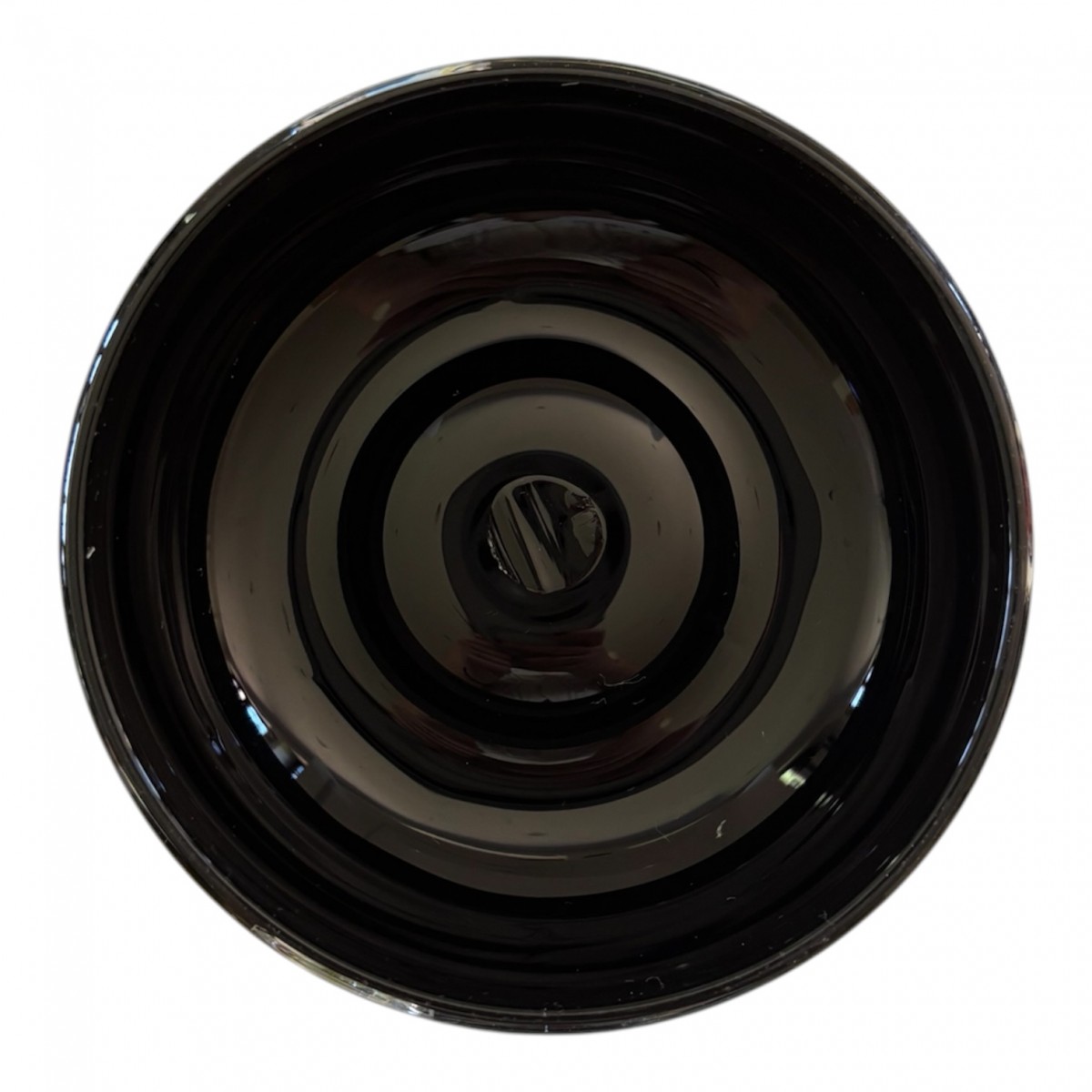
Signature engraved at the tip on the base "Memphis by Toso Vetri d'Arte".
Dimensions:
H 21 x D 13 cm
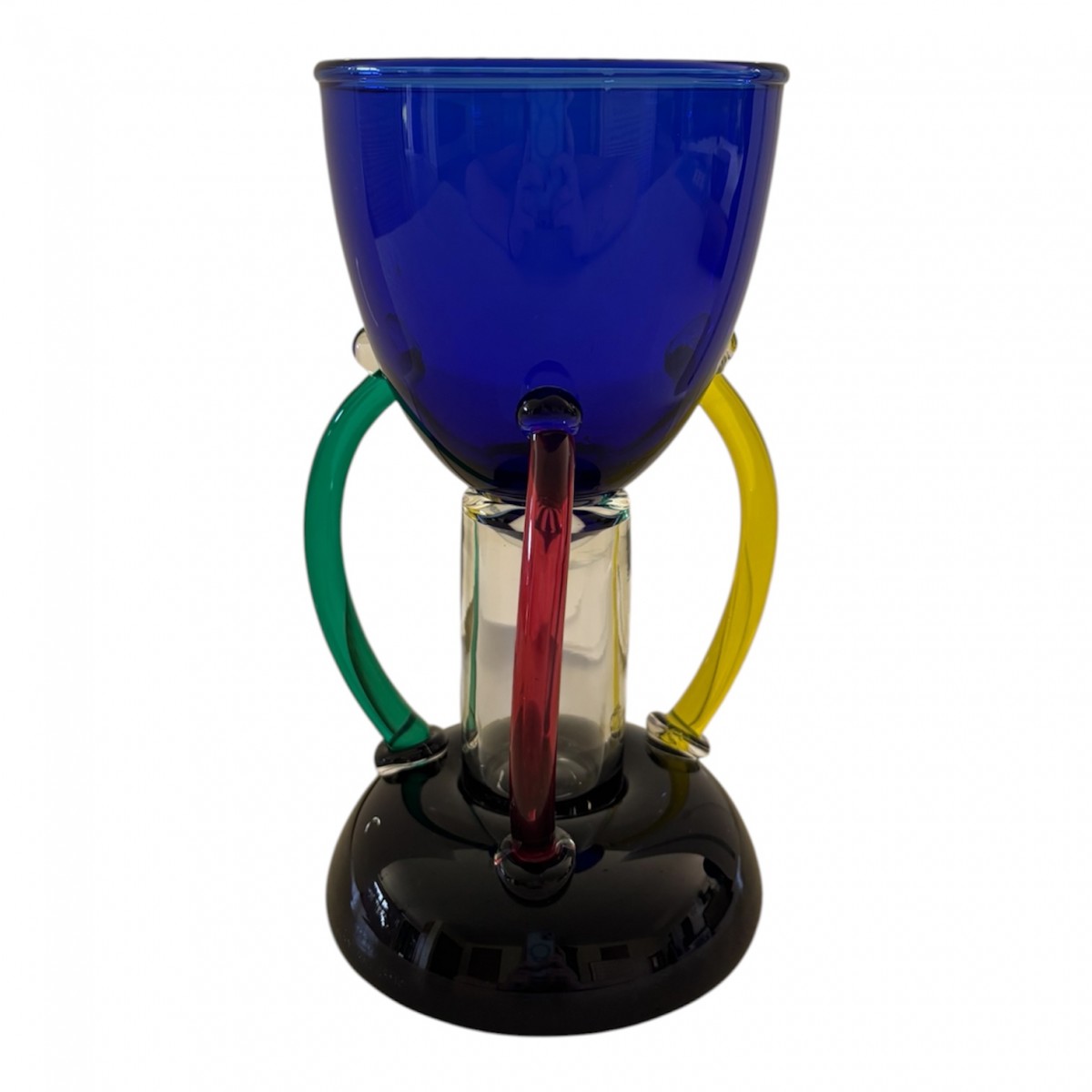
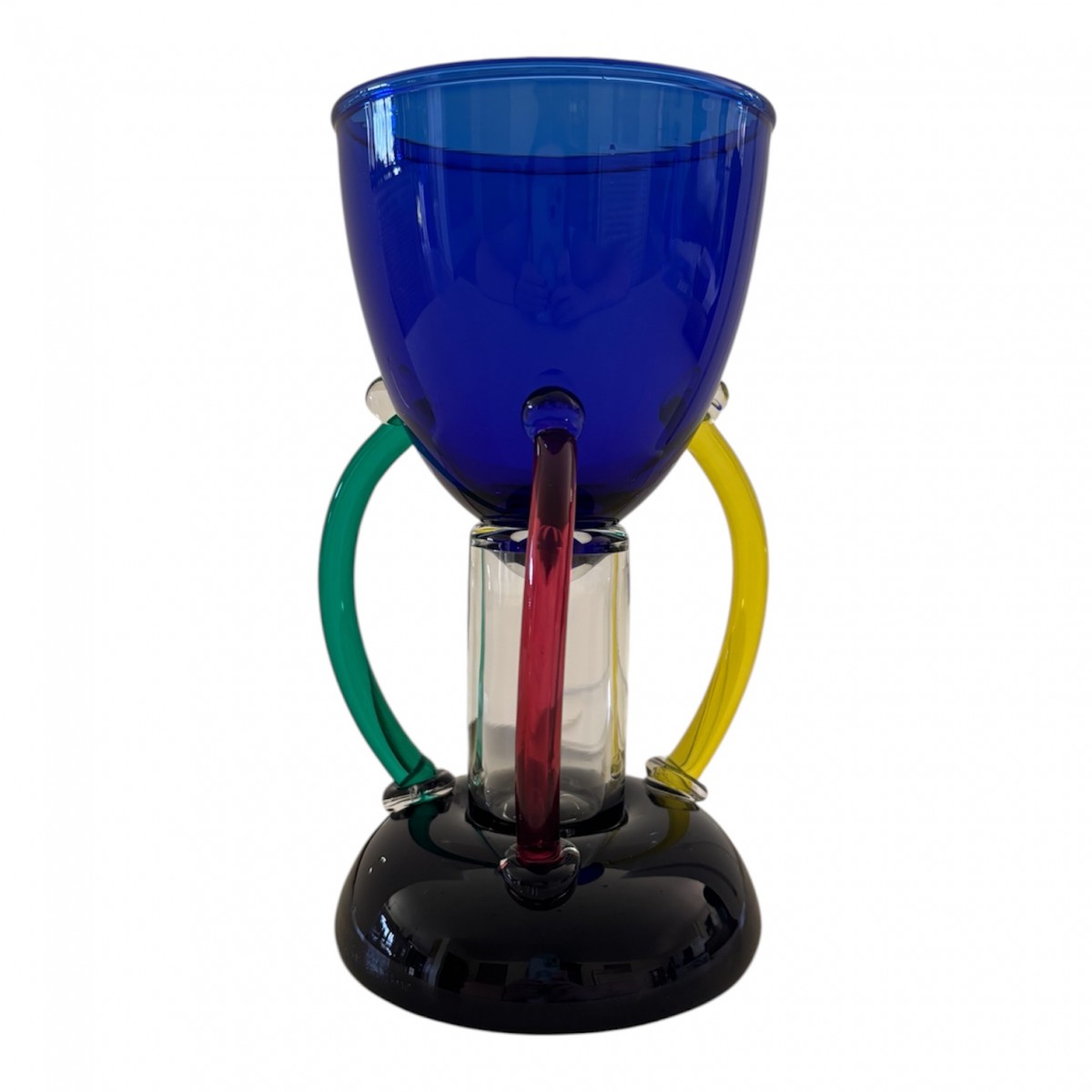
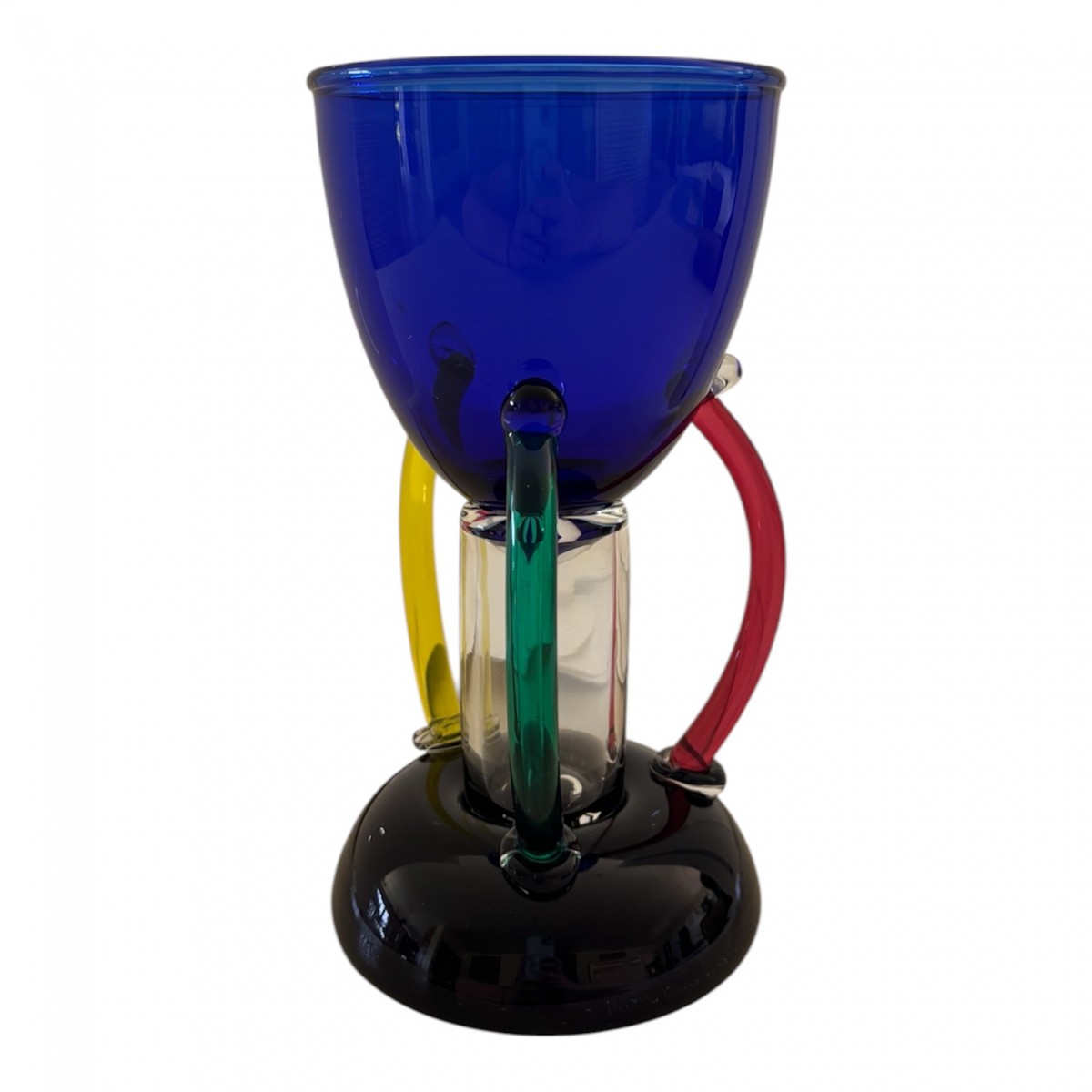
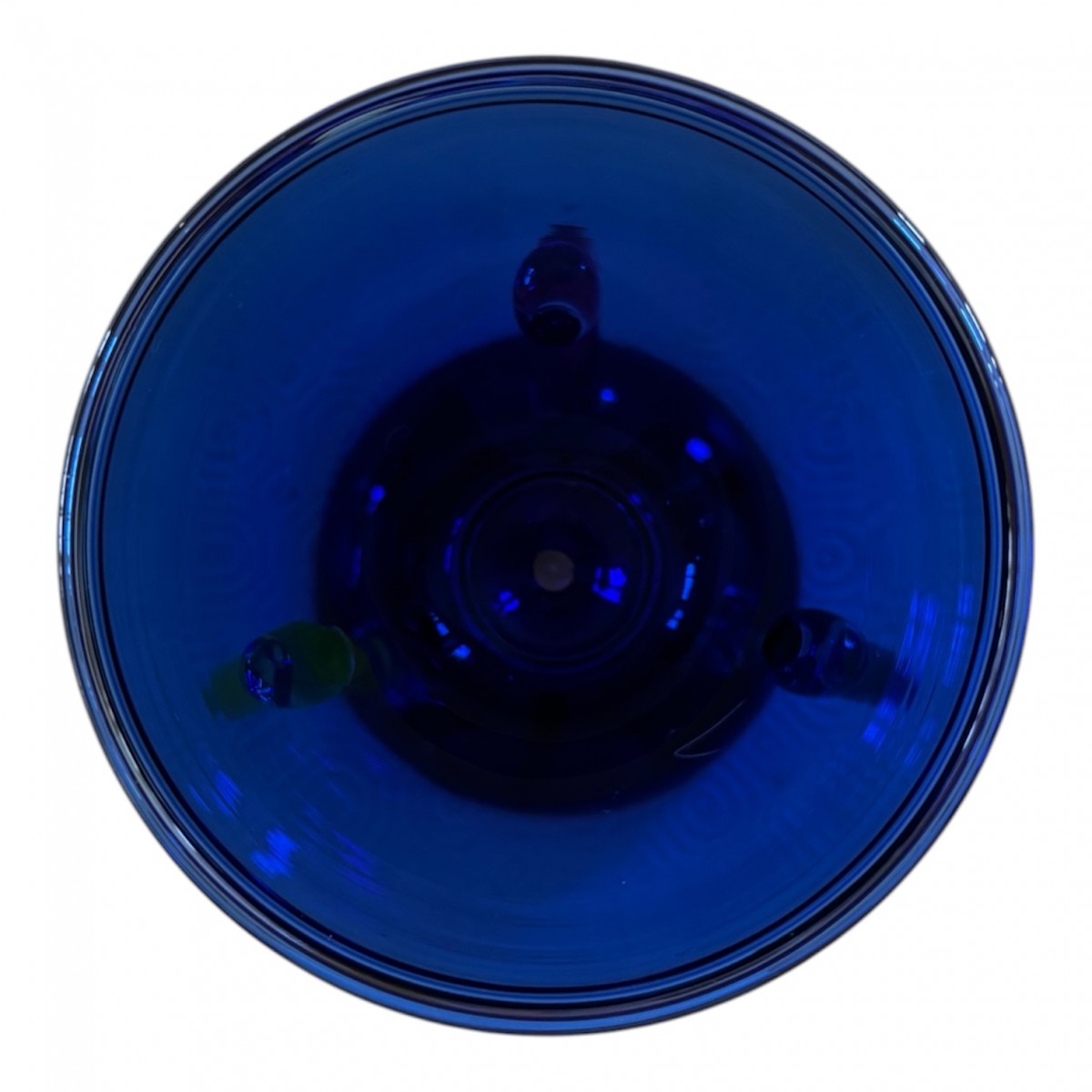
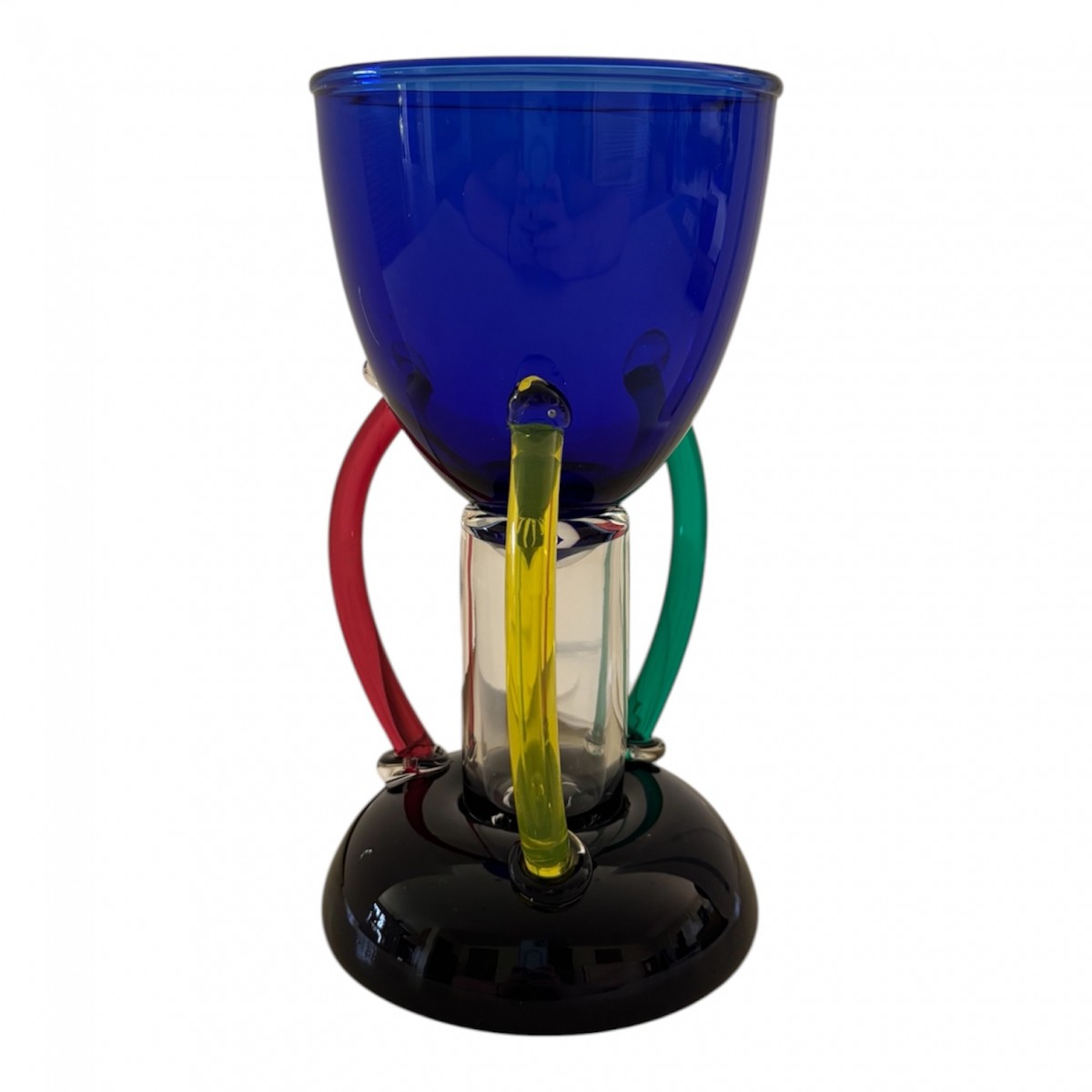
Polychrome blown glass bowl consisting of a large oval receptacle in cobalt blue glass resting on a cylindrical element in colorless glass, the whole being supported by a circular domed base in black glass.
Three tubular elements of coloured glass, bent in an arc and arranged around the central axis, connect the receptacle to the base. Respectively tinted with green, yellow and amethyst-red, they are fixed at the ends by ring-shaped fasteners made of colourless glass. The transparency of the different elements, combined with the intensity of blue and black, creates a particularly graphic interplay of superimposed volumes and bold colours.
Analysis and comment :
Designed in 1982, the "Deneb" cup belongs to the first glass creations designed by Ettore SOTTSASS for Memphis, a movement of which he is the founding figure.
The adventure began in Milan at the end of 1980 around Ettore SOTTSASS, surrounded by Martine BEDIN, Aldo CIBIC, Michele DE LUCCHI, Nathalie DU PASQUIER, Matteo THUN and George J. SOWDEN.
From the first collection presented in September 1981, the group opened up to other personalities of international design and architecture, including Andrea BRANZI, Shiro KURAMATA, Peter SHIRE, Michael GRAVES, Hans HOLLEIN, Arata ISOZAKI and Masanori UMEDA. Barbara RADICE, design critic and theorist, accompanies the adventure and plays an essential role in its formulation and diffusion.
Memphis sought to break away from the rationalist and functionalist principles that had dominated much of modern design. To formal unity and discretion, its creators oppose readily dissonant assemblages, frank colors, bold decorative patterns and materials hitherto considered incompatible. The object is no longer thought only according to its use: it becomes a carrier of an image, of a narrative and emotional dimension.
It is in this context that Ettore SOTTSASS draws "Deneb". The model belongs to a set of glassworks created in 1982 and executed by Toso Vetri d'Arte in Murano, alongside notably "Altair", "Mizar" and "Sirio".
The use of master glassmakers from Murano allows the designer to confront the radical language of Memphis with a centuries-old artisanal tradition, making blown glass a true plastic building material. The historical Memphis catalog documents "Deneb" as early as 1982 and specifically identifies Toso Vetri d'Arte as the manufacturer.
The uniqueness of "Deneb" lies precisely in this conception of the object as an assembly. Rather than seeking the unity and continuity of a traditional form, Ettore SOTTSASS juxtaposes elements of different geometries, dimensions and colors. Their balance seems almost improbable, as if the cut resulted from a temporary construction. This visual tension, skillfully controlled, is characteristic of his work in the early 1980s.
Polychromy fully participates in this architecture. Colored masses, transparent elements and contrasting tones do not constitute a decoration applied to the form: color itself becomes a constructive element. The transparency of glass also allows the different parts to visually overlap and constantly renews the perception of the object according to its orientation and the light passing through it.
The name "Deneb" is taken from the main star in the constellation of Cygnus, one of the brightest stars in the night sky. It is part of the celestial nomenclature adopted by Ettore SOTTSASS for several Memphis glassworks from 1982, including "Altair", "Mizar" and "Sirio".
This poetic dimension offers a subtle counterpoint to the formal radicalness of these objects. On the border between a use object, sculpture and design manifesto, "Deneb" thus summarizes several of the essential principles of Memphis: freedom of composition, expressive primacy of color, questioning of traditional hierarchies between decorative arts and finearts, and a meeting between contemporary creation and artisanal know-how. By its immediately identifiable design, it is today one of the characteristic glassworks of the Memphis period of Ettore SOTTSASS.
Bibliography:
Barbara Radice, Memphis: Research, Experiences, Results, Failures and Successes of New Design, Rizzoli, NY 1984;
Milco Carboni, Ettore Sottsass Jr. '60-'70, Hyx, Orléans, 2006;
AA.VV., Memphis Milano. Thanksgiving official 1982-1983, Milan, 1983.
Delevery information :
We take care of the packaging and shipping of the items.
Shipments are tracked and insured.
Transport costs are the responsibility of the buyer.