Offered by Galerie Philippe Guegan
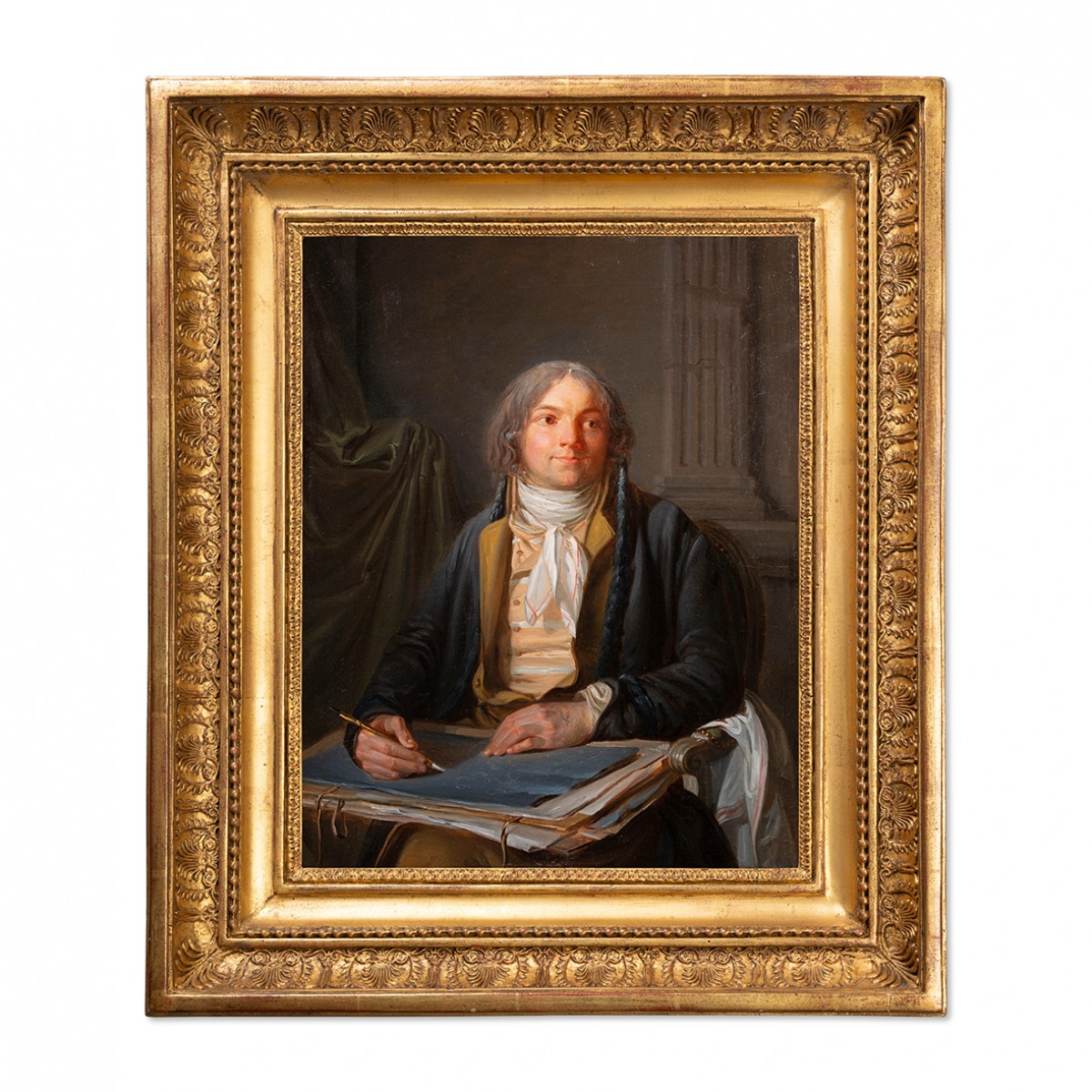

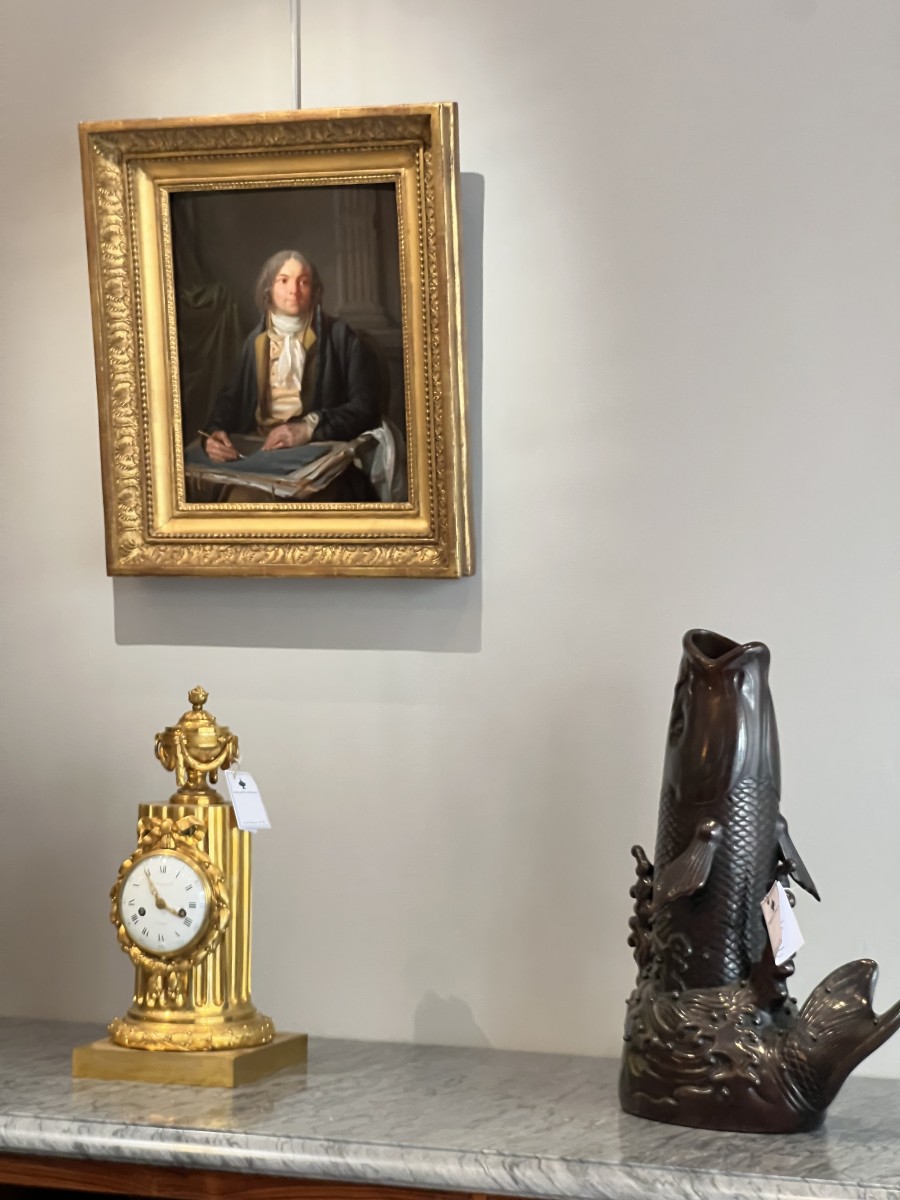
NICOLAS LE JEUNE (1750-1804) (ATTRIBUTED TO)
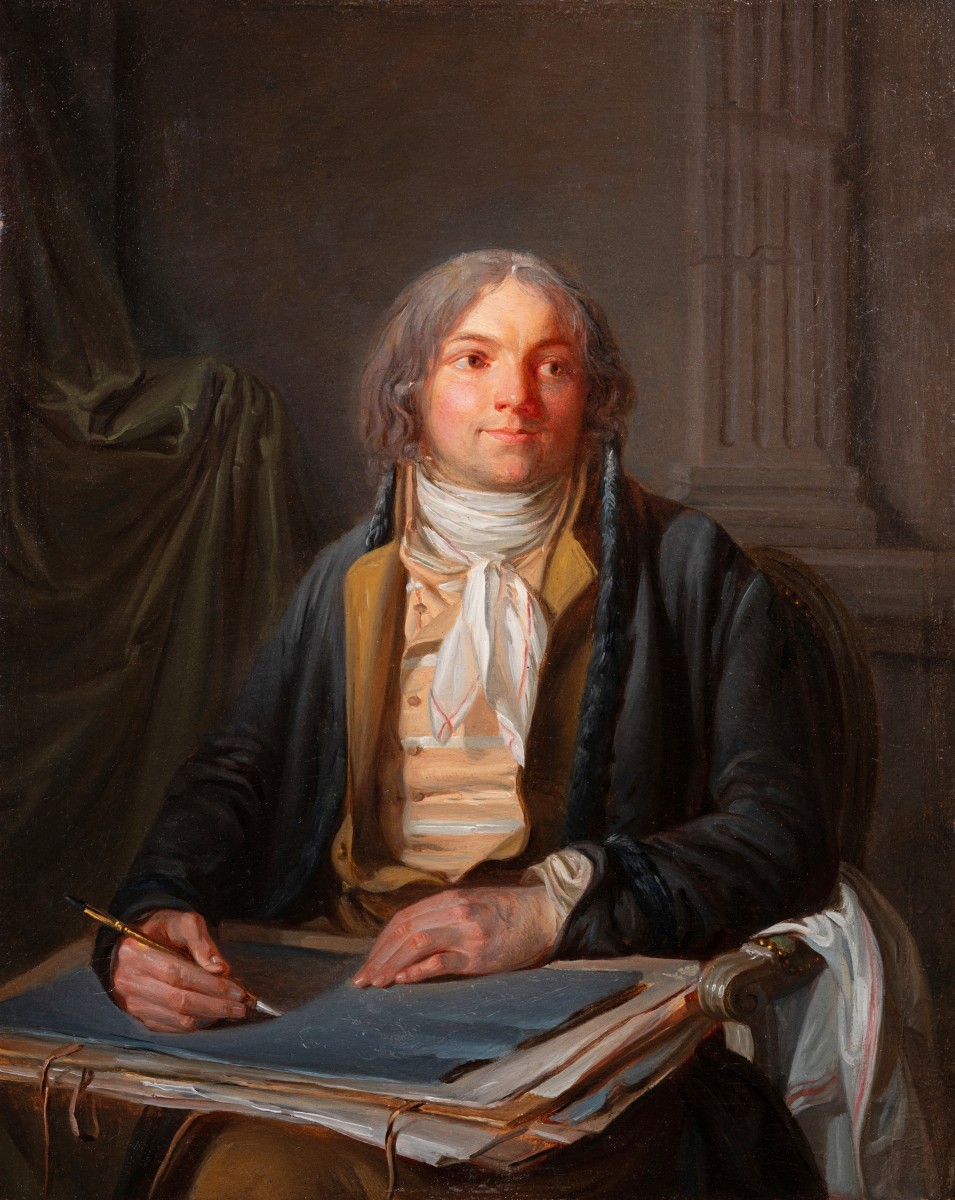
Portrait of the painter Jean-Baptiste Jacques Augustin (1759-1832)
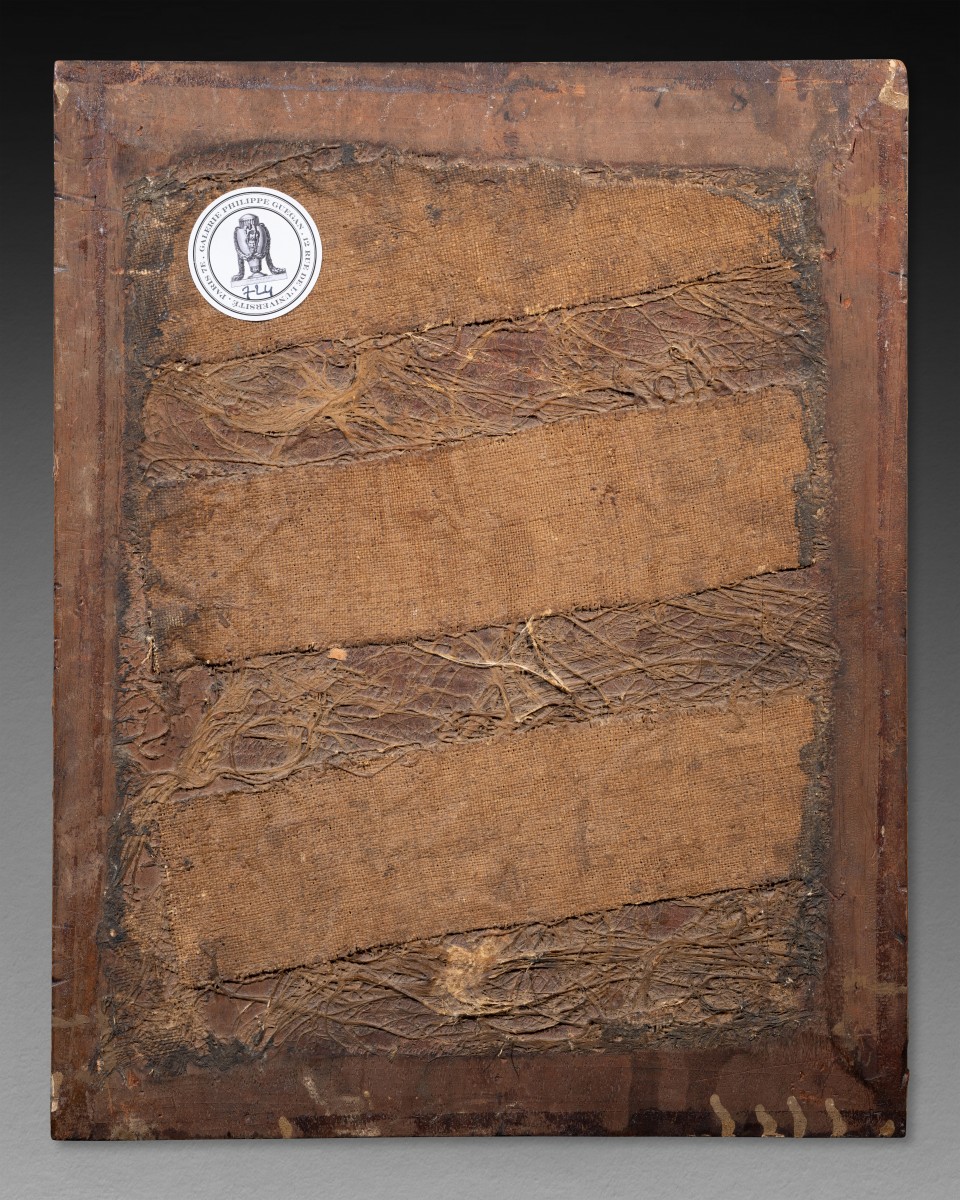
Oil on panel by 1795 : 32,5 x 25,8 cm (12,8 x 10,1 in.)
Exhibited: in all likelihood the Salon of 1796, no. 281
Giltwood frame with palmette decoration: 44,5 x 38,5 cm (17,5 x 15,2 in.)
Litt. : Bernd Pape, Jean-Baptiste Jacques Augustin 1759-1832, Scripta Edizioni, 2015, page 33
The present painting constitutes the rediscovery of a portrait of Augustin executed by Nicolas Le Jeune, recorded by Bernd Pape in his monograph devoted to this prodigy of miniature portraiture, and hitherto considered untraced.
The iconography of Jean-Baptiste Jacques Augustin is particularly rich. Throughout his career, he produced numerous self-portraits and, in the closing years of the eighteenth century, sat for several artists. His friend Henri-J. François portrayed him in 1791 , exhibiting the work at the Salon of that year . At the Salon of 1796, Nicolas Le Jeune presented the present portrait of his friend Augustin, while, in 1798, Louis Léopold Boilly included him in the background of his Réunion d’artistes dans l’atelier d’Isabey .
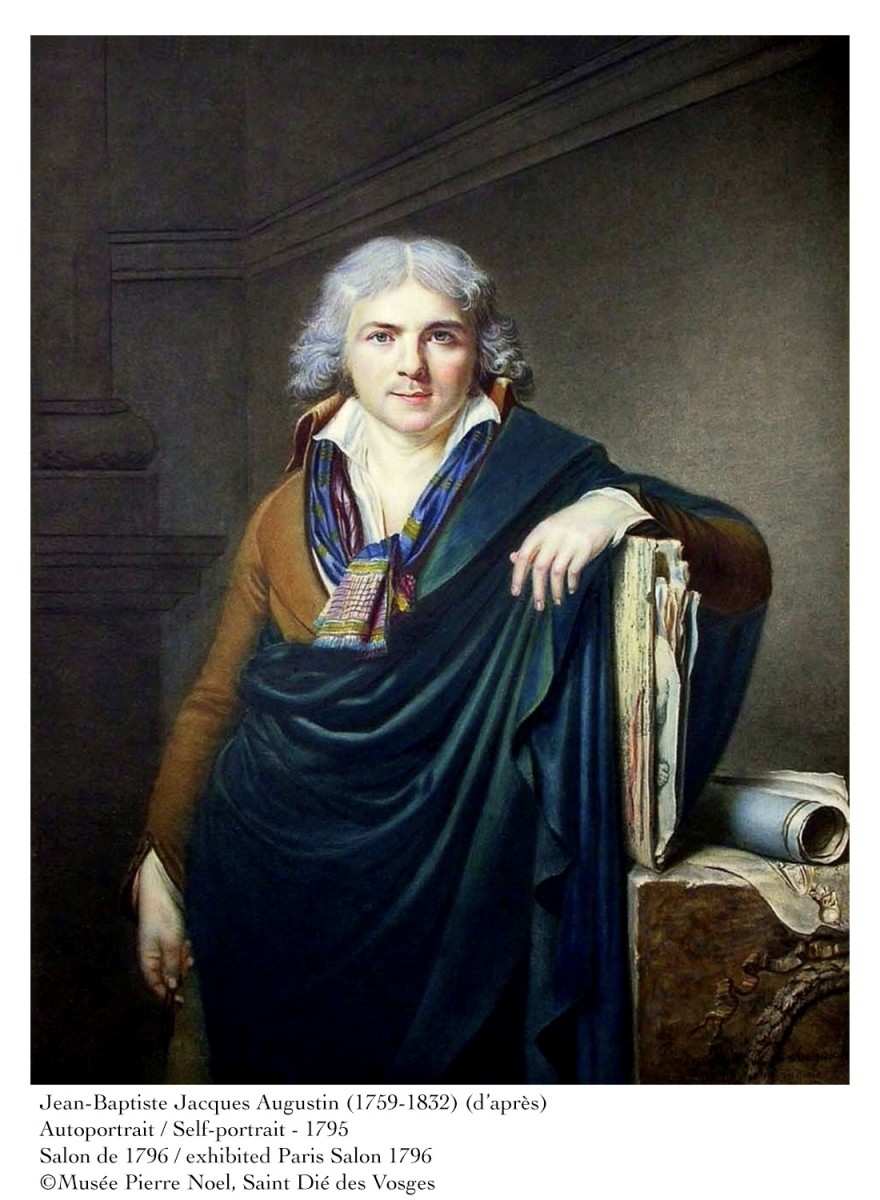
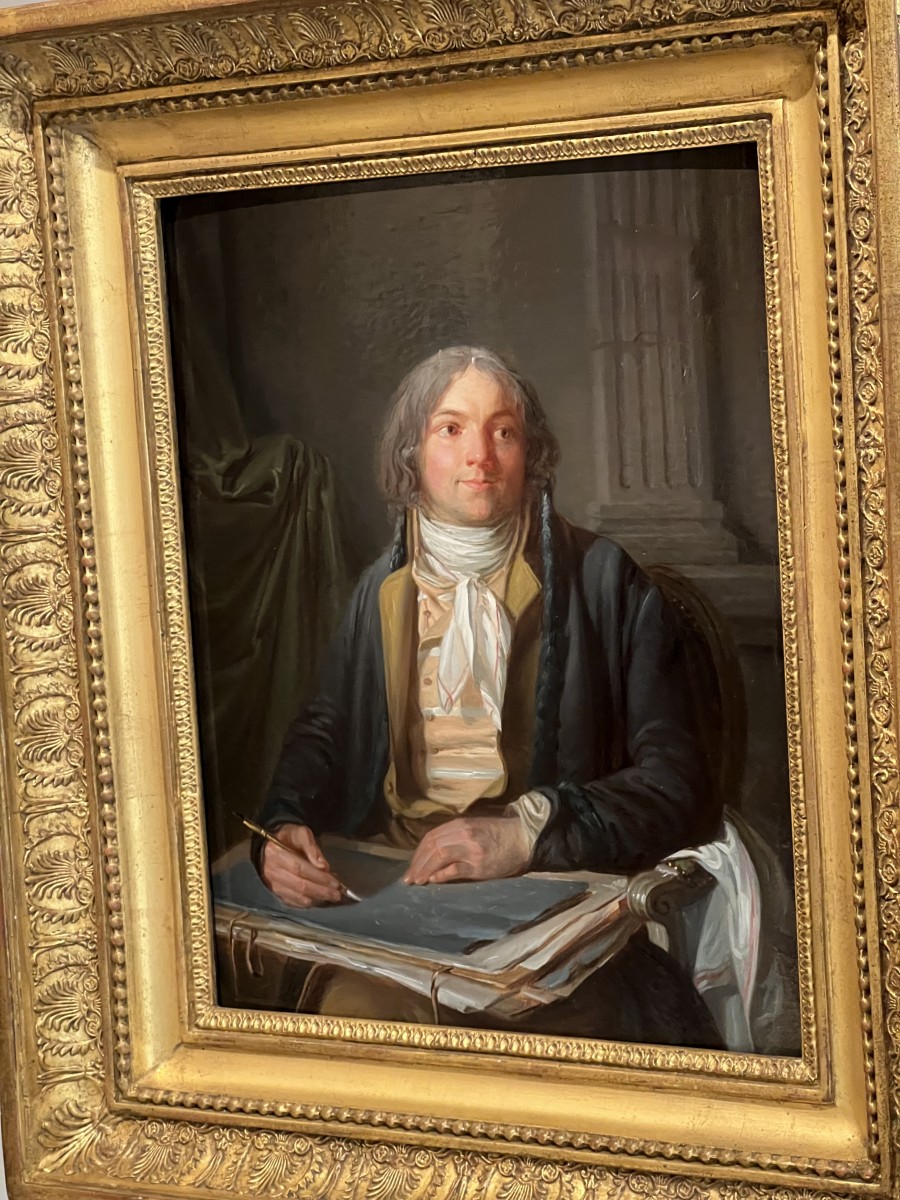
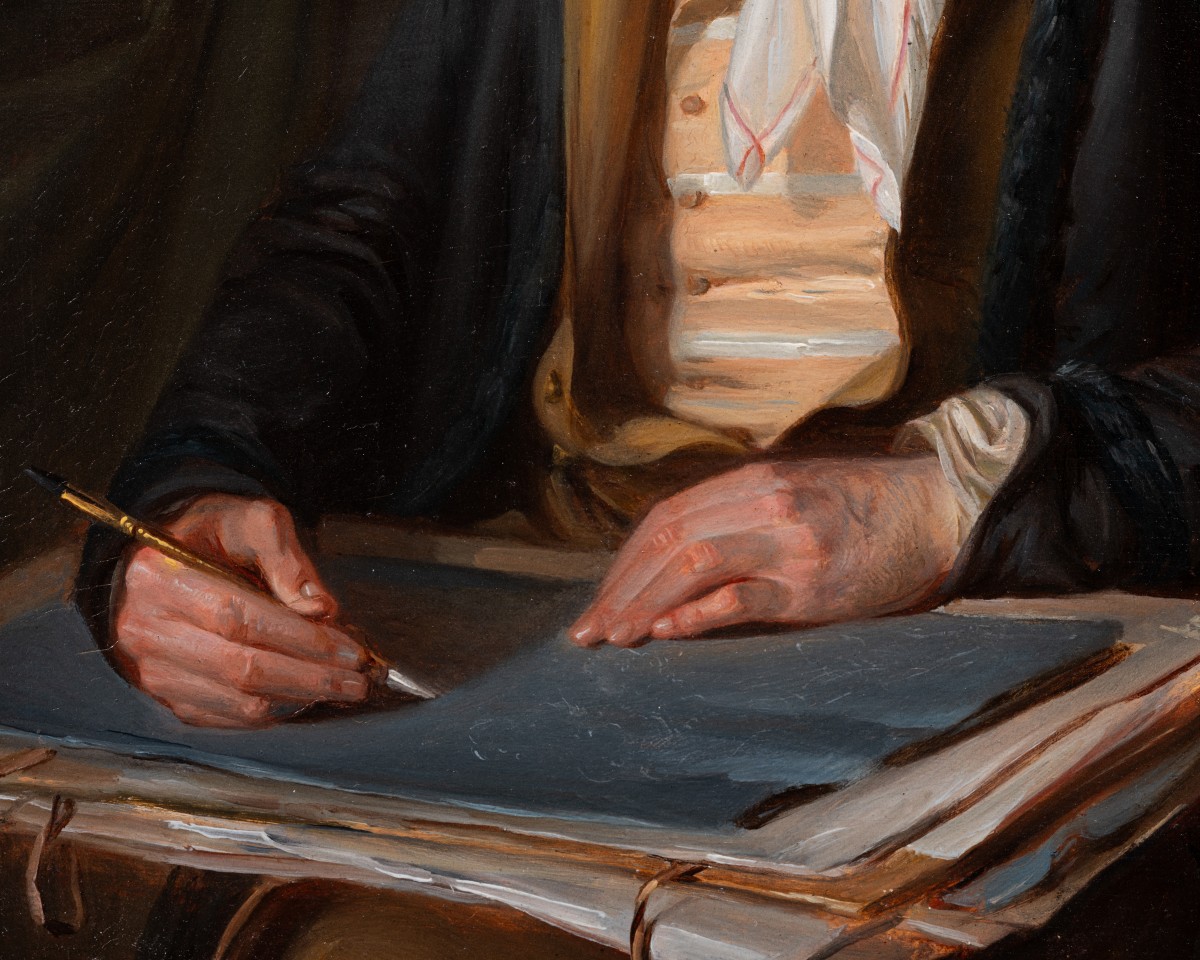
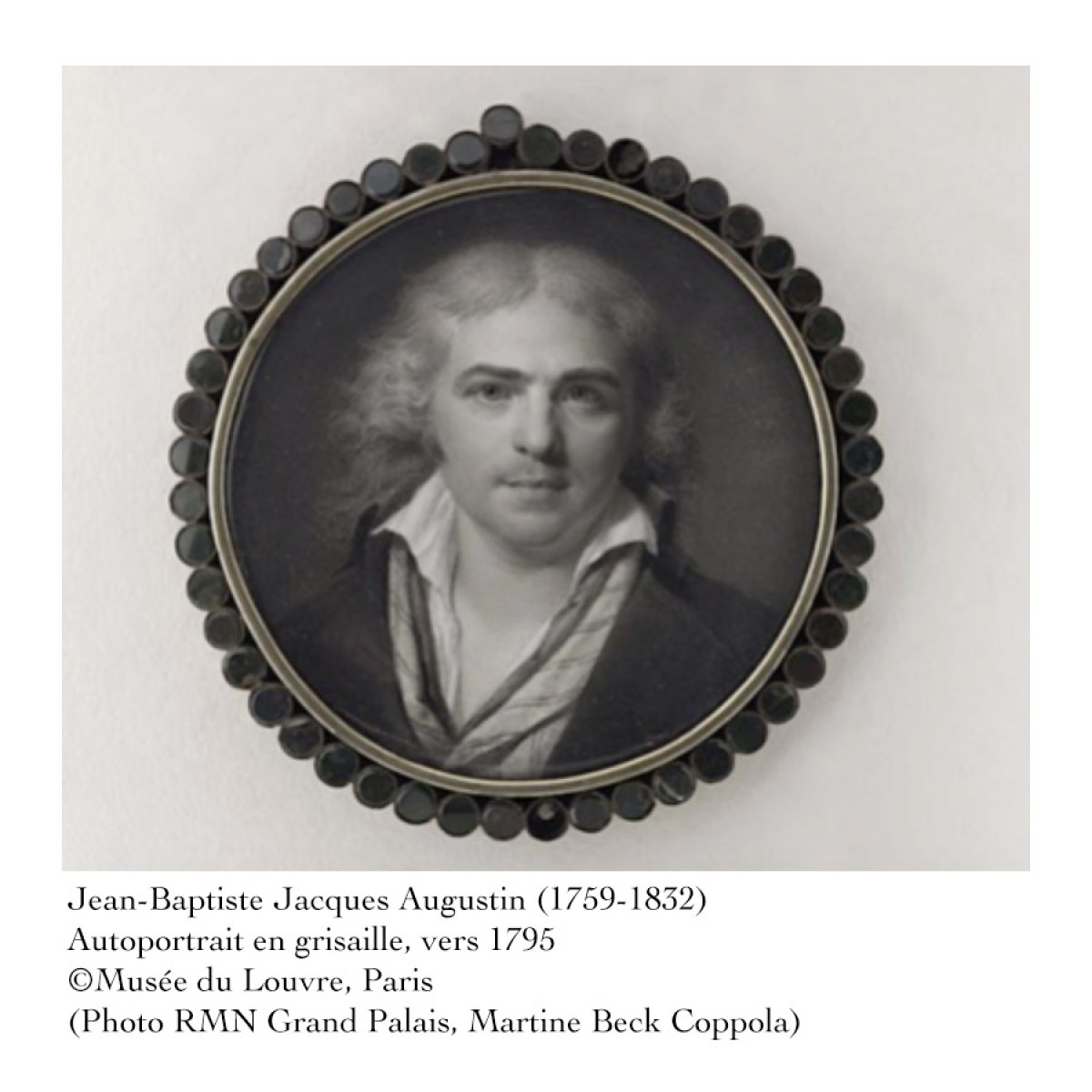
Here, the artist is depicted half-length, seated in an armchair, engaged in drawing with white chalk upon a sheet of blue paper, a portfolio resting upon his knees. As in the self-portrait he exhibited at the same Salon of 1796 , Augustin is represented as a painter rather than as a miniaturist—a distinction of no small consequence, for the latter discipline had been explicitly devalued by the Institut, which, in 1795, refused miniaturists admission to the Académie des Beaux-Arts. Deeply affected by this rebuff, Augustin devoted his entire career to elevating miniature painting to the rank of oil painting, a medium he mastered with consummate skill, and in which he sought recognition as a painter in the fullest sense. His self-portrait of 1796, in this regard, met with widespread acclaim .
As in the large miniature of 1795, he is here attired in an elegant fawn-coloured coat, over which is draped a blue mantle. Augustin appears to have been particularly attached to this garment, which Bernd Pape has interpreted as a possible allusion to a small circle of artists close to David—the so-called Primitifs or Barbus—active between circa 1790 and 1795 under the leadership of Maurice Quai. The latter exhorted his followers to renew their art by returning to the sources of archaic Greek art (antecedent to Phidias), and enjoined them to adopt antique modes of dress, including the wearing of a voluminous blue cloak:
“I have resolved to abandon these paltry garments worn by all men of our century […] I have let my hair and beard grow; a large white tunic is now being completed, which I shall wear beneath a broad blue cloak, and henceforth I shall wear nothing upon my feet but cothurni. ”.
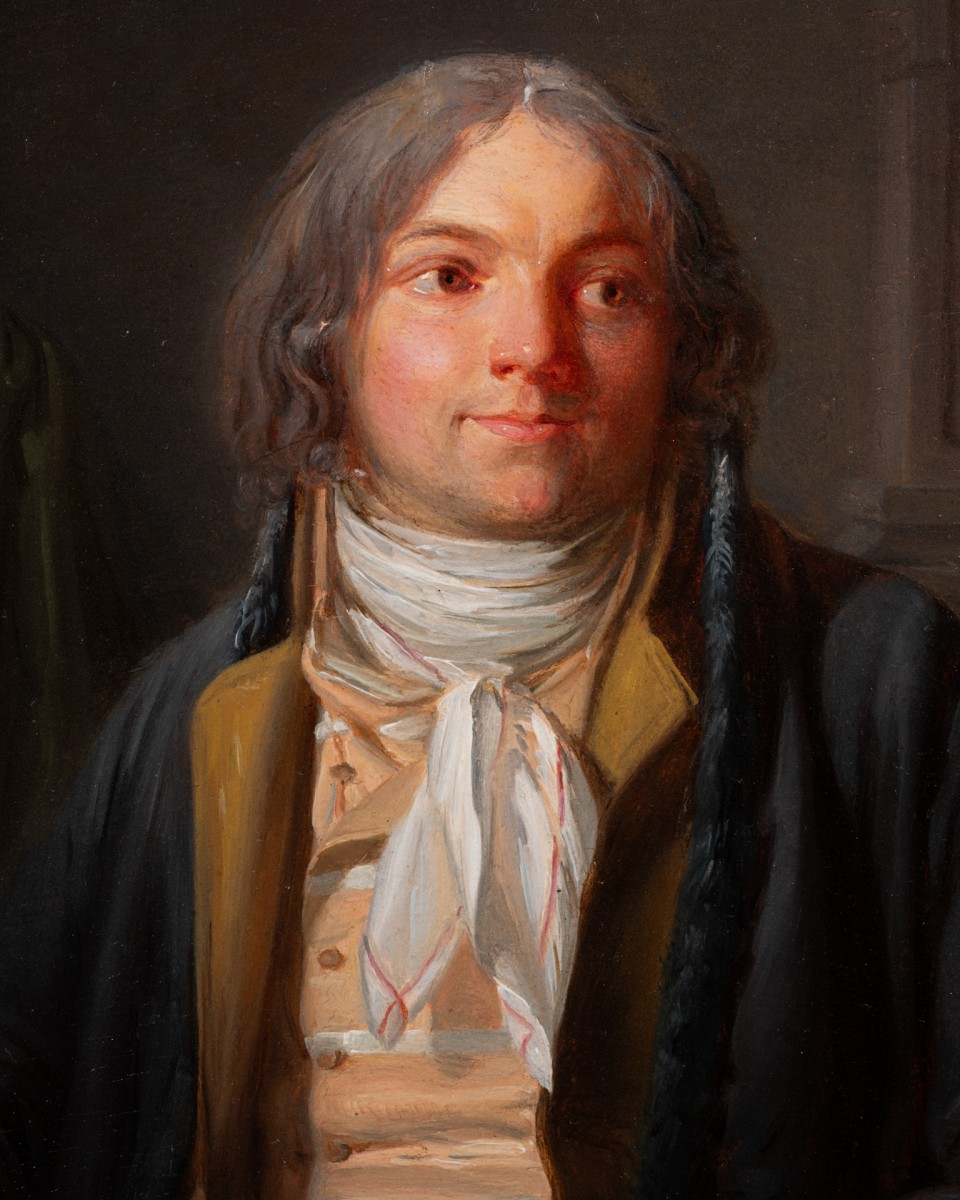
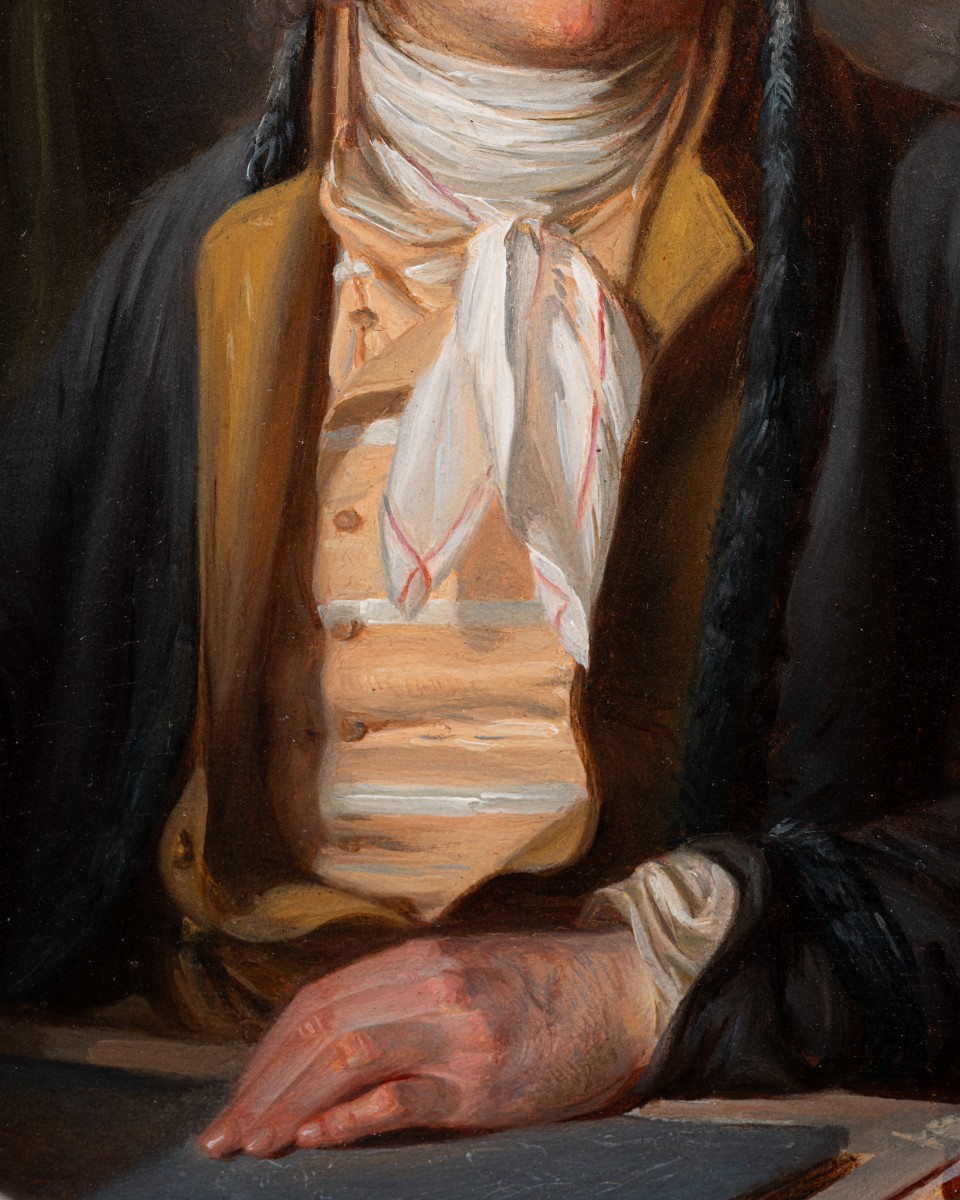
Although Augustin does indeed wear his hair long, arranged in the so-called oreilles de chien fashion framing the face, he does not appear to have embraced the more extravagant vestimentary prescriptions of Maurice Quai. Rather, he is clad in the fashion of the Revolutionary years, readily identifiable in the striped silk waistcoat and the scarf with coloured borders replacing the lace cravat of the Ancien Régime—elements likewise visible in several portraits he painted between 1795 and 1797 .
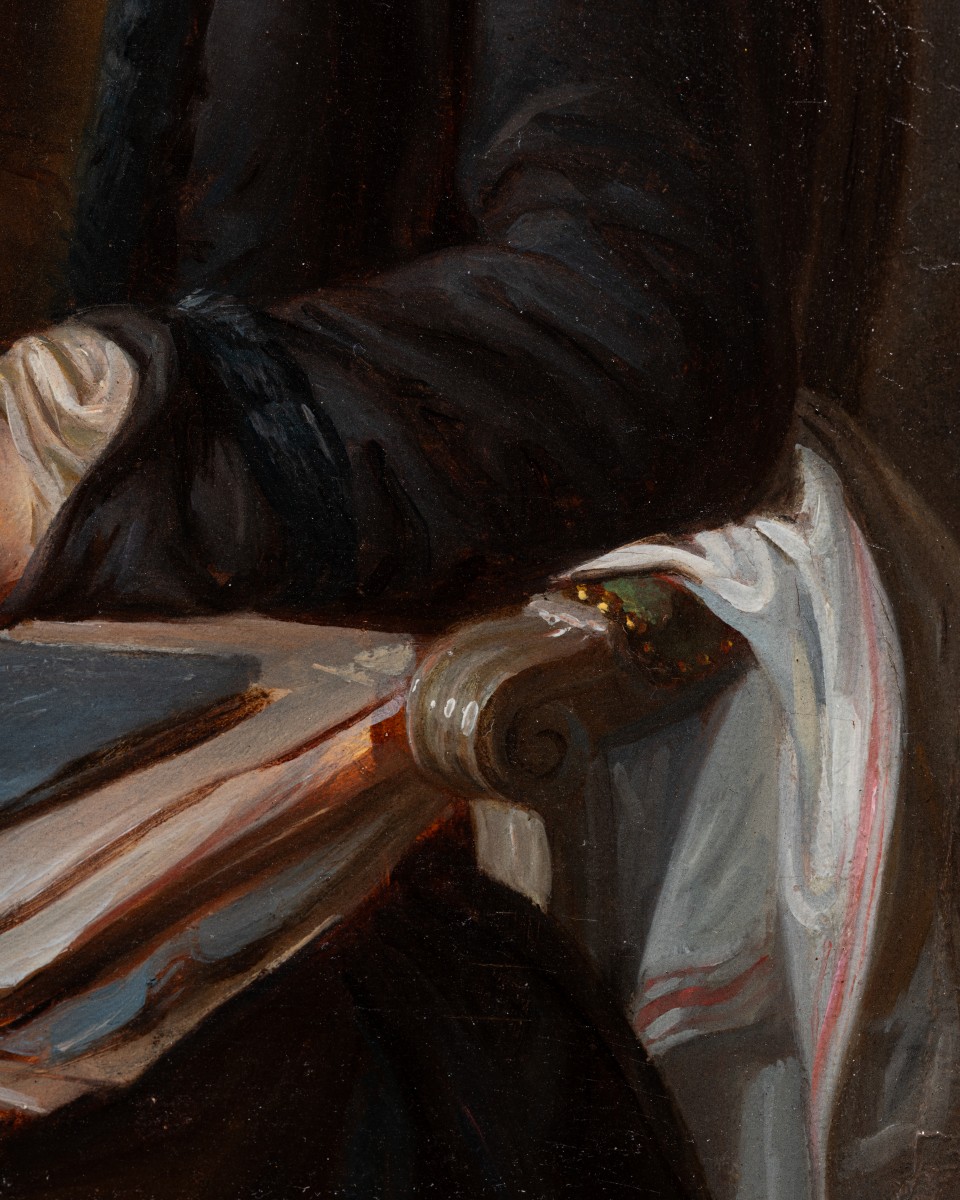
The background, almost monochrome, reveals in a subtle gradation of greys a fluted pilaster adorning the rear wall, while a green drapery closes the composition to the left. The white handkerchief edged in red, placed upon the arm of the chair, echoes that tied about the artist’s neck. A lateral, oblique light entering from the left models the flesh tones of the face and hands in a refined chiaroscuro, catching the sheen of the silk waistcoat and the lacquered surface of the chair, while leaving the face itself partially in shadow, turned three-quarters towards the subject upon which he is intent.
Nicolas Le Jeune (1750–1804)
Few biographical details concerning Nicolas Le Jeune have come down to us. He was a pupil of the Académie Royale, and subsequently trained in the Paris studio of Louis Jean François Lagrenée. He travelled to Rome in the early 1770s, as attested by a number of etchings dated there in 1771, and by the second prize he was awarded that same year at the Concorso Clementino of the Accademia di San Luca for his drawing The Feast of Absalom , a version of which is now held in the Horvitz Collection .
In the 1790s, he became a member of the Berlin Academy and painter to the King of Prussia, and took part in his first Salon in Paris in 1793 under the title of painter to the Berlin Academy. He likely lived and worked in Prussia at the turn of the 1780s and 1790s. He continued to exhibit at the Salons until 1804, presenting history subjects, landscapes, and painted portraits.
During the Revolutionary period, he produced numerous drawings for the engraver François-Anne David, a pupil of Lebas, who recorded through print the events of the early Revolution relating to the Estates-General and the constitutional monarchy, including The Oath of Louis XVI before the National Assembly on 4 June 1790, which appeared in the sale of drawings from the Léon Roux collection, 20–22 April 1903.
Nicolas Le Jeune appears to have been a close friend of Augustin. Bernd Pape notes that he was the author of the painted ceiling of Augustin’s study at his residence at 25 rue Croix-des-Petits-Champs; a watercolour depiction of this interior, dated circa 1820, is preserved in the collections of the Musée de l’Horlogerie in Geneva .
Jean-Baptiste Jacques Augustin (1759–1832)
Jean-Baptiste Jacques Augustin, one of the foremost French painters in miniature, was born in Saint-Dié. He was probably trained by Jean-Baptiste Claudot in Nancy in the late 1770s, and by his brother Augustin Dubourg in Dijon, although he described himself as self-taught.
He arrived in Paris during Lent 1781, at the age of twenty-two, and was likely introduced by the Lorrain Guibal, son of the sculptor of the same name, into the studio of the miniature painter Gatien Philipon. In 1791, he occupied a furnished apartment at the Café David, at the corner of the rue Saint-Honoré and the rue du Roule, and took part in the Salon for the first time. The following year, the expansion of his clientele appears to have secured him a more comfortable situation, as he moved into an apartment on the boulevard de Bonne-Nouvelle, in the house of Citizen La Salle.
Augustin reached full artistic maturity during the Directory. In 1796, he exhibited at the Salon his self-portrait, a landmark in his career, and from that point onward held a pre-eminent position among French miniaturists, alongside Jean-Baptiste Isabey and Jean-Baptiste Guérin.
Official painter to the court under the Empire, his reputation endured under the Bourbon Restoration, and in 1814 he was appointed peintre ordinaire du roi.
Delevery information :
Please contact us upon this matter. For delivery abroad, we will ask door to door transportation to be quoted by independant shipping companies,