Offered by Franck Baptiste Paris
REQUEST INFORMATION
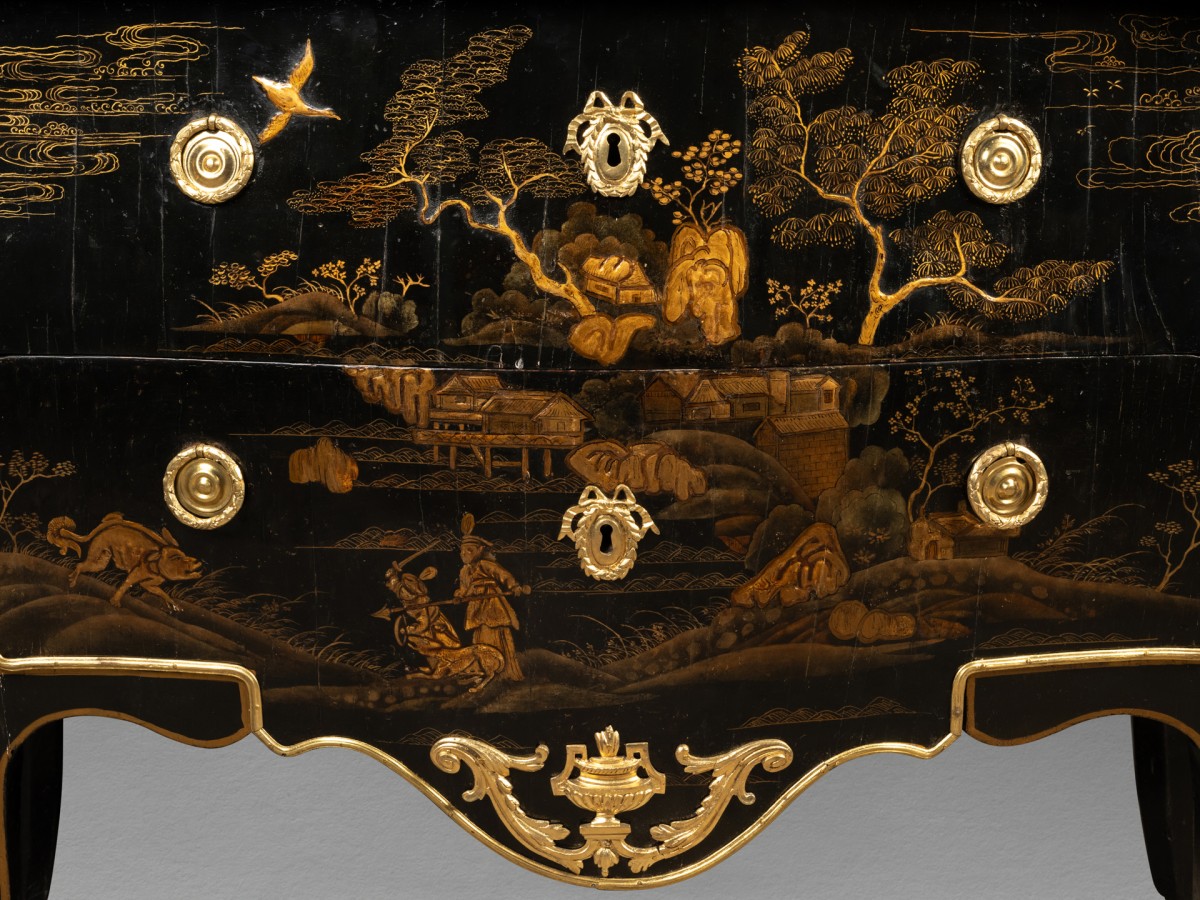
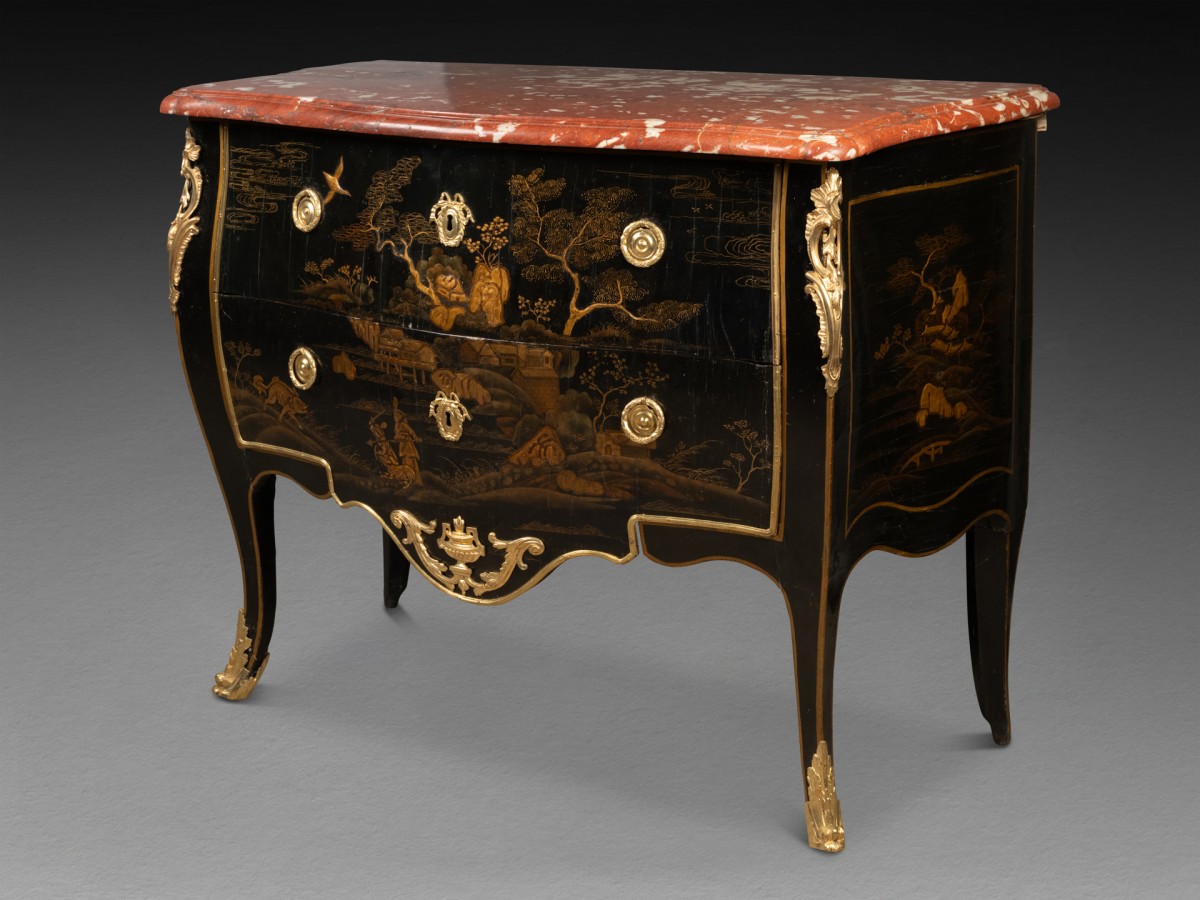

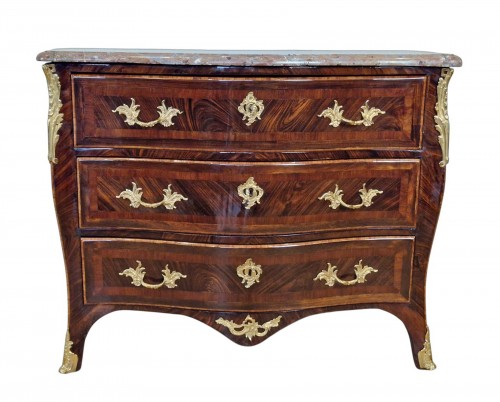
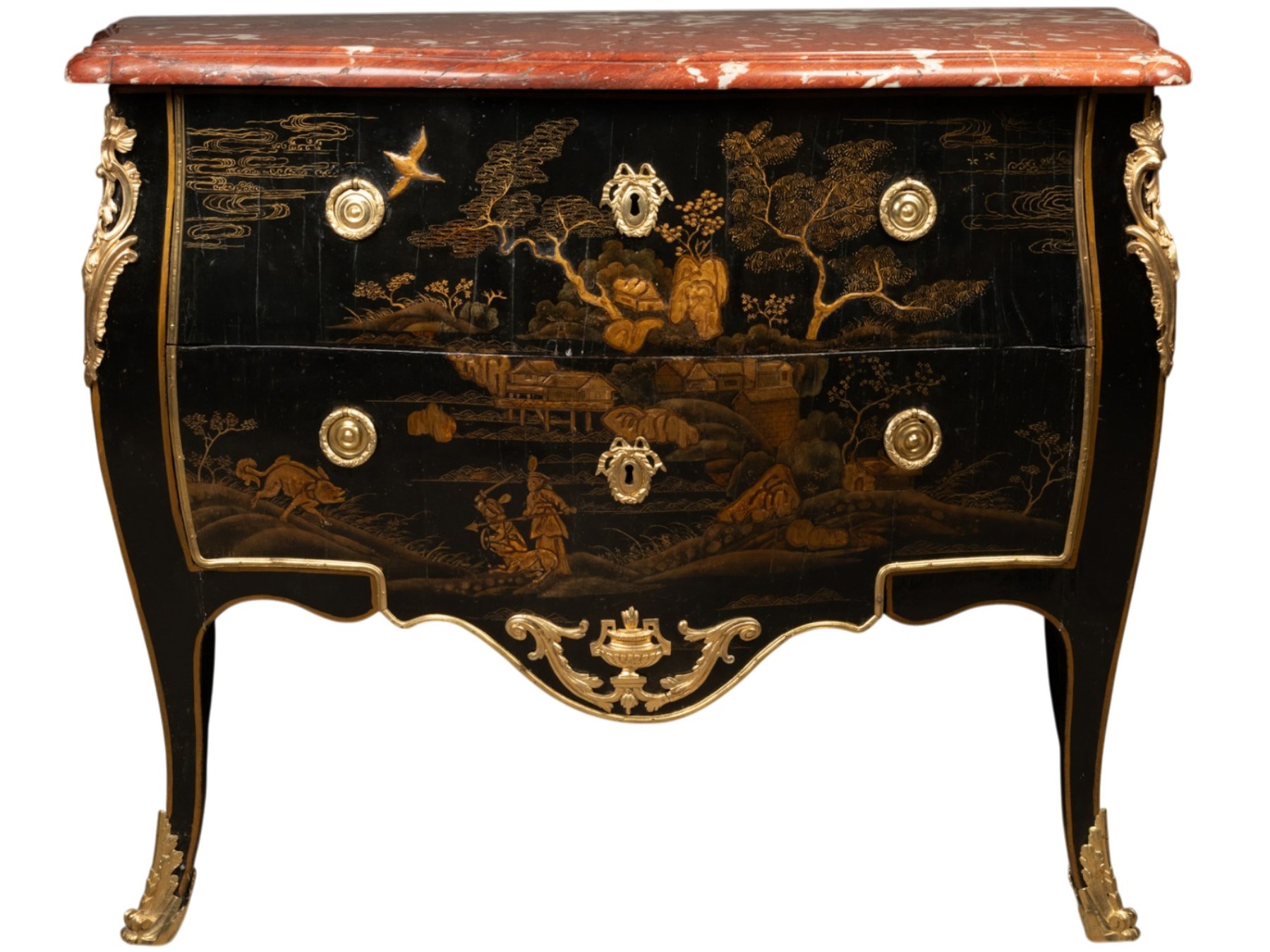
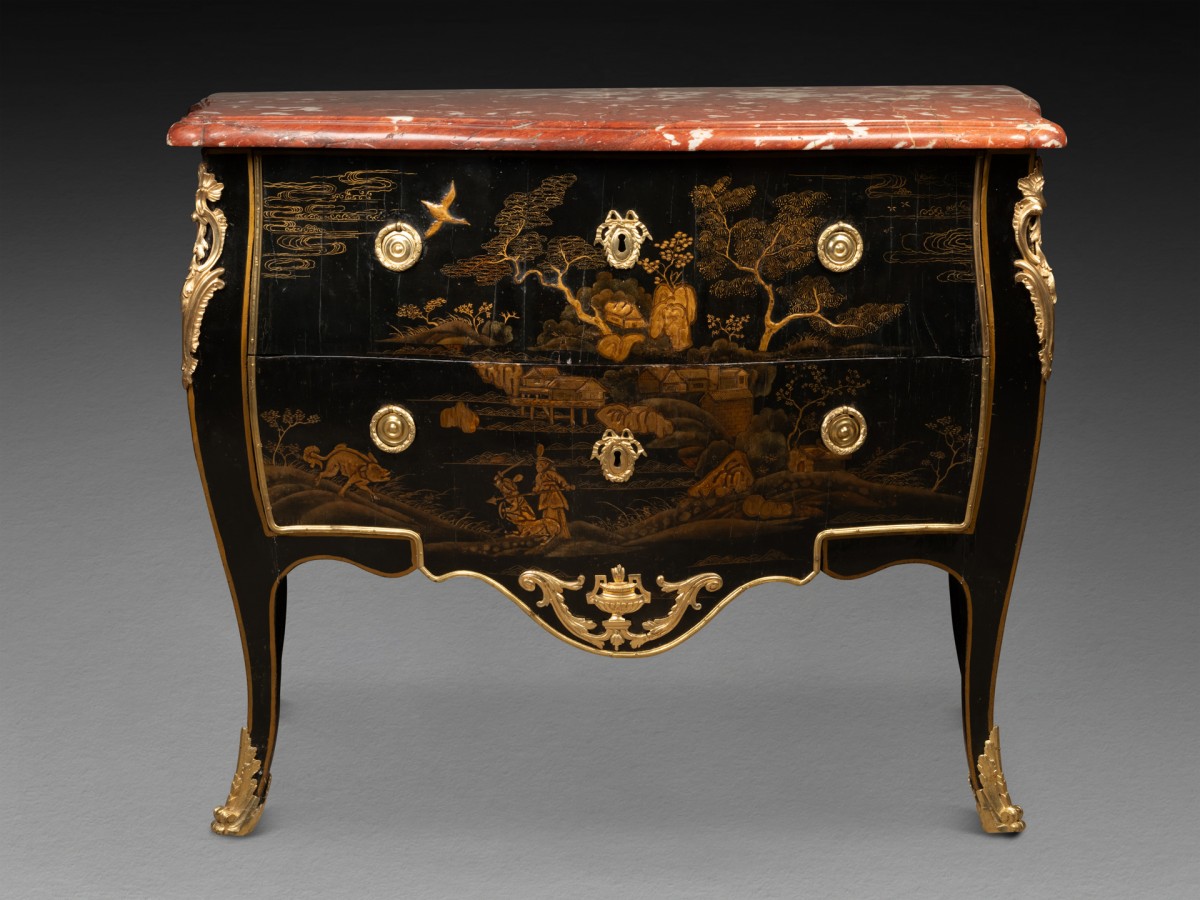
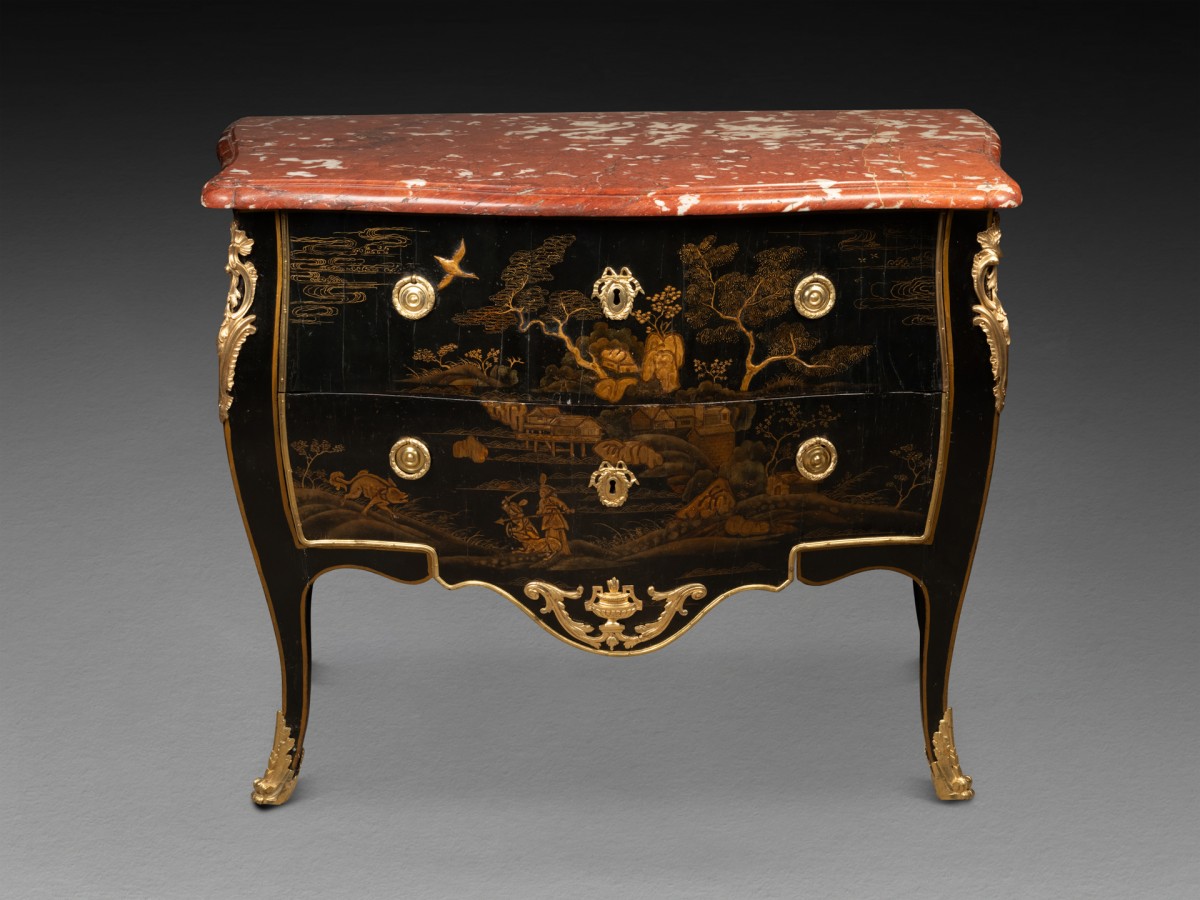
An elegant commode with two drawers and no central divider, curved on the front and sides, resting on four cabriole legs.
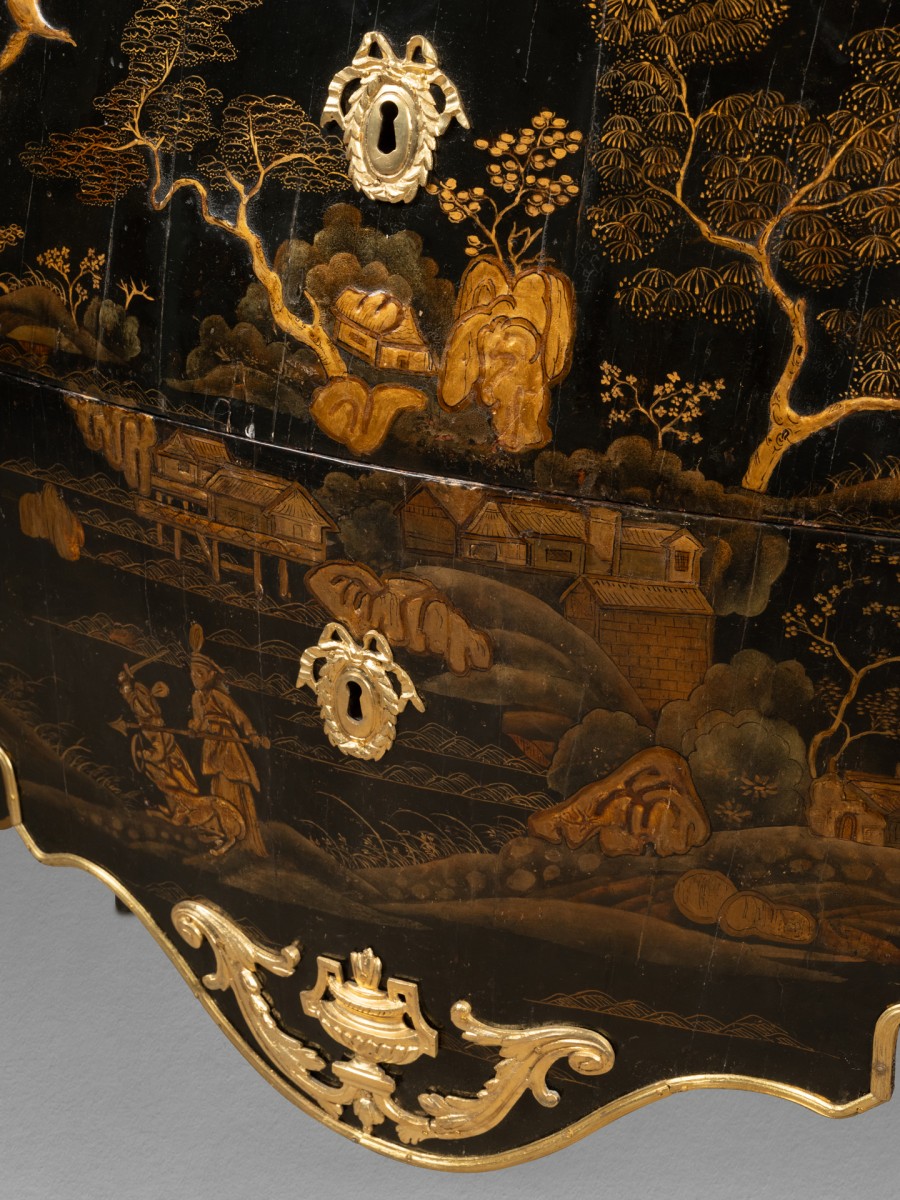
The Martin varnish decoration, executed in imitation of Chinese lacquer, adorns the three sides: against a deep black background, lakeside landscapes unfold in high relief with gold and copper powder, enlivened by strollers in traditional costumes, a junk, and houses on stilts.
The original mercury-gilt bronze mounts consist of corner drops, openwork foot finials, a lamp base, keyhole escutcheons, and handles with laurel wreaths, all finely chased.
Original "royal red" marble top.
Oak frame and back.
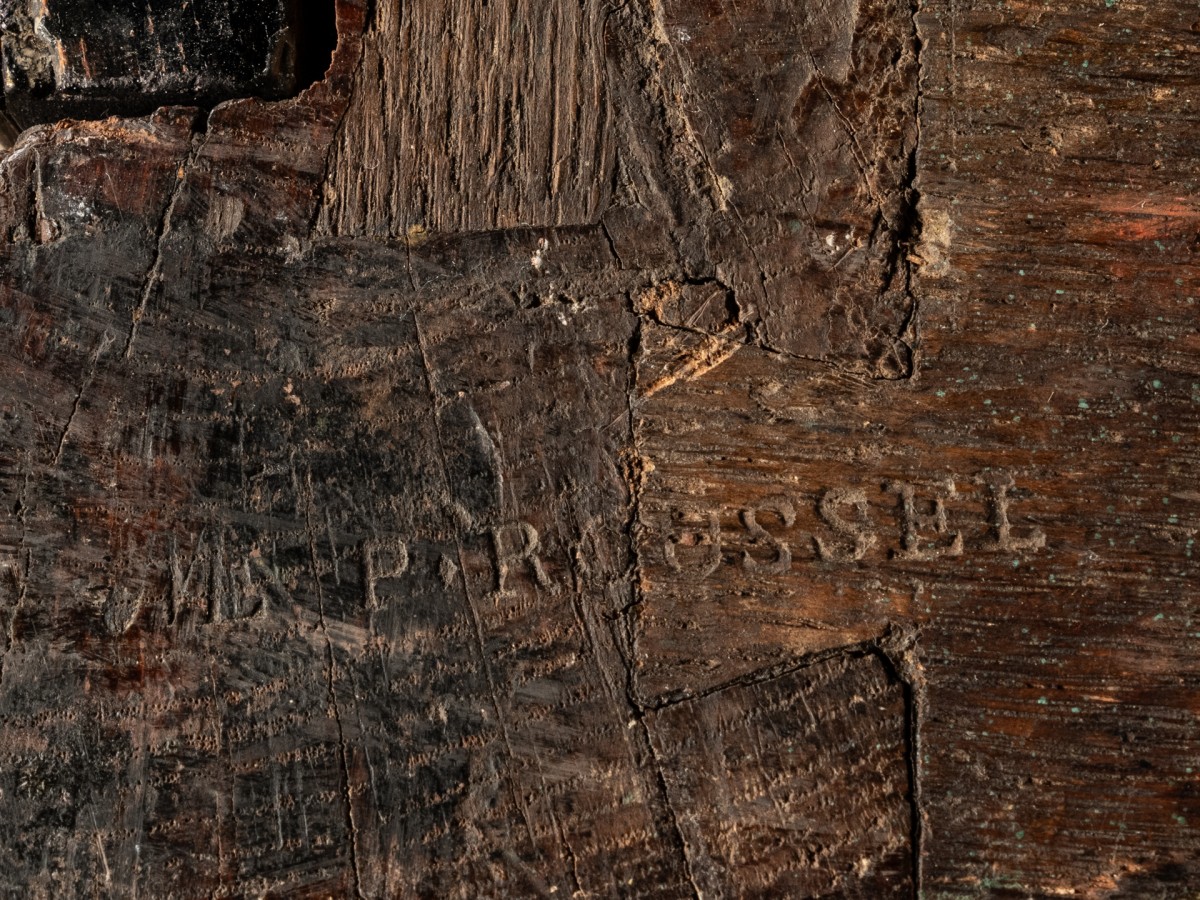
The commode is stamped "Roussel" on one of the uprights and also bears the hallmark of the Guild of Cabinetmakers (JME).
In perfect condition.
Parisian work from the Louis XV period, circa 1765-1770.
Dimensions:
Width: 110 cm – Height: 87 cm – Depth: 58 cm
Pierre Roussel (1723-1782) Cabinetmaker, admitted as a master in Paris on August 21, 1745.
A highly skilled marquetry artist, Roussel left behind a large, diverse, and excellent body of work. Having become a Master Cabinetmaker in 1745, Pierre Roussel established himself on Rue de Charonne, in the Faubourg Saint-Antoine, under the sign "L'Image de Saint Pierre" (The Image of Saint Peter). Thanks to his exceptional skills as a cabinetmaker and especially as a marquetry artist, he quickly gained a great reputation. In 1762, he became a sworn member of his guild. By 1767, he was considered one of the finest cabinetmakers of his time, a fact confirmed by the 1769 "Almanach d'indication générale ou du Vray mérite," which lists him as one of the leading cabinetmakers in Paris. Highly regarded by his colleagues, he became a representative of the cabinetmakers' guild in 1777 and then its syndic two years later. His abundant and varied output adapted to all the styles of the 18th century with elegance and refinement. Many Louis XV commodes, veneered in rosewood or violet wood, are decorated with marquetry of flowers or ribbon bows. Lacquer and landscapes inspired by the Far East are also frequently used in his decoration. Among the Transition and Louis XVI style furniture, one finds many pieces inlaid with architectural landscapes of cities, rivers, or ports, not forgetting, of course, the geometric marquetry often employed. The inventory of his merchandise, drawn up after his death, testifies to the prosperity of his business, which his wife, in partnership with his sons, took over.
Works in Museums:
A wide-bodied commode, circa 1745-1750, opening with two drawers and no visible crossbar. Musée des Arts Décoratifs, Paris - No. MAD157. A large commode with two drawers and no crossbar. Curved on three sides, it is made of Japanese lacquer decorated with polychrome flowers and birds and gold on a black background. Musée des Arts Décoratifs, No. MAD1678. A rectangular flat desk. Museum of Decorative Arts - Lyon
Louis XV Commode with Two Drawers - Beauvais Museum
Louis XV Commode - Decorative Arts of Paris
Large Louis XV Table - Louvre Museum
Small Kidney Table - Petit Palais - Paris
Transition Writing and Dressing Table - Museum of Fine Arts - Boston
Late Louis XV Commode - Museum of Art - Cleveland
Bibliography:
Pierre Roussel, Cabinetmaker and Dealer - Patricia Lemonnier - L'Estampille/L'Objet d'art, no. 230, November 1989, pp. 40-45
French Furniture of the 18th Century - Pierre Kjellberg - Les Editions de l'Amateur - 2008
18th-Century Cabinetmakers - Count François de Salverte - Les éditions d'Art et d'Histoire - 19