Offered by Galerie Tourbillon

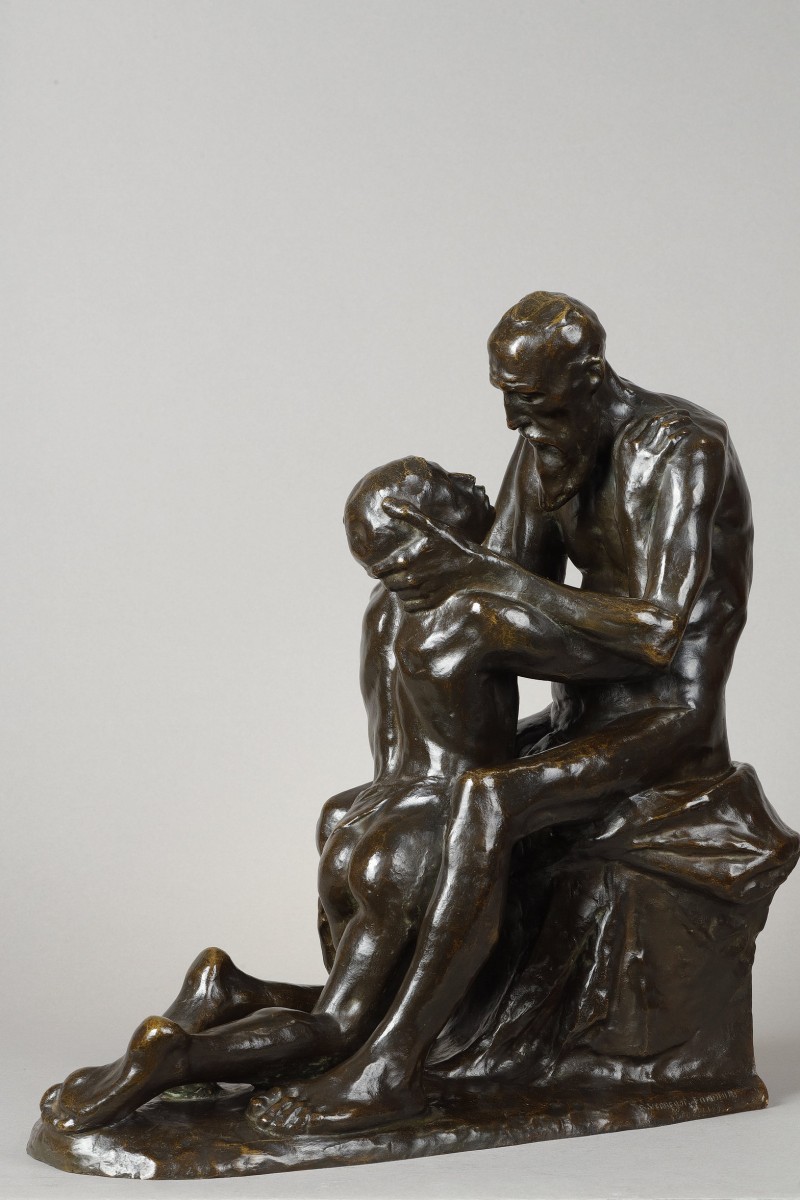
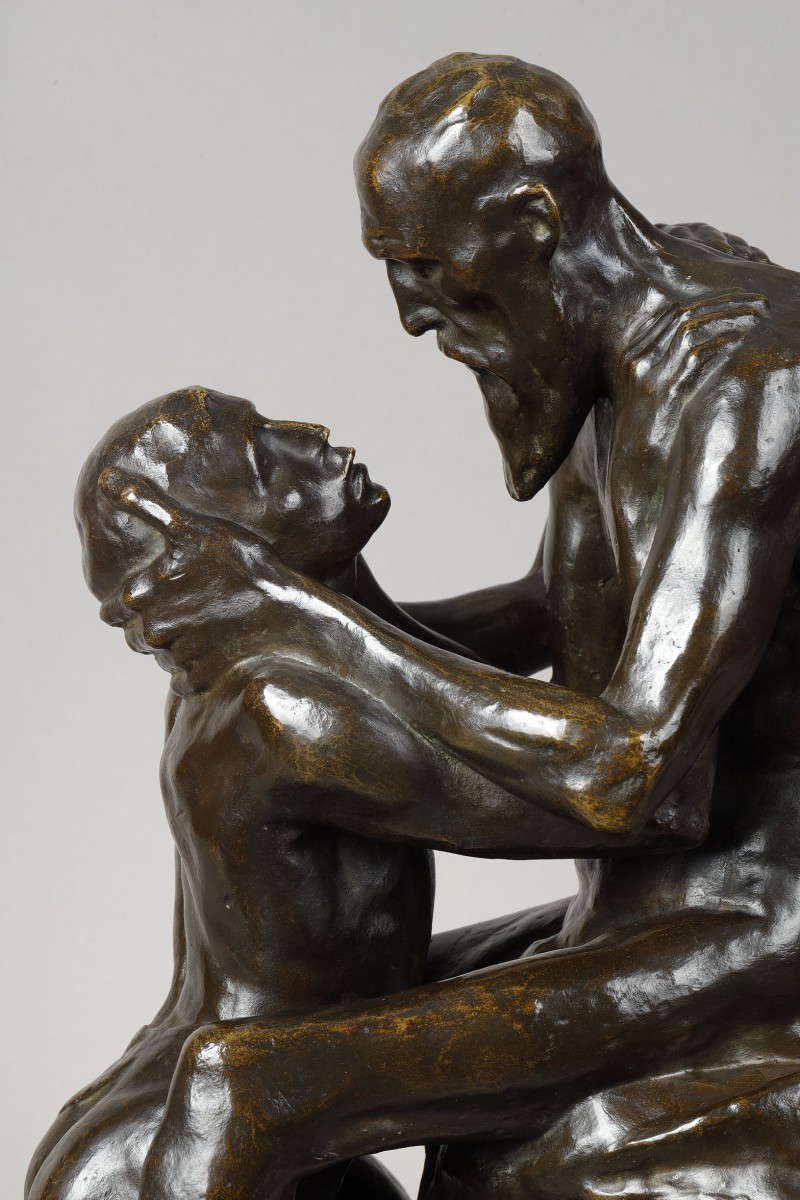


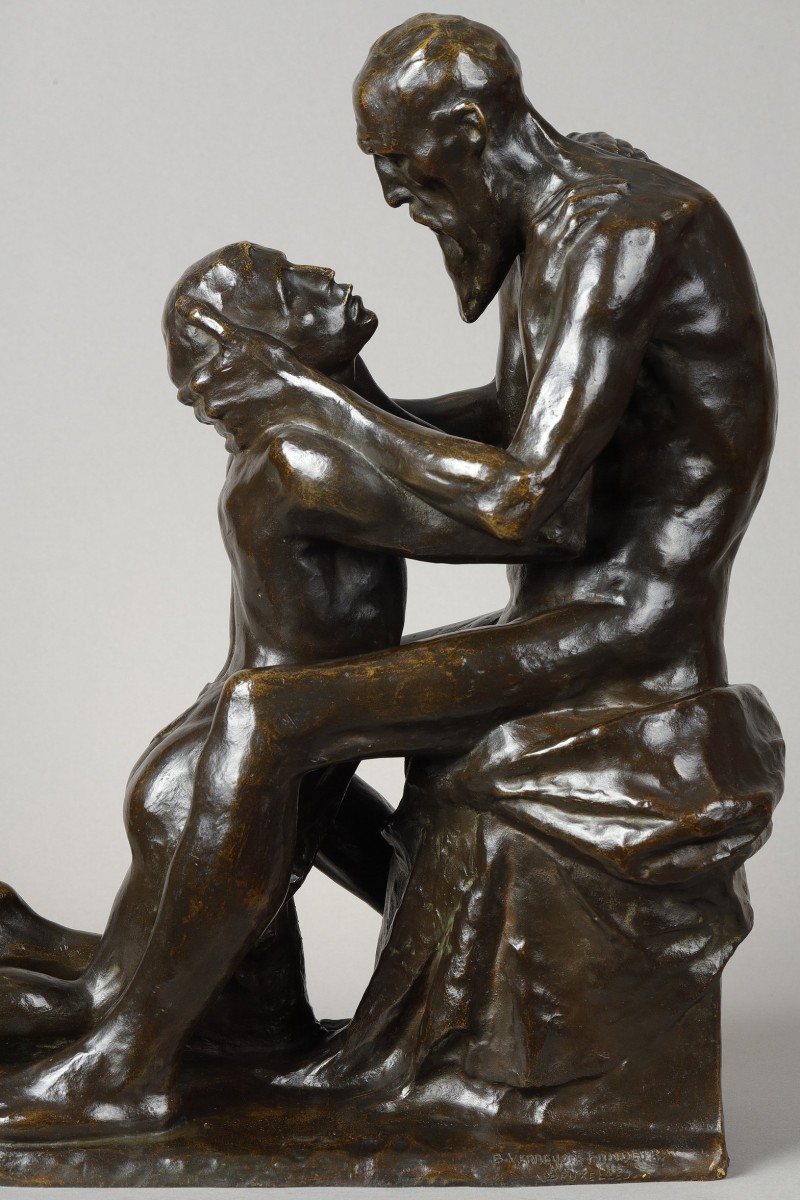
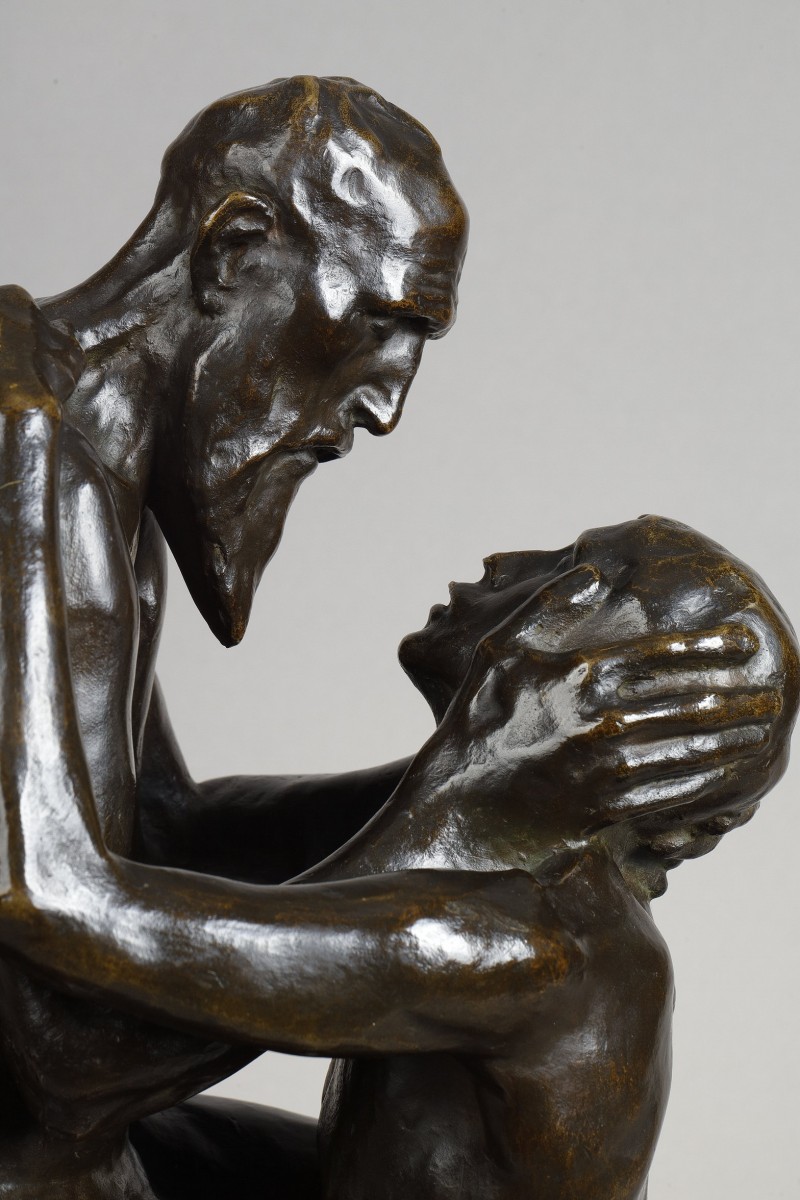
The Return of the Prodigal Son
or The Reconciliation
A rare bronze group with a nuanced dark brown patina
signed on the back "C. Meunier"
cast by "B. Verbeyst fondeur Bruxelles" (with the foundry mark)
Belgium
model created in 1895
cast around 1904
height 44,5 cm
width 43 cm
depth 20 cm
A similar model reproduced in "Hommage à Constantin Meunier", S. Levine et F. Urban, Ed. Galerie M. Tzwern, 1998, p.80 et 81.
and in "La sculpture belge au 19ème siècle", J. Van Lennep, 1990, vol. II, p.498.
Biography :
Constantin Meunier (1831-1905) was a Belgian painter and sculptor, renowned for his vision of the working class world. He was the father of the painter and engraver Karl Meunier and the uncle of the poster artist Henri Meunier. First painter of religious scenes, Constantin Meunier was deeply marked by his visit, along with his friend the writer Camille Lemonnier, in the Borinage region, the black country mining basin of the province of Hainaut in Belgium. He became a socialist activist in the Belgian Workers Party. At a time when Belgium was profoundly transformed by the industrialization of steel and by the rise of trade unions, political organizations and workers' cooperatives, he endeavored to represent the world of work. He became one of the masters of a realistic and social art. He helped to give a face to the worker and participated in the description of the new realities generated by the industrial boom. Meunier interpreted it through his dark and dramatic painting, and from the mid-1880s, his bronzes with angular features. After a stay of some six months in Spain, from October 1882 to April 1883 with his son Karl, Theo Van Rysselberghe and Dario de Regoyos, sculpture occupied a more and more important place in his work. Sent to Seville by the Belgian government to make a copy of a "Deposition from the Cross" by Pedro Campaña of the sixteenth century, he also brought back some more personal paintings including "The Tobacco Factory in Seville" (Royal Museums of Fine Arts of Belgium). But Andalusia brought him back to his deep desire to devote his art to the work of the workers and his hold on the material, which sculpture expressed perfectly.
A letter from Vincent van Gogh to his brother Theo spoke of Constantin Meunier in an extremely flattering manner: "Dear Theo, In all his works, Meunier is far superior to me. In Brussels, I saw his paintings at an exhibition. In fact, he is the only one of all the Belgian artists to have strongly touched me. He painted the Borinage metalworkers and their procession en route to the mine or the factories. His works stand out clearly, both in color and in treatment. He painted all these things that I have always dreamed of being able to realize ... " 1894 was for Constantin Meunier a very difficult year: he lost successively his two sons. During the last years of his life, he executed sculptures for the Work Monument. Project that was erected in Laeken only after his death. Auguste Rodin said of him: "Constantin Meunier is an admirable man. He has the grandeur of Millet. He is one of the greatest artists of the century." A collection of his works is kept in Ixelles at the Constantin-Meunier Museum in the artist's studio. His bronzes adorn squares and parks of Belgium and Europe. Meunier was the first foreign sculptor bought by the French State for the Luxembourg Museum. There were two bronze statuettes, "Antwerp Docker" and "Hammer Worker", acquired in 1890 at the first salon of the National Society of Fine Arts, a secessionist society of the French Artists.