Offered by Franck Baptiste Paris
REQUEST INFORMATION
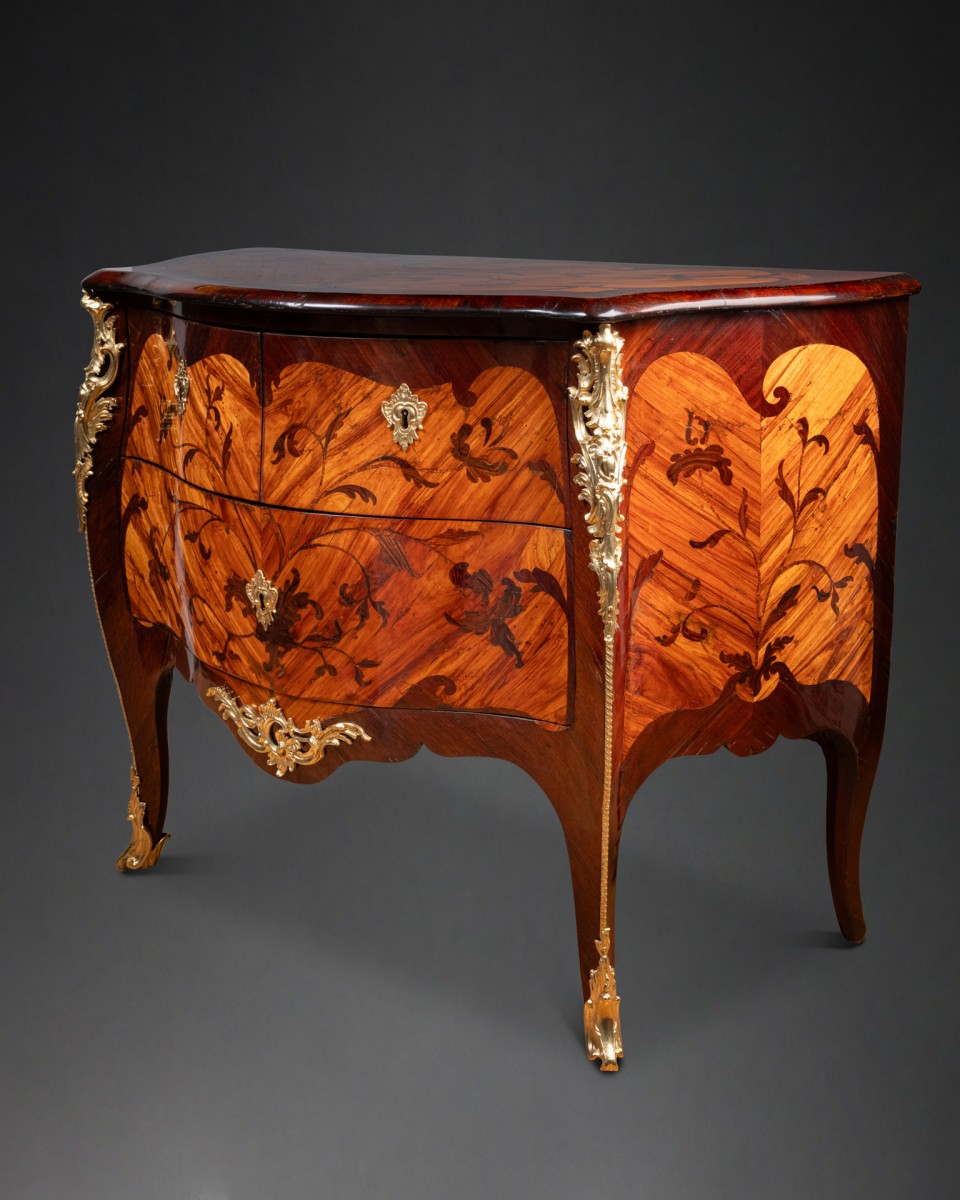


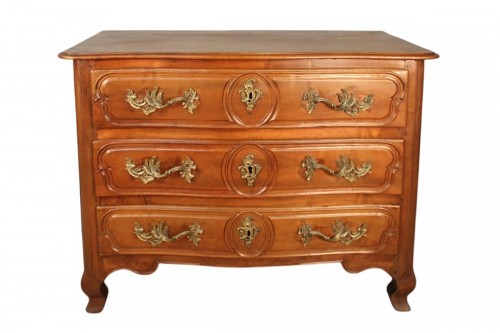
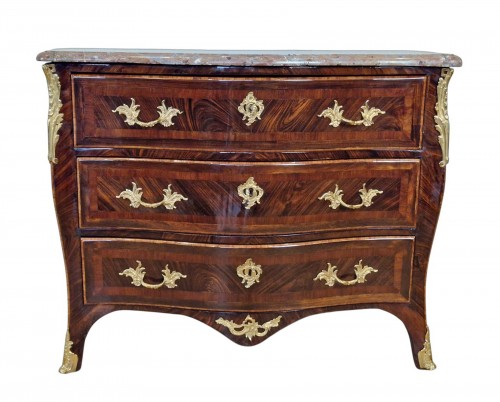
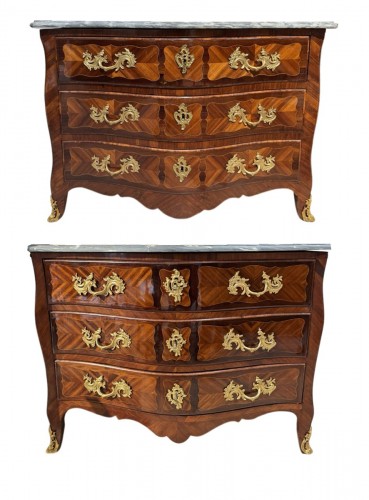
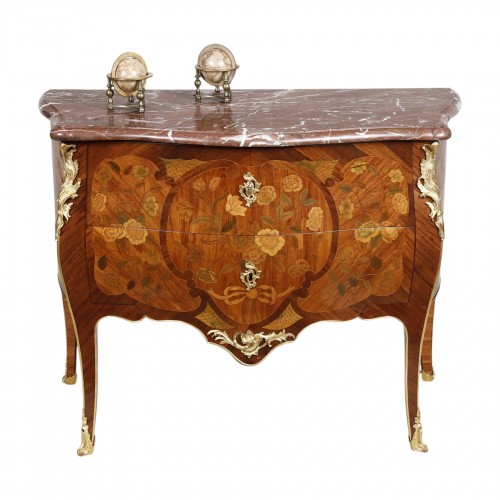
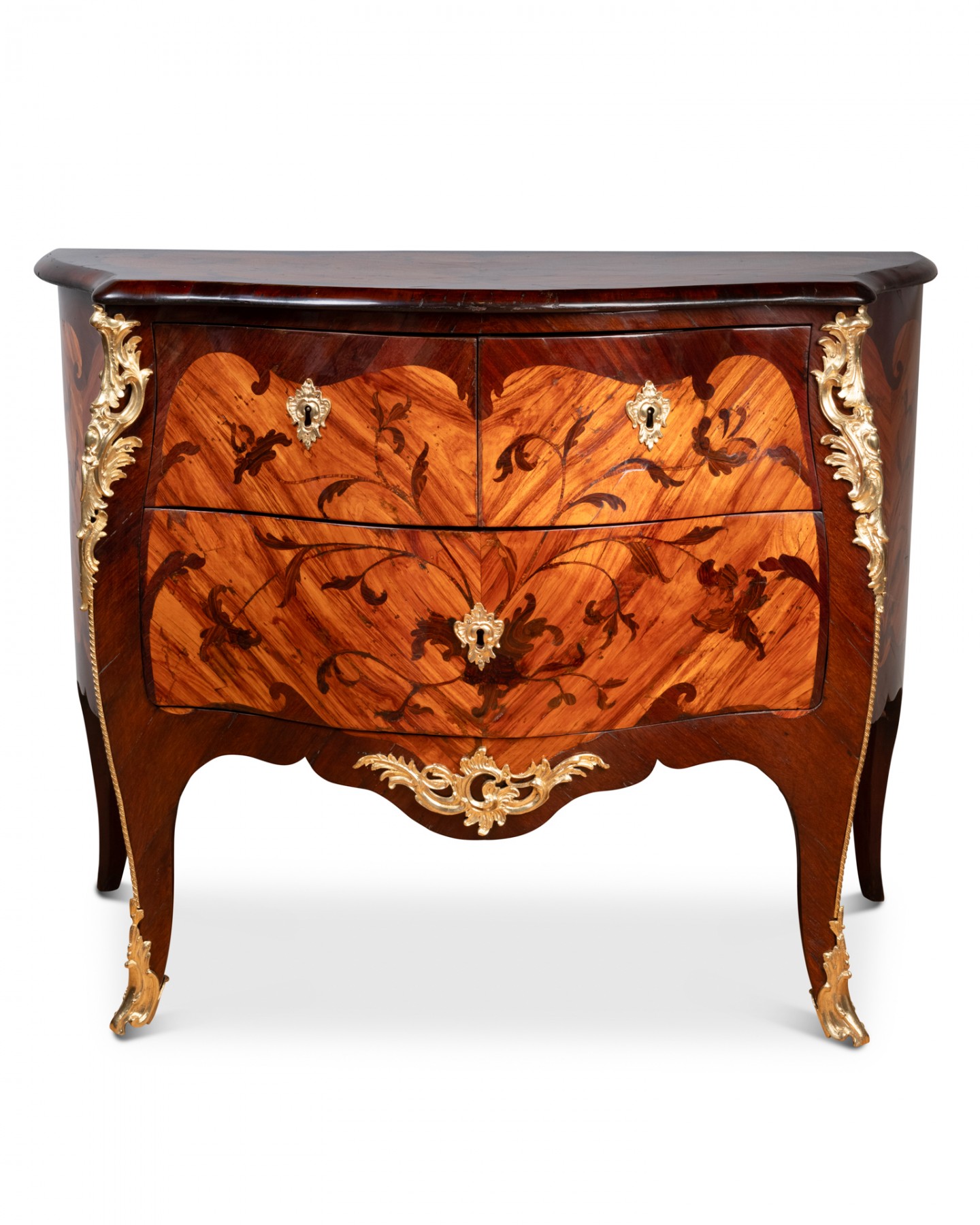
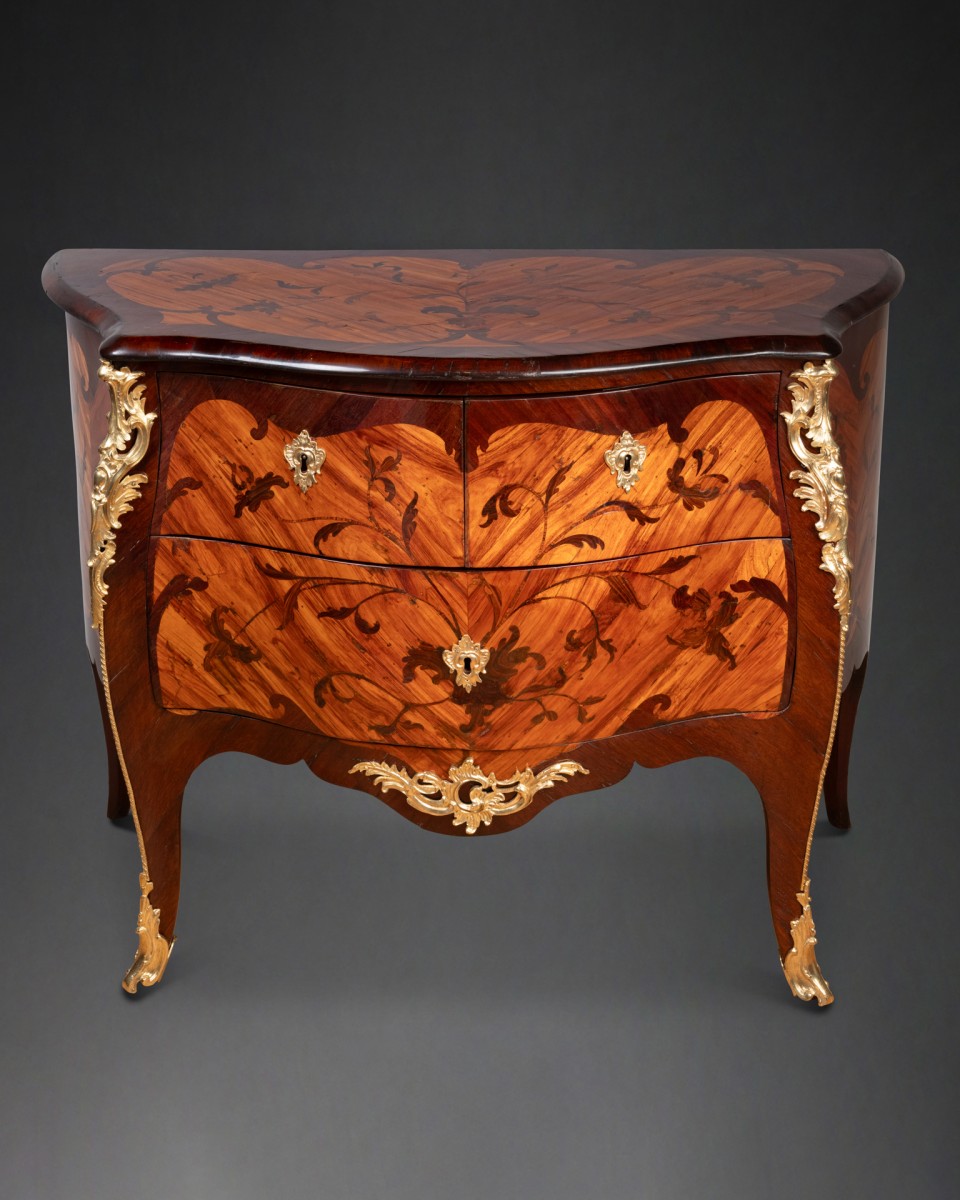
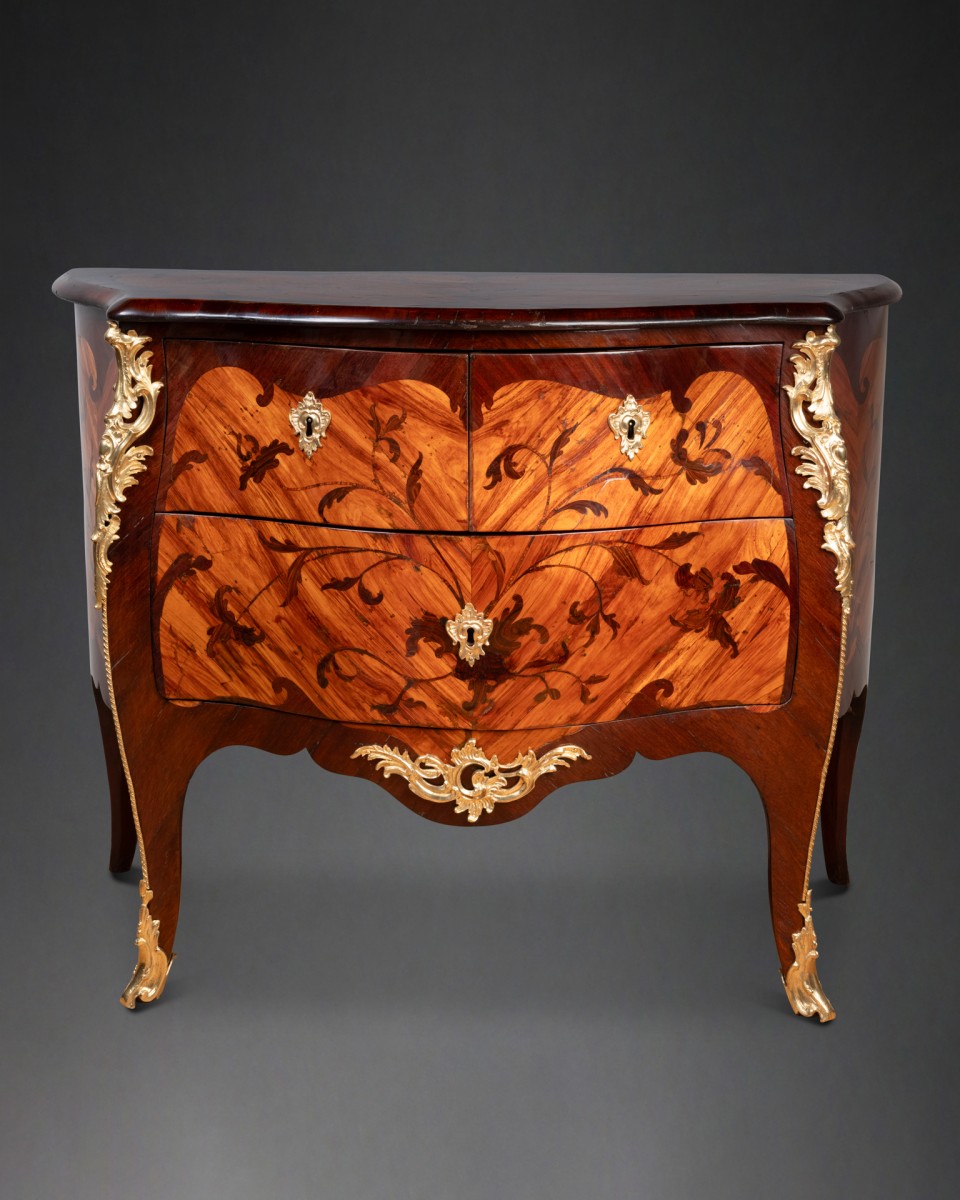
A rare commode with a curved front and sides, both in plan and elevation.
It features three drawers in two rows without a central crossbar.
It boasts a beautiful symmetrical decoration of central reserves in rosewood veneer, treated in a butterfly wing pattern, surrounded by delicately shaped frames in amaranth wood veneer.
The reserves are inlaid with floral stems in violet wood veneer.
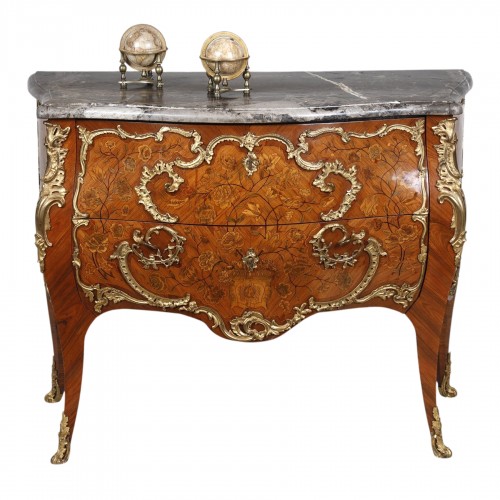
The commode is topped with its rare original marquetry top, which repeats the same floral design.
It features exquisite mercury-gilt bronze mounts, including large openwork rocaille drops, foot finials, and a lamp base.
Oak back.
In good condition, with minor wear and restorations to the marquetry consistent with age.
Stamped BVRB and with the JME guild mark on the right rear upright.
Work by the cabinetmaker Bernard II Van Riesen Burgh*, Paris, circa 1760.
Dimensions:
Width: 107 cm; Depth: 53 cm; Height: 82 cm
Our opinion:
The commode we are presenting is rare for several reasons, firstly for its very curved and bulbous shape, accentuated by the absence of any horizontal or vertical crossbars, but also for its original floral marquetry top with end-grain wood inlays, which is quite exceptional for a commode dating from the reign of Louis XV.
To achieve this feat, our cabinetmaker ingeniously constructed a top with an oak core bonded to a thick veneer of the same wood, but applied against the grain, which has allowed it to reach us in very good condition.
The presence of the guild mark, resulting from the new laws governing the cabinetmakers' community (1751), and BVRB's death date (1760) provide us with a narrow production window.
During this period, the Rococo style was waning and forms were becoming more restrained; the great master, then at the height of his career, embraced this new approach while retaining his successful elements such as strong color contrasts, inlays of violet wood sawn into the edge, and openwork bronzes.
But now, however, the scrolls, reserves, and bronzes are perfectly symmetrical and complement each other in perfect harmony. Our commode is one of the last works of the great master's life, created just before 1760. Yet, even after a very long career, he demonstrates his adaptability by producing a piece of furniture that is not merely a common item, but an original creation that he himself designed and crafted, and for which, to our knowledge, no equivalent exists.
Bernard II VAN RISEN BURGH, known as BVRB.
Bernard II Van Risen Burgh (Paris, before 1705 – Paris, February 23, 1766) Received his Master's Certificate in 1730. BVRB produced only the finest luxury furniture in the Rococo style that flourished during the reign of Louis XV, pieces found in the most sumptuous homes and castles.
Born into a family of Dutch origin, whose grandfather, father, and son all shared the same first name, Bernard II is certainly the most famous of them. He owes his fame to the sheer volume of his work, but above all to its exceptional quality. He first established himself on the rue de Reuilly, then on the rue Saint-Nicolas, and finally ended his career on the rue de Charenton. He worked for renowned merchants such as Hébert and Lazare Duvaux, who undoubtedly preferred to keep the origins of the furniture they delivered a secret from their clients. It seems that this, and perhaps also the length and foreign sound of his name, is why he signed his work simply with his initials. He became a master craftsman around 1735, worked for a very wealthy clientele and for the royal family, and produced only the finest luxury furniture in the Rococo style.