Offered by Richard Redding Antiques

REQUEST INFORMATION

Leading antique and fine art gallery, specialises in the finest French clocks.
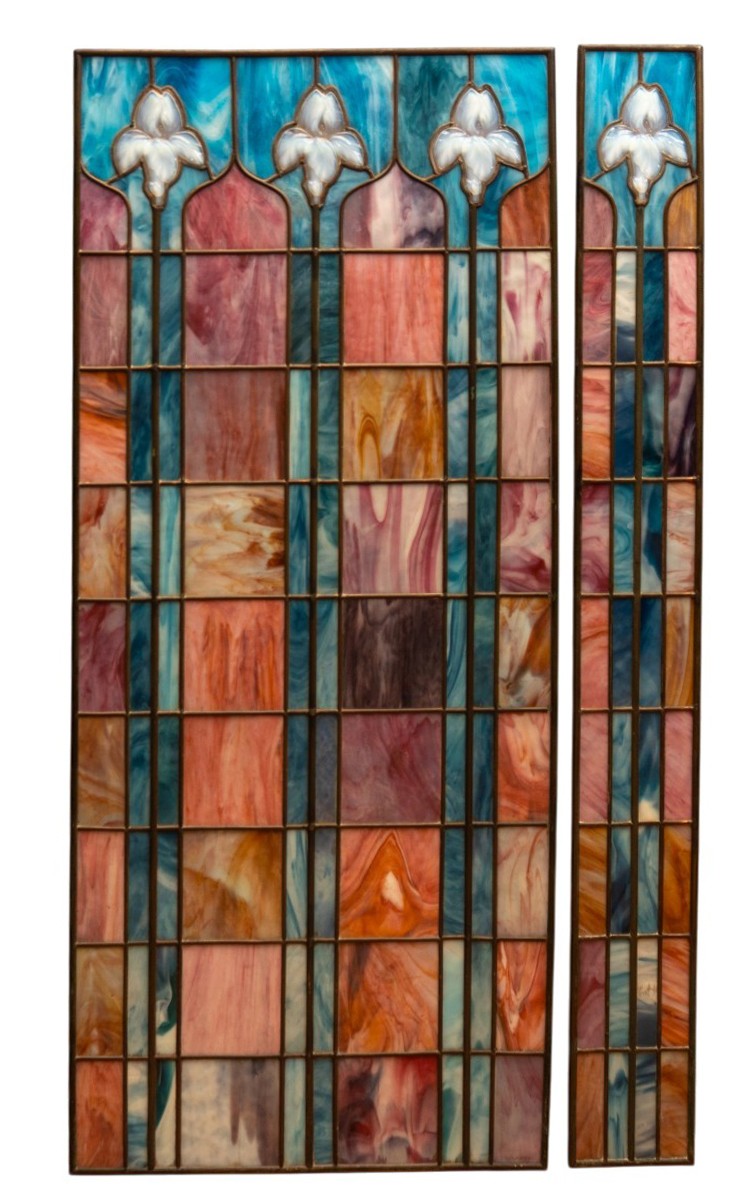
Two very beautiful Art Nouveau leaded and plated glass windows, one bearing the stamp: TIFFANY STVDIOS / NEW YORK (lower centre left), the larger window headed by a trio of three-dimensional iris heads with shimmering iridescent petals that are set against a mottled blue background that trails downward between multi-coloured pink, cream, ochre and yellow shaped panels, the smaller window with one iris above correspondingly shaped panels; both set within a rectangular frame
The larger window: Height 160, width 60 cm, the smaller window: Height 160 cm, width 16 cm.
New York, early twentieth century
Provenance: From a private villa in Santiago, Chile until purchased by this gallery in the 1970s, along with three companion windows.
These stunning leaded and plated glass windows, of which the larger bears the stamp of the Tiffany Studios, New York, are remarkable works of art. At the top are exquisitely worked irises composed of three-dimensional opalescent and iridescent glass. Such glass is known as Favrile glass, which was a technique that the American artist and designer Louis Comfort Tiffany (1848-1933) developed and then patented in 1892. Tiffany described Favrile glass as being “distinguished by brilliant or deeply toned colours, usually iridescent like the wings of certain American butterflies, the necks of pigeons and peacocks, the wing covers of various beetles”. In addition to their iridescence, the irises are three-dimensional, which was a particular type of Favrile glass that Tiffany perfected and is known as drapery glass. Here the textured glass has the appearance of folded fabric. Tiffany made abundant use of drapery glass in his stained-glass windows to imitate the natural forms of leaves and petals or, in the case of ecclesiastical windows, to add a robust visual and textural impact to flowing robes or angel wings. The making of drapery glass required skill and experience in which a hand-held roller was manipulated forcefully over a sheet of molten glass to produce heavy ripples, while folding and creasing the entire sheet. The ripples then become rigid and permanent as the glass cooled; in this way, each sheet produced from this process was unique. Unlike the flat, coloured glass panes common in Medieval and Gothic stained-glass, Tiffany’s opalescent glass was thicker, layered, and more varied in texture and hue. This glass could diffuse light in complex ways, creating a sense of depth and luminosity that was previously unattainable.
The irises are set against a blue background that resembles the sky. The same blue then flanks a variety of pink and cream glass panels that cascade like marbled pools, reminiscent of the colours that one sees at sunset. The windows have never been restored yet still remain in excellent condition. When purchased by Richard Redding Antiques, there were originally five panels, which were said to have come from a private villa in Santiago, Chile. Three of the five were subsequently sold and are now in a private residence. Whether a set of five or simply two, one of the joys of these windows is that they will enhance any type of interior, blending in with antique, modern and more contemporary works alike, much in the same way that a painting would. For this reason, present day collectors are able to incorporate such windows into an interior in a variety of creative ways.
The windows, with their naturalistic irises, epitomise the Art Nouveau – a style that predominated at the beginning of the twentieth century and celebrated organic forms, natural motifs and sinuous flowing lines. Indeed, Louis Comfort Tiffany was a leader in the creation of Art Nouveau glass windows. He was the son of Charles Lewis Tiffany (1812-1902), founder of the famous Tiffany & Co jewellery company. Louis Comfort initially trained as a painter but subsequently shifted his focus toward the decorative arts, particularly leaded and plated glass windows. His work marked a departure from traditional stained-glass, which had often relied on geometric patterns and religious iconography. Instead, Tiffany introduced a style that emphasized naturalism, rich textures, and a vibrant palette inspired by the world around him. Such innovation helped elevate stained-glass from mere architectural ornamentation to a true art form.
Tiffany was inspired by the precious and semi-precious stones, from diamonds to agate, that were used in his father’s jewellery workshop. At his own studios, Tiffany and his craftsmen chose from glass spanning thousands of colours and textures to create windows that reflected the beauty of the natural world, in all its jewel-like complexity. In this, Tiffany aimed to replicate the technique of painting in the medium of glass, combining daubs of colour to form glittering scenes. Nature also provided endless inspiration for Tiffany’s designs. Like his chief landscape designer Agnes Northrop (1857-1953), Tiffany was an avid draftsman and photographer and often sketched or photographed flowers and other botanical specimens. Northrop lived near large nurseries in Flushing, Queens while Tiffany himself had large gardens at his various residences. Thus flowers, plants, insects, birds, and flowing water all appeared as central motifs in his work. The windows often depict stylized irises as we see here, as well as water lilies, poppies, and wisteria, rendered in soft yet vibrant colours that mimic their real-life counterparts but with an ethereal quality.
Tiffany’s New York workshops produced a wide range of stained-glass windows, from small panels designed for private homes to monumental windows intended for churches and public buildings. Each window was a labour-intensive masterpiece, often taking months or even years to complete. The process involved not only glass cutting and assembly but also painting, etching, and sometimes layering of glass pieces to enhance colour effects. Tiffany employed a team of skilled artisans, glassmakers, painters, and metalworkers who collaborated to realize his artistic vision.
The popularity of Tiffany Art Nouveau stained-glass windows coincided with the rise of the American Aesthetic Movement and the Arts and Crafts Movement, which emphasized handcrafted quality and artistic integrity in reaction to industrial mass production. Tiffany’s windows were seen as symbols of refinement, cultural sophistication, and an appreciation for nature’s beauty. Wealthy patrons and institutions commissioned these windows for their homes, libraries, hotels, and places of worship, contributing to their widespread dissemination.
The work of Tiffany Studios was highly sought after by major institutions and members of the America’s most prominent families, and custom Tiffany windows can be found in many of the most important churches and newly built private residences dating from the late nineteenth and early twentieth centuries. Among those made for private residences one can cite the ‘Cypress and Azalea’ landscape window, sold at Christie’s New York, 14th June 2023 as part of the Ann and Gordon Getty collection, which was originally commissioned for ‘Carmore’, the home of Charles E. Rushmore in Woodbury Falls, New York, circa 1908. Tiffany also installed stained-glass windows in his own home - Laurelton Hall in Oyster Bay, New York, including the four panels of his impressive ‘Four Seasons’ window, which he exhibited at the 1900 Exposition Universelle in Paris. Other notable installations include windows in the Morse Museum in Florida, which houses one of the largest collections of Tiffany’s work. Numerous Tiffany windows can also be seen in various churches and cathedrals throughout the world, while others are still being enjoyed as focal points in private residences. Whether admired in historic mansions, museums, or churches, these windows invite viewers to experience the delicate interplay of art and nature that defined a pivotal moment in design history.